
2027 Best Online Video Game Design Degree Programs

Co-Founder and Chief Data Scientist
Students comparing online video game design degrees usually face two questions at once: which program can help them build a serious portfolio, and which option fits their budget, schedule, and career target. The decision matters because game design is no longer limited to entertainment studios. Design, programming, animation, interactive media, simulation, AR/VR, education technology, and software companies all use game-development skills.
This guide explains what online video game design programs teach, how long they take, what they cost, which schools stand out for 2027, and how to compare programs without relying only on rankings. It is written for prospective students who want a practical path into game design, game art, game programming, UX, QA, or interactive media and need to understand the trade-offs before enrolling.
Quick Answer: Is an Online Video Game Design Degree Worth Considering?
An online video game design degree can be a worthwhile option if you want structured training in game design, programming, 3D modeling, storytelling, level design, and portfolio development while studying remotely. It is most useful when the program is accredited, project-based, taught with current tools, and aligned with the type of game career you want. It may not be the best fit if you need daily in-person studio access, already have a strong portfolio and professional network, or want the lowest-cost route into programming.
What are the main benefits of earning a video game design degree online?
- An online video game design degree can prepare students for roles in gaming, software, entertainment, education, marketing, simulation, and interactive media.
- Online delivery can make it easier to study while working, caregiving, serving in the military, or living far from a campus with a game design program.
- Game design skills can support a financially promising path: Zippia reported an average annual salary of around $95,185 for video game designers, though earnings vary by role, location, portfolio quality, and experience.
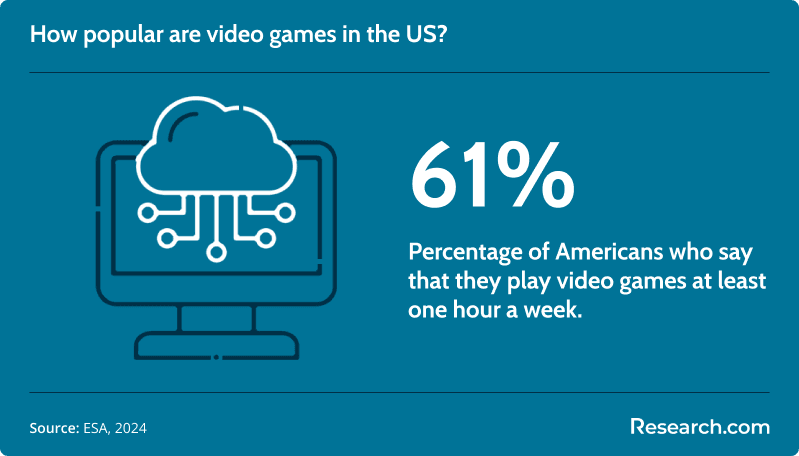
- The audience for games remains large. In 2024, 61% of people in the U.S. played video games at least once a week, according to the ESA.
What can I expect from an online video game design program?
Most online video game design programs combine creative production with technical coursework. Students commonly study game mechanics, level design, interactive storytelling, 3D modeling, animation, game engines, user experience, quality assurance, and programming languages such as C++ or Python. Strong programs also require repeated project work so students graduate with playable prototypes, art assets, design documents, or interactive experiences for a portfolio.
Online students should expect more than lectures. Many programs use discussion boards, critique sessions, recorded demonstrations, collaborative tools, cloud-based software, and capstone projects. The quality of the experience depends heavily on software access, faculty feedback, peer collaboration, and whether the curriculum reflects current production workflows.
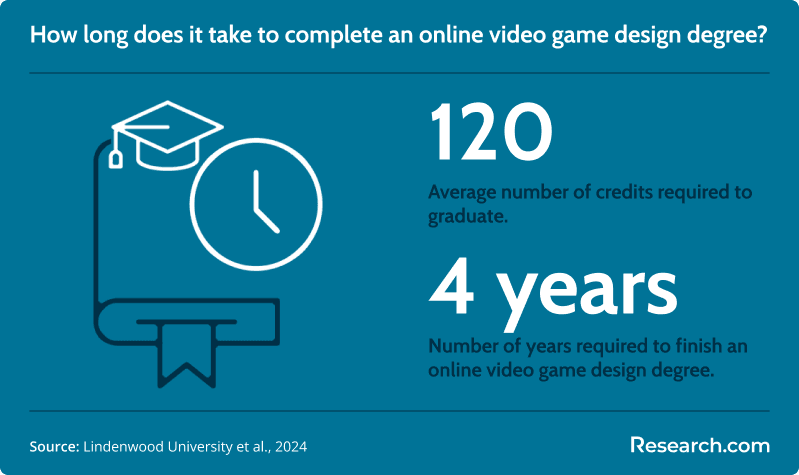
Tuition often falls between $400 to $600 per credit hour, though specific schools may charge less or more. Full-time bachelor’s students usually finish in three to four years, while some accelerated options can be completed in about two years. Part-time students, transfer students, and students in highly specialized tracks may follow different timelines.
| Program feature | What to look for | Why it matters |
| Portfolio development | Multiple finished projects, capstone work, and critique-based revisions | Employers often evaluate what you can build, not just the degree title. |
| Technical curriculum | Game engines, programming, debugging, UI/UX, and production tools | Technical fluency can expand opportunities beyond pure design roles. |
| Creative curriculum | Art direction, narrative design, animation, level design, and player experience | Designers need to understand how visuals, mechanics, story, and usability work together. |
| Student support | Advising, tutoring, tech help, career services, and faculty access | Online students need strong support systems to stay on track. |
| Industry alignment | Relevant tools, internships, partnerships, and experienced instructors | Programs connected to current workflows can make the transition to employment easier. |
Where can I work with an online video game design degree?
A video game design degree can lead to more than one employment path. Graduates may work at game studios as game designers, level designers, character artists, technical artists, programmers, QA testers, producers, or UX/UI designers. The same skills can also apply to educational games, training simulations, advertising campaigns, film and animation, virtual reality, augmented reality, mobile apps, and interactive web products.
Some graduates pursue freelance or independent development work. That path offers creative control but requires business skills, client management, self-promotion, and financial planning. Others choose software development, animation, or UX roles where game design training is useful but not the only qualification employers expect.
Data published by the BLS in 2024 identifies the following as the largest employers of software developers:
- Computer systems design and related services (32%)
- Software publishers (10%)
- Finance and insurance (10%)
- Manufacturing (9%)
- Management of companies and enterprises (5%)
How much can I make with an online video game design degree?
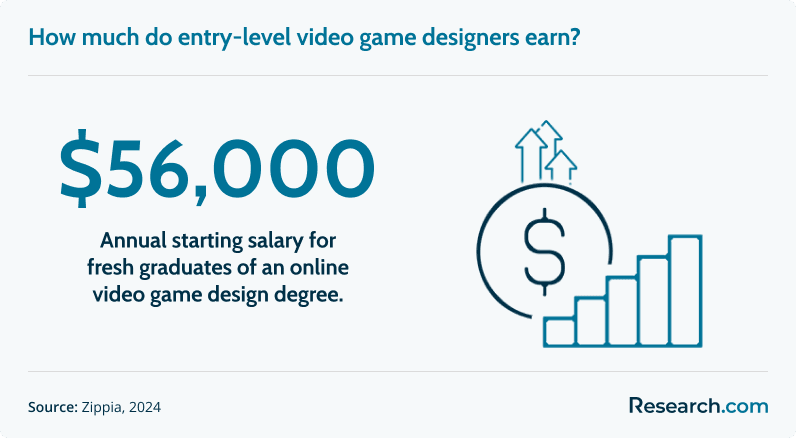
Zippia’s 2024 data reports that video game designers earn about $95,185 per year on average. Entry-level roles typically start lower, around $50,000 to $60,000 per year. Pay can increase with experience, a strong portfolio, technical specialization, leadership responsibility, or work in higher-demand areas such as programming, 3D animation, game systems, or technical art. Some senior designers or professionals at major studios can earn well over $100,000 annually.
Salary should not be treated as guaranteed. Game industry compensation depends on location, employer size, specialization, released-project experience, portfolio strength, and competition for roles. Students should compare salary expectations against total program cost, debt, time to completion, and alternative routes such as computer science, animation, or graphic design.
- Best Online Video Game Design Degree Programs for 2027
- Program Length: How Long Online Game Design Degrees Take
- Online vs. Campus Game Design Programs
- Average Cost of an Online Video Game Design Degree
- Financial Aid Options for Online Game Design Students
- Admissions Requirements and Prerequisites
- Common Courses in Online Game Design Programs
- Specializations in Online Video Game Design
- Career Development After Graduation
- Video Game Design vs. Graphic Design Degrees
- Accreditation and Industry Partnerships
- Computer Science Skills for Game Designers
- Common Challenges in Online Game Design Programs
- Financial Value of a Video Game Design Degree
- Employment Outcomes for Online Graduates
- Student Support and Mentorship
- Interdisciplinary Study for Game Designers
- How Interdisciplinary Training Expands Career Options
- Ethics in Online Video Game Design Education
- Certifications That Can Strengthen a Game Design Career
- Return on Investment for Online Game Design Degrees
- Engineering Concepts in Game Design Education
- How to Choose the Right Online Video Game Design Program
- Using Data Analytics in Game Design
- Career Paths for Video Game Design Graduates
- Job Market for Online Game Design Graduates
- Emerging Technology in Game Design Programs
- Trends in Video Game Design Education
- Strategies for Succeeding as an Online Student
- Why Soft Skills Matter in Game Design
List of the Best Online Video Game Design Degree Programs for 2027
How do we rank our schools?
Research.com rankings are designed to help readers compare programs using transparent education data rather than marketing language alone. The ranking process draws from sources such as the IPEDS database, Peterson's database, the College Scorecard, and the National Center for Education Statistics. Readers can review the broader ranking approach on the Research.com methodology page.
| School | Program focus | Required credits | Listed cost | Accreditation |
| Lindenwood University | Game design with general and Game Art options | 78 credits, plus 54 credits for Game Art emphasis | $495 per credit hour | Higher Learning Commission (HLC) |
| Baker College | Game software development | 120 credits | $450 per credit hour | HLC |
| Southern New Hampshire University | Game art, development, and programming pathways | 120 credits | $330 per credit hour | New England Commission of Higher Education (NECHE) |
| Savannah College of Art and Design | Interactive design and game development | 180 credits | $41,130 per year | Southern Association of Colleges and Schools Commission on Colleges (SACSCOC) |
| Liberty University | Information technology with gaming design | 120 credits | $390 per credit hour | SACSCOC |
1. Lindenwood University
Lindenwood University offers a Bachelor of Arts in Game Design built around creative development, production practice, and portfolio-building work. Students study advanced design concepts, storytelling, characters, game aesthetics, and applied production. The program is available online and on campus, which can be useful for students who want flexibility without giving up the option of a traditional format.
- Required Credits to Graduate: 78 credits, plus 54 credits for Game Art emphasis
- Tracks/Concentrations: General, Game Art
- Cost: $495 per credit hour
- Accreditation: Higher Learning Commission (HLC)
2. Baker College
Baker College provides a Game Software Development program that follows the game creation cycle from concept through publication. The curriculum emphasizes design, development, testing, multiplatform production, and computer science fundamentals. Students who want a more technical game-development path may find the program’s software emphasis especially relevant.
- Required Credits to Graduate: 120 credits
- Tracks/Concentrations: Game Development
- Cost: $450 per credit hour
- Accreditation: HLC
3. Southern New Hampshire University
Southern New Hampshire University offers a Bachelor of Arts in Game Art and Development for students interested in interactive characters, environments, animation, and digital game media. Coursework includes creative problem-solving and tools such as Adobe Creative Suite and 3ds Max. Students can use the program to develop portfolio work for game art, design, development, and animation roles.
- Required Credits to Graduate: 120 credits
- Tracks/Concentrations: Game Art and Development, Game Programming and Development
- Cost: $330 per credit hour
- Accreditation: New England Commission of Higher Education (NECHE)
4. Savannah College of Art and Design
Savannah College of Art and Design offers an interactive design and game development program with access to advanced technology, AR/VR labs, and industry-facing opportunities. The curriculum spans game art, interactive design, and programming. SCAD students have earned recognition in gaming competitions and have secured roles at companies such as Electronic Arts and Microsoft. Beginning in Fall 2024, SCAD will offer both B.A. and B.F.A. degrees in game development.
- Required Credits to Graduate: 180 credits
- Tracks/Concentrations: BA, BFA
- Cost: $41,130 per year
- Accreditation: Southern Association of Colleges and Schools Commission on Colleges (SACSCOC)
5. Liberty University
Liberty University offers a Bachelor of Science in Information Technology – Gaming Design that combines IT, programming, design, software management, graphic design, and animation. The program may appeal to students who want a game design degree housed within an information technology framework rather than a purely art-focused curriculum.
- Required Credits to Graduate: 120 credits
- Tracks/Concentrations: Video Game Design
- Cost: $390 per credit hour
- Accreditation: SACSCOC
What Online Game Design Students Commonly Value
Students who choose online game design programs often point to flexibility, access to remote learning tools, and the ability to build a portfolio while managing work or family responsibilities. Common positive themes include self-paced project work, opportunities to connect with classmates in different locations, and assignments that produce usable portfolio pieces.
The most common concerns are also worth noting. Online students need discipline, reliable hardware, consistent internet access, and the confidence to ask for feedback. Programs with regular critiques, faculty access, career advising, and collaborative projects can make the online format more effective.
Key Findings
- Most online video game design bachelor’s programs take 3 to 4 years to finish, although accelerated formats may be available.
- Many bachelor’s programs require 120 to 130 credits, which is similar to other undergraduate degrees.
- Online video game design tuition commonly ranges from $400 and $600 per credit, depending on the institution.
- Entry-level video game designers earn an average salary of $56,000 per year.
- BLS projections show special effects artists and animators growing by 4% from 2022 to 2032, while software developers are projected to grow by 17% over the same period.
How long does it take to complete an online video game design program?
A full-time online video game design bachelor’s degree usually takes about four years. Some schools offer accelerated pathways that can reduce the timeline to as little as three years, and certain fast-track options may be completed sooner depending on credit load and transfer credit. Students comparing accelerated models may find it useful to understand how other online degree pathways, such as cheap RN to BSN online programs, structure shorter completion plans.
Part-time enrollment can extend the timeline, especially for students balancing work, family, or military commitments. A concentration in game art, programming, or another specialized area may also add time if it requires additional credits or sequential studio courses. Transfer credits, prior learning assessment, and year-round course availability can shorten the path.
| Student situation | Likely timeline | Best fit |
| Full-time first-year student | About four years | Students who want a traditional bachelor’s timeline |
| Accelerated learner | As little as three years | Students who can handle heavier course loads |
| Transfer student | Varies by accepted credits | Students with prior college coursework |
| Part-time student | May take longer than four years | Working adults and students with major outside obligations |
| Specialized concentration student | Can take up to five years in some cases | Students pursuing deeper training in game art, programming, or production |
How does an online video game design program compare to an on-campus program?
Online and campus-based game design programs can both lead to strong outcomes, but they serve different learning preferences. Online programs are usually best for students who need scheduling flexibility and can work independently. Campus programs may be better for students who want daily studio access, in-person collaboration, and specialized labs.
| Factor | Online program | On-campus program |
| Schedule | Often more flexible and easier to combine with work | Usually follows set class times and studio schedules |
| Location | Accessible from anywhere with the required technology | Requires commuting or relocating |
| Collaboration | Depends on video meetings, forums, cloud tools, and group projects | Allows more spontaneous in-person teamwork |
| Equipment | Students may need to provide more of their own hardware and software access | May offer labs, studios, motion capture spaces, or specialty equipment |
| Learning style | Best for self-directed learners | Best for students who want more in-person structure |
- Choose online if you need flexibility, already have a reliable workspace, and are comfortable seeking feedback virtually.
- Choose campus if you learn best in studios, want immediate peer interaction, or need access to specialized equipment.
- Choose hybrid if available if you want remote coursework but occasional hands-on campus experiences.
What is the average cost of an online video game design degree?
The total cost of an online video game design degree commonly ranges from $30,000 to $60,000. This is comparable to some technology-focused online programs, including options students may review when comparing the cheapest online software engineering degree. Tuition is only part of the budget. Students may also pay for textbooks, digital resources, software, hardware, fees, and portfolio-related tools.
Textbooks and digital materials can add approximately $500 to $1,200 annually. Specialized software licenses for game development tools may cost around $300 to $600 annually. A high-performance computer or hardware upgrade can add a one-time cost of $1,000 to $2,500. Students trying to control costs should compare total expenses, not only tuition, and may want to review affordable degree programs for video game design online.
| Cost category | Estimated amount stated | Decision tip |
| Total program cost | $30,000 to $60,000 | Compare the full degree price after transfer credits and aid. |
| Typical per-credit tuition | $400 to $600 per credit hour | Check whether the rate differs for part-time, out-of-state, or online students. |
| Textbooks and digital resources | $500 to $1,200 annually | Ask whether required materials are included in tuition or fees. |
| Software licenses | $300 to $600 annually | Confirm whether the school provides access to game engines and design tools. |
| Computer or hardware upgrade | $1,000 to $2,500 one-time cost | Review minimum and recommended hardware requirements before enrolling. |
The chart below lists the average tuition for degree-granting schools in the US, according to data published by the NCES in 2024.
What are the financial aid options for students enrolling in an online video game design program?
Online video game design students may qualify for several forms of financial aid, but eligibility depends on the school, program accreditation, enrollment status, citizenship or residency requirements, and financial need. Students should begin with federal aid, then compare institutional scholarships, state programs, employer support, and payment options.
- Federal Student Aid: Submit the FAFSA to be considered for federal grants, loans, and work-study. Pell Grants are need-based and do not have to be repaid.
- School Scholarships: Many institutions offer merit-based, need-based, technology-focused, or creative-field scholarships for students in game design and related majors.
- State Grants and Scholarships: Some states support residents attending eligible schools. The California Cal Grant is one example of state aid for low-income students.
- Employer Tuition Reimbursement: Working students should ask employers whether job-related coursework in design, software, IT, or interactive media qualifies for reimbursement.
- Private Loans: Bank or credit union loans may help cover remaining costs, but students should compare interest rates, fees, repayment timing, and borrower protections carefully.
- Military Benefits: Veterans, active-duty service members, and eligible dependents may be able to use GI Bill benefits for tuition and education expenses.
- Payment Plans: Some schools allow students to divide tuition into installment payments during a semester or term.
- Institutional Grants: Colleges may award internal grants based on financial need, academic record, or program fit.
- Crowdfunding: Some students use platforms such as GoFundMe, although this should be treated as uncertain supplemental support rather than a primary plan.
What are the prerequisites for enrolling in an online video game design program?
Admission requirements differ by school, but most bachelor’s programs require a high school diploma or GED. Competitive or art-focused programs may also request a portfolio, essay, recommendations, or evidence of technical readiness.
- High School Diploma or GED: This is the baseline requirement for most undergraduate online video game design programs.
- Computer Readiness: Students should be comfortable with file management, operating systems, digital collaboration, and standard software. Learners who want broader computing preparation may also compare options such as the cheapest BS in Computer Information Systems.
- Portfolio: Some programs, especially art and design tracks, ask applicants to submit digital artwork, game concepts, animations, coding projects, or other creative samples.
- Math Preparation: Algebra and geometry can support programming, 3D modeling, physics, and spatial design coursework.
- Recommendation Letters: Some schools request letters from teachers, employers, or mentors who can speak to your creativity, work habits, or technical potential.
- Personal Statement: Applicants may need to explain why they want to study game design and how the program supports their goals.
| Before applying, ask | Why this matters |
| Is a portfolio required or optional? | A portfolio requirement can affect your application timeline. |
| Are there minimum technology requirements? | Game design software may require a powerful computer. |
| Can I transfer credits? | Accepted transfer credits can reduce time and cost. |
| Are courses asynchronous or scheduled live? | The format determines whether the program fits your weekly schedule. |
| Does the program require campus visits? | Some online programs include residencies, labs, or in-person components. |
What courses are typically in an online video game design program?
Online video game design programs usually include a mix of technical, artistic, and production-based courses. The exact course list depends on whether the degree emphasizes design, art, programming, or interactive media.
- Game Design Fundamentals: Students learn how mechanics, rules, player goals, feedback, challenge, and engagement shape a playable experience.
- 3D Modeling and Animation: This course teaches students to create characters, objects, environments, and motion using 3D production tools.
- Game Programming: Students practice coding game mechanics, interactivity, and systems using languages such as C++ or Python.
- Level Design: Coursework focuses on building game spaces that are visually clear, balanced, functional, and engaging.
- Storytelling and Narrative Design: Students study character arcs, dialogue, world-building, branching narrative, and player agency. Learners especially interested in storytelling may also compare creative graduate pathways such as online MFA programs.
- User Interface (UI) and User Experience (UX) Design: Students learn how players navigate menus, controls, feedback systems, and interface elements.
- Sound Design and Music for Games: This course covers sound effects, music, voice, atmosphere, and audio implementation.
- Game Testing and Debugging: Students learn to identify bugs, document issues, test mechanics, and improve performance.
- Virtual Reality (VR) and Augmented Reality (AR): Some programs introduce design principles for immersive and location-aware media.
- Project Management for Game Development: Students study planning, milestones, team roles, production schedules, and release workflows.
What types of specializations are available in an online video game design program?
Specializations help students align their degree with a specific job target. A student who wants to code gameplay systems should not choose the same electives as a student who wants to create characters, write interactive stories, or manage production pipelines.
| Specialization | Best for students who want to | Common skill focus |
| Game Art and Animation | Create characters, environments, effects, and motion | 3D modeling, texture mapping, animation, and visual design |
| Game Programming | Build mechanics, systems, and gameplay functionality | C++, Python, Unity, scripting, engines, and debugging |
| Game Design | Design rules, systems, levels, and player experiences | Mechanics, balancing, level design, and playtesting |
| UX Design | Improve how players understand and interact with games | Interface design, usability testing, and feedback analysis |
| Audio Design | Create soundscapes, music, effects, and voice integration | Audio tools, implementation, and emotional pacing |
| VR and AR | Design immersive or augmented environments | Spatial interaction, immersive design, and platform constraints |
| Mobile Game Development | Build games for phones and tablets | Touch controls, mobile performance, monetization, and platform design |
| Narrative and Storytelling | Write characters, branching plots, and game worlds | Interactive writing, player choice, and world-building |
| Game Production and Project Management | Coordinate teams, schedules, budgets, and releases | Production planning, leadership, risk management, and pipelines |
Students interested in visual production can compare game art tracks with animation degree programs. Those focused on narrative depth may also explore how human behavior and motivation are studied in programs such as the cheapest online masters degree in psychology, although a psychology degree is not required for game writing.
The chart below lists the most popular reasons why Americans play video games, according to a 2024 report from the ESA.
What career development opportunities exist for game design graduates?
Graduation is not the end of preparation in game design. The strongest candidates continue building portfolio pieces, improving technical skills, joining industry communities, and seeking hands-on experience. Some graduates pursue advanced study, including 1 year masters programs online, to deepen expertise in programming, interactive media, AI, production, or leadership.
Internships, contract work, game jams, open-source projects, and freelance assignments can help graduates demonstrate practical ability. A small but polished playable project is often more persuasive than a list of unfinished concepts. Networking also matters. Industry conferences, online communities, alumni groups, and professional organizations such as the International Game Developers Association can help graduates meet collaborators and employers.
How do online video game design degrees compare to online graphic design degrees?
Online video game design degrees focus on interactive systems, gameplay, programming, 3D environments, player experience, and game production. Online graphic design degrees focus more on visual communication, typography, branding, layout, digital media, and design strategy. Students deciding between the two should start with the type of work they want to do every day.
| Degree path | Better fit if you want to | Common career targets |
| Video game design | Build playable experiences, game systems, levels, or interactive worlds | Game designer, level designer, game artist, QA tester, UX/UI designer, game producer |
| Graphic design | Create visual identities, layouts, campaigns, and digital assets | Graphic designer, brand designer, visual designer, marketing designer, production artist |
Cost-conscious students comparing creative paths can review the cheapest online graphic design degree options alongside game design programs to understand the financial differences between related fields.
Do industry partnerships and accreditation enhance online video game design degrees?
Yes, accreditation and industry relevance both matter, but they serve different purposes. Accreditation helps show that the institution meets recognized academic standards. Industry partnerships can create access to internships, mentoring, guest speakers, portfolio reviews, collaborative projects, or recruiting pipelines. Students can also compare accredited options through Research.com’s guide to game design schools online.
Before enrolling, confirm whether the school is institutionally accredited, whether credits may transfer, and whether the program has documented relationships with employers or studios. Be cautious of vague claims such as “industry-aligned” if the school does not identify specific tools, projects, partners, or outcomes.
How can additional computer science training boost my video game design career?
Computer science training can make a game designer more technically versatile. Coursework in algorithms, data structures, software engineering, databases, AI, and systems design can support roles in gameplay programming, tools development, technical design, and simulation. Students who want a faster technical supplement can compare options such as a 1 year computer science degree online.
Additional technical study is especially helpful for students who want to move beyond concept design into systems, AI behavior, procedural content, engine scripting, or technical leadership.
What are the common challenges in an online video game design program?
Online game design students often struggle with time management, technical setup, feedback delays, isolation, and limited direct access to studio hardware. These challenges are manageable, but students need to plan for them before enrolling.
| Common mistake | Why it creates problems | Better approach |
| Choosing a program without checking accreditation | Credits, financial aid eligibility, and employer recognition may be affected. | Verify institutional accreditation before applying. |
| Focusing only on tuition | Software, hardware, books, and fees can raise total cost. | Build a full cost estimate before comparing schools. |
| Assuming online means easy | Game projects require sustained technical and creative work. | Create a weekly production schedule and milestone plan. |
| Ignoring portfolio quality | A degree alone may not prove job readiness. | Prioritize programs with critique, capstones, and finished projects. |
| Waiting until senior year to network | Game roles can be competitive. | Join communities, game jams, internships, and alumni groups early. |
Students who want deeper technical preparation may also consider an online masters in computer science, particularly if they already hold an undergraduate degree and want to target software-heavy roles.
Is a video game design degree a sound financial investment?
A video game design degree can be a sound investment when the program is affordable, accredited, portfolio-driven, and matched to a realistic career plan. It becomes riskier when students borrow heavily, choose a program with weak support, or enter without understanding how competitive entry-level creative roles can be.
Evaluate the degree the way you would evaluate any major purchase: total cost, borrowing, time to completion, job targets, salary expectations, and alternatives. Comparing expenses across technical fields, such as reviewing cyber security degree cost, can help students see whether game design offers the right balance of cost, interest, and career opportunity.
What are the employment outcomes for online video game design graduates?
Employment outcomes depend on specialization, portfolio strength, internship experience, software proficiency, networking, and local or remote job availability. Some programs report job placement, alumni employers, internship participation, or portfolio outcomes, but students should ask how the school defines and verifies those metrics.
Graduates with strong technical skills may compete for a wider range of roles in software development, QA, technical art, simulation, or interactive media. Students who want to broaden their technical profile can compare game design with an online degree computer science to decide whether a more programming-heavy path better fits their goals.
What student support and mentorship services are available for online video game design students?
Strong online programs provide more than course access. Look for academic advising, technical support, virtual tutoring, writing support, career coaching, faculty office hours, alumni mentorship, peer critique sessions, and help preparing resumes, portfolios, and interview materials. Programs that encourage cross-disciplinary learning may also connect students with fields such as an information technology online degree.
Ask whether support is available during evenings or weekends, especially if you work full time. Also ask whether portfolio reviews are conducted by faculty, alumni, or industry professionals.
Should video game designers diversify their expertise with interdisciplinary studies?
Interdisciplinary study can help game designers stand out when it is clearly connected to a career goal. Useful combinations include computer science for gameplay systems, psychology for player behavior, writing for narrative design, business for production, data analytics for live-service games, and art or animation for visual development.
Some students explore advanced fields outside traditional game design to build analytical range. For example, an online bioinformatics master's degree can expose learners to large data sets and complex modeling, though students should choose such a path only if it supports a specific professional objective.
How can interdisciplinary studies broaden career opportunities in video game design?
Game design increasingly overlaps with simulation, training, education, health, data visualization, AI, interactive storytelling, and immersive technology. Students who combine design with another field may be able to work in serious games, medical simulation, defense training, education technology, research visualization, or product UX.
Programs in scientific and technical fields, including a biotech master online, can introduce methods for modeling complex systems. Those methods may inspire design approaches in simulations or interactive environments, but students should weigh the time and cost against their intended career direction.
How do online video game design programs address ethical challenges?
Modern game design programs increasingly address ethics because games influence behavior, culture, spending, accessibility, and representation. Relevant topics include inclusive character design, cultural sensitivity, accessibility, data privacy, responsible monetization, harassment prevention, age-appropriate design, and the social impact of interactive systems.
Students should look for curricula that treat ethics as a design responsibility rather than a single isolated lecture. Comparing how different fields approach applied ethics, including programs such as the cheapest HIM bachelor's degree online, can help students understand why data, representation, and user impact matter across digital professions.
What additional certifications can enhance my video game design career?
Certifications can support a degree when they fill a specific skill gap. Useful areas may include project management, Unity, Unreal Engine, C++, Python, 3D software, UX tools, cloud platforms, QA testing, VR/AR development, or data analytics. A certificate is most valuable when it leads to portfolio evidence or tool fluency employers can verify.
Students interested in simulation, data analysis, and complex systems may also compare interdisciplinary graduate options such as the best online bioinformatics masters, though this is a specialized route rather than a standard game design credential.
What is the return on investment for an online video game design degree?
ROI depends on what you pay, how much you borrow, how quickly you graduate, and whether the program helps you build employable skills. Students should compare total cost against realistic career outcomes rather than assuming the average salary applies to every graduate. The degree is likely to deliver better value when it includes portfolio development, technical training, career support, and internship or project experience.
Students focused on high-paying technical alternatives can compare game design outcomes with Research.com’s overview of the highest paying jobs in IT. That comparison can clarify whether you prefer a creative game-focused path or a broader technology career.
How can engineering principles complement online video game design education?
Engineering concepts can strengthen game design by improving systems thinking, optimization, physics, simulation, production planning, and problem-solving. Designers who understand constraints, trade-offs, testing, and iteration can communicate more effectively with programmers and technical teams.
Students who want additional structured technical preparation can compare options such as cheap engineering online colleges. Engineering study is not required for every game design role, but it can be useful for simulation, tools, technical design, or systems-heavy work.
How to choose the best online video game design program?
The best online video game design program is the one that matches your career goal, budget, learning style, and technical needs. Do not choose based only on school name or tuition. A lower-cost program with weak portfolio support may be less useful than a slightly more expensive program with strong projects and advising.
| Selection factor | Question to ask | Why it matters |
| Accreditation | Is the institution accredited by a recognized accreditor? | Accreditation can affect financial aid, transfer credit, and degree recognition. |
| Curriculum | Does the coursework match game art, design, programming, or production goals? | Different tracks lead to different job opportunities. |
| Faculty background | Have instructors worked in game design, software, animation, or interactive media? | Industry experience can improve feedback and career guidance. |
| Software access | Does the program provide or require tools such as Unity, Unreal Engine, or Maya? | Tool fluency is important for portfolio development. |
| Cost and aid | What is the total cost after fees, equipment, software, and financial aid? | Sticker tuition does not show the full investment. |
| Portfolio support | Will I graduate with polished playable or visual work? | Employers need proof of ability. |
| Career services | Are internships, alumni mentoring, and portfolio reviews available? | Support can help students move from coursework to job search. |
| Flexibility | Are courses asynchronous, synchronous, part-time, or accelerated? | The format must fit your real schedule. |
Students comparing technology-heavy programs may also look at how cyber security schools online structure software access, career support, and hands-on technical learning.
How can integrating data analytics enhance video game design outcomes?
Data analytics can help designers understand how players behave, where they get stuck, which mechanics are balanced, and how design changes affect engagement. In professional settings, analytics may support playtesting, level tuning, monetization analysis, UX improvements, and live-service updates.
Students interested in data-informed design can explore statistics, machine learning, visualization, and experimentation. Research.com’s guide to data science degree careers can help students understand how analytical skills connect to broader technology roles.
What career paths are available for graduates of an online video game design degree?
Online video game design graduates can pursue creative, technical, production, and testing roles. The best path depends on the student’s portfolio, specialization, internships, and software skills.
| Career path | What the role does | Useful preparation |
| Game Designer | Develops concepts, rules, mechanics, player goals, and design documentation | Systems design, prototyping, playtesting, and communication |
| Game Programmer | Writes code for mechanics, AI, physics, tools, and interactivity | C++, Python, engines, algorithms, and debugging |
| Game Artist | Creates characters, environments, textures, props, and visual assets | 2D art, 3D modeling, animation, and portfolio work |
| Level Designer | Builds stages, maps, missions, puzzles, and gameplay spaces | Level tools, pacing, balance, environmental storytelling, and playtesting |
| Sound Designer | Produces sound effects, ambience, music integration, and voice assets | Audio software, implementation, timing, and creative direction |
| Quality Assurance Tester | Finds, documents, and retests bugs before release | Detail orientation, test plans, bug tracking, and communication |
| Game Producer | Manages schedules, budgets, milestones, teams, and production risks | Project management, leadership, planning, and collaboration |
| UX/UI Designer | Designs interfaces, menus, controls, feedback systems, and player flows | Usability testing, interface design, wireframing, and player research |
Students aiming for AI-heavy game programming roles may consider advanced training such as an online masters in artificial intelligence to study techniques that can support responsive characters, procedural systems, or intelligent game behavior.
What is the job market for graduates with an online video game design degree?
The job market depends strongly on specialization. Students focused on animation or special effects can look to the BLS category for special effects artists and animators, which is projected to grow by 4% from 2022 to 2032. Students with stronger programming skills may also qualify for software development roles, where the BLS projects 17% growth over the same period.
Not all technical roles are growing equally. The BLS expects computer programming employment to decline by 10%, partly because of outsourcing and automation in some programming tasks. This makes specialization important. Students should build skills that are difficult to replace with routine coding alone: systems thinking, design judgment, collaboration, debugging, AI literacy, player research, and portfolio-proven production experience.
How are emerging technologies integrated into online video game design programs?
Many game design programs now introduce emerging technologies through coursework, projects, and tool-based assignments. Common topics include AR, VR, AI-assisted workflows, procedural content generation, automated asset creation, dynamic user experiences, and machine learning concepts. Students interested in deeper AI preparation can compare a dedicated artificial intelligence degree online with a game design degree to decide which route better fits their goals.
The key question is whether emerging technology is taught through practical projects. A course description that names AI or VR is less useful than a course requiring students to build, test, and revise an interactive experience using those tools.
What are the trends in video game design education?
Video game design education is becoming more interdisciplinary, project-based, and technology-driven. Programs increasingly include VR, AR, AI, collaborative online production, game engines, portfolio reviews, and live critique. Online learning platforms also make it easier for students in different locations to work together in teams that resemble distributed game studios.
Another trend is the blending of game design with software development, UX, data analytics, and interactive media. Students are expected to understand not only how to create a game concept but also how to test player behavior, iterate based on feedback, and work across art, programming, sound, and production teams.
Students seeking lower-cost online options can compare broader affordability resources, including the most affordable online universities in USA, while still checking whether a specific program offers the software access and portfolio support required for game design.
What are the best strategies for success in an online video game design program?
- Create a production calendar: Treat each assignment like a development milestone with deadlines for concept, prototype, revision, testing, and final submission.
- Build small finished projects: A polished prototype is usually more useful than several unfinished ideas.
- Ask for critique early: Waiting until a project is “perfect” can delay improvement. Feedback is part of the design process.
- Use collaboration tools: Practice version control, shared documents, video meetings, and task boards because remote production is common in digital work.
- Document your process: Employers often want to understand your design decisions, not just see final screenshots.
- Protect your schedule: Online flexibility only works when you reserve consistent time for projects, testing, and revisions.
- Explore adjacent fields carefully: Programs such as health informatics degrees online can offer interdisciplinary perspectives, but students should choose additional study only when it supports a clear career goal.
Why do soft skills matter for video game designers?
Game design is collaborative. Technical skills such as programming, modeling, animation, and engine use are essential, but designers also need to explain ideas clearly, respond to feedback, solve problems, and work under deadlines. Many game projects fail not because of a lack of ideas, but because teams cannot communicate, prioritize, test, or revise effectively.
- Communication: Designers must explain mechanics, story ideas, requirements, and revisions to artists, programmers, producers, writers, and testers.
- Teamwork: Most professional game work happens in multidisciplinary groups, so collaboration and compromise are daily requirements.
- Problem-solving: Designers need to troubleshoot unclear mechanics, technical limitations, pacing problems, player confusion, and production constraints.
- Time management: Game projects involve deadlines, revisions, playtests, and milestone reviews that require disciplined planning.
- Adaptability: New tools, platforms, AI workflows, VR/AR systems, and production methods continue to change how games are made.
When comparing the best online colleges, look for programs that teach teamwork, critique, communication, and project management alongside software and design skills.
Key Insights
- An online video game design degree is strongest when it combines accredited coursework, hands-on projects, current software tools, faculty feedback, and portfolio development.
- Program fit matters more than the degree title. A future game programmer needs different training than a future character artist, narrative designer, producer, or UX designer.
- Total cost should include tuition, fees, books, software, and hardware. Published tuition alone does not show the full investment.
- Online programs offer flexibility, but students must be self-directed and proactive about critique, collaboration, networking, and time management.
- Career outcomes vary. Zippia reports an average annual salary of around $95,185 for video game designers, while BLS projections differ across related roles: 4% growth for special effects artists and animators, 17% growth for software developers, and a 10% decline for computer programmers.
- The best next step is to shortlist accredited programs, compare portfolio requirements and software access, calculate net cost after aid, ask about career support, and choose the specialization that matches the work you actually want to do.
References:
- Bureau of Labor Statistics (BLS). (2024a). Software Developers, Quality Assurance Analysts, and Testers. Occupational Outlook Handbook. BLS.
- Bureau of Labor Statistics (BLS). (2024b). Special Effects Artists and Animators. Occupational Outlook Handbook. BLS.
- Entertainment Software Association (ESA). (2024). 2024 Essential Facts About the U.S. Video Game Industry. ESA.
- National Center for Education Statistics (NCES). (2024). Average undergraduate tuition, fees, room, and board charges for full-time students in degree-granting postsecondary institutions, by control and level of institution and state: Academic years 2021-22 and 2022-23. Digest of Education Statistics. NCES.
- Zippia. (2024a). Video Game Designer Education Requirements. Zippia.
- Zippia. (2024b). Video Game Designer Salary. Zippia.
Other Things You Should Know About an Online Video Game Design Degree
Many online video game design programs offer scholarships, funded by private organizations and universities, to help students with tuition. Typically, these require a strong academic record and demonstration of financial need. Application deadlines generally fall before the school year starts.
In 2027, essential technology skills for online video game design degree programs include proficiency in game engines such as Unity or Unreal Engine, coding languages like C++ or Python, and expertise in 3D modeling software such as Blender or Maya. These skills are critical for program success.
Yes. Many 2027 online video game design degree programs require a capstone portfolio or project that shows game art, level design, coding, or interactive prototypes. Programs often ask for original work completed during the degree, and some require a portfolio review before graduation.


