2027 Best Online UX Design Training Bootcamps

Co-Founder and Chief Data Scientist
The digital age has created a steady demand for professionals specializing in data and technology around the globe. Many businesses depend on tech professionals to develop effective, customer-centric online platforms to ensure that their customers are satisfied and that operations run smoothly.
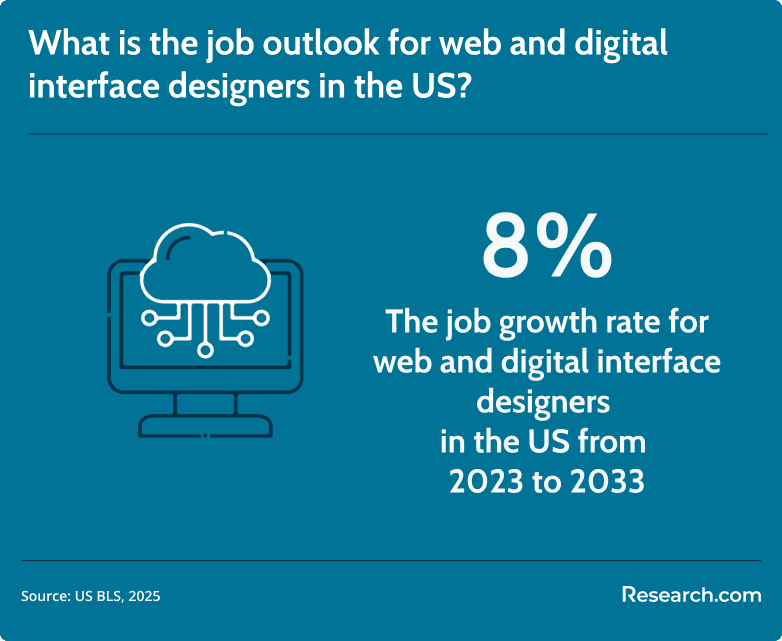
For instance, employment for web and digital interface designers in the United States (US) is expected to increase by 8% from 2023 to 2033. The figure is faster than the average job growth rate for all occupations in the country in the same period [US Bureau of Labor Statistics (BLS), 2025].
To help you get started on your tech career, I crafted this comprehensive guide to online UX design training bootcamps. Explore academic institutions, program costs, common courses, salary potential, and career outlooks.
What are the benefits of completing an online UX design training bootcamp?
- Learning about UX design through online bootcamps can help you land several roles in different industries, including web developer, web and digital interface designer, as well as software developer.
- In May 2024, web and digital interface designers across the US had a median annual wage of $98,090 (US BLS, 2025).
- Completing online UX design training bootcamps provides individuals with the option to study the field at their own pace. Students are also given access to experienced mentors and peers, and they are required to work on real-world projects that build practical skills.
What can I expect from an online UX design training bootcamp?
If you plan on enrolling in online UX design training bootcamps, you can expect a highly structured and immersive learning experience designed to prepare you for real-world design challenges.
Some aspects of taking up an online bootcamp that you may want to take note of include the following:
- These programs often combine self-paced study with scheduled live sessions, giving you both flexibility and accountability.
- Many training providers offer a mix of video lectures, interactive assignments, hands-on projects, and one-on-one or group mentorship from experienced industry professionals who can provide valuable insights and career guidance.
- Students typically engage in the full UX design process, including user research, wireframing, prototyping, and usability testing throughout the course.
- Students are expected to gain proficiency in tools like Figma, Adobe XD, or Sketch.
- Collaborative projects and peer feedback sessions replicate the dynamics of professional design teams, helping learners build communication and problem-solving skills in addition to technical expertise.
- By the end of the program, participants usually compile their best work into a polished professional portfolio, which is essential for showcasing skills and attracting potential employers during the job search.
Where can I work with an online UX design training bootcamp certificate?
In 2023, 128,600 web and digital interface designers worked across the US. The following industries employed the largest shares of these professionals this year (US BLS, 2025):
- Computer Systems Design and Related Services: 16%
- Self-employed Workers: 10%
- Retail Trade: 5%
- Finance and Insurance: 5%
- Advertising, Public Relations, and Related Services: 4%
Meanwhile, the following industries employed the largest shares of the 94,100 web developers that worked in the US in 2023 (US BLS, 2025):
- Computer Systems Design and Related Services: 23%
- Educational Services (State, Local, and Private): 8%
- Management, Scientific, and Technical Consulting Services: 7%
- Self-employed Workers: 6%
- Advertising, Public Relations, and Related Services: 5%
How much can I make with an online UX design training bootcamp certificate?
Web developers in the US had a $90,930 median annual wage in May 2024, which is higher than the $49,500 median annual wage of all occupations across the country. Web and digital interface designers can earn even higher salaries, with a $98,090 median annual wage during the same period (US BLS, 2025).
Moreover, the following are the highest-paying industries for web and digital interface designers in the US in May 2024 (US BLS, 2025):
- Finance and Insurance: $121,710
- Computer Systems Design and Related Services: $98,610
- Advertising, Public Relations, and Related Services: $74,510
- Retail Trade: $69,280
- List of Online UX Design Training Bootcamps for 2027 List of Programs
- How long does it take to complete an online UX design training bootcamp? Completion Time
- How does an online UX design training bootcamp compare to an on-campus program? How does an online UX design training bootcamp compare to an on-campus program?
- What is the average cost of an online UX design training bootcamp? Program Cost
- What are the financial aid options for students enrolling in an online UX design training bootcamp? Financial Aid
- What are the prerequisites for enrolling in an online UX design training bootcamp? Requirements
- What courses are typically in an online UX design training bootcamp? What courses are typically in an online UX design training bootcamp?
- What types of specializations are available in online UX design training bootcamps? What types of specializations are available in online UX design training bootcamps?
- How do you choose the best online UX design training bootcamp? How do you choose the best online UX design training bootcamp?
- What career paths are available to graduates of online UX design training bootcamps? Career Paths
- What is the job market like for graduates of online UX design training bootcamps? Job Market
- Should I Pursue Further Education After an Online UX Design Bootcamp? Should I Pursue Further Education After an Online UX Design Bootcamp?
- What challenges might I face during an online UX design bootcamp? What challenges might I face during an online UX design bootcamp?
Best Online UX Design Training Bootcamps for 2027
Choosing an online UX design bootcamp is a high-stakes decision: tuition can cost thousands of dollars, timelines vary widely, and not every program offers the same level of mentorship, portfolio support, or career preparation. The right bootcamp can help beginners build practical design skills faster than a traditional degree path, but the wrong one can leave students with a weak portfolio and limited job-market readiness.
This guide explains how online UX design training bootcamps work, how long they take, what they cost, what students usually learn, and how to compare programs before enrolling. It is designed for career changers, recent graduates, creative professionals, web specialists, and working adults who want structured UX training without relocating or committing to a full degree program.
Quick answer: Are online UX design bootcamps worth considering?
An online UX design bootcamp can be worth considering if you want a focused, project-based route into user experience design and you are prepared to build a strong portfolio. These programs are best for learners who want practical training in user research, wireframing, prototyping, usability testing, and digital product design. They are not a guaranteed path to employment, so students should compare curriculum quality, instructor experience, portfolio outcomes, career support, cost, and schedule flexibility before enrolling.
How we selected these programs
The online UX design training bootcamps below were reviewed using Research.com’s research methodology. Our team analyzed current information from sources such as the IPEDS database, Peterson's database, the College Scorecard database, and the National Center for Education Statistics. Because bootcamps are not always structured like degree-granting colleges, students should also verify each provider’s latest tuition, refund policy, financing terms, curriculum, instructor support, and career services before applying.
| Bootcamp provider | Best fit | Program length | Listed cost | Key topics |
| Brainstation | Learners who want a shorter live online UX certification course | 4 to 8 sessions; 24 hours in total | Contact the organization for information on program cost. | UX research, strategy, high-fidelity design, design communication |
| CareerFoundry | Students who want a longer online program with UX fundamentals, immersion, and specialization | 5 to 10 months | $7,900 | Design thinking, user research, information architecture, usability testing, prototyping |
| Flatiron School | Learners seeking a product design bootcamp with mentorship and portfolio work | 40 weeks | $14,900 | Product design, generative AI, UI design process |
| General Assembly | Students comparing full-time and part-time UX bootcamp formats | 12 to 32 weeks | $16,450 | Wireframing, prototyping, user research, usability testing, visual design, UI design |
| UX Academy | Beginners who want mentorship and may need a foundations option first | Contact Designlab for information on program length. | $7,999 (Full Upfront Tuition) | Contact Designlab for curriculum information. |
1. Brainstation
Brainstation offers a live online UX Design Certification (UXDC™) course for students who want a compact introduction to UX design concepts and workflows. The curriculum emphasizes design thinking, human-centered design, user flows, user research, and interaction design. Students may also be able to choose in-person study and select from multiple start dates.
- Program length: 4 to 8 sessions; 24 hours in total
- Curriculum: Introduction to UX Research & Strategy; Structuring & Planning Design Solutions; High-fidelity Design; and Elevating & Communicating Design Solutions
- Program cost: Contact the organization for information on program cost.
2. CareerFoundry
CareerFoundry’s online UX design program is structured around UX fundamentals, deeper immersion, and specialization. Students study core areas such as design thinking, user research, information architecture, usability testing, and prototyping, making it a stronger fit for learners who want a longer and more comprehensive online path.
- Program length: 5 to 10 months
- Curriculum: UX Fundamentals; UX Immersion; UX Specialization
- Program cost: $7,900
3. Flatiron School
Flatiron School provides an online UX/UI product design bootcamp that combines hands-on assignments, lab work, portfolio development, and one-on-one mentorship. The program includes product design, the use of generative AI as a research analysis tool, and key elements of the UI design process.
- Program length: 40 weeks
- Curriculum: Product Design; Generative AI; UI Design Process
- Program cost: $14,900
4. General Assembly
General Assembly’s online UX design bootcamp trains students in wireframing, prototyping, user research, usability testing, visual design, and user interface design. The program offers both part-time and full-time tracks, so students can compare a more flexible schedule with a more structured classroom-style experience.
- Program length: 12 to 32 weeks
- Curriculum: Wireframing; Prototyping; User Research; Usability Testing; Visual Design; User Interface Design
- Program cost: $16,450
5. UX Academy
Designlab’s UX Academy is built around an updated curriculum and one-on-one mentorship. Students who are new to design can begin with UX Academy Foundations, which introduces UI basics and commonly used industry tools over 4 to 8 weeks.
- Program length: Contact Designlab for information on program length.
- Curriculum: Contact Designlab for curriculum information.
- Program cost: $7,999 (Full Upfront Tuition)
How long does it take to complete an online UX design training bootcamp?
Most online UX design training bootcamps take 8 to 24 weeks to complete, although some programs are shorter or longer depending on intensity, schedule, and curriculum depth. Full-time bootcamps often run 8 to 12 weeks, while part-time or self-paced options may take up to 6 months. Students who want a shorter path can also compare the fastest online user experience design programs to see how accelerated UX-related options differ.
Part-time online formats are often more realistic for students who are working, parenting, freelancing, or changing careers gradually. However, flexibility does not mean the program is easy. UX bootcamps still require consistent time for lectures, readings, design exercises, research work, portfolio projects, peer feedback, and revisions.
| Format | Typical fit | Main advantage | Main trade-off |
| Full-time online bootcamp | Students who can study intensively and want a faster transition | Shorter completion timeline and more structured weekly pace | Harder to manage with full-time work or major personal obligations |
| Part-time online bootcamp | Working adults and career changers who need schedule flexibility | More manageable alongside employment or family responsibilities | Longer timeline and greater need for self-discipline |
| Short certification course | Learners testing interest in UX or adding UX basics to an existing role | Lower time commitment and focused skill exposure | May not provide enough portfolio depth for entry-level UX roles |
Some online UX design bootcamps also provide extended access to learning materials, portfolio resources, or career support after completion. Before enrolling, ask whether access is time-limited, what type of support continues after graduation, and whether mentorship or job-search help is included in tuition.
How does an online UX design training bootcamp compare to an on-campus program?
Online and on-campus UX bootcamps can both teach practical design skills, but the learning experience is different. The better choice depends on your schedule, learning style, location, budget, and need for in-person networking.
| Factor | Online UX bootcamp | On-campus UX bootcamp |
| Schedule flexibility | Usually better for students who need to study from home or balance work and school | Often more rigid because students must attend at set times and locations |
| Learning environment | Requires a reliable computer, stable internet connection, and a distraction-controlled workspace | Provides a physical classroom setting that may help some students stay focused |
| Collaboration | Depends on video calls, messaging tools, shared files, critiques, and online discussion spaces | Allows face-to-face critiques, group work, and local networking |
| Access to instructors | Can be strong when the program includes live sessions, office hours, and regular project feedback | May feel more immediate because students can ask questions in person |
| Best for | Self-directed learners who want location flexibility | Students who learn better through in-person structure and direct interaction |
Online bootcamps can be a practical choice for learners who value adaptable schedules, similar to students considering fast-track online CompTIA Cloud+ certification programs. The key question is not whether online learning can work; it is whether the specific program offers enough structure, feedback, and accountability for your learning style.
What is the average cost of an online UX design training bootcamp?
There is no single standard price for an online UX design bootcamp. Among the featured programs with published tuition, listed costs include $7,900, $14,900, $16,450, and $7,999 (Full Upfront Tuition). Brainstation instructs prospective students to contact the organization for program cost information.
- CareerFoundry: $7,900
- Flatiron School: $14,900
- General Assembly: $16,450
- UX Academy: $7,999 (Full Upfront Tuition)
Tuition is only one part of the decision. Students should also consider financing fees, refund policies, equipment needs, software subscriptions, time away from work, and whether career coaching or mentor access is included.
| Cost factor | Why it matters | Question to ask before enrolling |
| Curriculum depth | Longer programs may include more projects, research practice, and portfolio development | How many completed portfolio projects will I have by the end? |
| Mentorship and feedback | UX skills improve through critique, iteration, and guidance from experienced designers | How often will an instructor or mentor review my work? |
| Career support | Resume help, portfolio reviews, interview prep, and job-search coaching can affect readiness | What career services are included, and how long do they continue after graduation? |
| Provider reputation | Brand recognition may help, but it should not replace evidence of strong outcomes and student support | Can I review recent graduate portfolios, employer connections, and support policies? |
| Accreditation and credential type | Many bootcamps are not the same as accredited degree programs | Is this a certificate, a noncredit bootcamp, or part of an accredited institution? |
The chart below visualizes the cost of the online UX design training bootcamps featured in this guide using the tuition information currently listed by the providers.
What financial aid options are available for online UX design training bootcamps?
Financial aid for bootcamps is different from financial aid for traditional college programs. Some bootcamps offer scholarships, tuition reductions, installment plans, employer sponsorship options, or workforce funding, but availability can vary by student, location, eligibility, and program format.
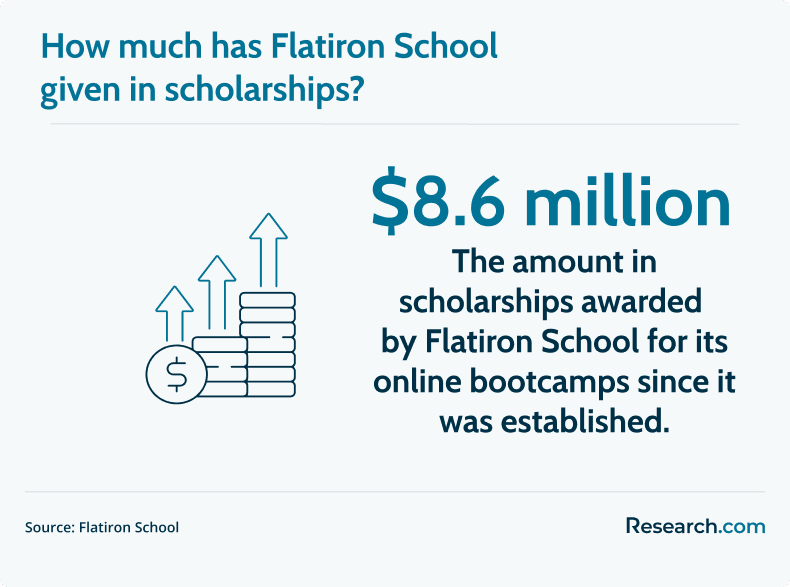
- Flatiron School Scholarships: Flatiron School lists three scholarship programs for eligible students: Access Scholarship, Merit Scholarship, and Women Take Tech.
- Workforce Innovation and Opportunity Act (WIOA): Enacted in 2014, WIOA supports access to employment, education, training, and related services. General Assembly’s online UX design bootcamp allows students to pay tuition in full through WIOA grants.
- CareerFoundry Tuition Reduction & Partial Scholarships: CareerFoundry offers partial scholarships or tuition reductions, including tuition reduction for active US military personnel and veterans.
Before using financing, read the agreement carefully. Confirm the total amount owed, repayment schedule, interest or fees, refund rules, deadlines, and whether financial support depends on enrollment status or program completion.
What are the prerequisites for enrolling in an online UX design training bootcamp?
Many online UX design bootcamps are open to beginners, but “beginner-friendly” does not mean “no preparation required.” Students are more likely to keep up when they already have basic technology skills, communication ability, curiosity about users, and enough time to practice outside class.
- Basic computer literacy: Students should be comfortable managing files, using online platforms, navigating browsers, and learning digital design tools.
- Clear communication: UX designers must explain design choices, document research findings, ask effective questions, and collaborate with developers, product managers, and stakeholders.
- Interest in design and problem-solving: Students do not always need prior design experience, but they should be willing to test ideas, receive critique, revise work, and think from the user’s perspective.
- Time for portfolio work: A bootcamp credential alone is rarely enough. Students need time to produce polished case studies that show process, reasoning, and outcomes.
- Comfort with feedback: UX design is iterative. Strong students learn to treat critique as part of the design process rather than as a final judgment.
What courses are typically included in an online UX design training bootcamp?
Online UX design bootcamps usually cover the full design process, from identifying user needs to testing and refining a digital product. The strongest programs teach students not only how to create attractive screens, but also how to make evidence-based design decisions.
| Course area | What students learn | Why it matters in UX work |
| Design thinking | Human-centered problem-solving, empathy, ideation, and iteration | Helps designers move from assumptions to tested solutions |
| User research | Interviews, surveys, observation, and analysis of user needs and behavior | Provides evidence for design decisions |
| Information architecture | Content structure, navigation, categorization, and user flows | Makes products easier to understand and use |
| Usability testing | Planning tests, observing users, identifying friction, and recommending improvements | Shows where a design succeeds or fails in real use |
| User interface design | Layout, typography, color, accessibility, visual hierarchy, and interaction patterns | Turns UX strategy into usable and visually coherent screens |
| Prototyping | Creating interactive mockups with tools such as Figma or Adobe XD | Allows teams to test and refine ideas before development |
Students who are drawn more strongly to visual communication may also compare UX bootcamps with the cheapest online graphic design degree options, since graphic design and UX design overlap but do not lead to identical training or career outcomes.
What types of specializations are available after an online UX design bootcamp?
After completing a UX design bootcamp, graduates may pursue roles that emphasize research, interface design, interaction design, product thinking, or front-end collaboration. Specialization is useful because UX job postings often ask for different combinations of research, visual design, prototyping, accessibility, and product strategy skills.
| Specialization | Main focus | Good fit for students who enjoy |
| UX Researcher | Studying user behavior through interviews, usability testing, surveys, and analysis | Asking questions, finding patterns, synthesizing data, and influencing product decisions |
| UI Designer | Designing the visual and interactive elements of websites, apps, and digital products | Layout, typography, color, design systems, accessibility, and visual polish |
| Interaction Designer | Planning how users move through a product and interact with its features | User flows, micro-interactions, wireframes, prototyping, and usability improvements |
UX skills can also support adjacent creative and technical paths. For example, students interested in entertainment technology can explore how user experience principles connect to a video game designer career path, where player interaction and intuitive design are central to the experience.
The chart below visualizes employment levels for occupations connected to UX design in the US in 2023, based on 2025 data from the US BLS.
How do you choose the best online UX design training bootcamp?
The best online UX design bootcamp is the one that matches your goals, schedule, budget, learning style, and career needs. Do not choose only by brand name, advertised outcomes, or a short timeline. Instead, evaluate how the program will help you build a job-ready portfolio and understand the full UX process.
- Review the curriculum in detail. Look for user research, usability testing, wireframing, prototyping, information architecture, UI design, accessibility, design systems, and portfolio case studies. Short formats can be useful, as seen in other accelerated tech-training options such as the shortest cloud engineering online bootcamps, but speed should not replace depth.
- Ask how mentorship works. Find out whether feedback is live or asynchronous, how often you meet with mentors, and whether reviewers have current UX or product design experience.
- Inspect graduate portfolios. A strong portfolio should show research, problem framing, design iterations, usability findings, and final outcomes—not just polished screens.
- Compare career support. Ask about resume help, portfolio reviews, interview coaching, networking events, job-search accountability, and how long support lasts after graduation.
- Understand the credential. Confirm whether you will earn a certificate, noncredit credential, or another type of completion document. Do not assume a bootcamp is equivalent to a degree.
- Calculate the total cost. Include tuition, fees, software, equipment, financing charges, and lost income if you reduce work hours.
Questions to ask before enrolling
- How many portfolio projects will I complete, and what types of problems will they solve?
- Who reviews my work, and how often will I receive detailed feedback?
- Are live classes required, optional, or unavailable?
- What happens if I fall behind?
- Are career services included in tuition?
- What refund policies apply if I withdraw?
- Can I speak with recent graduates or view recent student portfolios?
- Does the program teach accessibility, responsive design, and collaboration with developers?
What career paths are available to graduates of online UX design training bootcamps?
UX bootcamp graduates may pursue entry-level and related roles in web design, digital product design, interface design, research support, software testing, and visual design. Career fit depends heavily on the graduate’s portfolio, prior experience, technical skills, communication ability, and local or remote job-market conditions.
| Career path | How UX training applies | Common portfolio evidence |
| Web Developers | UX knowledge helps developers build websites that are easier to use, navigate, and test | Responsive website projects, usability improvements, front-end collaboration |
| Web and Digital Interface Designers | These professionals design digital interfaces for websites, applications, and other online products | Wireframes, prototypes, interface systems, usability test summaries |
| Software Developers | UX principles help software teams improve usability, accessibility, and user satisfaction | Product flows, feature prototypes, user-centered problem statements |
| Software Quality Assurance Analysts and Testers | UX training supports the ability to identify usability issues in addition to technical defects | Usability test plans, bug reports, user feedback analysis |
| Graphic Designers | Visual design skills can combine with UX methods to create clearer, more user-centered digital materials | Brand-aligned interfaces, visual layouts, icons, design systems |
Students comparing UX with broader business or design pathways may find it useful to review business administration course subjects for product or management-oriented roles, or an online graphic design degree for a more visual communication-focused route.
The chart below visualizes the median annual wages of occupations related to UX design in the US in May 2024, according to 2025 data from the US BLS.
What is the job market like for graduates of online UX design training bootcamps?
The labor market for UX-related roles is promising in several connected occupations, but bootcamp graduates should expect competition. Employers often want evidence of practical design ability, collaboration experience, and a portfolio that explains design decisions clearly.
From 2023 to 2033, employment for web and digital interface designers in the US is expected to increase by 8%, which is higher than the average job growth rate for all occupations in the country. Across the US, 128,600 of these professionals were employed in 2023, and the figure is projected to rise to 138,800 by 2033 (US BLS, 2025).
Employment for web developers is projected to grow by 9% during the same period. In 2023, 94,100 web developers worked in the US, and that number is expected to increase to 102,500 (US BLS, 2025).
Employment for software developers, quality assurance analysts, and testers is projected to rise by 17%. This is equivalent to an average of about 140,100 job openings annually from 2023 to 2033 (US BLS, 2025).
These figures show opportunity in UX-adjacent technology roles, but they do not guarantee that every bootcamp graduate will secure a UX job. Hiring outcomes depend on experience, portfolio quality, networking, interview performance, market conditions, and the match between a graduate’s skills and employer expectations.
Should I pursue further education after an online UX design bootcamp?
Further education may be useful if you want to move into advanced product leadership, research-heavy roles, human-computer interaction, information architecture, software development, data-informed design, or industry-specific UX. A bootcamp can build practical skills quickly, while a degree or graduate certificate may provide deeper academic training, broader theory, or credentials for roles that prefer formal education.
| Next step | When it makes sense | When it may not be necessary |
| Another UX specialization course | You need stronger skills in research, accessibility, design systems, or advanced prototyping | Your portfolio already shows depth in the specialization you want |
| Graphic design or visual design study | You want to strengthen typography, layout, branding, and visual composition | Your target roles focus more on research than visual interface work |
| Business or product management education | You want to move toward product strategy, operations, or leadership | You prefer hands-on design execution and do not want management responsibilities |
| Graduate-level technical education | You want to combine UX with analytics, health technology, or software systems | You are seeking an entry-level UX role and need portfolio experience more than another credential |
Some professionals also compare UX with other fields before committing. If you are exploring non-UX options, Research.com offers guides on topics such as fastest online masters degree in health informatics, online healthcare administration degree pathways, masters multilingual learner education salary considerations, fastest anthropology degrees online, and nursing education graduate certificate jobs.
What challenges might I face during an online UX design bootcamp?
Online UX bootcamps can be effective, but students should prepare for the challenges of remote, project-based learning. The most common difficulties include staying motivated without a physical classroom, managing feedback cycles, learning design tools quickly, and balancing coursework with work or personal responsibilities.
| Common challenge | Why it matters | Better strategy |
| Underestimating the workload | UX projects require research, design, testing, revision, and documentation | Block weekly time for both class sessions and independent portfolio work |
| Choosing based only on tuition | A cheaper program may not include enough mentorship, feedback, or career support | Compare total value, not just sticker price |
| Ignoring portfolio quality | Employers often evaluate case studies more closely than certificates | Prioritize programs that require complete, well-documented portfolio projects |
| Assuming all bootcamps are equivalent | Curriculum depth, instructor quality, and support services vary widely | Ask for syllabi, mentor details, graduate examples, and support policies |
| Relying only on advertised job outcomes | Career results can depend on student background, location, effort, and market conditions | Review methodology behind outcome claims and speak with alumni when possible |
| Neglecting technical setup | Remote learning depends on stable internet, reliable hardware, and design software access | Confirm technology requirements before the first day of class |
Key Insights
- Online UX bootcamps are best for practical, portfolio-based training. They can help students learn user research, wireframing, prototyping, usability testing, and UI design without enrolling in a full degree program.
- Program length varies significantly. Many online UX design bootcamps take 8 to 24 weeks, while featured programs range from 4 to 8 sessions; 24 hours in total to 40 weeks.
- Published tuition among featured programs differs widely. Listed costs include $7,900, $14,900, $16,450, and $7,999 (Full Upfront Tuition), while Brainstation directs students to contact the organization for cost details.
- Mentorship and portfolio feedback are critical. A certificate alone is not enough; students need case studies that show research, design reasoning, iteration, testing, and final outcomes.
- Online learning works best for disciplined students. Flexibility is valuable, but students must manage deadlines, critiques, tool practice, and independent project work.
- Career prospects exist in UX-related fields, but outcomes are not guaranteed. BLS data shows projected growth for web and digital interface designers, web developers, and software developers, quality assurance analysts, and testers, but hiring depends on skills, experience, portfolio quality, and market conditions.
- The best bootcamp is not always the fastest or most expensive option. Choose based on curriculum depth, instructor access, career support, financing terms, portfolio expectations, and fit with your career goals.
References:
- US Bureau of Labor Statistics. (2025, April 18). Graphic Designers. Occupational Outlook Handbook. https://www.bls.gov/ooh/arts-and-design/graphic-designers.htm
- US Bureau of Labor Statistics. (2025). Occupational Employment and Wage Statistics, Industry: Cross-industry, Private, Federal, State, and Local Government. Occupational Employment and Wage Statistics Query System. https://data.bls.gov/oes/#/industry/000000
- US Bureau of Labor Statistics. (2025, April 18). Software Developers, Quality Assurance Analysts, and Testers. Occupational Outlook Handbook. https://www.bls.gov/ooh/computer-and-information-technology/software-developers.htm
- US Bureau of Labor Statistics. (2025, April 18). Web Developers and Digital Designers. Occupational Outlook Handbook. https://www.bls.gov/ooh/computer-and-information-technology/web-developers.htm
Other Things You Need to Know about Online UX Design Training Bootcamps
When selecting an online UX design bootcamp in 2027, consider the curriculum's alignment with current industry trends, instructor expertise, mentorship availability, alumni success rates, and career support services. These factors ensure graduates are well-prepared for the job market.
Graduates of online UX design training bootcamps in 2026 can expect entry-level salaries ranging from $50,000 to $75,000 annually, depending on their location, experience, and specific skills. Factors like the reputation of the bootcamp and networking opportunities can also influence salary potential in the UX design field.