
2027 Easiest Communications Degree Programs

Co-Founder and Chief Data Scientist
Choosing an “easy” communications degree is not really about finding a program with no challenge. It is about finding the fastest, most manageable path that still builds marketable skills in writing, speaking, media, persuasion, audience analysis, and digital communication. According to the most recent NCES data, approximately 87,000 bachelor’s degrees in communication, journalism, and related programs were conferred in the US, which shows that this remains a popular field—but popularity also makes program choice more important.
This guide is for students who want a practical communications credential without committing to an overly technical or research-heavy path. You will learn which communications degrees are usually the easiest to complete, how associate, bachelor’s, master’s, and certificate options compare, what jobs may be available, how much these programs can cost, and what to check before enrolling.
Quick answer: What is the easiest communications degree?
The easiest communications degree for most students is usually an associate’s degree in communications because it has the shortest timeline, broader coursework, and fewer advanced specialization requirements. It can often be completed in about two years of full-time study and may prepare students for entry-level roles or transfer into a bachelor’s program. At the bachelor’s level, general communication, social media, advertising, and public relations concentrations are often more accessible than technical communication, political communication, strategic communication, or communication management.
What are the benefits of getting a communications degree?
- Broad career flexibility: Communications graduates may work in advertising, public relations, journalism, social media, marketing, media production, customer service, sales, corporate communication, nonprofit outreach, and government communication.
- Transferable workplace skills: The degree emphasizes writing, presenting, persuasion, interviewing, research, audience awareness, collaboration, and message design—skills used across many industries.
- Income potential varies by role: The median annual salary for communications degree holders is around $60,000, while some specialized roles report higher median wages.
- Online study can be practical: An online communications degree may help working adults, parents, and transfer students complete coursework with fewer relocation or commuting barriers.
What can I expect from the easiest communications degree programs?
The most accessible communications programs usually start with general education and foundational communication courses rather than advanced research, production, analytics, or technical writing requirements. At the associate level, students commonly study public speaking, media writing, interpersonal communication, group communication, and basic digital media. These courses are designed to build communication confidence and workplace-ready skills rather than prepare students for highly specialized professional practice right away.
“Easy,” however, depends on the student. A creative student may find advertising, social media, or public relations more intuitive because the work involves content ideas, campaigns, storytelling, and audience engagement. A student who enjoys systems, software, documentation, and precision may prefer technical communication even though it can be more specialized. The best fit is the program that matches your strengths, not simply the one with the least demanding reputation.
| Degree option | Typical level of difficulty | Best for | Main trade-off |
| Associate’s degree in communications | Usually the easiest and shortest option | Students who want an entry-level credential or transfer pathway | May limit access to roles that prefer a bachelor’s degree |
| Bachelor’s degree in communications | Moderate difficulty, depending on concentration | Students seeking stronger career mobility and internships | Costs more and takes longer than an associate degree |
| Master’s degree in communications | More advanced and specialized | Professionals aiming for leadership, strategy, research, or teaching-related roles | Requires prior college study and often stronger writing or research skills |
| Certificate program | Focused and usually shorter | Career changers or professionals adding a skill such as social media, PR, or technical writing | May not replace a degree for employers that require one |
Where can I work after graduating from the easiest communications degree program?
Graduates from easier communications programs often begin in roles that rely on clear writing, audience interaction, content support, and coordination. With an associate’s degree, likely entry points include social media assistant, marketing assistant, customer service lead, office communication support, media production assistant, sales support specialist, or public relations assistant. Some employers may prefer or require a bachelor’s degree for roles such as public relations specialist, communications coordinator, copywriter, editor, or digital content strategist.
Communications skills are not limited to media companies. Healthcare organizations need patient education materials, technology firms need user communication and product messaging, schools need outreach staff, nonprofits need donor communication, and government agencies need public information support. The degree is broad, so career outcomes depend heavily on internships, portfolio work, writing samples, platform experience, and the industry you target.
How much can I make with a degree from the easiest communications degree program?
Earnings depend on the role, industry, location, experience level, and whether the job requires specialized writing, editing, digital, or technical skills. The median annual wage for individuals with a communications degree is around $60,000, but that figure should not be treated as a guaranteed starting salary. Entry-level salaries may be lower, especially for students with only an associate’s degree or limited internship experience.
Several communications-related roles report higher median wages. Technical writers earn a median salary of $80,050, public relations specialists earn around $66,750, and roles such as writers and authors, editors, and film and video editors fall in the $60,000 to $75,000 annual range. Students focused on return on investment should compare program cost against realistic job targets, not just the highest-paying occupations in the field.
- List of the Easiest Communications Degree Programs for 2027
- How long does it take to complete the easiest communications degree programs?
- How does an online communications degree compare to an on-campus program?
- What is the average cost of the easiest communications degree programs?
- What are the financial aid options for students enrolling in the easiest communications degree programs?
- What are the prerequisites for enrolling in the easiest communications degree program?
- What courses are typically in the easiest communications degree program?
- What are the most common specializations available in the communications degree programs?
- What additional certifications can enhance your communications career?
- How can emerging technologies boost your communications career?
- How can communications degrees keep pace with digital transformation?
- Could an accelerated marketing degree online complement your communications studies?
- Are the Easiest Communications Degree Programs Accredited and Recognized?
- How do internships complement communications degree programs?
- How can further education enhance your communications career?
- Should You Combine Your Communications Degree with an Interdisciplinary Program?
- Can a communications degree prepare you for a teaching career?
- How do communications degrees compare to related liberal arts programs?
- What are the potential challenges of the easiest communications degree programs?
- Should I pursue advanced studies to specialize beyond an easy communications degree?
- How do you choose the best easiest communications degree program?
- What career paths are available for graduates of the easiest communications degree programs?
- What is the job market for graduates with the easiest communications degrees?
List of the Easiest Communications Degree Programs for 2027
The easiest communications degree path is usually the associate’s degree because it is shorter, more introductory, and often designed for students who want either an entry-level job or a transfer route into a bachelor’s program. Bachelor’s degrees remain the more common credential for many professional communications roles, while master’s degrees are better suited for leadership, strategy, research, or specialized practice.
Types of communications degrees
- Associate’s degree: A two-year program focused on basic writing, public speaking, media literacy, interpersonal communication, and general education. It is a practical starting point for students who want a lower-commitment route into the field.
- Bachelor’s degree: A four-year program that covers communication theory, media practice, research methods, writing, campaign planning, and concentrations such as journalism, public relations, advertising, or digital media. This is often the stronger option for long-term career growth.
- Master’s degree: An advanced credential that usually takes 1-2 years beyond the bachelor’s degree. It may focus on strategic communication, media management, corporate communication, health communication, or research-based communication work.
- Certificate programs: Shorter programs, typically less than a year, that build targeted skills in areas such as social media, public relations, digital marketing, technical writing, or content strategy. Certificates can be useful add-ons but may not carry the same weight as a degree.
Specialization increases as the degree level rises. Associate programs are usually broad. Bachelor’s programs introduce more career-specific tracks. Master’s programs often expect students to apply theory, analytics, research, and strategy to complex communication problems.
Communications Majors and Specializations Ranked: From General to Specialized
The following ranking organizes common communications concentrations from the most general and intuitive to the more specialized and technical. This is not a ranking of career value. Instead, it shows which options may feel more manageable for students who want an easier academic path and which options may require deeper analytical, political, organizational, technical, or management knowledge.
Use this list to match a concentration with your strengths. If you like writing and storytelling, journalism or media communication may fit. If you enjoy platforms and audience engagement, social media may be a better route. If you prefer systems, products, and detailed instructions, technical communication may be worth the added challenge.
1. Communication
A general communication major is often the easiest and most flexible option because it covers broad principles rather than one narrow professional track. Students study how people create, interpret, and share messages in interpersonal, group, public, organizational, and media settings. This path works well for students who want adaptable skills for marketing, public relations, journalism, sales, human resources, or corporate communication.
2. Social Media
Social media programs focus on digital platforms, audience engagement, content calendars, brand voice, analytics basics, and online community management. Many students find this concentration approachable because they already understand social platforms as users. The academic challenge is learning to use those platforms strategically, professionally, and ethically rather than casually.
3. Advertising
Advertising blends creativity with business goals. Students learn how campaigns are planned, how persuasive messages are built, how audiences are segmented, and how brands use visuals and copy to influence consumer behavior. This can be a good fit for students who enjoy creative problem-solving, branding, and promotional strategy. Advertising can also connect with visual communication careers; it may overlap with paths discussed in Research.com’s guide to the best jobs with a graphics design masters degree.
4. Public Relations
Public relations teaches students how organizations communicate with the public, news media, customers, employees, donors, or other stakeholders. Coursework may include press releases, media relations, reputation management, crisis communication, event promotion, and campaign planning. It is a strong option for students who like writing, relationship-building, public messaging, and fast-moving communication problems.
5. Journalism
Journalism emphasizes reporting, interviewing, fact-checking, editing, ethics, news judgment, and deadline-based writing. It can be manageable for students who enjoy research and storytelling, but it requires accuracy, persistence, and comfort with revision. Students interested in reporting, editing, podcasting, broadcasting, newsletters, or digital news may find this path rewarding.
6. Media Communication
Media communication examines how messages are created and distributed through television, radio, print, streaming platforms, social media, podcasts, and digital publications. Compared with a general communication major, it spends more time on media systems, production, content analysis, and audience behavior. Students who want a media-related career but do not want a narrow journalism or production degree may prefer this option.
7. Health Communication
Health communication applies communication skills to patient education, public health campaigns, healthcare organizations, community outreach, and health-related behavior change. Students learn to make complex health information clearer for different audiences. This concentration can be more specialized because it requires sensitivity to health literacy, ethics, cultural differences, and public trust.
8. Organizational Communication
Organizational communication focuses on how information moves inside workplaces. Students study internal messaging, conflict resolution, team communication, corporate culture, leadership communication, employee engagement, and change management. This track is useful for students interested in human resources, training, management support, or internal communications.
9. Strategic Communication
Strategic communication teaches students to connect communication plans to organizational goals. It often combines public relations, marketing communication, research, campaign planning, branding, and evaluation. This concentration can be more demanding because students must think beyond single messages and learn to design, justify, and measure communication strategies.
10. Political Communication
Political communication studies campaign messaging, public opinion, political media, advocacy, debate, policy communication, and the relationship between media and political behavior. It is best for students interested in politics, government, polling, campaigns, public affairs, or advocacy work. The added challenge is that students need both communication skills and a working understanding of political systems and public issues.
11. Technical Communication
Technical communication is one of the more specialized communication paths. Students learn to translate complex information into clear instructions, manuals, help articles, product documentation, training materials, and user support content. It can be highly marketable, but it requires precision, audience testing, document design, and often comfort with technical products or software.
12. Communication Management
Communication management prepares students to supervise communication functions, teams, campaigns, and internal or external messaging systems. Coursework may involve leadership, budgeting, corporate communication planning, stakeholder communication, and performance evaluation. This path is usually more advanced and is often better suited to students with professional experience or leadership goals.
The right concentration should reflect both your academic strengths and your target job market. A general communication or social media track may be easier to complete, while technical communication or strategic communication may take more effort but lead to more specialized opportunities.
Some communications graduates later move toward education or training roles. If that is your goal, you may want to compare graduate education options such as the best 1 year online master's in education programs to understand faster master’s-level pathways.
How long does it take to complete the easiest communications degree programs?
Completion time depends on degree level, transfer credits, course load, term structure, and whether the program offers accelerated formats. Full-time students usually finish faster, while part-time students may need additional semesters.
- Associate’s degree: A standard associate’s degree in communications typically takes about 2 years. Some students in an accelerated communications degree program may finish in around 18 months if they can handle a heavier or more compressed schedule.
- Bachelor’s degree: A traditional bachelor’s degree usually takes 4 years. In an accelerated format, some students may complete the degree in 3 years, depending on transfer credits, course availability, and enrollment intensity.
- Master’s degree: A full-time master’s in communications commonly takes 1.5 to 2 years. Accelerated programs may shorten the timeline to about 1 year when the curriculum and school policies allow it.
| Path | Typical timeline | Fastest route mentioned | Who should consider it |
| Associate’s degree | About 2 years | Around 18 months | Students who want the quickest degree-based entry point |
| Bachelor’s degree | Usually 4 years | Potentially 3 years | Students who want stronger access to professional communications roles |
| Master’s degree | 1.5 to 2 years | About 1 year | Professionals seeking specialization, leadership, or advancement |
How does an online communications degree compare to an on-campus program?
Online and on-campus communications degrees can cover similar academic material, but the student experience is different. Online programs are often better for learners who need flexibility, while campus programs may offer more structured interaction, live production opportunities, student media organizations, and face-to-face networking.
| Factor | Online communications degree | On-campus communications degree |
| Schedule | Often more flexible, especially for working adults | Usually follows set class meeting times |
| Interaction | Uses discussion boards, video meetings, online feedback, and digital collaboration | Offers in-person class discussion, campus events, and direct faculty access |
| Hands-on learning | Can include remote projects, virtual internships, portfolios, and digital campaigns | May provide easier access to studios, student media, campus PR teams, or local internships |
| Cost considerations | May reduce commuting, housing, or relocation expenses | May involve additional campus, housing, transportation, or activity costs |
| Best fit | Self-directed students who need flexibility | Students who want structure, in-person networking, and campus resources |
Program quality matters more than delivery format. Whether you choose a campus program or an online option such as an online master’s in communication, check accreditation, faculty experience, internship support, portfolio requirements, and whether the curriculum matches your career goals.
What is the average cost of the easiest communications degree programs?
Communications degree costs vary by credential level, institution type, residency status, delivery format, and fees. Tuition is only one part of the total price; students should also account for books, technology, transportation, housing, graduation fees, and lost work time if they reduce employment while studying.
For an associate's degree in communications, online programs typically cost between $250 and $400 per credit hour, with total program costs ranging from around $15,000 to $24,000 for the 60 credits required. On-campus associate's degree programs are usually more affordable, with tuition ranging from $3,000 to $10,000 per year. The total cost for a two-year program generally falls between $6,000 and $20,000, depending on institution and residency status.
For a bachelor’s degree in communications, tuition rates are usually around $300 to $500 per credit hour. Total costs can reach between $51,000 and $70,000 when books and supplies are included. Public universities tend to charge in-state students about $9,375 per year, while out-of-state tuition runs about $27,000 annually. Private universities typically cost more, averaging around $32,800 per year. The total average cost for a bachelor's degree in communications is approximately $51,500.
| Program type | Cost figures provided | Decision point |
| Online associate’s degree | $250 to $400 per credit hour; around $15,000 to $24,000 for 60 credits | Good for flexibility, but compare total fees carefully |
| On-campus associate’s degree | $3,000 to $10,000 per year; $6,000 to $20,000 total for two years | Often affordable at community colleges, especially for in-district students |
| Bachelor’s degree | $300 to $500 per credit hour; $51,000 to $70,000 with added expenses | May improve access to professional roles but requires a larger investment |
| Public university bachelor’s tuition | About $9,375 per year for in-state students; about $27,000 annually for out-of-state students | Residency status can heavily affect price |
| Private university bachelor’s tuition | Averaging around $32,800 per year | Scholarships and institutional aid can change the net cost |
Median Annual Salary for Communications Degree Holders
The median annual wage for people holding communications degrees is approximately $60,000. Some higher-paying communications-related occupations include:
- Technical Writers - $80,050
- Editors - $75,020
- Writers and Authors - $73,690
- Public Relations Specialists - $66,750
To evaluate ROI, compare the net cost after grants and scholarships with the salary range for the specific role you want. A low-cost associate’s degree may be a smart first step if you plan to transfer, while a higher-cost bachelor’s program should offer clear advantages such as internships, portfolio support, employer connections, or strong career services.
What are the financial aid options for students enrolling in the easiest communications degree programs?
Financial aid can make a communications degree more affordable, but students should understand the difference between aid that lowers the price and aid that must be repaid. Start with grants and scholarships, then compare federal loan options before considering private loans.
- Federal financial aid: Students can complete the Free Application for Federal Student Aid (FAFSA) to be considered for Pell Grants, federal loans, and work-study opportunities. Grants do not need to be repaid, while loans do.
- State grants and scholarships: Many states offer aid for residents attending eligible institutions. Awards may depend on need, merit, enrollment level, or program type.
- University scholarships and grants: Colleges, including not for profit online universities, may provide institutional scholarships based on academic performance, financial need, transfer status, or major.
- Private scholarships: Professional associations, foundations, local organizations, employers, and media-related groups may offer awards for communications students.
- Private loans: These can help fill funding gaps, but students should compare interest rates, repayment terms, cosigner requirements, and borrower protections before borrowing.
- Work-study programs: Federal work-study may allow eligible students to earn money through part-time work while enrolled.
Before accepting aid, ask the school for a full cost of attendance and a net price estimate. The cheapest tuition is not always the lowest total cost if fees, books, travel, or lost transfer credits increase expenses.
What are the prerequisites for enrolling in the easiest communications degree program?
Admissions requirements vary by school and degree level, but communications programs are often accessible compared with highly technical majors. Students still need to meet academic, application, and sometimes placement requirements.
- Associate's degree: Applicants usually need a high school diploma or GED. Some colleges may require placement testing, a minimum GPA, or prerequisite English courses, but barriers are generally lower than for upper-division programs.
- Bachelor's degree: Applicants typically need a high school diploma or GED and may need a competitive GPA. Depending on the institution, SAT/ACT scores, personal statements, recommendations, or evidence of writing, speaking, media, or extracurricular experience may be considered.
- Master’s degree: Applicants usually need a bachelor’s degree. Some programs may expect a minimum GPA, professional experience, writing samples, a portfolio, or evidence of readiness for graduate-level research and analysis.
Students considering communications should also review career information from sources such as the Bureau of Labor Statistics page on media and communications occupations. This helps connect admissions decisions with realistic job requirements.
What courses are typically in the easiest communications degree program?
The easiest communications programs usually begin with broad courses that build confidence in writing, speaking, listening, persuasion, and media awareness. More specialized courses appear later, especially in bachelor’s and master’s programs.
Core Courses
Common foundational courses include:
- Introduction to Communication: Covers major communication concepts, theories, contexts, and professional applications.
- Public Speaking: Builds presentation, audience analysis, organization, delivery, and speechwriting skills.
- Writing for the Media: Introduces news writing, press releases, digital content, and concise professional communication.
- Interpersonal Communication: Explores one-on-one communication, listening, relationships, conflict, identity, and small-group interaction.
Elective Courses
Electives help students shape the degree around career goals. Examples include:
- Advertising and Marketing Communication: Focuses on persuasive campaigns, brand messaging, target audiences, and promotional strategy.
- Public Relations: Covers reputation management, media outreach, press materials, crisis communication, and stakeholder messaging.
- Digital Communication: Examines online platforms, digital audiences, content strategy, analytics basics, and technology-supported communication.
Communications coursework can apply across business, education, healthcare, finance, social work, sports, and nonprofit settings. Students interested in athletics-related roles can compare how communication skills fit into sports management careers and salaries.
Students who want a more technical profile can add electives or certificates in analytics, digital media, or research methods. For example, combining communication coursework with a data analytics program online may help students prepare for roles that require campaign measurement, audience segmentation, or digital performance reporting.
A strong communications curriculum should help students produce evidence of their skills. Look for programs that require writing samples, presentations, campaigns, media projects, client work, internships, or a portfolio.
What are the most common specializations available in the communications degree programs?
Specializations help students turn a broad communications degree into a clearer career direction. The most common concentrations reflect how graduates use communication skills in media, business, journalism, and public-facing roles.
- Communication: This broad specialization develops verbal, written, interpersonal, public, and digital communication skills. It is the most common option, with 56% of communications professionals choosing this specialization.
- Journalism: Journalism focuses on reporting, interviewing, writing, editing, media ethics, and storytelling. About 18% of communications professionals focus on journalism.
- Mass Media: This concentration covers content creation, distribution, media platforms, and audience behavior across television, radio, print, and digital channels. Around 16% of professionals in the communications field specialize in mass media.
- Advertising and Public Relations: This specialization teaches students to build persuasive campaigns, manage reputation, write public-facing materials, and support brand communication. Approximately 11% of communications professionals specialize in advertising and public relations.
Students aiming for management may later pair communications with business study. Comparing cheap MBA online programs can help you understand whether a business credential would support advancement in marketing, corporate communication, or leadership roles.
What additional certifications can enhance your communications career?
Certifications can strengthen a communications degree when they add a specific, employer-recognizable skill. Useful areas include digital marketing, social media management, project management, analytics, search strategy, content management systems, editing, and technical writing. The goal is not to collect credentials randomly; it is to close a skill gap for the job you want.
For students interested in data-supported messaging, an affordable online mba in data analytics may be relevant later in their career. This type of study can support roles where communication decisions are tied to performance dashboards, customer insights, market research, or business strategy.
How can emerging technologies boost your communications career?
Technology is changing communications work by making content production faster, audience targeting more detailed, and campaign measurement more visible. Students should expect employers to value familiarity with content management systems, analytics platforms, collaboration tools, accessibility practices, multimedia production, and AI-supported workflows.
AI tools can help with brainstorming, transcription, research organization, social listening, editing support, and performance analysis, but they do not replace judgment, ethics, source verification, audience understanding, or original strategy. Students who want deeper technical knowledge can explore options such as an online AI degree to understand how intelligent systems affect communication, automation, and digital media.
How can communications degrees keep pace with digital transformation?
A modern communications program should teach more than public speaking and writing. Look for coursework in social media strategy, digital analytics, multimedia storytelling, audience research, search behavior, brand voice, online reputation, accessibility, and platform-specific content planning. Programs that still treat digital communication as an elective afterthought may not prepare students as well for current workplace expectations.
Students who want a more platform-focused credential may compare an online social media marketing degree with a broader communications degree. The communications degree may offer wider career flexibility, while the social media marketing path may provide more targeted digital campaign preparation.
Could an accelerated marketing degree online complement your communications studies?
An accelerated marketing degree online can complement communications study if your career goal involves branding, advertising, digital campaigns, consumer behavior, market research, or sales enablement. Communications programs teach message design and audience connection; marketing programs often add pricing, positioning, campaign measurement, and customer acquisition strategy.
This combination may be especially useful for students who want roles in content marketing, brand communication, social media strategy, or marketing communications. It may be less necessary for students focused on journalism, internal communication, public affairs, or media production.
Are the Easiest Communications Degree Programs Accredited and Recognized?
Accreditation should be one of the first things you verify. Institutional accreditation affects transfer credits, financial aid eligibility, graduate school admission, and employer confidence. A program can be flexible and easy to enter, but if the school lacks appropriate accreditation, the credential may create problems later.
Recognition also depends on curriculum quality, faculty experience, internship access, alumni outcomes, and portfolio development. Students who want to strengthen writing-heavy career options may also compare related programs such as an online creative writing degree, especially if they are targeting content creation, publishing, copywriting, or editing.
How do internships complement communications degree programs?
Internships are especially important in communications because employers often want proof that you can write, present, coordinate, edit, publish, pitch, analyze, or manage content in real settings. A transcript shows what you studied; an internship and portfolio show what you can do.
Strong programs help students find internships in media organizations, nonprofits, marketing agencies, corporate communications offices, public relations firms, schools, hospitals, government agencies, or startups. If you are comparing programs, ask whether internships are required, optional, remote, paid, credit-bearing, or supported by dedicated career staff. Students who want to sharpen writing and storytelling may also consider an online creative writing degree as a complementary pathway.
How can further education enhance your communications career?
Further education can help communications professionals move into leadership, teaching, training, research, consulting, or specialized communication roles. A master’s degree may be enough for many advancement goals, while doctoral programs are generally most relevant for senior leadership, higher education, organizational research, or specialized academic work.
For professionals interested in executive, academic, or education-related leadership, online EdD programs may be worth comparing. Before enrolling, confirm whether the degree aligns with your target role and whether the cost, timeline, and dissertation or capstone requirements are realistic.
Should You Combine Your Communications Degree with an Interdisciplinary Program?
Combining communications with another field can make sense when the second field gives you domain expertise. Employers often value communicators who understand the industry they serve, such as healthcare, technology, education, business, law, politics, or information management.
For example, a librarian degree online may be relevant for students interested in research, information organization, digital archives, knowledge management, academic libraries, or public information services. The best interdisciplinary pairing is the one that connects directly to a specific career goal.
Can a communications degree prepare you for a teaching career?
A communications degree can support teaching-related work because it builds public speaking, lesson presentation, writing, interpersonal communication, and audience adaptation skills. However, teaching in K-12 public schools usually requires state-specific licensure or certification, and a communications degree alone may not meet those requirements.
If you want to become a teacher, review the rules in the state where you plan to work and compare teacher preparation routes. Research.com’s guide on how quickly can you get a teaching degree online can help you understand accelerated education pathways.
How do communications degrees compare to related liberal arts programs?
Communications and other liberal arts programs can overlap, but their emphasis differs. Communications degrees usually focus on applied messaging, media, persuasion, public speaking, digital platforms, and organizational communication. English degrees typically emphasize literature, advanced writing, criticism, rhetoric, and textual analysis.
Students who want public relations, marketing communication, media, or corporate messaging may prefer communications. Students who want literary study, editing, publishing, writing-intensive graduate work, or language-focused analysis may prefer English. If cost is a major factor, compare options such as the most affordable online bachelors degree in English alongside communications programs.
What are the potential challenges of the easiest communications degree programs?
The easiest path is not always the strongest path. A short or general communications program may help you graduate faster, but it may offer fewer specialized courses, weaker internship pipelines, less portfolio development, or limited employer connections. This matters because communications hiring is often skills- and experience-driven.
Another challenge is competition. Because communications skills are broad, graduates may compete with applicants from marketing, English, journalism, business, design, political science, and media production backgrounds. Students interested in public affairs or policy-focused communication may want to compare communications with an affordable political science bachelors online.
| Common mistake | Why it matters | Better approach |
| Choosing the easiest program without checking outcomes | A simple curriculum may not lead to strong job preparation | Review internships, portfolios, alumni roles, and career support |
| Focusing only on tuition | Fees, transfer policies, books, and lost credits can raise total cost | Compare net price and total cost of attendance |
| Ignoring accreditation | Credits may not transfer and aid eligibility may be affected | Verify institutional accreditation before applying |
| Assuming online means easier | Online courses require time management and self-direction | Ask about course format, deadlines, faculty access, and support |
| Graduating without a portfolio | Employers often want writing samples, campaigns, or published work | Build a portfolio through class projects, internships, and freelance work |
Should I pursue advanced studies to specialize beyond an easy communications degree?
Advanced study can be valuable if it connects to a specific outcome: leadership, research, teaching, health communication, organizational consulting, speech-related services, or another specialized field. It is less useful if you pursue it only because you are unsure what job to target after graduation.
Some students move into communication-adjacent fields that require more specialized training. For example, candidates interested in speech-language-related work may compare options such as fully funded SLP programs online. Always check licensure, clinical, accreditation, and placement requirements before assuming a communications background is enough.
How do you choose the best easiest communications degree program?
The best easy communications degree is not simply the fastest one. It is the program that you can realistically complete, afford, and use to build evidence of employable skills. Use the following factors before applying.
- Curriculum fit: Check whether the program is general or specialized. If you want flexibility, a general communication track may work. If you want a defined role, look for public relations, journalism, digital media, advertising, or technical communication coursework.
- Flexibility: Online programs can be helpful for students balancing work, family, or transfer credits. Confirm whether classes are asynchronous, synchronous, accelerated, or self-paced.
- Support services: Strong advising, tutoring, writing support, career counseling, internship placement, and networking opportunities can make a major difference, especially for online students.
- Return on investment: Compare total cost with likely job outcomes. A lower-cost associate degree may be a smart start, but a bachelor’s program with strong internships may provide better long-term value.
- Accreditation and reputation: Verify institutional accreditation and review employer connections, faculty backgrounds, student media opportunities, and alumni career paths.
- Portfolio opportunities: Prioritize programs that require writing samples, campaign projects, presentations, video or audio work, digital content, or applied client projects.
Before enrolling, ask admissions or advising staff these questions: Will my credits transfer? Are internships required or supported? What software or platforms will I learn? Can online students access career services? What percentage of courses are taught by full-time faculty? What portfolio projects will I complete? What jobs do recent graduates enter?
What career paths are available for graduates of the easiest communications degree programs?
Communications graduates enter many fields because the degree is built around skills used in almost every organization: writing, speaking, persuasion, audience analysis, collaboration, and message planning. Career outcomes still depend on degree level, experience, internships, portfolio strength, and specialization.
- Management occupations: Approximately 22% of communications graduates work in management occupations. These roles may involve supervising marketing, media relations, internal communication, public relations, or outreach teams.
- Business and financial operations: Around 13% of communications degree holders are in business and financial operations. These jobs may involve corporate communication, client communication, business development support, or stakeholder messaging.
- Arts, design, entertainment, sports, and media: 12% of communications degree holders work in this occupation group. Roles may include media production, advertising, journalism, entertainment communication, sports media, or content creation.
- Sales and related occupations: About 11% of communications graduates work in sales and related occupations, where presentation, persuasion, relationship-building, and negotiation are central.
- Office and administrative support: 10% of communications graduates are in office and administrative support occupations. These roles may use communication skills for coordination, correspondence, scheduling, information management, and internal support.
- Other occupations: Around 32% of communications degree holders work across other categories, including education, human resources, nonprofits, public service, customer success, and training. Communications can also complement humanities backgrounds, including some paths discussed in Research.com’s guide to the best jobs for masters in history graduates.
Professionals who want executive-level advancement may eventually consider leadership-focused graduate study, such as an online doctorate in leadership. This is most relevant after gaining work experience and clarifying leadership goals.
What is the job market for graduates with the easiest communications degrees?
The job market for communications graduates is broad rather than limited to one occupation. Graduates can pursue roles in media, marketing, human resources, public relations, sales, corporate communication, training, nonprofit outreach, and digital content. Because the field is broad, students should not rely on the degree title alone; they should build a focused resume around internships, platform skills, writing samples, analytics experience, and industry knowledge.
External career guides also describe a wide range of career paths for communications graduates. The strongest candidates usually pair communication fundamentals with a clear specialty, such as social media strategy, editing, PR writing, technical documentation, internal communication, or campaign analytics.
Here's What Graduates Have to Say About Their Easy Communications Degree Programs
- I knew I wanted a media career, but I did not know how to get started. My communications program helped me practice writing, editing, and storytelling, and the internship experience gave me work samples I could actually show employers. That combination helped me begin freelancing in digital media. Oliver
- After finishing my associate’s degree in communications, I started using those skills immediately in customer service and team coordination. Learning how to explain ideas clearly, listen well, and handle workplace conversations helped me move into a leadership role. Trevor
- I chose an online communications degree because I needed flexibility. The courses pushed me to communicate in writing, presentations, and digital formats. Those skills helped me move into corporate communications and continue growing within my company. Anna
Key Insights
- The easiest communications degree for most students is an associate’s degree because it is shorter, broader, and less specialized than bachelor’s or master’s programs.
- At the bachelor’s level, general communication, social media, advertising, and public relations are often more approachable than technical communication, political communication, strategic communication, or communication management.
- Cost and ROI vary widely. Associate programs may cost less and finish faster, while bachelor’s programs may offer stronger access to internships, portfolios, and professional roles.
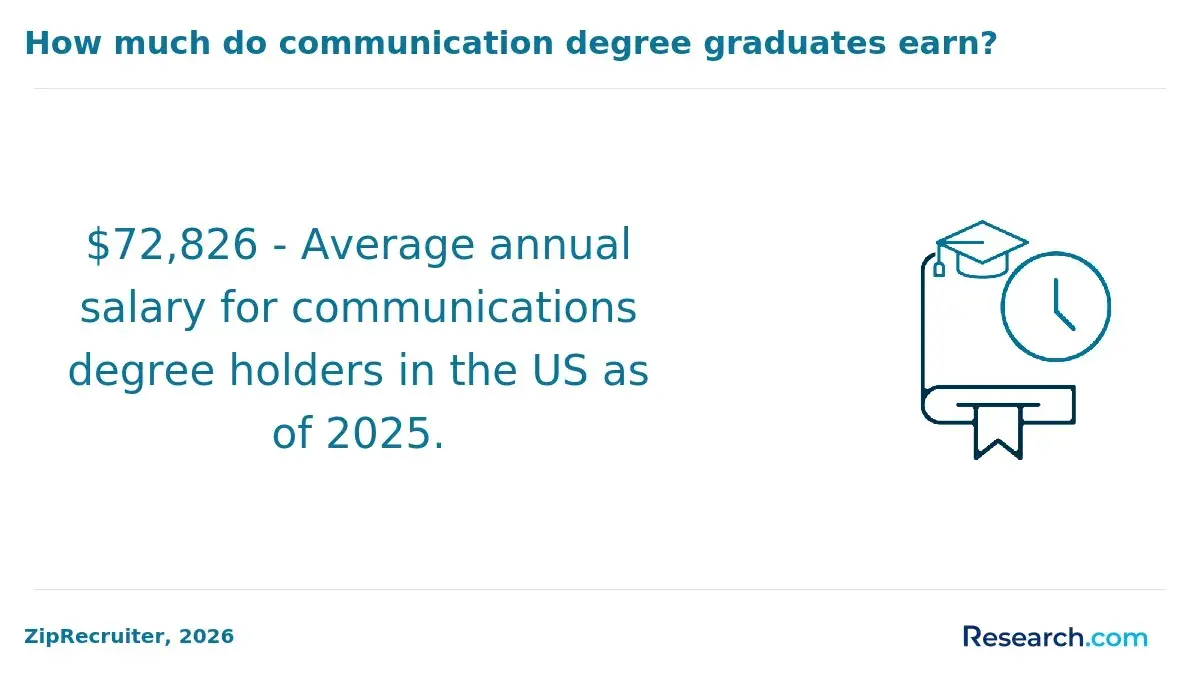
- Salary figures should be interpreted carefully. The median annual wage for communications degree holders is approximately $60,000, while the Key Findings data reports $72,826 in 2025, and specialized roles such as technical writers report $80,050.
- Program quality matters more than whether a degree is labeled easy. Check accreditation, transfer policies, internship support, portfolio requirements, faculty experience, and career services.
- Online communications degrees can be a strong option for self-directed students, but they are not automatically easier. They require time management, consistent writing, and active participation.
- The most employable graduates usually combine communication fundamentals with a practical specialty, such as digital media, PR writing, social media strategy, technical writing, analytics, or internal communication.
Key Findings
- The median annual wage for communications degree holders in the US was $72,826 in 2025.
- Over 3 million people (3,007,870) in the US workforce hold a communications degree.
- The most common communications degree specialization is "Communications" (56%), followed by "Journalism" (18%) and "Mass Media" (16%).
- Communications degree holders are most employed in management (22%) and business and financial operations (13%) occupations.
- Top-employing roles for communications graduates include marketing managers, human resource specialists, and producers, each representing 8% of the workforce.
References:
- Bureau of Labor Statistics. (2024). Field of degree: Communications. Retrieved January 8, 2025, from BLS.
- Coursera. (2024, September 5). What can you do with a communications degree? 10 careers. Retrieved January 8, 2025, from Coursera.
- Data USA. (2025). Communications. Retrieved January 8, 2025, from Data USA.
- University of Illinois at Urbana-Champaign. (2025). Careers in communication. Retrieved January 8, 2025, from UOI.
- ZipRecruiter. (2026). Communications salary in the United States. https://www.ziprecruiter.com/Salaries/Communications-Salary
Other Things You Should Know About The Easiest Communications Degree Programs
Many communications programs accept up to 60 semester credits from regionally accredited colleges. Some also grant credit for CLEP exams, military training, or prior learning assessments, but they usually require at least 30 credits to be completed at the degree-granting school.
Yes, many of the easiest Communications Degree Programs in 2027 offer part-time study options. This allows students to balance their studies with other commitments. Program duration may be extended, typically taking around five to six years to complete at a part-time pace.


