
2027 History Degree Guide: Costs, Requirements & Job Opportunities

Co-Founder and Chief Data Scientist
Choosing a history degree is really a decision about how you want to use research, evidence, writing, and interpretation in your career. History majors study how societies change over time, but the degree is not limited to teaching or museum work. It can also prepare students for roles in government, law, archives, journalism, policy, nonprofit work, business, and graduate study. This guide explains what a history degree includes, how long it takes, what it costs, which programs stand out, and how to judge whether the degree fits your goals.
Quick answer: Is a history degree worth considering?
- A history degree can be a strong fit for students who enjoy reading deeply, evaluating evidence, writing clearly, and connecting past events to present-day issues.
- The median income for history majors is $74,050, but actual earnings depend heavily on role, degree level, location, and experience.
- Most online history bachelor's degree programs include 120 credits, taking full-time students about four years to complete.
- Employment of historians is expected to grow by about 300 openings annually by 2034, so students should also consider adjacent careers that use historical research and communication skills.
What can I expect from a history degree?
A history degree teaches students how to investigate the past using primary sources, scholarly research, archival materials, oral histories, maps, artifacts, and statistical records. Students learn not only what happened, but also how historians build evidence-based explanations about why events happened and how they affected different groups.
The degree is usually reading- and writing-intensive. Expect long-form research papers, document analysis, class discussions, presentations, and courses organized by period, region, theme, or method. Common academic areas include world history, U.S. history, ancient history, modern history, military history, public history, gender history, political history, and digital humanities.
| What history students study | Why it matters for careers |
| Primary and secondary source analysis | Builds evidence evaluation skills useful in research, law, policy, journalism, and archives. |
| Historical writing and argumentation | Develops clear, persuasive communication for reports, briefs, articles, and public-facing content. |
| Comparative and global perspectives | Helps graduates understand institutions, cultures, conflicts, and social change across contexts. |
| Research methods | Prepares students to locate, organize, verify, and synthesize complex information. |
| Public history or digital tools | Can support work in museums, cultural organizations, digital archives, and education technology. |
Where can I work with a history degree?
History graduates can work in more places than many students expect. Some pursue traditional history-related roles in schools, archives, museums, libraries, historical societies, government agencies, preservation offices, or research organizations. Others use their training in evidence, writing, and context to enter law, communications, public policy, consulting, publishing, nonprofit advocacy, business research, or media.
The best career path usually depends on whether you stop at the associate, bachelor’s, master’s, or doctoral level. For example, a bachelor’s degree may support entry-level roles in research support, communications, education services, or administration, while many archivist, curator, faculty, and advanced research roles often require graduate education or specialized experience.
How much can I make with a history degree?
History-related earnings vary widely because graduates enter many different occupations. The median income for history majors is $74,050 per year. Social science research assistants can earn up to $58,040. These figures should be treated as reference points rather than guarantees, since salary depends on job title, employer, region, experience, graduate education, and whether the role is in academia, government, nonprofit work, or the private sector.
| Role or outcome | Income figure cited | What to consider |
| History majors | $74,050 median income | Reflects broad outcomes across many career paths, not one specific job. |
| Social science research assistants | Up to $58,040 | May be a practical entry point for graduates with strong research and data skills. |
| Curators | $61,770 median annual wage | Often tied to museums, cultural institutions, collections, and public history work. |
| Historians | Around $74,050 median annual wage | Advanced research roles may require a master’s or doctoral degree. |
- Best History Degree Programs for 2027
- What skills do you gain from a history degree?
- How long does it take to complete a history program?
- How does an online history program compare to an on-campus program?
- What is the average cost of a history program?
- What are the financial aid options for students enrolling in a history program?
- What are the prerequisites for enrolling in a history program?
- What courses are typically in a history program?
- What types of specializations are available in a history program?
- How to choose the best history program?
- How can internships and experiential learning enhance a history degree?
- What emerging trends are transforming history education?
- Is a remote PhD in History a viable option for advanced research?
- What career paths are available for graduates of a history program?
- Is a history degree a smart investment?
- Are there affordable online history programs to start your academic journey?
- Is an online associate degree in history a viable foundation for career and academic growth?
- Can supplemental certifications enhance career prospects for history graduates?
- What is the job market for graduates with a history degree?
- How can digital tools and technologies enhance history research and learning?
- What are the challenges of earning an online history degree?
- Can accelerated college programs expedite a history degree?
- How does pursuing a history degree impact critical thinking and problem-solving skills?
Best History Degree Programs for 2027
Research.com reviewed current public datasets from recognized education sources to identify history programs with strong academic quality, accessibility, cost considerations, and accreditation. The review also considered curriculum design, available concentrations, and the broader benefits students may gain from completing a history degree.
How do we rank schools?
Because history programs differ by degree level, faculty expertise, research opportunities, delivery format, and cost, comparing schools can be difficult. Research.com uses a validated ranking approach designed to help prospective students evaluate programs more clearly and make better-informed academic decisions.
- Integrated Postsecondary Education Data System (IPEDS database)
- Peterson’s database, including their Distance Learning Licensed Data Set
- College Scorecard database
- National Center for Education Statistics
1. Columbia University
Columbia University offers a history program shaped by international study, faculty diversity, and advanced research opportunities. Students interested in global historical analysis can pursue the dual MA/MSc degree in International and World History with the London School of Economics. Columbia also offers an M.A. in History and Literature at Reid Hall, its Paris campus, giving students the opportunity to study historical questions across cultural and geographic settings.
- Program Length: 2 years
- Program Level: Master’s Degree
- Tracks/concentrations: International and World History
- Estimated Cost per Credit: $3,262
- Required Credits to Graduate: 34
- Accreditation: Middle States Commission on Higher Education
2. Stanford University
The history major at Stanford University gives undergraduates access to a selective academic environment where faculty interaction and independent inquiry are central to the learning experience. Students can build research skills while exploring historical questions through close mentorship and rigorous coursework.
- Program Length: 4 years
- Program Level: Bachelor’s Degree
- Tracks/concentrations: World History
- Estimated Cost per Credit: $1,372
- Required Credits to Graduate: 63
- Accreditation: North Central Association of Colleges and Schools (NCA)
3. Massachusetts Institute of Technology
The history major at Massachusetts Institute of Technology emphasizes critical inquiry, historical interpretation, and an understanding of how past societies inform the present. Students work with written texts, images, audio sources, lectures, and discussions to examine human experience across time while sharpening analytical and interpretive skills.
- Program Length: 4 years
- Program Level: Bachelor’s Degree
- Tracks/concentrations: History
- Estimated Cost per Credit: $2,489
- Required Credits to Graduate: 180
- Accreditation: New England Commission of Higher Education
4. University of Chicago
The history program at the University of Chicago allows students to choose among the Thesis Track, Capstone Track, and Colloquium Track. The Thesis Track centers on original scholarship, the Capstone Track supports projects such as documentaries, podcasts, or art installations, and the Colloquium Track provides additional room for elective exploration without a final project requirement.
- Program Length: 4 years
- Program Level: Bachelor’s Degree
- Tracks/concentrations: History
- Estimated Cost per Credit: $1,320
- Required Credits to Graduate: 42
- Accreditation: North Central Association of Colleges and Schools (NCA)
5. University of California-Berkeley
The history program at the University of California, Berkeley combines curricular flexibility, faculty expertise, and opportunities for original research. Students can participate in small seminars with less than fifteen students, giving them a setting where discussion, close reading, and research development are emphasized.
- Program Length: 5 years
- Program Level: Ph.D.
- Tracks/concentrations: History
- Estimated Cost per Credit: $538
- Required Credits to Graduate: 34
- Accreditation: Western Association of Schools and Colleges (WASC)
6. Princeton University
Princeton University offers a flexible history curriculum that lets students pursue areas such as Knowledge & Belief, Power & Conflict, Pre-Modern (pre-1700), and Race & Difference. The department also supports seniors who travel for archival research, helping students connect classroom learning with original historical investigation.
- Program Length: 5 years
- Program Level: Ph.D.
- Tracks/concentrations: History
- Estimated Cost per Credit: $4,533
- Required Credits to Graduate: 36
- Accreditation: Middle States Commission on Higher Education
7. Duke University
The history major at Duke University is built to help students understand history as a discipline while strengthening analytical thinking and written communication. The curriculum includes an area of concentration, a Gateway Seminar, and a Capstone Seminar, giving students both structure and room for focused inquiry.
- Program Length: 4 years
- Program Level: Bachelor’s Degree
- Tracks/concentrations: History
- Estimated Cost per Credit: $2,115
- Required Credits to Graduate: 120
- Accreditation: Southern Association of Colleges and Schools Commission on Colleges (SACSCOC)
8. University of Pennsylvania
The University of Pennsylvania offers a bachelor’s degree in history that covers political and cultural developments across regions from the early medieval period to the present. Students build knowledge of specific times, places, and historical problems while learning to analyze continuity and change. Independent research opportunities include junior papers and a senior thesis.
- Program Length: 4 years
- Program Level: Bachelor’s Degree
- Tracks/concentrations: Ancient History
- Estimated Cost per Credit: $3,748
- Required Credits to Graduate: 32
- Accreditation: Middle States Commission on Higher Education (MSCHE)
9. University of Michigan
The history major at the University of Michigan gives students wide flexibility to study historical themes, places, and periods that match their interests. Faculty mentoring helps students shape a coherent course plan around a chosen focus area while maintaining breadth across the discipline.
- Program Length: 4 years
- Program Level: Bachelor’s Degree
- Tracks/concentrations: History
- Estimated Cost per Credit: $1,440
- Required Credits to Graduate: 30
- Accreditation: Higher Learning Commission of North Central Association of Colleges and Schools
10. Cornell University
Cornell University offers a Ph.D. in History centered on advanced research, original interpretation, and close faculty guidance. Students benefit from interdisciplinary study, independent research opportunities, and the university’s committee system, which allows doctoral candidates to shape a scholarly path across fields and methods.
- Program Length: 5 years
- Program Level: Ph.D
- Tracks/concentrations: History (Ithaca)
- Estimated Cost per Credit: $2,066
- Required Credits to Graduate: 7 graduate-level seminars
- Accreditation: Middle States Commission on Higher Education
What graduates say a history degree helped them do
“History taught me to connect evidence, context, and human behavior instead of memorizing isolated facts. The research habits I built now help me understand audiences and plan stronger marketing strategies.” -Mary
“Studying historical injustice changed how I understood civic responsibility. It pushed me toward community work and helped me see how education, policy, and access shape people’s lives.” -David
“People questioned whether history was practical, but the degree strengthened my writing, analysis, and argument skills. Those abilities helped during my law firm internship and continue to support my work as a paralegal.” -Emily
Key Findings
- Job growth for historians is expected to be a modest 2.2% through 2034.
- Curators have a median annual wage of $61,770.
- The average cost of an undergraduate history education degree falls under $30,000 for in-state students.
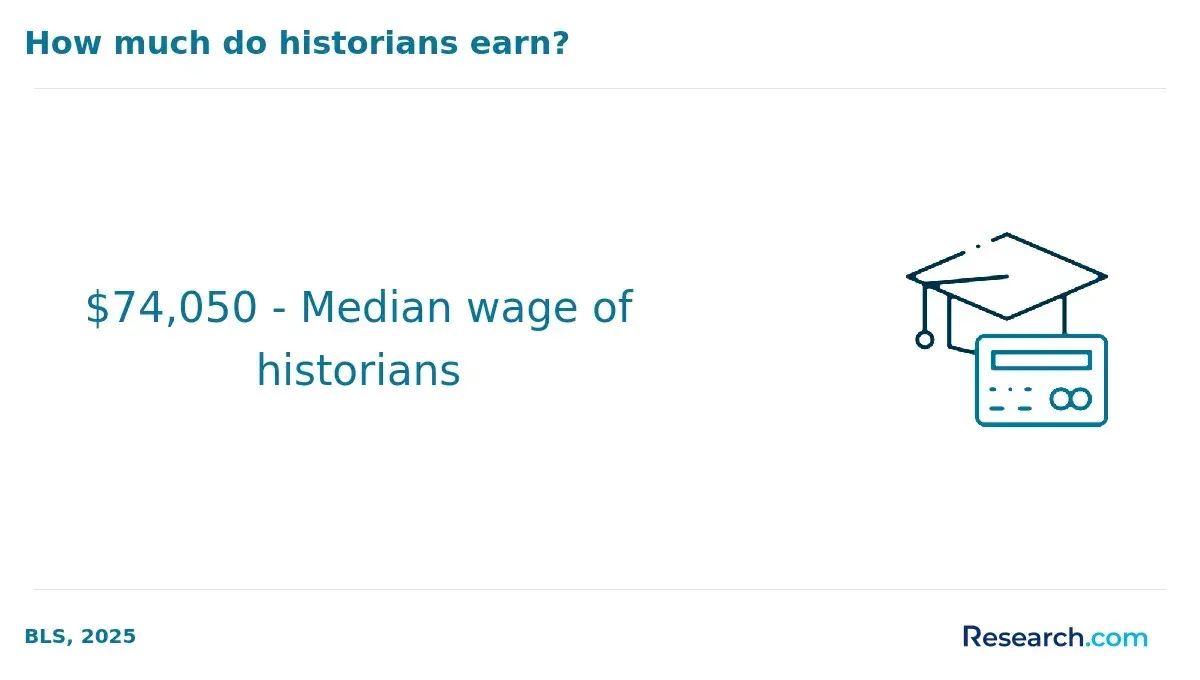
- The median annual wage of historians is around $74,050.
- A Doctor of Philosophy in History degree program generally takes five to nine years to complete.
What skills do you gain from a history degree?
A history degree is valuable because it builds transferable skills that employers often need but that are not tied to only one occupation. Students learn to find credible evidence, interpret incomplete information, write for different audiences, and explain complex developments clearly.
- Research and analytical skills: History majors learn to locate primary and secondary sources, compare viewpoints, identify bias, and build interpretations from evidence.
- Critical thinking: Students practice questioning assumptions, testing arguments, and explaining cause and effect without oversimplifying complex events.
- Written and oral communication: Research papers, presentations, seminars, and class debates help students explain ideas with structure, clarity, and support.
- Attention to detail: Historical work requires careful reading of documents, dates, terminology, context, and source origins.
- Time management: Large research assignments train students to plan reading, note-taking, drafting, revision, and citation work across long deadlines.
How long does it take to complete a history program?
The time required to finish a degree program in history depends on the credential, enrollment status, transfer credits, thesis or dissertation requirements, and whether the student adds another major, minor, or certificate.
| Degree level | Average time to complete | Best for |
| Associate’s Degree in History | 2 years | Students seeking a lower-cost start before transfer or entry-level work requiring general college preparation. |
| Bachelor’s Degree in History | 4 years | Students preparing for broad career options, graduate school, teaching pathways, public history, or research support roles. |
| Master’s Degree in History | 2 years | Students seeking advanced research training, public history work, archival roles, teaching advancement, or doctoral preparation. |
| Doctoral Degree in History | 5 to 9 years | Students pursuing original scholarship, university teaching, advanced research, or specialized academic careers. |
Associate’s Degree in History
Average time to complete: 2 years
An Associate of Arts (A.A.) in History typically introduces students to world civilizations, U.S. history, historical interpretation, and basic research methods. Students learn how cultural, economic, political, and religious forces shape people, institutions, and events. Many students use this degree as a transfer pathway into a bachelor’s program.
Bachelor’s Degree in History
Average time to complete: 4 years
At the bachelor’s level, students may pursue a Bachelor of Arts (B.A.) in History or a Bachelor of Science (B.S.) in History. The B.A. is usually rooted in the humanities and liberal arts, while the B.S. may include a more science-oriented approach to analyzing the past and may be recommended by some universities for pre-medical students.
Master’s Degree in History
Average time to complete: 2 years
A Master of Arts in History provides deeper training in historical methods, historiography, research design, and specialized subject areas. Students are expected to work extensively with primary and secondary sources and produce sophisticated written analysis based on multiple bodies of evidence.
Doctoral Degree in History
Average time to complete: 5 to 9 years
A Doctor of Philosophy in History prepares students to conduct original research and contribute new scholarship to the field. Doctoral study involves intensive reading, theory, methodology, language preparation when needed, archival work, comprehensive exams, and a dissertation.
How does an online history program compare to an on-campus program?
Online history programs can offer the same core academic content as campus programs, especially when they are regionally accredited and taught by qualified faculty. The main difference is how students interact with instructors, classmates, libraries, archives, and experiential opportunities. Online study can be ideal for working adults, transfer students, military learners, caregivers, or students who need geographic flexibility. Campus study may be better for students who want frequent in-person seminars, direct access to physical archives, museum placements, or face-to-face faculty mentoring.
| Factor | Online history program | On-campus history program |
| Flexibility | Often easier to balance with work or family responsibilities. | Typically follows set class times and campus schedules. |
| Class interaction | Uses discussion boards, video meetings, and digital collaboration tools. | Offers live seminars, informal faculty access, and in-person peer discussion. |
| Research access | Strong programs provide digital databases and remote library support. | May offer easier use of physical collections, archives, and special exhibits. |
| Experiential learning | May require students to arrange local internships or virtual projects. | May have established partnerships with nearby museums, archives, and historical sites. |
| Best fit | Self-directed students who need schedule and location flexibility. | Students who learn best through face-to-face discussion and campus resources. |
What is the average cost of a history program?
Cost depends on degree level, school type, residency status, delivery format, fees, transfer credits, and financial aid. On average, a bachelor’s degree costs $11,950, and the average total tuition cost sits at $21,340 in-state, according to the College Board (2025). An associate degree’s average tuition is less than half of that of a bachelor’s degree at $4,150. Students who want a lower-cost first step can review what is an associate degree before committing to a four-year pathway.
Graduate history programs generally cost more than undergraduate options, especially when students pursue master’s or doctoral study at private institutions. However, cost should be evaluated alongside funding, assistantships, expected career path, transfer credit policies, and whether a graduate degree is actually required for the roles you want.
What are the financial aid options for students enrolling in a history program?
History students can use many of the same financial aid options available to other college students. The best strategy is to start with federal aid, then compare institutional scholarships, state programs, humanities awards, work-study, and loans only after lower-cost funding has been explored.
- Free Application for Federal Student Aid (FAFSA): The FAFSA is the starting point for federal grants, federal loans, and many institutional aid decisions.
- National and state-specific scholarships: Some scholarships support history majors, future educators, humanities students, public service candidates, or students studying specific regions or cultures.
- Work-study programs: Eligible students may work part time through approved jobs to help pay for education-related expenses.
- Private loans: Private loans can fill funding gaps, but they often carry different interest rates and borrower protections than federal loans, so students should compare terms carefully.
What are the prerequisites for enrolling in a history program?
Admission requirements vary by degree level and institution. Undergraduate programs usually require a high school diploma or equivalent, transcripts, and general college admissions materials. Graduate programs typically expect a bachelor’s degree, writing samples, recommendations, a statement of purpose, and evidence of research readiness.
- General education requirements: Most undergraduate students complete foundational coursework in English, mathematics, science, social sciences, and humanities.
- High school GPA and standardized tests: Some schools review GPA and may request SAT or ACT scores, although test policies vary by institution.
- High school history courses: Courses such as World History or United States History can show preparation for college-level historical study.
- Foreign language requirements: Some programs, especially master’s and Ph.D. programs, may expect language proficiency when students work with sources outside English.
What courses are typically in a history program?
History curricula vary, but most programs combine broad survey courses, specialized electives, research methods, writing-intensive seminars, and sometimes a capstone, thesis, or portfolio. Students should always review the catalog for the exact requirements of a specific school.
- Western Civilization: Covers major developments in the Western world, often from ancient Greece and Rome through modern periods.
- World History: Examines civilizations, regions, exchanges, conflicts, and global connections across time.
- Historiography and Historical Methods: Introduces how historians ask questions, evaluate sources, use evidence, and write scholarly arguments.
- Language Courses: Foreign language study may support research in original sources and can be especially important for graduate study.
What types of specializations are available in a history program?
Many history departments allow students to concentrate in a period, region, theme, or methodology. The right specialization depends on your research interests, faculty expertise, career goals, and whether you plan to pursue graduate school or public history work.
- Ancient History: Focuses on early civilizations such as Greece, Rome, Egypt, Mesoamerica, and China.
- Medieval History: Studies the Middle Ages, including Christianity, feudalism, the Crusades, Islamic societies, and developments in East Asia.
- Modern History: Explores the Renaissance through the present, often including revolution, industrialization, imperialism, decolonization, and modern political change.
How to choose the best history program?
The best history program is the one that matches your academic interests, budget, delivery needs, and career plans. A prestigious name can help in some contexts, but it should not be the only factor. Students should compare accreditation, faculty expertise, curriculum structure, cost, research access, internship options, graduate outcomes, and flexibility.
Available Specializations
History courses often reflect the research strengths of a department’s faculty. If you want to study a specific period, region, or topic, review faculty publications, course rotations, seminar offerings, and thesis supervision areas before applying.
Accreditation
Accreditation helps confirm that an institution meets recognized standards for higher education quality. Before enrolling, verify the school’s accreditation status and confirm that credits are likely to transfer if you may change schools later. Students considering distance learning can also review these online education statistics to better understand the online education landscape.
Student-Teacher Ratio
Lower student-to-teacher ratios can mean more opportunities for feedback, mentoring, and discussion. This matters in history because writing, research design, and source interpretation often improve through close faculty guidance.
Financial Aid Options
Cost should be evaluated after aid, not just by listed tuition. Public institutions often provide state and federal aid options, while private scholarships such as the Islamic Scholarship Fund (ISF) and the Neil Martin Carman Scholarship may support qualifying students. You can also examine broader trends in free college education in the United States.
| Question to ask before enrolling | Why it matters |
| Is the institution accredited? | Accreditation affects transfer credit, financial aid eligibility, and employer recognition. |
| Does the department offer my area of interest? | A program is stronger for you when faculty and courses match your goals. |
| Are internships, archives, or museum partnerships available? | Experience can help translate academic training into employment options. |
| What is the total cost after aid? | Fees, books, travel, and lost work time can change the true price of a degree. |
| Does the program support career planning? | History majors benefit from early planning around internships, portfolios, graduate school, or alternative careers. |
How can internships and experiential learning enhance a history degree?
Internships help history students turn academic skills into visible work experience. Placements in archives, museums, cultural institutions, historical societies, government agencies, libraries, and nonprofits can build practical skills in collections work, exhibit planning, public programming, research assistance, preservation, and digital documentation. Students comparing cost-conscious bachelor’s options can also review the cheapest online college bachelor degree programs as part of a broader affordability search.
What emerging trends are transforming history education?
History education is increasingly shaped by digital humanities, interdisciplinary research, online archives, public-facing scholarship, and new forms of historical storytelling. Students may now work with digitized newspapers, GIS mapping, oral history platforms, podcasting, data visualization, and collaborative research tools. Some institutions also offer accelerated degree programs for students who want a condensed timeline, though faster formats require strong organization and consistent study time.
Is a remote PhD in History a viable option for advanced research?
A remote doctoral path in history may work for highly independent researchers who have access to digital archives, remote advising, and a clear dissertation plan. However, students should be careful: doctoral work often depends on archival travel, language preparation, teaching opportunities, funding, and close faculty mentorship. Before applying, ask how the program supports remote research, dissertation supervision, academic networking, and career placement. Students exploring flexible doctoral options can review this guide to remote PhD programs.
What career paths are available for graduates of a history program?
History graduates can pursue careers inside and outside academia. Some become teachers, professors, researchers, curators, archivists, or library science professionals. Others work for government agencies, nonprofits, think tanks, private companies, media organizations, law offices, consulting firms, or cultural institutions.
- Historian: Historians investigate, interpret, and explain the past using documents, artifacts, oral accounts, and other evidence. They may collaborate with archaeologists, forensic science professionals, anthropologists, and other researchers. The median annual wage of historians is around $74,050.
- Librarian: Librarians manage print and digital collections, support research, and help users locate credible information. They work in schools, government agencies, universities, and private organizations. The median pay is $64,320.
- Researcher: Research assistants and analysts collect, organize, verify, and interpret information. This path can fit history graduates who enjoy evidence gathering, pattern recognition, and written reporting.
- Journalist: Historical training can support journalism because both fields require fact-checking, context, interviewing, source evaluation, and clear explanation for public audiences.
- Archivist, Curator, and Museum Worker: These professionals preserve, organize, interpret, and present collections of historical objects, documents, artwork, and cultural materials. They may work for museums, historical sites, schools, government agencies, corporations, or nonprofits. Curators have a median annual wage of $57,100.
Is a history degree a smart investment?
A history degree can be a smart investment when students intentionally connect the degree to a career plan. The return is strongest when students build marketable experience through internships, research projects, writing samples, digital tools, teaching preparation, or a graduate pathway that aligns with their target role. It may be a weaker choice for students who want a direct technical credential with a clearly defined occupation immediately after graduation. Students focused on speed and earnings may also want to compare alternatives such as fast degrees that pay well.
Are there affordable online history programs to start your academic journey?
Affordable online history programs can be a practical starting point for students who need flexibility and want to reduce upfront costs. An online associate degree may help students complete general education requirements, develop foundational research skills, and later transfer into a bachelor’s program. To compare lower-cost options, review colleges with the most affordable online associate's degrees.
Is an online associate degree in history a viable foundation for career and academic growth?
An online associate degree in history can provide a useful academic foundation, especially for students planning to transfer to a four-year program. It introduces core historical thinking, writing, and research skills while allowing students to test their interest before committing to a bachelor’s degree. Students seeking a shortened pathway can compare programs such as a top 6 month associate degree online, but they should verify accreditation, transferability, workload, and whether the accelerated format is realistic.
Can supplemental certifications enhance career prospects for history graduates?
Certifications can help history graduates show applied skills beyond the degree. Useful add-ons may include digital archiving, data analysis, geographic information systems, museum studies, project management, grant writing, technical communication, or education technology. The best certification depends on the target career, not on prestige alone. Students comparing options can review top paying certifications to understand how credentials may complement a humanities background.
What is the job market for graduates with a history degree?
The job market for history graduates is broad but competitive. Job growth for historians is expected to be a modest 2.2% through 2034, so students should not assume that the degree alone will lead to a traditional historian role. A stronger strategy is to pair historical training with internships, digital research tools, writing samples, language skills, policy knowledge, teaching preparation, or graduate study when required.
According to the Bureau of Labor and Statistics, the industries with the highest employment for historians are the federal government, local government, professional, scientific, and technical services, and state government. Students interested in economic history or policy research may also find connections with fields such as economics.
How can digital tools and technologies enhance history research and learning?
Digital tools have changed how students and historians find sources, organize evidence, present arguments, and collaborate. While physical archives remain important, many projects now begin with digitized collections, online catalogs, mapping tools, citation managers, and collaborative platforms.
1. Digital Archives and Databases
Digitized archives make letters, maps, newspapers, photographs, government records, and artifacts easier to access from different locations. This can expand research possibilities, especially for online students or researchers who cannot travel frequently.
2. Online Collaboration Platforms
Tools such as Google Scholar, Zotero, and Mendeley help students find scholarship, manage citations, organize sources, and collaborate on research projects. These tools are especially useful for long papers, theses, and group assignments.
3. Virtual Reality (VR) and Augmented Reality (AR)
VR and AR can help instructors recreate historical places, objects, or events in immersive formats. These technologies should supplement, not replace, source-based analysis, but they can make historical learning more interactive.
4. Data Analysis and Visualization Tools
GIS, digital mapping, and visualization platforms can help students examine migration, land use, conflict, trade, demographic shifts, and other spatial or quantitative patterns that are difficult to see in narrative sources alone.
What are the challenges of earning an online history degree?
An online format can make a history degree more accessible, but it also requires strong self-direction. Choosing accredited online history degree programs with good library access, faculty support, and internship guidance can reduce some of the common problems.
- Self-discipline and time management: Online students must keep up with reading, discussions, research, and writing without the structure of regular in-person meetings.
- Limited face-to-face interaction: Students who learn best through live seminars and informal faculty conversations may miss the campus environment.
- Access to resources and networking: Physical archives, museum collections, and campus events may be harder to use unless the program offers strong remote support or local placement options.
- Technical challenges: Reliable internet access, comfort with learning platforms, and basic digital research skills are essential.
- Limited hands-on experience: Online students may need to be proactive in finding local internships, archival work, or public history projects.
- Potential for isolation: Remote study can feel disconnected, so students should seek faculty office hours, peer groups, professional associations, and virtual events.
Can accelerated college programs expedite a history degree?
Accelerated programs can shorten the time to completion for motivated students who can handle condensed courses and steady reading and writing deadlines. They may be useful for transfer students, working adults, or students who already have credits. However, history courses often require deep reading and careful writing, so faster does not always mean easier. Students considering accelerated college programs should ask about weekly workload, transfer credit limits, course availability, and whether the pace leaves enough time for internships or research projects.
How does pursuing a history degree impact critical thinking and problem-solving skills?
A history degree strengthens critical thinking by requiring students to evaluate evidence, compare interpretations, identify patterns, and explain complex events without reducing them to simple answers. Students learn that historical questions often involve incomplete sources, conflicting viewpoints, and multiple causes.
Research papers, seminars, debates, and source analyses train students to build arguments, recognize weak evidence, and revise conclusions when new information appears. These habits are useful in law, business, public policy, journalism, education, and management because many professional problems also require judgment under uncertainty.
History also develops problem-solving skills by asking students to synthesize information from different types of evidence. Instead of looking for one fixed answer, students learn to weigh competing explanations and defend the most convincing interpretation.
Students who want a lower-cost way to build these skills can compare cheapest online history degree programs, while still checking accreditation, faculty access, transfer policies, and career support.
Common mistakes to avoid when choosing a history degree
- Choosing only by school name: A famous university is not always the best fit if it lacks your preferred specialization or costs more than you can reasonably afford.
- Ignoring accreditation: Accreditation can affect financial aid, graduate admissions, credit transfer, and employer recognition.
- Assuming the degree automatically leads to a historian job: Traditional historian roles are limited, so students should prepare for adjacent careers as well.
- Overlooking internships: Experience in archives, museums, research offices, nonprofits, or media can make a major difference after graduation.
- Focusing only on tuition: Fees, books, travel, technology, housing, and lost work time can change the real cost.
- Failing to build digital skills: Digital archives, citation tools, mapping, data visualization, and content platforms can make graduates more versatile.
Key Insights
- A history degree is strongest when paired with a plan: Students should connect coursework to internships, writing samples, digital tools, graduate school goals, or a specific career field.
- The degree builds transferable skills: Research, analysis, writing, source evaluation, and argumentation are useful in education, law, government, archives, journalism, nonprofits, and business.
- Career outcomes vary by degree level: Associate and bachelor’s degrees can support entry-level and transfer pathways, while many advanced research, archival, curatorial, and academic roles may require graduate study.
- Cost and accreditation matter: Compare total cost after aid, transfer policies, and institutional accreditation before enrolling, especially in online or accelerated programs.
- The job market is competitive: Historian job growth is expected to be a modest 2.2% through 2034, so students should prepare for both traditional and adjacent roles.
- Online history degrees can work well for independent learners: The best programs provide strong faculty support, digital library access, research guidance, and opportunities for practical experience.
- Digital humanities skills are increasingly valuable: Experience with digital archives, GIS, citation tools, visualization, and public-facing research can help graduates stand out.
References:
- Ma, J., Pender, M., & Hu, X. (2025). Trends in College Pricing and Student Aid 2025. College Board. https://research.collegeboard.org/media/pdf/Trends-in-College-Pricing-and-Student-Aid-2025-final_1.pdf
- U.S. Bureau of Labor Statistics. (2025, August 28). Historians, Occupational Outlook Handbook. Retrieved March 2026, from https://www.bls.gov/ooh/life-physical-and-social-science/historians.htm
- U.S. Bureau of Labor Statistics. (2025, August 28). Occupational projections, 2024–2034, and worker characteristics. Retrieved March 2026, from https://www.bls.gov/emp/tables/occupational-projections-and-characteristics.htm
Other Things You Should Know About the History Degrees
Application deadlines for history degree programs in 2027 vary by institution, but many fall between January and March for fall semester admissions. It's crucial to check with specific universities for exact dates to ensure all required materials are submitted on time.
To choose the best history program, consider the program's faculty expertise, available specializations, internship opportunities, and alumni success. Evaluate the curriculum to ensure it aligns with your career goals and interests. Additionally, assess campus facilities and resources to enhance your educational experience.
In 2027, prerequisites for a history program generally include a high school diploma or equivalent. Additionally, some programs may require coursework in social sciences, literature, or advanced placement history for admission. These requirements vary by institution, so it's essential to check specific college guidelines.
The cost varies by degree level and institution. On average, a bachelor’s degree costs $11,950, and the average total tuition cost sits at $21,340 in-state, according to the College Board. Graduate degrees for history tend to cost higher.
The duration depends on the degree level: an associate degree typically takes two years, a bachelor's degree four years, a master's degree two years, and a doctoral degree five to nine years.
Analytical thinking and research skills are essential for success in a history degree program. History students should be proficient in evaluating sources, constructing arguments, and clearly communicating findings. Developing writing and critical thinking skills is also crucial, as these are regularly employed in coursework and research projects.
Common courses include Western Civilization, World History, Historiography and Historical Methods, and various regional and thematic history courses. Language courses may also be required or recommended.
Career paths include roles as historians, archivists, museum educators, historic preservation specialists, researchers, journalists, librarians, and educators. History graduates can also find opportunities in government agencies, non-profits, and private companies.


