
2027 What Can You Do With an English Bachelor’s Degree?

Co-Founder and Chief Data Scientist
An English bachelor’s degree can lead to more careers than teaching or publishing, but the path is rarely automatic. Employers may value the writing, research, interpretation, and communication skills English majors develop, yet graduates still need to connect those strengths to specific roles, portfolios, internships, certifications, and industry expectations. That is where many students and career changers get stuck.
This guide explains what you can do with an English bachelor’s degree, how the degree is structured, which skills employers tend to value, and when additional education or certificates may be worth considering. It is designed for prospective English majors, current students, recent graduates, and working adults who want a clearer plan for turning an English background into practical career options.
Quick answer: Is an English bachelor’s degree useful for 2027?
Yes, an English bachelor’s degree can be useful when students pair it with career-focused experience, strong writing samples, digital communication skills, and a clear target industry. English graduates work in writing, editing, marketing, public relations, technical communication, education, legal support, nonprofit work, management, and other fields. In 2022, approximately 1,878,040 people with an English degree were employed, and the average annual pay for English degree jobs is $53,610. Outcomes vary widely by role, location, experience, portfolio quality, and additional credentials.
Key Things You Should Know About English Bachelor’s Degrees
- An English degree can support careers in content writing, marketing, editing, technical writing, public relations, UX writing, grant writing, SEO, social media, and paralegal work.
- Common salary examples include content writing at $84,151/year, marketing at $50,705/year, editing at $64,031/year, and technical writing at $81,001/year.
- The degree builds transferable strengths in written communication, close reading, research, analysis, persuasion, creativity, and audience awareness.
- Students may shape the degree around creative writing, literature, film and popular culture, rhetoric, professional writing, media writing, or secondary education.
- The degree has the strongest career value when students graduate with evidence of applied skill, such as internships, published work, technical documentation, campaign samples, editing projects, or teaching-related field experience.
- What jobs can you get with an English bachelor’s degree for 2027?
- What courses are usually included in an English bachelor’s degree?
- What English degree specializations should you consider?
- How long does an English bachelor’s degree take?
- What are the admission requirements for an English bachelor’s degree?
- What skills do English majors develop?
- How can an online EdD degree support long-term education careers?
- Which certifications can strengthen an English bachelor’s degree?
- Can creative writing studies improve career options for English majors?
- Can online creative writing courses add value to an English degree?
- Should you pursue a master’s degree after an English bachelor’s?
- Can library science expand career options for English graduates?
- Can an accelerated teaching degree help you move into education faster?
- How do you choose the right English bachelor’s degree program?
- Why do internships matter for English majors?
- Can a specialized online master’s degree diversify your career path?
- Can an online master’s in education support career growth? Review master’s degree decision factors
- What are the benefits of further study for English majors for 2027?
- How much can you earn with an English bachelor’s degree?
- What is the job outlook for English bachelor’s degree graduates?
What jobs can you get with an English bachelor’s degree for 2027?
English majors are often strongest in roles that require clear language, careful interpretation, persuasive messaging, research, editing, and the ability to adapt tone for different audiences. The best job target depends on whether you prefer creative work, business communication, technical explanation, education, legal support, or digital content strategy.
| Career path | What the role usually involves | Average salary | When this path makes sense |
| Content Writer | Writes articles, website copy, blog posts, email content, social media captions, and campaign materials, often with SEO and audience strategy in mind. | $84,151 /year | Best for graduates who enjoy drafting frequently, learning brand voice, researching unfamiliar topics, and building a public writing portfolio. |
| Marketing Associate | Supports campaigns, market research, promotional content, email marketing, reporting, and coordination between creative and business teams. | $50,705 /year | A good fit for English majors who want a business-facing role and are willing to learn analytics, customer research, and campaign tools. |
| Editor | Improves structure, clarity, accuracy, grammar, consistency, and style across articles, books, websites, reports, or organizational communications. | $64,031 /year | Works well for detail-oriented graduates who can give constructive feedback and protect both readability and author intent. |
| Technical Writer | Turns complex procedures, product features, policies, or technical concepts into manuals, guides, help-center articles, and documentation. | $81,001 /year | Strong option for English majors who are comfortable learning software, healthcare, engineering, or other technical subject matter. |
| Public Relations Specialist | Public relations specialists develop messages, write press materials, coordinate media outreach, and help organizations manage reputation. | $83,626 /year | Appropriate for graduates who write quickly, understand public audiences, and can communicate carefully under pressure. |
| UX Writer | Creates interface language for websites, apps, forms, buttons, error messages, onboarding flows, and digital product experiences. | $81,001 /year | Best for writers interested in product design, user behavior, plain language, and collaboration with designers and developers. |
| Grant Writer | Researches funding opportunities and prepares proposals for nonprofits, schools, public agencies, and mission-driven organizations. | $66,107 /year | Useful for graduates who enjoy persuasive writing, budgets, outcomes, research, and nonprofit or public-service work. |
| SEO Specialist | Improves website visibility through keyword research, content planning, optimization, performance review, and search-focused publishing strategy. | $67,388 /year | A practical route for English majors who want to combine writing, research, data, and digital marketing. |
| Social Media Manager | Plans platform-specific content, manages community engagement, tracks metrics, and helps organizations maintain a consistent digital presence. | $64,845 /year | Good for graduates who understand voice, audience, trends, and measurement. A social media marketing degree online may add more specialized training in platforms, analytics, and digital campaigns. |
| Paralegal | Conducts legal research, organizes case materials, drafts documents, and helps attorneys prepare contracts, briefs, and filings. | $59,731 /year | Suitable for English majors with strong reading precision, research discipline, and interest in law. An accelerated paralegal program may help graduates gain job-specific legal training more quickly. |
How to choose the right career direction
Do not choose a job title only because it appears on a list of “English major careers.” Instead, compare three things: the kind of writing you like doing, the industry you are willing to learn, and the proof employers expect. For example, technical writing usually requires documentation samples, UX writing benefits from product-copy samples, and marketing roles often require campaign or analytics experience.
What courses are usually included in an English bachelor’s degree?
English bachelor’s programs typically combine literature, composition, research, language study, and writing practice. The exact curriculum varies by institution, but most programs require students to read closely, write often, interpret texts, and produce evidence-based arguments.
- Introductory literature and composition: Early courses such as "Ways of Reading Literature" and "English Composition" introduce close reading, argument development, academic writing, and interpretation.
- Literary history and traditions: Students often study British, American, world, early, and contemporary literature to understand how texts reflect culture, politics, identity, and historical context.
- Writing, grammar, and rhetoric: Courses such as "Critical Writing Workshop," "Modern English Grammar," and "Professional Writing" help students write for different purposes and audiences.
- Electives and focused study: Depending on the program, students may choose classes in creative writing, linguistics, film, media, publishing, digital writing, or cultural studies.
- Capstone or senior seminar: Many programs end with a major paper, portfolio, thesis, or research project, often through a course such as "Senior Seminar."
Course planning tip
If your goal is employment immediately after graduation, balance literary and theory courses with applied writing classes. Professional writing, digital media, editing, technical writing, grant writing, and internship credits can make the degree easier to translate into a first job.
What English degree specializations should you consider?
Specializations help turn a broad English degree into a more focused academic and career plan. The right concentration should match both your interests and the type of work you want to pursue after graduation.
| Specialization | Primary focus | Potential career relevance |
| Creative Writing | Fiction, poetry, nonfiction, revision, workshop critique, and voice development. | Useful for authorship, content development, publishing, copywriting, screenwriting, and portfolio-based creative roles. |
| Literature, Film, and Popular Culture Studies | Analysis of literary texts, film, media, culture, genre, and representation. | Relevant for media criticism, education, cultural organizations, publishing, communications, and graduate study. |
| Writing, Rhetoric, and Literacy (WRL) | Writing theory, literacy practices, rhetoric, persuasion, and writing instruction. | Helpful for teaching, tutoring, writing program work, editing, communication, and professional writing. |
| Professional & Media Writing | Workplace writing, digital communication, media content, audience strategy, and editing. | Strong option for students targeting marketing, communications, content strategy, social media, or corporate writing. |
| Rhetoric & Writing | Persuasive language, argument, discourse, composition theory, and public communication. | Relevant for law, advocacy, public relations, policy communication, teaching, and graduate study. |
| English Pre-Education | English coursework combined with early preparation for teaching pathways. | Best for students considering middle school or high school teaching but still confirming licensure requirements. |
| English Secondary Education | English content knowledge, pedagogy, classroom preparation, and secondary teaching requirements. | Designed for students planning to become secondary school English teachers, subject to state requirements. |
How long does an English bachelor’s degree take?
A full-time student commonly completes an English bachelor’s degree in four years. The actual timeline can change if you study part time, bring transfer credits, switch majors, enroll online, take summer courses, or choose a program with accelerated scheduling.
Some online English degrees advertise shorter formats, and some programs allow students to finish in 16 months. Speed should not be the only deciding factor. Before choosing the fastest option, compare tuition, required fees, book costs, course intensity, transfer-credit rules, faculty access, academic support, and accreditation. If affordability is your top concern, a guide to the cheapest online English degree can help you compare cost alongside program quality.
| Enrollment choice | Potential advantage | Trade-off to review |
| Traditional full-time study | Predictable academic path with steady access to campus resources. | Less flexible for students working substantial hours or managing family responsibilities. |
| Part-time study | Allows students to balance school with work or caregiving. | Usually extends the time to graduation and may affect financial aid pacing. |
| Online study | Can offer flexible scheduling and access from home. | Requires self-direction, technology readiness, and careful review of student support services. |
| Accelerated study | May shorten the calendar time to completion. | Compressed courses can be demanding and may leave less time for internships or portfolio building. |
What are the admission requirements for an English bachelor’s degree?
Admission requirements differ by college and by whether you are applying as a first-year student, transfer student, or current student declaring the English major. Most English programs do not require a separate audition or portfolio at the undergraduate level, but some schools do ask for writing-related materials.
- Minimum GPA: Colleges may require applicants or internal major applicants to meet a specific grade point average.
- Prerequisite coursework: Some departments expect students to complete introductory writing, composition, or literature classes before entering the major.
- Formal major application: At some universities, students are admitted to the institution first and apply to the English major later. Materials may include a statement of purpose, writing sample, or recommendation letters.
- Transfer-credit policies: Schools may limit how many previously earned credits can count toward the English major, even if the credits count toward general graduation requirements.
- Class standing or credit-hour rules: Some programs require students to complete a certain number of credits before declaring or advancing in the major.
Questions to ask before applying
- Does the English major require a separate application after admission to the university?
- How many transfer credits can count toward major requirements?
- Are online students eligible for the same advising, writing center, library, and career services?
- Does the program offer internships, portfolio courses, or applied writing electives?
- If you plan to teach, does the program align with your state’s teacher preparation requirements?
What skills do English majors develop?
An English bachelor’s degree is valuable because it trains students to work with language, meaning, evidence, and audience. Those skills are useful in many fields, but graduates need to describe them in employer-friendly terms rather than relying only on broad phrases such as “good writer.”
| Skill | How the degree develops it | How to show it to employers |
| Written communication | Frequent essays, revisions, research papers, creative work, and professional writing assignments. | Writing samples, published clips, reports, web copy, newsletters, documentation, or portfolio projects. |
| Critical analysis | Close reading of complex texts and interpretation of language, structure, context, and argument. | Research memos, editorial analysis, policy summaries, annotated samples, or case studies. |
| Research and information literacy | Use of academic databases, source evaluation, citation practices, and evidence-based argument. | Research briefs, grant proposals, literature reviews, fact-checking work, or market research samples. |
| Editing and proofreading | Revision workshops, grammar study, peer review, and attention to style and clarity. | Before-and-after edits, style-guide work, copyediting tests, or publication experience. |
| Creativity | Creative writing, interpretive thinking, narrative structure, and original argument development. | Campaign concepts, creative portfolios, scripts, stories, brand voice samples, or content calendars. |
| Empathy and cultural literacy | Reading across periods, communities, identities, and traditions. | Audience analysis, inclusive communication samples, teaching materials, or community-facing projects. |
| Independence and adaptability | Long-term projects, varied genres, deadlines, and open-ended analytical assignments. | Capstone work, internship projects, freelance work, or examples of learning unfamiliar industries quickly. |
How can an online EdD degree enhance my career prospects?
An online EdD is not a typical next step for every English major, but it can make sense for graduates who move into education, curriculum work, training, school leadership, or academic administration. Doctoral-level education study can strengthen leadership, applied research, program evaluation, and policy skills. For professionals already working in education who need flexibility, online EdD programs may offer a more manageable format than a traditional campus-based schedule.
Which additional certifications can complement my English bachelor’s degree?
Certifications can help English graduates signal job-ready skills in areas that are not always covered deeply in a literature-focused curriculum. Useful options may include digital marketing, SEO, technical writing, project management, instructional design, editing, grant writing, or communication tools. The best certificate is one that matches a specific job target and produces a concrete portfolio artifact.
For English graduates considering a longer-term move into education leadership, accredited online EdD programs may be worth comparing after gaining relevant professional experience.
Could supplementing my English degree with creative writing studies enhance my career prospects?
Creative writing can strengthen an English major’s ability to shape voice, narrative, character, pacing, and emotional impact. That can be useful in publishing, advertising, content development, brand storytelling, entertainment media, and nonprofit communications. However, the career value depends heavily on the quality of the portfolio and the student’s ability to adapt creative techniques to professional contexts.
Students who want more structured creative training while maintaining schedule flexibility may compare a creative writing degree online with shorter certificate or workshop-based options.
Can online creative writing courses complement my English degree effectively?
Online creative writing courses can be useful when they provide serious feedback, regular deadlines, genre-specific practice, and portfolio development. They are less useful if they offer only passive lectures with little revision or critique. English majors considering fiction, poetry, screenwriting, copywriting, or narrative content roles should look for courses that require finished work and instructor or peer review.
To compare flexible options, review creative writing degrees online and focus on curriculum fit, faculty background, workshop format, and portfolio outcomes.
Should you pursue a master’s degree after an English bachelor’s?
A master’s degree can be valuable for some English graduates, but it is not automatically the best move. It is most useful when it is required for the career you want, gives you specialized training you cannot gain elsewhere, or helps you qualify for advancement. If your main goal is an entry-level writing, marketing, communications, or editing job, experience and portfolio strength may matter more than immediately starting graduate school.
Cost and time investment
A Master's degree generally costs between $44,640 and $71,140. School, major, and program length influence the final price. Before enrolling, compare the total cost with the likely career benefit in your target field. Include tuition, fees, books, lost work time, loan interest, and whether the degree is necessary for the job you want.
If cost is the deciding factor, compare public institutions, employer tuition support, scholarships, grants, payment plans, and flexible scheduling. A resource on a low-cost master's degree online can help you identify programs that may reduce the financial burden.
Personal and academic fit
Graduate school is more demanding and specialized than undergraduate study. It is a stronger choice if you are genuinely interested in advanced research, teaching, writing, literature, rhetoric, library science, education, speech-language study, or another defined field.
Job market alignment
Do not assume that a graduate degree guarantees higher earnings or easier employment. Some academic and publishing roles are highly competitive, while other fields reward applied experience, technical skills, or industry knowledge. Review job postings before applying. If employers ask for a portfolio, software skills, certifications, or work experience, a master’s degree alone may not solve the gap.
The chart below shows the average salary of an English major by industry:
Could enhancing my profile with library science boost my career prospects?
Library science can be a strong graduate-level direction for English majors who enjoy research, organization, information access, archives, digital resources, literacy, and public service. It can move an English background toward roles involving information management rather than only writing or literary analysis.
If this path interests you, compare library science master's programs online by curriculum, practicum requirements, technology training, accreditation considerations, and career placement support.
Can an accelerated teaching degree fast-track my career transition?
English graduates who want to teach should be careful: a degree in English alone may not meet teacher licensure requirements. Accelerated teaching programs may shorten the path into education, but students must verify curriculum, fieldwork, student teaching, accreditation, and state approval before enrolling.
To understand how compressed formats work, review how fast can you get a teaching degree online and compare timelines against your state’s requirements.
How do I choose the right English bachelor’s degree program?
The right English program is not simply the cheapest, fastest, or highest-ranked option. It should match your learning style, budget, transfer situation, academic interests, and career goals. For online learners especially, student support and course design matter as much as convenience.
| Selection factor | Why it matters | What to check |
| Accreditation | Accreditation affects credit transfer, graduate school eligibility, and employer confidence. | Confirm institutional accreditation through official school and accreditor information. |
| Curriculum fit | Programs vary widely in literary focus, writing options, media courses, and education pathways. | Review required courses, electives, capstone options, and internship credits. |
| Career preparation | English majors benefit from applied experience and portfolio development. | Look for internships, writing labs, publications, career advising, and alumni examples. |
| Faculty expertise | Faculty interests influence course options, mentoring, and research or writing opportunities. | Read faculty profiles and check whether their specialties match your goals. |
| Total cost | Tuition alone does not show the full price. | Compare fees, books, technology costs, transfer-credit acceptance, and financial aid. |
| Delivery format | Online, hybrid, and campus programs require different levels of schedule control and interaction. | Ask whether courses are synchronous, asynchronous, accelerated, or semester-based. |
Students seeking a more affordable route can start by comparing low cost English bachelor degree online options, then narrow the list based on accreditation, curriculum quality, and career support.
What role do internships and practical experiences play in leveraging an English bachelor's degree?
Internships, campus publications, tutoring, freelance work, research assistantships, communications projects, and volunteer writing assignments can turn an English degree into visible evidence of workplace ability. They also help students test different fields before graduation.
Practical experience is especially important because many employers want proof that a graduate can write for real audiences, meet deadlines, accept edits, use workplace tools, and collaborate with non-English specialists. Interdisciplinary study can also broaden career options. For example, students interested in public policy, law, advocacy, or government communication may compare affordable online political science degrees as a complementary academic direction.
Can an online master's in a specialized field diversify my career opportunities?
A specialized master’s degree can help English graduates move into fields where language skills intersect with professional or technical expertise. Examples include education, library science, communication, instructional design, legal studies, health communication, and speech-language-related fields. The key is choosing a program that leads to a defined career path rather than enrolling only because the subject sounds interesting.
For students interested in clinical communication and language-related work, comparing online SLP programs masters may help clarify admissions requirements, training structure, and cost considerations.
Can an online master's in education boost my career growth?
An online master’s in education may help English graduates who are already teaching or who want to move into curriculum design, instructional leadership, educational administration, literacy instruction, or training-related roles. The value depends on your current credentials, your state or employer requirements, and whether the program includes the specialization you need.
Before enrolling, compare licensure alignment, field experience expectations, course delivery, faculty support, and total cost. A guide to the most affordable online master's in education can help cost-conscious students begin that comparison.
What are the benefits of further study for English majors for 2027?
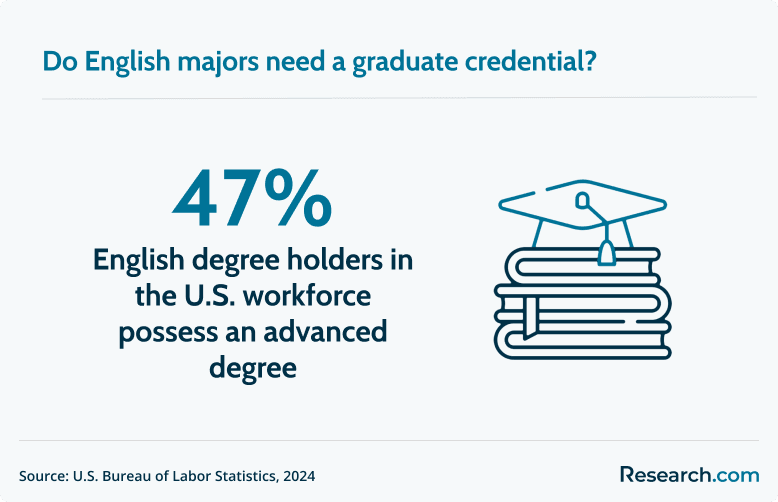
Further study can help English majors specialize, qualify for new roles, or prepare for academic and education-related careers. It can also be expensive, so the decision should be tied to a specific outcome. Students should understand the difference between continuing their education through a short certificate, a master’s degree, a licensure program, or a doctoral program.
- Access to advanced roles: Some positions prefer or require graduate education, especially in teaching, higher education, library science, administration, or specialized professional fields.
- Sharper research and communication skills: Graduate study can deepen analytical ability, writing discipline, scholarly research, and subject expertise.
- Specialized knowledge: Students can focus on literary theory, rhetoric, creative writing, pedagogy, composition, library science, or another defined field.
- Broader career options: Advanced or specialized training may support careers in copywriting, technical writing, public relations, marketing, editing, grant writing, teaching, and information management.
- Preparation for doctoral study: A master’s degree can be a step toward Ph.D. programs or college-level teaching. However, a Ph.D. without a dissertation is exceptionally rare and generally not considered a terminal degree in most academic fields, severely limiting career options in academia.
Common mistakes English majors should avoid
| Mistake | Why it can hurt your outcome | Better approach |
| Choosing a program without checking accreditation | It may affect transfer credit, graduate admission, and employer recognition. | Verify accreditation before applying or enrolling. |
| Focusing only on tuition | Fees, books, technology costs, and lost time can change the real price. | Compare total cost of attendance and financial aid options. |
| Assuming the degree alone is enough | Many writing and communication jobs require samples or experience. | Build a portfolio through internships, publications, class projects, and freelance work. |
| Ignoring transfer-credit limits | Some credits may not apply to the major, delaying graduation. | Request a formal transfer evaluation before committing. |
| Starting graduate school without a career target | A master’s degree can add cost without improving job fit. | Review job postings and talk to professionals before applying. |
| Assuming online programs meet licensure requirements | Teaching and clinical fields may have state-specific rules. | Confirm state approval, fieldwork, and licensure alignment in writing. |
How much can you earn with an English bachelor’s degree?
Earnings for English bachelor’s graduates vary because the degree feeds into many occupations rather than one standardized job. In the United States, the average annual pay for English degree jobs is $53,610 a year. Individual pay depends on the job title, location, industry, experience, portfolio strength, management responsibility, and added technical or professional skills.
- Specific career path, such as technical writing, content management, teaching, marketing, editing, or legal support
- Geographic location and local labor market conditions
- Years of relevant experience
- Additional certifications, software skills, industry knowledge, or graduate education
The chart below shows the top five highest-paying cities for English degree jobs.
What is the job outlook for English bachelor’s degree graduates?
The outlook for English graduates is best understood as broad but uneven. English majors do not enter a single occupation with one hiring pipeline; instead, they compete across communication-heavy roles in business, education, media, technology, nonprofits, law, and management. In 2022, about 1,878,040 people with an English degree were employed. The median annual wage was $60,000. Most English majors specialized in English Language and Literature (91%), followed by Composition and Rhetoric (9%). The largest occupational groups were education and libraries (21%) and management (17%).
Reported top jobs for English majors include postsecondary health specialties teachers, managers, chief executives, lawyers, and writers. Postsecondary health specialties teachers are expected to grow by 19%, and 72% of degree holders are in this field.
The main labor-market advantage of an English degree is adaptability. The main challenge is specificity. Graduates who can pair communication ability with a target skill set, such as SEO, technical documentation, grant writing, teaching preparation, editing, UX writing, or digital marketing, are usually better positioned than those who describe their goals only as “writing” or “working with books.”
The chart below shows the employment distribution of workers with an English degree, by occupational group in 2022.
Here’s What Graduates Have to Say About Having an English Bachelor’s Degree
-
: "
Because I was balancing work and family, a traditional schedule would not have worked for me. The online English program gave me room to study from home, build stronger writing habits, and engage more deeply with literature at a pace I could manage. - Ceb
"
-
: "
I was unsure at first whether an English degree would be practical, but the class discussions and accessible professors helped me feel connected. The program exposed me to many literary viewpoints and strengthened the critical thinking I now use in my career. - Justin
"
-
: "
The learning resources made the degree feel flexible and substantial. I could review lectures and materials when my schedule allowed, which helped me stay focused while managing other responsibilities. - Eric
"
References:
- Bureau of Labor Statistics, U.S. Department of Labor. (2024). Field of degree: English. Retrieved from https://www.bls.gov/ooh/field-of-degree/english/english-field-of-degree.htm
- EducationData.org. (2024, November 23). Average cost of a master’s degree. Retrieved from https://educationdata.org/average-cost-of-a-masters-degree
- Zippia. (2023, September 14). Average English major salary. Retrieved from https://www.zippia.com/english-major/salary
- ZipRecruiter. (2025). Content writer salary. Retrieved from https://www.ziprecruiter.com/Salaries/Content-Writer-Salary#Yearly
- ZipRecruiter. (2025). Editor salary. Retrieved from https://www.ziprecruiter.com/Salaries/Editor-Salary
- ZipRecruiter. (2025). English degree salary. Retrieved from https://www.ziprecruiter.com/Salaries/English-Degree-Salary
- ZipRecruiter. (2025). Grant writer salary. Retrieved from https://www.ziprecruiter.com/Salaries/Grant-Writer-Salary
- ZipRecruiter. (2025). Marketing associate salary. Retrieved from https://www.ziprecruiter.com/Salaries/Marketing-Associate-Salary
- ZipRecruiter. (2025). Paralegal salary. Retrieved from https://www.ziprecruiter.com/Salaries/Paralegal-Salary
- ZipRecruiter. (2025). Public relations salary. Retrieved from https://www.ziprecruiter.com/Salaries/Public-Relations-Salary
- ZipRecruiter. (2025). Public relations salary. Retrieved from https://www.ziprecruiter.com/Salaries/Public-Relations-Salary
- ZipRecruiter. (2025). SEO specialist salary. Retrieved from https://www.ziprecruiter.com/Salaries/Seo-Specialist-Salary
- ZipRecruiter. (2025). Social media manager salary. Retrieved from https://www.ziprecruiter.com/Salaries/Social-Media-Manager-Salary
- ZipRecruiter. (2025). Technical writer salary. Retrieved from https://www.ziprecruiter.com/Salaries/Technical-Writer-Salary#Yearly
- ZipRecruiter.(2025). UX writer salary. Retrieved from https://www.ziprecruiter.com/Salaries/Ux-Writer-Salary#Yearly
Key Insights
- An English bachelor’s degree is most useful when paired with a clear career direction, applied experience, and a portfolio that proves writing, editing, research, or communication ability.
- English graduates can pursue many roles, but salary and hiring prospects depend heavily on specialization, location, experience, and industry-specific skills.
- Students interested in employment immediately after graduation should prioritize internships, digital writing, technical writing, editing, SEO, media, or professional communication courses alongside literature study.
- Online and accelerated programs can be convenient, but students should verify accreditation, total cost, transfer-credit rules, course intensity, and support services before enrolling.
- A master’s degree can help in education, library science, specialized communication fields, or academic preparation, but it should be tied to a specific career goal rather than used as a default next step.
- The strongest English major career strategy is to translate broad academic skills into employer language: writing samples, research briefs, documentation, campaign work, editing projects, teaching experience, or measurable communication outcomes.
Other Things You Should Know About English Bachelor’s Degrees
In 2027, English majors can pursue careers in education, publishing, journalism, corporate communications, and content creation. Opportunities also exist in marketing, public relations, and freelance writing, thanks to their skills in critical analysis, research, and effective communication.
In 2027, a bachelor's degree in English remains relevant as it cultivates strong communication, analytical, and critical thinking skills. These competencies are in demand across various fields such as content creation, marketing, public relations, and education, thereby providing diverse career opportunities.
In 2027, a bachelor's degree in English remains highly versatile. Graduates can pursue careers in writing, editing, teaching, marketing, public relations, and more. The degree develops critical thinking, communication, and analytical skills, which are valuable in various industries. Networking and internships can enhance career prospects.


