
2027 Most Affordable Online English Degree Programs

Co-Founder and Chief Data Scientist
Choosing an affordable online English degree is not just about finding the lowest tuition. The better question is whether the program helps you build marketable writing, analysis, editing, research, and communication skills without taking on unnecessary cost or choosing a school that will not support your goals. This guide is designed for students comparing online bachelor’s programs in English, working adults returning to college, transfer students trying to finish a degree, and future writers, teachers, editors, communicators, or graduate students who want a practical path forward.
You will learn what an online English degree includes, how long it takes, what it may cost, which affordable programs stand out for 2027, how online study compares with campus study, and how to evaluate accreditation, transfer credits, financial aid, career outcomes, and specialization options before enrolling.
Quick Answer: Is an Online English Degree Worth Considering?
An online English degree can be a strong option if you want a flexible bachelor’s program that develops writing, interpretation, research, editing, and communication skills used in education, publishing, marketing, public relations, technical writing, content strategy, nonprofit work, and corporate communications. It is usually most valuable when you choose an accredited program, keep costs manageable, build a portfolio, complete internships or applied projects, and pair the degree with job-ready skills such as technical writing, digital content, editing, teaching preparation, or communications strategy.
- Best fit: Students who enjoy reading, writing, language, analysis, and communication and want a broad degree that can apply across several industries.
- Use caution if: You want a direct vocational path with a clearly defined license or trade outcome; in that case, compare English with career-specific alternatives before committing.
- Typical timeline: Most bachelor’s programs require 120 credits and are commonly designed for four years of full-time study.
- Career value: The degree is strongest when combined with a specialization, portfolio, internship, certification, teaching credential, or graduate study plan.
What can I expect from an online English degree program?
An online English degree is a humanities-based program focused on language, literature, writing, interpretation, argumentation, research, and communication. Students usually study literary traditions, rhetoric, composition, grammar, creative writing, professional writing, and language analysis while completing general education and elective requirements.
The degree is not limited to reading novels or writing essays. A well-designed program should help students learn how to evaluate evidence, explain complex ideas clearly, adapt tone for different audiences, revise written work, discuss texts critically, and produce polished documents for academic or professional settings. These skills matter because humanities departments, including English, identify “student concerns about jobs” as a major challenge, making career preparation and applied communication increasingly important parts of the degree conversation.
Online programs typically use learning management systems, recorded lectures, discussion boards, virtual workshops, peer review, research papers, digital libraries, and instructor feedback. Some classes may be asynchronous, while others may include scheduled live sessions. Before enrolling, check whether the program includes portfolio development, writing workshops, career services, internship options, faculty interaction, and courses aligned with your intended career path.
Where can I work with an online English degree?
Graduates with an English degree can work in fields where clear communication, interpretation, editing, research, and audience awareness are valuable. Common areas include education, publishing, media, marketing, public relations, technical communication, nonprofit administration, government, corporate training, and digital content.
Traditional roles may include teacher, editor, proofreader, writer, librarian, or publishing assistant. Other graduates move into business or organizational roles such as communications coordinator, content strategist, grant writer, public relations associate, documentation specialist, human resources writer, or marketing copywriter. The most competitive graduates usually show employers concrete evidence of their skills through writing samples, editorial work, digital projects, teaching preparation, internships, or industry-specific certifications.
How much can I make with an online English degree?
Salary depends heavily on job title, industry, location, experience, graduate education, and specialized skills. The article data reports an average wage of $88,294 annually and an 8.92% growth figure, but students should not treat any single salary number as a guaranteed outcome for all English graduates.
Entry-level positions such as content writer, editorial assistant, teaching assistant, or communications assistant may pay less while helping graduates build experience. More specialized or senior roles, including technical writer, public relations specialist, senior editor, or communications manager, may offer higher earning potential. Experienced professionals in technical writing can earn between $80,000 and $130,000 annually, especially when they understand complex products, software, compliance documents, engineering concepts, or specialized business processes.
- Most Affordable Online English Degree Programs for 2027
- How long does it take to complete an online English degree?
- How does an online English degree compare to an on-campus program?
- What is the average cost of an online English degree program?
- What financial aid options are available?
- What are the prerequisites for online English degree admission?
- What courses are usually included?
- What specializations are available?
- How can you verify academic quality?
- What advantages does an online associate degree offer?
- Can you fast-track advanced education after an English degree?
- What challenges should online students expect?
- Can an online English degree strengthen creative writing skills?
- Are online English programs good for working adults?
- How do you choose the best online English degree program?
- How does an English degree compare with trade-focused education?
- How can you make an online English degree more cost-efficient?
- Which certifications can improve career prospects?
- How do programs use modern technology and digital tools?
- What career paths are available?
- What is the job market for English graduates?
- What advanced education can complement an English degree?
- References and sources
Most Affordable Online English Degree Programs for 2027
How do we rank schools?
Affordability matters, but it should not be separated from academic quality, accreditation, transfer policies, student support, and program fit. Research.com’s rankings are prepared using data-focused review methods and draw from sources such as the IPEDS database, Peterson’s database through the Distance Learning Licensed Data Set, the College Scorecard database, and the National Center for Education Statistics. You can review additional details in our ranking methodology.
| School | Online English Program | Credits | Cost Information | Best For |
| Florida State University | Bachelor of Arts in English | 120 | $235.57 per credit hour for Florida residents | Students seeking an affordable in-state option with general English and creative writing options |
| Indiana University | Bachelor of Arts in English | 120 | $249.73 per credit for in-state students | Transfer students interested in technical and professional writing |
| Louisiana State University | Bachelor of Arts in English | 120 | $325 per credit | Students who want flexible scheduling and generous transfer credit potential |
| Thomas Edison State University | Bachelor of Arts in English | 120 | $3,319 flat-rate tuition for New Jersey residents; $110.63 per credit | Adult learners seeking a composition and literature-focused degree |
| University of Massachusetts-Dartmouth | Bachelor of Arts in English | 120 | $352 per credit | Students planning careers in content, teaching-related fields, or language instruction |
| University of Massachusetts-Lowell | Bachelor of Arts in English | 120 | $380 per credit | Learners interested in publishing, marketing, law-related preparation, or flexible completion |
| Columbia College | Bachelor of Arts in English | 120 | $375 per credit | Students with transfer credits who want literature and language foundations |
| Holy Apostles College and Seminary | Bachelor of Arts in English in Humanities | 120 | $395 per credit | Students interested in humanities-centered English study |
| University of Missouri-Columbia | Bachelor of Arts in English | 120 | $542 per credit | Part-time learners focused on writing, editing, and communication |
| King University | Bachelor of Arts in English | 124 | $305 per credit | Students looking for condensed five-week courses and accelerated major coursework |
1. Florida State University
Florida State University offers an online 120-credit hour Bachelor of Arts in English. The program is designed to strengthen writing, cultural understanding, critical reading, and analytical thinking. At $235.57 per credit hour for Florida residents, it may be especially attractive to in-state students seeking a lower-cost path into English language and literature study.
- Program length: Four years
- Tracks/concentrations: General English, Creative Writing
- Cost per credit: $235.57 (in-state)
- Required credits to graduate: 120
- Accreditation: Southern Association of Colleges and Schools Commission on Colleges (SACSCOC)
2. Indiana University
Indiana University provides a fully online Bachelor of Arts in English with a focus on technical and professional writing. The 120-credit program includes 48 credits of foundational English coursework, charges $249.73 per credit for in-state students, and allows transfer options of up to 64 credits. It is a practical fit for students considering documentation specialist, editorial assistant, or workplace writing roles.
- Program length: Four years
- Tracks/concentrations: Technical Writing, Literature
- Cost per credit: $249.73 (in-state)
- Required credits to graduate: 120
- Accreditation: Higher Learning Commission (HLC)
3. Louisiana State University
Louisiana State University offers an online Bachelor of Arts in English that requires 120 credits and supports flexible scheduling. The program costs $325 per credit, accepts applicants with a minimum 2.0 GPA, and allows students to transfer up to 75% of degree requirements. Course options such as poetry, creative writing, and public speaking help students connect literary study with practical communication.
- Program length: Four years
- Tracks/concentrations: Creative Writing, Public Speaking
- Cost per credit: $325
- Required credits to graduate: 120
- Accreditation: SACSCOC
4. Thomas Edison State University
Thomas Edison State University offers an online Bachelor of Arts in English centered on composition and literature. The 120-credit curriculum includes subjects such as rhetorical grammar and composition, along with 18 elective credits that allow students to explore additional areas of English studies. For New Jersey residents, the flat-rate tuition is $3,319, listed as $110.63 per credit.
- Program length: Four years
- Tracks/concentrations: General English, Composition
- Cost per credit: $110.63 (flat rate of $3,319 for in-state residents)
- Required credits to graduate: 120
- Accreditation: Middle States Commission on Higher Education (MSCHE)
5. University of Massachusetts-Dartmouth
The University of Massachusetts-Dartmouth offers an online 120-credit Bachelor of Arts in English and accepts up to 75 transfer credits. With tuition listed at $352 per credit, the program can support students preparing for web content management, secondary education-related pathways, and teaching English as a foreign language.
- Program length: Four years
- Tracks/concentrations: Literature, Writing
- Cost per credit: $352
- Required credits to graduate: 120
- Accreditation: New England Commission of Higher Education (NECHE)
6. University of Massachusetts-Lowell
The University of Massachusetts-Lowell delivers an online Bachelor of Arts in English with tuition of $380 per credit. The 120-credit program is positioned for students interested in publishing, marketing, and law-related preparation. Its flexible structure allows completion in as little as 12 to 36 months.
- Program length: Four years
- Tracks/concentrations: Literature, Creative Writing
- Cost per credit: $380
- Required credits to graduate: 120
- Accreditation: NECHE
7. Columbia College
Columbia College offers an online Bachelor of Arts in English that requires 120 credits. The program charges $375 per credit and accepts up to 90 transfer credits, which can make it appealing for students who have already completed substantial college coursework. Topics include grammar, American literature, and the history of the English language.
- Program length: Four years
- Tracks/concentrations: Literature, General English
- Cost per credit: $375
- Required credits to graduate: 120
- Accreditation: HLC
8. Holy Apostles College and Seminary
Holy Apostles College and Seminary provides an online Bachelor of Arts in English in Humanities requiring 120 credits. Tuition is $395 per credit, and students may complete the degree in three to six years. Graduates may apply their communication and humanities training to fields such as speechwriting, legislative aid, and admissions counseling.
- Program length: Four years
- Tracks/concentrations: General English
- Cost per credit: $395
- Required credits to graduate: 120
- Accreditation: NECHE
9. University of Missouri-Columbia
The University of Missouri-Columbia offers an online Bachelor of Arts in English requiring 120 credits. The program accepts up to 60 transfer credits, costs $542 per credit, serves part-time learners, and requires a minimum 2.5 GPA for admission. It is designed to prepare students for writing, editing, and communication-focused work.
- Program length: Four years
- Tracks/concentrations: Literature, Writing
- Cost per credit: $542
- Required credits to graduate: 120
- Accreditation: HLC
10. King University
King University offers a fully online Bachelor of Arts in English requiring 124 credits. Tuition is $305 per credit, and students can complete major coursework in as little as 16 months. The program uses condensed five-week courses and prepares graduates for writing, library science, and public service opportunities.
- Program length: Four years
- Tracks/concentrations: Writing, Literature
- Cost per credit: $305
- Required credits to graduate: 124
- Accreditation: SACSCOC
How long does it take to complete an online English degree?
A bachelor’s in English commonly takes four years for full-time students and typically requires 120 credits. The actual completion time can be shorter or longer depending on course load, transfer credits, academic calendar, prior college work, and whether the program offers accelerated terms.
Part-time students may need more time because they take fewer courses each term. Transfer students may finish faster if the school accepts a large number of previously earned credits. Some students comparing fast online completion models also review programs such as accelerated online communications degree options because communications and English can lead to overlapping writing, media, and public-facing career paths.
Students with business goals may combine English with entrepreneurship, marketing, or content strategy. In that case, an online entrepreneurship degree can be a useful comparison point for learners who want to turn writing, publishing, editing, or digital content skills into freelance or business opportunities.
A master’s degree in English generally takes one to two years, depending on program structure and enrollment intensity. Students considering graduate school should ask whether they want advanced literary research, teaching preparation, professional writing, rhetoric and composition, library science, law school preparation, or another specialized path. Students whose interests shift toward legal, investigative, or scientific applications may also compare English with an online forensic science degree to understand how career-specific programs differ from broad humanities degrees.
How does an online English degree compare to an on-campus program?
The academic content of an online English degree can be similar to an on-campus degree when both are offered by accredited institutions. The main differences usually involve schedule, learning format, campus access, networking style, costs, and the level of self-direction required.
| Factor | Online English Degree | On-Campus English Degree | Decision Point |
| Schedule | Often more flexible, with asynchronous or partially asynchronous coursework | Usually follows set class times and campus schedules | Online may fit better for working adults, caregivers, and students far from campus |
| Interaction | Uses discussion boards, video meetings, peer review platforms, and email feedback | Offers face-to-face class discussion, campus events, and in-person faculty access | Choose the format that matches how you learn and build relationships |
| Cost | May reduce commuting, housing, and relocation expenses | May include higher living or transportation costs, depending on location | Compare total cost, not tuition alone |
| Campus resources | Depends on remote access to tutoring, library services, advising, and career support | May provide easier access to campus writing centers, libraries, and events | Ask what online students can use before enrolling |
| Self-management | Requires strong time management and independent study habits | Provides more built-in schedule structure | Online learning works best for students who can plan weekly work consistently |
Flexibility and access
Online English programs are often chosen by students who need to continue working, manage family responsibilities, avoid relocation, or study from a different region. The main advantage is scheduling control. The main risk is falling behind if deadlines, readings, and writing assignments are not managed carefully.
Learning experience
On-campus programs offer immediate in-person discussion and informal networking. Online programs recreate parts of that experience through virtual workshops, group projects, recorded lectures, and live sessions. Before choosing an online program, ask how often students receive faculty feedback on writing and whether peer workshops are required.
Cost comparison
Online study can lower some non-tuition expenses, particularly commuting, housing, and relocation costs. However, online students may still pay technology fees, course materials, software subscriptions, and student service charges. If your long-term interest is in communication for healthcare, aging services, or nonprofit administration, you may also compare English with an affordable online gerontology master’s degree as a future graduate option.
What is the average cost of an online English degree program?
Costs vary by institution, residency status, transfer credit acceptance, public or private school type, fees, and course load. According to Data USA, median in-state tuition for public institutions is $7,616 annually, while out-of-state public tuition averages around $19,548. For private institutions, median out-of-state tuition is approximately $36,236.
Students should calculate the total program cost, not just the advertised per-credit rate. Important expenses may include textbooks, digital course materials, technology fees, library fees, graduation fees, software licenses, and lost income if you reduce work hours. If you are comparing English with adjacent graduate pathways, note that programs such as a masters in library science online cost can vary by school and program length, so the same total-cost approach applies.
| Cost Category | What to Check | Why It Matters |
| Tuition per credit | Resident, nonresident, and online rates | A low per-credit price can make a major difference across 120 credits |
| Transfer credits | Maximum accepted credits and how they apply to major requirements | Accepted credits can reduce both cost and completion time |
| Fees | Technology, student services, graduation, course, and distance learning fees | Fees can change the real cost of an “affordable” program |
| Books and materials | Required literature, databases, writing software, and digital access codes | English courses can involve substantial reading and writing resources |
| Financial aid | Federal aid, scholarships, grants, employer assistance, and institutional awards | A higher sticker price may be less expensive after aid |
What are the financial aid options for students enrolling in an online English degree program?
Online English degree students may qualify for several types of financial aid, but eligibility depends on the school, program, enrollment status, accreditation, and individual circumstances. Always confirm that the program participates in the aid programs you plan to use.
- Federal aid: Submit the FAFSA, or Free Application for Federal Student Aid, to be considered for federal grants, loans, and work-study options.
- Scholarships: Look for awards from universities, writing organizations, community foundations, honor societies, and private groups. Students focused on writing may also compare dedicated online degree creative writing programs and related scholarship opportunities.
- Employer tuition assistance: Some employers reimburse tuition or provide education benefits for workers building communication, writing, training, or leadership skills.
- State aid: State-funded grants or scholarships may be available to eligible residents attending approved institutions.
- Institutional aid: Universities may offer need-based grants, merit scholarships, transfer scholarships, military benefits, or online student discounts.
Before borrowing, compare your expected debt with realistic entry-level salaries in the roles you plan to pursue. If you are uncertain about career direction, start with lower-cost credits, use transfer pathways strategically, and avoid taking unnecessary electives that do not apply to graduation.
What are the prerequisites for enrolling in an online English degree program?
Admission requirements differ by school, but undergraduate online English programs commonly require proof of high school completion or equivalent preparation. Transfer applicants may need to submit transcripts from every previously attended college.
- High school diploma or equivalent: Most bachelor’s programs require this for first-year admission.
- GPA requirements: Some schools set minimum GPA expectations, often around 2.5 to 3.0.
- Standardized test scores: SAT or ACT scores may be required by some institutions, although many online programs now use test-optional policies.
- Application materials: Applicants may need a personal statement, recommendation letters, resume, or writing-related materials, depending on the school.
- Prior college credits: Transfer students should request a formal credit evaluation before enrolling. Students comparing admission flexibility in other fields may also review resources such as the easiest online SLP programs to get into to understand how requirements vary across disciplines.
If your goal involves teaching young learners, curriculum design, or school leadership, English may be one step in a longer education path. You may want to compare outcomes with related graduate options by asking what jobs can you get with a master’s in early childhood education and whether that route better matches your long-term plans.
What courses are typically in an online English degree program?
Online English programs combine general education, major requirements, writing-intensive courses, literature study, language analysis, and electives. Course titles vary, but most programs aim to develop close reading, clear writing, research, interpretation, and revision skills.
- Literature studies: Courses may examine classic, modern, global, American, British, multicultural, or genre-based literature.
- Creative writing: Workshops may focus on fiction, poetry, creative nonfiction, screenwriting, or narrative craft.
- Professional writing: Students learn workplace communication, technical writing, business writing, editing, document design, or digital content creation.
- Linguistics: Coursework may cover language structure, grammar, sociolinguistics, history of English, or language use.
- Rhetoric and composition: Students study argument, persuasion, writing pedagogy, audience, and rhetorical theory.
- Capstone or portfolio: Many programs end with a major research paper, writing portfolio, senior project, or applied communication project.
Some students use English as a foundation for language, communication, or education-related graduate study. For example, those interested in speech and language careers may compare English coursework with an accelerated speech-language pathology program to see whether additional science, clinical, or licensure requirements would be needed.
What types of specializations are available in online English degree programs?
Specializations help convert a broad English degree into a clearer career signal. According to the US Bureau of Labor Statistics (BLS), in 2022, 91% of English majors focused on English Language and Literature, while 9% specialized in Composition and Rhetoric.
| Specialization | What You Study | Potential Fit |
| Creative Writing | Fiction, poetry, nonfiction, workshop practice, storytelling, and revision | Aspiring authors, content creators, screenwriters, and graduate writing applicants |
| Technical Writing | Documentation, user guides, reports, editing, information design, and workplace communication | Students interested in technology, healthcare, engineering, government, or compliance communication |
| Literary Studies | Literary history, theory, genres, close reading, and research | Students considering teaching, graduate study, publishing, or cultural analysis |
| Teaching English | Language instruction, composition, pedagogy, literacy, and communication | Students who may pursue teaching credentials, tutoring, ESL-related work, or graduate education |
| Composition and Rhetoric | Writing theory, argumentation, academic writing, persuasion, and writing instruction | Students interested in writing centers, instruction, editing, communication, or graduate study |
Choose a specialization based on the kind of work you want to do after graduation. If you do not yet have a clear career goal, prioritize programs that offer flexible electives, career advising, and portfolio-building assignments.
How can you verify the academic quality of an online English degree program?
Start with accreditation. Confirm the institution’s status through recognized sources and use the official accreditation search tool when checking a school. Accreditation affects credit transfer, graduate school eligibility, employer recognition, and access to some financial aid options.
Academic quality also depends on curriculum depth, faculty qualifications, student support, writing feedback, library access, tutoring, career services, and whether online students receive the same academic expectations as campus students. Independent school profiles and resources on online universities can help you compare institutional quality, but rankings should be only one part of your decision.
What advantages does an online associate degree offer compared to a bachelor’s in English?
An online associate degree in English or a related liberal arts field can be a lower-cost starting point for students who want to build college-level reading, writing, and research skills before committing to a full bachelor’s program. It may also help undecided students test whether English is the right academic direction.
The biggest advantage is flexibility. If credits transfer cleanly into a bachelor’s program, an associate pathway can reduce cost and risk. The biggest limitation is that many professional roles and graduate programs still prefer or require a bachelor’s degree. Students who want a shorter credential should compare transfer policies carefully and may also review the best associate degree in 6 months online options when evaluating accelerated associate-level study.
Can you fast-track your advanced education after an English degree?
Yes, but the best route depends on your career goal. English graduates may move into master’s programs in English, rhetoric, creative writing, communication, library science, education, law-related fields, business communication, or public administration. Students interested in education leadership may eventually consider accelerated doctoral pathways, including an EdD online program.
Fast-track programs are not always the best choice for every learner. Before enrolling, compare workload, advising, research requirements, dissertation or capstone expectations, tuition, and whether the accelerated format leaves enough time for strong writing and faculty feedback.
What challenges might you face in an online English degree program?
Online English programs can be rigorous because reading-heavy and writing-heavy courses require consistent weekly effort. Students may also miss the immediacy of in-person discussion, informal peer networks, and face-to-face writing support.
- Time management: Long readings and writing assignments can pile up quickly without a weekly study schedule.
- Limited in-person interaction: Students need to be proactive about discussion boards, virtual office hours, peer workshops, and faculty communication.
- Writing feedback delays: Ask how quickly instructors return comments and whether drafts are reviewed before final submission.
- Technology requirements: Confirm platform access, library tools, video meeting expectations, and technical support hours.
- Career translation: Students must learn how to explain English skills in employer language, such as editing, research, documentation, content development, and audience analysis.
Students comparing online academic support across fields may find it useful to look at how graduate programs structure services, such as those listed among the most affordable EdD programs, even if they are not pursuing an education doctorate.
Can an online English degree program be tailored to boost creative writing capabilities?
Yes. Many online English programs allow students to choose creative writing electives, workshop courses, literature courses connected to genre study, and capstone projects built around original writing. The strongest creative writing experience includes repeated practice, instructor critique, peer review, revision, and exposure to contemporary publishing formats.
If creative writing is your main goal, compare a general English degree with a dedicated online creative writing degree. A general English program may offer broader preparation, while a creative writing-focused program may provide more structured workshops and portfolio development.
Are online English degree programs ideal for working adults?
Online English programs can work well for adults balancing employment, caregiving, military service, or other responsibilities, especially when courses are asynchronous and advising is available outside standard business hours. However, flexibility does not mean the program is easy. Reading, writing, research, and discussion still require significant time.
Working adults should ask whether the program allows part-time enrollment, accepts prior credits, offers multiple start dates, provides online tutoring, and has career services for remote learners. For broader comparisons of flexible schools, review options for online degrees for working adults.
How do you choose the best online English degree program?
The best online English degree is the one that fits your goals, budget, schedule, transfer situation, and preferred career direction. Do not choose based on tuition or ranking alone.
| Question to Ask | Why It Matters | What to Look For |
| Is the school accredited? | Accreditation affects aid, transfer, graduate study, and recognition | Institutional accreditation from a recognized accreditor |
| How many credits will transfer? | Transfer acceptance can reduce cost and time | A written transfer evaluation before enrollment |
| Does the curriculum match my goal? | English is broad; specialization matters | Courses in technical writing, creative writing, literature, teaching, editing, or rhetoric |
| Will I build a portfolio? | Employers often want proof of writing ability | Capstone projects, workshops, internships, publications, or applied writing assignments |
| What support do online students receive? | Writing-intensive degrees require feedback and advising | Online tutoring, library access, career coaching, tech support, and faculty office hours |
| What is the total cost after aid? | Sticker price may not reflect your real cost | Tuition, fees, books, aid offers, employer benefits, and transfer savings |
Common mistakes to avoid
- Choosing only the cheapest program: Low tuition is helpful, but weak support or poor transfer policies can cost more later.
- Ignoring accreditation: Always verify institutional accreditation before applying.
- Assuming online means self-paced: Many online courses still have weekly deadlines and fixed term schedules.
- Overlooking career preparation: Look for portfolio work, internships, professional writing, editing, and digital communication assignments.
- Failing to compare transfer policies: A school that accepts more applicable credits may be less expensive than one with lower tuition.
- Assuming salary outcomes are guaranteed: Earnings vary widely by role, industry, location, experience, and additional credentials.
How does an online English degree compare to trade-focused education alternatives?
An online English degree develops transferable communication and analytical skills. Trade-focused education usually prepares students for specific technical or hands-on roles with more direct occupational training. Neither path is automatically better; the right choice depends on your work style, timeline, budget, and career target.
Choose English if you want flexibility across writing, education, media, communication, publishing, or graduate study. Consider trade-focused education if you prefer applied technical training and want a more occupation-specific route. To compare earnings-focused vocational paths, review examples of the best trade school jobs.
How can you enhance cost-efficiency while pursuing an online English degree?
The most affordable degree is not always the one with the lowest advertised tuition. Cost-efficiency comes from reducing unnecessary credits, maximizing aid, finishing on time, and choosing a program that supports your career goals.
- Complete a transfer evaluation before enrolling: Make sure prior credits count toward general education, electives, or major requirements.
- Compare total program cost: Include tuition, fees, books, technology charges, and expected time to completion.
- Use community college strategically: If transferable, lower-cost general education credits may reduce bachelor’s expenses.
- Apply for aid every year: FAFSA, scholarships, grants, and employer reimbursement can change your net cost.
- Avoid excess electives: Take courses that apply directly to graduation or career goals.
- Compare affordable bachelor’s options broadly: A resource on the cheapest online bachelors degree programs can help you benchmark pricing across fields.
Which additional certifications can enhance your career prospects?
Certifications can help English graduates show applied skills beyond the degree. They are especially useful when they connect writing ability to a specific workplace need.
| Certification Area | How It Complements English | Potential Career Use |
| Technical writing | Builds documentation, process writing, and information design skills | Technical writer, documentation specialist, UX content roles |
| Digital marketing | Adds SEO, content strategy, analytics, and campaign skills | Content marketer, copywriter, communications associate |
| Editing or publishing | Strengthens proofreading, style, grammar, and editorial workflow | Editor, proofreader, publishing assistant |
| Project management | Connects communication skills with coordination and team leadership | Communications coordinator, editorial project manager |
| Teaching-related credentials | May support tutoring, language instruction, or education pathways | Teacher preparation, ESL-related roles, academic support |
When comparing credentials, focus on reputable providers, employer recognition, portfolio value, and whether the certification leads to skills you can demonstrate. You may also review guidance on what certificates make the most money, but always match the credential to your target role rather than choosing based only on earning claims.
How do online English degree programs integrate modern technology and digital tools?
Online English programs now rely on digital platforms for discussion, research, writing feedback, group projects, and document sharing. Students may use virtual classrooms, digital libraries, annotation tools, plagiarism and citation platforms, multimedia presentations, peer-review systems, and collaborative writing software.
AI tools are also affecting writing, editing, research, and content work. A strong program should teach students how to use technology responsibly, verify sources, revise thoughtfully, maintain originality, and understand ethical writing practices. Students planning rapid graduate study after an English degree may compare broader digital and flexible learning formats through online 1 year masters programs.
What career paths are available for graduates of online English degree programs?
English graduates can pursue many types of roles, but outcomes depend on the student’s experience, specialization, portfolio, and additional credentials. According to the BLS, English degree holders are found in several occupational groups, including Educational Instruction and Library Occupations, Management Occupations, Business and Financial Operations, and Arts, Design, Entertainment, and Media.
| Career Area | Example Roles | How an English Degree Helps |
| Education and libraries | Teacher, tutor, librarian pathway, academic support specialist | Builds reading, writing, instruction, interpretation, and research skills |
| Writing and editing | Writer, editor, proofreader, publishing assistant, content creator | Develops drafting, revision, grammar, style, and audience awareness |
| Technical communication | Technical writer, documentation specialist, knowledge base writer | Trains students to explain complex information clearly and accurately |
| Marketing and public relations | Copywriter, content strategist, communications coordinator, PR associate | Supports persuasive writing, storytelling, brand voice, and message development |
| Nonprofit and government | Grant writer, program coordinator, outreach specialist, speechwriter | Applies research, clear communication, and public-facing writing |
| Business operations | Project support, HR communications, training content, internal communications | Uses writing, organization, documentation, and stakeholder communication |
Students who want education-related advancement may later compare graduate earnings and roles using resources on masters in education salary, especially if their plan includes teaching, curriculum, administration, or instructional leadership.
What is the job market for graduates with an online English degree?
The market for English graduates is broad rather than tied to one occupation. That can be an advantage because graduates can move across fields, but it also means students must be intentional about building career-specific experience.
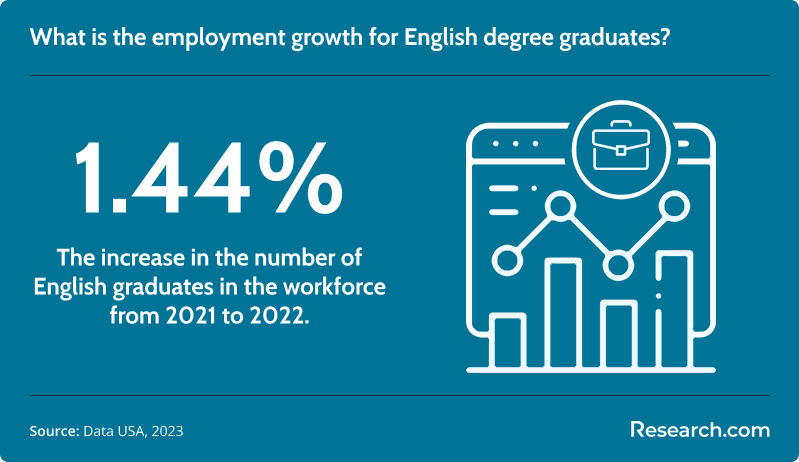
According to Data USA, the workforce of English graduates grew by 1.44% annually, from 1.51 million in 2021 to 1.54 million in 2022. Based on that growth rate, the number of graduates in the workforce could increase by approximately 14.4% over the next decade. This does not guarantee employment for every graduate, but it shows that English degree holders continue to participate in a wide range of roles.
To be competitive, students should graduate with more than a transcript. Build a portfolio, complete internships when possible, learn digital tools, practice editing, collect writing samples, and translate coursework into employer-ready language such as research, documentation, content development, audience analysis, and project communication.
What advanced educational opportunities can complement an online English degree?
An online English degree can support several graduate and professional pathways. Common options include master’s programs in English, creative writing, rhetoric and composition, communication, education, library science, technical communication, law-related fields, public administration, and business communication.
Graduate school makes the most sense when it is connected to a clear goal, such as teaching, academic research, professional writing leadership, librarianship, editing specialization, or education advancement. Before enrolling, compare admissions requirements, thesis or capstone expectations, assistantship opportunities, licensure implications, faculty expertise, and career outcomes. If return on investment is a major concern, you may also compare fields using resources on high paying master degrees.
How to prepare for success in an online English degree
- Set a weekly reading and writing schedule: English courses often involve sustained reading and multiple draft cycles.
- Create a portfolio from the first term: Save polished essays, articles, technical documents, creative work, presentations, and research projects.
- Use faculty feedback strategically: Revision is one of the strongest ways to improve as a writer.
- Choose electives with a career goal in mind: Technical writing, editing, digital content, teaching, or creative writing electives can shape your next step.
- Seek applied experience: Look for internships, campus publications, nonprofit writing projects, tutoring, freelance assignments, or volunteer grant writing.
- Learn workplace tools: Become comfortable with collaboration platforms, content management systems, citation tools, document design, and digital research databases.
- Translate your skills for employers: Use specific language such as “edited long-form content,” “conducted research,” “wrote audience-specific materials,” or “managed peer review.”
Questions to ask before enrolling
- Is the institution accredited, and is the online degree identical in recognition to the campus degree?
- How many of my previous credits will apply to the 120-credit or 124-credit requirement?
- Are courses asynchronous, synchronous, or mixed?
- How often will I receive detailed feedback on my writing?
- Does the program include a capstone, portfolio, internship, or applied writing project?
- Which specializations are available, and do they match my career goal?
- What is the full cost after tuition, fees, books, and financial aid?
- Are online students eligible for tutoring, library services, writing center support, and career counseling?
- Does the program prepare students for teaching credentials, if that is my goal?
- What outcomes do graduates pursue, and how does the school support job searches?
References:
- BLS. (2024). Field of Degree: English. BLS English field of degree resource.
- BLS. (2024). Occupational Outlook Handbook: Technical Writers. BLS technical writers profile.
- Data USA. (2023). English. Data USA English profile.
- Modern Language Association of America. (2024). Report on English Majors’ Career Preparation and Outcomes. MLA career preparation and outcomes report.
Key Insights
- An affordable online English degree is most valuable when it combines low cost with accreditation, strong writing feedback, relevant electives, career support, and portfolio-building opportunities.
- Most listed bachelor’s programs require 120 credits, while King University requires 124 credits; transfer credit policies can significantly affect both cost and completion time.
- English is a flexible degree, not a single-career credential. Students should choose a specialization such as creative writing, technical writing, literature, teaching English, or composition and rhetoric to make the degree more career-directed.
- Online study can reduce commuting, relocation, and housing costs, but students still need to budget for fees, materials, technology, and the time required for reading and writing-intensive coursework.
- Accreditation should be verified before enrollment. It affects financial aid eligibility, transferability, graduate school options, and employer confidence.
- Career outcomes are strongest for students who graduate with applied experience: writing samples, editing work, internships, digital content projects, technical documentation, tutoring experience, or relevant certifications.
- Do not rely on rankings or tuition alone. The best program is the one that fits your budget, schedule, transfer credits, learning style, and career plan.
Other Things You Should Know About the Most Affordable Online English Degree Programs
Yes. Many affordable online English degree programs in 2027 use asynchronous classes, letting students complete readings, discussions, and assignments on a weekly schedule. Some schools still require occasional live sessions or proctored exams, so applicants should check the course format before enrolling.
The accreditation for online English degree programs in 2027 is typically managed by regional accrediting bodies like the Middle States Commission on Higher Education (MSCHE) or the Western Association of Schools and Colleges (WASC). Accreditation ensures the quality and recognition of the degree.


