
2027 Are Online Psychology Degrees Legitimate & Respected?

Co-Founder and Chief Data Scientist
Choosing an online psychology degree is not just a question of convenience. The real issue is whether the program will be taken seriously by employers, graduate schools, and licensing boards after you invest time, tuition, and effort. That answer depends less on the word “online” and more on accreditation, curriculum quality, supervised training requirements, and how well the degree fits your career goal.
This guide explains how online psychology degrees work, which accreditation signals matter, how employers usually view accredited online programs, what careers may be available, and when an online psychology degree is a smart investment. It is written for prospective undergraduate students, working adults considering a career change, and graduate applicants comparing online, hybrid, and campus-based psychology options.
Quick answer: Are online psychology degrees legitimate?
Yes, an online psychology degree can be legitimate and respected if it is earned from a properly accredited institution and, when required for licensure, from a program that meets professional standards in your state. Employers typically focus on the school’s credibility, your degree level, your experience, and whether you meet job or licensure requirements—not simply whether your classes were online.
The biggest risk is enrolling in a program without recognized accreditation or assuming that every online psychology degree leads to licensure. A bachelor’s degree in psychology can support entry-level roles or graduate study, while becoming a licensed psychologist generally requires a doctoral degree, supervised experience, and state licensure.
Key things you should know about online psychology degrees
- Recognized institutional accreditation is essential. For clinical, counseling, or school psychology doctoral pathways, APA accreditation may also matter for licensure, internships, and employer recognition.
- Online psychology programs can be useful for students who need flexible scheduling because of work, caregiving, military service, or location constraints.
- Accelerated online psychology programs can take around 3 years to complete, but faster timelines usually require a heavier course load and strong time-management skills.
Table of Contents:
- What accreditation should I look for in an online psychology degree?
- Are online psychology degrees from accredited universities respected?
- How long does it take to complete an online psychology degree?
- Do employers take online psychology degrees seriously?
- How do online psychology programs compare to traditional ones?
- What is the average salary for licensed psychologists in the U.S.?
- What courses are typically offered in an online psychology degree?
- What job roles can I get with an online psychology degree?
- What student support services are available in online psychology programs?
- Is an online psychology degree worth the investment?
- What is the job outlook for psychologists in the U.S. within the next 10 years?
- What specialized tracks can I pursue with an online psychology degree?
- How can I evaluate the quality and fit of online PsyD programs for my career goals?
- Key Insights
What accreditation should I look for in an online psychology degree?
Accreditation is the first thing to verify before applying to any online psychology program. It tells you whether the institution has been reviewed by a recognized accrediting body and whether the degree is likely to be accepted by employers, graduate schools, financial aid agencies, and licensing boards.
For most students, there are two levels to understand: institutional accreditation and programmatic accreditation. Institutional accreditation applies to the college or university as a whole. Programmatic accreditation applies to specific professional programs and is especially important for students pursuing licensure in clinical, counseling, or school psychology.
- MSCHE: The Middle States Commission on Higher Education evaluates colleges and universities in areas such as New York, New Jersey, and Pennsylvania. A degree from an MSCHE-accredited institution is generally recognized by employers and graduate schools.
- New England Commission of Higher Education (NECHE): NECHE reviews institutions across the six New England states, including Massachusetts, Connecticut, and Vermont. NECHE accreditation indicates that a school meets standards for academic quality, institutional integrity, and student outcomes.
- HLC: The Higher Learning Commission accredits institutions in 19 states across the central U.S., including Illinois, Minnesota, and Colorado. HLC accreditation shows that the school has met expectations for teaching, learning, governance, and ongoing improvement.
- SACSCOC: The Southern Association of Colleges and Schools Commission on Colleges reviews institutions in southern states such as Texas, Florida, Georgia, and the Carolinas. Attending a SACSCOC-accredited school can support degree recognition and access to federal financial aid when other eligibility requirements are met.
- WASC Senior College and University Commission (WSCUC): WSCUC accredits colleges and universities in California, Hawaii, and U.S. territories in the Pacific. WSCUC accreditation helps confirm that an institution meets academic, operational, and financial standards.
- Northwest Commission on Colleges and Universities (NWCCU): NWCCU reviews institutions in the northwestern U.S., including Washington, Oregon, Utah, and Alaska. NWCCU accreditation can make credits and degrees more portable across schools and employers.
| Accreditation question | Why it matters | What to verify before enrolling |
| Is the institution accredited by a recognized accreditor? | This affects degree credibility, transfer credits, graduate admissions, and financial aid eligibility. | Check the school’s accreditation page and confirm the accreditor directly through its official website. |
| Does the program meet licensure expectations? | Psychology licensure rules vary by state and usually require specific graduate-level training and supervised experience. | Ask whether the program is designed to meet requirements in your state, not just the school’s home state. |
| Is APA accreditation relevant? | APA accreditation is especially important for doctoral programs in clinical, counseling, and school psychology. | Review the program’s accreditation status before assuming it will qualify you for psychologist licensure. |
| Are practicum, internship, or clinical placements required? | Online coursework alone is not enough for many counseling or psychology licensure paths. | Find out whether placements are arranged locally and whether the school helps secure approved sites. |
Are online psychology degrees from accredited universities respected?
Online psychology degrees from accredited universities are generally respected when the school has recognized accreditation and the program fits the student’s intended career path. The delivery format matters less than whether the degree comes from a credible institution and whether the student has completed the required coursework, fieldwork, and credentials for the role they want.
This distinction is similar to the way employers and graduate programs evaluate related social science fields. When comparing psychology vs sociology, decision-makers look at academic quality, relevance of training, and fit for the job or graduate program rather than relying only on the name of the major.
Many universities that offer online psychology degrees use the same faculty, learning outcomes, and academic policies as their campus programs. In many cases, the diploma does not specify that the degree was completed online. Still, students should confirm this with the school and avoid assuming that every online option carries the same professional value.
How long does it take to complete an online psychology degree?
The time required depends on the degree level, transfer credits, enrollment status, course availability, and whether the program uses accelerated terms. Students who work full time often choose part-time study, while students who want to finish quickly may prefer year-round or condensed courses.
- Online Bachelor’s in Psychology (BA or BS): A full-time online bachelor’s degree in psychology typically takes four years. Part-time students may need five to six years, depending on how many courses they take each term and how many credits they transfer in.
- Online Master’s in Psychology (MA, MS, or MEd): A full-time online master’s program in psychology usually takes two to three years. Students who choose part-time study or complete a thesis, practicum, or other applied requirement may take three or even four years.
- Online Accelerated Psychology Programs: Accelerated options use compressed courses, heavier schedules, or year-round enrollment. These formats can shorten a bachelor’s degree to 2.5 to 3 years or allow a master’s degree to be completed in as little as 12 to 18 months if the student maintains the required pace.
- Online PhD or PsyD in Psychology: Online or hybrid doctoral psychology programs typically require four to seven years. Dissertation requirements, clinical training, internship expectations, specialization, and whether the student enters with a master’s degree can all affect the timeline.
Before selecting a bachelor’s, master’s, accelerated psychology degree online, or doctoral program, compare the academic calendar, field experience requirements, and expected weekly workload. A shorter program is not always better if it limits your ability to work, maintain grades, or complete required supervised training.
| Degree type | Typical completion time | Best fit |
| Online bachelor’s in psychology | Four years full time; five to six years part time | Students seeking entry-level roles, graduate school preparation, or a broad behavioral science foundation |
| Online master’s in psychology | Two to three years full time; three or even four years part time | Students pursuing advanced nonclinical roles, research preparation, or a stepping stone to doctoral study |
| Accelerated online psychology program | 2.5 to 3 years for a bachelor’s degree; as little as 12 to 18 months for a master’s degree | Students with strong time-management skills who can handle condensed coursework |
| Online PhD or PsyD in psychology | Four to seven years | Students preparing for advanced research, teaching, clinical practice, or licensure-dependent roles |
Do employers take online psychology degrees seriously?
Most employers take accredited online psychology degrees seriously, particularly when the university is recognized and the applicant can show relevant skills, experience, internships, research, or supervised practice. For many non-licensed roles, employers care about what you can do with the degree: communicate clearly, analyze behavior, interpret data, support clients or teams, and solve people-related problems.
A 2023 survey by Northeastern University found that 61% of HR leaders view online credentials as equal in quality to traditional degrees. That does not mean every online degree is viewed the same way. A degree from an accredited, well-established university will usually carry more weight than a credential from an unfamiliar or poorly reviewed provider.
For students interested in developmental, behavioral, and communication-related work, psychology can also pair well with speech-language pathology. Researching ASHA-accredited online SLP programs may be useful for students considering education, medical, or rehabilitation settings.
| What employers usually evaluate | Why it matters | How to strengthen your application |
| Accreditation and school reputation | These signals help employers judge whether the degree meets accepted academic standards. | List the institution clearly and be ready to explain the program’s rigor if asked. |
| Relevant experience | Psychology roles often require applied skills, not just classroom knowledge. | Complete internships, volunteer work, research projects, or supervised field experiences. |
| Degree level | Some jobs require only a bachelor’s degree, while clinical roles may require graduate education and licensure. | Match your degree plan to actual job postings and state requirements. |
| Communication and data skills | Psychology graduates often work with clients, teams, reports, surveys, or behavioral data. | Build a portfolio of research, writing, assessment, or project-based work. |
How do online psychology programs compare to traditional ones?
Accredited online and campus psychology programs can be academically comparable, but the student experience is different. Online programs offer more scheduling flexibility, while campus programs may provide easier access to face-to-face networking, labs, and informal faculty interaction. The better choice depends on your learning style, career goal, and need for structure.
- Curriculum and academic expectations: Many online psychology programs use the same course objectives, assignments, textbooks, and faculty standards as campus-based versions. Always confirm whether the online program is identical, parallel, or separately designed.
- Flexibility and scheduling: Online programs are usually easier to fit around work and family responsibilities. Asynchronous courses can be especially helpful, but they require discipline because there is less built-in routine.
- Interaction and support: Campus programs provide direct face-to-face access, while online programs may rely on live video meetings, discussion boards, email, virtual office hours, and learning platforms. Strong online programs make support easy to access rather than leaving students to manage alone.
- Hands-on training: Graduate programs that lead to clinical or counseling practice often require in-person practicum, internship, or supervised experience. Online students should ask how placements are approved, monitored, and documented.
- Employer and licensure perception: Degrees from institutions and APA-accredited programs, when applicable, are more likely to be viewed as credible. The key is whether the program meets the standards required for the specific professional path.
| Program format | Advantages | Trade-offs | Best for |
| Online psychology degree | Flexible scheduling, location independence, easier to combine with work | Requires self-direction; networking and lab access may require extra effort | Working adults, caregivers, remote learners, and students with strong time-management skills |
| Campus psychology degree | In-person advising, easier access to campus resources, more structured routine | Less scheduling flexibility and potential relocation or commuting costs | Students who prefer face-to-face learning, campus labs, and daily structure |
| Hybrid psychology degree | Combines online convenience with periodic in-person learning | May require travel for residencies, intensives, or clinical components | Students who want flexibility but still value some in-person training |
What is the average salary for licensed psychologists in the U.S.?
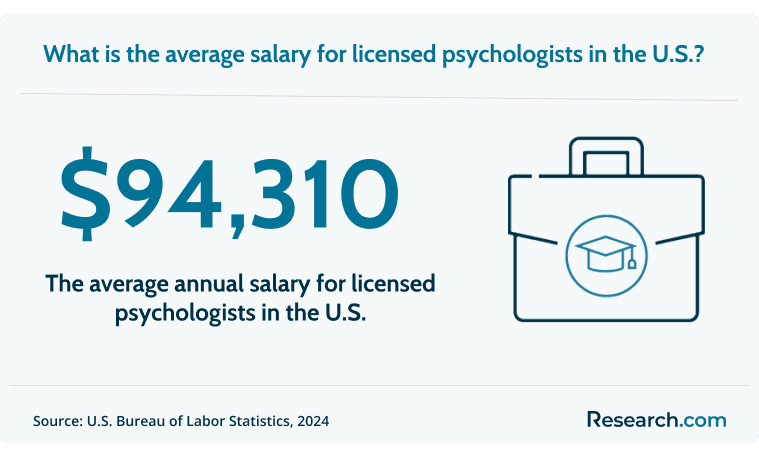
The average salary for licensed psychologists in the U.S. is approximately $94,310 per year, or about $45.34 per hour, according to the latest national data. This figure reflects psychologists across different specialties, locations, experience levels, and employment settings, so it should be treated as a broad benchmark rather than a guaranteed outcome.
Pay can differ significantly between clinical practice, school settings, hospitals, government roles, private practice, research, consulting, and corporate environments. The comparison between psychiatrist vs psychologist salary also matters for students deciding between mental health careers because psychiatrists complete medical training and can prescribe medication, which often affects compensation.
Salary can be influenced by several factors, including:
- Specialization, such as clinical, counseling, forensic, industrial-organizational, or neuropsychology
- Years of experience and level of responsibility
- Work setting, including private practice, hospitals, government agencies, schools, academia, or corporate employers
- Geographic location and local cost of living
- Degree level, licensure status, and additional credentials
- Demand for services among specific populations or in specialized practice areas
What courses are typically offered in an online psychology degree?
Online psychology programs usually combine foundational theory, research methods, human development, behavior, ethics, and applied electives. Bachelor’s programs tend to build broad knowledge, while graduate programs typically go deeper into assessment, research, counseling theory, specialization, or supervised practice.
Course names vary by school, but these subjects are common in many online psychology degrees:
- Introduction to Psychology: This survey course introduces major theories, research areas, and concepts such as perception, learning, emotion, personality, cognition, and social behavior. It also gives students a base for specialized paths, including those researching how to become a military psychologist.
- Abnormal Psychology: Students examine psychological disorders such as anxiety, depression, and schizophrenia, including symptoms, possible causes, diagnostic frameworks, and treatment approaches.
- Developmental Psychology: This course studies physical, cognitive, emotional, and social development from infancy through older adulthood.
- Research Methods in Psychology: Students learn how psychological studies are designed, how data is collected, and how research findings are evaluated. Many versions also introduce statistics and ethical research practices.
- Social Psychology: This class explores how people think, behave, and make decisions in social contexts. Topics may include group behavior, prejudice, conformity, persuasion, and relationships.
- Cognitive Psychology: Students study mental processes such as attention, memory, decision-making, language, problem-solving, and perception.
- Ethics in Psychology: This course covers professional responsibilities in research and practice, including confidentiality, informed consent, boundaries, legal issues, and responsible conduct.
Students who want an advanced clinical mental health role but are also interested in nursing-based practice may compare psychology graduate pathways with cheapest online PMHNP certificate programs. That route is different from psychology licensure, so applicants should review accreditation, admission requirements, nursing prerequisites, and state licensure rules carefully.
What job roles can I get with an online psychology degree?
An online psychology degree can lead to different careers depending on the degree level. A bachelor’s degree may support entry-level roles in human services, business, research support, case management, or human resources. Counseling and psychologist roles usually require graduate education, supervised experience, and state licensure.
| Job role | Average salary estimate | Typical work | Education or credential note |
| Licensed Psychologist | $94,310 | Evaluates, diagnoses, and treats mental health, emotional, and behavioral concerns through assessment, therapy, and evidence-based interventions. | Typically requires a PhD or PsyD, supervised experience, and state licensure. |
| Mental Health Counselor | $59,190 | Supports individuals, couples, families, or groups dealing with emotional, behavioral, or mental health challenges. | Usually requires a relevant graduate degree and licensure, depending on the state and role. |
| Human Resources Specialist | $72,910 | Applies knowledge of motivation, communication, and workplace behavior to recruiting, employee relations, performance processes, and policy support. | A bachelor’s degree may qualify applicants for many entry-level HR roles. |
| Market Research Analyst | $76,950 | Studies consumer behavior, survey results, and market trends to help organizations make product, messaging, and strategy decisions. | Psychology graduates with statistics, research, and data skills may be competitive. |
| Social and Community Service Manager | $61,330 | Coordinates programs in areas such as mental health, family services, youth outreach, or community support. | Experience in social services and program administration is often important. |
| Industrial-Organizational Psychologist | $147,420 | Uses psychological principles to improve hiring, training, leadership, employee engagement, assessment, and organizational performance. | Advanced graduate training is typically expected for psychologist-level roles. |
Some psychology students also consider shorter healthcare credentials if they want faster entry into patient-facing work. If that applies to you, compare psychology pathways with what jobs can you get with a medical assistant certificate before committing to a longer academic route.
What student support services are available in online psychology programs?
Strong online psychology programs do more than post lectures and assignments. They provide academic advising, technical help, library access, tutoring, career guidance, writing support, faculty office hours, and clear communication channels. For graduate students, support with practicum or internship placement can be especially important.
Students should also look for mental health resources, disability accommodations, peer discussion opportunities, alumni networks, and professional development events. If your interest is family systems, counseling, or relational therapy, reviewing affordable online marriage and family therapy programs can help you compare psychology with related licensure-oriented paths.
| Support service | Why it matters in an online psychology program | Question to ask the school |
| Academic advising | Helps you choose courses that match graduation, transfer, graduate school, or licensure goals. | Will I have a dedicated advisor familiar with psychology pathways? |
| Career services | Supports resume writing, interview preparation, internships, and job searches. | Do online students receive the same career support as campus students? |
| Field placement support | Critical for programs with practicum, internship, or supervised experience requirements. | Does the school help locate approved placements near where I live? |
| Faculty access | Psychology students often need feedback on writing, research, ethics, and career planning. | How do online students meet with instructors outside class? |
| Technical and library support | Online students rely heavily on stable platforms, databases, journals, and research tools. | Is support available during evenings or weekends? |
Is an online psychology degree worth the investment?
An online psychology degree can be worth it when the program is accredited, reasonably priced, aligned with your career plan, and realistic for your schedule. It may be a strong option for students who need flexibility, want to keep working, or cannot relocate for school. However, the value depends heavily on degree level and career target.
A bachelor’s degree in psychology is versatile, but it does not by itself qualify graduates to become licensed psychologists. Students who want clinical authority, independent practice, or psychologist licensure must plan for graduate education and supervised experience. Students who want business, HR, research support, social services, or community roles may find that a bachelor’s or master’s degree provides a useful foundation.
Factors that can make an online psychology degree a stronger investment include:
- Accreditation: Recognized institutional accreditation, and APA accreditation when relevant, can affect licensure, graduate admissions, credit transfer, and employer confidence.
- Clear career goals: The degree should match the requirements of the job you actually want, especially if licensure is involved.
- Manageable cost and flexible scheduling: Online study may allow students to continue working while earning a degree. This can matter even more for advanced study, including psychology PhD programs.
- Transfer and graduate school options: Credits from accredited institutions are more likely to be considered by other schools, although transfer is never automatic.
- Practical experience: Internships, research projects, fieldwork, and supervised placements can improve the degree’s career value.
Some students eventually decide that psychology is not the best match for their long-term goals. If you are weighing management, consulting, organizational leadership, or business roles, comparing psychology pathways with MBA benefits can clarify whether a behavioral science degree or business degree offers the better return for your plans.
Common mistakes to avoid when choosing an online psychology degree
- Choosing a program before verifying institutional accreditation.
- Assuming an online bachelor’s degree qualifies you to become a licensed psychologist.
- Ignoring state licensure rules until after graduation.
- Comparing tuition only, without checking fees, residency costs, textbooks, technology requirements, and lost work time.
- Enrolling in an accelerated program without considering the weekly workload.
- Assuming the school will automatically find practicum or internship placements near you.
- Relying only on rankings instead of reviewing curriculum, faculty, student support, outcomes, and licensure alignment.
What is the job outlook for psychologists in the U.S. within the next 10 years?
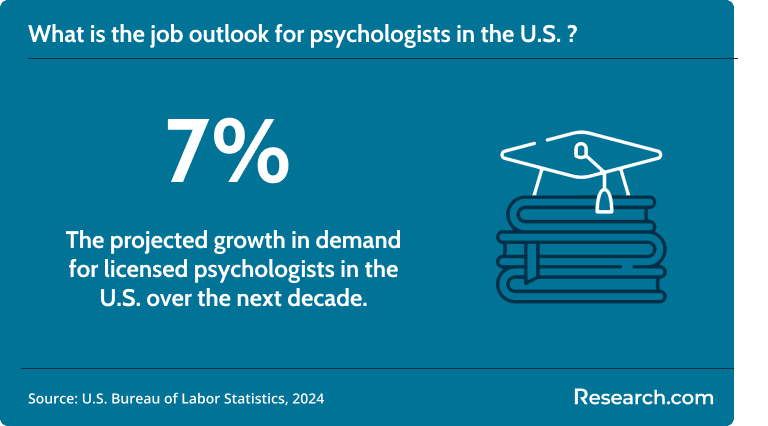
The employment outlook for psychologists in the U.S. is favorable. Overall employment is projected to grow 7 percent from 2023 to 2033, which is faster than the average for all occupations. Demand is expected to come from schools, hospitals, mental health centers, social service agencies, and other settings where psychological services are needed.
About 13,000 job openings for psychologists are projected each year over the next decade. These openings are expected to result from both new jobs and the need to replace workers who retire or move into other occupations. Opportunities may be stronger for candidates with advanced degrees, specialized training, and willingness to work in areas with limited access to mental health services.
Psychology is also becoming more interdisciplinary. Some professionals use data and mapping tools to study public health, access to services, behavioral patterns, and community needs. Students interested in those applications may want to explore the best GIS degree programs as a complement to psychology training.
Here’s what graduates have to say about their online psychology degrees:
-
: "
I wanted to study psychology for years, but a campus schedule did not work with my job. The online format let me keep working while completing my classes, and I did not feel as if I had to pause my life to earn the degree. The flexibility helped me spend more time with the material, participate when I was prepared, and connect what I learned to my work. I finished with more confidence in my ability to apply psychological ideas in real situations. — Bobby
"
-
: "
What surprised me most was how connected the online classroom felt. I worked with classmates in different locations, and their perspectives made discussions much more valuable. My professors were responsive and available for conversations, so I never felt like I was learning completely on my own. — Michael
"
-
: "
With a full-time job and family responsibilities, online study made the degree possible. I could build schoolwork into my schedule instead of rearranging everything around campus meetings. The coursework also changed how I understood people, stress, coping, and mental health, which helped me professionally and personally. — Sandra
"
What specialized tracks can I pursue with an online psychology degree?
Many online psychology programs allow students to choose electives, concentrations, or formal tracks that align with career interests. Common areas include clinical psychology, counseling psychology, developmental psychology, forensic psychology, sports psychology, industrial-organizational psychology, and neuropsychology. Availability varies widely by school and degree level.
Students interested in psychology’s connection to law, investigation, and criminal behavior may compare general psychology programs with forensic psychology master's programs. A specialization can help focus your coursework, but it should be chosen based on job requirements, licensure implications, and whether the program includes the applied training expected in your field.
| Specialization | What it focuses on | Career direction to research |
| Clinical or counseling psychology | Mental health assessment, therapy, diagnosis, ethics, and treatment models | Licensed psychologist, therapist, counselor, or doctoral study pathways |
| Forensic psychology | Psychology in legal, correctional, investigative, and court-related settings | Forensic casework, victim services, corrections, or graduate study |
| Industrial-organizational psychology | Workplace behavior, hiring, leadership, employee assessment, and organizational change | HR analytics, talent development, consulting, or I-O psychology roles |
| Developmental psychology | Human growth, learning, behavior, and change across the lifespan | Education, child services, aging services, research, or graduate study |
| Sports psychology | Performance, motivation, mindset, stress, and behavior in athletic contexts | Coaching support, performance consulting, or advanced specialized training |
How can I evaluate the quality and fit of online PsyD programs for my career goals?
Online PsyD programs require especially careful review because students are often preparing for clinical practice, licensure, and supervised professional work. Before applying, check accreditation, faculty qualifications, clinical training structure, residency requirements, internship expectations, technology support, and whether the curriculum aligns with your state’s licensure rules.
Ask each program for licensure outcomes, internship match information, student support details, and clinical placement policies. Speaking with current students or alumni can also reveal whether the program delivers the support promised on its website. For a broader comparison of options, review Research.com’s guide to online PsyD programs.
Questions to ask before enrolling in an online psychology program
- Is the institution accredited by a recognized accrediting body?
- Does the program meet education requirements for my intended career and state?
- Will I need a practicum, internship, residency, or supervised clinical experience?
- Does the school help online students secure approved field placements?
- Are online students taught by the same faculty as campus students?
- What student support services are available outside standard business hours?
- How much will the full program cost after tuition, fees, books, technology, travel, and residency expenses?
- What are the graduation, licensure, and career outcomes for recent students?
Key Insights
- Online psychology degrees can be legitimate and respected, but only when the institution is properly accredited and the program fits the student’s academic or licensure goal.
- The average salary for licensed psychologists in the U.S. is $94,310 per year, but earnings vary by specialization, setting, location, experience, and credentials.
- Employment for psychologists is projected to grow 7 percent from 2023 to 2033, with about 13,000 job openings expected each year over the decade.
- A bachelor’s degree in psychology can support entry-level and graduate-school pathways, but becoming a licensed psychologist generally requires doctoral education, supervised experience, and state licensure.
- Online programs are best for students who need flexibility and can manage independent learning; campus or hybrid programs may suit students who want more face-to-face structure.
- Before enrolling, verify accreditation, licensure alignment, field placement support, total cost, and student services. Do not rely on delivery format or rankings alone.
References:
- Bellevue University. (n.d.). How Long Does It Take to Earn a Degree in Psychology? Bellevue University
- Northeastern University. (2023). Educational credentials come of age: A survey on online learning and workforce readiness. Northeastern University
- U.S. Bureau of Labor Statistics. (2024). OOH: Psychologists. U.S. BLS
Other Things You Should Know About Online Psychology Degrees
In 2027, employment opportunities for graduates with online psychology degrees are comparable to those with traditional degrees. Employers are increasingly recognizing the credibility of accredited online programs, focusing on candidates' skills and experiences rather than the mode of their education.
Yes, if the program is accredited and meets the state board’s education rules. In most U.S. states, licensure requires a doctoral degree, supervised clinical hours, and passing the Examination for Professional Practice in Psychology (EPPP), plus any state-specific jurisprudence exam.





