
2027 Most Affordable Online Master's Degrees in Forensic Psychology

Co-Founder and Chief Data Scientist
The path to becoming a forensic psychologist can be daunting, especially when considering the cost of a graduate degree. Traditional on-campus programs can be expensive, and juggling work, family, and financial obligations can make them seem out of reach.
The rise of online education offers a compelling alternative. However, navigating the online landscape and choosing the most affordable program that meets your academic needs and career goals can feel like a labyrinth. In this guide, I will discuss the common challenges students face when searching for the right online program, equip you with key questions to ask, and ultimately steer you toward the most affordable path to your forensic psychology aspirations.
What are the benefits of getting an affordable online master’s in forensic psychology?
- You could work as a probation officer, correctional counselor, criminal analyst, victim advocate, or jury consultant.
- Forensic psychologists earn a base salary ranging from $38,000 to $75,000.
- An online master's program in forensic psychology that is reasonably priced can provide you with an invaluable foundation in the application of psychological principles to legal issues.
What can I expect from an affordable online master’s in forensic psychology?
An affordable online master's in forensic psychology can equip you with a valuable foundation in applying psychological principles to legal matters. The program can prepare you for careers in related fields like mental health counseling in forensic settings, victim advocacy, or research assistant roles.
You will gain a solid understanding of core forensic psychology principles, criminal behavior, legal issues, and psychological assessment. The program will hone your critical thinking, research, writing, and analytical skills applicable to various forensic psychology-related careers.
An affordable online master's program can be a stepping stone for doctoral studies, typically required for full licensure as a forensic psychologist.
Where can I work with an affordable online master’s in forensic psychology?
An affordable online master's degrees in forensic psychology can equip you for various rewarding careers in the legal system and related fields. You can work as a probation officer, correctional counselor, crime analyst, victim advocate, and jury consultant.
Mental health fields with forensic applications, research, and consulting, are also among the potential career paths that you can pursue.
How much can I make with an affordable online master’s in forensic psychology?
While an online master's typically doesn't qualify you for full licensure as a forensic psychologist (usually requiring a doctoral degree), it can position you for careers with various salary ranges.
| Probation Officer | $45,000 - $65,000 |
| Correctional Counselor | $40,000 - $60,000 |
| Mental Health Counselor in Forensic Settings | $48,000 - $70,000 |
| Addiction Counselor | $42,000 - $62,000 |
| Crime Analyst | $50,000 - $75,000 |
| Victim Advocate | $38,000 - $58,000 |
- 2027 List of the Most Affordable Online Master’s Degrees in Forensic Psychology Affordable Programs
- How long does it take to complete an affordable online master’s in forensic psychology program? Completion Time
- How does an affordable online master’s in forensic psychology compare to an on-campus program? How does an affordable online master’s in forensic psychology compare to an on-campus program?
- What is the average cost of an affordable online master’s in forensic psychology program? Average Cost
- What are the financial aid options for students enrolling in an affordable online master’s in forensic psychology program? Financial Aid
- Why choose accredited online colleges that accept FAFSA? Why choose accredited online colleges that accept FAFSA?
- What are the prerequisites for enrolling in an affordable online master’s in forensic psychology program? Requirements
- What courses are typically in an affordable online master’s in forensic psychology program? What courses are typically in an affordable online master’s in forensic psychology program?
- What types of specializations are available in an affordable online master’s in forensic psychology programs? What types of specializations are available in an affordable online master’s in forensic psychology programs?
- How do you choose the most affordable online master’s in forensic psychology program? How do you choose the most affordable online master’s in forensic psychology program?
- How Do Online Forensic Psychology Programs Address Ethical Challenges? How Do Online Forensic Psychology Programs Address Ethical Challenges?
- How Can Networking and Mentorship Opportunities Enhance Your Online Forensic Psychology Education? How Can Networking and Mentorship Opportunities Enhance Your Online Forensic Psychology Education?
- Is an affordable online master's in forensic psychology worth the investment? Is an affordable online master's in forensic psychology worth the investment?
- What additional certifications can enhance my forensic psychology career? What additional certifications can enhance my forensic psychology career?
- Can an affordable online master’s in forensic psychology pave the way to a doctoral degree? Can an affordable online master’s in forensic psychology pave the way to a doctoral degree?
- What career paths are available for graduates of an affordable online master’s in forensic psychology programs? What career paths are available for graduates of an affordable online master’s in forensic psychology programs?
- What is the job market for graduates with an affordable online master’s in forensic psychology? Job Market
- What skills are essential for success in an online master’s in forensic psychology program? What skills are essential for success in an online master’s in forensic psychology program?
- How quickly can you complete a master's in forensic psychology? How quickly can you complete a master's in forensic psychology?
- How Technology Enhances Online Forensic Psychology Programs How Technology Enhances Online Forensic Psychology Programs
- Can an Accelerated Learning Approach Boost Your Forensic Psychology Career? Can an Accelerated Learning Approach Boost Your Forensic Psychology Career?
2027 Most Affordable Online Master’s Degrees in Forensic Psychology: Costs, Timelines, and How to Choose
An online master’s in forensic psychology can be a practical next step if you want to apply psychology to criminal justice, courts, corrections, victim services, threat assessment, or forensic mental health settings. The key decision is not simply which program is cheapest. You also need to know whether the degree fits your career goal, whether the school is properly accredited, how much the full program will cost, and whether the curriculum includes the legal, assessment, ethics, and research training employers or doctoral programs may expect.
This guide is designed for working adults, recent psychology or criminal justice graduates, and career changers comparing affordable online forensic psychology master’s programs. You will find ranked program options, cost and credit comparisons, admissions requirements, online-versus-campus trade-offs, financial aid considerations, career paths, common mistakes, and questions to ask before enrolling.
Quick answer: What is the most affordable online master’s in forensic psychology?
Based on the programs listed in this guide, affordable online master’s degrees in forensic psychology typically cost between $477 and $1,227 per credit hour and commonly require 30 to 60 credits. Completion time can range from 16 months to three years, depending on course load, transfer credits, and whether you study full time or part time. The lowest per-credit option listed is the University of Louisiana at Monroe at $477 - $900 per credit, followed by Purdue Global at $510 and the University of North Dakota at $528 - $1,110.
For most students, the best-value program is the one that balances total cost, accreditation, curriculum fit, faculty support, internship or applied learning opportunities, and compatibility with long-term goals such as doctoral study, licensure, public-sector employment, or forensic consulting.
How Research.com ranks schools
Research.com evaluates online programs using a transparent ranking process. You can review our full methodology to understand how schools are assessed and how affordability, institutional quality, and program data are considered.
Our research draws from established education data sources, including the IPEDS database, Peterson's database and its Distance Learning Licensed Data Set, the College Scorecard database, and the National Center for Education Statistics. Rankings should be used as a starting point, not as the only factor in your decision.
Most affordable online master’s degrees in forensic psychology at a glance
| Rank | School | Online degree | Credits | Cost per credit | Typical completion time | Accreditation |
| 1 | University of North Dakota | Master of Science in Applied Psychology with a Forensic Specialization | 30 | $528 - $1,110 | 2 years full-time; up to 6 years part-time | The Higher Learning Commission (HLC) |
| 2 | University of Louisiana at Monroe | Master of Arts in Criminal Justice with a concentration in Forensic Psychology | 36 | $477 - $900 | 1.5 - 2 years | Southern Association of Colleges and Schools Commission on Colleges (SACSCOC) |
| 3 | Arizona State University | Master of Science in Forensic Psychology | 36 | $744 - $1,488 | 2 years full-time; 3-5 years part-time | Higher Learning Commission (HLC) |
| 4 | Capella University | Master of Science in Forensic Psychology | 54 | $558 | 2.5 years | The Higher Learning Commission (HLC) |
| 5 | Liberty University | Master of Arts in Psychology with a Forensic Psychology Specialization | 60 | $590 | 2 years full-time | Southern Association of Colleges and Schools Commission on Colleges (SACSCOC) |
| 6 | Nova Southeastern University | Master of Science in Forensic Psychology | 36 | $1,227 | 1.5 - 2 years full-time or part-time | Southern Association of Colleges and Schools Commission on Colleges (SACSCOC) |
| 7 | Purdue Global | Master of Arts in Psychology with a Forensic Psychology Specialization | 48 | $510 | 1.5 - 3 years with flexible pacing | The Higher Learning Commission (HLC) |
| 8 | Touro University Worldwide | Master of Science in Forensic Psychology | 36 | $990 | 18 months | Western Association of Schools and Colleges Senior College and University Commission (WASC CUC) |
| 9 | Southern New Hampshire University | Master of Science in Psychology with a concentration in Forensic Psychology | 36 | $775 | 2 years full-time | New England Commission of Higher Education (NECHE) |
| 10 | National University | Master of Science in Forensic Psychology | 36 | $795 | 16 months | Accrediting Commission for Education in Psychology (ACEP) |
1. University of North Dakota
The University of North Dakota offers an online Master of Science in Applied Psychology with a Forensic Specialization. The program, launched in 2018, is built for professionals who want graduate-level psychology training with a focus on forensic applications. Courses are delivered asynchronously, which can help students manage graduate coursework alongside employment or family responsibilities.
- Program length: 2 years full-time; can be extended up to 6 years part-time
- Tracks or concentrations: Forensic Specialization
- Cost per credit: $528 - $1,110
- Required credits: 30
- Accreditation: The Higher Learning Commission (HLC)
2. University of Louisiana at Monroe
The University of Louisiana at Monroe provides an online Master of Arts in Criminal Justice with a concentration in Forensic Psychology. Established in 2015, the program may appeal to students who want to work at the intersection of criminal justice, psychology, corrections, and legal systems. Coursework is primarily online, with possible video conferencing components that add real-time interaction.
- Program length: 1.5 - 2 years
- Tracks or concentrations: Concentration in Forensic Psychology
- Cost per credit: $477 - $900
- Required credits: 36
- Accreditation: Southern Association of Colleges and Schools Commission on Colleges (SACSCOC)
3. Arizona State University
Arizona State University’s online Master of Science in Forensic Psychology focuses on criminal behavior, legal psychology, and the use of psychological knowledge in justice-related settings. Established in 2019, the program is intended for students interested in assessment, consultation, research, or related forensic psychology roles. Courses are asynchronous, with faculty interaction and collaborative learning opportunities built into the online format.
- Program length: 2 years full-time; 3-5 years part-time
- Tracks or concentrations: Forensic Psychology
- Cost per credit: $744 - $1,488
- Required credits: 36
- Accreditation: Higher Learning Commission (HLC)
4. Capella University
Capella University offers an online Master of Science in Forensic Psychology designed for adult learners who need scheduling flexibility. Launched in 2012, the program covers core forensic psychology concepts through a format that may combine asynchronous study with synchronous interaction.
- Program length: 2.5 years
- Tracks or concentrations: Forensic Psychology
- Cost per credit: $558
- Required credits: 54
- Accreditation: The Higher Learning Commission (HLC)
5. Liberty University
Liberty University’s online Master of Arts in Psychology with a Forensic Psychology Specialization is structured for students who want to study forensic psychology within a Christian academic framework. Established in 2010, the program uses asynchronous online coursework, discussion activities, and faculty interaction.
- Program length: 2 years full-time
- Tracks or concentrations: Forensic Psychology
- Cost per credit: $590
- Required credits: 60
- Accreditation: Southern Association of Colleges and Schools Commission on Colleges (SACSCOC)
6. Nova Southeastern University
Nova Southeastern University’s online Master of Science in Forensic Psychology examines legal issues, criminal justice, and psychological assessment in forensic contexts. Established in 2017, the program is designed for students considering forensic evaluation, consultation, research, or related roles. Online coursework is asynchronous, with opportunities for webinars and faculty engagement.
- Program length: 1.5 - 2 years full-time or part-time
- Tracks or concentrations: Forensic Psychology in the Legal System; Forensic Psychology for Mental Health Workers, First Responders, and Disaster Teams
- Cost per credit: $1,227
- Required credits: 36
- Accreditation: Southern Association of Colleges and Schools Commission on Colleges (SACSCOC)
7. Purdue Global
Purdue Global’s online Master of Arts in Psychology with a Forensic Psychology Specialization gives students a graduate foundation in legal psychology, criminal behavior, and psychology in justice-related environments. Launched in 2013, the program is geared toward working adults and uses a flexible online format with both asynchronous and synchronous elements.
- Program length: 1.5 - 3 years with flexible pacing
- Tracks or concentrations: Forensic Psychology
- Cost per credit: $510
- Required credits: 48
- Accreditation: The Higher Learning Commission (HLC)
8. Touro University Worldwide
Touro University Worldwide offers an online Master of Science in Forensic Psychology for professionals who want to apply psychological concepts to legal and criminal justice issues. Established in 2011, the program is primarily online and includes opportunities for interaction with instructors and classmates.
- Program length: 18 months
- Tracks or concentrations: Forensic Psychology
- Cost per credit: $990
- Required credits: 36
- Accreditation: Western Association of Schools and Colleges Senior College and University Commission (WASC CUC)
9. Southern New Hampshire University Online
Southern New Hampshire University offers an online Master of Science in Psychology with a concentration in Forensic Psychology. Launched in 2010, the program is fully online and asynchronous, making it a flexible option for students who need to fit graduate study around existing responsibilities.
- Program length: 2 years full-time
- Tracks or concentrations: Forensic Psychology
- Cost per credit: $775
- Required credits: 36
- Accreditation: New England Commission of Higher Education (NECHE)
10. National University
National University’s online Master of Science in Forensic Psychology explores criminal behavior, mental health assessment, and legal psychology. Established in 2009, the program is designed for working adults interested in forensic assessment, consultation, research, or legal-system roles. Courses are mainly asynchronous, with opportunities for one-on-one faculty mentor interaction.
- Program length: 16 months
- Tracks or concentrations: General Forensic Psychology; Threat Assessment and Management
- Cost per credit: $795
- Required credits: 36
- Accreditation: Accrediting Commission for Education in Psychology (ACEP)
How long does it take to complete an affordable online master’s in forensic psychology program?
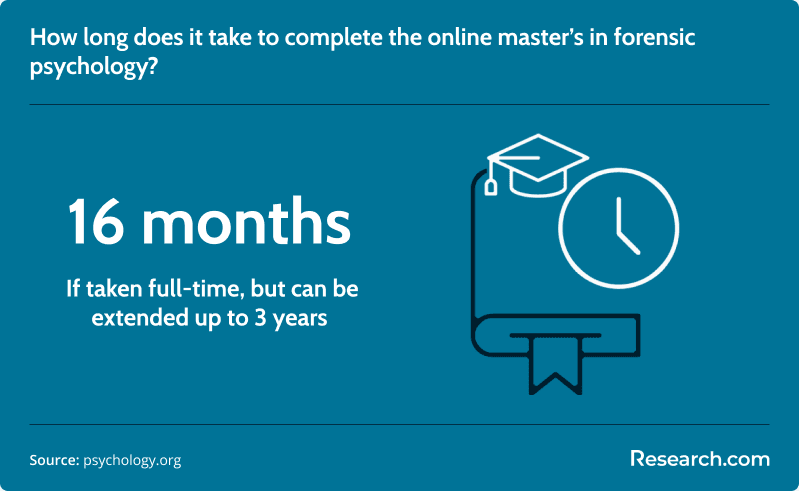
Most online master’s programs in forensic psychology take 16 months to three years to complete. The actual timeline depends on the number of required credits, whether you enroll full time or part time, the availability of accelerated courses, and whether the school accepts transfer graduate credits.
Programs in this guide require 30 to 60 credits. A 30-credit program can usually be completed faster than a 54- or 60-credit program, but credit count is not the only factor. Term length, course sequencing, capstone requirements, and whether classes are offered every term can also affect graduation timing.
| Enrollment pace | Typical time range | Best for | Trade-off |
| Accelerated full-time | 16 months to 18 months | Students who can handle a heavy academic schedule | Less flexibility and a faster workload |
| Standard full-time | About 2 years | Students who want steady progress without the most compressed pace | May require careful planning if working full time |
| Part-time | 3 years or longer | Working adults, caregivers, and students with variable schedules | Longer time to completion and possible additional fees over time |
| Extended part-time | Up to 6 years in some programs | Students who need maximum scheduling flexibility | Requires strong long-term motivation and attention to program completion limits |
How does an affordable online master’s in forensic psychology compare to an on-campus program?
Online and campus-based forensic psychology master’s programs often cover similar academic foundations: psychology and law, criminal behavior, forensic assessment, legal and ethical issues, victimology, and research methods. The more important difference is how you learn, how much flexibility you need, and whether the program gives you access to applied experience.
An online program may be the better fit if you need to keep working, cannot relocate, or want to reduce costs tied to commuting and housing. Students comparing broader graduate psychology options can also review masters psychology online programs to understand how forensic psychology fits within the wider psychology degree market.
For the academic year 2023-24, student housing increased by 3.7% to $12,770. Avoiding relocation or campus housing can make online study financially attractive, although online programs may still charge technology fees, residency fees, or course materials costs.
Campus programs may be stronger for students who want in-person research assistantships, supervised field placements, lab-based training, or direct networking with local courts, correctional facilities, hospitals, and community agencies. If you are aiming for doctoral study or future clinical licensure, ask each online program how it supports research experience, supervised practice, and faculty mentorship.
| Factor | Online master’s in forensic psychology | On-campus master’s in forensic psychology |
| Scheduling | Often asynchronous or partially asynchronous; easier to fit around work | Requires set class times and may require commuting or relocation |
| Cost profile | Can reduce housing and transportation expenses | May include higher living and commuting costs |
| Applied learning | Varies widely; some programs require students to arrange local opportunities | May offer easier access to campus-based research, practicum, or local partnerships |
| Networking | Depends on virtual events, discussion forums, faculty access, and alumni networks | Often more natural through campus events, labs, and local agency connections |
| Best fit | Working adults, remote learners, and students prioritizing flexibility | Students who want face-to-face mentoring and local field experiences |
What is the average cost of an affordable online master’s in forensic psychology program?
The average cost of an online master’s in forensic psychology program typically ranges from $11,000 to $27,000. Among the programs listed here, per-credit tuition ranges from $477 to $1,227, and required credits range from 30 to 60. Because tuition is usually charged by credit hour, a lower per-credit rate does not always mean a lower total cost if the program requires significantly more credits.
Students comparing psychology graduate programs should calculate total estimated tuition, not just advertised per-credit cost. Some of the cheapest masters in psychology options may also include accelerated formats, transfer credit policies, or employer tuition benefits that reduce the final out-of-pocket cost.
Online graduate programs may also charge technology fees, graduation fees, course materials fees, residency fees, or assessment fees. Before enrolling, request a full program cost estimate in writing. If you are still comparing degree types, reviewing the best online master programs can help you see how forensic psychology compares with other online graduate fields.
| Cost item | Why it matters | Question to ask the school |
| Per-credit tuition | Determines the base tuition cost | Is the quoted rate the same for online, out-of-state, and part-time students? |
| Required credits | Affects the total program price | How many credits are required after transfer credit review? |
| Fees | Can increase the real cost beyond tuition | Are there technology, assessment, residency, graduation, or clinical placement fees? |
| Books and materials | Costs vary by course and term | Are digital materials included, optional, or billed separately? |
| Time to completion | Longer enrollment can increase total expenses | Are courses available every term, and what happens if I need to pause? |
| Financial aid eligibility | Federal aid access depends on institutional eligibility and student status | Does the program participate in FAFSA-based aid, and what enrollment level is required? |
What financial aid options are available for online forensic psychology master’s students?
In 2022-23, the average aid per full-time equivalent (FTE) graduate student was $28,300. If affordability is your top concern, start with the FAFSA and compare aid packages alongside the cheapest online masters degree options. A low-tuition program is helpful, but the best financial choice may be the program that gives you the lowest net cost after scholarships, grants, employer support, and manageable borrowing.
- Direct Unsubsidized Loans: These federal loans are available to eligible graduate students and are not based on financial need. Interest accrues after disbursement, so students should borrow only what they need.
- Direct PLUS Loans: Graduate and professional students may use PLUS loans to cover costs not met by other aid. These loans are unsubsidized and typically have higher borrowing limits than Direct Unsubsidized Loans.
- Federal grants and service-based aid: Grant aid is less common at the graduate level than at the undergraduate level. Students should check federal, state, institutional, and service-based programs for eligibility.
- State grants: Some states offer graduate aid programs. Availability and eligibility vary, so contact your state financial aid agency.
- University scholarships: Many schools offer scholarships or tuition discounts for online graduate students, alumni, military-affiliated students, public-sector employees, or high-achieving applicants.
- Professional association scholarships: Organizations such as the American Psychological Association (APA) and affiliated groups may offer scholarships, awards, or research funding for psychology students.
- Employer tuition assistance: If you work in corrections, law enforcement, social services, behavioral health, or government, ask whether your employer reimburses graduate tuition.
This chart shows the percentage of forensic psychologists and their second specialization.
Why should you choose an accredited online college that accepts FAFSA?
Choosing one of the accredited online colleges that accept FAFSA matters for two reasons: quality assurance and aid access. Accreditation helps confirm that a college meets recognized academic and administrative standards, while FAFSA participation may allow eligible students to access federal student aid.
Accreditation helps protect the value of your degree
Institutional accreditation indicates that a college has gone through external review. For students, this can affect credit transfer, employer recognition, financial aid eligibility, and admission to future doctoral programs. Forensic psychology master’s programs may not all have specialized programmatic accreditation, so institutional accreditation is a baseline requirement you should verify before applying.
FAFSA access can reduce immediate financial pressure
FAFSA-participating schools can offer eligible students federal loans and, in some cases, access to other institutional or state aid programs. This does not mean the program is automatically affordable. It means you can compare net cost after aid rather than judging programs by tuition alone.
Student support matters in online programs
Accredited online colleges often provide academic advising, library access, technical support, writing help, and career services. These services are especially important in forensic psychology because students may need guidance on doctoral preparation, research experience, field placement options, and career paths that do or do not require licensure.
Questions to ask about accreditation and aid
- Is the institution accredited by a recognized accrediting agency?
- Does the online forensic psychology program qualify for federal student aid?
- What is the total cost after scholarships, discounts, and fees?
- Will credits transfer if I later pursue a doctorate?
- Does the program meet any requirements for my intended career or state credential?
What are the prerequisites for enrolling in an affordable online master’s in forensic psychology program?
Admissions requirements vary by school, but most online forensic psychology master’s programs expect applicants to show readiness for graduate-level work in psychology, criminal justice, research, writing, and ethical decision-making. Based on APA data, 71% of psychologists specializing in forensic psychology are engaged in individual practice, which underscores why strong academic preparation and professional judgment matter in this field.
Students considering counseling licensure should be especially careful. A forensic psychology master’s is not the same as a counseling degree, and applicants comparing licensure-oriented options may also want to review cheapest CACREP accredited programs online.
- Bachelor’s degree: Programs generally require a bachelor’s degree from an accredited college or university. Psychology is a common background, but criminal justice, sociology, social work, or related fields may also be accepted.
- Minimum GPA: Many programs expect a GPA around 3.0, often measured in the last 60 credit hours of undergraduate study or in previous graduate coursework.
- GRE scores: Some programs may request GRE scores, although many online graduate programs no longer require them. When required, preferred scores may be around 300 on the verbal and quantitative sections of the revised GRE.
- Personal statement: Applicants usually explain why they want to study forensic psychology, how the degree fits their goals, and what professional experience they bring.
- Letters of recommendation: Strong recommendations from faculty members, supervisors, or professionals familiar with your writing, judgment, and reliability can strengthen an application.
- Prerequisite coursework: Some programs may prefer or require prior coursework in psychology, statistics, research methods, abnormal psychology, or criminal justice.
What courses are typically included in an online master’s in forensic psychology?
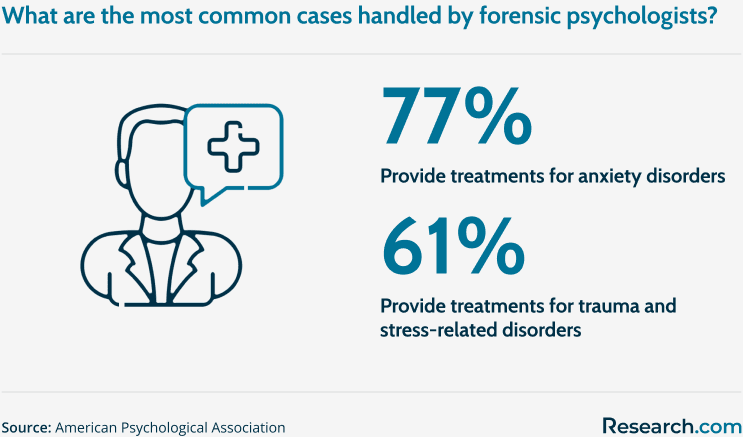
Forensic psychology master’s programs teach students how psychological science applies to legal questions, criminal behavior, victim experiences, corrections, risk assessment, and ethical practice. Among forensic psychologists, 77% reported that anxiety disorders are among their most frequently provided treatments, followed by trauma and stress-related disorders at 61%, so many programs also address mental health concerns common in forensic settings.
- Psychology and law: This course examines how psychological concepts interact with legal standards, court processes, competency issues, expert testimony, and mental health questions in legal contexts.
- Criminal behavior: Students study theories of crime, risk factors, offender decision-making, and behavioral patterns. In applied research and case analysis, forensic psychologists often find patterns in behavior that may inform prevention, assessment, or intervention.
- Forensic assessment: This course introduces interviewing, psychological testing, evaluation methods, documentation, and report writing for legal or correctional settings.
- Victimology: Students examine the psychological effects of crime, trauma-informed services, victim advocacy, and the role of support systems.
- Legal issues in psychology: Coursework covers confidentiality, informed consent, boundaries, expert witness responsibilities, recordkeeping, and the limits of psychological practice in legal environments.
- Research methods and statistics: Students learn to interpret research, evaluate evidence, and apply empirical findings to forensic questions.
- Ethics in forensic practice: Programs often include scenarios involving dual roles, data privacy, mandated reporting, professional competence, and culturally responsive practice.
What specializations are available in online master’s in forensic psychology programs?
Specializations help students align coursework with a career direction. Only 4% of forensic psychologists specialize solely in the civil field, which suggests that the job outlook for forensic psychologist can include multiple practice and consultation areas rather than one narrow pathway.
| Specialization | What it emphasizes | Best fit for students interested in |
| General Forensic Psychology | Core concepts in psychology, law, assessment, criminal behavior, and expert testimony | Broad forensic roles or preparation for doctoral study, including the best and cheapest online PSYD programs |
| Legal Psychology | Decision-making, competency, eyewitness memory, juries, and legal consultation | Trial consulting, research, legal support, and attorney collaboration |
| Criminology and Criminal Justice | Crime causation, corrections, risk assessment, offender rehabilitation, and justice systems | Corrections, probation, parole, law enforcement support, and criminal psychology careers |
| Victimology | Trauma, crisis response, victim services, advocacy, and restorative justice | Victim advocacy, crisis services, and agencies serving survivors of crime |
| Police Psychology | Officer wellness, crisis intervention, use-of-force decision-making, screening, and stress management | Police departments, public safety agencies, and first responder support roles |
Among psychology specialties, police psychology is one area where mental health knowledge and public safety work intersect. Students interested in this route should ask whether a program includes crisis intervention, organizational psychology, trauma, and consultation training.
How do you choose the most affordable online master’s in forensic psychology program?
In the academic year 2020-21, 1,236 master’s degrees in forensic psychology were conferred based on NCES data. With multiple online options available, students need a decision process that goes beyond rankings. The best program for you should match your career plan, budget, learning style, and future credential requirements.
The same careful comparison applies to related fields such as online masters degree programs in counseling, where accreditation, licensure alignment, and supervised experience can strongly affect career outcomes.
Step-by-step checklist for choosing a program
- Define your career target first. Decide whether you want roles in corrections, victim services, law enforcement support, research, doctoral study, or forensic mental health.
- Verify institutional accreditation. Confirm the school’s accreditation status through an official accreditor or federal database before applying.
- Check whether the degree leads to your intended credential. A forensic psychology master’s may not meet counseling or psychologist licensure requirements. Ask your state licensing board if licensure is part of your plan.
- Compare total cost, not just tuition. Add tuition, fees, books, residency requirements, travel, technology costs, and lost income if you reduce work hours.
- Review the curriculum course by course. Look for forensic assessment, psychology and law, ethics, research methods, criminal behavior, trauma, and legal writing.
- Ask about applied learning. Practicum, internship, capstone, case analysis, research assistantship, or field-based projects can improve career readiness.
- Evaluate faculty expertise. Look for instructors with forensic psychology, correctional mental health, legal consulting, threat assessment, or research experience.
- Confirm online support services. Ask about academic advising, career coaching, library access, writing support, disability accommodations, and technical help.
- Compare completion rules. Ask whether courses are offered year-round, whether you can pause enrollment, and how long you have to finish.
- Request outcomes information. Ask where graduates work, whether alumni pursue doctorates, and what career services are available to online students.
Common mistakes to avoid
| Mistake | Why it can hurt you | Better approach |
| Choosing the lowest per-credit price only | A program with more required credits or added fees can cost more overall | Calculate full program cost from enrollment to graduation |
| Ignoring accreditation | Unaccredited programs can create problems with financial aid, transfer credit, and employer recognition | Verify institutional accreditation before applying |
| Assuming the degree leads to psychologist licensure | Full licensure as a psychologist typically requires a doctoral degree and supervised clinical experience | Check state licensure rules and ask the program directly about credential outcomes |
| Overlooking field experience | Forensic roles often value applied skills, report writing, and real-world exposure | Prioritize programs with practicum, capstone, research, or applied casework opportunities |
| Relying only on rankings | A highly ranked program may not fit your schedule, budget, or career goal | Use rankings as a shortlist, then compare curriculum, support, and outcomes |
| Not asking about online student support | Remote learners need advising, tech help, career guidance, and faculty access | Ask how online students receive the same support as campus students |
How do online forensic psychology programs address ethical challenges?
Ethics is central to forensic psychology because professionals may work with sensitive legal records, vulnerable populations, court-ordered evaluations, confidential mental health information, and high-stakes decisions. Online programs commonly use case studies, scenario-based assignments, policy analysis, and discussion-based exercises to help students apply professional standards to realistic situations.
Important ethics topics include confidentiality, informed consent, dual relationships, data protection, cultural competence, mandated reporting, expert witness boundaries, and the responsible use of psychological assessment information. Digital ethics is also increasingly important because online students and professionals may use virtual platforms, electronic records, remote interviews, and online research tools. Students who want a broader justice-science foundation may also compare a forensic science degree.
How can networking and mentorship improve your online forensic psychology education?
Networking can be harder online, so strong programs create intentional opportunities for students to interact with faculty, alumni, classmates, and professionals in forensic settings. Virtual speaker events, discussion boards, research groups, mentorship programs, and career webinars can help students clarify goals and learn how forensic psychology is used in the field.
Mentorship is especially valuable if you are deciding between employment after the master’s degree and doctoral study. A faculty mentor can help you choose research topics, identify applied opportunities, strengthen doctoral applications, or understand career paths in corrections, victim services, crisis response, legal consultation, or behavioral health. Students comparing related justice-focused programs may also review affordable forensic science colleges.
Is an affordable online master’s in forensic psychology worth the investment?
An affordable online master’s in forensic psychology can be worth it if the degree helps you qualify for a specific role, strengthens your current career, prepares you for doctoral study, or gives you applied skills that employers value. It may not be worth it if you assume the master’s alone will make you a licensed forensic psychologist or guarantee a high-paying clinical role.
To judge return on investment, compare the total cost of attendance with your realistic career plan. Ask whether graduates enter roles you want, whether the degree supports doctoral applications, and whether the curriculum includes practical training in assessment, ethics, research, and legal systems. If speed is a priority, reviewing a master degree in psychology online in an accelerated format may help you compare faster pathways.
Who is this degree best for?
- Students who want graduate training in psychology and law without relocating
- Criminal justice, corrections, victim services, or public safety professionals seeking advancement
- Psychology graduates preparing for doctoral study in forensic, clinical, counseling, or legal psychology
- Working adults who need flexible online coursework
- Students interested in research, policy, assessment support, or forensic consultation roles
Who should consider a different path?
- Students whose main goal is licensed clinical practice and who need a licensure-aligned counseling, social work, or doctoral psychology pathway
- Students who need extensive in-person practicum or supervised clinical hours built directly into the program
- Students who want crime scene investigation rather than psychology-focused legal and behavioral analysis
- Students who cannot commit to intensive reading, writing, research, and ethics-based coursework
What additional certifications can enhance a forensic psychology career?
Supplemental training can strengthen your resume when it aligns with your target role. Useful areas may include forensic interviewing, crisis intervention, trauma-informed care, threat assessment, victim advocacy, correctional counseling, research methods, psychological first aid, or legal writing. Certifications should be chosen carefully: some are professional development credentials, while others may require a license, supervised experience, or a specific degree.
If you plan to move toward clinical leadership, assessment, or doctoral-level practice, you may also want to compare related advanced pathways such as accelerated clinical psychology programs. Always check whether a certification is recognized by employers in your state or field before paying for it.
Can an affordable online master’s in forensic psychology lead to a doctoral degree?
Yes, many students use a forensic psychology master’s as preparation for doctoral study, especially if the program includes research methods, statistics, advanced writing, faculty mentorship, and a thesis or capstone. A master’s can help you clarify your specialization and build a stronger academic profile, but doctoral admissions remain competitive and program-specific.
If your long-term goal is to become a licensed psychologist, teach at the college level, conduct advanced research, or provide independent forensic evaluations where a doctorate is expected, compare doctoral prerequisites early. Exploring an online psychology PhD can help you understand how master’s coursework, research experience, and faculty recommendations may fit into a longer academic pathway.
What career paths are available with an affordable online master’s in forensic psychology?
Around 46% of forensic psychologists hold a doctoral degree. A master’s degree alone may not qualify you for all roles that use the title forensic psychologist, and licensure rules vary by state and job function. However, graduates can pursue several psychology-adjacent, criminal justice, research, advocacy, and behavioral health roles depending on their background, experience, and local requirements.
Students exploring broader careers in forensic psychology should compare job descriptions carefully. Titles, credential requirements, and clinical responsibilities can differ significantly by employer and jurisdiction.
| Career path | Typical responsibilities | Important credential note |
| Probation Officer | Supervise people released from jail or prison, monitor court-ordered conditions, and support rehabilitation plans | Requirements vary by agency and state |
| Correctional Counselor | Provide counseling, case support, and rehabilitation programming in jails, prisons, or correctional facilities | Clinical duties may require state licensure |
| Crime Analyst | Analyze crime data, trends, locations, and patterns to support investigations and prevention strategies | Data analysis skills may be as important as psychology coursework |
| Victim Advocate | Help crime victims access resources, understand court processes, and cope with trauma-related needs | May require advocacy training or agency-specific certification |
| Jury Consultant | Support attorneys with jury selection, case themes, and behavioral insights related to juror decision-making | Often requires strong research, communication, and legal-system knowledge |
| Mental Health Counselor in Forensic Settings | Work with people involved in courts, corrections, diversion programs, or mandated treatment | Counseling roles typically require licensure |
| Forensic Consultant | Assist with psychological questions in legal cases, policy, risk assessment, or program evaluation | Expert testimony or independent assessment may require advanced credentials or licensure |
What is the job market for graduates with an online master’s in forensic psychology?
The Bureau of Labor Statistics (BLS) projects an 8% growth rate for clinical psychology jobs through 2030, which includes forensic psychology. The BLS also projects a 20% growth rate for substance abuse, behavioral, and mental health counselors. These figures suggest continued need for psychology and behavioral health professionals, including in settings that serve justice-involved or trauma-affected populations.
Online degrees are increasingly common, but employer acceptance depends on institutional reputation, accreditation, skills, experience, and whether the program matches the job’s credential requirements. A reputable online degree can be useful for roles in corrections, victim services, research support, policy, advocacy, and forensic mental health environments. However, some positions still require licensure, supervised clinical hours, public-sector testing, or a doctoral degree.
Technology is also changing the field. Forensic psychology students may encounter telehealth, digital records, online assessment tools, virtual simulations, data analytics, and AI-supported research workflows. These tools can improve access and efficiency, but they also raise ethical questions about privacy, bias, documentation, and professional judgment.
What skills are essential for success in an online master’s in forensic psychology program?
Online forensic psychology programs require more than interest in crime and behavior. Students need the discipline to study independently, the judgment to handle sensitive legal and psychological material, and the writing skills to explain complex ideas clearly.
- Time management: Online coursework requires planning, especially if you work full time or have family responsibilities. Weekly schedules, assignment calendars, and early communication with instructors are essential.
- Critical thinking: Forensic psychology involves evidence, legal standards, behavioral theories, and ethical trade-offs. Students must analyze rather than simply memorize.
- Written and oral communication: Reports, case analyses, discussion posts, presentations, and legal-style writing are common. Clear communication is also important for future court, agency, or team-based work.
- Technical proficiency: Students must be comfortable with learning management systems, video conferencing, research databases, online assessments, and digital collaboration tools.
- Research skills: Graduate students need to read empirical studies, evaluate methods, synthesize literature, and apply findings to legal or forensic questions.
- Ethical judgment: Forensic settings often involve confidentiality, public safety, trauma, coercion, and legal consequences. Students must learn to recognize and manage ethical risk.
- Emotional resilience: Coursework may involve violence, trauma, victimization, mental illness, and criminal behavior. Students should be prepared to engage with difficult material professionally.
How quickly can you complete a master’s in forensic psychology?
Some online programs allow motivated students to finish quickly, with listed program lengths as short as 16 months or 18 months. Accelerated programs usually use shorter terms, year-round enrollment, heavier course loads, or tightly sequenced classes.
Fast completion can help students move sooner into roles such as forensic assessment support, victim advocacy, correctional counseling, or crime analysis. However, accelerated study is demanding. Students who rush without building research, writing, and applied experience may graduate faster but feel less prepared for competitive roles or doctoral applications. Students comparing fast online pathways in related behavioral fields may also review the fastest master's in applied behavior analysis online.
When an accelerated program makes sense
- You can study consistently every week without frequent interruptions.
- You already have a psychology, criminal justice, or social science background.
- Your employer supports your schedule or offers tuition assistance.
- You are not relying on the program to provide extensive in-person field experience.
- You understand the workload and have a clear post-graduation plan.
How technology enhances online forensic psychology programs
Technology can make online forensic psychology education more interactive and practice-oriented. Strong programs use learning platforms, digital libraries, video tools, simulations, and online case exercises to help students connect theory with real-world forensic decisions.
- Virtual simulations: Some courses may use scenario-based activities to explore interviews, crisis response, legal decision-making, or case assessment.
- Online databases: Students rely on digital research libraries, case studies, legal materials, and peer-reviewed journals.
- Video conferencing: Live sessions, office hours, guest lectures, and group projects can help online learners build connections.
- Online assessment tools: Digital tools may be used for learning about psychological testing, scoring, documentation, and assessment ethics.
- Collaboration platforms: Group case reviews and research projects may use shared documents, discussion forums, and recorded presentations.
If you want to compare programs beyond affordability, resources on the best online forensic psychology master's programs can help you evaluate curriculum depth, flexibility, and academic fit.
How do faculty credentials and research opportunities strengthen an online forensic psychology education?
Faculty expertise can significantly affect program quality. Instructors with forensic research, legal consulting, correctional mental health, trauma, assessment, or public-sector experience can help students understand how theories are applied in real cases and institutions.
Research opportunities are also important for students considering doctoral study or analytical roles. Look for programs that allow students to complete a thesis, capstone, research project, literature review, or faculty-supported study. If you want to continue into professional psychology training, comparing the most affordable PsyD programs can help you plan beyond the master’s level.
Here’s what graduates say about affordable online master’s programs in forensic psychology
- : "The online format made graduate school possible while I was balancing work and family responsibilities. I could complete assignments around my schedule, but I still felt connected through discussion boards and virtual meetings. The program helped me build the foundation I needed to pursue work in forensic mental health within a correctional setting. — Sarah"
- : "Studying forensic psychology online renewed my interest in criminal justice. Courses on criminal behavior and legal psychology gave me a stronger way to think about patterns, evidence, and decision-making. The workload was challenging, but faculty support helped me stay on track. I now use that training in crime analysis work. — David"
- : "I was unsure whether an online program would feel rigorous enough, but the coursework was demanding and case-based. Interacting with classmates from different states gave me perspectives I would not have encountered in a local classroom. The program also helped me build a professional network that supported my move into forensic psychology research. — Maria"
Can an accelerated learning approach boost your forensic psychology career?
An accelerated online forensic psychology program can help students move through graduate coursework more quickly, but speed should not come at the expense of preparation. The best accelerated formats still include research, ethics, legal analysis, forensic assessment concepts, and applied casework.
Students who are planning a longer academic pathway may also benefit from an efficient undergraduate foundation, such as a fast track online psychology bachelor's degree. A streamlined path can reduce time in school, but students should still prioritize accreditation, academic rigor, and the credentials required for their intended role.
References
- American Psychological Association (2024). Data Tool: Areas of Specialty
- National Center for Education Statistics (2023). Fast Facts: Student Debt
- National Center for Education Statistics (2023). Bachelor’s, Master’s, and Doctor’s Degrees Conferred by Program
- The College Board (2023). Trends in Student Aid Highlights
- U.S. Bureau of Labor Statistics (2023). Clinical and Counseling Psychologists
Key Insights
- Affordability depends on total cost, not just tuition. Compare per-credit rates, required credits, fees, course materials, and time to completion before choosing a program.
- Online forensic psychology master’s programs usually take 16 months to three years. Accelerated options can be efficient, but they require strong time management and may leave less room for applied experience.
- A master’s degree is useful but not always enough for licensure. Full practice as a forensic psychologist typically requires doctoral training and supervised clinical experience, so verify state requirements early.
- Accreditation and FAFSA eligibility matter. Choose an accredited institution and confirm whether the online program qualifies for federal student aid.
- Career fit should drive program choice. Students aiming for corrections, victim advocacy, crime analysis, forensic research, or doctoral study may need different courses and experiences.
- Applied learning is a major value factor. Practicum, capstone, case-based assignments, research projects, and faculty mentorship can make an affordable program more career-relevant.
- Do not rely only on rankings. Use rankings to build a shortlist, then compare curriculum, faculty expertise, support services, accreditation, total cost, and graduate outcomes.
Other Things You Should Know About Affordable Online Forensic Psychology Degrees
Yes. A legitimate online forensic psychology master's program should hold institutional accreditation from a U.S. Department of Education-recognized regional accreditor, such as HLC, SACSCOC, WSCUC, NECHE, MSCHE, or NWCCU. Programmatic accreditation is less common in forensic psychology, so institutional accreditation is the key check.
Students pursuing affordable online master's degrees in forensic psychology in 2027 may access federal loans, grants like the Pell Grant, or scholarships offered by professional organizations in psychology. Specific opportunities vary by program and require separate applications beyond admission.


