
2027 Master’s in Forensic Accounting Programs Guide

Co-Founder and Chief Data Scientist
Choosing a master’s in forensic accounting is a practical decision: you are not just comparing graduate schools, but deciding whether advanced training in fraud investigation, financial evidence, auditing, data analysis, and litigation support is worth the time and cost. This guide is for accounting graduates, auditors, finance professionals, investigators, and career changers who want to understand what these programs teach, how online and campus options differ, what careers may follow, and which program features matter most before applying.
Below, you will find a decision-focused overview of master’s in forensic accounting programs, including common admissions requirements, program length, cost considerations, financial aid, certifications, career paths, salary information, current technology trends, and a ranked list of programs to help you compare options more confidently.
Quick answer: Is a Master’s in Forensic Accounting worth considering?
A master’s in forensic accounting can be a strong choice if you already have an accounting or finance foundation and want to move into fraud examination, investigative accounting, litigation support, compliance, or financial crime analysis. Many programs require 30 to 36 credit hours and can often be completed in one to two years. The degree may be especially useful when paired with credentials such as the Certified Fraud Examiner (CFE) or Certified Public Accountant (CPA), but outcomes depend on your experience, location, employer, certifications, and total program cost.
What are the main benefits of earning a Master’s in Forensic Accounting?
- Specialized fraud investigation training. These programs build quantitative, auditing, legal, and technical skills used to detect suspicious transactions, analyze records, and support investigations.
- Broader employment options. Graduates may pursue roles in public accounting firms, government agencies, corporations, consulting firms, and education-related settings.
- Access to related higher-responsibility roles. Financial examiners, one related occupation for graduates, earn an average annual pay of $82,210.
What can I expect from a Master’s in Forensic Accounting degree?
A master’s in forensic accounting applies advanced accounting, auditing, investigative, and legal concepts to financial disputes, fraud schemes, regulatory concerns, and financial crime cases. Unlike a general accounting degree, this graduate path focuses on how financial information can be examined, challenged, documented, and explained in investigative or legal contexts.
Students typically study fraud data analysis, forensic investigation methods, financial statement analysis, fraud risk assessment, evidence evaluation, legal issues in accounting, and communication of findings. The goal is not only to identify irregularities but also to explain what the evidence shows in a way that attorneys, executives, regulators, clients, or courts can understand.
| Program focus | What students learn | Why it matters |
| Fraud detection | How to identify unusual patterns, misstatements, and suspicious transactions | Supports investigations into theft, embezzlement, financial statement fraud, and related misconduct |
| Forensic auditing | How to review records, controls, and documentation for investigative purposes | Helps organizations test whether financial processes are reliable and compliant |
| Legal and regulatory context | How accounting evidence may be used in disputes, litigation, and enforcement matters | Prepares graduates to work with attorneys, regulators, and investigators |
| Data and technology | How analytics, digital records, and forensic tools can support case work | Reflects how modern fraud investigations increasingly rely on digital evidence |
Where can I work with a Master’s in Forensic Accounting degree?
Graduates with advanced forensic accounting training can work in settings where organizations need help investigating financial records, reducing fraud exposure, supporting litigation, or strengthening compliance. Common employment environments include:
- Public accounting firms
- Government agencies
- Corporate sector
- Consulting firms
- Education sector
The right setting depends on your preferred work style. Public accounting and consulting roles may involve client-based projects and varied cases, while government or corporate roles may provide more consistent investigative, compliance, or internal audit responsibilities.
How much can I make with a Master’s in Forensic Accounting degree?
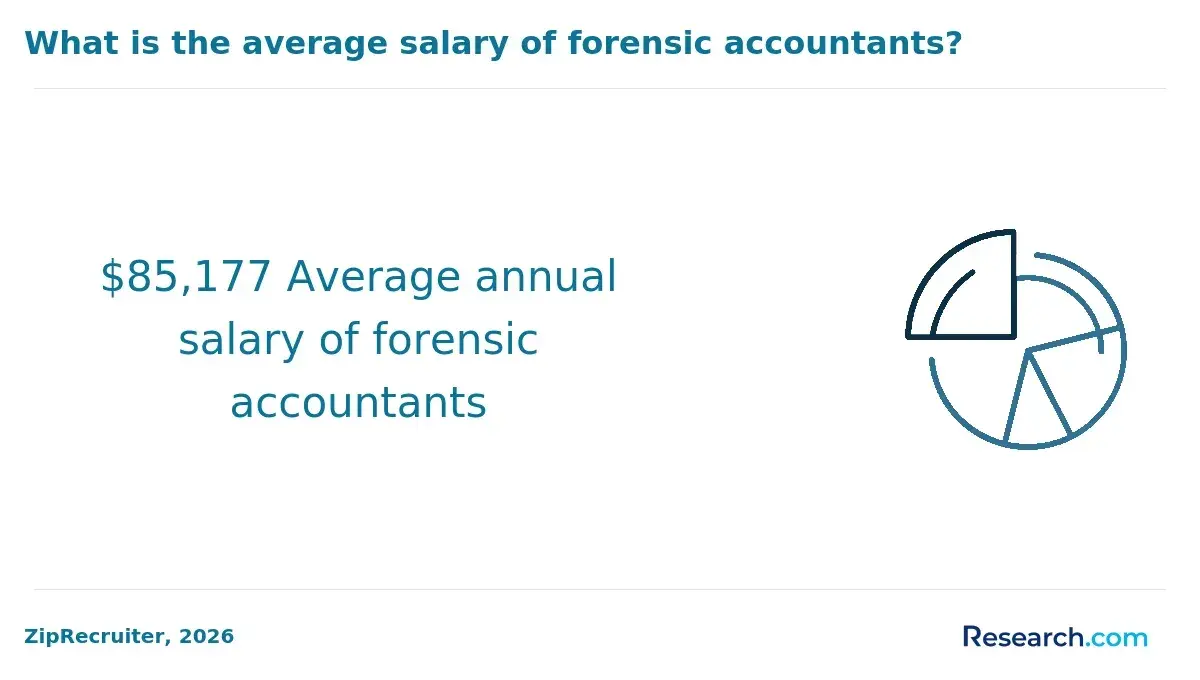
Forensic accounting can offer both professional challenge and solid earning potential, but salary varies widely by job title, experience, location, employer, credentials, and industry. According to PayScale, the average salary for forensic accountants was $82,281 in 2026, while top earners in the field received up to $128,000 annually.
Pay often increases as professionals gain investigative experience, develop specialized knowledge, earn certifications, and move into senior, consulting, management, or expert-witness work. However, a graduate degree alone does not guarantee a specific salary. Prospective students should compare tuition, debt, time away from work, certification plans, and realistic local job opportunities before estimating return on investment.
- 2027 best master’s in forensic accounting programs
- Program length and completion timelines
- Online versus on-campus forensic accounting master’s programs
- Average program cost
- Financial aid options
- Potential ROI of the degreeFunding considerations
- Admissions prerequisites
- Typical graduate courses
- Specialization options
- Supplemental certifications and courses
- Technology trends in forensic accounting
- Practical training opportunities
- Mentorship and networking supportHands-on learningTechnology preparationAdditional credentialsConcentrations
- How to choose the right program
- Career paths after graduation
- Professional certifications
- Certification impact on salary and advancementCredential planningCareer options
- ROI for a master’s in forensic accounting
- Common student challenges
- Using an associate degree as a starting point
- Fastest ways to complete the degreeROI reviewJob market outlookKey insights
2027 Best Master’s in Forensic Accounting Degree Programs
How do we rank schools?
Research.com evaluates master’s in forensic accounting programs with the goal of helping prospective students compare credible graduate options more efficiently. The ranking process uses a structured research methodology and draws from reliable education data sources, including the IPEDS database, Peterson’s database and its Distance Learning Licensed Data Set, the College Scorecard database, and the National Center for Education Statistics. Students should use rankings as a starting point, not as the only factor in choosing a school.
| School | Program format or focus | Credits and timeline stated | Accreditation stated |
| University of Albany | MS in Forensic Accounting | 30 credits; one year | AACSB |
| Utica University | Online MS in Forensic Accounting | 30 credits; two years | MSCHE |
| SUNY Old Westbury | MS in Forensic Accounting | 30 credits; one year | AACSB International |
| Roosevelt University | MS in Accounting Forensics | 31 credits; two years | HLC |
| University of South Wales | MSc in Forensic Audit and Accounting | One to two years | MSCHE and NASAD |
| CSU Global | Master’s in Professional Accounting with Fraud Investigation and Forensic Accounting focus | Approximately 30 to 36 credits; one to two years | ACBSP |
| Florida Atlantic University | Executive Master of Accounting with Forensic Accounting concentration | 36 credits; two years | AACSB International |
| Liberty University | MSA with Forensic Accounting specialization | 30 credit hours; one year | ACBSP |
| West Virginia University | MS in Forensic and Fraud Examination | 30 credits; one to two years | AACSB International |
| Stevenson University | Online MS in Forensic Accounting | 36 credit hours; two years or less | MSCHE |
1. University of Albany
The University of Albany offers a 30-credit MS in Forensic Accounting that can be completed in one year. The program is accredited by the Association to Advance Collegiate Schools of Business (AACSB) and is designed for students who want to apply public accounting knowledge to more advanced investigative and assurance topics. Concentration areas include Statistical Methods for Forensic Accounting and Assurance, Fraud Examination, Financial Statement Fraud and Corporate Governance, Digital Forensics, and other related subjects.
2. Utica University
Utica University offers an online MS in Forensic Accounting focused on preparing students to identify, investigate, and help prevent fraud and financial crime. The Middle States Commission on Higher Education (MSCHE)-accredited program takes two years and requires 30 credits. Its curriculum is aligned with CPA licensure education requirements in New York and many other states. The program also does not require a bachelor’s degree or GMAT/GRE scores.
3. State University of New York (SUNY) System Old Westbury
SUNY Old Westbury offers an MS in Forensic Accounting described as the only master’s program of its kind in Long Island. The AACSB International-accredited program requires 30 credits and can be completed in one year. It is structured to help students work toward the 150-credit hour requirement for the CPA licensure exam in New York and provides preparation relevant to the Certified Fraud Examiner (CFE) exam.
4. Roosevelt University
Roosevelt University offers a Master of Science in Accounting Forensics that emphasizes advanced auditing and investigative skills. Accredited by the Higher Learning Commission (HLC), the program requires 31 credits and takes two years. Students study how to analyze financial reporting documents, conduct investigations, and provide expert witness support in court. Concentration topics include Fraud Examination, Financial Statements and Fraud, Anti-Money Laundering, Computer Forensics and Auditing, and Topics in Business Forensics.
5. University of South Wales
The University of South Wales has offered its MSc in Forensic Audit and Accounting for more than a decade. The program can take one to two years and is accredited by MSCHE and NASAD. Available study tracks include Forensic Financial Analysis, Audit, Governance and Risk Management, Research Methods in Accounting and Finance, and other related areas.
6. CSU Global
CSU Global offers a Master’s in Professional Accounting with a focus on Fraud Investigation and Forensic Accounting. The ACBSP-accredited program can be completed in one to two years and requires approximately 30 to 36 credits. Coursework includes Forensic Accounting and Fraud Examination, International Accounting, Accounting Ethics, Advanced Cost Accounting, and Advanced Auditing and Assurance Services. The program also highlights faculty with professional and academic backgrounds in forensic accounting, fraud examination, and financial investigation.
7. Florida Atlantic University
Florida Atlantic University offers an Executive Master of Accounting (EMAC) with a concentration in Forensic Accounting. This AACSB International-accredited program requires 36 credits and can be completed in two years. Courses include Business Valuation for Forensic Accountants, Advanced Digital Forensics in Forensic Accounting, Advanced Auditing Theory and Practice, Advanced Accounting Information Systems, and Concepts of Federal Income Tax. Students may also pursue a dual concentration in Forensic Accounting and Digital Accounting Forensics and Data Analytics.
8. Liberty University
Liberty University offers an MSA with a specialization in Forensic Accounting. The ACBSP-accredited program requires 30 credit hours and can be completed within one year. Coursework may include Advanced Business Law for Accountants, Advanced Cost Accounting, Accounting Information Systems, Tax Research and Jurisprudence, and Advanced Auditing. Faculty include professors with experience in accounting, auditing, and fraud investigation, and many hold credentials such as CPA and CFE.
9. West Virginia University
West Virginia University offers an MS in Forensic and Fraud Examination that requires 30 credits and can be completed in one to two years. The program is accredited by AACSB International. Students take courses such as Introduction to Forensic and Fraud Examination, Financial Statement Fraud, Occupational Fraud, Data Analytics for Fraud Examination, and Legal Aspects of Fraud Examination. The program is also noted for helping shape the national curriculum for forensic and fraud accounting programs.
10. Stevenson University
Stevenson University offers an online MS in Forensic Accounting that requires 36 credit hours and can be completed in two years or less. The program is accredited by MSCHE.
Coursework includes Fraud: Accounting, Investigation and Analysis: Auditing, Investigation and Analysis: Tax, Business Valuation, and Litigation Theory and Practice. Stevenson University also notes its long history of offering accounting degrees since 1947 and emphasizes individualized student attention.
What graduates say about Master’s in Forensic Accounting programs
-
: "
“My master’s in forensic accounting changed the way I approached financial data. The program strengthened my technical skills, gave me experience with realistic cases, and helped me see fraud investigation as both analytical work and public-interest work.” Sadie
"
-
: "
“Graduate study in forensic accounting introduced me to the global side of financial crime. Courses in digital forensics, legal issues, and international topics gave me a broader view of how fraud investigations work across different environments.” Michael
"
-
: "
“The program pushed me beyond basic accounting. I learned to think about ethics, evidence, expert communication, and professional responsibility while building relationships with faculty and practitioners through workshops and networking events.” Lauren
"
Key findings for prospective students
- Most master’s in forensic accounting programs require 30 to 36 credit hours, though some may require up to 50.
- Full-time students can often finish in one to two years, and some accelerated programs can be completed in just one year.
- About 20% of forensic accountants have a master’s degree.
- The average cost of a master’s in forensic accounting program can be $400 per credit or more.
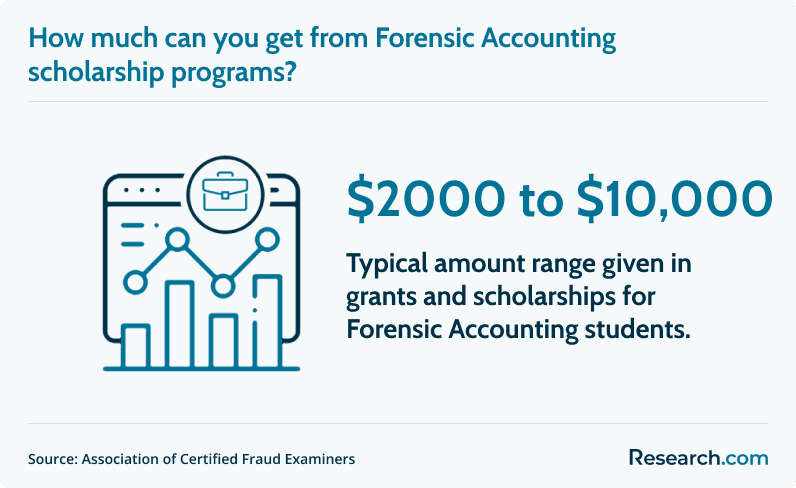
- Scholarship programs may provide aspiring master’s in forensic accounting students with $2,000 to $10,000.
- The expected employment growth for accountants, including forensic accountants, is 5% from 2024 to 2034 (BLS, 2025).
How long does it take to complete a Master’s in Forensic Accounting degree program?
Completion time depends on the number of required credits, enrollment status, course scheduling, transfer policies, and whether the program is accelerated. Most master’s in forensic accounting programs require 30 to 36 credit hours, although some programs may require as many as 50 credit hours.
Full-time students commonly finish in one to two years. Accelerated programs may take as little as one year, while part-time options for working professionals often take two to four years or more. According to Zippia data, 71% of forensic accountants have a bachelor’s degree, while 20% have a master’s degree.
The chart below, based on Zippia data, shows forensic accountants by degree type.
How does an online Master’s in Forensic Accounting degree program compare to an on-campus program?
An online master’s in forensic accounting can be a good fit for working adults, students who live far from campus, and learners who need more scheduling flexibility. Online programs may also reduce relocation and commuting costs. However, students should confirm whether the program offers live interaction, career support, access to forensic accounting tools, and opportunities for applied projects.
On-campus programs may be better for students who prefer face-to-face discussion, easier access to faculty, campus recruiting, in-person networking, and research or lab resources. The best choice depends on your schedule, budget, learning style, and career goals rather than the delivery format alone.
| Factor | Online program | On-campus program |
| Best for | Working professionals, remote learners, and students who need flexibility | Students who value in-person interaction and campus-based resources |
| Schedule | May offer asynchronous or flexible coursework | Often follows fixed class meeting times |
| Networking | May rely on virtual events, discussion boards, alumni platforms, and online career services | May offer easier access to in-person events, faculty, and campus recruiting |
| Cost considerations | May reduce commuting or relocation expenses | May involve housing, transportation, and campus fees |
| What to verify | Accreditation, technology access, internship support, and state CPA alignment | Accreditation, faculty expertise, practical training, and local employer connections |
What is the average cost of a Master’s in Forensic Accounting degree program?
Based on information gathered from university websites offering forensic accounting master’s programs, the average cost can be $400 per credit or more. Some programs cost less, while others charge significantly more depending on school type, location, delivery format, program reputation, and included services.
Students should look beyond tuition alone. Fees, books, software, travel, residency requirements, lost income, certification exam costs, and financing charges can affect the real price. Before enrolling, compare total program cost with your likely career path, employer tuition assistance, transfer credit options, and available scholarships or grants.
What are the financial aid options for students enrolling in a Master’s in Forensic Accounting program?
Graduate students in forensic accounting may consider scholarships, grants, loans, employer tuition assistance, assistantships, and work-study opportunities where available. One field-relevant option is the Ritchie-Jennings Memorial Scholarship Program from the ACFE Foundation, which supports students pursuing anti-fraud education and careers. Awards range from $2,000 to $10,000 and are paid directly to the recipient’s university or college.
| Funding option | What to check before relying on it |
| Scholarships | Eligibility rules, deadlines, renewal requirements, and whether funds apply to graduate study |
| Grants | Need-based or field-specific eligibility and whether repayment is required under certain conditions |
| Loans | Total repayment cost, interest, monthly payment estimates, and borrowing limits |
| Employer tuition assistance | Reimbursement caps, grade requirements, service commitments, and approved program lists |
| Work-study or assistantships | Availability for graduate students, workload, and whether positions align with accounting or investigation experience |
What is the potential ROI of a master’s degree in forensic accounting?
The return on investment for a master’s in forensic accounting depends on the total cost of attendance, how much debt you take on, whether you keep working while enrolled, and whether the degree helps you access roles in fraud examination, forensic auditing, litigation support, risk management, or financial investigation.
According to the U.S. Bureau of Labor Statistics, accountants and auditors earn a median annual wage of $77,250, and forensic accountants may earn more when specialized expertise, certifications, and experience are valued by employers. Credentials such as the CFE or CPA can also strengthen advancement potential, depending on the role and jurisdiction.
Because tuition can vary widely, prospective students comparing graduate accounting options should understand how much is a masters in accounting in relation to expected outcomes. The degree is most likely to produce a strong ROI when students choose an accredited, appropriately priced program; gain practical investigative experience; and pursue relevant certifications.
What are the prerequisites for enrolling in a Master’s in Forensic Accounting degree program?
Admissions requirements vary by school, so applicants should review each program carefully. Many requirements resemble those found in graduate accounting pathways such as online MBA accounting programs, but forensic accounting programs may place extra emphasis on accounting preparation, analytical skills, ethics, and investigative interest.
Admission Requirements
- Bachelor’s degree. Most graduate accounting programs, including many of the best online master’s degrees in accounting today, require applicants to hold a bachelor’s degree from an accredited institution. Some programs prefer or require prior coursework in accounting or a closely related field.
- Relevant work experience. Some schools favor applicants with experience in accounting, auditing, finance, compliance, law enforcement, or related business roles. The required or preferred amount of experience differs by program.
- Test scores. GMAT or GRE scores may be required, although some programs waive them for applicants who meet academic or professional criteria. International applicants may need TOEFL or International English Language Testing System (IELTS) scores if English is not their native language.
- Additional application materials. Programs may ask for a personal statement, resume, and recommendation letters from professors, supervisors, or employers who can speak to the applicant’s academic and professional readiness.
Skill Requirements
- Accounting fundamentals. Many programs expect students to understand core accounting concepts or complete prerequisite courses. Students who pursue an accounting degree often build this foundation before graduate study.
- Analytical ability. Forensic accountants review large volumes of financial information, identify patterns, and evaluate whether data supports a conclusion.
- Attention to detail. Small inconsistencies can matter in fraud investigations, so careful document review is essential.
- Legal and regulatory awareness. Forensic accountants need to understand rules affecting financial reporting, auditing, fraud, and evidence. In some cases, knowledge connected to a criminal justice degree may strengthen investigative perspective.
- Technical proficiency. Modern forensic accounting increasingly involves accounting software, analytics tools, electronic discovery systems, and digital evidence platforms.
What courses are typically in a Master’s in Forensic Accounting degree program?
Forensic accounting curricula combine advanced accounting with investigation, auditing, law, and data analysis. Exact course titles vary, but many programs include the following subjects.
- Fraud Examination. Students learn how fraud schemes are planned, concealed, detected, and documented. The course may cover investigative techniques, interviewing, data review, and reporting evidence.
- Auditing. This course examines financial statements, transactions, internal controls, and compliance requirements. In a forensic context, auditing skills help professionals identify irregularities and support investigations.
- Financial Reporting. Students study how financial statements are prepared and analyzed, with emphasis on accuracy, transparency, and warning signs of misstatement or misconduct.
- Legal Issues. This course explores the legal environment surrounding financial investigations, including regulations, litigation support, expert testimony, and collaboration with attorneys.
What types of specializations are available in Master’s in Forensic Accounting degree programs?
Specializations help students align graduate study with specific career goals. Because 51% of organizations have faced fraud in recent years, focused training can be valuable for students who want to work in high-risk, regulated, or investigation-heavy environments.
- Fraud Examination. This concentration emphasizes fraud schemes, prevention, investigative methods, and legal considerations. It may be especially relevant in sectors where health industries face 40% cybercrime and 30% asset misappropriation challenges.
- Litigation Support. Students study how forensic accountants assist attorneys, calculate damages, analyze cases, and prepare expert testimony.
- International Accounting. This area focuses on financial reporting, controls, and regulations affecting international businesses and cross-border organizations.
- Financial Accounting. This specialization deepens knowledge of financial management, documentation, reporting, and federal compliance requirements.
What supplemental certifications and courses can enhance your forensic accounting expertise?
A master’s degree can provide advanced academic preparation, but additional credentials and short courses may help you build job-ready skills in digital investigation, analytics, cybersecurity, auditing, and compliance. Courses in recordkeeping and financial documentation can also reinforce core accounting discipline. For example, accredited bookkeeping courses may help students or career changers strengthen the financial records foundation needed before moving into more complex forensic work.
How are emerging technologies influencing forensic accounting practices?
Forensic accounting is increasingly shaped by data-heavy investigations. Graduate programs may expose students to advanced analytics, artificial intelligence, blockchain-related issues, digital forensics, and tools used to identify anomalies in large financial datasets. These technologies do not replace professional judgment, but they can help investigators screen transactions, organize evidence, test patterns, and work more efficiently. Students comparing programs should ask how technology is taught and whether the curriculum reflects current employer expectations connected to the forensic accountant salary and career market.
How do Master’s in Forensic Accounting programs incorporate practical training opportunities?
Strong programs often connect theory to practice through fraud simulations, case studies, capstone projects, internships, externships, or applied investigations using realistic financial records. Practical work matters because forensic accountants must be able to document findings, explain evidence, and perform under deadlines. Students who are still building an accounting foundation may also explore lower-cost undergraduate pathways such as the cheapest online accounting bachelors degree before pursuing graduate-level forensic specialization.
Do Master’s in Forensic Accounting programs offer mentorship and networking opportunities?
Many programs support students through faculty mentoring, alumni connections, career services, professional association events, workshops, guest speakers, and live case discussions. These opportunities can be especially valuable for students moving from general accounting into fraud examination or litigation support. When comparing schools, ask whether networking is built into the curriculum or left entirely to students. Strong mentoring can help clarify the next step in an accountant career path.
How to choose the best Master’s in Forensic Accounting degree program?
The best program is not automatically the highest-ranked or most expensive one. It is the program that fits your career goal, budget, schedule, certification plans, and academic background. Before applying, compare programs using factors that directly affect employability and return on investment.
- Curriculum relevance. Look for coursework in fraud examination, auditing, legal issues, data analytics, digital evidence, financial statement fraud, and investigative reporting. Faculty with forensic accounting experience can add practical context.
- Accreditation. Accreditation supports quality assurance, financial aid eligibility, and transferability. Accounting-related programs may hold recognition from the Accreditation Council for Business Schools and Programs, AACSB International, or the International Accreditation Council for Business Education.
- Capstone or applied project. A capstone can help students practice case analysis, research, report writing, and collaboration with organizations. It may also create work samples or professional connections.
- Resources and career support. Ask whether students receive access to accounting databases, analytics tools, forensic software, career coaching, employer events, job placement support, and alumni mentoring.
| Question to ask | Why it matters |
| Is the institution properly accredited? | Accreditation can affect financial aid, credit transfer, and employer confidence. |
| Does the curriculum include technology and data analytics? | Fraud investigations increasingly involve large datasets and digital evidence. |
| Will the program help with CPA or CFE preparation? | Certification alignment can improve long-term career planning. |
| Are internships, simulations, or capstone projects available? | Applied work helps students demonstrate skills beyond classroom knowledge. |
| What is the total cost, not just tuition? | Fees, software, books, travel, and borrowing costs affect ROI. |
| What career services are available to online students? | Remote learners should not assume they receive the same support unless the school confirms it. |
Common mistakes to avoid when choosing a forensic accounting master’s program
- Choosing based only on tuition. Low tuition can be attractive, but weak career support, limited practical training, or poor curriculum fit may reduce value.
- Ignoring accreditation. Always verify institutional and program-level accreditation before applying.
- Assuming online programs are all equivalent. Online formats differ in faculty access, live instruction, technology tools, internship support, and networking.
- Overlooking CPA requirements. If CPA licensure is part of your plan, confirm whether the program helps meet the education rules in your state.
- Skipping certification planning. A degree may be more powerful when paired with the CFE, CPA, or other relevant credentials.
- Relying only on rankings. Rankings can narrow your search, but your final decision should reflect cost, format, outcomes, support, and career fit.
What career paths are available for graduates of Master’s in Forensic Accounting degree programs?
A master’s degree in forensic accounting can support several investigative, compliance, accounting, and advisory career paths. Some graduates also strengthen their preparation through additional credentials, including options connected to the best accounting certificate programs.
- Forensic Accountants. Forensic accountants analyze financial data, identify irregularities, prepare reports, and may support legal proceedings. Forensic accountants work for law enforcement agencies, accounting firms, and consulting companies.
- Fraud Examiners. Fraud examiners investigate suspected fraud, review financial records, interview witnesses or suspects, and prepare findings for employers, agencies, or legal teams.
- Auditors. Auditors evaluate financial statements, transactions, processes, and controls to assess compliance and detect errors or potential fraud. They may work in corporate, government, or public accounting settings.
- Risk Management Specialists. Risk management specialists identify threats to an organization’s finances, operations, and compliance posture. They help address risks such as fraud, data breaches, and related financial crimes. The average certified public accountant salary for this job is $72,396.
How can professional certifications enhance my forensic accounting career?
Professional certifications can make your graduate training more marketable by validating specialized competence. The Certified Fraud Examiner (CFE) and Certified Public Accountant (CPA) are especially relevant for many forensic accounting roles because they signal expertise in fraud, ethics, accounting standards, auditing, and professional judgment. Other targeted credentials, such as certified public bookkeeper certification, may also strengthen practical recordkeeping and technical skills for professionals building their accounting foundation.
How do professional certifications impact my salary and career prospects?
Certifications such as the CPA and CFE can help professionals stand out for roles that require advanced technical knowledge, ethical standards, and investigative credibility. They may also support promotion into senior, consulting, compliance, or expert roles. Data on CPA salary shows why many accounting professionals consider licensure when planning long-term advancement. Still, certification value depends on the employer, role, region, and the professional’s experience.
What is the job market for graduates with Master’s in Forensic Accounting degrees?
The labor market for forensic accounting graduates is influenced by employer concern about fraud, cybercrime, money laundering, compliance failures, and financial transparency. Organizations across industries need professionals who can evaluate financial evidence, strengthen controls, and assist with investigations.
The employment outlook for accountants and auditors, including forensic accountants, shows projected 5% growth from 2024 to 2034, faster than the average for all occupations. About 124,200 openings are expected each year during this period, with many openings resulting from workers moving into other occupations or retiring.
What is the ROI for a master’s in forensic accounting?
ROI should be calculated by comparing total education cost with realistic career gains. Tuition for these programs typically ranges from $20,000 to $70,000, so the financial case is strongest when the degree leads to better job access, promotion, certification eligibility, or specialized work that would be harder to obtain with a bachelor’s degree alone.
Graduates may pursue well-paying roles tied to financial investigation and compliance. Related roles such as financial examiners have a median salary of $82,210 annually, while top earners make over $162,000. Professionals with credentials such as the Certified Fraud Examiner (CFE) may qualify for stronger opportunities in public accounting firms, government agencies, and consulting firms.
Many forensic accounting graduates work toward salaries between $70,000 to $120,000 annually, depending on experience, role, employer, location, and certifications. The degree may be worth the investment for students committed to fraud investigation, forensic auditing, litigation support, or financial compliance work.
If you are asking is getting a masters in accounting worth it, the answer depends on your costs and goals. For students who choose an accredited program, control debt, gain practical experience, and pursue relevant certifications, the ROI can be meaningful.
What challenges do students encounter in a Master’s in Forensic Accounting program?
Students should expect demanding coursework, detailed case analysis, technical tools, legal concepts, and assignments that require precision. Many learners also have to balance graduate study with work, certification preparation, and the search for internships or applied projects. Another challenge is keeping pace with changing technology, including analytics tools and digital evidence methods. Understanding these pressures can help students plan more effectively and evaluate career outcomes, including questions such as how much can an accountant make.
Can an Associate’s Degree Lay a Solid Foundation for Forensic Accounting?
An associate degree is not enough for most advanced forensic accounting roles, but it can be a cost-conscious starting point. Students who begin with a most affordable associates degree in accounting online can build early skills in bookkeeping, financial records, basic accounting, and business math before progressing to a bachelor’s degree and then graduate forensic accounting study. This pathway can make sense for learners who want to reduce costs while building academic momentum.
What are the fastest ways to earn a master’s in forensic accounting?
The fastest path is usually an accelerated master’s program, particularly for students who already have strong accounting preparation. Some programs compress coursework so students can graduate in as little as 12-18 months. These options are demanding and may be best for students who can manage a heavier course load.
Other speed-focused options include online programs with flexible scheduling, full-time enrollment, and integrated bachelor’s-to-master’s pathways that allow students to overlap credits. Before choosing the fastest option, confirm whether the program still includes practical training, career support, accreditation, and coursework aligned with your certification goals.
Students who want to compare accelerated pathways can review fast degree programs as part of a broader search for streamlined forensic accounting options. Speed is useful only if the program still supports your long-term career plan.
Key Insights
- A master’s in forensic accounting is best suited for students who want specialized work in fraud examination, forensic auditing, litigation support, financial investigation, or compliance.
- Most programs require 30 to 36 credit hours and can often be completed in one to two years, though some accelerated options take as little as one year.
- Online programs can be convenient for working professionals, but students should verify accreditation, practical training, technology access, and career services before enrolling.
- Cost matters. Programs may cost $400 per credit or more, and tuition can range from $20,000 to $70,000, so students should calculate total cost and likely career benefit before borrowing.
- Certifications such as the CFE and CPA can strengthen the value of the degree, especially for students seeking investigative, advisory, or senior accounting roles.
- Do not choose a program based only on rankings. The better decision is based on accreditation, curriculum, applied learning, faculty expertise, state CPA alignment, total cost, and career support.
References:
- Association of Certified Fraud Examiners. (n.d.). Ritchie-Jennings Memorial Scholarship Program. https://www.acfe.com/scholarship.aspx
- ACFE scholarship information PayScale. (2026). Forensic accountant salary in the United States. https://www.payscale.com/research/US/Job=Forensic_Accountant/Salary
- U.S. Bureau of Labor Statistics. (2025). Accountants and auditors (Pay section). In Occupational Outlook Handbook. U.S. Department of Labor. Retrieved February 4, 2026, from https://www.bls.gov/ooh/business-and-financial/accountants-and-auditors.htm
- Zippia. (n.d.). Forensic Accountant Jobs. https://www.zippia.com/forensic-accountant-jobs/education/BLS accountants and auditors outlookZippia education data
- ZipRecruiter. (2026). Risk Management Specialist Salary. https://www.ziprecruiter.com/Salaries/RISK-Management-Specialist-Salary
Other Things You Should Know About Master’s in Forensic Accounting Degree Programs
A forensic accounting master’s can help students meet CPA education requirements by adding graduate-level accounting coursework, often 30 to 36 total semester hours beyond the bachelor’s degree. It does not replace state licensure rules, which still require a bachelor’s degree, exam passage, ethics requirements, and supervised experience set by each state board.
Most Master’s in Forensic Accounting programs in 2027 require the Graduate Records Examination (GRE) for admission. Some schools may accept the Graduate Management Admission Test (GMAT) instead. Verify specific program requirements as these can vary by institution.
Admission requirements typically include a bachelor's degree in accounting or a related field, a minimum GPA of 3.0, and satisfactory scores on entrance exams like the GMAT or GRE. Some programs may also require professional experience in accounting or finance.
Master's in forensic accounting programs prepare students for professional certifications such as Certified Fraud Examiner (CFE) or Certified Public Accountant (CPA) through a combination of targeted coursework, exam preparation, and practical experience. The curriculum typically includes advanced topics in fraud examination, forensic accounting, legal aspects of fraud, and ethical issues, which align with the content of these certification exams. Programs often offer dedicated review courses, practice exams, and study resources tailored to the specific requirements of the CFE and CPA exams. Additionally, students gain hands-on experience through internships, case studies, and simulations, which help them apply theoretical knowledge to real-world scenarios. This comprehensive approach ensures that graduates are well-equipped to meet the rigorous standards of these professional certifications.


