2027 Best Accounting Certificate Programs

Co-Founder and Chief Data Scientist
If you want to enter accounting without committing immediately to an associate, bachelor’s, or master’s degree, an accounting certificate can be a practical first credential. These programs are designed to teach the core skills used in bookkeeping, accounts payable, payroll support, financial recordkeeping, and entry-level accounting assistance.
The timing matters because accounting remains a replacement-driven labor market. On average, there are estimated to be approximately 130,000 accounting job opportunities each year over the decade from 2024 to 2034, largely because employers need to replace workers who move into other occupations or leave the labor force, including through retirement (U.S. Bureau of Labor Statistics, 2025).
This guide explains what an accounting certificate can and cannot do, how it compares with CPA licensure, what it may cost, how to evaluate program quality, which certificate types are available, and how to use the credential as a starting point for a longer accounting career.
Best Accounting Certificate Programs for 2026 Table of Contents
- Accounting Certificate vs. Certified Public Accountant
- How much does an Accounting Certificate cost?
- How to Apply for an Accounting Certificate
- Types of Accounting Certificates
- How to Get an Accounting Certificate
- Accounting Certificate Salary Potential
- The Role of Accounting Certifications in Career Progression
- Accelerated Pathways to Advanced Accounting Roles
- Best Accounting Certificate Programs for 2026
- How Can an Accounting Certificate Accelerate Your Journey to CPA Certification?
- How does industry demand shape the future value of an accounting certificate?
- Can complementary online degrees enhance your accounting career?
- What online resources can help you find the best-paying certification programs?
- What is the return on investment of an accounting certificate?
- What additional skills can enhance your accounting certificate for career advancement?
- Can an Accounting Certificate Open Pathways to an Actuarial Career?
- What are the career outcomes of combining an accounting certificate with a master's degree?
- How do digital transformation trends impact accounting career opportunities?
- How do online accounting certificate programs compare to traditional in-person programs?
Quick Answer: Is an Accounting Certificate Worth Considering?
An accounting certificate can be worth considering if you want a shorter, lower-cost route into entry-level accounting support roles or if you need targeted coursework before continuing into a degree program. It is not the same as becoming a certified public accountant, and it usually will not qualify you for CPA licensure by itself. Its value depends on accreditation, curriculum quality, transferability, software training, career support, and whether the program matches your target role.
| Best fit | When an accounting certificate makes sense | When another path may be better |
| Career starters | You want preparation for bookkeeping, accounting clerk, accounts payable, or accounting assistant work. | You want roles that usually require a bachelor’s degree or CPA licensure. |
| Career changers | You already have workplace experience and need accounting fundamentals quickly. | You need a full academic credential for advancement, graduate study, or licensure planning. |
| Degree-bound students | You want credits that may stack into an associate or bachelor’s program. | The certificate credits do not transfer or the school is not properly accredited. |
| Working adults | You need online, evening, or part-time study options while employed. | You learn better through in-person labs, scheduled classes, and local networking. |
The Difference Between a Certified Public Accountant and Accounting Certificate
The most important distinction is this: an accounting certificate is an educational credential, while CPA status is a professional license. A certificate can help you build job-ready accounting skills, but it does not automatically make you a CPA.
Certified Public Accountant
A certified public accountant has met state board requirements that typically include college-level coursework, passing the Uniform CPA Examination, and satisfying additional licensure rules. According to recent NASBA data, the number of actively licensed CPAs in the US is 653,408 as of August 2025, with most working in the private sector (National Association of State Boards of Accountancy, 2025).
Some students use post-baccalaureate coursework or graduate study to complete the credit hours required for CPA eligibility. For example, MBA in Accounting students may use their program to help meet CPA exam eligibility requirements, depending on state rules and course selection.
Accounting Certificate
An accounting certificate usually focuses on applied accounting knowledge for entry-level work. Students commonly study financial statements, tax document organization, payroll basics, bookkeeping procedures, accounting software, and business recordkeeping.
The certificate can stand alone for job preparation or serve as a bridge into a higher credential. If you plan to continue your education, confirm before enrolling whether the certificate credits can be applied to an associate or bachelor’s degree.
| Credential | Main purpose | Typical outcome | Important limitation |
| Accounting certificate | Build foundational accounting and bookkeeping skills. | Entry-level accounting support, bookkeeping, or clerical accounting roles. | Usually does not meet CPA requirements by itself. |
| CPA license | Authorize qualified professionals to perform CPA-level accounting services. | Licensed public accounting, audit, tax, advisory, and higher-level accounting roles. | Requires meeting state-specific education, exam, and licensure rules. |
How much does an Accounting Certificate cost?
The cost of an accounting certificate varies by school, residency status, delivery format, and credit load. Students should expect to pay an average of approximately $80 to $400 per credit. Based on current trends in college pricing, community colleges generally offer the lowest published rates for in-state students, while out-of-state students may pay more.
Certificate programs usually require fewer credits than associate or bachelor’s degrees, which can reduce total tuition and shorten the time before you can apply for entry-level roles. By comparison, traditional 2-year degrees in accounting may have a higher total cost of attendance, with public institutions averaging around $21,500 (National Center for Education Statistics, 2025).
Some students may qualify for scholarships, grants, federal loans, or institutional aid, but aid availability depends on the school and program. If you are comparing online options, review low-cost accounting certificate programs and ask whether online tuition is charged at in-state, out-of-state, or separate distance-learning rates.
| Cost factor | Why it matters | What to ask before enrolling |
| Per-credit tuition | This is the base price used to estimate total tuition. | Is the rate $80 to $400 per credit, and does it differ for online, in-state, and out-of-state students? |
| Required credits | More credits increase total cost, even when the per-credit rate is low. | How many credits are required to complete the certificate? |
| Fees and materials | Technology fees, textbooks, software access, and exam costs can raise the final price. | Which costs are not included in tuition? |
| Transferability | Transferable credits may improve long-term value if you later pursue a degree. | Can the credits apply to an accounting associate or bachelor’s program? |
| Financial aid eligibility | Not all certificate programs qualify for the same aid options. | Is this specific certificate eligible for federal aid, scholarships, or grants? |
How to Apply for Accounting Certification Programs
Applying to an accounting certificate program is usually simpler than applying to a degree program, but you should still evaluate the school carefully. Admissions requirements, program length, credit transfer rules, and certificate recognition can vary significantly.
How long is an Accounting Certificate valid for?
An academic accounting certificate generally does not expire. Once awarded, it remains proof that you completed the required coursework at that institution.
That said, accounting practices, tax rules, software systems, and reporting expectations change over time. Employers may value recent training, continuing education, and current software experience, especially if several years have passed since you earned the certificate.
Criteria of a Good Accounting Certificate Program
According to the NCES 2024 Report on the Condition of Education, the number of certificates below the baccalaureate level remained stable at about 1.0 million. Public institutions continued to confer the majority (~93% of certificates), consistent with prior years.
Because many schools offer short accounting credentials, the strongest program is not always the one with the fastest timeline or lowest tuition. Use the following criteria to separate a useful certificate from one that may have limited value.
Accreditation
Choose a program offered by an accredited institution. Business and accounting accreditation, including standards from the Association to Advance Collegiate Schools of Business, can signal that a school has met recognized standards of quality for business schools. Institutional accreditation is also important for credit transfer, financial aid eligibility, and employer recognition.
Curriculum
Look for coursework in financial accounting, managerial accounting, taxation, auditing, payroll, spreadsheets, and accounting software. A strong certificate should teach both concepts and workplace application, such as preparing reports, reconciling records, and using common tools.
Faculty
Review instructor backgrounds. Faculty with academic preparation and accounting work experience can help connect textbook concepts to real business documents, compliance issues, and employer expectations.
Career Support
Career services can matter as much as coursework, especially for first-time accounting job seekers. Look for resume support, interview preparation, job boards, employer partnerships, internship guidance, networking events, and connections to professional organizations.
Flexibility
If you work or care for family members, delivery format may determine whether you can finish. Compare traditional and online or part-time options, but do not choose flexibility at the expense of accreditation, faculty access, or credit transfer.
| Program quality question | Why the answer matters |
| Is the institution accredited? | Accreditation affects credibility, aid access, and possible credit transfer. |
| Does the curriculum include accounting software? | Entry-level accounting roles often require comfort with digital tools. |
| Can credits stack into a degree? | Stackable credits can reduce time and cost if you continue your education. |
| Are courses taught by accounting professionals or qualified faculty? | Experienced instructors can provide practical context and career guidance. |
| What job support is available? | A certificate is more useful when the school helps students connect credentials to employment. |
Types of Accounting Certification Programs
Accounting certificates vary by provider and purpose. Some are academic programs offered by colleges, while others are professional credentials focused on a specific skill set. The National Association of Certified Public Bookkeepers (NACPB) offers several accounting certification programs and related training resources.
Before choosing a credential, decide whether your goal is broad accounting preparation, bookkeeping, software proficiency, payroll support, tax preparation, or eventual CPA planning.
Accounting Certification
This credential covers core accounting topics such as accounts payable, inventory, financial statements, and reporting standards. To qualify, candidates must first complete a course on accounting principles (NACPB, n.d.).
Accounting Analysis Certification
This option emphasizes the business use of accounting information, including how financial information is produced and interpreted. Before taking the exam, candidates must complete NACPB’s accounting analysis course (NACPB, n.d.).
Bookkeeping Certification
This certification is designed to demonstrate bookkeeping competency. Candidates must complete a bookkeeping course that introduces accounting and bookkeeping fundamentals for learners with little or no previous background in the field (NACPB, n.d.).
QuickBooks Certification
This credential focuses on QuickBooks training and practical familiarity. QuickBooks is among the best accounting software for small business and is widely used by accounting agencies and small organizations. Candidates must complete a foundational QuickBooks course before qualifying for the certification (NACPB, n.d.).
| Certification | Primary focus | Best for |
| Accounting Certification | Accounts payable, inventory, financial statements, and reporting standards | Learners who want broad introductory accounting knowledge. |
| Accounting Analysis Certification | Generation and analysis of accounting information | Learners interested in interpreting financial information for business decisions. |
| Bookkeeping Certification | Accounting and bookkeeping fundamentals | Students targeting bookkeeping or small-business recordkeeping roles. |
| QuickBooks Certification | QuickBooks training and familiarization | Candidates who want software skills for accounting support work. |
How to Get an Accounting Certificate
The path to earning an accounting certificate is straightforward, but the best results come from planning ahead. Treat the certificate as part of a career strategy rather than a standalone purchase.
1. Research and Choose a Program
Start with accredited schools and programs that match your career goal. A student seeking bookkeeping work may need different coursework than someone planning to transfer into a bachelor’s program or prepare for CPA eligibility later.
Because policies differ by institution, review the program website and contact admissions or academic advising before applying. Ask about course format, transfer credit, graduation requirements, software access, and career support.
2. Meet the Admission Requirements
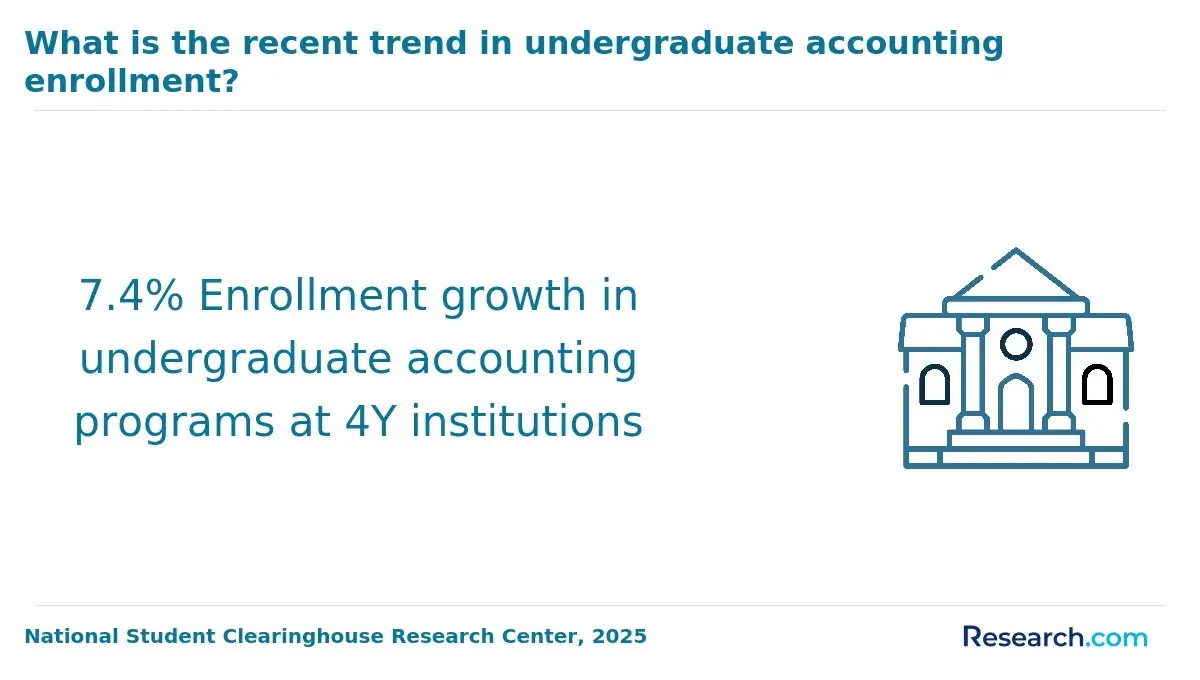
Undergraduate enrollment has been recovering post-pandemic, with spring 2025 total postsecondary enrollment up 3.2% year-over-year (National Student Clearinghouse Research Center, 2025).
Most undergraduate certificate programs require a high school diploma or equivalent. Some may expect prior coursework in mathematics, business, computer applications, or college readiness subjects.
3. Complete the Application
Submit the application with accurate educational history, work experience, and any required transcripts. Some schools also require placement testing, residency documentation, or an application fee.
4. Enroll and Complete the Required Courses
After admission, register for the required accounting courses and complete assignments, projects, exams, and software-based activities. If you are working while enrolled, confirm course pacing and deadlines before the term begins.
5. Meet the Completion Requirements
Each school sets its own graduation rules. Requirements may include completing a specified number of credits, earning minimum grades, finishing all required courses, or maintaining a minimum grade point average.
6. Obtain the Accounting Certificate
Once you satisfy the program requirements, the school awards the certificate. Keep official records because employers, transfer schools, or professional credentialing organizations may request proof of completion.
| Step | Action | Decision point |
| Research | Compare accredited certificate programs. | Does the program match your target job or transfer plan? |
| Apply | Submit the application, transcripts, and required materials. | Are you eligible, and do you understand all costs? |
| Enroll | Register for accounting, software, and business courses. | Can you manage the schedule and workload? |
| Complete | Finish required credits and meet grade rules. | Have you documented your projects, software skills, and achievements? |
| Use the credential | Apply for roles or continue into a degree pathway. | Does your resume clearly connect the certificate to job requirements? |
Accounting Certificate Salary Potential
An accounting certificate can support entry-level employment, but salary depends on job title, location, employer, experience, software skills, and whether you continue your education. Certificate completion does not guarantee a specific wage.
After completing an accounting certification program, available job opportunities show an average annual salary of $64,500, based on updated data from thousands of profiles (Payscale, 2025). The roles below are common starting points for certificate holders.
Accounting Specialist
Accounting specialists help organizations maintain accurate account records, process transactions, monitor invoices, and support financial reporting. Their work reduces billing errors, improves payment tracking, and helps accounting teams keep records current.
Accounting specialists earn an average yearly salary of $52,300, with salary ranges typically spanning from a minimum of $40,000 to a maximum of $71,000 based on updated profiles (Payscale, 2025).
Accounts Payable Clerk
Accounts payable clerks usually work in accounting departments or accounting firms. They process bills, enter payment data, maintain vendor files, answer payment-related questions, and help prepare financial documentation. Accuracy is essential because errors can affect vendor relationships and internal records.
Based on updated profiles, accounts payable clerks receive an average annual salary of $43,200, with a salary range spanning from a minimum of $34,000 to a maximum of $57,000 (Payscale, 2025).
Bookkeeper
Bookkeepers record, classify, reconcile, and summarize financial transactions. Employers often expect familiarity with QuickBooks or similar financial accounting software, along with strong spreadsheet skills. Payroll, bank reconciliation, and financial report preparation are also common responsibilities. Earning one of the best bookkeeping certification options can strengthen a candidate’s profile for this path.
Based on updated profiles, bookkeepers earn an average annual salary of $47,100, with salary ranges varying from a minimum of $33,000 to a maximum of $66,000 (Payscale, 2025).
| Role | Typical responsibilities | Average annual salary | Reported salary range |
| Accounting Specialist | Account records, invoices, payment tracking, and financial support tasks. | $52,300 | $40,000 to $71,000 |
| Accounts Payable Clerk | Vendor records, data entry, payment processing, and financial documentation. | $43,200 | $34,000 to $57,000 |
| Bookkeeper | Transaction recording, reconciliation, payroll support, and report preparation. | $47,100 | $33,000 to $66,000 |
The Role of Accounting Certifications in Career Progression
Accounting certifications can help early-career professionals prove specific skills, especially when they do not yet have extensive work experience. A certificate may make the strongest impact when it is paired with software proficiency, clean work samples, internships, or related administrative experience.
For beginners, focused credentials in bookkeeping, payroll, tax support, or accounting software can make the job search more targeted. If you are comparing beginner-friendly options, review guidance on accounting certifications for beginners to understand which credential fits your starting point.
As your career develops, additional education and more specialized credentials can help you move from transaction processing into analysis, supervision, auditing support, tax preparation, or management. Continuing education also helps you stay current with changing regulations, software platforms, and employer expectations.
The best strategy is to use the certificate as one step in a longer plan: gain entry-level experience, build software fluency, document measurable achievements, and decide whether a degree, CPA pathway, or specialized finance credential is needed for your next role.
Accelerated Pathways to Advanced Accounting Roles
Accelerated accounting pathways are designed for students who want to build credentials faster than they would in a traditional degree sequence. These options may appeal to career changers, working adults, or entry-level employees who need stronger accounting knowledge without delaying employment goals.
An accelerated accounting degree can provide a broader academic foundation than a certificate while still prioritizing speed and flexibility. It may be useful if you want to move beyond clerical accounting work into staff accounting, auditing support, financial analysis, or CPA preparation. For structured online options, see the fast track accounting degree guide.
Before choosing an accelerated route, compare cost, accreditation, transfer credit, course intensity, and whether the faster pace is realistic with your work schedule. Speed is valuable only if you can complete the program successfully and retain the skills employers expect.
Best Accounting Certificate Programs for 2026
Research.com reviewed publicly available information from reputable sources to identify accounting certificate programs for 2026. The evaluation considered affordability, accreditation, program structure, and other practical factors that matter to students comparing short accounting credentials.
1. New River Community College
The accounting certificate at New River Community College prepares students for entry-level accounting assistant work in service and manufacturing settings. The program includes training in computerized applications such as general ledger systems, spreadsheets, databases, and word-processing tools.
- Program Length: One year
- Tracks/concentrations: Accounting; Keyboarding
- Cost per Credit: $154 (in-state); $331 (out-of-state)
- Required Credits to Graduate: 26
- Accreditation: Southern Association of Colleges and Schools Commission on Colleges (SACSCOC)
2. Palm Beach State College
Palm Beach State College offers an accounting certificate built around the principles, procedures, and theories used to organize business and financial records. Students learn how to maintain records and prepare financial reports that support business decision-making.
- Program Length: One year
- Tracks/concentrations: Accounting
- Cost per Credit: $101 (in-state); $363 (out-of-state)
- Required Credits to Graduate: 27
- Accreditation: SACSCOC
3. Southwest Wisconsin Technical College
The accounting certificate at Southwest Wisconsin Technical College provides preparation for entry-level roles in private businesses, industries, government agencies, and public accounting firms. The program is intended as a foundation, while experience and additional education remain important for advancement.
- Program Length: One to two years
- Tracks/concentrations: Accounting
- Cost per Credit: $146.20 (in-state and online classes); $219.30 (out-of-state)
- Accreditation: SACSCOC
4. Moraine Park Technical College
Moraine Park Technical College offers an accounting certificate taught by experienced instructors. Coursework covers cost accounting, payroll, taxation, and auditing, with emphasis on financial transactions, business information, and payroll preparation.
- Program Length: One to two years
- Tracks/concentrations: Accounts Payable
- Cost per Credit: $143 (in-state); $215 (out-of-state)
5. Seminole State College of Florida
The certificate at Seminole State College of Florida introduces students to accounting software data entry, financial report preparation, report presentation, and financial analysis. Students learn both manual accounting methods and software-based processes. The certificate can also connect with higher-level programs such as the A.S. degree in Administrative Office Management or Accounting Technology.
- Program Length: Less than one year
- Tracks/concentrations: Accounting
- Cost per Credit: $79.78 (in-state); $236.69 (out-of-state)
- Required Credits to Graduate: 12
- Accreditation: SACSCOC
| School | Program length | Cost per credit | Best decision factor |
| New River Community College | One year | $154 (in-state); $331 (out-of-state) | Good fit for students seeking accounting assistant preparation with office software training. |
| Palm Beach State College | One year | $101 (in-state); $363 (out-of-state) | Strong option for students focused on business and financial recordkeeping fundamentals. |
| Southwest Wisconsin Technical College | One to two years | $146.20 (in-state and online classes); $219.30 (out-of-state) | Useful for students seeking entry-level preparation across business, government, and public accounting settings. |
| Moraine Park Technical College | One to two years | $143 (in-state); $215 (out-of-state) | Relevant for students interested in accounts payable, payroll, taxation, and auditing basics. |
| Seminole State College of Florida | Less than one year | $79.78 (in-state); $236.69 (out-of-state) | Practical for students who want a shorter credential that may connect to higher-level programs. |
How do digital transformation trends impact accounting career opportunities?
Digital transformation is changing accounting work by increasing the use of automation, cloud-based systems, analytics tools, and cybersecurity-aware financial processes. Certificate holders who can work confidently with accounting software, spreadsheets, reporting tools, and digital records may be better positioned for modern accounting support roles.
This shift also means that traditional recordkeeping skills are no longer enough. Candidates should build comfort with data accuracy, workflow automation, secure document handling, and software-based reporting. These skills can help certificate holders compete for stronger jobs in accounting as employers modernize finance operations.
However, certificate holders may still face advancement limits if employers require a degree for higher-level accounting roles. One way to address that gap is to combine experience with further education, such as exploring the cheapest online master's in accounting options when graduate study fits your goals.
How do online accounting certificate programs compare to traditional in-person programs?
Online accounting certificate programs often appeal to working adults because they reduce commuting, allow more flexible scheduling, and provide direct access to digital learning tools. In-person programs may be better for students who want a structured classroom setting, face-to-face faculty interaction, and local networking.
The better format depends on how you learn, how much schedule control you need, and whether you can access instructor support when problems arise. If you plan to continue beyond a certificate, also compare online graduate pathways such as the cheapest online master's in accounting as part of a longer credential plan.
| Format | Advantages | Potential drawbacks | Best for |
| Online accounting certificate | Flexible scheduling, lower commuting burden, frequent use of digital tools. | Requires self-discipline, reliable technology, and comfort asking for help remotely. | Working adults, career changers, and students outside commuting distance. |
| In-person accounting certificate | Structured class meetings, direct faculty access, and local peer connections. | Less scheduling flexibility and possible transportation costs. | Students who prefer live instruction and campus-based support. |
| Hybrid accounting certificate | Combines online convenience with some face-to-face support. | May still require campus visits at fixed times. | Students who want flexibility but benefit from occasional in-person instruction. |
Starting Your Accounting Career with a Certification Program
An accounting certificate can be a sensible first move if you want practical accounting skills, a shorter timeline, and a credential that may help you compete for entry-level roles. It is especially useful when the program includes software training, career support, and credits that may transfer into a future degree.
Before enrolling, be clear about your goal. If you want bookkeeping or accounting clerk work, a certificate may be enough to start applying. If you want CPA licensure, financial leadership, forensic accounting, or advanced analysis roles, the certificate should be viewed as one step toward additional education and experience.
How Can an Accounting Certificate Accelerate Your Journey to CPA Certification?
An accounting certificate can support CPA planning when its courses fill gaps in accounting fundamentals or help students prepare for more advanced study. It may be especially useful for learners who need structured coursework before entering a bachelor’s, post-baccalaureate, or graduate accounting program.
Because CPA rules are set by state boards, students should not assume every certificate course will count toward exam eligibility. Review your state’s requirements, compare course descriptions, and speak with an advisor. For a broader roadmap, see Research.com’s guide on how to become CPA.
How does industry demand shape the future value of an accounting certificate?
The future value of an accounting certificate depends on whether the credential keeps pace with employer needs. Economic shifts, technology adoption, and regulatory changes can affect the skills accounting teams expect from entry-level candidates.
Certificate holders can improve long-term value by adding digital competencies, communication skills, spreadsheet fluency, and problem-solving ability. Those aiming for management, corporate finance, or higher-level finance roles may eventually compare additional education options, including cheap masters in finance online programs.
Can complementary online degrees enhance your accounting career?
A complementary online degree can broaden your career options when it adds business, management, analytics, or industry-specific expertise to your accounting foundation. This can be useful if you want to move into operations, administration, financial coordination, or a specialized industry environment.
The key is relevance. Choose a degree that supports your target role rather than collecting credentials without a plan. For example, students interested in business operations within athletics or recreation organizations may explore affordable online sports management bachelor degrees as one possible industry-focused pairing.
What online resources can help you find the best-paying certification programs?
When comparing certificate options, look for resources that explain program cost, job relevance, employer demand, and likely career outcomes. Salary should be part of the decision, but it should not be the only factor because pay varies by location, experience, industry, and credential level.
Research.com’s guide to online certificate programs can help you compare credentials that may offer stronger earning potential across fields, including options related to accounting, business, and technology.
What is the return on investment of an accounting certificate?
The return on investment of an accounting certificate depends on the total cost of attendance, how quickly you complete the program, whether credits transfer, and whether the credential helps you qualify for a job or promotion. A lower-cost certificate can offer better ROI if it is accredited, respected, and aligned with real job requirements.
To evaluate ROI, compare tuition and fees against realistic salary outcomes, job availability, and future education value. If you already know you want a degree, it may be more efficient to compare certificate pathways with the cheapest accredited online accounting degree options so you do not pay twice for similar coursework.
| ROI question | Why it matters |
| Will this credential help me qualify for my target job? | A certificate has stronger value when it matches actual job postings. |
| Can I transfer credits later? | Transferable credits can reduce the cost of a future degree. |
| How much will I pay beyond tuition? | Fees, books, software, and exam costs affect the true price. |
| Does the school offer career support? | Job search help can improve the practical value of the credential. |
| Will I need additional credentials soon? | If your target role requires a degree or CPA path, plan for those costs early. |
What additional skills can enhance your accounting certificate for career advancement?
An accounting certificate is more valuable when paired with skills that employers use every day. These abilities can help you move from basic recordkeeping into more responsible accounting support, reporting, or supervisory work.
- Accounting software proficiency: Learn QuickBooks and consider exposure to tools such as Xero, FreshBooks, and Sage so you can adapt to different employer systems.
- Spreadsheet and data skills: Strong Microsoft Excel skills are especially important. Power BI or Tableau can also help if your target role involves reporting or financial analysis.
- Communication: Accounting staff must explain financial details clearly to managers, vendors, clients, and non-accounting colleagues.
- Attention to detail: Accurate data entry, reconciliation, and report preparation reduce financial errors and compliance risks.
- Time management: Accounting work often follows strict deadlines for invoices, payroll, month-end close, reports, and audits.
- Ethical judgment: Handling financial records requires confidentiality, honesty, and consistent adherence to reporting standards and company policies.
Can an Accounting Certificate Open Pathways to an Actuarial Career?
An accounting certificate can help build quantitative discipline, financial literacy, and comfort with business data, but it is not a direct actuarial credential. Actuarial careers require deeper preparation in probability, statistics, financial modeling, and professional exams.
If you are interested in risk analysis or insurance-related finance, use the certificate as a starting point and then map the additional coursework and exams required. Research.com’s guide to actuary requirements explains the more specialized preparation needed for that path.
What are the career outcomes of combining an accounting certificate with a master's degree?
Combining an accounting certificate with a master’s degree can make sense when the certificate supplies practical technical skills and the graduate degree builds advanced accounting, tax, auditing, leadership, or strategic finance knowledge. This combination is most useful for students who already know they want roles beyond entry-level accounting support.
- Stronger technical foundation: Certificate coursework can reinforce practical accounting tasks before advanced graduate study.
- Preparation for more complex roles: A master’s program may support movement toward senior accounting, auditing, tax, or finance leadership roles.
- CPA planning: For CPA-focused students, graduate coursework may help satisfy the 150-credit-hour requirement, while certificate courses can strengthen targeted knowledge areas.
- Broader career options: Pairing credentials can support paths in financial analysis, forensic accounting, consulting, and education-related roles.
- Better degree decision-making: Before enrolling, compare cost and career goals carefully, including whether is getting a masters in accounting worth it for your situation.
Common Mistakes to Avoid When Choosing an Accounting Certificate
- Choosing a program without checking accreditation: Accreditation affects credibility, transfer credit, and sometimes financial aid eligibility.
- Looking only at tuition: Fees, books, software, commuting, and lost work time can change the true cost.
- Assuming every certificate leads to CPA eligibility: CPA rules are state-specific, and many certificates are not designed to meet licensure requirements by themselves.
- Ignoring transfer policies: If you may pursue a degree later, confirm in writing whether credits can transfer or stack.
- Skipping software training: Accounting support roles often require practical experience with spreadsheets and accounting platforms.
- Relying only on rankings: A ranked program may still be a poor fit if the schedule, curriculum, cost, or location does not match your needs.
- Assuming salary outcomes are guaranteed: Pay depends on job title, region, employer, experience, and additional credentials.
Questions to Ask Before Enrolling
| Question | What a strong answer should clarify |
| Is the institution accredited? | The school should clearly identify its accreditor and accreditation status. |
| What jobs does this certificate prepare students for? | The program should name realistic entry-level roles and related skills. |
| Does the curriculum include accounting software? | Students should gain hands-on practice with relevant tools. |
| Can credits apply to a degree later? | The school should explain transfer and stackable credential policies. |
| What is the total estimated cost? | The estimate should include tuition, fees, materials, software, and other required expenses. |
| What career support is available? | Look for resume help, job search guidance, employer connections, and interview preparation. |
| Are online students supported equally? | Online learners should have access to advising, tutoring, faculty help, and career services. |
Key Insights
- An accounting certificate is not the same as CPA licensure: A certificate can build entry-level skills, but CPA status requires meeting state board rules, passing the Uniform CPA Examination, and satisfying licensure requirements.
- The credential is best for practical entry-level preparation: Common pathways include accounting specialist, accounts payable clerk, bookkeeper, and related support roles.
- Cost varies widely: Students should expect approximately $80 to $400 per credit, and public 2-year accounting pathways may involve a higher total cost of attendance averaging around $21,500.
- Accreditation and transferability are critical: A low-cost certificate loses value if employers do not recognize it or if credits cannot support future education.
- Software skills increase usefulness: QuickBooks, spreadsheets, and other accounting platforms can make certificate holders more job-ready.
- Online programs can be effective for working adults: Compare flexibility with support quality, faculty access, and career services before choosing a format.
- ROI depends on your plan: The best certificate is one that fits your target job, keeps total cost manageable, and can connect to a degree or advanced credential if your goals change.
References:
- AICPA. (2025). AICPA 2025 trends report. https://www.aicpa-cima.com/professional-insights/download/2025-trends-report
- IBISWorld. (n.d.). Forensic accounting services employment (U.S.). https://www.ibisworld.com/united-states/employment/forensic-accounting-services/4791/
- NACPB. (n.d.-a). Accounting Analysis Certification NACPB. https://nacpb.org/bookkeeping-school/certification/accounting-analysis/accounting-analysis-certification
- NACPB. (n.d.-b). Accounting Certification NACPB. https://nacpb.org/bookkeeping-school/certification/accounting/accounting-certification
- NACPB. (n.d.-c). Bookkeeping Certification NACPB. https://nacpb.org/bookkeeping-school/certification/bookkeeping/bookkeeping-certification
- NACPB. (n.d.-d). QuickBooks Online Certification NACPB. https://nacpb.org/bookkeeping-school/certification/quickbooks/quickbooks-online-certification
- National Association of State Boards of Accountancy. (2025, August 28). How many CPAs are there? https://nasba.org/licensure/howmanycpas/
- National Center for Education Statistics. (2024). Postsecondary certificates and degrees conferred. https://nces.ed.gov/programs/coe/pdf/2024/cts_508c.pdf
- National Center for Education Statistics. (2025). Average cost of attendance for public 2-year institutions. https://nces.ed.gov/programs/digest/current_tables.asp
- National Student Clearinghouse Research Center. (2025). Clearinghouse enrollment insights series: Final fall enrollment trends. https://nscresearchcenter.org/final-fall-enrollment-trends/
- National Student Clearinghouse Research Center. (n.d.). Current term enrollment estimates. https://nscresearchcenter.org/current-term-enrollment-estimates/
- Payscale. (2025). Accounting certificate holder salary data. Payscale Career Profiles Database. https://www.payscale.com/research/US/Job=Accountant/Salary
- U.S. Bureau of Labor Statistics. (2025, August 27). Accountants and auditors. Occupational Outlook Handbook. https://www.bls.gov/ooh/business-and-financial/accountants-and-auditors.htm
Other Things You Should Know About Accounting Certificate Programs
To choose a good accounting certificate program, consider factors like accreditation, curriculum content, faculty expertise, and program flexibility. Look for programs that align with your career goals, financial situation, and available study time. These elements ensure a comprehensive and job-market relevant learning experience in 2027.
The cost of an accounting certificate program varies by institution, with an average cost ranging from $80 to $400 per credit. Community colleges typically offer lower rates for in-state students, while out-of-state students may incur higher costs. Financial aid options, including scholarships and federal loans, may be available to eligible students.
The duration of an accounting certificate program can range from a few months to two years, depending on whether the student is enrolled full-time or part-time. Some programs may offer accelerated options that allow students to complete the certificate in less than a year.
Admission requirements for accounting certificate programs typically include a high school diploma or equivalent. Some programs may also have prerequisites such as coursework in mathematics or business. Additionally, applicants may need to submit transcripts and pay an application fee.