
2027 Most Affordable Online Digital Photography Degree Programs

Co-Founder and Chief Data Scientist
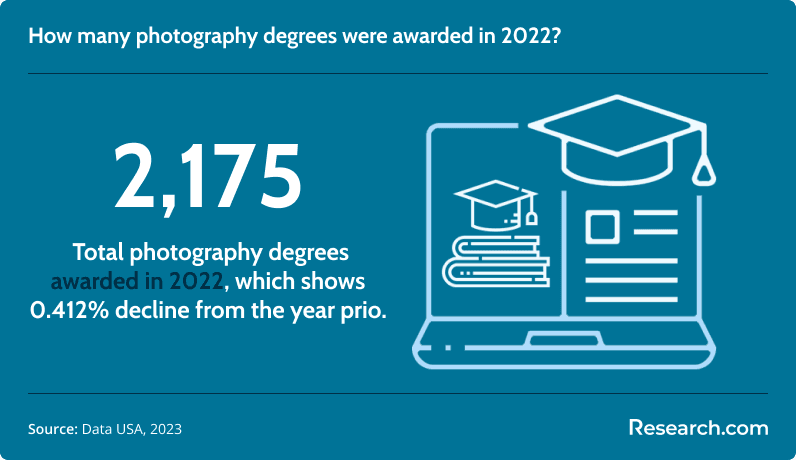
Choosing an online digital photography degree is not just about finding the lowest tuition. You also have to think about equipment costs, portfolio quality, software access, accreditation, transfer credits, and whether the program prepares you for freelance, commercial, editorial, or creative work. In 2022, more than 2,000 photography degrees were awarded in the United States, reflecting continued interest in formal training even as high equipment and specialized instruction costs have made affordability a major concern for students.
This guide is for aspiring photographers, working creatives, career changers, and adult learners who want a flexible path into digital photography without overspending. You will learn how online digital photography degrees work, what they cost, how long they take, which affordable programs stand out, what careers they can lead to, and how to compare programs before enrolling.
Quick answer: Is an online digital photography degree worth it?
An online digital photography degree can be worth it if you want structured training, regular critique, a professional portfolio, and a credential from an accredited institution. It is most useful for students who want to work in commercial photography, portraiture, digital media, photo editing, visual storytelling, or freelance creative services. It may be less necessary if you already have a strong portfolio, established clients, and only need short-term training in one skill such as lighting, editing, or business operations.
| Choose an online digital photography degree if... | Consider another option if... |
| You want a full bachelor’s-level education with general education, art, design, business, and portfolio courses. | You only need one specific skill, such as Lightroom editing, studio lighting, or drone photography. |
| You need flexibility because you work, freelance, care for family, or cannot relocate. | You learn best through daily in-person studio access and face-to-face demonstrations. |
| You want access to federal financial aid through an accredited college or university. | You prefer lower-cost workshops, certificates, apprenticeships, or self-paced courses. |
| You are building a career portfolio from the ground up and need instructor feedback. | You already have a client-ready portfolio and mainly need business coaching or marketing support. |
What are the benefits of getting an online digital photography degree?
- Lower total attendance costs: Online students often avoid campus housing, relocation, transportation, and some facility-related expenses, which can make a photography degree more manageable financially.
- More control over your schedule: Many online programs allow students to complete lectures, critiques, editing assignments, and portfolio work around jobs, family obligations, or freelance projects.
- Practice with digital tools: Online photography programs commonly emphasize digital imaging, editing workflows, portfolio websites, visual storytelling, and software-based production skills used in modern creative work.
- Portfolio development: A strong program should help you graduate with polished work samples, not just completed courses. For photography careers, the portfolio is often as important as the degree itself.
- Access from anywhere: Students can shoot assignments in their own communities, which can be useful for documentary, landscape, event, portrait, or local commercial photography.
What can I expect from an online digital photography degree?
An online digital photography degree usually combines studio art, camera technique, image editing, visual communication, and professional practice. Students learn how to plan shoots, control exposure, use natural and artificial light, compose images, edit digital files, critique visual work, and build a portfolio that reflects a clear creative point of view.
Most programs require more than taking attractive photos. You may study art history, design principles, color theory, business practices, copyright, branding, web presentation, and client communication. Bachelor’s programs also include general education courses, while BFA programs tend to place heavier emphasis on studio practice and portfolio depth.
Because the program is online, instruction is usually delivered through recorded lectures, live or asynchronous critiques, discussion boards, digital submissions, video demonstrations, and instructor feedback. You should expect to provide your own camera, computer, editing software, and, depending on the course, lenses, lighting equipment, storage drives, or printing resources.
| Program component | What it means for students |
| Camera and lighting assignments | You complete practical shoots and submit image sets for critique. |
| Editing and post-production | You learn workflows using tools such as Adobe Photoshop and Lightroom. |
| Peer and instructor critique | You receive feedback on technical execution, concept, composition, and visual impact. |
| Portfolio courses | You refine your strongest work into a professional presentation for clients, employers, or graduate study. |
| Business and marketing content | You study pricing, branding, contracts, client communication, copyright, and self-promotion. |
Where can I work with an online digital photography degree?
Graduates can work in freelance, commercial, editorial, creative, nonprofit, and media settings. About 65% of photographers are self-employed, which means many professionals earn income through client work, small businesses, contract projects, or specialized services such as weddings, portraits, real estate, products, events, and brand photography.
Others work for photographic services companies, publishers, retailers, advertising teams, media organizations, arts institutions, universities, museums, real estate firms, design studios, and content production teams. The strongest job options usually go to graduates who pair technical skill with a focused portfolio, reliable business practices, and the ability to deliver images for a specific market.
How much can I make with an online digital photography degree?
As of 2024, photographers earn an average annual salary of around $42,520, according to the U.S. Bureau of Labor Statistics. Earnings can differ widely by location, experience, specialty, employer type, client base, and whether you work independently or as an employee. Freelance wedding, commercial, product, and corporate photographers may increase earnings by building repeat clients and charging project-based rates, while entry-level roles and smaller local markets may pay less.
Salary data should be used as a planning benchmark, not a guarantee. Photography income often depends on portfolio quality, marketing ability, turnaround speed, editing skill, niche demand, referrals, and business management.
- Most Affordable Online Digital Photography Degree Programs for 2027
- How long does it take to complete an online digital photography degree program?
- How does an online digital photography degree compare to an on-campus program?
- What is the average cost of an online digital photography degree program?
- What are the financial aid options for students enrolling in an online digital photography degree program?
- What are the prerequisites for enrolling in an online digital photography degree program?
- What courses are typically in an online digital photography degree program?
- What types of specializations are available in online digital photography degree programs?
- How does one choose the best online digital photography degree program?
- Are online digital photography degree programs accredited and industry-recognized?
- Can integrating interdisciplinary studies boost digital photography careers?
- Can I pursue graduate studies to further enhance my digital photography career?
- How do online digital photography programs incorporate emerging digital trends?
- What career paths are available for graduates of online digital photography degree programs?
- What is the job market for graduates with an online digital photography degree?
Most Affordable Online Digital Photography Degree Programs for 2027
How do we rank schools?
Affordability matters, but a low price is only useful when the program also offers credible instruction, recognized accreditation, clear graduation requirements, and enough portfolio support to help students compete after graduation. Research.com evaluates programs with a focus on transparent information that students can use when comparing schools.
This ranking uses established education data sources, including the IPEDS database, Peterson’s database—including their Distance Learning Licensed Data Set—the College Scorecard database, and the National Center for Education Statistics.
To understand the ranking process in more detail, review our methodology section.
| School | Program focus | Cost information | Credits |
| Arizona State University | Digital Photography | $6,515 per semester | 120 |
| Southern New Hampshire University | General Digital Photography | $330 per credit | 120 |
| Liberty University | Photographic Design | $250 per credit | 120 |
| Lindenwood University | Photography | $495 per credit | 120 |
| Pennsylvania State University (Penn State) World Campus | Digital Multimedia Design | Approximately $576–$617 per credit | 120 |
| Rocky Mountain College of Art + Design (RMCAD) | Photography | $740 per credit | 120 |
| Savannah College of Art and Design (SCAD) | Photography | $712 per credit | 180 |
| Southeastern University | Digital Design | $250 per credit | 120 |
| Academy of Art University | Photography | $1,301 per credit | Varies by program |
| Sessions College for Professional Design | General Digital Photography | $300 per credit | 120 |
1. Arizona State University
Arizona State University offers an online Bachelor of Fine Arts in Art with a concentration in Digital Photography for students who want a studio-centered degree with substantial creative development. The curriculum asks students to experiment with photographic processes and concepts through work such as portraits, landscapes, videos, and print-to-order books. Online critiques and instructor feedback help students refine both technique and artistic intent. Graduates complete the program with a portfolio and artist statement that may support work in editorial photography, design, museum curation, and related visual fields.
- Program Length: 4 years
- Tracks/concentrations: Digital Photography
- Cost: $6,515 per semester
- Required Credits to Graduate: 120
- Accreditation: Higher Learning Commission (HLC)
2. Southern New Hampshire University
Southern New Hampshire University, or SNHU, provides a Bachelor of Arts in Digital Photography that combines creative practice with career-oriented instruction. Students study advanced camera operation, lighting, editing technology, and portfolio development. The asynchronous format can work well for adults and working students, and the transfer policy may reduce completion time for those with previous college credit.
- Program Length: 4 years
- Tracks/concentrations: General Digital Photography
- Cost per Credit: $330
- Required Credits to Graduate: 120
- Accreditation: New England Commission of Higher Education
3. Liberty University
Liberty University in Lynchburg, VA, offers a Bachelor of Science in Digital Design with a concentration in Photographic Design. The fully online format uses 8-week courses and multiple start dates, which may appeal to students who want a more flexible academic calendar. Students can potentially transfer up to 75% of their credits, making the program worth reviewing for applicants who already have college coursework.
- Program Length: 3.5 years
- Tracks/concentrations: Photographic Design
- Cost per Credit: $250
- Required Credits to Graduate: 120
- Accreditation: Southern Association of Colleges and Schools Commission on Colleges
4. Lindenwood University
Lindenwood University offers a Bachelor of Fine Arts in Art and Design with an emphasis in Photography. The program takes an interdisciplinary approach, which can be useful for students who want photography training alongside broader art and design preparation. Students may gain applied experience through internships or participation in the university's Art and Design Firm, and the degree concludes with a capstone project. The program is available in both on-campus and online formats.
- Program Length: 4 years
- Tracks/concentrations: Photography
- Cost per Credit: $495
- Required Credits to Graduate: 120
- Accreditation: Higher Learning Commission
5. Pennsylvania State University (Penn State) World Campus
Penn State offers an online Bachelor of Design in Digital Multimedia Design through a collaboration among the Colleges of Arts and Architecture, Communications, and Information Sciences and Technology. Although the program is broader than photography alone, it may fit students who want to combine image-making with design, communication, and interactive media. Coursework emphasizes creative communication, critical reasoning, and technology-supported visual work.
- Program Length: 4 years
- Tracks/concentrations: Digital Multimedia Design
- Cost per Credit: Approximately $576–$617
- Required Credits to Graduate: 120
- Accreditation: Middle States Commission on Higher Education
6. Rocky Mountain College of Art + Design (RMCAD)
RMCAD offers a fully online Bachelor of Fine Arts in Photography focused on both artistic identity and professional preparation. Students study commercial photography, lighting, visual storytelling, and business operations. The program places strong emphasis on portfolio development, helping students present a consistent style and technical skill set for creative industry opportunities.
- Program Length: 4 years
- Tracks/concentrations: Photography
- Cost per Credit: $740
- Required Credits to Graduate: 120
- Accreditation: Higher Learning Commission
7. Savannah College of Art and Design (SCAD)
Savannah College of Art and Design, also known as SCAD, offers an online Bachelor of Fine Arts in Photography through SCADnow. The program includes foundation studies, general education, and major coursework for a total of 180 credit hours. Students should expect a rigorous creative curriculum designed to mirror the standards and opportunities available to campus-based learners.
- Program Length: 4 years
- Tracks/concentrations: Photography
- Cost per Credit: $712
- Required Credits to Graduate: 180
- Accreditation: Southern Association of Colleges and Schools Commission on Colleges
8. Southeastern University
Southeastern University offers an online Bachelor of Science in Digital Media and Design with a track in Digital Design. The curriculum covers visual storytelling, color theory, and international visual communication. Students who want a broader digital media degree rather than a photography-only program may find this option useful, especially if they are interested in creative production across multiple platforms.
- Program Length: 4 years
- Tracks/concentrations: Digital Design
- Cost per Credit: $250
- Required Credits to Graduate: 120
- Accreditation: Southern Association of Colleges and Schools Commission on Colleges
9. Academy of Art University
The Academy of Art University provides online photography degree options through its Learning Management System. Students use instructional resources such as videos, audio lectures, interactive slides, and workbooks while developing technical and aesthetic skills. The curriculum is designed to help students translate creative direction into a professional portfolio.
- Program Length: Varies by program
- Tracks/concentrations: Photography
- Cost per Credit: $1,301
- Required Credits to Graduate: Varies by program
- Accreditation: WASC Senior College and University Commission
10. Sessions College for Professional Design
Sessions College offers a Bachelor of Fine Arts in Digital Photography with a portfolio-centered curriculum. Students build a foundation in art and photography, then use advanced coursework to align their studies with professional goals. Flexible scheduling may support both full-time and part-time students.
- Program Length: 3.3 years
- Tracks/concentrations: General Digital Photography
- Cost per Credit: $300
- Required Credits to Graduate: 120
- Accreditation: Distance Education Accrediting Commission (DEAC)
How long does it take to complete an online digital photography degree program?
A full-time online bachelor’s degree in digital photography usually takes about four years and often requires around 120 credit hours. Students complete general education requirements along with major courses in lighting, image editing, digital imaging, composition, business practices, and visual storytelling. Some programs may take less time if students transfer credits, study year-round, or choose accelerated terms.
Part-time students should plan for a longer timeline, often five or six years depending on course load and program policies. This flexibility can be valuable for students who are working, caregiving, freelancing, or building a photography business while studying. Associate degrees and certificates may provide shorter routes into entry-level creative work, but they usually do not offer the same depth as a bachelor’s degree.
| Study path | Typical fit | What to check before enrolling |
| Full-time bachelor’s program | Students who can take a standard course load and want to finish in about four years. | Credit requirements, term length, portfolio expectations, and equipment needs. |
| Part-time bachelor’s program | Working adults, caregivers, military students, and freelancers who need a slower pace. | Maximum completion time, course rotation, and financial aid eligibility by enrollment status. |
| Accelerated or transfer-friendly program | Students with prior college credits or a strong plan to take classes continuously. | Transfer limits, residency requirements, and whether photography major courses must be taken at the school. |
| Associate degree or certificate | Students who want faster training for basic technical or portfolio skills. | Whether credits can transfer into a bachelor’s program later. |
The chart below shows the most common majors pursued by digital photographers:
How does an online digital photography degree compare to an on-campus program?
Online and on-campus photography degrees can lead to similar academic credentials, but the learning experience is different. Online programs are often better for students who need schedule flexibility, lower relocation costs, and the ability to complete assignments from home or local shooting locations. This can make them a practical option for working adults, career changers, and students researching the best degrees for older adults.
Campus programs may offer easier access to studios, darkrooms, galleries, lighting equipment, printing labs, and in-person collaboration. However, they may also involve higher living, commuting, and campus-based costs. The better choice depends on your learning style, budget, location, and access to equipment.
| Factor | Online digital photography degree | On-campus digital photography degree |
| Schedule | Often asynchronous or flexible, with online deadlines and remote critiques. | Usually follows set class times, studio sessions, and campus schedules. |
| Equipment access | Students often use their own cameras, computers, lighting, and software. | Students may have access to campus studios, labs, darkrooms, printers, and loaner equipment. |
| Feedback | Delivered through digital submissions, recorded comments, video meetings, and discussion boards. | Often happens in real time through studio critiques and in-person demonstrations. |
| Cost structure | May reduce commuting, housing, and relocation costs. | May include campus fees, housing, transportation, and facility-related expenses. |
| Best for | Independent learners with reliable equipment access and strong time management. | Students who want daily studio access and face-to-face creative collaboration. |
What is the average cost of an online digital photography degree program?
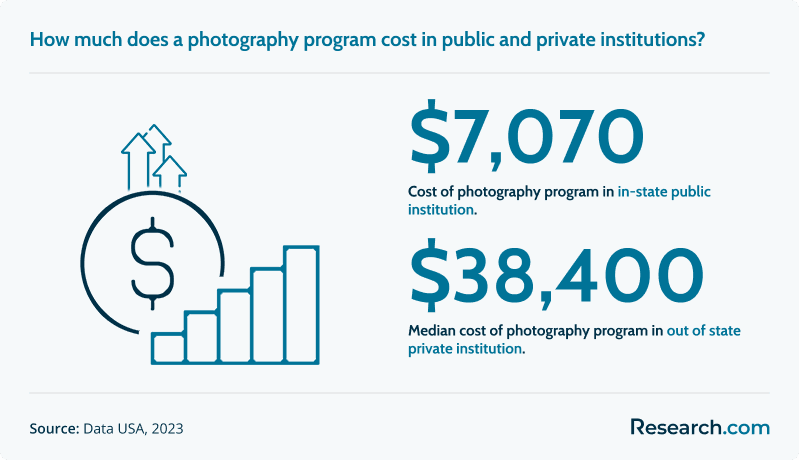
The cost of an online digital photography degree depends on the institution, residency rules, transfer credits, program length, fees, and required equipment. According to Data USA, the median in-state tuition at public institutions is about $7,070 per year, with an annual growth rate of 3.24%. Private programs can cost more. For example, Southern New Hampshire University offers a Bachelor of Arts in Digital Photography for $38,400, while Sessions College offers a Bachelor of Fine Arts for $300 per credit, totaling $36,000.
As with cheap one year master's programs online, the lowest advertised tuition does not always equal the lowest final cost. Students should compare total program price, transfer credit policies, fees, supplies, software, and time to completion.
| Cost factor | Why it matters | Question to ask |
| Tuition rate | Per-credit and per-semester pricing can lead to very different total costs. | What is the estimated full program cost, not just the tuition rate? |
| Transfer credits | Schools that accept prior credits may reduce the number of courses you need to pay for. | How many credits can I transfer, and which ones count toward the major? |
| Equipment | Students may need cameras, lenses, lighting gear, tripods, storage, and printing resources. | Does the program provide an equipment list before enrollment? |
| Software | Editing and workflow courses may require paid subscriptions or specific applications. | Are student discounts or included software licenses available? |
| Fees | Online, technology, graduation, portfolio, or course fees can affect affordability. | Are there additional fees beyond tuition? |
| Time to completion | A longer program may increase living costs, fees, and loan borrowing. | Can I finish faster through transfer credits or year-round enrollment? |
Students comparing low-cost online degrees may also review the cheapest online BS in sustainability degree to see how online programs in different fields structure tuition, flexibility, and career-focused coursework.
Additional expenses can be significant. Students should budget for equipment such as cameras and lenses, which can range from $800 to $1,300, and software subscriptions like Adobe Creative Cloud, which costs about $9.99 per month. These costs should be included when estimating affordability.
What are the financial aid options for students enrolling in an online digital photography degree program?
Students in accredited online digital photography degree programs may qualify for many of the same financial aid options as campus students. The key is accreditation and eligibility: not every online program, certificate, or private training provider qualifies for federal aid.
- Federal Financial Aid: Submit the Free Application for Federal Student Aid (FAFSA) to be considered for federal grants, loans, and work-study. Pell Grants may be available to eligible students and do not have to be repaid.
- State Grants and Aid: Some states provide grants or tuition assistance for residents enrolled in eligible accredited online programs.
- Institutional Scholarships: Schools may offer awards based on academic record, financial need, creative talent, portfolio quality, or major.
- External Scholarships: Photography, art, media, nonprofit, and community organizations may provide scholarships for creative students.
- Student Loans: Federal and private loans can help cover remaining costs. Federal loans often provide more flexible repayment options than private loans.
- Military and Veteran Benefits: Active-duty service members, veterans, and eligible dependents may use tuition assistance, GI Bill benefits, or military-related scholarships.
- Employer Tuition Assistance: Students working in marketing, media, communications, design, or content production may be able to use employer reimbursement programs.
- Payment Plans: Many colleges allow students to divide tuition into monthly payments rather than paying the full balance upfront.
Financial aid structures for creative programs often resemble those used in technical training. Students comparing short credential options can look at the cheapest online AutocCAD certificate programs for another example of how scholarships, grants, employer support, and payment options may reduce upfront costs.
What are the prerequisites for enrolling in an online digital photography degree program?
Admission requirements vary by school, but most online bachelor’s programs in digital photography expect applicants to meet standard undergraduate entry requirements and have access to the technology needed for image production and online learning.
| Requirement | What it usually involves | Why it matters |
| High school diploma or equivalent | Applicants typically submit proof of high school completion or a GED. | This is the basic academic requirement for most bachelor’s programs. |
| Application materials | Schools may request an application form, fee, transcripts, essay, or personal statement. | Requirements affect deadlines and admission readiness. |
| Portfolio | Some fine arts or competitive programs may ask for samples of creative work. | A portfolio can show readiness for studio-based study. |
| Photography equipment | Students may need a DSLR or mirrorless camera, lenses, tripod, lighting tools, and storage. | Assignments usually require original image production. |
| Computer and software | A reliable computer, internet connection, and editing software such as Adobe Photoshop and Lightroom may be needed. | Online coursework depends on digital submission and editing workflows. |
| English language proficiency | International students may need TOEFL or IELTS scores. | Programs require students to participate in critiques, writing assignments, and discussions. |
Because photography graduate numbers have declined over the past three years, students should not assume every program has the same admissions expectations. Review the official admissions page, equipment list, transfer policy, and software requirements before applying.
What courses are typically in an online digital photography degree program?
Online digital photography programs usually blend art foundations, technical camera training, editing, visual storytelling, and professional preparation. The goal is to help students make stronger images, explain creative choices, manage digital workflows, and present a polished portfolio.
- Introduction to Digital Photography: Covers camera controls, exposure, composition, file formats, and basic lighting.
- History of Photography: Examines major photographers, movements, technologies, and cultural uses of photographic images.
- Studio and Lighting Techniques: Teaches students how to shape light in portraits, products, interiors, and controlled environments.
- Photo Editing and Post-Production: Develops image correction, retouching, color management, file organization, and editing workflows in tools such as Adobe Photoshop and Lightroom.
- Color Theory and Design Principles: Explores how color, contrast, balance, framing, and layout influence visual communication. These concepts are also relevant to students researching the certification needed to be an art teacher, since art education often requires knowledge of design fundamentals.
- Visual Storytelling and Narrative Photography: Focuses on building photo essays, documentary projects, editorial sequences, and concept-driven bodies of work.
- Commercial and Portrait Photography: Introduces professional techniques for clients, products, brands, events, and studio portraits.
- Photography Business and Marketing: Covers branding, pricing, contracts, client management, copyright, licensing, invoicing, and self-promotion.
- Web and Portfolio Development: Helps students create a professional online presence and organize work for clients, employers, or graduate applications.
- Capstone Project or Senior Portfolio: Requires students to produce and present a final body of work that demonstrates technical skill and creative direction.
Electives may include photojournalism, fashion photography, multimedia production, motion work, digital imaging, or advanced retouching depending on the school.
What types of specializations are available in online digital photography degree programs?
Specializations help students aim their portfolio toward a specific market. This matters because employers and clients usually hire photographers for a clear need: portraits, products, events, editorial storytelling, real estate, fashion, or artistic work.
| Specialization | Best for students interested in | Portfolio should show |
| Portrait Photography | Families, seniors, weddings, corporate headshots, studio work, and personal branding. | Lighting control, posing, expression, client direction, and consistent editing. |
| Commercial and Product Photography | Advertising, e-commerce, catalogs, restaurants, brands, and marketing teams. | Clean lighting, detail, product styling, color accuracy, and brand awareness. |
| Photojournalism | News, documentary work, magazines, nonprofits, and editorial media. | Story sequencing, ethical image-making, captions, context, and visual narrative. |
| Fine Art Photography | Gallery work, exhibitions, artist books, creative projects, and independent practice. | Conceptual strength, visual coherence, artist statement, and experimentation. |
| Nature and Wildlife Photography | Outdoor, travel, conservation, landscape, and environmental storytelling. | Patience, field technique, composition, natural light use, and subject knowledge. |
| Fashion Photography | Editorial shoots, designers, models, brands, campaigns, and fashion media. | Model direction, styling awareness, lighting, mood, and polished production. |
| Digital Post-Production | Retouching, compositing, editing workflows, image restoration, and visual effects. | Before-and-after edits, technical precision, consistency, and file management. |
Students interested in outdoor and environmental work may find that nature photography overlaps with field-based careers, including the forest ranger career path, where documentation and public communication can support conservation education.
Photography students are not the only creative learners who specialize. Students in the most affordable online cinematography degree programs often focus on lighting, camera operation, post-production, or visual storytelling, showing how digital media programs can be tailored to distinct creative goals.
In 2023, 55% of photography program graduates earned a bachelor’s degree, which suggests many students continue to value broad undergraduate training when preparing for specialized creative work.
How does one choose the best online digital photography degree program?
The best online digital photography degree is the one that fits your goals, budget, schedule, equipment access, and desired career path. A program with low tuition but weak critique, unclear portfolio support, or poor transfer policies may cost more in the long run. Use the factors below before applying.
- Accreditation: Confirm that the institution is accredited by a recognized agency. Accreditation can affect financial aid eligibility, credit transfer, graduate school admission, and employer confidence.
- Curriculum fit: Look for courses that match your goals, whether you want commercial photography, portrait work, fine art, photojournalism, digital media, or post-production.
- Faculty background: Review instructor experience, creative work, industry connections, and whether faculty provide meaningful critique.
- Cost and Financial Aid: Compare tuition, fees, equipment, software, and transfer credit options. If you plan to use federal aid, prioritize online colleges that accept FAFSA.
- Flexibility: Check whether courses are asynchronous, synchronous, accelerated, self-paced, or cohort-based.
- Technology and equipment requirements: Make sure you can afford and access the required camera, lenses, computer, storage, lighting, and editing software.
- Portfolio outcomes: Strong programs should include critique, revision, capstone work, and portfolio presentation—not just quizzes and lectures.
- Student support: Look for academic advising, career services, library access, tutoring, technical support, and online student communities.
Questions to ask before enrolling
- Is the school institutionally accredited, and by which agency?
- How many credits are required, and how many can I transfer?
- What camera, computer, lighting, and software will I need before the first term?
- Will I receive instructor critique on every major project?
- Does the program include business training for freelance photographers?
- Can I graduate with a complete portfolio and website?
- Are there additional course, technology, portfolio, or graduation fees?
- Do online students receive the same career services as campus students?
Common mistakes to avoid
| Mistake | Why it can hurt you | Better approach |
| Choosing only by tuition | The cheapest program may still require expensive gear, software, fees, or extra terms. | Compare the total cost of attendance and required supplies. |
| Ignoring accreditation | Credits may not transfer, and financial aid eligibility may be limited. | Verify institutional accreditation before applying. |
| Assuming online means easier | Photography assignments require planning, shooting, editing, critique, and revision. | Review weekly workload expectations and deadlines. |
| Underestimating equipment needs | Missing gear can delay assignments or lower project quality. | Ask for a required equipment list before enrollment. |
| Neglecting business skills | Many photographers are self-employed and must manage clients, pricing, contracts, and marketing. | Choose a program with business, branding, or entrepreneurship coursework. |
| Graduating without a focused portfolio | A broad but unfocused portfolio may make it harder to attract clients or employers. | Use electives and capstone work to build a clear specialty. |
Are online digital photography degree programs accredited and industry-recognized?
Online digital photography degrees can be accredited and respected when they are offered by properly accredited institutions. Accreditation is important because it signals that a school meets recognized academic standards. It can also affect access to financial aid, credit transfer, graduate school options, and how employers or clients view the credential.
Students should distinguish institutional accreditation from industry reputation. Institutional accreditation is tied to the college or university. Industry recognition depends more on portfolio quality, faculty experience, alumni outcomes, employer relationships, exhibitions, internships, professional partnerships, and the program’s connection to current creative practice. This same distinction matters when comparing other creative degrees, such as the cheapest online creative writing degree.
Can integrating interdisciplinary studies boost digital photography careers?
Yes. Digital photography increasingly overlaps with writing, marketing, design, video, social media, journalism, user experience, conservation, and brand strategy. A photographer who can write captions, design campaigns, understand audiences, edit short-form video, or manage digital platforms may have more ways to earn income than someone who only captures images.
Interdisciplinary study is especially valuable for students interested in multimedia journalism, advertising, content strategy, nonprofit communications, museum work, and digital publishing. Pairing photography with writing or communication can strengthen visual storytelling; students considering advanced narrative training may also review pathways related to creative writing MFA degree jobs.
Can I pursue graduate studies to further enhance my digital photography career?
Graduates with an online digital photography degree can pursue graduate study if they want deeper studio practice, advanced critique, teaching preparation, curatorial work, research, or a stronger fine arts credential. A graduate program may be useful for students who want to teach at certain institutions, develop a major body of creative work, or build professional networks through faculty mentorship and exhibitions.
Before applying, compare curriculum depth, faculty work, residency requirements, critique structure, thesis expectations, cost, and funding. Students seeking lower-cost advanced creative programs can explore affordable MFA degree programs online.
How do online digital photography programs incorporate emerging digital trends?
Online photography programs increasingly reflect changes in digital image production, including AI-assisted editing, mobile-first content, virtual exhibitions, digital asset management, multimedia storytelling, short-form video, and new imaging software. The best programs do not treat these tools as shortcuts. They teach students how to use them responsibly while maintaining authorship, ethical standards, and visual quality.
Students may encounter virtual workshops, online critique sessions, portfolio reviews, webinars with working creatives, and assignments that integrate design or interactive media. Programs that connect photography with digital product design or audience experience may also overlap with topics found in the best online UX programs.
What career paths are available for graduates of online digital photography degree programs?
Graduates can pursue roles across photography, media, design, marketing, publishing, real estate, events, art, and digital content. Career options depend less on the delivery format of the degree and more on portfolio quality, niche expertise, business skills, and professional relationships.
| Career path | Typical work | Skills that matter most |
| Portrait Photographer | Creates individual and group portraits for families, seniors, weddings, businesses, and personal brands. | Lighting, posing, client communication, retouching, and studio workflow. |
| Commercial Photographer | Produces images for advertising, product promotion, catalogs, websites, and marketing campaigns. | Brand awareness, lighting precision, composition, editing, and project management. |
| Photojournalist | Documents news, communities, events, and social issues for media outlets or digital publications. | Ethics, storytelling, timing, captions, editing speed, and field judgment. |
| Fine Art Photographer | Creates conceptual or artistic images for exhibitions, galleries, publications, or collectors. | Creative vision, artist statements, sequencing, printing, and exhibition preparation. |
| Event Photographer | Captures weddings, concerts, conferences, ceremonies, and corporate events. | Low-light shooting, quick decision-making, client service, editing volume, and delivery systems. |
| Real Estate Photographer | Photographs homes, commercial properties, interiors, and architectural spaces for listings and marketing. | Wide-angle composition, lighting balance, editing consistency, and fast turnaround. |
| Conservation Photographer | Uses images to document ecosystems, wildlife, environmental issues, and conservation stories. | Fieldwork, research, environmental awareness, patience, and narrative sequencing. |
| Fashion Photographer | Works with models, stylists, designers, magazines, and brands to create editorial and campaign images. | Lighting, direction, styling awareness, production planning, and collaboration. |
| Film and Video Editor | Uses visual storytelling and editing skills to assemble digital media for film, television, or online platforms. | Editing software, pacing, file management, visual continuity, and storytelling. |
| Camera Operator | Captures footage for television, film, streaming, live events, or corporate production. | Camera systems, framing, movement, lighting, and collaboration with directors. |
| Multimedia Artist/Animator | Combines photography, digital design, animation, and visual effects for media projects. | Design, motion tools, compositing, storytelling, and technical production. |
| Drone Pilot | Captures aerial images and footage for real estate, events, landscapes, inspections, and media production. | Flight planning, composition, safety, editing, and regulatory compliance. |
Conservation photography may overlap with environmental advocacy and field communication. Students interested in that route can review conservationist job requirements to understand how scientific knowledge and field experience may support visual work.
Because many photographers operate as freelancers or small business owners, business training can be a strong complement to creative study. Students who want broader management preparation may also compare an affordable online bachelor's in management degree.
According to recent data from the U.S. Bureau of Labor Statistics, many photographers are self-employed. This gives photographers flexibility, but it also means they must manage marketing, pricing, taxes, contracts, client communication, and inconsistent income cycles.
What is the job market for graduates with an online digital photography degree?
The photography job market is stable but competitive. According to the U.S. Bureau of Labor Statistics, there were around 151,100 working photographers in 2023, with employment projected to grow by 4% through 2033, which is about as fast as the average for all occupations. Roughly 13,700 job openings are expected each year, largely because workers retire, change careers, or move into related fields.
Graduates should expect competition, especially in popular freelance niches. Demand is strongest for photographers who can solve business problems: producing product images, social media content, marketing visuals, event coverage, real estate imagery, editorial packages, or brand storytelling. Technical skill alone is usually not enough. Employers and clients also value reliability, editing consistency, communication, fast delivery, and a portfolio that clearly matches the work they need.
How to improve your career prospects while enrolled
- Build a focused portfolio for one or two markets instead of trying to show every type of photography.
- Learn business basics, including pricing, contracts, invoicing, licensing, and copyright.
- Practice fast, consistent editing workflows and organized file delivery.
- Seek critique from instructors, peers, working photographers, and potential clients.
- Create a professional website and keep social media channels aligned with your niche.
- Use class projects to build real-world samples, such as product sets, portraits, events, editorial stories, or brand campaigns.
- Consider certifications or regulatory requirements when entering specialized areas such as commercial drone photography, where drone operators must be certified by the Federal Aviation Administration (FAA).
Key Insights
- An online digital photography degree is most valuable when it delivers three things: accredited coursework, serious critique, and a portfolio strong enough to show clients or employers.
- Affordability should include tuition, fees, transfer credits, camera gear, lenses, lighting, computer needs, and software—not just the advertised per-credit rate.
- About 65% of photographers are self-employed, so students should prioritize programs that teach business, marketing, pricing, contracts, and client communication.
- As of 2024, photographers earn an average annual salary of around $42,520 according to the U.S. Bureau of Labor Statistics, while ZipRecruiter reports the average salary for digital photographers is around $42,345 per year.
- The median in-state tuition at public institutions is about $7,070 per year, while private examples include Southern New Hampshire University at $38,400 and Sessions College at $36,000.
- Online programs are best for independent learners with reliable equipment and time-management skills; campus programs may be better for students who need studio access and in-person collaboration.
- In 2023, 55% of photography graduates completed a bachelor’s degree, showing that many students still choose comprehensive undergraduate training for creative careers.
- Photographers working in publishing, broadcasting, and content creation earn some of the highest wages, averaging about $59,530 annually.
- Students should verify accreditation, equipment requirements, portfolio outcomes, transfer policies, and financial aid eligibility before committing to any program.
References:
- Data USA. (2023). Photography. DataUSA.io. Retrieved May 21, 2025.
- FSA. (n.d.). Understanding College Costs. Federal Student Aid. Retrieved May 21, 2025.
- NCES. (2023). IPEDS data center. National Center for Education Statistics. Retrieved May 21, 2025.
- U.S. BLS. (2025, April 18). Occupational outlook handbook: Photographers. U.S. Bureau of Labor Statistics. Retrieved May 21, 2025.
- U.S. BLS. (2025, April 18). Photographers: Job outlook. U.S. Bureau of Labor Statistics. Retrieved May 21, 2025.
- U.S. BLS. (2025, April 18). Photographers: Pay. U.S. Bureau of Labor Statistics. Retrieved May 21, 2025.
- ZipRecruiter. (2025, May 13). Digital photographer salary. ZipRecruiter.com. Retrieved May 21, 2025.
Other Things You Should Know About the Most Affordable Online Digital Photography Degree Programs
Yes, beyond tuition, students may incur costs for software subscriptions, online resources, and camera equipment. Some programs may also charge fees for course materials or online exams. It's important to review each program's fee structure for specifics.
Most programs expect students to know basic Adobe Photoshop or Lightroom workflows and to save images in JPEG, TIFF, and RAW formats. Some also require a computer that can run current creative software and enough storage for large photo files, usually before the first studio or editing course begins.


