
2027 How to Become a School Social Worker: State Requirements

Co-Founder and Chief Data Scientist
Becoming a school social worker usually requires more than compassion for children and families. The role sits at the intersection of education, mental health support, family services, crisis response, and student advocacy. For students facing stress, bullying, housing insecurity, family conflict, trauma, disability-related barriers, or mental health concerns, a school social worker can be one of the most important adults in the building. A 2024 report indicates that around 76% of students deal with moderate to high levels of stress, which helps explain why schools increasingly rely on trained support professionals.
This guide explains how to become a school social worker, what education and licensure steps are usually required, how the ASWB exam fits into the process, what salaries and job prospects look like, and how to decide whether this career path is right for you. It is written for prospective BSW and MSW students, career changers, educators considering social work, and current social work students planning to work in K-12 settings.
Quick answer: How do you become a school social worker?
To become a school social worker, you generally need to earn a bachelor’s degree, complete a Master of Social Work from a CSWE-accredited program if your state or employer requires it, finish supervised fieldwork, pass the required ASWB licensing exam, and apply for the appropriate state social work license or school social work credential. Some states allow limited roles with a BSW, but many school-based positions prefer or require an MSW and state-specific certification.
Key things you should know about becoming a school social worker
- According to 2024 data, social workers in the United States receive a median annual salary of $62,000.
- Social workers in educational services take home a median annual salary of $62,980.
- The ASWB exam passing rates for the Bachelor's, Master's, Advanced Generalist, and Clinical levels are 64.5%, 72.1%, 57.8%, and 74.4%, respectively.
- The ASWB exam has about 170 multiple-choice items and should be completed in four hours.
- Social workers can retake the ASWB exam after 90 days.
- By 2032, an estimated 374,300 child, family, and school social workers will have been employed in the United States.
- What does a school social worker do?
- What are the admission requirements for social work degrees?
- What are the required courses for social work degrees?
- How does one pass the ASWB exam?
- What are the state licensure requirements for school social workers in 2027?
- How does one maintain a license for school social workers?
- What is the average salary of school social workers?
- What is the job outlook for school social workers?
- Can online programs fully prepare you for a school social work career?
- What future trends are shaping the field of school social work?
- How important are internships and fieldwork for aspiring school social workers?
- How can an advanced standing MSW online program benefit my career in school social work?
- How can school social workers manage stress and prevent burnout?
- What are the challenges and rewards of a career in school social work?
- What determines the salary range for school social workers in different states?
- What are the career advancement opportunities for school social workers?
- Is pursuing a doctorate in social work a worthwhile investment for school social workers?
- What are the educational cost considerations for aspiring school social workers?
What school social workers say about the work
Practitioners often describe school social work as challenging, relationship-centered, and meaningful. Jo emphasized the daily opportunity to help students manage difficult moments and connect families with needed services. Eric described the value of working with teachers, caregivers, and community organizations to create safer and more supportive learning environments. Colin highlighted the advocacy side of the profession, especially helping students feel included, heard, and supported within the school community.
These reflections capture a core truth about the job: school social workers do not work with students in isolation. They coordinate with families, teachers, administrators, mental health providers, child welfare agencies, and community organizations to reduce barriers that affect learning and well-being.
What does a school social worker do?
A school social worker helps students address social, emotional, behavioral, family, and environmental challenges that interfere with school success. Unlike a classroom teacher, whose primary responsibility is instruction, a school social worker focuses on the conditions that affect a student’s ability to participate, learn, build relationships, and stay safe.
Day-to-day responsibilities may include individual counseling, group support, crisis intervention, behavior assessment, attendance interventions, family outreach, resource referrals, and collaboration with teachers. In some schools, social workers also help design prevention programs related to bullying, suicide awareness, substance misuse, trauma, grief, conflict resolution, or social-emotional learning.
School social workers assess students in context. That means they consider academic performance, peer relationships, family circumstances, cultural background, disability status, housing stability, mental health needs, and community resources. They may develop intervention plans with educators and parents, connect families to mental health services or financial assistance, and advocate for changes that make school more accessible for vulnerable students.
Some school social workers also support teachers. A 2024 study has shown a 25% increase in teacher satisfaction ever since they worked with school social workers. In practice, this support may include consultation on classroom behavior concerns, crisis response planning, and help connecting staff with appropriate resources.
When comparing social work vs psychology, social work generally places stronger emphasis on systems, advocacy, resource coordination, and social conditions, while psychology more often centers on assessment, diagnosis, and mental health treatment. In schools, the two fields may overlap, but school social workers typically focus heavily on how family, school, and community factors affect students.
Core responsibilities of school social workers
- Counseling and support: Helping students process stress, grief, conflict, bullying, family instability, or social-emotional concerns.
- Crisis intervention: Responding to urgent situations involving student safety, trauma, self-harm risk, violence, or family emergencies.
- Student assessments: Evaluating needs, strengths, risks, behavior patterns, and environmental factors affecting school participation.
- Resource referral and advocacy: Connecting students and families with mental health providers, housing support, food assistance, healthcare, or social services.
- Preventive programming: Supporting schoolwide or targeted programs that address attendance, bullying, coping skills, peer relationships, and student well-being.
| Responsibility | What it can look like in a school | Why it matters |
| Student counseling | Meeting with students individually or in groups to address stress, behavior, family conflict, or peer issues | Students often need support before problems escalate into academic failure, absenteeism, or crisis |
| Family engagement | Contacting caregivers, coordinating meetings, and helping families access resources | Many student challenges are connected to home, transportation, housing, healthcare, or financial conditions |
| Teacher consultation | Helping educators understand behavioral triggers, trauma responses, or support plans | Teachers can respond more effectively when they understand the social and emotional context |
| Crisis response | Supporting students after emergencies, safety concerns, grief, threats, or traumatic events | Schools need trained professionals who can respond calmly and ethically under pressure |
| Systems advocacy | Identifying gaps in school policies, services, or access and recommending improvements | School social work is not only casework; it also addresses patterns that affect many students |

Steps to become a licensed school social worker
The path usually includes formal education, supervised practice, examination, and state approval. Exact requirements vary by state, so students should verify rules with their state social work board, education department, or credentialing agency before choosing a program.
1. Earn a bachelor’s degree
A Bachelor of Social Work is often the most direct undergraduate choice because it introduces students to social welfare policy, human behavior, social justice, research, ethics, and field education. A BSW may also make students eligible for advanced standing MSW options at some schools.
Students with bachelor’s degrees in psychology, education, human development, sociology, or related fields may also qualify for MSW admission, depending on the school. These majors can be useful for understanding child development, learning environments, family systems, and community needs.
Students comparing costs often ask, how much does it cost to become a social worker? A bachelor’s degree in social work may cost around $30,412, while a master’s degree merits expenses of around $43,545.
2. Complete a Master of Social Work when required
Many school social worker roles require or strongly prefer an MSW. Students should look for CSWE-accredited programs because accreditation is commonly tied to licensure eligibility. A school social work concentration, child and adolescent mental health track, or field placement in a K-12 setting can make the degree more relevant to school-based practice.
Students who want a faster route may consider the fastest online MSW programs, but accelerated formats are not automatically easier. They often require heavier course loads, careful scheduling, and strong time management, especially when field placement hours are involved.
3. Complete supervised fieldwork or an internship
Field education is where students learn how school social work actually operates. During an MSW, students may complete a supervised placement in a school or a youth-serving agency. This experience helps them practice assessment, documentation, family engagement, mandated reporting, crisis response, and collaboration with educators under professional supervision.
4. Pass the required ASWB exam
Licensure usually involves passing an Association of Social Work Boards exam at the level required by the state. Many candidates pursuing school-based roles take the Masters exam, although some states or roles may require a different level. Additional state-specific tests or education credentials may also apply.
5. Apply for state licensure and school credentialing
After meeting education, fieldwork, and exam requirements, candidates submit a license or credential application to the appropriate state agency. This may include transcripts, exam results, supervised experience documentation, background checks, fees, and proof of program accreditation.
6. Keep learning after licensure
Licensure is not the end of training. School social workers must stay current on ethics, trauma-informed practice, child welfare rules, special education procedures, crisis response, cultural competence, and evolving issues within the field.
| Stage | Main decision | What to verify before moving forward |
| Bachelor’s degree | BSW or related major | Whether the major supports MSW admission and possible advanced standing eligibility |
| MSW program | Campus, online, accelerated, or advanced standing | CSWE accreditation, school social work field placement options, and state licensure alignment |
| Fieldwork | School-based or youth-focused placement | Supervision quality, documentation requirements, and placement availability in your area |
| Licensure exam | ASWB level required by your state | Which exam your state requires and whether additional state exams apply |
| Credential renewal | Continuing education and state compliance | Renewal deadlines, CE hour requirements, and approved providers |
What are the admission requirements for social work degrees?
Admission requirements differ by school and degree level, but most programs want evidence that applicants can handle academic work, communicate clearly, and understand the responsibilities of professional social work. BSW admissions usually focus on college readiness and interest in the field. MSW admissions place more emphasis on undergraduate performance, purpose, maturity, experience, and fit with the program.
Typical BSW admission requirements
- High school diploma or equivalent: Applicants are generally expected to have completed high school or earned an equivalent credential such as a GED.
- Minimum GPA: Programs often use GPA to evaluate academic preparation and readiness for college-level social work coursework.
- Application form: Students submit basic personal, academic, and sometimes employment information through the college or university application system.
- Personal statement or essay: Many programs ask applicants to explain why they want to study social work, what experiences shaped their interest, and what career goals they hope to pursue.
- Letters of recommendation: Schools may request recommendations from teachers, supervisors, employers, or community leaders who can speak to the applicant’s character and preparation.
- Interview: Some programs use interviews to assess communication skills, professionalism, motivation, and understanding of the social work profession.
Typical MSW admission requirements
- Bachelor’s degree: Applicants usually need a bachelor’s degree from an accredited institution. The degree may be in social work or a related field such as psychology, sociology, or human services.
- Minimum GPA: Many MSW programs set a GPA requirement, typically ranging from 2.5 to 3.0 on a 4.0 scale, although some schools consider applicants with lower GPAs when other strengths are present.
- Official transcripts: Programs review transcripts from all postsecondary institutions to confirm degree completion, prerequisite coursework, and academic performance.
- Letters of recommendation: Most MSW applications require two to three letters from people who can evaluate academic ability, work ethic, service experience, or readiness for graduate study.
- Statement of purpose: Applicants explain why they want an MSW, how their goals align with the program, and what areas of practice interest them.
- Resume or curriculum vitae: A resume or CV should summarize education, work history, volunteer roles, internships, certifications, and relevant accomplishments.
- Relevant experience: Schools often value employment, volunteer work, internships, or service in healthcare, schools, social service agencies, community organizations, or human services.
- GRE scores: Some programs may still require the GRE, but an increasing number have removed it or made it optional.
- Interview: Some MSW programs interview applicants to assess interpersonal ability, professional judgment, and readiness for the demands of graduate social work training.
| Applicant type | Best-fit pathway | What to pay attention to |
| High school graduate | BSW program | Field education opportunities, social work advising, and transfer policies |
| College graduate with a BSW | Advanced standing MSW if eligible | CSWE accreditation, GPA requirements, and accelerated course intensity |
| College graduate from another major | Traditional MSW | Prerequisites, experience expectations, and school social work placement options |
| Working adult | Part-time, online, or hybrid MSW | Scheduling flexibility, field placement support, and state licensure alignment |
What are the required courses for social work degrees?
BSW and MSW programs both cover social work theory, ethics, research, policy, human behavior, and supervised practice, but they do so at different levels. A BSW introduces core concepts and generalist practice. An MSW builds advanced practice skills and may allow specialization in school social work, mental health, child welfare, healthcare, or community practice.
Students considering flexible graduate study can compare online social work degree programs, but they should confirm that online coursework still includes approved field education and meets licensure requirements in the state where they plan to work.
Common BSW required courses
- Introduction to social work: Covers the profession’s history, values, ethical commitments, practice settings, and role in social welfare systems.
- Human behavior and the social environment: Examines how individuals develop within family, community, cultural, psychological, and social contexts.
- Social welfare policy and services: Reviews the development and impact of social welfare systems, especially for marginalized and vulnerable populations.
- Social work practice: Introduces assessment, intervention, case management, communication, advocacy, and culturally responsive service delivery.
- Research methods in social work: Teaches students how to evaluate research, understand data, and apply evidence to practice decisions.
- Field education: Places students in supervised social service settings where they apply classroom learning with real clients and communities.
Common MSW required courses
- Advanced social work practice: Develops skills for work with individuals, families, groups, organizations, and communities.
- Human behavior and the social environment: Explores social, cultural, biological, psychological, and environmental influences on human development and functioning.
- Social welfare policy: Helps students analyze policies, understand social inequities, and advocate for change.
- Research methods: Covers research design, literature review, data collection, evaluation, and evidence-based practice.
- Field education: Provides supervised practice in agencies, schools, healthcare settings, or community organizations.
- Diversity and cultural competence: Focuses on identity, power, oppression, equity, and effective practice with diverse populations.
- Social work ethics: Examines confidentiality, boundaries, professional responsibility, ethical decision-making, and client rights.
- Specialized electives: May include school social work, child welfare, mental health, substance abuse, gerontology, healthcare, community development, or policy practice.
How does one pass the ASWB exam?
Passing the ASWB exam requires more than rereading old class notes. Candidates should understand the exam structure, identify weak content areas, practice with timed questions, review the ASWB code-related concepts and ethics frameworks, and build a study schedule that allows repeated review before test day.
The ASWB exam is offered at different levels based on education, licensure goals, and state rules. The 2024 pass rates listed below show that pass rates vary by exam level:
- Associate: 65.5%
- Bachelor's: 64.5%
- Master's: 72.1%
- Advanced Generalist: 57.8%
- Clinical: 74.4%
The exam typically includes around 170 multiple-choice questions and must be completed within four hours. Because the test emphasizes applied judgment, candidates should practice answering scenario-based questions that ask for the best, next, or most ethical response.
Practical ASWB exam preparation strategy
- Confirm the correct exam level: Check your state board’s requirements before registering.
- Review the official content outline: Use it to identify the domains most likely to appear on your test.
- Build a study calendar: Schedule regular sessions instead of cramming shortly before the exam.
- Use practice questions strategically: Track wrong answers and review why the correct answer is stronger.
- Study ethics and professional judgment: Many questions test how social workers should respond, not just what they know.
- Practice timed sections: The four-hour limit makes pacing important.
- Join a study group if it helps: Explaining concepts to peers can reveal gaps in understanding.
Candidates who do not pass can retake the ASWB exam after 90 days. That waiting period should be used to review score feedback, rebuild weak areas, and practice under timed conditions.
The chart below shows passing rates across ASWB exam levels, with the clinical and master’s level exams reporting higher rates than some other categories.
What are the state licensure requirements for school social workers in 2027?
School social worker requirements vary by state. Most states require some combination of a social work degree, supervised field experience, ASWB exam passage, state licensure, school-specific certification, and continuing education. Before enrolling in a program, students should confirm that the curriculum and field placement options match the rules in the state where they plan to work.
Common school social worker licensure requirements
- Education: Some states allow entry-level social work roles with a BSW or equivalent degree, while higher-level roles often require an MSW or equivalent preparation.
- Social work license: Many states require a license such as Licensed Master Social Worker, Licensed Clinical Social Worker, or a comparable credential.
- School-specific certification: Some states require an education credential or school social work endorsement in addition to a social work license.
- Supervised experience: States may require supervised fieldwork or clinical hours to document readiness for professional practice.
- Research and evidence-based practice preparation: Social work students are commonly trained to evaluate research and apply findings to practice.
- Continuing education: License holders often must complete approved continuing education to renew their license or credential.
How to become a school social worker in California
- Earn a master’s degree: Complete a CSWE-accredited MSW program and confirm that it includes school social work-related coursework when possible.
- Build field experience: Complete at least two years of social work experience after the master’s degree through internships, supervised work, or field placements.
- Pass required examinations: After the MSW, candidates in California must pass the Board of Behavioral Sciences California Law and Ethics Exam and the ASWB Clinical Level Exam before applying for a license.
- Apply to the BBS: Submit the licensure application, required forms, fees, transcripts, and documentation of supervised experience.
- Complete supervised clinical experience if applicable: Candidates working toward clinical licensure must complete supervised clinical work after receiving an associate clinical social worker registration number.
- Apply for school social work credentials: After licensure, apply to the California Commission on Teacher Credentialing for a School Social Work Services Credential.
- Maintain continuing education: Complete renewal training or coursework required during each renewal period.
How to become a school social worker in New York
- Complete an MSW: Earn a Master of Social Work from a CSWE-accredited program.
- Apply for a provisional certificate: Apply through the Department’s Online Teaching Application System. A provisional school social worker certificate for five years will be issued if the MSW degree is recognized.
- Earn LMSW or LCSW licensure: To qualify for the permanent school social worker certificate after the five-year provisional period, candidates must become licensed as an LMSW or LCSW.
- Keep registration active: Maintaining LMSW or LCSW registration is required to continue working as a school social worker.
How to become a school social worker in Texas
- Earn a master’s degree: Complete an MSW from a CSWE-accredited program.
- Complete required coursework: Confirm that the MSW includes areas required by the Texas State Board of Social Worker Examiners, including social work practice, social policy, human behavior and the social environment, research methods, and ethics.
- Finish field experience: Complete internships or supervised fieldwork during the MSW to apply classroom learning in practice settings.
- Pass required exams: After completing the MSW, take and pass the TSBSWE exam required for social work licensure in Texas.
- Apply for licensure: Submit the application, official transcripts, exam scores, documentation, and processing fee.
- Complete supervised work experience: To take the licensing exam and practice clinical social work, candidates need two years of supervised post-master social work experience. The TSBSWE requires 3,000 clinical hours under supervision, 100 of which must be with a licensed clinical social worker.
- Apply for school social worker certification: After licensure, candidates may apply for TEA School Social Worker Certification to work as a Texas public school social worker.
- Maintain licensure and certification: Texas social workers and school social workers must complete continuing education or professional development during the renewal cycle.
| State example | Typical graduate education expectation | School-specific step to verify |
| California | CSWE-accredited MSW | School Social Work Services Credential through the California Commission on Teacher Credentialing |
| New York | CSWE-accredited MSW | Provisional and permanent school social worker certification process |
| Texas | CSWE-accredited MSW | TEA School Social Worker Certification after licensure |
How does one maintain a license for school social workers?
A social work license is only valid for two years. To avoid interruption in employment eligibility, school social workers should track renewal deadlines early, complete continuing education before the due date, and keep documentation organized in case the licensing board requests proof.
- Submit the state renewal application: File renewal materials with the correct state agency, such as a social work board, education department, or board of education, before the license expires.
- Complete continuing education: Finish the CE hours required by the state using approved providers and relevant topics such as ethics, child welfare, trauma-informed practice, crisis response, school law, or mental health support.
- Document professional experience if required: Some states may ask for proof of current school social work, related employment, supervision, or qualifying volunteer activity.
- Follow current state rules: Licensed social workers must comply with professional conduct standards, mandatory reporting laws, confidentiality requirements, and state board updates.
- Monitor state agency updates: Requirements can change, so school social workers should regularly check their state board or education department website.
Common license renewal mistakes to avoid
- Waiting until the final month to look for approved continuing education courses.
- Assuming CE rules are the same after moving to another state.
- Keeping poor records of certificates, supervision hours, or renewal confirmations.
- Completing courses from providers that are not approved by the licensing board.
- Letting a school credential lapse even if the social work license remains active.
What jobs can social work graduates pursue?
The roles available to social work graduates depend heavily on degree level, licensure, supervised experience, and state law. A BSW may qualify graduates for entry-level case management and social service roles. An MSW can open the door to school social work, clinical practice, healthcare social work, leadership, and specialized roles. Some professionals also pursue macro social work jobs examples in policy, community organizing, program development, or administration.
Common jobs with a Bachelor of Social Work
- Case manager: Assesses client needs, develops service plans, and links people with resources in settings such as mental health, child welfare, housing, or elder care.
- Family service worker: Supports families dealing with poverty, domestic violence, addiction, child welfare involvement, or other barriers.
- Residential case manager: Works with residents in group homes, recovery programs, halfway houses, or rehabilitation centers to monitor progress and coordinate services.
- Activity or workshop director: Plans programs in community centers or social service organizations to support social connection, skill building, and client engagement.
- Child welfare specialist: Helps investigate reports of abuse or neglect, support child safety, and connect families with services.
Common jobs with a Master of Social Work
- Licensed Clinical Social Worker: Provides psychotherapy, develops treatment plans, and may diagnose mental health conditions depending on state law and licensure level.
- School social worker: Supports students’ social, emotional, behavioral, and family-related needs in collaboration with schools and caregivers.
- Medical social worker: Helps patients and families navigate healthcare systems, discharge planning, psychosocial stressors, and resource access.
- Substance abuse counselor: Supports clients struggling with addiction through counseling, recovery planning, relapse prevention, and referrals.
- Community organizer: Works with communities to address social justice issues such as poverty, homelessness, discrimination, or unequal access to services.
| Degree level | Typical role options | When this path makes sense |
| BSW | Case manager, family service worker, residential case manager, child welfare specialist | You want to enter human services sooner or prepare for advanced standing MSW study |
| MSW | School social worker, medical social worker, LCSW pathway, substance abuse counselor | You want school-based practice, clinical options, higher responsibility, or broader licensure eligibility |
| Post-MSW credentials | Clinical specialist, supervisor, administrator, policy or program leader | You want advancement, specialized practice, supervision, or leadership roles |
What is the average salary of school social workers?
According to 2024 data from the United States Bureau of Labor Statistics, social workers in the United States receive a median annual salary of $58,380. This is higher than the median annual pay of all US occupations, which is $48,060.
Salary comparisons should be interpreted carefully because pay depends on role, state, employer, union agreements, licensure level, years of experience, and whether the position is school-year or year-round. In a social work vs psychology salary comparison, psychologists have the edge, but social workers look at far more job openings.
School-based social workers may earn more than some other social workers. The BLS reports that social workers employed by schools take home a median annual salary of $62,980. The only employer category listed as providing a higher salary is local government.
| Salary figure cited | Amount | How to use it |
| Median annual salary for social workers in the United States | $58,380 | Useful as a broad national benchmark across social work roles |
| Median annual salary for all US occupations | $48,060 | Helpful for comparing social work pay with the overall labor market |
| Median annual salary for social workers in educational services | $62,980 | Most relevant when estimating pay for school-based social work roles |
| Median annual salary cited in 2024 data | $62,000 | Useful as another general salary reference point for social workers |
What is the job outlook for school social workers?
According to 2024 BLS data, employment of social workers in the United States from 2022 to 2032 is projected to grow by 7%, faster than the collective growth rate of all US professions at 3%. Child, family, and school social worker jobs have the slowest growth rate among the social work categories cited, at 5%.
Even with a lower growth rate than some social work specialties, child, family, and school social work remains a large employment area. By 2032, child, family, and school workers are projected to account for 374,300 jobs, followed by healthcare social workers at 209,800, mental health and substance abuse social workers at 125,500, and all other types of social workers at 72,900.
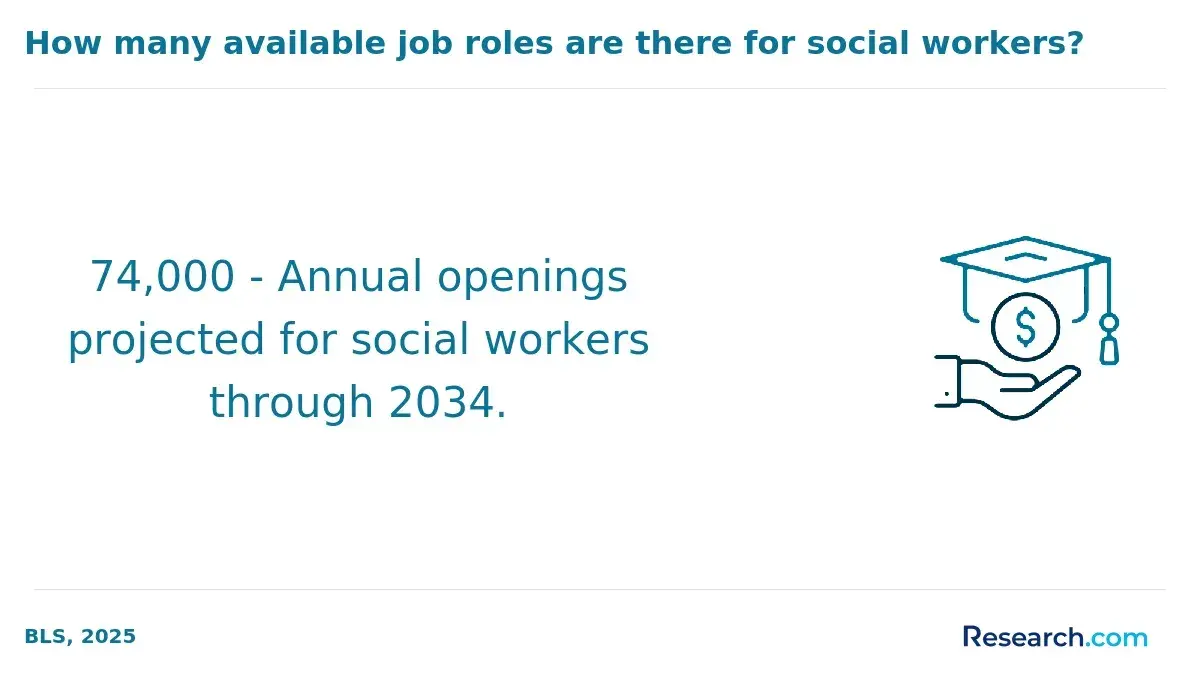
The same period is expected to include 63,800 annual job openings. Graduates who complete accredited education, obtain the required license, and gain school-based field experience may be better positioned for school social work roles, but no degree or license guarantees employment.
Can online programs fully prepare you for a school social work career?
Online social work programs can prepare students for school social work when they are properly accredited, include supervised field education, and align with the licensure rules of the student’s state. The online format can deliver theory, ethics, policy, research, and practice courses, but school social work cannot be learned through coursework alone. Students still need real-world field placement experience with children, families, schools, or youth-serving organizations.
Before enrolling, students should confirm CSWE accreditation, field placement support, state authorization, faculty expertise, and whether the program helps students meet school social worker credential requirements. A program may be academically strong but still not meet every state’s school certification rules. Prospective students comparing flexible undergraduate routes can review options such as a social worker degree online.
| Online program factor | Why it matters for school social work | Question to ask the school |
| CSWE accreditation | Often essential for MSW licensure eligibility | Is the program currently CSWE-accredited? |
| Field placement support | School social work requires supervised practice, not only online courses | Will the program help secure placements near me? |
| State licensure alignment | Requirements differ across states | Does the curriculum meet requirements in the state where I plan to work? |
| School-based specialization | Relevant coursework can strengthen preparation for K-12 settings | Are school social work electives, placements, or certificates available? |
| Schedule design | Working adults need realistic pacing | Can I complete field hours while working? |
What future trends are shaping the field of school social work?
School social work is being shaped by student mental health needs, trauma-informed practices, digital service delivery, multidisciplinary teams, and increased attention to prevention. Telehealth and online counseling tools can expand access in some settings, but they also require careful attention to privacy, consent, crisis response, and equity for students who lack reliable technology.
Schools are also using more data-informed approaches to identify attendance problems, behavioral patterns, and early warning signs. For school social workers, this means stronger collaboration with counselors, psychologists, nurses, teachers, administrators, and community providers. Students considering broader MSW career options can explore what can I do with an MSW to understand how school social work connects to other advanced practice roles.
How important are internships and fieldwork for aspiring school social workers?
Internships and fieldwork are essential because they connect classroom learning to the realities of school-based practice. A student may understand counseling theories, ethics, and policy in theory, but fieldwork teaches how to document a case note, handle a difficult parent meeting, respond to a crisis, collaborate with a teacher, and work within district procedures.
Why internships matter
- They provide direct exposure: Students observe and practice the daily responsibilities of school social workers, including counseling, case coordination, family outreach, and student support.
- They build practical skills: Supervised practice strengthens communication, conflict resolution, documentation, assessment, and case management.
- They may support licensure eligibility: Many states include supervised fieldwork within school social worker requirements.
- They help students build networks: Field placements can connect students with supervisors, school administrators, community partners, and future references.
How to choose a strong field placement
- Ask whether the placement involves direct work with students and families.
- Confirm who will provide supervision and whether that supervisor meets program requirements.
- Look for exposure to IEP meetings, attendance concerns, crisis response, family systems, and community referrals.
- Ask how interns are trained in documentation, confidentiality, mandated reporting, and school policies.
- Choose a site that matches your career goals, not only one that is convenient.
How can an advanced standing MSW online program benefit my career in school social work?
An advanced standing MSW online program can be valuable for students who already hold a qualifying BSW and want to move into master’s-level practice more efficiently. These programs may reduce duplicated foundational coursework and allow students to focus sooner on advanced practice, field education, and specialized topics related to children, families, schools, and mental health.
However, the faster format can be demanding. Students should evaluate accreditation, faculty expertise, school social work coursework, placement quality, and state licensure alignment before enrolling. To compare options, review advanced standing MSW online programs.
How can school social workers manage stress and prevent burnout?
School social workers often handle emotionally intense situations, large caseloads, resource shortages, urgent safety concerns, and competing expectations from families and school staff. Burnout prevention should be treated as a professional skill, not a personal weakness.
Burnout prevention strategies
- Use supervision consistently: Bring complex cases, ethical concerns, and emotional stressors to a qualified supervisor.
- Set boundaries: Clarify working hours, emergency procedures, documentation time, and realistic availability.
- Prioritize documentation systems: Organized records reduce stress and protect both the student and practitioner.
- Build peer support: Consultation with other school social workers can reduce isolation and improve problem-solving.
- Protect recovery time: Sleep, exercise, therapy, mindfulness, and non-work relationships can help sustain long-term practice.
- Plan financially: Understanding pay, benefits, and debt obligations matters. Related financial context, such as a degree in human services salary, can help students compare adjacent helping professions.
What are the challenges and rewards of a career in school social work?
School social work can be highly meaningful, but it is not an easy role. Prospective students should consider both the emotional demands and the professional rewards before investing in the required education and licensure pathway.
Challenges of school social work
- Complex student needs: School social workers may support students facing trauma, mental health concerns, bullying, neglect, family conflict, disability-related needs, homelessness, or poverty.
- Limited resources: Many schools have fewer support services than students need, which can make referrals and follow-up difficult.
- Heavy workload: Caseloads may intensify during the start of the school year, testing periods, crises, or major community events.
- Policy and bureaucracy: School social workers must work within district policies, state laws, confidentiality rules, and reporting requirements.
- Emotional strain: Regular exposure to student and family hardship requires strong boundaries and active self-care.
Rewards of school social work
- Visible impact: Helping a student stabilize, return to class, rebuild confidence, or access support can be deeply meaningful.
- Varied workdays: The role involves students, families, teachers, administrators, outside providers, and community agencies.
- Advocacy opportunities: School social workers can influence policies and services that improve equity and student support.
- Professional growth: Advanced training, including online clinical MSW programs, can support movement into clinical, supervisory, or specialized roles.
- Employment relevance: Schools continue to need professionals who can address social, emotional, and family barriers to learning.
| This career may fit you if... | You may want another path if... |
| You want to work directly with students while also addressing family and community factors | You prefer work with minimal emotional intensity or crisis exposure |
| You are comfortable collaborating with teachers, parents, administrators, and outside agencies | You want a role with little documentation or regulation |
| You can balance empathy with professional boundaries | You want guaranteed salary outcomes regardless of location or employer |
| You are willing to complete licensure, supervision, and continuing education requirements | You do not want to navigate state-specific credential rules |
What determines the salary range for school social workers in different states?
School social worker salaries differ by state because pay is shaped by cost of living, district budgets, union contracts, years of experience, licensure level, school calendar structure, local demand, and state investment in education and social services. Two professionals with the same MSW may earn different salaries depending on whether they work for a rural district, urban district, charter school, private school, local government agency, or year-round program.
Students should compare salary with total compensation, not only base pay. Benefits, pension eligibility, health insurance, school-year schedules, loan repayment options, and advancement pathways can affect the real value of a job offer. For state-by-state salary context, including LCSW salary information, applicants can review guides that compare location-specific pay patterns.
What are the career advancement opportunities for school social workers?
Career advancement in school social work can involve clinical specialization, supervision, school district leadership, program coordination, policy work, training, research, or administration. Some school social workers become lead social workers, student support directors, behavior intervention coordinators, mental health program managers, or district-level consultants.
Advancement usually requires a combination of experience, licensure, continuing education, strong documentation skills, leadership ability, and professional networks. Practitioners who want to enter the field first can review the broader pathway in Research.com’s guide on how to become a social worker.
Ways to strengthen advancement potential
- Earn and maintain the highest license relevant to your goals.
- Seek training in trauma-informed practice, crisis response, special education, family systems, and school law.
- Volunteer for committees related to attendance, mental health, equity, or student support.
- Track outcomes from programs or interventions to show measurable impact.
- Build relationships with supervisors, district leaders, and community partners.
Is pursuing a doctorate in social work a worthwhile investment for school social workers?
A doctorate in social work can be worthwhile for school social workers who want roles in leadership, higher education, applied research, program evaluation, policy development, or advanced systems-level practice. It is usually less necessary for professionals whose primary goal is direct school-based counseling or case management.
Before pursuing a doctorate, compare tuition, time commitment, opportunity cost, and the specific roles that require or reward doctoral training. Some professionals explore affordable DSW programs to reduce cost while preparing for leadership or advanced practice goals.
What are the educational cost considerations for aspiring school social workers?
The education path to school social work can include both undergraduate and graduate study, so cost planning should begin early. Tuition is only one part of the total price. Students also need to consider fees, books, transportation, technology, field placement scheduling, lost work hours, exam fees, application fees, and license renewal costs.
Online and hybrid programs may reduce commuting and relocation costs, but they are not automatically cheaper. Students should compare total program cost, accreditation, field placement support, financial aid, transfer credit rules, and whether the program meets their state’s licensure requirements. Those looking for lower-cost graduate options can review Research.com’s guide to the cheapest online school for masters in social work.
Questions to ask before choosing a social work program
- Is the program CSWE-accredited?
- Does the program meet licensure requirements in the state where I plan to work?
- Does it offer school social work coursework, certification preparation, or relevant field placements?
- How does the school help online students secure local internships?
- What is the full cost after tuition, fees, books, travel, and field placement expenses?
- Are scholarships, grants, employer tuition assistance, work-study options, or assistantships available?
- Can I keep working while completing coursework and field hours?
- What happens if I move to another state during or after the program?
Common mistakes aspiring school social workers should avoid
- Choosing a program without checking accreditation: Accreditation can affect licensure eligibility and employer recognition.
- Looking only at tuition: Field placement logistics, fees, lost wages, and licensure costs can change the true cost.
- Assuming every online MSW meets every state requirement: Licensure and school certification rules vary by state.
- Ignoring field placement quality: A strong school-based placement can be more valuable than a convenient but unrelated site.
- Relying only on rankings: Program fit, accreditation, placement support, cost, and licensure alignment matter more than brand alone.
- Assuming salary outcomes are guaranteed: Pay depends on employer, state, experience, licensure, and local funding.
Key Insights
- School social work is a regulated career path that usually requires accredited education, supervised fieldwork, licensure exams, and state-specific credentials.
- An MSW is often the most practical degree for school social worker roles, especially in states or districts that require graduate-level preparation.
- Field placement quality matters. Students should prioritize programs that can place them in schools or youth-serving environments with strong supervision.
- The ASWB exam is a major licensure step. The exam has about 170 multiple-choice items, a four-hour limit, and can be retaken after 90 days if needed.
- Salary should be evaluated by role and location. BLS data cited here reports $58,380 as the median annual salary for social workers and $62,980 for social workers employed in educational services.
- Job prospects are supported by continued need for student mental health, family support, attendance intervention, and crisis response services, but employment is never guaranteed by a degree alone.
- Before enrolling, confirm CSWE accreditation, state licensure alignment, field placement support, total cost, and whether the program prepares you for school-specific credentialing.
References:
- BLS (2024, April 17). Social workers. BLS
- Davies-Lashley, M. (2024, January 26). Why schools need a social worker for teachers. EdSurge
- Zippia (2024, April 5). School social worker demographics and statistics in the US. Zippia
- ZipRecruiter (2024, April 22). School social worker salary. ZipRecruiter
Other Things You Should Know About School Social Workers
In 2027, states like California, Illinois, and New York require passing the ASWB exam for school social worker licensure. These exams assess social work competencies and ensure candidates meet state-specific standards for practice in educational settings.
The state education agency or social work licensing board issues school social worker credentials in 2027. In many states, the Department of Education sets school-based authorization rules, while the state board of social work licenses the social work credential and oversees renewal, background checks, and disciplinary action.
In 2027, continuing education is essential for maintaining a school social worker's license. States often require a certain number of continuing education hours annually or biennially to ensure professionals remain updated on best practices and new regulations relevant to their field.
Yes, state requirements for school social workers can vary significantly in 2027. While some states require a Master of Social Work (MSW) with a school social work specialization and state licensing, others might also need additional supervised practice hours or specific certifications. Always check individual state guidelines for the most accurate information.
Common licensure requirements for school social workers in 2027 typically include completing a master's degree in social work (MSW), passing a state-specific exam, and obtaining supervised field experience. Some states may also mandate a background check and continuing education units to maintain licensure.


