
2027 What Can You Do With an Urban Planning Degree?

Co-Founder and Chief Data Scientist
An urban planning degree opens doors to a career that blends creativity, problem-solving, and social impact. Graduates gain the skills to shape sustainable cities, improve transportation systems, expand affordable housing, and design healthier, more resilient communities.
As urban populations grow and climate challenges intensify, the demand for skilled planners continues to rise worldwide. The United States Bureau of Labor Statistics (BLS) projects 3,400 job openings each year for urban and regional planners until 2034.
In this guide, I have outlined some key insights into how an urban planning degree sets you toward a rewarding and essential profession.
What are the benefits of getting an Urban Planning degree?
- Urban planning degree graduates can pursue roles that exist across the public, private, and non-profit sectors, including with local governments, private consulting firms, and real estate development companies.
- Urban planners with this degree typically earn a yearly median salary of about $83,720, with higher earnings potential in government agencies, senior roles, or specialized consulting positions.
- Pursuing an urban planning degree online offers flexibility for working professionals, accessibility for those in remote areas, and allows students to balance education with personal and professional commitments while still gaining the same accredited curriculum and career opportunities as traditional programs.
- What are the top urban planning degree career opportunities? Career Opportunities
- What is the salary potential for recent graduates of urban planning degrees? Salary Potential
- What is the urban planner job outlook for recent graduates? Job Outlook
- What are the latest technological tools and software every modern urban planner should know? What are the latest technological tools and software every modern urban planner should know?
- What skills are gained from an urban planning degree? Key Skills
- What are some of the major global challenges urban planners are tackling today? What are some of the major global challenges urban planners are tackling today?
- Do urban planners need certification? Certification
- What networking strategies work best for urban planning graduates? What networking strategies work best for urban planning graduates?
- How can integrating technology enhance urban planning careers? How can integrating technology enhance urban planning careers?
- What are alternative careers for urban planning graduates? Alternative Careers
- What are some of the best advanced urban planning degrees to pursue? Best Degrees
Urban Planning Degree Careers: What Can You Do With This Major?
An urban planning degree prepares graduates to help communities decide how land, housing, transportation, public spaces, infrastructure, and environmental resources should be used. That makes the degree especially relevant for students who want work that combines policy, design, data analysis, sustainability, and public service.
This guide is for current urban planning students, recent graduates, career changers, and anyone comparing planning-related degrees. You will learn which jobs fit this major, what salary and hiring data suggest, which software tools employers value, when certification matters, and how to choose an academic or career path that matches your goals.
Quick Answer: Is an Urban Planning Degree Useful for Careers?
Yes. An urban planning degree can lead to roles in city and regional planning, transportation, housing, sustainability, GIS, community development, real estate development, public policy, and consulting. The strongest opportunities usually go to graduates who can combine planning knowledge with GIS, data analysis, public engagement, writing, and an understanding of zoning, environmental review, and local government processes.
The degree is a particularly good fit if you want to work on practical community problems such as affordable housing, transit access, climate resilience, land use, neighborhood revitalization, and infrastructure planning. It may be less ideal if you want a purely design-focused architecture role, a highly technical engineering career, or a path with guaranteed salary outcomes immediately after graduation.
Top Career Paths for Urban Planning Degree Graduates
Urban planning graduates can work in public agencies, consulting firms, nonprofit organizations, real estate companies, transportation authorities, environmental organizations, and research groups. The best career path depends on whether you prefer policy, analytics, design, public engagement, sustainability, or development review.
| Career path | What the role focuses on | Best fit for graduates who enjoy |
| Urban and Regional Planner | Preparing land-use plans, reviewing development proposals, shaping zoning policy, and guiding long-term community growth. | Local government, public meetings, policy analysis, and community impact. |
| Transportation Planner | Improving mobility systems such as roads, public transit, pedestrian networks, bike infrastructure, and micromobility options. | Transit access, infrastructure, data, traffic patterns, and sustainability. |
| Real Estate Development Planner | Connecting planning rules with development feasibility, zoning approvals, site analysis, and land-use strategy. Students interested in the property side of planning can compare related pathways in Research.com’s guide to fast online real estate degree programs. | Development projects, zoning, market feasibility, and cross-functional work with developers and public agencies. |
| Environmental Planner | Evaluating environmental impacts, supporting conservation goals, and helping projects comply with environmental regulations. | Climate resilience, natural resources, environmental review, and sustainability planning. |
| Housing and Community Development Specialist | Working on affordable housing, neighborhood revitalization, housing needs assessments, and equitable community investment. | Social equity, housing policy, nonprofit work, and neighborhood-level planning. |
| GIS Analyst or Mapping Specialist | Using geographic information systems to map spatial patterns, analyze land use, visualize demographic data, and support planning decisions. | Data, maps, spatial analysis, and technical problem-solving. |
| Policy Analyst or Public Affairs Specialist | Researching urban policy, advising on infrastructure funding, analyzing zoning or housing proposals, and communicating policy options. Some planning graduates strengthen this route with an accelerated online public policy degree. | Research, writing, legislation, public finance, and government decision-making. |
| Smart City or Sustainability Consultant | Helping cities and organizations use technology, data, energy strategies, and sustainable infrastructure to improve urban services. | Innovation, climate goals, data platforms, digital tools, and consulting work. |
A practical way to choose among these paths is to look at the work environment. Public-sector planning often involves public hearings, policy writing, permitting, and long-term community plans. Private consulting can involve faster project cycles, client work, environmental review, or transportation studies. Nonprofit and community development roles often focus more heavily on equity, housing access, and resident engagement.
Urban Planning Salary Potential for Recent Graduates
The U.S. Bureau of Labor Statistics reports a yearly median wage of $83,720 for urban and regional planners. For new graduates, pay can vary by degree level, location, employer type, technical skills, and the specific role. Graduates entering local government, consulting, transportation, environmental planning, or GIS roles may see different starting points even when their degree title is similar.
Based on the research used for this guide, recent graduates from traditional programs and accelerated online urban planning degree programs often see starting salaries in the range of around $50,000 to $65,000 annually, depending on location, employer, and job function.
| Career stage or salary marker | Salary information stated in source material | How to interpret it |
| Recent graduate or entry-level planner | Starting salaries typically range from around $50,000 to $65,000 annually. | Assistant planner, junior planner, GIS support, and analyst roles often fall closer to the lower end, especially outside high-cost metropolitan areas. |
| Field-wide median range noted in the guide | Median urban planner salaries rise to about $79,000 to $83,000 overall in the field. | Experience, specialization, certification, and employer type can move earnings upward over time. |
| BLS yearly median wage | $83,720 for urban and regional planners. | This figure is a broad occupational benchmark, not a guarantee for new graduates. |
| Top 10% of earners | The top 10% of earners made a yearly median salary of $128,550. | Higher earnings are more common in senior, specialized, management, consulting, or high-cost-region roles. |
Salaries tend to be higher in large metropolitan areas and in specialized sectors such as transportation planning, environmental planning, GIS-heavy planning, and consulting. However, higher salaries can also come with higher living costs, heavier project deadlines, or more client-facing responsibilities. When comparing jobs, look beyond salary and consider benefits, pension or retirement plans, advancement potential, remote or hybrid options, and the type of planning work you will actually do.
The chart below provides a visual overview of earning potential for urban planning degree graduates.
Urban Planner Job Outlook and Hiring Demand
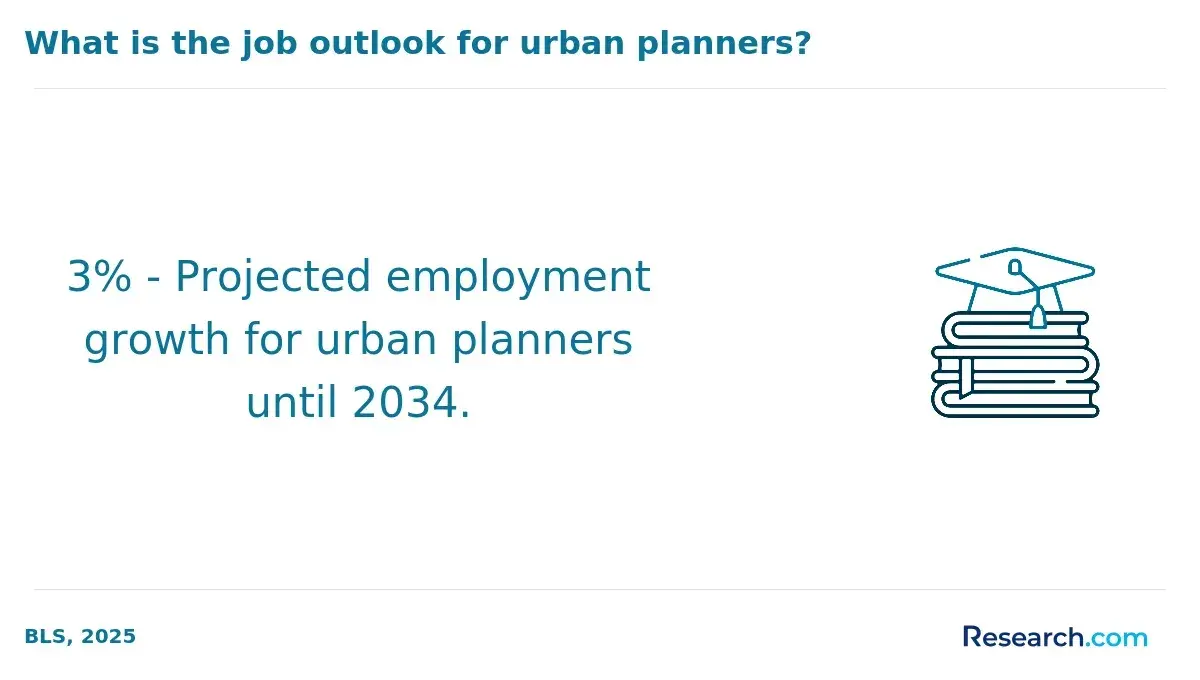
The job outlook for urban planning graduates is steady rather than explosive. The U.S. Bureau of Labor Statistics projects a 3% growth rate for urban and regional planners through 2034, which is about as fast as the average for all occupations.
Demand is connected to population growth, infrastructure needs, environmental concerns, housing pressure, and the need for more sustainable and resilient communities. A World Bank overview of urban development notes that the urban population is expected to grow by more than double by 2050, with seven in 10 people projected to live in cities. That long-term urban shift helps explain why planning skills remain relevant even when hiring varies by region and public budgets.
Urban planning is also one of several community-impact fields. If you are comparing planning with other leadership-focused educational routes, Research.com’s guide to the best online Christian leadership degree programs can provide a useful contrast; urban planning, however, is more directly tied to land use, public infrastructure, zoning, transportation, and spatial analysis.
| Related occupation | Expected number of jobs each year from O*NET OnLine | Why urban planning graduates may fit |
| Urban and Regional Planners | 3,400 | Direct match for graduates trained in land use, zoning, community engagement, and development review. |
| Environmental Restoration Planners | 8,500 | Relevant for students who study sustainability, environmental impact, conservation, or resilience planning. |
| GIS Technologists and Technicians | 31,300 | A strong option for graduates with advanced mapping, spatial data, and analytics skills. |
| Sustainability Specialists | 108,200 | Relevant for planners interested in climate adaptation, green infrastructure, energy, and organizational sustainability. |
| Transportation Planners | 3,200 | A good fit for graduates focused on transit systems, mobility data, pedestrian planning, and infrastructure policy. |
Recent graduates can improve their hiring prospects by completing internships, building a GIS portfolio, learning how local planning processes work, writing strong staff reports or policy memos, and showing evidence of public engagement experience.
Technology and Software Urban Planners Should Know
Modern urban planning is increasingly data-driven. Employers often expect graduates to use digital tools to evaluate sites, map community conditions, model scenarios, visualize proposals, and communicate with the public. The exact software required depends on the role, but GIS, data analysis, visualization, and collaboration platforms are now central to many planning jobs.
Students comparing how different professions use specialized tools may also find it helpful to review Research.com’s guide to the best online AGACNP graduate certificate programs. In planning, the equivalent lesson is clear: technical fluency can make graduates more effective, but it should support—not replace—sound policy judgment and community engagement.
Geographic Information Systems
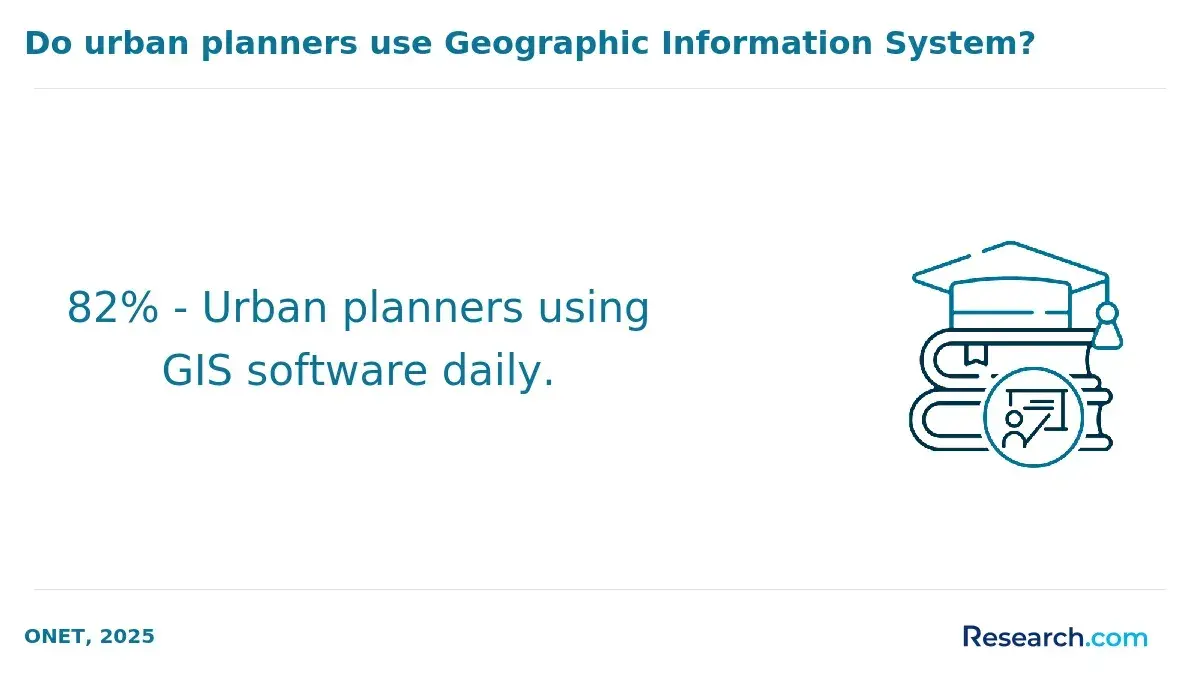
GIS is one of the most important technical foundations for urban planners because it connects data to location. Planners use GIS to evaluate land use, demographics, environmental constraints, infrastructure access, housing patterns, and development impacts.
- ArcGIS. ArcGIS is widely used in the planning profession for mapping, spatial analysis, 3D visualization, and land-use management.
- QGIS. QGIS is a free, open-source GIS platform that gives students and professionals a lower-cost way to build spatial analysis and mapping skills.
3D Modeling and Visualization
Visualization tools help planners explain complex proposals to elected officials, community members, developers, and agency partners. These tools are especially valuable for urban design, redevelopment, master planning, and public engagement.
- SketchUp. SketchUp is commonly used for quick 3D models of buildings, streets, plazas, and neighborhood concepts.
- CityEngine. CityEngine supports large-scale procedural modeling and can help planners visualize growth scenarios and master plans.
- Lumion. Lumion turns 3D models into more polished images and videos that can make planning proposals easier for nontechnical audiences to understand.
Data Analytics and Simulation
Planning decisions increasingly rely on datasets, scenario testing, and impact modeling. Graduates who can analyze data and explain the limits of that analysis can stand out in both public and private roles.
- UrbanFootprint. UrbanFootprint is a geospatial data platform used to evaluate urban development, resilience, energy demand, carbon emissions, and planning scenarios.
- TestFit. TestFit uses AI-powered algorithms to generate building and site plan options based on zoning rules and development constraints.
- Python/R. Python and R are useful for advanced data analysis, workflow automation, custom mapping, and statistical modeling.
Community Engagement and Collaboration
Digital engagement tools can broaden participation, collect feedback, and document community priorities. They should be used carefully, because online tools may not reach residents with limited internet access or limited trust in public processes.
- CoUrbanize. CoUrbanize supports online community engagement for planning and development projects.
- Digital Blue Foam. Digital Blue Foam uses AI and real-time data to support rapid urban design scenarios and collaborative planning.
AI and Emerging Technologies
The application of AI technologies in urban planning is expanding as agencies and firms look for faster scenario modeling, improved visualization, and more efficient analysis. Still, AI-generated outputs need professional review because planning decisions involve legal constraints, equity impacts, local politics, and community values.
- Digital Twins. Digital twins are real-time virtual models of a city’s physical systems. Planners can use them to test traffic, energy, infrastructure, and policy scenarios before changes are made in the real world.
- Generative AI Tools. Platforms such as UrbanistAI can support participatory design by helping communities visualize and co-create urban spaces.
When comparing programs, look for courses or studios that require GIS, visualization, data analysis, public engagement tools, and applied planning projects. A strong technology curriculum should also teach ethics, data limitations, accessibility, and how to communicate findings to nontechnical audiences.
Skills You Gain in an Urban Planning Degree
An urban planning degree develops a mix of technical, analytical, policy, communication, and project skills. That combination is why planning graduates can work across government, consulting, nonprofits, development, transportation, GIS, and sustainability roles. If you are comparing interdisciplinary majors, Research.com’s guide on what you can do with an organizational communication degree offers another example of how broad skills can translate into multiple career paths.
Technical and Analytical Skills
- GIS and spatial analysis. Using tools such as ArcGIS and QGIS to map patterns, evaluate sites, and visualize planning data.
- Data analysis and forecasting. Applying statistics, demographic trends, and economic indicators to estimate future needs.
- Urban design and land-use planning. Preparing zoning concepts, site layouts, redevelopment scenarios, and physical planning recommendations.
- Transportation and infrastructure planning. Studying mobility systems and helping design safer, more efficient, and more sustainable networks.
- Environmental and sustainability planning. Integrating conservation, climate resilience, green infrastructure, and environmental review into development decisions.
Research and Policy Skills
- Policy development and evaluation. Understanding how zoning, housing policy, land-use law, and public investment shape communities.
- Community development. Designing strategies for housing access, neighborhood revitalization, public spaces, and local economic opportunity.
- Impact assessment. Reviewing potential environmental, social, mobility, and land-use effects of proposed projects.
Professional and Interpersonal Skills
- Communication and public engagement. Preparing reports, presenting at public meetings, facilitating workshops, and translating technical findings for residents and decision-makers.
- Collaboration and project management. Working with engineers, architects, developers, elected officials, community groups, and agency staff.
- Problem-solving and critical thinking. Weighing trade-offs around housing, traffic, climate risk, affordability, development pressure, and public resources.
- Ethics and equity awareness. Recognizing how planning decisions can affect displacement, access, cultural preservation, environmental justice, and community trust.
These skills are valuable because planning work rarely has one perfect answer. Strong planners learn to compare options, explain trade-offs, and recommend decisions that are legally workable, technically sound, and responsive to community needs.
The chart below draws from the World Economic Forum Future of Jobs 2025 report and highlights core skills that employers identify as important.
Major Challenges Urban Planners Are Working On
Urban planners deal with problems that cut across housing, transportation, infrastructure, environment, public finance, and community well-being. Like the question of what you can do with an MSN degree in clinical nurse leadership, the planning career question is ultimately about how advanced training can prepare professionals to improve complex systems. For planners, those systems are cities, neighborhoods, corridors, regions, and public spaces.
| Challenge | What planners may work on | Why it matters for careers |
| Climate change and sustainability | Resilient infrastructure, emissions reduction, green infrastructure, flood planning, heat mitigation, and sustainable growth strategies. | Environmental planning and resilience skills are increasingly useful in public agencies and consulting. |
| Rapid urbanization and population growth | Housing capacity, infrastructure demand, service access, density management, and strategies to limit sprawl and overcrowding. | Growth management remains a central planning function in many metropolitan regions. |
| Affordable housing and social equity | Housing needs assessments, inclusionary policies, neighborhood investment, anti-displacement strategies, and access to safe housing. | Housing policy is a major career area for planners interested in equity and community development. |
| Transportation and mobility | Transit access, complete streets, walkability, bikeability, congestion reduction, safety improvements, and cleaner mobility options. | Transportation planning rewards graduates who can combine data, design, and public engagement. |
| Infrastructure and resource management | Aging infrastructure, water and energy systems, public facilities, parks, and integrated land-use decisions. | Infrastructure planning often requires coordination across agencies, engineers, finance teams, and residents. |
| Economic development and job creation | Land-use strategies that support employment, business districts, redevelopment, and community investment while managing environmental and social effects. | Graduates with policy, real estate, and economic analysis skills may find opportunities in redevelopment and public-private projects. |
A strong urban planning program should help students practice multidisciplinary thinking. The work is not just about drawing maps or writing policy; it is about helping communities choose among imperfect options with real consequences.
Do Urban Planners Need Certification or Licensure?
Most U.S. states do not require certification or licensure to work as an urban planner. Currently, only New Jersey requires planners to have a license.
Even when it is not legally required, professional certification can help with credibility, advancement, and access to senior roles. The most recognized U.S. credential is the American Institute of Certified Planners (AICP) certification. It generally requires a relevant bachelor’s or master’s degree, qualifying work experience, and passing an exam.
| Credential or requirement | What to know | When it matters most |
| State licensure | Certification or licensure is not required in most U.S. states; New Jersey is the exception noted in this guide. | Important if you plan to work in a jurisdiction with licensing rules or move between states. |
| AICP certification | The AICP credential is widely recognized and requires education, experience, and an exam. | Useful for planners seeking senior, leadership, public-sector, or competitive consulting roles. |
| Continuing education | Maintaining certification requires ongoing professional development. | Important for staying current with planning law, ethics, technology, climate planning, housing policy, and best practices. |
- Certification can signal professional competence, ethical commitment, and planning expertise to employers, clients, and the public.
- According to the American Planning Association, 97% of AICP members say certification meets or exceeds expectations for demonstrating commitment to ethical standards of practice.
- The American Planning Association reports that AICP-certified planners typically earn $16,000 more annually than non-certified peers.
- Many senior and leadership roles, especially in public agencies, require or strongly prefer AICP certification.
- Four out of five AICP members attribute their career advancement to earning certification.
For students, the practical takeaway is simple: you do not usually need AICP to get your first job, but you should understand the eligibility path early if you want long-term advancement in professional planning.
Networking Strategies for Urban Planning Graduates
Networking matters in urban planning because many opportunities come through internships, local agencies, consulting contacts, alumni, professional organizations, and community projects. The best networking strategy is not just collecting contacts; it is building a reputation as someone who can listen, analyze, write clearly, and follow through.
- Join professional organizations. Membership in groups such as the American Planning Association or regional planning institutes can provide access to events, webinars, job boards, mentorship, and local chapter activity.
- Attend conferences, public meetings, and workshops. Planning is a relationship-heavy field. Local hearings, planning commission meetings, transportation workshops, and professional conferences can help you understand real issues while meeting practitioners.
- Use LinkedIn strategically. Share studio projects, GIS maps, capstone work, policy memos, and internship experience. Connect with planners, alumni, consultants, and public agency staff with specific, thoughtful messages.
- Complete internships and volunteer projects. Practical experience gives you work samples and references. It also helps you learn what kind of planning work you actually enjoy.
- Contact alumni from your program. Alumni can explain local hiring patterns, recommended skills, agency cultures, and entry-level job expectations.
- Request informational interviews. Ask planners about their daily work, required skills, early-career mistakes, and how they entered the field. Keep requests short and respectful of their time.
A useful networking goal for new graduates is to have a small set of people who know your interests and can speak to your work quality. One strong internship supervisor or alumni mentor is often more valuable than dozens of superficial connections.
How Technology Can Strengthen an Urban Planning Career
Technology can make planners more competitive when it improves their ability to analyze data, model scenarios, communicate trade-offs, and manage complex projects. GIS, programming, dashboards, simulation tools, digital engagement platforms, and AI-assisted design tools can all support planning work when used responsibly.
Graduates who want deeper technical training may benefit from software or analytics coursework. Research.com’s guide to the most affordable online software engineering degrees can help students understand one possible route for building programming and software development skills. For planners, those skills are most useful when applied to spatial data, digital infrastructure, civic technology, automation, and scenario modeling.
| If you want to specialize in... | Technology skills to prioritize | Career direction it can support |
| GIS and spatial analytics | ArcGIS, QGIS, spatial databases, Python/R, cartography, demographic mapping. | GIS analyst, mapping specialist, planning analyst, urban data role. |
| Transportation planning | Travel data, mobility dashboards, simulation tools, network analysis, public transit data. | Transportation planner, mobility analyst, transit agency role. |
| Sustainability and resilience | Climate risk mapping, emissions modeling, green infrastructure analysis, scenario tools. | Environmental planner, resilience planner, sustainability consultant. |
| Urban design and development | 3D modeling, visualization, site feasibility tools, zoning analysis, rendering software. | Urban designer, development planner, planning consultant. |
The strongest candidates are not just tool users. They can explain why a method was chosen, what the data does and does not show, and how the analysis should inform a decision.
Alternative Careers for Urban Planning Graduates
An urban planning degree can also support careers outside the traditional planner title. Because the degree blends policy, design, social science, data, law, and public engagement, graduates may be able to pivot into related fields with additional coursework, experience, or licensure depending on the role.
| Alternative career | How planning skills transfer | Important limitation |
| Building Inspector or Surveyor | Knowledge of codes, land use, development review, and the built environment can be useful when evaluating buildings and sites. | Some roles require specific credentials, inspections training, or jurisdiction-specific qualifications. |
| Public Administrator or City Manager | Planners understand local government, public services, budgets, land-use decisions, and community needs. | Leadership roles may require significant experience or additional public administration training. |
| Housing Officer | Housing policy, community development, equity analysis, and resident engagement are directly relevant. | Nonprofit and government roles may require grant management, compliance, or program administration experience. |
| Market Research Analyst | Urban planners often analyze demographics, economic trends, land use, consumer location patterns, and development feasibility. | Business analytics, survey research, or industry-specific market analysis skills may be needed. |
| Architect | Planning knowledge can help with site context, zoning, urban design, and community impact. However, becoming an architect generally requires licensure after completing an accredited traditional or accelerated online architecture degree. | Urban planning alone is not a substitute for architecture licensure requirements. |
| Landscape Architect | Planning training in public spaces, sustainability, environmental systems, and site design can be relevant. | Some landscape architecture positions require a specific license or accredited landscape architecture education. |
| Urban Designer | Graduates can apply planning, design, placemaking, streetscape, and master planning skills to physical urban form. | Strong portfolios and design software skills are often important. |
Graduates who enjoy research, writing, and data can also pursue academic or policy roles such as research assistant, think tank analyst, lecturer, or urban policy researcher. The best alternative path depends on whether you are willing to add credentials, build a portfolio, or gain specialized experience.
The chart below provides more detail on related opportunities and industries for urban planning graduates.
Best Advanced Degrees After an Urban Planning Degree
An advanced degree can help urban planning graduates move into specialized, leadership, research, or higher-responsibility roles. It is not automatically necessary for every career path, so the right choice depends on your target job, employer expectations, location, budget, and whether you want to qualify for certification or doctoral-level research work.
| Advanced degree | Best for | Common focus areas |
| Master of Urban and Regional Planning (MUP or MURP) | Students who want a professional planning credential and broad preparation for planning practice. | Land use, housing, transportation, GIS, community development, and planning law. |
| Master’s in Sustainable Urban Planning or Environmental Planning | Graduates interested in climate resilience, environmental consulting, renewable energy planning, or green infrastructure. Students comparing management-oriented sustainability pathways can also review Research.com’s guide to the fastest online MBA programs in environmental management. | Sustainability, environmental review, resilience, conservation, and climate adaptation. |
| Master’s in Urban Design or City Design | Students who want more design-intensive work in public spaces, streetscapes, placemaking, or development planning. | Urban form, design studios, public realm planning, visualization, and redevelopment. |
| Master’s in Transportation Planning or Mobility Systems | Graduates who want to specialize in transit, traffic, mobility equity, or transportation infrastructure. | Transit systems, traffic analysis, micromobility, mobility policy, and tools such as PTV Vissim or TransCAD. |
| Master’s in Geographic Information Science or Spatial Data Science | Planners who want analytics-heavy roles in GIS, smart cities, urban data, or mapping technology. | Geospatial technology, big data, spatial statistics, programming, and data visualization. |
| Master of Public Policy (MPP) or Master of Public Administration (MPA) | Students who want to influence housing, infrastructure, zoning, budgeting, or public-sector leadership. | Policy analysis, public finance, administration, governance, and program evaluation. |
| Master’s in International Development or Global Urban Studies | Graduates interested in global cities, rapid urbanization, urban poverty, NGOs, United Nations agencies, or international consulting. | Global housing, development policy, urban inequality, and international planning challenges. |
| PhD in Urban Planning, Policy, or Urban Studies | Students pursuing academic, think tank, advanced research, or high-level policy careers. | Research methods, theory, policy evaluation, teaching, and original scholarship. |
Data from Zippia shows that 64% of urban planners in the United States have a bachelor’s, 30% have a master’s, and 2% have a doctorate. That means a graduate degree can be valuable, but it is not the only route into the field.
Before enrolling in an advanced program, compare the cost, delivery format, faculty expertise, internship access, alumni outcomes, accreditation, assistantship opportunities, and whether the curriculum matches your intended specialization. Avoid assuming that a higher degree automatically produces a higher salary; outcomes depend on market demand, experience, skills, and employer needs.
What Urban Planning Graduates Say About the Work
- Rebecca: "Urban planning has allowed me to contribute to communities in visible ways, from walkable neighborhood plans to better transit access. The most satisfying part is seeing a project improve how people move through and experience their daily environment."
- Nicky : "The field keeps me engaged because it combines creativity with evidence-based problem-solving. Each project requires me to connect design ideas, data, and public priorities in a way that supports more inclusive and sustainable places."
- Pat : "Planning has put me in the same room with engineers, residents, elected officials, developers, and policy staff. That collaboration can be challenging, but the long-term community impact makes the work meaningful."
How to Choose the Right Urban Planning Program or Career Path
The best urban planning path is the one that matches your preferred work, not just the one with the most impressive title. A student who wants to run transit models should choose differently from someone who wants to work in housing policy, environmental review, or urban design.
- Define your planning interest. Decide whether you are most drawn to housing, transportation, GIS, sustainability, community development, public policy, design, or real estate development.
- Review the curriculum carefully. Look for applied studios, GIS, planning law, quantitative methods, community engagement, land-use planning, environmental planning, and electives aligned with your goals.
- Ask about internships and local agency partnerships. Planning is practice-oriented. Programs with strong connections to cities, counties, MPOs, nonprofits, and consulting firms can improve your access to experience.
- Evaluate technology training. Strong programs should help you build a portfolio with maps, reports, plans, policy memos, and visualizations.
- Check accreditation and certification alignment. If you plan to pursue AICP later, understand how your degree and experience may fit eligibility expectations.
- Compare total cost, not just tuition. Include fees, software, commuting, housing, lost wages, and the time needed to complete internships or studio work.
- Talk to recent graduates. Ask where they work, how long the job search took, which courses mattered most, and what they wish they had learned earlier.
Common Mistakes to Avoid
| Mistake | Why it can hurt your plans | Better approach |
| Choosing a program based only on name recognition | A well-known school may not offer the specialization, internship network, or technical training you need. | Compare curriculum, faculty expertise, career support, applied projects, and alumni roles. |
| Ignoring GIS and data skills | Many entry-level planning roles require mapping, data interpretation, and technical communication. | Graduate with a portfolio that includes maps, analysis, reports, and planning recommendations. |
| Assuming all planning jobs are the same | Transportation, housing, environmental planning, zoning, and urban design involve different daily tasks. | Use internships, informational interviews, and studio projects to test your fit. |
| Focusing only on salary | A higher-paying role may involve longer hours, more travel, client pressure, or work outside your interests. | Compare salary alongside benefits, work-life balance, mission fit, growth potential, and job duties. |
| Waiting too long to build professional contacts | Planning hiring is often local and relationship-based. | Start networking through alumni, local APA chapters, internships, public meetings, and community projects. |
| Assuming certification is needed immediately | AICP is valuable, but many graduates begin without it. | Learn the certification pathway early, then build the education and experience needed for future eligibility. |
Questions to Ask Before Committing to Urban Planning
- Do I want to work directly with communities, or do I prefer technical analysis behind the scenes?
- Am I comfortable with public meetings, competing stakeholder interests, and political decision-making?
- Which specialization fits me best: housing, transportation, GIS, sustainability, design, policy, or development?
- Does the program provide applied projects, internships, and portfolio-building opportunities?
- Will I need a master’s degree for the roles I want, or can I start with a bachelor’s and gain experience?
- How strong are my writing, presentation, mapping, and data analysis skills?
- Am I choosing this path because I understand the daily work, or only because I like the idea of improving cities?
References:
- American Planning Association. Why AICP? https://www.planning.org/aicp/why
- O*NET OnLine. 19-3051.00 - Urban and regional planners. https://www.onetonline.org/link/summary/19-3051.00
- U.S. Bureau of Labor Statistics. Urban and regional planners: Occupational outlook handbook. https://www.bls.gov/ooh/life-physical-and-social-science/urban-and-regional-planners.htm
- World Economic Forum. Future of Jobs Report 2025. https://reports.weforum.org/docs/WEF_Future_of_Jobs_Report_2025.pdf
- Zippia. Urban planner demographics and statistics in the United States. https://www.zippia.com/urban-planner-jobs/demographics
Key Insights
- An urban planning degree can lead to careers in land use, transportation, housing, environmental planning, GIS, public policy, sustainability, real estate development, and consulting.
- The U.S. Bureau of Labor Statistics reports a yearly median wage of $83,720 for urban and regional planners, while recent graduates often begin around $50,000 to $65,000 annually depending on location, employer, and role.
- The BLS projects 3% growth for urban and regional planners through 2034, so graduates should improve competitiveness through internships, GIS skills, writing samples, and applied project experience.
- Technology matters. ArcGIS, QGIS, visualization software, data analysis tools, and emerging AI platforms can strengthen a planning career when paired with sound judgment and community engagement.
- AICP certification is not usually required for entry-level work, but it can support advancement; New Jersey is currently the only state noted here as requiring planner licensure.
- A graduate degree can help with specialization or leadership, but it should be chosen based on career fit, cost, curriculum, internship access, and likely return—not prestige alone.
- The best planning careers go to graduates who can balance technical analysis with public communication, ethics, equity, and practical decision-making.
Other Things You Need to Know About Urban Planning Degrees
Technology is reshaping urban planning careers by integrating data analytics, Geographic Information Systems (GIS), and smart city solutions. Urban planners in 2027 often use technology to design sustainable, efficient urban environments, manage resources better, and improve community engagement through advanced simulation and visualization tools.
The American Institute of Certified Planners (AICP) credential is the best-known certification for public-sector planning roles. Candidates usually need an accredited planning degree, at least 2 years of professional experience, and must pass the AICP exam administered by the American Planning Association.
In 2027, successful urban planners need proficiency in data analysis and Geographic Information Systems (GIS). Strong communication and community engagement skills are also vital, as is the ability to incorporate sustainable and smart city technologies into urban design and policy-making.


