
2027 Highest-Paying Social Worker Jobs with Salary and Descriptions

Co-Founder and Chief Data Scientist
With about 74,000 social work openings projected each year, the challenge isn't finding a job—it's building a career that is both impactful and financially sustainable. Many people believe that choosing this field means accepting a low salary, but that simply isn't the full picture. The highest-paying social worker jobs are the direct result of strategic specialization and advanced licensure.
To give you a clear path forward, our career planning experts, with over 10 years of experience, built this guide. It moves beyond simple lists to provide a clear, actionable roadmap from your degree to a well-compensated and meaningful career.
What are the benefits of pursuing high-paying social worker jobs?
- Securing an advanced role allows you to move into leadership positions where you can shape policy and manage programs that create systemic change for entire communities.
- While the median salary for social workers is around $61,330, specializing in high-demand areas gives you a clear path to earning over $99,500 annually.
- Earning the required master's degree through a flexible online program allows you to continue working and gaining experience as you prepare for these advanced roles.
What can I expect from high-paying social worker jobs?
You should expect these roles to focus less on day-to-day crisis intervention and more on leadership, strategic planning, and program oversight. It's a common misconception that a higher-paying job is just a more stressful version of a front-line position; in reality, the nature of the work itself changes.
Your daily tasks will likely shift toward supervising staff, managing budgets, developing new community programs, and shaping organizational policy. For example, in a modern healthcare system, you might be responsible for designing and running an entire patient care coordination program rather than handling individual cases.
This is a move from directly helping one person at a time to building the systems that help hundreds or thousands. It requires a different skill set, one focused on the big picture, which is why these positions command higher salaries.
Where can I work with for high-paying social worker jobs?
You’ll find the highest-paying roles are concentrated in specific environments. Look toward healthcare systems like hospitals and integrated clinics, private clinical practices, senior roles within government agencies, and corporate settings.
Now, it’s true that individual and family services (17%) and local government (14%) are some of the largest employers of social workers. But the key to a top salary isn't just the setting—it's your level of responsibility within it.
A program director role in a hospital or a management position in a corporate employee assistance program has a much higher earning potential than a front-line job. The strategy is to target leadership tracks within these high-growth sectors.
How much can I make with high-paying social worker jobs?
Alright, let's get straight to the numbers, because this is the central question for many people.
The median salary for a social worker was about $61,330 in 2024. But the most important number to focus on is the top 10%, who earned more than $99,500. Six-figure salaries are not an exception; they are the standard for specialists with advanced licensure.
Reaching that top tier is entirely about the strategic choices you make. Getting your clinical license and choosing a high-demand specialization is what closes the gap between the median salary and the top-end potential.
- What are the highest-paying jobs in social work? Highest-Paying Jobs
- Which branch of social work pays the most? Which branch of social work pays the most?
- Do licensed clinical social workers (LCSWs) make more than general social workers? LCSW Salary
- Which states pay clinical social workers the most? Highest-Paying States
- Do substance abuse social workers earn competitive salaries? Do substance abuse social workers earn competitive salaries?
- Are psychiatric social workers among the best-paid social workers? Are psychiatric social workers among the best-paid social workers?
- Do school social workers make more with advanced degrees? Advanced Degrees Salary
- Do corporate social workers earn more than traditional social workers? Corporate vs Traditional
- What qualifications are needed to land a high-paying military social work job? What qualifications are needed to land a high-paying military social work job?
- Can advanced psychological training elevate your social work career? Can advanced psychological training elevate your social work career?
- Are leadership positions in social work among the highest-paying? Are leadership positions in social work among the highest-paying?
- How Can Interdisciplinary Certifications Boost Your Social Work Career? How Can Interdisciplinary Certifications Boost Your Social Work Career?
What are the highest-paying social worker jobs?
The highest-paying social work jobs usually combine three things: graduate education, specialized practice authority, and responsibility for either clinical outcomes, budgets, programs, or research. A bachelor’s degree can open the door to entry-level case management and community service work, but the strongest salary potential is typically found in healthcare, clinical practice, policy, research, administration, military social work, and corporate social impact roles.
This guide is for students, early-career social workers, and working professionals who want to understand which social work paths can lead to higher earnings without losing sight of mission-driven work. You will learn which roles pay more, what qualifications they usually require, how licensure changes earning power, and what trade-offs to consider before choosing a specialization.
If your goal is to move into specialized clinical, healthcare, or leadership roles, earning a Master of Social Work is often part of the plan. Program length matters because it affects when you can qualify for supervised hours, licensure, and higher-level roles, so it is worth reviewing how long it takes to get an MSW degree before mapping out your career timeline.
Quick answer: which social work jobs pay the most?
Among the roles listed here, the strongest salary potential appears in social science research, nonprofit and healthcare leadership, policy analysis, clinical social work, rehabilitation leadership, healthcare administration, medical social work, and discharge planning. The best-paid paths often require an MSW, clinical licensure, management experience, or an adjacent credential in healthcare, policy, research, or administration.
| Role | Typical higher-paying path | Average salary or stated salary range | Common qualification route |
| Social Science Researcher | Research design, policy evaluation, universities, government, think tanks | $113,100 | MSW plus research training, or social science master’s/PhD |
| Development Director | Fundraising strategy, donor relations, grants, nonprofit revenue leadership | 98,600; annual salary typically $90,00 to $123,000 | Social sector experience; CFRE certification may help |
| Policy Analyst | Social policy research, government, NGOs, public policy organizations | $96,900; experienced analysts often earn $120,000 with upper ranges up to $172,000 | Bachelor’s in social work or policy; MSW or MPP/MPA preferred |
| Director of Rehabilitation | Program oversight in hospitals, rehabilitation centers, or veteran services | $88,346; supervisory clinical managers in rehab settings typically earn $75,000 to $100,000 | MSW or related clinical degree, licensure, supervisory experience |
| Executive Director | Agency-wide leadership, strategy, fundraising, board management | $86,864; small nonprofits offer $65,000 to $100,00, large metropolitan nonprofits can pay $200,000 to $300,000 | MSW can help; leadership experience is critical |
| Speech-Language Pathologist | Clinical work in hospitals, schools, and clinics | $82,922 | Master’s in speech-language pathology from a CAA-accredited program, licensure, ASHA certification |
| Health Services Administrator | Hospital or clinic operations, compliance, budgeting, staff management | $81,822; median salary ranges from $69,000 to $219,000 | MSW plus healthcare management training, MHA, or MBA often useful |
| Community Service Manager | Program leadership, staff supervision, budgets, community outcomes | $78,240 | BSW or MSW plus management experience |
| Licensed Clinical Social Worker | Therapy, diagnosis, independent practice, clinical supervision | $73,700 | MSW, at least 3,000 supervised clinical hours, state exam, licensure |
| Medical Discharge Planner | Post-hospital care coordination and safe discharge planning | $73,500 | MSW, clinical experience, licensure in some states |
| Mental Health Technician | Psychiatric support under clinical supervision | $73,279 | Bachelor’s in psychology or social work often used; on-the-job training required |
| Medical Social Worker | Hospital care coordination, counseling, patient advocacy, discharge planning | $68,000 | BSW or preferably MSW; LMSW/LCSW commonly required by state or employer |
| Therapist | Counseling, psychotherapy, agency or private practice | $61,727; typical LCSW earning $65,000 to $100,000 depending on setting and region | MSW plus LCSW or equivalent counseling license |
| Certified Addiction Counselor | Substance use treatment, counseling, relapse prevention, recovery support | $54,266 | Bachelor’s at minimum plus state-specific certification such as CAC or CADC |
| Postsecondary Instructor | Teaching, field education, academic research, university programs | $53,712; lecturers receiving $60,000 to 70,000, assistant professors range receiving $80,000 to $100,000 depending on rank and institution | MSW for some roles; DSW or PhD usually needed for tenure-track positions |
1. Medical Social Worker
Medical social workers help patients and families manage the emotional, financial, and practical effects of illness. Their work often includes counseling, coordinating services, preparing discharge plans, explaining community resources, and communicating with healthcare teams. A BSW may qualify candidates for some roles, but many hospitals prefer or require an MSW, and state licensure such as LMSW or LCSW is often expected.
Average salary: $68,000
2. Social Science Researcher
Social science researchers study social problems, programs, policies, and interventions. They may work for universities, public agencies, research institutes, or policy organizations. This path is a strong option for social workers who enjoy data, evaluation, writing, and evidence-based program design. Employers commonly look for an MSW with research methods training or a related social science master’s/PhD.
Average salary: $113,100
3. Licensed Clinical Social Worker
An LCSW provides clinical assessment, mental health diagnosis, psychotherapy, treatment planning, and sometimes clinical supervision. This is one of the most important credentials for social workers who want autonomy and higher earnings in mental health settings. Requirements vary by state, but the path generally includes an MSW, at least 3,000 supervised clinical hours, and a state licensure exam.
Average salary: $73,700
4. Community Service Manager
Community service managers oversee social service programs rather than handling only individual cases. Their responsibilities can include supervising staff, managing budgets, reporting outcomes, improving services, and working with funders or government partners. A BSW may be enough for some positions, but an MSW and management experience can make a candidate more competitive.
Average salary: $78,240
5. Therapist
Therapists provide counseling and psychotherapy in clinics, schools, agencies, hospitals, and private practice. Social workers who want to become therapists usually need an MSW and an LCSW or comparable clinical license. Earnings can vary sharply by region, employer, caseload, insurance reimbursement, and whether the professional works independently.
Average salary: $61,727
6. Development Director
Development directors lead fundraising for nonprofits and social service organizations. Their work may include major gifts, donor cultivation, grant strategy, campaign planning, and revenue forecasting. This role can suit social workers who understand community needs but also have strong writing, relationship-building, and financial strategy skills. Some professionals also pursue CFRE certification.
Average salary: 98,600
7. Policy Analyst
Policy analysts examine social problems, evaluate policy options, review program outcomes, and prepare recommendations for government agencies, advocacy groups, nonprofits, and NGOs. This path is a good fit for social workers who want to influence systems rather than provide direct services full time. A bachelor’s degree in social work or policy may be acceptable for some roles, while an MSW, MPP, or MPA is often preferred.
Average salary: $96,900
8. Health Services Administrator
Health services administrators manage operations in hospitals, clinics, behavioral health organizations, and other healthcare settings. Their responsibilities may include staffing, compliance, budgets, quality improvement, patient flow, and service delivery. Social workers who move into this role often combine an MSW with healthcare management preparation, such as an MHA or MBA.
Average salary: $81,822
9. Postsecondary Instructor
Postsecondary instructors teach social work or related subjects, guide students in field placement, mentor future practitioners, and may conduct research. Some teaching roles are open to MSW holders, especially practice-oriented or adjunct positions. Tenure-track academic roles usually require a DSW or PhD, and compensation depends heavily on rank, institution type, and appointment status.
Average salary: $53,712
10. Executive Director
Executive directors lead entire nonprofit or social service organizations. Instead of managing a single caseload, they guide strategy, oversee budgets, work with boards, supervise senior staff, build partnerships, and often lead fundraising. An MSW can be valuable because it provides direct knowledge of service systems, but executive leadership experience is usually the deciding factor.
Average salary: $86,864
11. Director of Rehabilitation
Directors of rehabilitation oversee programs that help clients recover functioning, manage disabilities, access services, or reintegrate into community life. They may work in hospitals, rehabilitation facilities, veterans’ services, or specialized treatment centers. These roles usually require clinical knowledge, leadership experience, and often licensure.
Average salary: $88,346
12. Mental Health Technician
Mental health technicians support patients in psychiatric and behavioral health settings under the supervision of licensed clinicians. Duties may include monitoring patient behavior, assisting with daily routines, supporting group activities, and documenting observations. Many candidates enter with a bachelor’s degree in psychology or social work, followed by employer-based training.
Average salary: $73,279
13. Speech-Language Pathologist
Speech-language pathologists evaluate and treat speech, language, communication, and swallowing disorders. They work in schools, clinics, hospitals, and rehabilitation settings. Although this is not a traditional social work role, it is an adjacent helping profession that may appeal to students comparing human services careers. The role requires a master’s in speech-language pathology from a CAA-accredited program, state licensure, and ASHA certification, known as CCC-SLP.
Average salary: $82,922
14. Certified Addiction Counselor
Certified addiction counselors work with people affected by substance use disorders. Their duties may include assessment support, treatment planning, counseling, relapse prevention, recovery education, and coordination with healthcare or community programs. Requirements vary by state, but the path usually includes at least a bachelor’s degree, specialized coursework, supervised hours, and a credential such as CAC or CADC.
Average salary: $54,266
15. Medical Discharge Planner
Medical discharge planners coordinate care after a hospital stay. They assess patient needs, arrange home health or facility placement, communicate with families, and help reduce unsafe or delayed discharges. This role often requires an MSW, healthcare experience, and licensure in some states.
Average salary: $73,500
Which branch of social work pays the most?
The highest-paying branches of social work are usually healthcare social work, clinical social work, policy and administration, research, and macro-level leadership. In 2024, social workers affiliated in healthcare received $68,090 on average annually. These branches tend to pay more because they operate in systems where specialized expertise, compliance, billing, program outcomes, and leadership carry direct financial value.
It is important not to judge an entire branch by one entry-level job title. Child welfare, for example, may include lower-paid frontline positions, but the same field also has supervisory, program director, policy, and executive roles. Students who want long-term earning potential should think vertically: choose a branch, build experience, add credentials, and move toward specialized or leadership responsibilities. A flexible online social work degree can help some students start that foundation while continuing to work.
Why healthcare, clinical, policy, and leadership roles often pay more
Higher-paying branches usually connect social work skills to institutional priorities. Hospitals need social workers who can coordinate care, support compliance, reduce unsafe discharge risks, and work within interdisciplinary teams. Clinical agencies and private practices need licensed professionals who can diagnose, treat, document, and bill for services. Government and nonprofit systems need policy analysts and administrators who can manage funding, evaluate programs, and improve outcomes.
Private practice also changes the financial model. A licensed clinician may be able to set rates, bill insurance, manage a caseload independently, and operate as a small business owner. That does not guarantee high income, because expenses and client volume matter, but it does raise the ceiling compared with many non-licensed roles.
| Branch | Why it can pay more | Best fit for |
| Healthcare social work | Integrated into hospitals, clinics, discharge planning, care coordination, and compliance-heavy environments | Social workers who want clinical-adjacent work, interdisciplinary teams, and medical settings |
| Clinical social work | Licensure allows diagnosis, psychotherapy, independent practice, supervision, and insurance billing | Professionals who want therapy, mental health treatment, or private practice |
| Policy and administration | Pay reflects responsibility for programs, budgets, outcomes, grants, and public systems | Social workers who prefer systems change, leadership, writing, data, and public impact |
| Research | Advanced training supports evaluation, evidence-based policy, and institutional decision-making | Professionals who enjoy data, methods, publishing, and program evaluation |
| Corporate and ESG-related work | Social work skills are applied in business settings where workforce well-being, social impact, and compliance matter | Macro practitioners interested in CSR, EAP, diversity and inclusion, or employee well-being |
Do licensed clinical social workers (LCSWs) make more than general social workers?
Yes. LCSWs generally have higher earning potential than general social workers because the license expands what they are legally and professionally allowed to do. An LCSW can provide clinical services with greater independence, diagnose mental health conditions, deliver psychotherapy, and qualify for roles that require billable clinical authority.
The LCSW should not be viewed as a minor add-on credential. For clinical social work, it is often the key qualification for private practice, advanced therapy roles, clinical supervision, many hospital behavioral health positions, and senior mental health jobs. Without clinical licensure, a social worker may still do valuable work, but access to the highest-paying clinical roles is more limited.
Some students begin by exploring shorter mental health education options before committing to graduate clinical training. For example, two-year counseling degrees can introduce core helping skills, but students who want LCSW-level practice should plan for bachelor’s and master’s education plus supervised clinical hours.
The business value of clinical licensure
The salary advantage of the LCSW is tied to reimbursement and autonomy. Many healthcare organizations, behavioral health agencies, and private practices need licensed clinicians because insurers and clinical regulations often distinguish between licensed and non-licensed providers. An LCSW can therefore be both a care provider and a revenue-generating professional within a clinical team.
Demand for mental health services has also made licensure more important. Employers competing for qualified clinicians often place a premium on professionals who can manage complex cases, provide therapy, document treatment, meet compliance standards, and supervise others. For students aiming at this route, a clinical social work master’s program is usually the academic foundation for later licensure.
Which states pay clinical social workers the most?
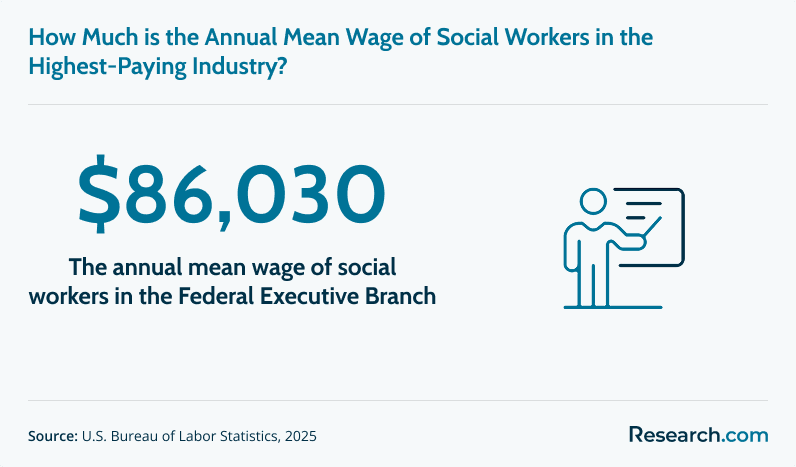
States with high costs of living and strong healthcare or mental health demand, including California and New York, often post some of the highest raw salaries for clinical social workers. For industries, the Federal Executive Branch pays $86,030 on average. However, salary alone does not show whether a job is financially better for your life.
A larger paycheck may not go as far in a high-rent area. A somewhat lower salary in a state with more affordable housing, lower commuting costs, or better benefits may produce a stronger overall quality of life. Before relocating for pay, compare salary, cost of living, caseload expectations, benefits, supervision quality, and licensure requirements.
What to check before moving for a higher-paying social work job
- Licensure portability: LCSW requirements are state-specific, so verify whether your license transfers easily or whether you need extra documentation, exams, hours, or applications.
- Cost of living: Compare rent, taxes, transportation, insurance, and childcare before judging a salary offer.
- Employer type: Hospitals, federal agencies, private practices, schools, and nonprofits may structure pay and benefits differently.
- Telehealth rules: Remote work may create more flexibility, but you generally need to be licensed where the client is located.
- Supervision and advancement: A slightly lower-paying job with strong supervision and advancement can be better than a higher-paying role with no growth path.
State-by-state comparisons can help you start the research process. One useful next step is reviewing a master’s in social work salary guide by state and then checking current licensure rules directly with the relevant state board.
Do substance abuse social workers earn competitive salaries?
Yes, substance abuse social workers can earn competitive salaries, especially when they combine clinical licensure with addiction-specific expertise. The strongest earning opportunities are often found in hospitals, private treatment centers, integrated behavioral health settings, supervisory roles, and programs serving complex substance use and co-occurring mental health needs.
The lower-paying stereotype usually comes from entry-level or underfunded nonprofit roles. Higher pay is more likely for LCSWs who add credentials such as Certified Alcohol and Drug Counselor, or CADC, and who can provide therapy, supervise staff, manage treatment planning, and meet documentation or reimbursement requirements. Some students use accelerated social work programs to complete graduate preparation faster, but they should still confirm accreditation, field placement quality, and licensure alignment.
Why addiction specialization remains in demand
Substance use treatment is tied to a major public health need. The opioid crisis and broader recognition of addiction as a treatable health condition have increased demand for clinicians who understand relapse prevention, trauma, family systems, co-occurring disorders, and coordinated care.
Employers value social workers who can work across medical, behavioral health, criminal justice, and community systems. The best-paid professionals in this specialty are usually not only counselors; they are licensed clinicians, program supervisors, clinical directors, or treatment leaders who can handle high-risk cases and support measurable outcomes.
Are psychiatric social workers among the best-paid social workers?
Yes. Psychiatric social workers are often among the better-paid professionals in social work because they serve clients with serious, complex, or acute mental health needs. They may work in inpatient psychiatric hospitals, emergency departments, VA medical centers, residential treatment settings, or integrated healthcare teams.
This role is different from general counseling. Psychiatric social workers often participate in diagnosis, crisis intervention, safety planning, discharge coordination, treatment planning, and collaboration with psychiatrists, nurses, psychologists, and case managers. The work requires clinical judgment, emotional steadiness, documentation skill, and comfort with high-risk situations.
Students interested in psychiatric social work may begin by building a strong undergraduate base in psychology, human development, research, and social systems. Some compare programs such as HBCUs with strong psychology programs before moving into MSW-level clinical preparation.
Why high-stakes mental health specialization can raise pay
Healthcare systems increasingly treat mental and physical health as connected. In integrated care models, psychiatric social workers help bridge medical treatment, behavioral health intervention, family support, and community follow-up. That combination makes them valuable in hospitals and clinics where untreated mental health conditions can affect recovery, safety, and readmission risk.
Professionals coming from education, counseling, or student support roles may also have transferable experience in crisis response, case coordination, and family communication. For example, some readers considering mental health careers first explore how to transition from teacher to school counselor before deciding whether clinical social work is the better long-term route.
Do school social workers make more with advanced degrees?
Yes. Advanced education can improve earning potential in school social work, and an MSW is the standard requirement for many school social work positions. Higher pay is more likely for professionals who earn clinical licensure, take on specialized mental health responsibilities, or move into district-level coordination and administrative roles.
School social workers should not be confused with guidance counselors. Their work often includes family crisis support, truancy intervention, special education meetings, behavioral health support, community referrals, and coordination with teachers, administrators, and outside agencies. Students seeking an accessible graduate route sometimes compare the easiest online MSW programs to get into, but ease of admission should never be the only selection factor.
Why clinical licensure can matter in schools
Some districts are placing greater value on LCSWs because clinically licensed professionals can provide mental health services that may be billable to insurance. This can create a higher-paid clinical tier within education, especially as schools respond to student mental health needs.
The strongest school social work candidates usually combine child and adolescent development knowledge, family systems training, crisis skills, special education familiarity, cultural competence, and documentation ability. An MSW can help, but field placement quality and state school social work requirements are just as important.
| School social work path | When it makes sense | Pay-growth factor |
| MSW-level school social worker | You want direct student and family support in a school setting | Graduate-level qualification for many roles |
| LCSW in a school district | You want to provide higher-level mental health services | Clinical authority and potential insurance-billable services |
| District coordinator or administrator | You want to design programs, supervise staff, or manage services across schools | Leadership, budgeting, compliance, and program responsibility |
Do corporate social workers earn more than traditional social workers?
Corporate social workers can earn more than many traditional nonprofit or government social workers because they apply social work skills inside business settings. These roles may involve Employee Assistance Programs, Corporate Social Responsibility, diversity and inclusion, workplace mental health, crisis response, community impact, or social risk strategy.
Corporate social work is still real social work when it uses social work methods to improve systems, support well-being, and address social impact. A corporate social worker may use macro practice skills such as needs assessment, program design, stakeholder engagement, evaluation, and policy development to support employees or communities at scale.
Why companies hire social workers
Companies face growing pressure to demonstrate responsible social practices, support employee well-being, manage workplace crises, and show measurable community impact. Environmental, Social, and Governance priorities have made social impact work more visible in many organizations.
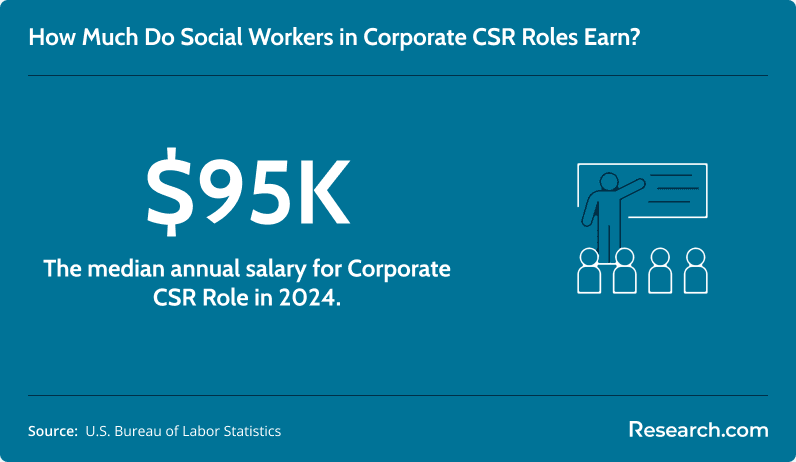
Social workers can be strong candidates because they understand human behavior, systems, trauma, equity, community needs, and program implementation. The salary difference can be meaningful, with corporate CSR roles offering around $95,000 average salary. The trade-off is that corporate roles may require comfort with business language, metrics, stakeholder management, and organizational politics.
What qualifications are needed to land a high-paying military social work job?
High-paying military social work roles, especially commissioned officer positions, have specific requirements. Candidates generally must be U.S. citizens, hold an MSW from a CSWE-accredited program, and have a valid state clinical license, such as an LCSW, in good standing.
It is not enough to have any social work background and apply for a base job. The most competitive roles in the Air Force, Army, or Navy require clinical readiness, professional discipline, and the ability to serve military members and families within a structured system. Students trying to control graduate costs may compare affordable online MSW programs, but they should confirm CSWE accreditation and field placement suitability before enrolling.
Why military social work can be stable and well compensated
The military has invested heavily in mental health, family support, trauma care, transition services, and resilience programs, particularly in the post-9/11 era. Social workers support readiness by helping service members and families manage deployment stress, trauma, family disruption, behavioral health needs, and reintegration challenges.
Military social work can be a strong fit for LCSWs who want structured advancement, interdisciplinary work, and service to a defined population. It may not be ideal for professionals who want full practice independence, geographic control, or a less hierarchical work environment.
Can advanced psychological training elevate your social work career?
Advanced psychological training can strengthen a social worker’s clinical reasoning, assessment skills, treatment planning, and understanding of complex mental health conditions. This can be especially useful in psychiatric social work, private practice, integrated care, clinical leadership, and research-focused roles.
However, social workers should be clear about the purpose of additional psychology training. A psychology credential does not automatically replace social work licensure, and it may not be necessary for every career goal. Professionals considering doctoral-level clinical psychology study can review options such as the best online PsyD programs, but they should compare cost, licensure outcomes, accreditation, internship requirements, and whether the credential truly supports their intended role.
Are leadership positions in social work among the highest-paying?
Yes. Leadership and administrative positions are consistently among the highest-paying social work paths because they carry responsibility for programs, people, budgets, compliance, fundraising, quality, and long-term strategy. Common titles include program director, executive director, clinical director, community service manager, healthcare administrator, and director of development.
Leadership is not simply “more paperwork.” It is a shift from helping one client or family at a time to shaping the system that serves many clients. The best leaders combine practice knowledge with financial literacy, supervision skills, data-informed decision-making, ethical judgment, and the ability to work with boards, funders, regulators, and community partners.
Why leadership commands higher pay
Organizations pay more for leaders because the stakes are higher. A director may manage budgets worth millions of dollars, supervise multidisciplinary teams, negotiate partnerships, protect funding, design programs, and make decisions that affect entire communities. In 2024, the Director of Development, Non-Profit Organization role earned 75,338 on average.
As social service and healthcare systems become more complex, demand grows for leaders who understand both care delivery and organizational performance. Research on the growing complexity of healthcare systems also reinforces why management capability matters in service environments.
| If you want higher pay through leadership | Build this capability | Why it matters |
| Program director | Program evaluation, staff supervision, grant reporting | You become responsible for outcomes, not only services |
| Clinical director | Licensure, supervision, compliance, treatment quality | You oversee clinical risk, documentation, and care standards |
| Executive director | Fundraising, board relations, strategy, finance | You lead the entire organization and its sustainability |
| Healthcare administrator | Operations, regulation, budgeting, quality improvement | You connect patient care, compliance, and business performance |
| Policy or systems leader | Data analysis, advocacy, legislation, stakeholder communication | You influence services at the community or government level |
What social workers say about moving into higher-paying roles
- : "After a decade in direct service, I realized I had reached both a salary ceiling and an energy limit. Preparing for administration felt uncertain at first, but it changed my career. I now oversee a community outreach program, my pay is 40% higher, and my field experience finally shapes decisions at a larger level. — David"
- : "Moving from nonprofit practice into a corporate EAP role made me question whether I was leaving social work behind. I learned quickly that I still use macro practice every day, just in a different setting. I help support hundreds of employees, and the compensation is far beyond what I expected in this profession. — Chen"
- : "I worried constantly about taking on debt for my MSW. What helped was choosing a substance abuse treatment specialty right after graduation. The starting salary was stronger than I expected, and I am paying off my loans much faster than I thought possible. — Jessica"
How can interdisciplinary certifications boost your social work career?
Interdisciplinary credentials can help social workers move into specialized roles when the credential clearly supports the job they want. Useful areas may include addiction counseling, trauma treatment, healthcare administration, program evaluation, grant writing, behavioral science, psychology, school mental health, mediation, or nonprofit leadership.
The key is to avoid collecting credentials without a plan. A certificate is most valuable when it fills a specific gap in your résumé, meets an employer requirement, supports licensure, or helps you qualify for a defined promotion. Students interested in expanding psychology knowledge may compare a fast track psychology degree online, but they should first ask whether a full degree, certificate, supervised experience, or continuing education course is the most efficient option.
Is a high-paying social work career worth it?
A high-paying social work career can be worth it if the path matches your strengths, values, and tolerance for responsibility. Higher pay often comes with heavier caseload complexity, more documentation, leadership pressure, clinical risk, fundraising targets, compliance duties, or business responsibilities. The best choice is not always the role with the largest salary figure; it is the role where compensation, workload, purpose, and long-term sustainability align.
| Path | Best for | Watch out for |
| Clinical practice | Social workers who want therapy, diagnosis, independent practice, and deep client work | Licensure takes time, supervision can be costly, and documentation demands are high |
| Healthcare social work | Professionals who like fast-paced teams, medical systems, and care coordination | Hospitals can involve high stress, discharge pressure, and complex family dynamics |
| Administration | Social workers who want wider impact through programs, teams, and budgets | You may do less direct client work and more finance, compliance, and personnel management |
| Policy and research | Professionals who enjoy systems change, analysis, writing, and evidence-based decisions | Roles may require advanced methods skills and can be competitive |
| Corporate social work | Macro practitioners interested in workforce well-being, ESG, CSR, and organizational change | You must adapt social work values to business goals and performance metrics |
How to choose the right high-paying social work path
- Decide whether you want direct practice, systems work, or both. Clinical roles center on client care. Leadership, policy, research, and corporate roles focus more on systems, programs, and institutions.
- Check the credential requirements early. If the role requires an MSW, CSWE accreditation, LCSW licensure, state school social work approval, or a specialty certification, plan backward from that requirement.
- Compare salary with cost and time. Include tuition, fees, field placement hours, lost work time, supervision costs, exam fees, and the timeline to higher pay.
- Look at field placement quality. A strong placement in a hospital, school, behavioral health clinic, policy office, or nonprofit leadership setting can shape your first job after graduation.
- Study job postings, not just job titles. Employers use titles differently. Read the duties, license requirements, salary range, supervision structure, and advancement options.
- Build a specialization that compounds. Healthcare plus LCSW, addiction plus clinical licensure, MSW plus MPA, or direct practice plus supervision experience can create stronger mobility than unrelated credentials.
- Ask about advancement before accepting a role. Find out whether the employer promotes internally, pays for licensure supervision, supports continuing education, or has senior clinical and management tracks.
Common mistakes to avoid when pursuing higher-paying social work jobs
| Mistake | Why it can hurt your career | Better approach |
| Choosing a program without checking accreditation | Non-accredited programs may not meet licensure or employer requirements | Verify CSWE accreditation for MSW pathways tied to social work licensure |
| Focusing only on tuition | A low tuition price can be offset by weak field placement support, delayed graduation, or poor licensure preparation | Compare total cost, placement quality, exam support, and graduation timeline |
| Assuming every online program works for licensure | Licensure rules vary by state, and field placement requirements can differ | Confirm state board requirements before enrolling |
| Ignoring supervised-hour requirements | You may graduate but still be years away from independent clinical practice | Plan how you will obtain supervision, hours, and exam eligibility |
| Relying only on rankings | A highly ranked program may not be the best fit for your budget, location, specialty, or licensure goal | Use rankings as one input, then compare outcomes and requirements |
| Assuming salary outcomes are guaranteed | Pay varies by employer, region, credential, experience, setting, and workload | Review current job postings and talk with professionals in your target market |
| Collecting certificates without a career plan | Credentials cost time and money if they do not connect to a specific role | Choose certifications that employers request or that support licensure, promotion, or specialization |
Questions to ask before choosing a high-paying social work specialization
- Do I want to spend most of my time with clients, teams, data, policy, donors, or executives?
- Does this path require an MSW, LCSW, school credential, military eligibility, or another license?
- How many years will it take to qualify for the higher-paying version of this role?
- Will I need unpaid or low-paid supervised hours before my salary increases?
- Are jobs in this specialty available where I want to live, or would I need to relocate?
- Does the salary still look strong after cost of living, benefits, debt, and workload are considered?
- What are the advancement steps after the first job?
- Will this role still feel meaningful if it includes more documentation, management, compliance, or business responsibility?
References
- National Center for ONET Development. (n.d.). Summary Report for: 21-1023.00 - Social Workers, All Other. ONET OnLine.
- National Association of Social Workers. (n.d.). National social work public opinion survey: Executive summary.
- Payscale. (n.d.). Social worker (MSW) salary.
- U.S. Department of Labor, Bureau of Labor Statistics. (2022). Occupational employment and wage statistics, May 2022.
- U.S. Department of Labor, Bureau of Labor Statistics. (n.d.). Social workers. In Occupational outlook handbook.
Key Insights
- The highest-paying social work jobs usually require more than a generalist background; MSW training, clinical licensure, management experience, research skills, or specialized credentials often make the difference.
- Clinical licensure is one of the strongest salary levers because it can qualify social workers for diagnosis, therapy, private practice, supervision, and insurance-billable roles.
- Healthcare, psychiatric, addiction, military, school mental health, corporate, policy, and leadership roles can all pay well, but each comes with different credential requirements and workplace pressures.
- Leadership roles often pay more because they shift responsibility from individual cases to programs, staff, budgets, compliance, strategy, and organizational survival.
- Raw salary should not be the only decision point. Cost of living, benefits, debt, licensure portability, supervision access, workload, and long-term advancement all affect real career value.
- The smartest path is to choose a specialization early, confirm accreditation and licensure requirements, build relevant field experience, and pursue credentials that directly support the role you want.
Other Things You Should Know About the Highest-Paying Social Worker Jobs
High-paying social worker positions in 2027 typically require a Master of Social Work (MSW) degree. Some roles might necessitate specialized certifications or licensure specific to their focus, such as clinical work. Accreditation by the Council on Social Work Education (CSWE) is often essential.
The highest-paying clinical social work jobs usually require the Licensed Clinical Social Worker (LCSW) credential. Most states also require a CSWE-accredited MSW, 3,000 supervised post-master’s hours, and a passing score on the ASWB clinical exam before independent practice.


