2027 Public Policy Careers: Guide to Career Paths, Options & Salary

Co-Founder and Chief Data Scientist
Public policy is not just about government. It is the field where institutions decide how to respond to social, economic, legal, health, environmental, and community problems using evidence, budgets, regulation, and public input. If you are weighing a public policy degree, the real question is whether the education, cost, and time commitment will lead to the kinds of roles you want.
This guide explains what public policy careers look like, which degrees and credentials matter, what employers expect, and how to compare pathways before you enroll. It also shows where the field is expanding, where it is competitive, and how to choose a program that fits your goals.
Quick answer: Public policy can lead to jobs in policy analysis, government affairs, legislative support, nonprofit leadership, regulatory affairs, budgeting, research, advocacy, and public administration. Some entry-level jobs may be open to candidates with an associate’s or bachelor’s degree, but many analyst, research, teaching, and leadership roles require a graduate degree, including master’s programs or doctoral study. The right path depends on whether you want to work in government, research, advocacy, compliance, or management.
Public Policy Careers Table of Contents
- Why pursue a career in public policy?
- Public policy career outlook
- Required skills for public policy professionals
- How to start your career in public policy
- Public policy careers in different sectors
- How can I advance my career in public policy?
- Alternative career options for public policy professionals
- How can public policy professionals use technology to improve outcomes?
- The role of ethics in public policy
- Can online degree programs benefit seniors entering public policy?
- How do I choose the right public policy program?
- Emerging trends in public policy education
- What are the most in-demand public policy jobs?
- Can an online accelerated bachelor's degree provide a competitive edge in public policy?
- What factors ensure quality in public policy programs?
- How can online certifications enhance your public policy career prospects?
- How can I transition into public policy from another field?
- How can I find cost-effective public policy programs?
Why pursue a career in public policy?
Choose public policy if you want a career focused on solving problems that affect large groups of people. The work centers on researching issues, comparing solutions, and helping organizations decide what should happen next. That may mean analyzing a budget, evaluating a program, drafting a memo, tracking a regulation, or advising leaders on a proposed change.
The field appeals to people who want to work where ideas become action. Public policy graduates may find roles in government, nonprofits, consulting, law, healthcare, education, housing, labor, environmental work, urban planning, compliance, and research. Public policy also shapes civic life by influencing how communities participate, trust institutions, and respond to change. Discussions such as the role of social capital in public policy show how closely policy design and public well-being are connected.
Many employers in this field include government agencies, think tanks, universities, advocacy organizations, nonprofits, and consulting firms. Think tanks are especially important because they turn research into policy recommendations that decision-makers can actually use.
The work can also feel meaningful on a personal level. Public service motivation often attracts people who want their work to improve communities, strengthen institutions, and support long-term public outcomes. In that sense, public policy is often a mission-driven career rather than just a job title.
| Your goal | Public policy is a strong match if you want to... | A different path may fit better if you want... |
| Research and analysis | Study public problems, interpret evidence, and recommend action | Work with little writing, little data work, or minimal public-sector context |
| Direct impact | Help shape programs in housing, health, education, justice, labor, or community development | Results that are mainly individual rather than institutional |
| Advocacy and influence | Support legislation, shape public debate, or represent organizational interests | A role with no stakeholder communication or public-facing work |
| Leadership | Manage budgets, teams, grants, or government affairs strategy | A purely technical role with no management or institutional context |
Public policy career outlook
Public policy is not tracked as one single occupation in most labor databases, so job outlook depends on the specific role you target. Related occupations in the U.S. Bureau of Labor Statistics include political scientists, economists, sociologists, lawyers, urban and regional planners, medical and health services managers, social and community service managers, budget analysts, and postsecondary teachers.
That means salary and hiring prospects vary by sector, location, employer, degree level, and policy specialty. A candidate seeking a local government role will face a different market than someone aiming for a think tank, a federal agency, or a research-heavy academic position.
Current public issues continue to drive demand. International and national policy discussions still focus on inequality, health systems, labor markets, climate, housing, and public trust. Public policy professionals help organizations test solutions, measure outcomes, and adjust strategy when conditions change.
For a practical salary benchmark, one comparable policy-related role is policy analyst, with a median salary of $70,662 in 2026. That figure should be treated as a reference point, not a guarantee, because pay changes with geography, employer type, and experience.
Projected demand also differs by occupation. The projected demand for political scientists is 6% per year through 2029. Related roles show different patterns: medical and health service managers have an outlook of 30%, while social and community service managers have projected job growth of 15%.
Specialized policy areas may grow at different rates as well. Climate change policy analyst careers are projected to grow 6% per year through 2032, while the outlook for healthcare policy analyst careers is 15% (U.S. Bureau of Labor Statistics, 2024). For federal employees, experienced policy professionals may advance to GS-15, which ranges from $126,384 to $164,301 (US OPM, 2026).
| Role | Salary | Demand |
| Market Researcher | $59,146 | 22% |
| Community Relations Coordinator | $46,290 | 11% |
| Legislative Aide | $45,793 | 12% |
| Social Science Research Assistant | $53,560 | 6% |
| Budget Analyst | $78,970 | 5% |
| Program Manager, Nonprofit | $53,661 | 15% |
| Chief Lobbyist | $91,000 | 9% |
| Policy Analyst | $75,645 | 9% |
| Nonprofit Director | $82,266 | 15% |
| Postsecondary Teacher | $89,204 | 12% |
Required skills for public policy professionals
Public policy sits at the intersection of research, economics, law, communication, statistics, and ethics. Employers want people who can do more than state an opinion. They want professionals who can investigate a problem, weigh trade-offs, understand institutions, and explain recommendations in a way that nonexperts can use.
Core skills employers expect
- Research skills. Policy work relies on surveys, interviews, administrative data, program evaluations, cost-benefit analysis, and case studies. Strong candidates can work with both quantitative evidence and human context.
- Policy analysis. Analysts compare options, predict consequences, identify winners and losers, and assess legal, social, political, and economic effects.
- Data interpretation. Good policy advice depends on understanding sample quality, bias, uncertainty, missing data, and the limits of correlation.
- Stakeholder communication. Policy professionals must speak with legislators, agency staff, nonprofit leaders, researchers, private-sector partners, and community members while keeping the message accurate and clear.
Skills that improve long-term mobility
- Leadership. Even nonmanagerial roles may involve coordinating teams, grants, meetings, research projects, or cross-agency work.
- Writing. Memos, briefs, testimony, reports, regulations, and public statements are central to the field.
- Attention to detail. Small mistakes in budgets, eligibility rules, laws, or data can change policy outcomes.
- Ethical judgment. Public policy decisions often involve privacy, equity, taxpayer money, public safety, and individual rights.
| Skill area | Why it matters | How to build it |
| Research methods | Helps you judge whether a policy is supported by evidence | Study statistics, research design, economics, and program evaluation |
| Writing and briefing | Turns technical findings into practical recommendations | Practice policy memos, executive summaries, testimony, and issue briefs |
| Budget and finance | Many policy choices depend on cost and resource trade-offs | Learn public budgeting, cost-benefit analysis, and grant management |
| Political and legal context | Recommendations must fit laws and institutions | Study administrative law, constitutional issues, legislative process, and governance |
| Community engagement | Policies fail when affected groups are ignored | Develop facilitation, interviewing, public meeting, and conflict-resolution skills |
How to start your career in public policy
The best entry point depends on both your current education and your target role. People with an associate’s degree often begin in administrative, legislative support, or community-facing positions. Bachelor’s degree holders can qualify for research assistant, budgeting, nonprofit, compliance, and entry-level policy jobs. Master’s degrees are often the most direct route to analyst, management, and specialized policy roles.
Public policy may appear as a stand-alone major, but it is also often offered as a concentration within public administration, political science, economics, urban studies, or social science programs. A degree in public administration is especially useful if you want to understand agency operations, budgets, public programs, and local government systems.
| Education level | Typical starting roles | Best for students who want... |
| Certificate | Community services coordinator, social researcher support roles, youth worker, administrative policy support | A focused credential, a career pivot, or added policy training without a full degree |
| Associate degree | Legislative aide, community relations coordinator, executive assistant | An entry point into public service, community programs, or legislative offices |
| Bachelor’s degree | Social science research assistant, nonprofit program manager, budget analyst, regulatory affairs manager | Broader access to research, program, budgeting, and compliance roles |
| Master’s degree | Policy analyst, senior budget analyst, chief lobbyist, program leader | Advanced analysis, leadership, specialized policy work, or higher-level public service roles |
| Doctorate | Postsecondary teacher, senior researcher, director-level policy leader | Academic, research-intensive, or senior advisory careers |
Jobs with an associate’s degree in public policy
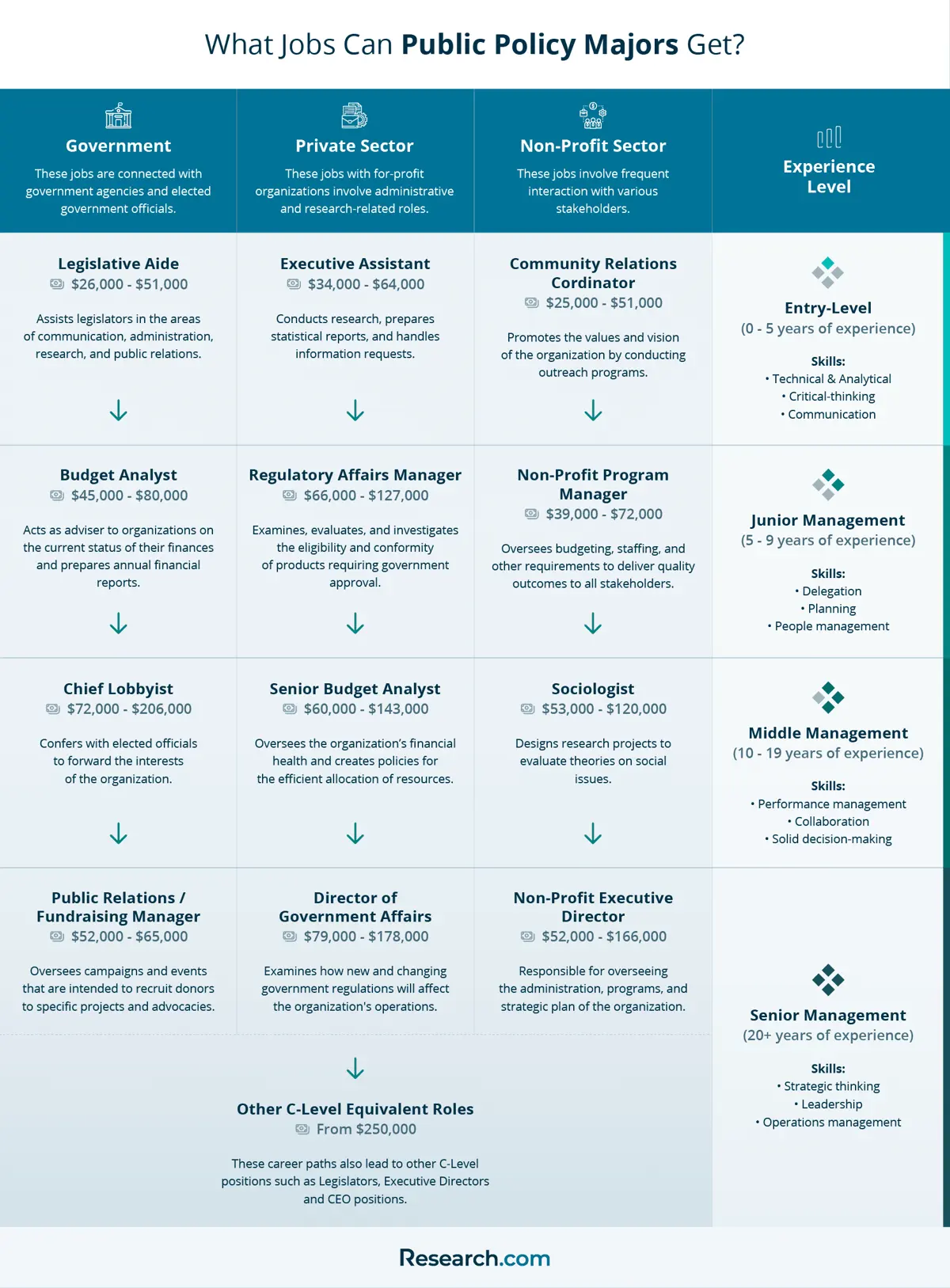
Legislative aide. Legislative aides support elected officials with research, constituent communication, scheduling, administrative tasks, public relations, and bill tracking. This can be a strong entry point for students interested in politics, law, or government affairs.
Median salary: $47,535
Community relations coordinator. This role builds relationships between an organization and the public. Work may include outreach events, education programs, fairs, site visits, and community presentations. It is a useful early-career role for learning how policy affects people at the local level.
Median salary: $47,850
Executive assistant. In policy-related organizations, executive assistants may prepare reports, organize meetings, handle information requests, and support sensitive administrative work for senior leaders.
Median salary: $60,631
Jobs with a bachelor’s degree in public policy
Social science research assistant. Research assistants help gather, organize, and analyze data for surveys, interviews, reports, and applied or academic studies. They may also handle literature reviews, data quality checks, and fieldwork support.
Median salary: $69,000
Nonprofit program manager. Program managers oversee mission-driven projects. Their work may include staffing, budgets, partner relations, reporting, grants, and outcome tracking.
Median salary: $56,161
Regulatory affairs manager. These managers make sure products, services, processes, or organizational practices meet government requirements. Duties may include compliance filings, inspection preparation, documentation, and internal procedure development.
Median salary: $108,213
Budget analyst. Budget analysts review financial resources, compare costs and benefits, prepare reports, and help organizations make fiscal decisions.
Median salary: $64,745
Can you get a public policy job with just a certificate?
Yes, but a certificate usually works best as a supplement rather than a full replacement for a degree. A public policy or public administration certificate can help if you already have work experience, want to move into a policy-adjacent role, or need focused training in budgeting, program evaluation, advocacy, or public management.
Certificate holders may be able to pursue roles such as social researcher support staff, youth worker, local community services coordinator, city services coordinator, or administrative policy support professional. For analyst, leadership, and research-heavy jobs, employers still often prefer a bachelor’s degree or higher.
Public policy careers in different sectors
Public policy professionals work in government, nonprofits, research organizations, private companies, and international institutions. Each sector emphasizes different strengths, so the right fit depends on whether you prefer implementation, research, advocacy, compliance, or diplomacy.
| Sector | Common roles | Best fit for candidates who want... | Potential trade-offs |
| Government | Policy analyst, legislative assistant, public affairs specialist, government relations director | Direct work on programs, regulation, implementation, and public service | Hiring can be slow, formal, and tied to civil service rules |
| Nonprofit organizations | Advocacy coordinator, program director, research associate, public policy officer | Mission-driven work in housing, health, education, poverty, environment, or equity | Funding may be limited and grant cycles can affect stability |
| Think tanks and research institutions | Research analyst, policy fellow, communications director, senior policy advisor | Evidence-based research, reports, public commentary, and specialized analysis | Advanced degrees and strong writing samples are often expected |
| Private sector | Public relations manager, corporate social responsibility manager, regulatory affairs specialist, government affairs consultant | Compliance, consulting, corporate strategy, and business-government relations | The work often serves organizational goals first |
| International organizations | International relations advisor, policy analyst for global development, humanitarian affairs officer, advocacy officer for international law | Global development, trade, diplomacy, humanitarian aid, or cross-border policy | Roles may require language skills, travel, regional expertise, or intense competition |
Government
Government remains the most traditional employer for public policy graduates. Work may take place in local, state, or federal agencies, legislative offices, regulatory bodies, or public affairs teams. Responsibilities can include drafting policy options, evaluating programs, analyzing budgets, coordinating public input, and interpreting rules.
Nonprofit organizations
Nonprofits often hire policy graduates for advocacy, research, community organizing, grant reporting, program management, and public education. These jobs are common in healthcare, education, housing, civil rights, the environment, and workforce development.
Think tanks and research institutions
Think tanks produce research-based recommendations for policymakers, media, agencies, and the public. Staff members often specialize deeply and create reports, briefs, testimony, data analysis, and public commentary.
Private sector
Companies hire policy professionals for regulatory affairs, government relations, public affairs, sustainability, corporate social responsibility, compliance, and consulting. These roles can offer strong advancement, but the work generally supports business strategy as well as public-facing goals.
International organizations
International roles may involve humanitarian response, public health, climate, migration, trade, human rights, or international law. Strong cross-cultural communication and knowledge of global institutions are usually essential.
If you want broader access to advanced roles across these sectors, an affordable online master's in public policy may be a practical way to build analysis, leadership, and policy design skills while keeping costs manageable.
How can I advance my career in public policy?
Career growth in public policy usually comes from combining education with specialization and experience. A bachelor’s degree can open the door, but analyst, research, and senior positions often require graduate training. If you are choosing between public policy and a political science degree, think about whether you want to study political systems broadly or focus on solving specific policy problems.
Professionals often move forward by specializing in health policy, climate policy, education policy, labor policy, criminal justice, housing, transportation, budgeting, public management, or regulatory affairs. Graduate certificates can also help experienced workers sharpen public management, strategic planning, leadership, or policy analysis skills.
Jobs with a master’s in public policy
Chief lobbyist. Chief lobbyists represent organizational interests before lawmakers and public agencies. The role combines strategy, relationship-building, legislative tracking, and public advocacy.
Median salary: $85,694
Senior budget analyst. Senior budget analysts manage financial planning, evaluate resource allocation, lead budget teams, and develop fiscal policies.
Median salary: $77,966
Sociologist. Sociologists study social behavior, inequality, and institutions through research and data analysis. Graduates with a sociology degree may also bring useful insight into public policy work.
Median salary: $60,000
Policy analyst. Policy analysts evaluate laws, regulations, programs, and proposals, then assess implementation challenges, stakeholder effects, risks, and unintended consequences.
Median salary: $62,592
Jobs with a doctorate in public policy
Director of government affairs. Directors of government affairs track legislation and regulation, prepare leadership for policy changes, and coordinate advocacy or compliance strategy.
Median salary: $102,751
Public policy postsecondary teacher. Postsecondary teachers teach public policy, supervise research, advise students, and contribute to scholarship and applied research.
Median salary: $89,204
Fundraising manager. Fundraising managers lead donor outreach, campaigns, and resource development that supports programs or advocacy efforts.
Median salary: $57,102
Which certification is best for public policy?
The best certificate is the one that closes a specific skill gap. Someone moving into nonprofit leadership may need nonprofit management training, while someone targeting analyst work may need stronger data or policy analysis skills. Common focus areas include:
- Strategic Planning and Public Policy
- Non-Profit Management and Leadership
- Government Management
- Public Management and Leadership
- Non-Profit Management
- Advanced Policy Analysis
A graduate certificate is most useful when it is focused, respected by employers, and tied to practical assignments. It adds less value if it repeats skills you already have or offers little evidence of real-world application.
Alternative career options for public policy professionals
A public policy background can transfer well into adjacent fields because the degree builds research, writing, data interpretation, and institutional analysis skills. Those abilities matter far beyond government and advocacy.
Where else can a public policy graduate work?
- Marketing campaign manager. Graduates who understand audience research, data, and persuasive communication may move into campaign strategy. Those who want deeper technical skills may consider an online master’s degree in data science to strengthen analytics.
- Chief evangelist. Brand and product evangelist roles rely on communication, stakeholder awareness, research-backed messaging, and alignment between audience needs and organizational goals.
- Technical writer. Policy graduates often turn complex laws, procedures, and research into clear documents, which transfers well to government, healthcare, technology, compliance, and consulting.
How can public policy professionals leverage technology to improve policy outcomes?
Technology is changing how policy professionals research issues, reach communities, monitor implementation, and evaluate outcomes. The best use of technology is to support judgment, not replace it. Public policy still requires context, legal awareness, ethics, and human review.
Data analytics for evidence-based decisions
Analytics tools can help identify patterns, compare populations, measure outcomes, and test possible policy effects. Professionals still need to understand data limits, including bias, missing records, outdated information, and variables that do not fully capture lived experience.
Digital platforms for public engagement
Online surveys, virtual town halls, comment tools, and social media monitoring can increase participation. They also need careful design because digital engagement may miss people without reliable internet access or those who distrust institutions.
Automation for administrative work
Automation can reduce repetitive tasks like document routing, data entry, report reminders, and compliance tracking. That gives professionals more time for analysis, implementation, and stakeholder engagement.
Blockchain for transparency and accountability
Blockchain may be useful when records need to be traceable and hard to alter. It should be considered only when it solves a real accountability problem; not every transparency issue needs blockchain.
Artificial intelligence for policy simulation
AI can summarize large text sets, identify patterns, support scenario testing, and assist with simulations. It should be used cautiously in areas such as policing, healthcare, housing, benefits, and employment, where biased data and opaque systems can create harm.
The role of ethics in public policy: balancing societal good and individual rights
Ethics is built into public policy. Every proposal raises questions about who benefits, who pays the cost, whose data is used, whose voice is missing, and whether the plan respects individual rights while pursuing public goals.
- Protecting privacy in data-driven policy. Agencies and organizations increasingly use data in healthcare, education, benefits, policing, and social services. Policy professionals must think about consent, security, retention, transparency, and misuse.
- Promoting equity and justice. Well-designed policies can reduce inequality, but poorly designed ones can deepen it by ignoring affected communities or relying on incomplete evidence.
- Managing conflicts of interest. Because policy work involves agencies, donors, businesses, elected officials, advocacy groups, and the public, clear disclosure and open decision-making are essential for trust.
- Recognizing unintended consequences. Even a well-intended policy can cause harm. Ethical practice includes monitoring outcomes and adjusting course when evidence changes.
Can online degree programs benefit seniors entering public policy?
Yes. Online programs can be a strong option for older learners and late-career adults who want to apply years of professional experience to public policy. Many already bring useful backgrounds in management, healthcare, education, finance, law, business, or public service.
The biggest advantage is flexibility. Online study can fit around work, family, volunteering, or caregiving. Before enrolling, seniors should compare accreditation, support services, pacing, technology requirements, and whether the program is designed for adult learners. Research.com’s guide to online degree programs for seniors is a helpful starting point for flexible options.
How do I choose the right public policy program?
Pick a program based on career fit, not brand name alone. A strong public policy program should help you build analytical skills, provide applied experience, and support your next professional step. If your goal is research or leadership, you may also compare doctoral pathways, including a PhD online, but faster is not automatically better.
| What to check | Why it matters | Questions to ask |
| Accreditation | Influences credibility, transferability, and financial aid eligibility | Is the institution accredited by a recognized accreditor? |
| Curriculum | Coursework should match your career goal | Does the program include policy analysis, statistics, economics, budgeting, ethics, and writing? |
| Applied experience | Employers prefer practical experience | Are internships, capstones, policy labs, or consulting projects available? |
| Faculty expertise | Faculty networks and research areas shape opportunities | Do faculty work in the policy area you want to enter? |
| Career outcomes | Graduate outcomes show market relevance | Where do graduates work, and what roles do they obtain? |
| Cost and aid | Tuition is only one part of the total cost | What are fees, books, residency costs, technology costs, and available aid? |
Emerging trends in public policy education
Public policy education is becoming more interdisciplinary, more data-driven, and more applied. Programs increasingly combine political science, economics, public administration, statistics, behavioral science, law, ethics, and communication because real-world policy problems rarely fit into one subject area.
Experiential learning is also becoming more valuable. Internships, policy labs, simulations, community partnerships, and capstone projects help students graduate with examples of memos, reports, presentations, dashboards, or evaluations they can show employers.
Another shift is the growing overlap between public policy and public administration. Students interested in agency leadership or nonprofit management often compare the two fields closely. Understanding potential outcomes, including masters in public administration salary considerations, can help with that choice.
Online education continues to expand access, especially for working adults. Strong online programs do more than deliver recorded lectures; they provide discussion, faculty interaction, project-based work, and career support.
What are the most in-demand public policy jobs?
Demand depends on location, sector, policy area, and degree level. Health policy, climate policy, public finance, social services, regulatory affairs, and government relations are all areas where policy training can be useful. For a broader list of possible roles, Research.com’s guide to public policy jobs can help you compare career directions.
When you judge demand, look beyond broad titles. Review job postings in your target market and note the skills that appear repeatedly. Common requests include statistical software, policy writing, stakeholder engagement, grant management, legislative research, budgeting, and program evaluation.
Can an online accelerated bachelor's degree provide a competitive edge in public policy?
An accelerated online bachelor’s degree can help some students enter the job market sooner, especially if they already have transfer credits or work experience. The trade-off is pace: faster programs can save time, but they may leave less room for deep writing, research, statistics, internships, or portfolio development.
Before choosing an accelerated path, compare workload, course length, transfer policies, faculty access, internship options, and total cost. Students who want a faster route can review Research.com’s guide to the online accelerated bachelor's degree.
What factors ensure quality in public policy programs?
Program quality depends on more than reputation. Students should look for accreditation, strong coursework, experienced faculty, practical assignments, transparent pricing, advising, and evidence that graduates move into relevant roles. For online students, interaction with faculty and peers matters as much as convenience.
Research.com’s guide to the top accredited online bachelor's degree programs can help you compare options, but you should still confirm that each school offers policy-relevant coursework and hands-on learning.
How can online certifications enhance your public policy career prospects?
Online certifications can strengthen a résumé when they teach a specific skill employers need. Useful options may include data analytics, public budgeting, grant writing, policy writing, regulatory compliance, strategic planning, nonprofit management, or program evaluation.
Before paying for a credential, compare curriculum depth, instructor background, assignments, employer recognition, and the chance to build a portfolio. Research.com’s guide to online courses can help you explore digital credentials, but the best certificate is the one tied to your target role.
How can I transition into public policy from another field?
Many career changers enter public policy by reframing existing experience in policy terms. A nurse may move into health policy. A teacher may move into education policy. A finance professional may become a budget analyst. A lawyer may move into regulatory affairs. A nonprofit manager may shift into advocacy or program evaluation.
- Choose a policy area. Pick a field where your background already gives you credibility, such as healthcare, education, housing, labor, environment, criminal justice, finance, or technology.
- Translate your experience. Show how your work connects to research, budgeting, writing, compliance, project management, stakeholder communication, or data analysis.
- Close skill gaps. Use courses, certificates, or degrees to build statistics, policy analysis, economics, public administration, or legal knowledge.
- Create samples. Write a policy memo, issue brief, budget analysis, or program evaluation to show how you think.
- Build a network. Attend policy forums, public meetings, webinars, and professional association events, and seek informational interviews with practitioners.
Some people also look at easy programs that make good money when changing careers, but public policy should be chosen for fit, not convenience. The strongest path is the one that builds the exact analytical and writing skills employers need.
How can I find cost-effective public policy programs?
The most cost-effective program is not always the cheapest one. It is the option that offers recognized accreditation, relevant training, practical experience, and a reasonable total price relative to the career outcomes you want.
- Verify accreditation first. Never commit before confirming institutional accreditation.
- Look at total cost. Include tuition, fees, books, technology, travel, residency costs, and lost income if you reduce work hours.
- Ask about transfer credit. A generous transfer policy can cut both time and cost.
- Check applied learning. Internships, capstones, policy labs, and research projects can improve employability.
- Review financial aid. Compare scholarships, employer tuition assistance, assistantships, public service benefits, and payment plans.
- Weigh online and campus options carefully. Online study can reduce commuting or relocation costs, but students should still confirm networking and support services.
If you want to start with lower-cost bachelor’s options, Research.com’s guide to what is the cheapest online bachelor degree is a useful place to begin before narrowing your list to public policy, public administration, political science, economics, or social science programs.
Common mistakes to avoid when pursuing public policy
- Skipping accreditation checks. Accreditation can affect transferability, financial aid, and employer trust.
- Focusing only on tuition. Fees, books, technology, internships, and lost wages can change the real cost.
- Assuming all policy jobs are in government. Nonprofits, companies, think tanks, universities, and international organizations also hire policy talent.
- Underestimating writing. Policy professionals must communicate clearly to decision-makers, not just write academic papers.
- Avoiding quantitative work. Even advocacy roles benefit from data literacy and budgeting skills.
- Assuming pay is predictable. Salaries vary by title, location, experience, and sector.
- Trusting rankings alone. Rankings do not replace checking curriculum fit, hands-on learning, faculty expertise, or cost.
Key insights
- Public policy is about decision-making with evidence. The field helps institutions compare options and respond to public problems more effectively.
- Career paths are wide-ranging. Graduates can work in government, nonprofits, think tanks, private companies, academia, and international organizations.
- Education level affects access. Associate and bachelor’s degrees can open entry-level roles, but many analyst, research, and leadership positions require graduate study.
- Employers care about skills, not just the degree title. Research, writing, data interpretation, budgeting, communication, ethics, and policy analysis matter across most roles.
- Salary and demand depend on the exact job. Policy work is broad, so use comparable occupations when evaluating earnings and outlook.
- Technology is changing the field, but not replacing judgment. Data tools, automation, and AI can improve policy work, but privacy, bias, and accountability remain critical.
- Program quality matters. Accreditation, applied learning, faculty expertise, career outcomes, and total cost should all influence your choice.
- The best path is the one that fits your goal. Choose the degree, certificate, or accelerated route that matches your target sector, timeline, and budget.
References:
- Gitnux. (2026). Public affairs industry statistics. https://gitnux.org/public-affairs-industry-statistics/
- Research and Markets. (2025). Social sciences and humanities services market outlook 2025-2034. https://www.researchandmarkets.com/reports/6186182/social-sciences-humanities-services-market
- U.S. Bureau of Labor Statistics (2025), Occupational Outlook Handbook, https://www.bls.gov/ooh/
- U.S. Office of Personnel Management, https://www.opm.gov/
- ZipRecruiter. (2025, July). Salary: Public Affairs (July, 2025) – United States. https://www.ziprecruiter.com/Salaries/Public-Affairs-Salary
Other Things You Should Know About Public Policy Careers
In 2027, certifications like the Certified Public Policy Analyst (CPPA) and Project Management Professional (PMP) can significantly enhance career advancement in public policy. These credentials validate expertise and may lead to higher responsibilities and salaries in governmental and non-governmental organizations.
In 2027, the average salary for a public policy professional depends on factors like experience, job role, and location. Entry-level positions may start around $50,000 annually, while experienced roles or specialized positions could earn upwards of $100,000.
The most common degree is a Master of Public Policy or Master of Public Administration. Many employers also accept degrees in economics, political science, public administration, or law. A master’s program usually requires about 36 credits and 1–2 years of full-time study.
In 2027, public policy professionals are in demand in various sectors, including government, nonprofits, and private consultancy firms. Salaries vary widely, with higher earnings in private consulting and healthcare sectors. The median salary for newly graduated professionals ranges from $55,000 to $75,000, depending on experience and location.