2027 Master’s in Social Work (MSW) Programs in Texas (TX) – Online & On-Campus

Co-Founder and Chief Data Scientist
Choosing a Master’s in Social Work (MSW) program in Texas is not just a school-search decision. It affects your licensure path, field placement options, specialization, total debt, and the types of clients or communities you may be qualified to serve after graduation. An MSW is the graduate degree commonly used to prepare for advanced social work practice, including clinical roles that may lead toward credentials such as Licensed Clinical Social Worker (LCSW), depending on state requirements.
This guide is for prospective MSW students comparing Texas programs, online and campus formats, costs, field education expectations, licensing considerations, and career outcomes. You will learn what an MSW covers, how long it takes, which Texas programs are commonly considered, what to ask before applying, and how to avoid expensive mistakes such as choosing a program without confirming accreditation or licensure alignment.
Quick answer: Is a Master’s in Social Work worth considering?
A Master’s in Social Work can be worth considering if your goal is advanced social work practice, clinical social work, leadership in human services, school or healthcare social work, policy work, or nonprofit administration. It is especially important for students who want to pursue clinical licensure, because many states require a CSWE-accredited MSW plus supervised post-graduate experience and licensing exams.
The degree is not the right fit for everyone. If you want to become a psychologist, psychiatrist, licensed professional counselor, or marriage and family therapist, compare those requirements carefully before committing. Social work overlaps with mental health and community services, but the training model, licensure rules, and career paths are different.
What are the main benefits of earning a Master’s in Social Work?
- Broader career options: An MSW can qualify graduates for roles in clinical practice, child welfare, healthcare, schools, community agencies, policy, nonprofit leadership, and case management.
- Licensure preparation: Many students pursue the MSW because it is a common academic requirement for advanced social work licenses, including clinical licensure pathways.
- Flexible study formats: Online MSW programs may reduce costs tied to commuting, campus fees, relocation, housing, and schedule disruption, especially for working adults.
- Field-based learning: MSW programs include supervised field placements, giving students direct experience in agencies, healthcare systems, schools, or community organizations.
- Salary potential: With a Master’s in Social Work degree, you can make a median annual salary of at least $55,350, though actual pay depends on location, role, licensure, specialization, and experience.
What is a Master’s in Social Work degree?
A Master’s in Social Work is a graduate-level professional degree focused on helping individuals, families, groups, organizations, and communities respond to social, emotional, behavioral, economic, and systemic challenges. Programs combine classroom instruction with supervised field education, so students learn both social work theory and applied practice.
Most MSW curricula include human behavior, social policy, research methods, ethics, diversity and social justice, practice methods, assessment, intervention planning, and field practicum. Students may choose clinical practice, macro practice, community leadership, policy, healthcare, child and family services, school social work, or other concentrations depending on the school.
What can I expect from a Master’s in Social Work degree?
An MSW is designed to build professional judgment, ethical decision-making, cultural humility, documentation skills, and the ability to work with complex client needs. Students should expect rigorous reading, writing, group work, self-reflection, field hours, and direct feedback from instructors and supervisors.
- Applied social change work: Students study how social workers promote equity, protect vulnerable populations, and support community well-being.
- Practice skill development: Coursework strengthens communication, assessment, crisis response, problem-solving, empathy, and culturally responsive practice.
- Career exploration: Graduates may work in healthcare, mental health, schools, child welfare, government, corrections, substance use treatment, community agencies, and nonprofits.
- Supervised field education: Field placements connect classroom learning with client services, agency operations, documentation, and professional supervision.
- Knowledge of systems and behavior: Students examine human development, family systems, social welfare policy, mental health, trauma, poverty, and research-informed practice.
- Advanced practice preparation: The MSW can support licensure goals in areas such as clinical social work, child and family services, or school social work. Students comparing mental health careers may also want to review what it takes to become a clinical psychologist before choosing a path.
- Professional growth: MSW training requires reflection on bias, power, ethics, boundaries, burnout, and how to serve people whose life experiences differ from your own.
Where can I work with a Master’s in Social Work degree?
MSW graduates work across public, private, nonprofit, healthcare, and educational settings. Your options depend on your specialization, state license, field placement experience, and whether you pursue clinical credentials after graduation.
| Work setting | Common responsibilities | Good fit for students interested in |
| Child welfare agencies | Supporting children and families, coordinating services, assessing safety, and helping with permanency planning | Child protection, foster care, adoption, family support |
| Community organizations | Connecting clients to housing, food, treatment, employment, legal help, and crisis resources | Poverty, homelessness, substance use, community advocacy |
| Schools and educational settings | Supporting students, families, teachers, and administrators with behavioral, social, and mental health concerns | K-12 support, school climate, student wellness |
| Government agencies | Managing programs, advising on policy, administering benefits, and advocating for system improvements | Public policy, social services administration, compliance |
| Healthcare settings | Helping patients and families manage illness, discharge planning, chronic conditions, grief, and care coordination | Hospitals, hospice, public health, medical social work |
| Mental health and substance abuse treatment facilities | Providing assessment, therapy, case management, crisis support, or recovery planning depending on license and role | Clinical practice, behavioral health, addiction recovery |
| Nonprofit organizations and private practice | Delivering programs, providing therapy when licensed, raising funds, managing staff, or serving a defined population | Leadership, counseling, advocacy, specialized services |
How much can I make with a Master’s in Social Work degree?
MSW salary outcomes vary widely. Location, employer type, years of experience, clinical licensure, specialization, union coverage, management duties, and whether the role is public, nonprofit, healthcare-based, or private practice all affect earnings.
The salary figures below should be treated as reference points rather than guarantees:
- The Average Annual Salary for a Social Worker (MSW) in Texas is around $70,647.
- The U.S. median annual salary of a social worker is around $55,350.
- The U.S. average salary for a social worker with a Master’s degree is $71,870, typically between $65,100 and $79,250.
- Clinical social workers earn an annual salary of around $81,847.
When comparing programs, do not assume that a higher tuition price will lead to higher pay. Instead, evaluate whether the program supports licensure, places students in relevant field settings, offers strong advising, and has a realistic path into the roles you want.
- Best Master’s in Social Work Programs in Texas for 2027
- How long does it take to complete a Master’s in Social Work degree program?
- How does an online Master’s in Social Work degree compare to an on-campus program?
- What is the average cost of a Master’s in Social Work degree program?
- What are the financial aid options for students enrolling in a Master’s in Social Work degree program?
- What are the prerequisites for enrolling in a Master’s in Social Work degree program?
- What courses are typically in a Master’s in Social Work degree program?
- What technology skills are essential for social workers in today's digital world?Course overview
- What types of specializations are available in Master’s in Social Work degree programs?
- How does one choose the best Master’s in Social Work degree program?
- What accreditation and licensing considerations are important for my MSW program?
- What career paths are available for graduates of Master’s in Social Work degree programs?
- How can I access affordable online MSW programs?
- How do online LCSW programs provide comprehensive clinical training?Affordable online MSW options
- What is the job market for graduates with a Master’s in Social Work degree?
- What are some career advancement opportunities for those with MSW in Texas?
- What is the social impact of a Master’s in Social Work degree?
- What factors indicate an easy online MSW program for prospective students?
- How can specializing in addiction counseling complement an MSW degree?
- How can adding an online sociology degree complement my MSW?
- How do MSW and related mental health professions compare in salary?
- How can I strategically transition from an MSW program to professional practice?
- Are there accelerated MSW programs available in Texas?Social impactAdvancementNext steps
Best Master’s in Social Work Programs in Texas for 2027
The programs below are Texas MSW options to compare based on format, credits, field education, tuition, specialization, and accreditation. Because social work licensure rules can change and may vary by state, always verify current requirements with the program and the appropriate licensing board before enrolling.
| Program | Program length | Credits or field requirement | Tuition information listed | Accreditation listed |
| University of Texas - Austin | 1-year program for BSW degree holders: 2, 3, and 3.5-year programs available for others | 60-credit hours of coursework + 960 clock hours of supervised field internship | 9 credit hours - Texas resident $10,340; Non-Texas resident $19,108; International student $19,108 | Council on Social Work Education (CSWE) |
| University of Texas-Arlington | 12-24 months | Advanced Standing students: 38 credit hours + one field placement internship; traditional students: 61 credit hours + two field placement internships | 9 credits - Resident $5,311; Non-resident $12,557 | Council on Social Work Education (CSWE) |
| Texas State University | Advanced standing: 4 semesters; traditional: 7-12 semesters | 61 credits; advanced standing students: 36 credits | Resident $357.36/credit; Non-resident $777.36/credit | Council on Social Work Education (CSWE) |
| Baylor University | Accelerated: 9 months; standard: 2 years | MSW-Standard 60 credits; MSW-Advanced Standing 32 credits | $825/credit | Council on Social Work Education (CSWE) |
| University of Houston | 2-3 years | Full-time track: 51 credit hours; advanced standing: 34 credit hours | Masters/PS Resident $474.76/SCH; Masters/PS Non-Resident $994.76/SCH | Council on Social Work Education (CSWE) |
| University of North Texas | Traditional: 2 years; Advanced standing: 1 year | Traditional 60 hours; Advanced standing 30 hours | Texas residents $26,134; Out-of-state students $33,694 | Southern Association of Colleges and Schools Commission on Colleges (SACSCOC) |
| University of Texas at El Paso | Traditional: 2 years; Advanced standing: 1 year | Traditional 60 credits; Advanced standing 30 hours | $490.00/credit | Council on Social Work Education (CSWE) |
| University of Texas - Rio Grande Valley | 2 years | 33 or 63 hours, depending on the track | Resident $741.35/credit; Non-resident $1,161.35/credit | Council on Social Work Education (CSWE) |
| Texas Christian University | Advanced standing: 9 months; traditional: 2 years | 59 | Resident $9,518; Non-resident $17,918 | Council on Social Work Education (CSWE) |
| Texas Tech University | Advanced: 1 year; traditional: 2 years | Not specified | Resident $8,504; Non-resident $15,848; Master TA/RA/GPTI $2,509 | Council on Social Work Education (CSWE) |
1. University of Texas - Austin
The Steve Hicks School of Social Work at the University of Texas at Austin offers a Master of Science in Social Work (MSSW) with pathways for both BSW and non-BSW students. The program includes foundation coursework, concentrations in Clinical Social Work and Administration and Policy Practice, and extensive supervised field training. Students complete 960 hours of supervised field experience across two practical placements, which helps connect theory, ethics, policy, assessment, and direct service. UT Austin also offers dual-degree options, including the MSSW/MBA for students interested in human services management and the MSSW/JD for those interested in law and social justice.
- Program Length: 1-year program for BSW degree holders: 2, 3, and 3.5-year programs available for others
- Tracks/concentrations: Two tracks: Clinical Social Work, Administration and Policy Practice
- Tuition Cost: 9 credit hours - Texas resident $10,340; Non-Texas resident $19,108; International student $19,108
- Required Credits to Graduate: 60-credit hours of coursework + 960 clock hours of supervised field internship
- Accreditation: Council on Social Work Education (CSWE)
2. University of Texas-Arlington
The University of Texas at Arlington School of Social Work offers an MSW with online and on-campus options, making it a practical choice for students who need scheduling flexibility. Students may attend full-time or part-time and can pursue different specialization areas. Applicants with a BSW from an accredited program and a 3.0 GPA in the last 60 credit hours may qualify for Advanced Standing, which requires 38 credit hours instead of the traditional 61 credit hours. UT Arlington also offers ten dual degree programs for students who want to pair the MSW with another graduate credential, such as an MBA or MPA.
- Program Length: 12-24 months
- Tracks/concentrations: Various
- Tuition Cost: 9 credits - Resident $5,311; Non-resident $12,557
- Required Credits to Graduate: Advanced Standing students (qualified BSW graduates), 38 credit hours + one field placement internship; traditional students (mostly non-BSW students), 61 credit hours + two field placement internships
- Accreditation: Council on Social Work Education (CSWE)
3. Texas State University
The Texas State University School of Social Work offers online and on-campus MSW tracks for both BSW and non-BSW students. The Foundation track is built for students without a BSW, while the Advanced Standing track serves eligible BSW graduates. The curriculum emphasizes social justice, advanced practice skills, and service across multiple social service environments. Electives include areas such as health care, diversity, international social work, gerontology, spirituality, adventure therapy, and veteran support.
- Program Length: Advanced standing: 4 semesters; traditional: 7-12 semesters
- Tracks/concentrations: Various
- Tuition Cost: Resident $357.36/credit; Non-resident $777.36/credit
- Required Credits to Graduate: 61 credits; advanced standing students: 36 credits
- Accreditation: Council on Social Work Education (CSWE)
4. Baylor University
The Diana R. Garland School of Social Work at Baylor University offers an MSW grounded in social justice, professional ethics, and the relationship between faith and social work practice. Students may choose Clinical or Community Practice specializations, with optional concentrations and joint degrees such as the Master of Divinity/MSW and the Master of Business Administration/MSW. Baylor offers residential and online options, which may appeal to students looking for a private university setting with flexible delivery.
- Program Length: Accelerated: 9 months; standard: 2 years
- Tracks/concentrations: Various
- Tuition Cost: $825/credit
- Required Credits to Graduate: MSW-Standard 60 credits; MSW-Advanced Standing 32 credits
- Accreditation: Council on Social Work Education (CSWE)
5. University of Houston
The University of Houston Graduate College of Social Work offers an MSW focused on social well-being, social justice, and professional practice. Students can choose full-time or advanced standing tracks and may study through face-to-face, hybrid, or online enrollment options. The full-time track requires 51 credit hours, while advanced standing requires 34 credit hours. Depending on enrollment pace, students may complete the program in two or three years of full-time or part-time study.
- Program Length: 2-3 years
- Tracks/concentrations: Various
- Tuition Cost (Annual): Masters/PS Resident $474.76/SCH; Masters/PS Non-Resident $994.76/SCH
- Required Credits to Graduate: full-time track: 51 credit hours; advanced standing: 34 credit hours
- Accreditation: Council on Social Work Education (CSWE)
6. University of North Texas
The College of Health and Public Service at the University of North Texas offers an MSW focused on advanced generalist practice. The curriculum emphasizes ethics, leadership, and the well-being of people and communities. Graduates may pursue roles in hospitals, schools, agencies, and other service settings as clinicians, administrators, case managers, and related professionals. The program has a one-year advanced standing option for BSW graduates and a two-year generalist route for students whose bachelor’s degree is in another field.
- Program Length: Traditional: 2 years; Advanced standing: 1 year
- Tracks/concentrations: Various
- Tuition Cost (Annual): Texas residents $26,134; Out-of-state students $33,694
- Required Credits to Graduate: Traditional 60 hours; Advanced standing 30 hours
- Accreditation: Southern Association of Colleges and Schools Commission on Colleges (SACSCOC)
7. University of Texas at El Paso
The University of Texas at El Paso offers an MSW centered on “Social Work in the Border Region.” The program is designed for students who want advanced practice and leadership preparation in the Paso del Norte border region. Traditional students complete 60 credits, while advanced-standing students complete 30 credits. Courses are offered mostly in the late afternoon or evenings, and field education is coordinated by the program. Students do not independently find placements; UTEP field faculty assist with matching students to approved sites.
- Program Length: Traditional: 2 years; Advanced standing: 1 year
- Tracks/concentrations: Various
- Tuition Cost: $490.00/credit
- Required Credits to Graduate: Traditional 60 credits; Advanced standing 30 hours
- Accreditation: Council on Social Work Education (CSWE)
8. University of Texas - Rio Grande Valley
The University of Texas - Rio Grande Valley offers a CSWE-accredited MSW focused on professional social work practice, social justice, and service to diverse communities. Students can pursue concentrations in direct practice with Latino populations or administration and community practice. The program is offered in multiple formats, including online options. Graduates may be eligible for Licensed Master Social Worker (LMSW) credentials and can pursue a variety of social work roles.
- Program Length: 2 years
- Tracks/concentrations: Various
- Tuition Cost: Resident $741.35/credit; Non-resident $1,161.35/credit
- Required Credits to Graduate: 33 or 63 hours, depending on the track
- Accreditation: Council on Social Work Education (CSWE)
9. Texas Christian University
The Harris College of Nursing and Health Science at Texas Christian University offers an MSW in online, hybrid, and in-person formats. The program prepares students for advanced generalist social work practice and offers advanced standing and traditional pathways. Students may specialize in health and mental health or children and families. TCU emphasizes small classes, practical internships, flexible delivery, and no GRE requirement.
- Program Length: Advanced standing: 9 months; traditional: 2 years
- Tracks/concentrations: Various
- Tuition Cost (Annual): Resident $9,518; Non-resident $17,918
- Required Credits to Graduate: 59
- Accreditation: Council on Social Work Education (CSWE)
10. Texas Tech University
The Texas Tech University MSW uses an advanced generalist model with attention to health and well-being. Students with a social work background may complete the advanced standing option in one year, while standard admission students typically complete the program in two years. Part-time enrollment is also available. The program is CSWE-accredited, and graduates may pursue national licensure pathways as applicable.
- Program Length: Advanced: 1 year; traditional: 2 years
- Tracks/concentrations: Various
- Tuition Cost (Annual): Resident $8,504; Non-resident $15,848; Master TA/RA/GPTI $2,509
- Required Credits to Graduate: Not specified
- Accreditation: Council on Social Work Education (CSWE)
What MSW graduates say they valued
Student experiences vary by program, employer, family obligations, and field placement quality. The comments below reflect common reasons students choose online or flexible MSW study.
- “Online courses made it possible for me to keep working full-time while I completed my MSW. I could view lectures around my schedule and finish assignments when I had open time.” — Hermie
- “Studying from home reduced my living costs, and online discussion boards helped me connect with classmates from different backgrounds. The format also gave me useful preparation for remote client service.” — Donna
- “The coursework connected directly to my job. Faculty were responsive, group projects were useful, and the online format let me work toward career growth without moving away from my family.” — Harriett
Key findings on MSW salary and demand
- According to BLS data, the median annual salary for social workers is approximately $55,350.
- With a master’s in social work, the average MSW salary is 25% higher than a bachelor’s in social work salary.
- The average salary for a Social Worker with a Master’s degree in the United States is $74,801 as of January 27, 2025. The salary range typically falls between $67,701 and $82,501.
- The average annual salary for a Social Worker (MSW) in Texas is around $70,647, with the 10th percentile earning $57,923 and the 90th percentile earning $84,498 annually.
- U.S. job growth in social work is pegged at around 7% through 2032.
- There were 788,822 people in the social work workforce, growing by 3.54.
How long does it take to complete a Master’s in Social Work degree program?
The time required to earn an MSW depends on whether you have a BSW, whether you study full-time or part-time, and how your program schedules field placements. Students with a recent BSW from an accredited program may qualify for advanced standing, which can significantly shorten the timeline.
| MSW pathway | Typical completion time | Best for |
| Traditional full-time MSW program | 2 years | Students without a BSW who can attend full-time |
| Part-time MSW program | 2-5 years, usually completed in 3 years | Working adults, caregivers, and students balancing school with other obligations |
| Advanced standing MSW program | 1 year | Eligible students who already hold a BSW degree |
| Online MSW programs | 2-3 years for full-time students | Students who need geographic flexibility or want to remain employed while studying |
Before choosing the fastest route, confirm that the schedule is realistic. Field placements can require daytime availability, even in online programs, and accelerated formats may leave little room for full-time work.
How does an online Master’s in Social Work degree compare to an on-campus program?
Online and campus-based MSW programs can lead to similar academic outcomes when they meet the same accreditation standards and include approved field education. In many cases, the diploma does not list whether courses were completed online or on campus. The bigger question is whether the format supports your learning style, schedule, field placement needs, and licensure goals.
| Factor | Online MSW | On-campus MSW |
| Curriculum | Usually follows the same accredited curriculum and learning outcomes | Usually follows the same accredited curriculum and learning outcomes |
| Fieldwork | Requires supervised placements, often arranged near the student when possible | Requires supervised placements, often tied to local agency partnerships |
| Flexibility | Often better for working adults or students outside commuting range | Works well for students who prefer scheduled in-person learning |
| Cost considerations | May reduce commuting, relocation, and some campus-related costs | May involve commuting, parking, relocation, or housing expenses |
| Networking | Relies on virtual cohorts, online discussion, and local field sites | Offers more face-to-face interaction with classmates, faculty, and agencies |
| Licensure planning | Students must confirm state rules for online coursework and field placement | Students must still confirm state licensure requirements |
When an online MSW may make sense
- You cannot relocate or commute regularly.
- You need to keep working while enrolled.
- You are comfortable with independent learning, digital platforms, and written communication.
- The program provides strong field placement support in your area.
When an on-campus MSW may be better
- You prefer in-person discussion, faculty access, and structured schedules.
- You want to build a local professional network in the same city as the university.
- You need more direct support adjusting to graduate study.
- You are targeting field placements near the campus and its agency partners.
What is the average cost of a Master’s in Social Work degree program?
MSW costs vary by public or private status, residency, credit load, online fees, field placement expenses, textbooks, technology, transportation, and whether you can qualify for advanced standing. A lower tuition rate does not always mean a lower total cost if the program requires more credits, travel, unpaid field hours, or extra fees.
According to Data USA, tuition costs for Social Work majors are, on average, $7,164 for in-state public colleges, and $32,400 for out of state private colleges.
For Clinical Social Work majors, the tuition costs are, on average, $8,334 for in-state public colleges, and $15,460 for out of state private colleges.
These averages are useful for broad comparison, but your actual cost depends on the specific school, residency classification, scholarships, assistantships, employer benefits, transfer or advanced standing eligibility, and the number of credits required.
| Cost factor | Why it matters | Question to ask |
| Tuition per credit | Programs with fewer credits may cost less even if the per-credit rate is higher | What is the total tuition for my exact track? |
| Fees | Online, technology, student service, graduation, and field placement fees can add up | Which fees are required each semester? |
| Field placement costs | Students may need transportation, background checks, immunizations, insurance, or reduced work hours | Are field placements paid, unpaid, or variable? |
| Residency status | Out-of-state tuition can change the return on investment | Can online students qualify for in-state or special tuition rates? |
| Advanced standing | Eligible BSW graduates may complete fewer credits | Do I qualify for advanced standing, and how many credits are waived? |
What are the financial aid options for students enrolling in a Master’s in Social Work degree program?
Financial aid for MSW students may include federal loans, institutional scholarships, employer support, military benefits, grants, assistantships, and loan forgiveness pathways. Compare the total repayment obligation, not only the first-year award letter. If you borrow, calculate interest and monthly payments before enrolling.
- Employer reimbursement: Some social service, healthcare, school, and government employers help pay for graduate education tied to professional development.
- Federal Direct PLUS Loans: Graduate students may use these loans to help cover the cost of attendance after other aid is applied.
- Federal Direct Unsubsidized Loans: These loans are available to graduate students regardless of financial need and include federal repayment options.
- Free Application for Federal Student Aid (FAFSA): The FAFSA is the starting point for federal loans, some grants, work-study, and school-based aid decisions.
- Loan Forgiveness Programs: Public Service Loan Forgiveness (PSLF) may forgive remaining federal student loan debt for borrowers who work full-time in qualifying public service and make qualifying payments for at least 10 years.
- Military benefits: Veterans and active military personnel may qualify for education benefits that can reduce MSW costs.
- Need-based and merit-based scholarships: Schools may offer scholarships based on academic performance, financial need, service interests, or leadership.
- Social work-specific scholarships: Professional organizations and universities may support students pursuing practice areas such as child welfare, behavioral health, or community services.
- State and local grants: Some states and local agencies provide assistance for students entering public service fields.
- Teacher Education Assistance for College and Higher Education (TEACH) Grant: This grant supports eligible students who agree to teach in high-need fields, including social work, in low-income schools for a minimum of four years after graduation.
- Work-study: Federal work-study can provide part-time employment while enrolled, though availability depends on the school and funding.
An MSW can lead to meaningful employment opportunities, but borrowing should still be conservative. In Texas, one reported average annual salary for a Social Worker (MSW) is around $70,647, while the 90th percentile earns $84,498 annually. Higher earnings are more likely to be associated with experience, licensure, specialization, advanced responsibility, or leadership roles rather than the degree alone.
What are the prerequisites for enrolling in a Master’s in Social Work degree program?
Admissions requirements differ by school and track. Traditional MSW programs usually accept applicants from many undergraduate majors, while advanced standing is generally reserved for students with a BSW that meets the program’s criteria.
- Baccalaureate degree: Most programs require a bachelor’s degree from an accredited institution.
- GPA requirement: Many programs set a minimum GPA, often ranging from 2.5 to 3.0, though competitive programs may expect stronger academic records.
- Social work or social science coursework: Some schools recommend or require prior coursework in social work, psychology, sociology, human development, statistics, or related areas.
- Standardized tests: Some programs may require the GRE or another test, though many MSW programs have moved away from standardized testing.
- Transcripts: Applicants typically submit official transcripts from every post-secondary institution attended.
- References: Academic, professional, or supervisory recommendations are commonly required.
- Statement of purpose: Schools often ask applicants to explain their career goals, relevant experience, commitment to social work values, and readiness for graduate study.
- Work or volunteer experience: Some programs prefer applicants with human services, advocacy, healthcare, education, nonprofit, or community-based experience.
- Technical readiness: Online and hybrid programs may expect comfort with learning management systems, video meetings, digital documents, and professional communication tools.
What courses are typically in a Master’s in Social Work degree program?
MSW courses vary by school, concentration, and whether the student is in a traditional or advanced standing track. However, most accredited programs cover the same core professional areas and require field education.
| Course area | What students learn | Why it matters in practice |
| Diversity and social justice | Race, ethnicity, gender, class, disability, sexual orientation, power, oppression, and culturally responsive practice | Prepares students to work ethically with diverse clients and communities |
| Human behavior and the social environment | Development, family systems, trauma, communities, organizations, and behavior across the lifespan | Helps social workers assess needs in context rather than viewing clients in isolation |
| Social work practice | Engagement, assessment, intervention, documentation, and evaluation with individuals, families, groups, organizations, and communities | Builds direct practice and macro practice skills |
| Social work research | Research methods, evidence-informed practice, data interpretation, and program evaluation | Supports accountable, measurable, and effective services |
| Social welfare policy | Policy history, program design, benefits systems, advocacy, and policy analysis | Explains how laws and institutions shape client options |
| Social work foundations | Professional history, values, ethics, service systems, and the role of social workers | Establishes the identity and responsibilities of the profession |
| Field practicum | Supervised agency-based experience with real clients, programs, documentation, and professional expectations | Connects classroom learning with actual social work practice |
What technology skills are essential for social workers in today's digital world?
Social workers increasingly use digital tools for documentation, telehealth, case management, resource coordination, research, and communication. Technology skills are now part of ethical practice because client privacy, accurate records, and secure communication directly affect service quality.
- Electronic record management: Familiarity with electronic health records and case management systems, such as Epic or Penelope, helps with documentation, case tracking, and service coordination.
- Telehealth platforms: Tools such as Zoom for Healthcare or Doxy.me are used for remote therapy, consultation, supervision, and client meetings, especially when privacy safeguards are in place.
- Data analysis: Microsoft Excel, Tableau, and similar tools can help social workers review service trends, evaluate programs, and communicate findings to stakeholders.
- Social media literacy: Professionals need to understand how social platforms can support outreach and advocacy while also creating ethical risks around boundaries and confidentiality.
- Cybersecurity awareness: Secure passwords, encryption awareness, privacy procedures, and HIPAA-conscious practices help protect sensitive client information.
What types of specializations are available in Master’s in Social Work degree programs?
MSW specializations generally fall into two broad categories: clinical practice and macro practice. Clinical tracks focus on assessment, counseling, therapy, behavioral health, and client-facing interventions. Macro tracks emphasize policy, program development, administration, community organizing, advocacy, and systems change.
Clinical practice specializations
- Child and Family Social Work: Supports children and families dealing with child welfare, trauma, family conflict, abuse, neglect, and service access.
- Clinical Social Work: Provides therapy and mental health services to individuals, families, and groups, usually after completing the required licensure process.
- Forensic Social Work: Works at the intersection of social services and the legal system, including assessment, advocacy, victim support, and reentry services. Students comparing related fields may also review forensic psychology job outlook information.
- Geriatric Social Work: Helps older adults and caregivers navigate aging, long-term care, healthcare, grief, benefits, and family decision-making.
- Medical and Public Health Social Work: Connects patients and families to resources, supports discharge planning, and addresses social factors affecting health.
- Military Social Work: Serves active-duty personnel, veterans, and families affected by deployment, trauma, transition, and mental health concerns.
- School Social Work: Supports K-12 students and families with social, emotional, behavioral, attendance, and resource-related challenges. Some students also explore behavioral science online degree programs to strengthen related knowledge.
- Substance Abuse and Addictions Social Work: Supports prevention, treatment, recovery, relapse planning, and family services for people affected by substance use.
Macro practice specializations
- Community Organizing and Social Development: Prepares students to mobilize communities, build coalitions, and develop programs that address social problems.
- Policy and Advocacy: Focuses on analyzing, shaping, and influencing policies that affect vulnerable populations and social service systems.
- Organizational Leadership and Management: Builds skills for managing agencies, teams, budgets, programs, grants, and service delivery.
- Social Administration and Community Development: Emphasizes program planning, administration, policy, advocacy, and community-level change.
Students deciding between social work and psychology should compare training models, licensure rules, and career outcomes. A useful starting point is this comparison of Masters in Social Work or Psychology pathways.
How does one choose the best Master’s in Social Work degree program?
The best MSW program is the one that matches your licensure goals, learning format, budget, specialization, field placement needs, and career direction. Rankings can help you discover schools, but they should not replace due diligence on accreditation, placement support, and total cost.
| Selection factor | What to check | Why it matters |
| Accreditation | Confirm CSWE accreditation when licensure is a goal | Many licensing boards require graduation from a CSWE-accredited program |
| Licensure alignment | Ask whether the curriculum and fieldwork meet requirements in the state where you plan to practice | Online students may live in a different state from the school |
| Field placement support | Find out who secures placements and whether approved sites exist near you | Field education is central to MSW training and can affect graduation timing |
| Cost and aid | Compare total program cost, fees, scholarships, assistantships, and loan repayment options | The cheapest per-credit rate may not be the lowest total cost |
| Format | Compare full-time, part-time, online, hybrid, and campus schedules | The wrong format can make fieldwork or employment difficult |
| Specialization | Review concentrations, electives, faculty expertise, and placement settings | Your specialization should support your intended career path |
| Student support | Ask about advising, writing help, technology support, career services, and licensure exam preparation | Graduate school success often depends on support outside the classroom |
| Outcomes | Request graduation, licensure, employment, and field placement information when available | Outcome data can help you evaluate value and fit |
Questions to ask before applying
- Is the program CSWE-accredited, and is that accreditation current?
- Does the program meet licensure education requirements in the state where I plan to work?
- Who is responsible for finding field placements?
- Can I complete field hours while working full-time?
- What is the total cost for my exact track, including fees?
- Do I qualify for advanced standing?
- What specializations and electives are available online, if I enroll online?
- What support is offered for licensure exams, job search, and supervision planning?
What accreditation and licensing considerations are important for my MSW program?
Accreditation is one of the most important MSW decision points. Accreditation by recognized bodies, especially the Council on Social Work Education (CSWE), indicates that a social work program meets established professional education standards. For students seeking licensure, this can be essential because licensing boards often use CSWE accreditation as part of eligibility review.
Licensure is separate from graduation. Completing an MSW does not automatically make someone an LCSW or independent clinical practitioner. Graduates typically need to apply through a state board, complete any required exams, meet supervised experience requirements, and comply with state-specific rules. Students who want flexibility may also compare earlier pathways such as a social work degree online, especially if they are still deciding whether to pursue graduate study.
Common licensing mistakes to avoid
- Assuming any MSW program will meet your state’s licensing rules.
- Choosing an online program without confirming field placement approval in your state.
- Ignoring whether your intended specialization supports clinical or nonclinical licensure goals.
- Waiting until graduation to learn about supervised post-degree hours and exam requirements.
- Confusing institutional accreditation with social work program accreditation.
What career paths are available for graduates of Master’s in Social Work degree programs?
MSW graduates can pursue direct service, clinical, administrative, policy, and research-oriented roles. Some positions are open to new graduates, while others require state licensure, supervised experience, or specialized training.
- Adoption/Foster Care Worker: Helps coordinate placements and supports children, birth families, foster families, and adoptive families.
- Case Manager: Coordinates services across healthcare, housing, legal, employment, social service, and behavioral health systems.
- Child Welfare Specialist: Responds to concerns about abuse or neglect and helps connect children and families to safety and support resources.
- Clinical Social Worker: Provides counseling, therapy, assessment, and treatment services when properly licensed.
- Community Organizer: Mobilizes residents, builds coalitions, and supports community-led solutions to social problems.
- Hospice/Palliative Care Social Worker: Supports patients and families facing serious illness, grief, end-of-life planning, and care decisions.
- Medical Social Worker: Works in hospitals, clinics, and health systems to support discharge planning, resource access, family communication, and psychosocial care.
- Mental Health/Substance Abuse Counselor: Supports people affected by mental illness, trauma, addiction, and substance use challenges. The skills of psychiatric social worker professionals are especially relevant in these settings.
- Program Manager/Administrator: Oversees staff, budgets, compliance, grants, service delivery, and program outcomes in nonprofit or government agencies.
- Researcher: Studies social issues, evaluates interventions, and helps agencies or policymakers use evidence to improve services.
- School Social Worker: Addresses barriers to student learning, family engagement, behavioral health, attendance, and crisis response.
- Social Policy Advocate: Works to shape laws, funding, regulations, and public programs that affect vulnerable communities.
- Vocational Rehabilitation Counselor: Helps people with disabilities prepare for, obtain, and maintain meaningful employment.
How can I access affordable online MSW programs?
To find an affordable online MSW, compare more than tuition. Accreditation, field placement support, fees, credit requirements, financial aid, scheduling, and licensure alignment all affect the real value of the program. A low-cost option that delays graduation because field placements are difficult to secure may cost more in the long run.
Start by narrowing your search to accredited programs that offer the track you need: traditional MSW, advanced standing, clinical focus, macro focus, full-time, or part-time. Then compare total program cost, not just the published per-credit price. For a structured comparison, review this guide to affordable accredited online MSW programs.
How do online LCSW programs provide comprehensive clinical training?
Online MSW programs that support clinical licensure preparation typically combine online coursework with supervised field placements in approved practice settings. The online portion may include live classes, recorded lectures, role-play, simulation, case analysis, assessment exercises, and telehealth-focused training. Field education remains the key bridge between academic learning and real client service.
Strong online clinical programs usually provide clear supervision expectations, placement coordination, documentation procedures, and guidance on state requirements. Some programs use virtual simulation labs, real-time role-playing exercises, and tele-supervision to supplement fieldwork, but students should confirm what their licensing board accepts. For more detail, see this overview of online LCSW programs.
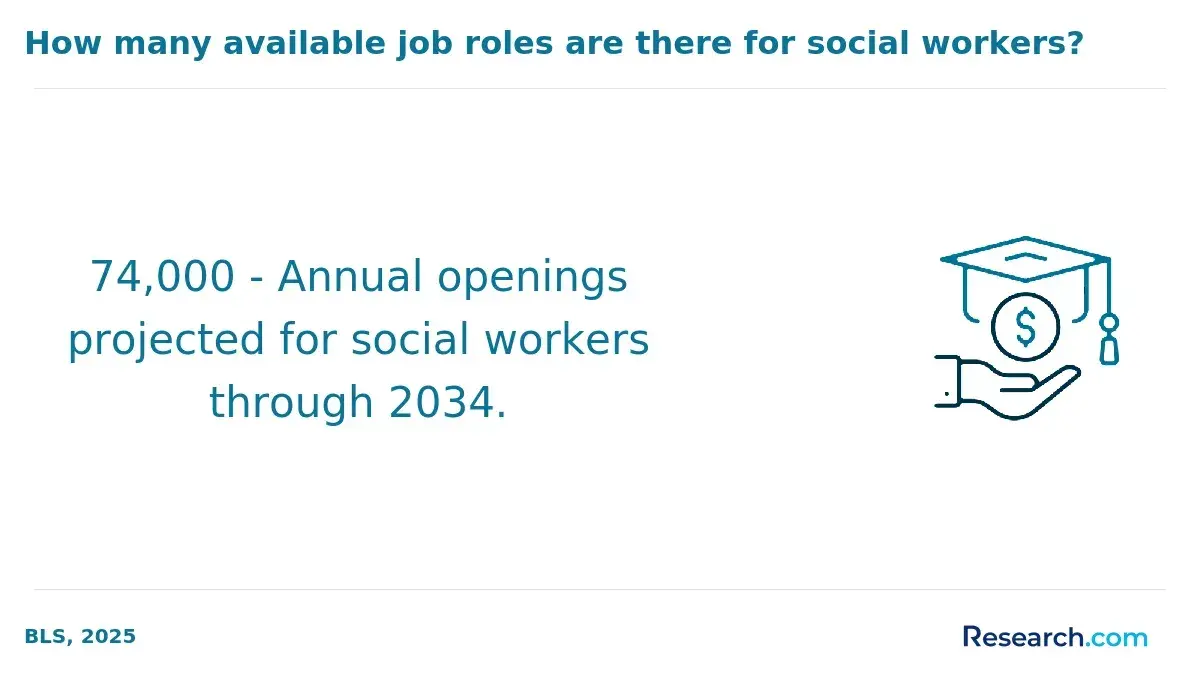
What is the job market for graduates with a Master’s in Social Work degree?
According to the Bureau of Labor Statistics, the job market for graduates with a Master’s in Social Work degree is positive, with job growth at 7%. forecast through 2032.
Demand is shaped by mental health needs, aging populations, healthcare access, school-based support, substance use treatment, child welfare, public benefits systems, and community services. However, opportunities differ by region and specialization. Rural areas, healthcare systems, schools, correctional settings, and behavioral health providers may have different hiring patterns and compensation structures.
As shown in the following chart, the median salaries for many social worker operations are around $76,000 per year, with some specializations earning much higher, such as clinical social workers with an annual salary of $81,847.
What are some career advancement opportunities for those with MSW in Texas?
An MSW can support advancement into clinical practice, supervision, program administration, policy roles, nonprofit leadership, healthcare coordination, school-based leadership, and specialized community services. In Texas, advancement often depends on licensure progress, field experience, supervision, and the population or system you serve.
Some graduates later pursue doctoral study, especially if they want to teach, conduct research, lead systems-level initiatives, or specialize further. For students exploring that route, online DSW programs may be worth comparing after gaining professional experience.
- Specialize in fields such as healthcare, behavioral health, child welfare, school social work, or community leadership.
- Move into supervision, program management, agency administration, or policy development.
- Pursue roles with higher earning potential and stronger long-term stability when supported by experience and licensure.
What is the social impact of a Master’s in Social Work degree?
The social impact of an MSW is tied to the profession’s focus on people, systems, and justice. Social workers help individuals manage crises, connect families to resources, support mental health, advocate for safer communities, and challenge barriers that limit access to care, housing, education, employment, and safety.
If you are asking is social work a good degree to have, consider both the personal and practical dimensions. Social work can be emotionally demanding, and the work is not always highly paid relative to its difficulty. But for students committed to service, advocacy, and complex human problems, the MSW can create a direct path into meaningful roles across healthcare, schools, government, nonprofits, and clinical practice.
The strongest candidates enter the field with realistic expectations. Social work requires boundaries, resilience, documentation discipline, cultural humility, ethical decision-making, and the ability to collaborate with professionals from many fields. The impact can be substantial, but it is built through consistent, skilled, and often difficult work.
What factors indicate an easy online MSW program for prospective students?
An “easy” online MSW should not mean academically weak or poorly supervised. A better way to think about ease is accessibility: clear admissions requirements, transparent pricing, flexible scheduling, strong advising, reliable technology, and organized field placement support.
Look for programs with a straightforward application process, no unnecessary barriers, clear advanced standing criteria, responsive admissions staff, and detailed field education information. Avoid choosing solely because admission seems simple. Accreditation and licensure alignment still matter most. For comparison, review this guide to an easy online MSW program.

How can specializing in addiction counseling complement an MSW degree?
Addiction counseling can strengthen an MSW by adding focused knowledge of substance use, recovery models, relapse prevention, family systems, co-occurring mental health conditions, and community-based treatment. This combination can be valuable in healthcare, behavioral health, corrections, child welfare, schools, and community agencies.
Students interested in this practice area should compare coursework, field placements, and credentialing rules carefully. Some roles may require additional state-specific addiction counseling credentials beyond the MSW. To explore related graduate options, review programs such as a master's in addiction counseling.
How can adding an online sociology degree complement my MSW?
Sociology can complement social work by deepening understanding of social structures, inequality, group behavior, institutions, research methods, and policy. While an MSW focuses on professional practice, sociology can strengthen the analytical lens students use to understand poverty, race, family systems, migration, labor markets, education, and community change.
This combination may be useful for students interested in policy, research, program evaluation, community development, or advocacy. If you are comparing interdisciplinary options, a cheap sociology degree online may help you evaluate whether additional sociology training fits your goals.
How do MSW and related mental health professions compare in salary?
MSW graduates often compare social work with psychology, counseling, marriage and family therapy, and related mental health careers. Salary differences depend on licensure, role, employer, state, private practice opportunities, specialization, and years of experience. Clinical roles may pay more than entry-level case management roles, but compensation is not guaranteed by degree alone.
Students should compare not only pay but also training length, licensure exams, supervised hours, scope of practice, debt, and the type of work they want to do daily. For a closer comparison, see this guide to social worker vs psychologist salary.
How can I strategically transition from an MSW program to professional practice?
The transition from MSW student to professional social worker should begin before graduation. Use field placements to build references, clarify your preferred population, document accomplishments, and understand which licenses or credentials your target roles require.
- Confirm licensure steps early: Identify the exact application, exam, supervision, and documentation requirements for the state where you plan to practice.
- Use fieldwork strategically: Choose placements aligned with your intended career, such as behavioral health, hospitals, schools, child welfare, or policy organizations.
- Build a practice-focused resume: Highlight client populations, interventions, documentation systems, crisis response, assessments, group work, and measurable contributions.
- Network through supervision: Field instructors, agency staff, faculty, and professional associations can become job leads and references.
- Target the right job boards: Research openings by specialization and license level. A helpful starting point is this guide to jobs for master in social work.
- Keep learning: Continue training in trauma-informed care, telehealth, ethics, documentation, cultural responsiveness, and evidence-based interventions.
Are there accelerated MSW programs available in Texas?
Yes. Accelerated MSW programs are available for eligible students, especially those who already hold a Bachelor of Social Work (BSW) from an accredited institution. These advanced standing pathways can allow students to complete the MSW in as little as 12 to 18 months by building on prior social work coursework and field education.
Accelerated programs are appealing because they can reduce time and total credits. However, they can also be intense. Students should confirm whether they can manage coursework, field placement hours, employment, family responsibilities, and licensure preparation within a compressed schedule.
Many Texas universities offer flexible accelerated MSW programs, including online and hybrid options for working professionals. These programs often include field placements in settings such as healthcare, education, and community organizations. To compare options, review this guide to MSW accelerated programs.
Common mistakes to avoid when choosing an MSW program
| Mistake | Why it can hurt you | Better approach |
| Choosing without checking accreditation | It may affect licensure eligibility and employer recognition | Verify CSWE accreditation and institutional accreditation before applying |
| Looking only at tuition | Fees, field costs, lost work hours, and extra credits can change affordability | Calculate total program cost for your exact track |
| Assuming online means fully flexible | Field placements may require daytime, in-person availability | Ask for field schedule expectations before enrolling |
| Ignoring state licensure rules | Graduation alone may not qualify you for your intended license | Check your state licensing board and ask the school for licensure disclosures |
| Choosing the fastest program automatically | Accelerated formats can be overwhelming and may limit work availability | Match pace to your finances, schedule, and support system |
| Relying only on rankings | A highly visible program may not fit your specialization or placement needs | Compare outcomes, field support, cost, licensure fit, and faculty expertise |
| Assuming salary outcomes are guaranteed | Pay varies by role, region, licensure, employer, and experience | Research job postings in your target area before borrowing heavily |
References:
- Association of Social Work Boards. (2026). Licensing exams and regulatory support. https://www.aswb.org/
- Council on Social Work Education. (2026). CSWE research & leadership opportunities. https://www.cswe.org/about-us/ASWB licensing information
- MSWDegrees.org. (2026). Social work programs in Texas (state overview). https://www.mswdegrees.org/states/texas/
- National Association of Social Workers. (2026). NASW practice standards & guidelines. https://www.socialworkers.org/Practice/NASW-Practice-Standards-Guidelines/Standards-for-Technology-in-Social-Work-Practice
- PublicServiceDegrees.org. (2025). Licensure by state overview. https://www.publicservicedegrees.org/college-resources/social-work/licensure-by-state/
- PublicServiceDegrees.org. (2025). Online MSW degrees in Texas & career outlook. https://www.publicservicedegrees.org/online-degrees/social-work-programs/masters-msw/texas/
- Salary.com. (2025). Social worker (MSW) salary in the United States. https://www.salary.com/research/salary/benchmark/social-worker-msw-salary
- SocialWorkDegrees.org. (2025). MSW programs in Texas. https://www.socialworkdegrees.org/program/masters/texas
- Salary.com. (2026). Social worker (MSW) salary in Texas. https://www.salary.com/research/salary/benchmark/social-worker-msw-salary/tx
- Texas Social Work. (2025). CSWE‑Accredited MSW programs in Texas. https://texassocialwork.org/cswe-accredited-programs/Salary.com MSW salary benchmark
- U.S. Bureau of Labor Statistics. (2025). Social workers occupational outlook. https://www.bls.gov/ooh/community-and-social-service/social-workers.htm
- BLS social workers occupational outlook U.S. Department of Health & Human Services, ASPE. (2025). Workforce development & employment quality. https://aspe.hhs.gov/reports/pathway-future-how-workforce-development-quality-jobs-can-promote-quality-care-conference-package-1
Key Insights
- An MSW is most valuable when it clearly supports your intended license, specialization, and work setting.
- CSWE accreditation is a critical checkpoint for students pursuing social work licensure; verify it before applying.
- Online MSW programs can be convenient, but field placements are still hands-on and may require in-person, daytime availability.
- Advanced standing programs can shorten the timeline for eligible BSW graduates, but accelerated study is demanding.
- Do not compare programs by tuition alone. Total cost includes fees, credits, field expenses, transportation, technology, and lost work hours.
- Salary varies by role, state, licensure, employer, and experience. Use salary data as planning information, not a guaranteed outcome.
- The best MSW program is not automatically the highest-ranked or fastest option. It is the program that fits your licensure state, budget, field placement needs, schedule, and long-term career goals.
Other Things You Should Know About Master’s in Social Work Degrees
In 2027, MSW programs in Texas generally require a bachelor's degree, often with a focus on behavioral or social sciences. Applicants typically need a minimum GPA of 3.0, letters of recommendation, a personal statement, and sometimes relevant work or volunteer experience.
In 2027, MSW programs in Texas offer diverse fieldwork opportunities, including placements in healthcare facilities, schools, nonprofit organizations, and community agencies. Students often engage in direct practice, policy analysis, and community organizing, gaining hands-on experience necessary for addressing complex social issues within various environments.
In 2027, students pursuing an MSW in Texas can access various financial aid options, including scholarships, fellowships, grants, and federal student loans. Many universities also offer specific scholarships for social work students, and students are encouraged to apply for external funding sources such as company or foundation grants.
The social work landscape in Texas offers a diverse range of career opportunities and practice areas for social work professionals. Texas has a growing demand for social workers in areas such as child welfare, mental health services, substance abuse treatment, school social work, and healthcare settings. Additionally, Texas is known for its culturally diverse population, which presents unique challenges and opportunities for social workers to engage with and support individuals from various backgrounds. Understanding these dynamics can help prospective social work students make informed decisions about their career paths and areas of specialization within the field.