
2027 How to Become a Licensed Pharmacist in Bakersfield, CA: License Requirements

Co-Founder and Chief Data Scientist
Becoming a pharmacist in Bakersfield, CA, is a high-responsibility healthcare career path that requires far more than earning a science degree. You must complete pharmacy prerequisites, graduate from an accredited Doctor of Pharmacy program, document supervised experience, pass national and California-specific exams, and satisfy state licensing rules before you can legally practice. For students, career changers, and healthcare workers considering pharmacy, the biggest risk is not knowing the full sequence early enough and losing time on missing prerequisites, unapproved programs, or incomplete licensure paperwork.
This guide explains how to become a licensed pharmacist in Bakersfield, what education and exams are required, how long the process usually takes, what local training options exist, how much pharmacists earn, and whether Bakersfield is a strong market for pharmacy careers. It also highlights common mistakes, financing considerations, alternative healthcare paths, and practical questions to ask before committing to a pharmacy program.
Quick Answer: Becoming a Licensed Pharmacist in Bakersfield, CA
- Employment for pharmacists in Bakersfield is projected to grow by 10% from 2022 to 2032, with about 1,760 annual job openings.
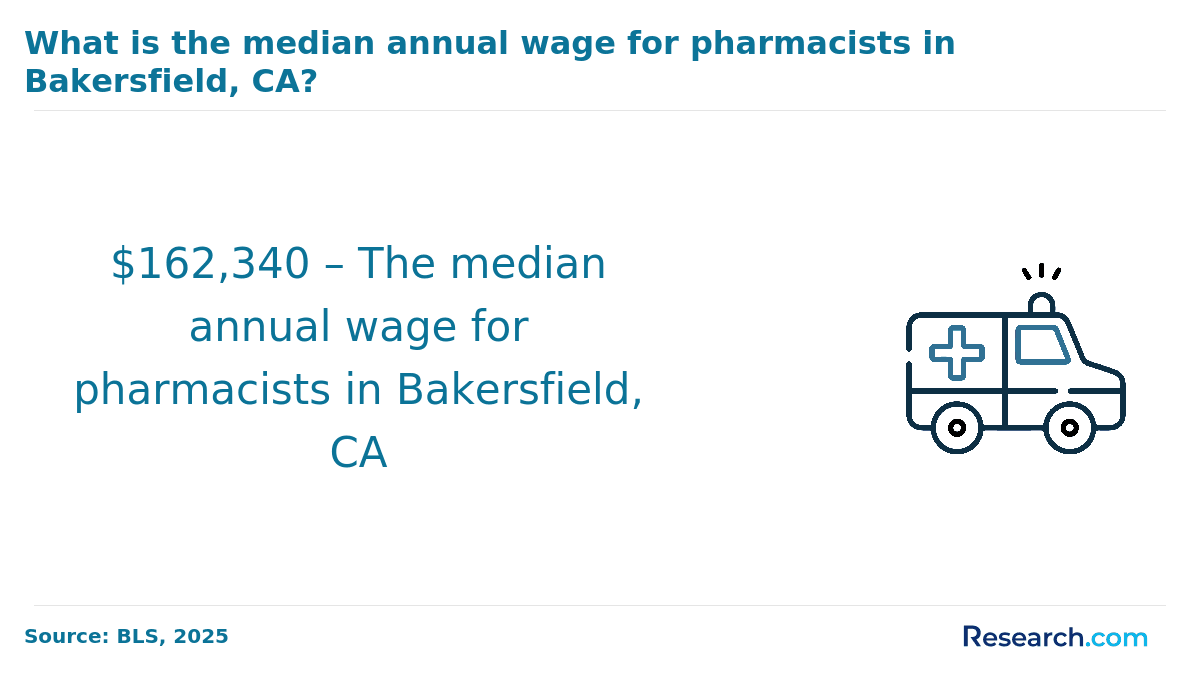
- Licensed pharmacists in Bakersfield earn an average annual salary of $162,340, or about $67.59 per hour.
- The standard path includes pre-pharmacy coursework, an accredited Pharm.D. degree, 1,500 supervised internship hours, the NAPLEX, the CPJE, fingerprinting, and approval from the California State Board of Pharmacy.
- Bakersfield has pharmacy technician training options, but students who want to become pharmacists should verify whether a school offers a full accredited Pharm.D. pathway or only technician-level preparation.
- California pharmacist licensure is state-specific. A California license may help when applying elsewhere, but other states can require additional exams, applications, or jurisprudence requirements.
- Education requirements for becoming a pharmacist in Bakersfield
- Pharmacy and pharmacy technician schools in Bakersfield
- Skills pharmacists need in Bakersfield healthcare settings
- California pharmacist licensure requirements
- Step-by-step licensing process
- Timeline to become licensed
- Alternative healthcare roles for pharmacists
- Continuing education requirements
- Advanced healthcare roles pharmacists can pursue
- Financing pharmacy education and licensure
- Counseling credentials and pharmacy careers
- Using a California pharmacist license in other states
- Pharmacist salary in Bakersfield
- Pharmacist demand in Bakersfield
- Whether Bakersfield is a good place to work as a pharmacist
What are the educational requirements to become a licensed pharmacist in Bakersfield, CA?
To work as a pharmacist in Bakersfield, you need the education required for California pharmacist licensure. The core credential is the Doctor of Pharmacy, usually called the Pharm.D. Before entering that program, students typically complete college-level science and math prerequisites.
- Finish pre-pharmacy prerequisites: Most applicants complete coursework in biology, general and organic chemistry, anatomy, physiology, microbiology, statistics, calculus, and related sciences. Requirements vary by Pharm.D. program, so students should compare prerequisite lists before choosing undergraduate courses.
- Earn an accredited Doctor of Pharmacy degree: A Pharm.D. from an accredited institution is the professional degree needed for pharmacist licensure. The program generally takes four years and combines pharmacology, therapeutics, law, patient care, medication safety, and clinical practice.
- Complete experiential pharmacy training: Pharm.D. students complete introductory and advanced practice experiences in pharmacy settings. These rotations are a major part of pharmacist training programs because they move students from classroom knowledge to patient-facing decision-making.
- Document supervised practical experience: California requires supervised experience before licensure. Students should confirm how their Pharm.D. program tracks internship hours and what documentation the California State Board of Pharmacy expects.
| Education stage | Purpose | What to verify before enrolling |
| Pre-pharmacy coursework | Builds the science foundation needed for Pharm.D. admission | Whether courses match the prerequisite list of your target Pharm.D. programs |
| Pharm.D. program | Provides the professional pharmacy degree required for licensure | Accreditation status, clinical rotation sites, graduation requirements, and licensure exam preparation |
| Clinical rotations and internship hours | Develops supervised practice experience in real pharmacy environments | How hours are recorded and whether they satisfy California requirements |
| Licensure exam preparation | Prepares candidates for the NAPLEX and CPJE | Pass-rate support, review resources, and California law preparation |
Are there schools in Bakersfield, CA that offer pharmacy programs?
Bakersfield offers local pharmacy technician training options, which can be useful for students who want entry-level pharmacy experience before deciding whether to pursue a Pharm.D. However, a pharmacy technician certificate is not the same as a pharmacist degree. Technician programs prepare graduates to support pharmacists; they do not qualify graduates to become licensed pharmacists.
The following Bakersfield options are pharmacy technician programs, not full Pharm.D. programs:
- California State University, Bakersfield (CSUB) – Pharmacy Technician Certificate: CSUB offers three in-person courses totaling 24 Continuing Education Units. The final course includes an externship, and the program is certified by the Pharmacy Technician Certification Board.
- High Desert Medical College (HDMC) – Pharmacy Technician Program: HDMC provides a 34-week program focused on practical technician skills, with an externship component that lets students apply classroom learning in a work setting.
- North-West College – Pharmacy Technician Program: North-West College’s Bakersfield program blends classroom instruction with hands-on training in medication preparation support, inventory procedures, pharmacy workflow, and dispensing assistance.
| Program type | Leads to pharmacist licensure? | Best for | Key limitation |
| Pharmacy technician certificate | No | Students seeking a quicker entry into pharmacy support work | Does not replace the Pharm.D. or pharmacist licensure exams |
| Pharm.D. degree | Yes, after exams and state approval | Students who want to diagnose medication-related problems, counsel patients, and practice as pharmacists | Requires significant time, cost, clinical training, and licensure steps |
| Online or hybrid Pharm.D. pathway | Potentially, if accredited and accepted for licensure | Students needing flexibility while completing professional pharmacy education | Clinical rotations, accreditation, and state eligibility must be checked carefully |
Before enrolling, ask the school directly whether the program is designed for pharmacy technician employment or pharmacist licensure. If your goal is to become a pharmacist, the program must connect to the Pharm.D. and California licensing path rather than stopping at technician preparation.
What skills do you need to become a licensed pharmacist in Bakersfield, CA?
Pharmacists in Bakersfield need a combination of clinical judgment, regulatory knowledge, communication ability, and technology fluency. The role is not limited to filling prescriptions. Pharmacists help prevent medication errors, identify safety concerns, educate patients, and coordinate with other healthcare professionals.
- Medication expertise: Pharmacists must understand drug actions, therapeutic uses, contraindications, interactions, adverse effects, and dosage considerations.
- Precision in dispensing and compounding: Accuracy is essential when preparing, checking, labeling, and dispensing medications, including sterile and non-sterile compounds where applicable.
- Clinical review skills: Pharmacists evaluate prescriptions for interaction risks, duplicate therapy, patient allergies, dosing concerns, and disease-specific precautions.
- California law and compliance knowledge: Practice requires familiarity with state pharmacy rules, federal controlled substance regulations, documentation standards, and ethical obligations.
- Patient counseling ability: Pharmacists must explain medication directions, side effects, adherence strategies, storage instructions, and when patients should contact a clinician.
- Pharmacy technology competence: Modern pharmacy practice depends on prescription management systems, inventory tools, electronic health records, insurance processing platforms, and safety alerts.
- Professional communication: Pharmacists often communicate with physicians, nurses, insurance representatives, technicians, caregivers, and patients with different levels of health literacy.
| Skill area | Why it matters | Example in practice |
| Clinical reasoning | Protects patients from unsafe medication use | Flagging a possible interaction before dispensing |
| Attention to detail | Reduces the risk of dispensing errors | Confirming dosage, strength, route, and patient identity |
| Communication | Improves adherence and patient understanding | Explaining how and when to take a new medication |
| Regulatory awareness | Keeps pharmacy practice legally compliant | Maintaining controlled substance records correctly |
| Technology use | Supports efficient, safe pharmacy operations | Using pharmacy software to check alerts and manage refills |
What are the requirements for pharmacist licensure in Bakersfield, CA?
Bakersfield pharmacists are licensed under California requirements, not separate city rules. The California State Board of Pharmacy determines whether an applicant has the education, experience, examination results, and background clearance needed to practice.
- Complete 1,500 hours of supervised pharmacy experience: Candidates must document at least 1,500 hours under the supervision of a licensed pharmacist.
- Pass the North American Pharmacist Licensure Examination: The NAPLEX measures whether a candidate has the knowledge and clinical ability required for safe entry-level pharmacy practice.
- Pass the California Practice Standards and Jurisprudence Examination: The CPJE tests California pharmacy law, practice standards, and state-specific professional responsibilities.
- Complete fingerprinting and a criminal background check: Applicants must meet the Board’s character and background review standards before a license can be issued.
Because state requirements can change, applicants should confirm current forms, fees, deadlines, and documentation rules with the California State Board of Pharmacy before submitting an application.
What is the licensing process for licensed pharmacists in Bakersfield, CA?
The pharmacist licensing process is sequential. Completing a Pharm.D. is a major milestone, but it is not the final step. You still need to satisfy state documentation, testing, and background review requirements before practicing independently.
- Choose a qualifying pharmacy education pathway: Complete an accredited Pharm.D. program. If you are comparing traditional options with online PharmD programs, confirm that the program’s accreditation and clinical training model support California licensure.
- Track supervised experience carefully: Make sure internship hours are recorded in the format California requires. Do not wait until graduation to discover missing documentation.
- Submit the California pharmacist application: Provide proof of pharmacy education, experience, identity, and other required materials to the California State Board of Pharmacy.
- Complete fingerprinting and background review: Follow the Board’s process for fingerprint submission and criminal background screening.
- Pass the NAPLEX: Use a structured review plan that covers therapeutics, calculations, patient safety, and pharmacy practice applications.
- Pass the CPJE: Study California pharmacy law and practice standards specifically; national exam preparation alone is not enough.
- Receive license approval: After the Board verifies that all requirements and fees are complete, the license authorizes pharmacist practice in Bakersfield and across California.
| Step | Common mistake | Better approach |
| Selecting a program | Assuming every pharmacy-related program leads to pharmacist licensure | Verify Pharm.D. accreditation and California eligibility before enrolling |
| Completing experience hours | Relying on informal records | Use official documentation processes required by the Board |
| Preparing for exams | Studying only for the NAPLEX | Prepare separately for the CPJE and California law content |
| Applying for licensure | Submitting incomplete or inconsistent paperwork | Review Board instructions line by line before filing |
How long does it take to become a licensed pharmacist in Bakersfield, CA?
The full pathway typically takes six to eight years when you combine prerequisite study, the Pharm.D., supervised experience, exam preparation, and licensure processing. Some students complete prerequisites during undergraduate study before applying to pharmacy school, while others choose integrated pathways such as 6 year pharmacy programs that combine early coursework with professional pharmacy training.
The Pharm.D. portion usually takes four years and includes academic instruction plus experiential learning. California also requires at least 1,500 internship hours, which may be completed during the Pharm.D. program or shortly afterward depending on the school and student’s situation. After graduation and experience documentation, candidates still need time to prepare for the NAPLEX and CPJE, submit licensure materials, complete fingerprinting, and wait for Board processing.
| Stage | Typical role in the timeline | What can delay progress |
| Prerequisite coursework | Prepares students for Pharm.D. admission | Missing required science labs or taking courses that do not transfer |
| Pharm.D. program | Provides professional pharmacy education | Academic probation, rotation scheduling issues, or program changes |
| Internship hours | Builds supervised practice experience | Incomplete hour tracking or failure to meet Board documentation rules |
| Licensure exams | Confirms national and California-specific readiness | Underestimating CPJE preparation or delaying exam registration |
| Board approval | Finalizes authority to practice | Incomplete applications, background review issues, or unpaid fees |
What alternative healthcare roles can diversify your career as a licensed pharmacist in Bakersfield, CA?
A pharmacist license can support more than one career direction. Some pharmacists remain in retail or hospital practice, while others move into medication safety, clinical research, public health, managed care, pharmacy education, informatics, or specialty pharmacy. The best choice depends on whether you want more patient counseling, more data analysis, more policy work, or more interprofessional clinical responsibility.
Pharmacists who are drawn to behavioral health and addiction treatment may also explore adjacent credentials. For example, learning how to become a substance abuse counselor in Bakersfield can help professionals understand a separate path focused on counseling, recovery support, and community health needs.
| Career direction | Why pharmacists consider it | Decision point |
| Clinical pharmacy | More direct involvement in medication therapy management | May require residency, specialization, or employer-specific experience |
| Public health | Focuses on prevention, access, vaccination, and population-level outcomes | Best for pharmacists interested in community impact and systems work |
| Clinical research | Uses drug knowledge in trials, safety monitoring, or research coordination | Strong fit for detail-oriented professionals who enjoy protocols and data |
| Behavioral health support roles | Builds skills for patient communication and substance use-related care | Requires separate training and may involve a different licensing pathway |
What are the continuing education requirements for maintaining your pharmacist license in Bakersfield, CA?
After becoming licensed, California pharmacists must meet continuing education expectations set by the California State Board of Pharmacy during each renewal cycle. Continuing education helps pharmacists stay current on medication safety, legal updates, disease management, new therapies, and evolving standards of care.
Do not treat continuing education as a last-minute administrative task. Choose accredited courses that strengthen the type of work you actually do, such as immunization services, chronic disease management, controlled substance compliance, medication therapy management, or specialty practice areas.
Some pharmacy professionals also use continuing education planning to evaluate related healthcare careers. If you want a non-pharmacy administrative path with healthcare relevance, compare the training steps in this guide to how to become a medical biller and coder in Bakersfield.
Before renewing your license, review the California State Board of Pharmacy’s current requirements so your completed courses satisfy the latest rules.
What advanced healthcare roles can pharmacists transition into in Bakersfield, CA?
Pharmacists who want broader clinical authority may consider advanced healthcare careers, but these transitions usually require additional education, clinical training, and a separate license. For example, becoming a nurse practitioner is not an automatic extension of pharmacy licensure; it is a distinct clinical pathway with its own degree and practice requirements.
Pharmacists comparing expanded patient care options can review how to become a nurse practitioner in Bakersfield to understand how that route differs from pharmacy practice in scope, training, and responsibilities.
What financing options are available for becoming a licensed pharmacist in Bakersfield, CA?
Pharmacy education can be a major investment, so students should build a funding plan before applying. The main options include scholarships, grants, federal student loans, private loans, work-study opportunities, employer tuition assistance, and payment plans. The right mix depends on program cost, living expenses, prior credits, enrollment status, and expected career goals.
When comparing programs, look beyond tuition. Fees, books, commuting, clinical rotation travel, exam costs, licensure fees, and time away from paid work can all affect the true price of becoming licensed. Students who are still exploring healthcare careers may also compare the education and financing path for another helping profession, such as how to become an MFT in Bakersfield.
| Cost or funding factor | Why it matters | Question to ask |
| Scholarships and grants | Can reduce borrowing because repayment is usually not required | Are awards available for pharmacy students, local residents, or healthcare trainees? |
| Federal loans | Often provide structured repayment options | What is the total projected borrowing for the full program? |
| Private loans | May fill funding gaps but can carry different terms | How do rates, repayment rules, and cosigner requirements compare? |
| Employer support | Some healthcare employers may help workers advance | Is tuition assistance available, and does it require a work commitment? |
| Licensure and exam costs | These expenses arrive after tuition has already been paid | Have NAPLEX, CPJE, application, and fingerprinting expenses been included in the budget? |
Can pursuing counseling credentials enhance your pharmacy career in Bakersfield, CA?
Counseling skills can make pharmacists more effective communicators, especially when working with patients who struggle with adherence, chronic disease management, mental health concerns, or substance use issues. However, a counseling credential is separate from pharmacy licensure and should be pursued only if it fits your long-term patient care goals.
If you are considering a formal counseling route, review the Bakersfield LPC license requirements to understand how counseling education, supervised experience, and licensing differ from the pharmacist pathway.
Will a pharmacist license from Bakersfield, CA allow you to work in other states?
A pharmacist licensed in California can apply to work in another state, but the license does not automatically transfer. California does not have reciprocity agreements with other states, and each state board of pharmacy sets its own rules for recognizing out-of-state pharmacists.
Common routes for seeking authorization in another state include the following:
- Licensure by endorsement: Some states allow already licensed pharmacists to apply based on an existing license if they satisfy that state’s conditions.
- Reciprocity processes: Where available, reciprocity can simplify recognition of an existing license, but policies differ by state and may not apply to California licenses in the way applicants expect.
- NAPLEX score transfer: Pharmacists may use NAPLEX score transfer procedures to support licensure applications in other jurisdictions.
- MPJE completion: Many states require the Multistate Pharmacy Jurisprudence Examination because pharmacy law is state-specific.
- State-specific documentation: Additional applications, background checks, proof of experience, fees, or law exams may be required depending on the destination state.
If you plan to move, contact the board of pharmacy in the state where you want to work before accepting a job offer. Licensure processing can affect your start date.
How much do Bakersfield, CA licensed pharmacists earn?
Licensed pharmacists in Bakersfield have strong reported earning potential. The average annual salary for a pharmacist in Bakersfield is approximately $162,340, equal to about $67.59 per hour. Entry-level roles typically begin around $126,750 per year, while experienced pharmacists can earn up to $170,560 annually.
Pay can vary by employer, shift, specialty, setting, and experience. Hospital pharmacist roles in Bakersfield report an average annual salary of approximately $129,399, with total pay reaching up to $148,912 per year. Inpatient pharmacists report average annual salaries around $166,400, with experienced professionals earning up to $174,720 annually. Targeted credentials and short-term training, including quick certifications in healthcare, may help pharmacists build specialized skills for certain roles, but no certification guarantees a specific salary.
| Role or experience level | Reported pay in Bakersfield | How to interpret it |
| Average pharmacist | $162,340 per year, or about $67.59 per hour | Useful as a broad market benchmark, not a guaranteed offer |
| Entry-level pharmacist | Around $126,750 per year | May apply to new graduates or pharmacists entering a new setting |
| Experienced pharmacist | Up to $170,560 annually | Often reflects stronger experience, specialized duties, or higher-demand roles |
| Hospital pharmacist | Approximately $129,399 annually, with total pay reaching up to $148,912 per year | Compensation may depend on hospital system, schedule, and responsibilities |
| Inpatient pharmacist | Around $166,400 annually, with experienced professionals earning up to $174,720 annually | Clinical experience and inpatient workflow skills may influence competitiveness |
Is there a demand for licensed pharmacists in Bakersfield, CA?
Demand for licensed pharmacists in Bakersfield is supported by healthcare growth, population needs, and replacement hiring. Bakersfield, CA projects a 10% increase in pharmacist employment from 2022 to 2032, with approximately 1,760 annual job openings due to growth and replacements.
Local opportunities may appear across hospitals, clinics, retail pharmacies, managed care organizations, long-term care settings, and specialty pharmacy environments. Employers such as Mercy Hospital, Adventist Health, Walgreens, and Albertsons are examples of organizations connected to pharmacist roles in the area. Candidates can strengthen their profile by building relevant clinical experience, improving patient counseling skills, and pursuing suitable certifications for healthcare careers when those credentials match their target jobs.
Competition can still exist, especially for preferred schedules, hospital roles, or specialized positions. New graduates should be flexible about setting, shift, and initial responsibilities while building experience.
Is Bakersfield, CA a good place to work as a licensed pharmacist?
Bakersfield can be a practical market for pharmacists who want California-level healthcare opportunities without necessarily working in a large coastal metro. The area offers retail, hospital, and community healthcare roles, and the projected growth suggests ongoing need for medication expertise.
- More manageable cost pressures: Bakersfield’s affordability compared with larger California cities may help pharmacists stretch income further, depending on housing, debt, and household expenses.
- Expanding healthcare needs: Population growth and healthcare access needs can support demand for pharmacists in multiple practice settings.
- Varied employer types: Community pharmacies, hospital systems, clinics, and long-term care providers can create different work environments and career options.
- Stable regional economy: Agriculture, energy, manufacturing, and healthcare all contribute to the local employment base, indirectly supporting medical services.
- Potential work-life advantages: Compared with larger metro areas, some pharmacists may find shorter commutes or less intense daily logistics.
- Room for specialization: As healthcare services expand, pharmacists who develop clinical, inpatient, specialty, or public health expertise may find additional pathways.
| Bakersfield may be a good fit if you want... | You may want to compare other markets if you need... |
| A California pharmacy career in a mid-sized regional healthcare market | A very large academic medical center ecosystem with many subspecialty pharmacy tracks |
| Retail, hospital, community, or long-term care opportunities | A narrow specialty role immediately after graduation |
| A potentially more affordable alternative to larger California cities | Access to every major pharmacy employer type within a dense urban area |
| A community-facing healthcare role with local patient impact | A career plan centered mainly on pharmaceutical industry headquarters or national research hubs |
Here’s What Graduates Have to Say about Becoming a Licensed Pharmacist in Bakersfield, CA
-
: "
Getting licensed as a pharmacist in Bakersfield helped me strengthen my clinical judgment while serving patients with very different healthcare needs. The local healthcare environment continues to grow, and that has made the work feel both stable and meaningful.
"
— Daniel
-
: "
My internship experience in Bakersfield showed me how important pharmacists are to everyday patient care. Working under experienced professionals gave me the confidence to handle real medication questions and understand the public health side of the profession.
"
— Yasmin
-
: "
The path was demanding, especially exam preparation and patient counseling practice, but each requirement built a skill I now use on the job. I’m proud to work in a community where pharmacists are trusted members of the healthcare team.
"
— Tina
Common mistakes to avoid when pursuing pharmacist licensure in Bakersfield
- Confusing pharmacy technician programs with pharmacist preparation: Technician training can be valuable, but it does not replace a Pharm.D. or state licensure.
- Skipping accreditation checks: Always verify that your pharmacy degree pathway is appropriately accredited and accepted for California licensure.
- Ignoring California-specific requirements: Passing a national exam is not enough; the CPJE and California Board requirements matter.
- Waiting too long to track internship hours: Poor documentation can delay licensure even if you completed the work.
- Budgeting only for tuition: Include books, fees, transportation, rotations, exam costs, background checks, and lost work time.
- Assuming salary figures are guaranteed: Pay depends on employer, experience, specialty, schedule, and local hiring conditions.
- Choosing a program based only on convenience: Flexibility matters, but licensure eligibility, clinical placement support, and exam preparation matter more.
Questions to ask before choosing a pharmacy pathway
- Is this program a Pharm.D. pathway, a pharmacy technician program, or another healthcare certificate?
- Is the Pharm.D. program accredited and recognized for California pharmacist licensure?
- How does the program help students complete and document the 1,500 supervised internship hours?
- What support is available for NAPLEX and CPJE preparation?
- Where are clinical rotations located, and will travel be required?
- What is the full cost after tuition, fees, books, transportation, exams, and licensure expenses?
- How many credits can transfer into the program, if any?
- What types of Bakersfield employers hire graduates or provide rotation opportunities?
- Does the program prepare students for retail, hospital, clinical, or specialty pharmacy goals?
- If you may move later, how will the degree and license support applications in other states?
Key Insights
- Becoming a pharmacist in Bakersfield requires a full California licensure pathway: prerequisites, a Pharm.D., 1,500 supervised hours, the NAPLEX, the CPJE, fingerprinting, and Board approval.
- Local Bakersfield pharmacy technician programs can be a useful starting point, but they do not qualify graduates to practice as pharmacists.
- The typical timeline is six to eight years, though accelerated pharmacy pathways may shorten the academic portion for some students.
- Bakersfield reports strong pharmacist earning potential, including an average annual salary of $162,340, but individual pay varies by role and employer.
- Demand appears favorable, with a projected 10% employment increase from 2022 to 2032 and about 1,760 annual job openings.
- The best pharmacy program choice is not simply the cheapest or most convenient option; accreditation, California licensure eligibility, clinical rotations, exam support, and total cost should drive the decision.
- A California pharmacist license can support applications in other states, but it does not automatically authorize practice elsewhere.
Related Articles for Nearby Cities
- 2027 How to Become a Licensed Pharmacist in Los Angeles, CA: License Requirements
- 2027 How to Become a Licensed Pharmacist in Fresno, CA: License Requirements
- 2027 How to Become a Licensed Pharmacist in Long Beach, CA: License Requirements
- 2027 How to Become a Licensed Pharmacist in Anaheim, CA: License Requirements
- 2027 How to Become a Licensed Pharmacist in Santa Ana, CA: License Requirements
- 2027 How to Become a Licensed Pharmacist in Riverside, CA: License Requirements
- 2027 How to Become a Licensed Pharmacist in Irvine, CA: License Requirements
- 2027 How to Become a Licensed Pharmacist in San Jose, CA: License Requirements
- 2027 How to Become a Licensed Pharmacist in San Diego, CA: License Requirements
- 2027 How to Become a Licensed Pharmacist in Stockton, CA: License Requirements
References:
- Chudnovsky Law. (n.d.). California pharmacist license defense lawyer. Retrieved from Chudnovsky Law.
- CSUB Extended Education. (n.d.). Pharmacy technician certificate. Retrieved from CSUB.
- High Desert Medical College. (n.d.). Pharmacy technician school - Bakersfield. Retrieved from HDMC.
- Kaiser Permanente. (n.d.). PGY1 pharmacy – Kern County-Bakersfield – Kaiser Permanente pharmacy residency program. Retrieved from Kaiser Permanente.
- O*NET OnLine. (n.d.). License: Pharmacist, registered. Retrieved from O*NET.
- San Joaquin Valley College. (n.d.). Guide to pharmacy technology in California. Retrieved from SJVC.
- Truecare24. (n.d.). Pharmacists salary in Bakersfield | $193,120 yearly salary in CA. Retrieved from Truecare24.
- Upwardly Global. (n.d.). California licensing guides for immigrant pharmacists. Retrieved from Upwardly Global.
- V-TECS. (n.d.). Pharmacy technician programs Bakersfield, CA. Retrieved from V-TECS.
- Walgreens. (n.d.). Pharmacist jobs in Bakersfield. Retrieved from Walgreens.
Other Things You Should Know About Becoming a Licensed Pharmacist in Bakersfield, CA
To become a licensed pharmacist in Bakersfield, CA, in 2027, candidates must pass two primary exams: the North American Pharmacist Licensure Examination (NAPLEX) and the California Practice Standards and Jurisprudence Examination for Pharmacists (CPJE). Successful completion of both is mandatory for licensure.
In 2027, aspiring pharmacists in Bakersfield, CA, must complete 1,500 hours of pharmacy practice experience before obtaining licensure. These hours are essential for gaining hands-on experience and must be completed under the supervision of a licensed pharmacist.
The California State Board of Pharmacy issues pharmacist licenses in Bakersfield and throughout the state. Applicants must graduate from an ACPE-accredited Pharm.D. program, complete the required internship hours, and pass the NAPLEX plus California’s law exam, the MPJE.


