2027 What Can You Do with an MBA in Information Technology? Costs & Opportunities

Co-Founder and Chief Data Scientist
Choosing an MBA in information technology is not just a question of earning another business credential. It is a career decision about whether you want to move from technical execution into technology strategy, digital transformation, cybersecurity leadership, analytics management, or executive IT roles. The decision matters because organizations continue to depend on cloud systems, data platforms, security infrastructure, automation, and software-enabled operations, while employers also expect technology leaders to understand budgets, risk, people, vendors, and business outcomes.
This guide explains what an MBA in information technology covers, who it is best suited for, what careers it can support, how it compares with other MBA concentrations, what admissions requirements to expect, and how to judge cost, quality, accreditation, and return on investment. It also highlights current labor market data from the U.S. Bureau of Labor Statistics (BLS), including the projection that employment of computer and information systems managers will grow by 15% from 2024 to 2034.
Quick Answer: Is an MBA in Information Technology Worth It?
An MBA in information technology can be worth it if your goal is to lead technology teams, manage digital transformation projects, move into IT strategy, or qualify for senior roles that require both business judgment and technical fluency. It is less useful if you want a purely technical career in software engineering, cybersecurity operations, or data science and do not need management training.
| Best fit | Consider another path if... |
| You already have technical, business, or operations experience and want leadership roles in IT. | You mainly want hands-on coding, systems administration, or research-heavy technical work. |
| You want to manage technology budgets, vendors, data initiatives, cybersecurity risk, or product teams. | You need a lower-cost technical credential and do not need an MBA-level business curriculum. |
| You are targeting roles such as IT manager, technology consultant, digital transformation manager, or CTO-track positions. | You are unsure whether you want management responsibilities or prefer individual contributor roles. |
Key Points:
- Computer and Information Systems Managers, a common target role for MBA in IT graduates, have a median annual wage of $164,070.
- The largest employer groups for professionals in this pathway include computer systems design and related services (22%), management of companies and enterprises (12%), and the educational sector (7%).
- The highest-paying states listed for these graduates are New York ($217,630), California ($215,130), and New Jersey ($203,160).
- What an MBA in Information Technology Covers
- Career Options With an MBA in IT
- MBA in IT vs. Other MBA Concentrations
- Program Formats: Full-Time, Part-Time, Online, and Executive
- Admissions Requirements
- Typical Courses
- How to Evaluate MBA in IT Programs
- Specialization Options
- How to Find a High-Quality Affordable Program
- IT Job Demand
- Salary Potential
- Executive MBA in IT and Strategic Leadership
- Emerging Technologies in MBA in IT Curricula
- Industries Hiring MBA in IT Graduates
- Certifications That Can Strengthen an MBA in IT
- Accreditation and Rankings
- How to Pay for an MBA in IT
- Online MBA Programs for IT Professionals
- Career Services and Networking
- Long-Term Outcomes
- Fast-Track MBA in IT ProgramsFast-track note
Key Findings
- The median annual wage for computer and information systems managers is $171,200, and the top 10% earn more than $239,200. Computer and information research scientists report a median annual wage of $136,620, while the highest 10% earn over $239,200.
- Computer and Information Research Scientists have high employment levels in Computer Systems Design and Related Services (10,240 employed), the Federal Executive Branch (9,540), and Scientific Research and Development Services (6,230).
- Among the highest-paying industries for Computer and Information Research Scientists are Software Publishers, with an average annual wage of $201,300, and Scientific Research and Development Services, with $162,410.
- Computer and information technology occupations are projected to grow much faster than the average for all occupations from 2024 to 2034, with about 317,700 openings each year on average from growth and replacement needs. The median annual wage for computer and information technology occupations is $105,990, which is higher than the median for all occupations.
- The business, analytics, security, and technology management skills developed in an MBA in information technology can be useful across global employers that rely on digital systems and IT-enabled operations.
- MBA in Information Technology graduates may pursue opportunities in Software Publishers, Computer Systems designers, and Computing Infrastructure Providers, with each industry offering different role types, compensation patterns, and advancement routes.
How Graduates Often Describe the MBA in Information Technology Experience
James described the degree as a turning point that helped him combine current technology knowledge with stronger leadership skills, supporting his move toward a CTO role.
Maria emphasized that the program pushed her to think more strategically about innovation and digital transformation, especially through applied case studies and team-based projects.
Aisha highlighted the value of an online format, noting that it allowed her to keep working while collaborating with classmates and faculty in a digital learning environment.
What is an MBA in information technology?
An MBA in information technology is a graduate business degree that combines core management training with coursework in technology strategy, information systems, analytics, cybersecurity, digital operations, and IT project leadership. Unlike a purely technical master’s degree, an MBA in IT is designed for people who want to connect technology decisions to revenue, risk, productivity, customer experience, and organizational strategy.
Students typically study finance, marketing, operations, organizational behavior, and strategy alongside IT-focused subjects such as data analytics, cybersecurity management, technology governance, cloud adoption, enterprise systems, and digital transformation. The result is a credential aimed at professionals who need to speak both the language of business leaders and the language of technology teams.
If you are aiming for competitive business schools, it is worth reviewing what admissions committees look for in applicants. Research.com’s guide on how to get into a top business school explains how academic records, professional experience, essays, recommendations, and career goals can shape an MBA application.
What can I do with an MBA in information technology?
An MBA in information technology can support careers in IT leadership, digital strategy, consulting, analytics management, cybersecurity oversight, enterprise systems, and technology-enabled operations. The degree is most valuable when paired with experience, because many target roles require judgment, stakeholder management, and a record of solving business problems through technology.
The broader computer and information technology field is projected to produce approximately 317,700 job openings each year, largely because of employment growth and replacement needs. The median annual wage for these occupations is $105,990, which helps explain why many working professionals compare MBA costs against long-term career mobility. Students who want a more technical academic foundation before graduate study may also compare the best information technology degrees.
The average cost of an MBA can be substantial, so the degree should be evaluated against your target role, employer expectations, debt level, and opportunity cost. Common career paths include the following:
| Role | What the role focuses on | Salary information stated |
| Computer and Information Systems Manager | Plans, directs, and coordinates technology systems, IT teams, budgets, security priorities, and infrastructure decisions. | Median salary: $164,070. |
| Computer and Information Research Scientist | Develops new uses for computing technology and advances methods in areas such as algorithms, data, cybersecurity, and systems. | Median salary: $136,620. |
| Chief Technology Officer (CTO) | Sets the organization’s technology vision, evaluates major investments, guides product or platform direction, and aligns technology with business strategy. | Average salary: typically above $150,000. |
| IT Director/Manager | Leads IT departments, manages resources, supervises implementation projects, and ensures that technology plans support business goals. | Salary range: $100,000 to $150,000. |
| Data Science Manager | Oversees analytics teams, data strategy, modeling projects, and business intelligence initiatives. | Salary range: $120,000 to $180,000. |
| Technology Consultant | Advises organizations on technology selection, digital transformation, process improvement, systems integration, and implementation planning. | Salary range: $80,000 to $140,000. |
| Business Intelligence Analyst/Manager | Turns organizational data into reports, dashboards, insights, and recommendations for leadership decisions. | Salary range: $90,000 to $130,000. |
| IT Risk and Compliance Manager | Assesses technology risk, monitors regulatory requirements, builds controls, and helps organizations meet security and compliance obligations. | Salary range: $100,000 to $140,000. |
| Digital Transformation Manager | Leads modernization efforts involving cloud platforms, automation, data systems, workflow redesign, and customer-facing digital tools. | Salary range: $110,000 to $160,000. |
| Cybersecurity Manager/Director | Directs cybersecurity programs, manages incident readiness, oversees security teams, and aligns security investments with business risk. | Salary range: $120,000 to $180,000. |
How does an MBA in IT compare to an MBA in other specializations regarding job opportunities?
An MBA in IT is strongest for students who want roles at the intersection of business leadership and technology execution. It often prepares graduates for jobs involving IT governance, digital transformation, cybersecurity management, analytics, technology consulting, systems implementation, and technology product strategy.
Other MBA concentrations can lead to different outcomes. Finance may be better for investment, corporate finance, risk, or financial planning roles. Marketing may fit students focused on brand strategy, customer acquisition, product marketing, or market research. Human resources may be better for talent strategy and organizational development. General management may work for students who want broad leadership preparation without committing to a technical emphasis.
| MBA concentration | Best suited for | Typical opportunity area |
| MBA in Information Technology | Professionals who want to lead technology-enabled business change. | IT management, technology consulting, digital transformation, cybersecurity leadership, analytics management. |
| MBA in Finance | Students focused on capital, investment, budgeting, valuation, or financial strategy. | Corporate finance, banking, financial analysis, risk management. |
| MBA in Marketing | Professionals interested in customers, markets, brand positioning, and growth strategy. | Marketing management, product marketing, digital marketing, customer analytics. |
| General MBA | Students who want broad management training and flexibility across industries. | Operations, consulting, general management, entrepreneurship. |
Working professionals who need flexibility often compare technology-focused programs with broader online MBA courses. The best choice depends on your target job, your current work experience, and whether employers in your field value technical specialization.
What are the types of MBA in information technology programs?
MBA in Information Technology programs are offered in several formats. The right format depends on your work schedule, experience level, learning preferences, career timeline, and willingness to relocate or pause employment.
| Program type | Who it works best for | Main trade-off |
| Full-time MBA in IT | Students who can step away from full-time work and want an immersive campus-based experience. | More networking and recruiting access, but higher opportunity cost from reduced work income. |
| Part-time MBA in IT | Working professionals who want to keep earning while studying. | More manageable financially, but completion can take longer. |
| Online MBA in IT | Students who need location flexibility or cannot attend campus regularly. | Convenient and often work-friendly, but networking quality varies by program design. |
| Executive MBA in IT | Mid-career and senior professionals who already manage people, budgets, projects, or business units. | Designed for experienced leaders, but may be less appropriate for early-career applicants. |
What are the requirements for an MBA in information technology programs?
Admissions requirements vary by school, but most MBA in information technology programs look for evidence that applicants can handle graduate-level business coursework and contribute professional insight in class discussions.
- Bachelor’s Degree: Applicants generally need a four-year degree from an accredited institution. The major may be business, information technology, computer science, engineering, or another field, depending on the program.
- Work Experience: Many schools prefer candidates with professional experience, often ranging from two to five years, especially for programs designed around leadership and applied projects.
- GMAT or GRE Scores: Some programs request GMAT or GRE results to evaluate quantitative, analytical, and verbal readiness, while others may offer waivers based on experience or prior academic performance.
- Academic Transcripts: Official transcripts help admissions teams review grades, course rigor, prerequisites, and prior graduate or undergraduate work.
- Letters of Recommendation: Recommendations from supervisors, faculty members, or professional mentors can help demonstrate leadership potential, reliability, and readiness for MBA study.
- Personal Statement or Essay: The essay usually explains why the applicant wants an MBA in Information Technology, what career goals they are pursuing, and how the program fits those goals.
Applicants comparing technology, finance, and management tracks should review each school’s exact admissions criteria. If you are still deciding between concentrations, this guide on whether an MBA in finance is the right fit may help you compare career direction and coursework expectations.
What courses are typically included in an MBA in information technology?
MBA in IT curricula usually combine traditional business foundations with courses that help managers evaluate, implement, secure, and govern technology systems. Course names differ by school, but the core themes are often similar.
- Information Systems Management: Examines how organizations plan, operate, and improve information systems to support business priorities.
- Data Analytics and Decision Making: Teaches students how to interpret data, evaluate performance, and use analytics in strategic decisions.
- Cybersecurity Principles: Introduces the major risks, controls, policies, and management practices used to protect digital assets.
- IT Project Management: Covers methods for planning, budgeting, leading, monitoring, and delivering technology projects.
- Network and Database Management: Explores how networks, databases, and enterprise systems are designed, maintained, and aligned with organizational needs.
Students planning academic or executive-level careers sometimes use an MBA as a stepping stone to doctoral work. If that is part of your long-term plan, compare MBA curricula with the expectations of a doctorate in business administration online.
What should I look for in an MBA in information technology program?
The strongest MBA in information technology program is not always the most famous or the cheapest. It is the one that matches your career target, gives you credible training in both management and technology, and offers enough support to justify the total cost.
- Accreditation: Confirm that the institution and business program meet recognized quality standards before you apply.
- Curriculum fit: Look for a balance of finance, strategy, leadership, analytics, cybersecurity, IT governance, and digital transformation.
- Faculty background: Review whether instructors bring relevant academic expertise, industry experience, consulting work, or research in technology management.
- Specialization depth: Make sure electives match your intended path, such as cybersecurity, analytics, cloud strategy, product management, or enterprise systems. Students who want deeper technical preparation may also compare options such as an online computer science bachelor’s degree.
- Career outcomes: Ask where graduates work, what roles they obtain, how quickly they advance, and whether the school provides employer relationships in technology sectors.
Questions to Ask Before Enrolling
| Question | Why it matters |
| Is the business school properly accredited? | Accreditation can affect credibility, transferability, employer recognition, and financial aid eligibility. |
| How many IT-specific electives are available? | A program with only one or two technology courses may not provide enough specialization for your goals. |
| Are projects based on real business technology problems? | Applied work can help you build a portfolio of leadership and problem-solving examples. |
| Can online students access the same career services as campus students? | Career coaching, employer events, and alumni access can influence the value of the degree. |
| What is the total cost after fees, books, travel, and lost work time? | Tuition alone does not show the full financial commitment. |
What are the various specializations available within an MBA in IT program?
Specializations allow students to tailor an MBA in information technology toward a specific role or industry. The best concentration depends on whether you want to manage risk, data, software delivery, enterprise platforms, or technology-enabled operations.
- Cybersecurity: Focuses on protecting systems, data, networks, and business operations from cyber risk. Students who want a dedicated technical route may also compare cybersecurity schools online.
- Data Analytics and Business Intelligence: Builds skills in data interpretation, reporting, dashboarding, forecasting, and evidence-based strategy.
- IT Project Management: Prepares students to lead complex technology projects involving budgets, vendors, stakeholders, risk, and deadlines.
- Software Development Management: Concentrates on leading software teams, managing product delivery, coordinating releases, and translating business needs into technical requirements.
- Enterprise Resource Planning (ERP): Covers the integration of finance, operations, supply chain, human resources, and other business functions through enterprise technology systems.
How do I choose a high-quality, affordable MBA in information technology program?
To find a strong program at a manageable price, compare total cost, accreditation, curriculum depth, faculty, career services, graduation requirements, and employer connections. Do not choose only by tuition sticker price. A low-cost program with weak advising, limited technology coursework, or poor career support may not deliver the outcome you need.
Start by identifying your target job, then work backward. If your goal is cybersecurity leadership, prioritize security governance, risk, and compliance courses. If you want analytics management, look for data strategy and business intelligence coursework. If you want IT consulting, applied projects and client-facing case work may matter more.
Students who want a lower-cost technology-focused option can also compare an online information technology degree with MBA programs to decide whether they need graduate business training or a more technical credential.
Are information technology jobs in high demand?
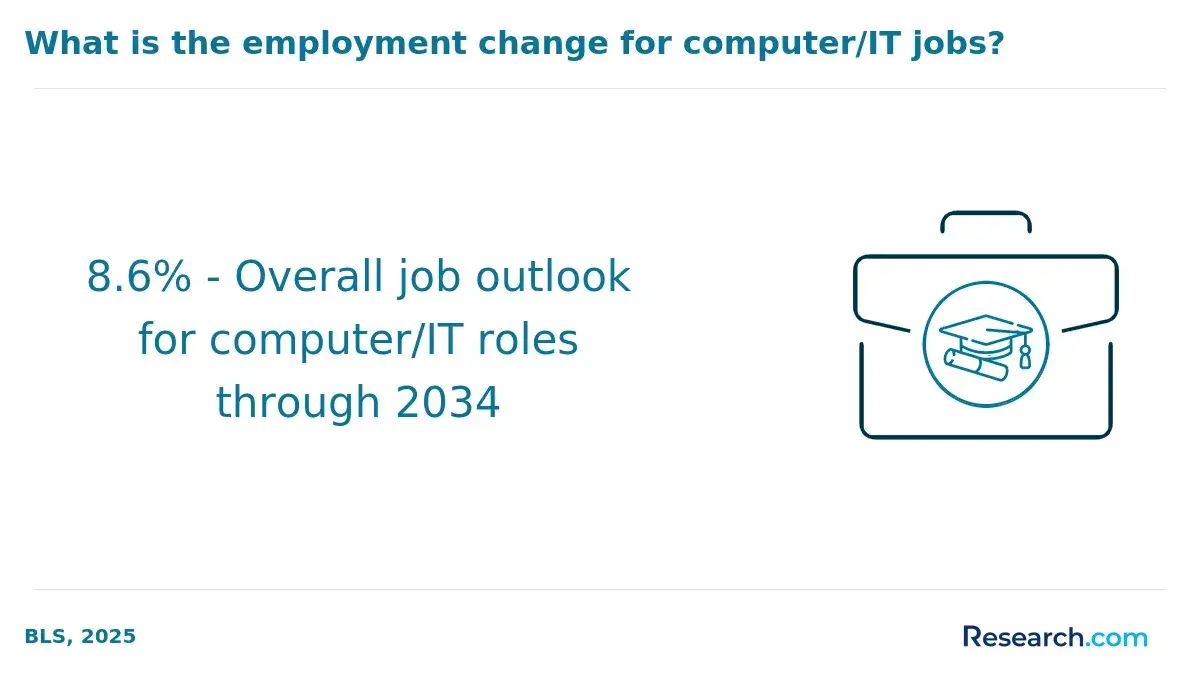
Yes. Computer and information technology occupations are generally projected to grow strongly from 2024 to 2034, with an average of 317,700 job openings each year. For MBA in IT graduates, one especially relevant occupation is computer and information systems manager, which is projected to grow by 15% over the same period.
Computer and information research scientists are also projected to grow by 23% in that period. Demand is connected to cybersecurity needs, data mining, digital services, and the increasing role of technology in business operations. Students comparing MBA concentrations may want to evaluate technology management against other pathways, including MBA in marketing salary outcomes.
Demand does not guarantee a job or a specific salary. Employers usually weigh experience, technical credibility, leadership ability, industry knowledge, and communication skills. For a broader view of related roles, see Research.com’s guide to information systems careers and salary.
How much can I earn from an MBA in information technology?
Earnings vary by role, experience, employer, industry, location, and whether the position is technical, managerial, or executive. One key benchmark is computer and information systems managers, who earn a median annual wage of $164,070. The top 10% in this field can earn more than $207,850.
Computer and information research scientists are another potential pathway, although some roles may require more technical or research-focused preparation. The bottom 10% earn less than $78,190, while top earners can make substantially more.
Location can also make a major difference. For computer and information systems managers, New York is listed at $217,630, followed by California ($215,130) and New Jersey ($203,160). For computer and information research scientists, California reports an annual mean wage of $232,210, followed by Oregon at $189,910 and Washington at $182,800.
Salary Factors to Evaluate Before Assuming ROI
- Current experience: An MBA may accelerate advancement, but it usually works best when paired with relevant work history.
- Industry: Software, finance, consulting, healthcare, government, education, and manufacturing can pay differently for similar technology roles.
- Location: High-paying states may also have higher living costs and more competitive job markets.
- Role level: Manager, director, vice president, and executive roles carry different compensation structures.
- Technical depth: Leaders who understand cybersecurity, analytics, cloud systems, or product delivery may be more competitive for specialized roles.
How does an executive MBA in IT prepare professionals for strategic leadership?
An executive MBA in IT is built for experienced professionals who already understand organizational complexity and want to make higher-level technology decisions. Rather than focusing only on technical tools, these programs emphasize strategy, governance, innovation, financial decision-making, leadership under uncertainty, and large-scale digital change.
The format can be useful for managers who need to keep working while preparing for senior leadership roles. Courses and projects often focus on practical decision-making, cross-functional leadership, and the ability to translate technology trends into business action. Professionals comparing flexible senior-level options can review executive MBA online programs.
How are emerging technologies integrated into MBA in IT curricula?
MBA in IT programs increasingly address technologies such as artificial intelligence, machine learning, blockchain, and cloud computing. The most useful programs do more than mention these topics in lectures. They require students to examine business cases, risk trade-offs, implementation challenges, governance questions, vendor decisions, and ethical implications.
Look for applied labs, case studies, simulations, consulting projects, and partnerships with employers. These elements can help students understand how emerging technologies affect budgets, cybersecurity, operations, customer experience, compliance, and workforce planning. If accreditation and cost are both priorities, compare programs such as the cheapest AACSB accredited online MBA programs.
What industries offer the most opportunities for MBA in information technology graduates?
MBA in Information Technology graduates are not limited to technology companies. Any industry that relies on software, data, cybersecurity, cloud infrastructure, automation, or digital customer experiences may need leaders who understand both IT and business strategy.
- Technology and Software Development: Software companies, IT service providers, startups, and platform businesses hire professionals for technology management, product strategy, systems architecture, implementation leadership, and executive technology roles.
- Healthcare and Biotechnology: Hospitals, health systems, biotech firms, and digital health companies need leaders for electronic health records, telemedicine, data analytics, medical technology integration, and secure information systems.
- Financial Services and Fintech: Banks, insurers, investment firms, payment companies, and fintech startups depend on cybersecurity, data governance, risk systems, automation, digital banking, and customer platforms.
- Consulting and Business Services: Consulting firms use MBA in IT graduates to advise clients on digital transformation, IT strategy, system selection, cybersecurity maturity, process redesign, and technology-enabled growth.
- Manufacturing and Supply Chain: Industry 4.0, smart factories, automation, ERP systems, logistics technology, and supply chain analytics create demand for managers who can modernize operations.
- Retail and E-commerce: Retailers and digital commerce companies need technology leaders for e-commerce platforms, inventory systems, payment technology, customer analytics, digital marketing systems, and personalization.
Affordable MBA Pathways in Business Analytics for IT Professionals
Business analytics is a natural extension for many IT professionals because it connects data infrastructure with executive decision-making. A business analytics MBA can be especially relevant for roles such as Business Intelligence Analyst, Data Science Manager, Technology Consultant, and analytics-focused digital transformation leader.
If cost is a major concern, compare programs that offer an affordable online MBA in business analytics. This route may be a strong fit if you want to build management skills while deepening your ability to lead data strategy, reporting, forecasting, and analytics-driven innovation.
Which additional certifications can further boost your MBA in IT?
Certifications can strengthen an MBA in IT when they match your target role. The MBA signals business and leadership preparation, while certifications can show job-specific capability in project management, cybersecurity, service management, cloud platforms, or data tools.
| Certification area | Examples mentioned | Best use |
| Project management | PMP | Useful for leading complex IT projects, budgets, teams, schedules, and implementation plans. |
| Cybersecurity | CISSP | Useful for security management, governance, risk, compliance, and executive security leadership. |
| IT service management | ITIL | Useful for IT operations, service delivery, process improvement, and enterprise technology support. |
Students who want a faster academic route while building business credentials can also explore the fastest online business degrees.
How do accreditation and rankings influence the quality of an MBA in IT program?
Accreditation is one of the first quality checks for any MBA in information technology. It helps confirm that a school meets recognized academic and administrative standards. For students, accreditation may affect employer perception, transfer credits, financial aid eligibility, and confidence that the program has gone through outside review.
Rankings can be useful, but they should not replace your own evaluation. A highly ranked program may be expensive or poorly aligned with your specific technology goals. A lower-ranked program may offer stronger flexibility, employer partnerships, or specialized coursework for your situation. Review ranking methodology, not just the final position.
Because technology leaders also deal with contracts, privacy, intellectual property, risk, and regulation, some students benefit from legal and compliance coursework. For that broader perspective, compare related options such as an online master degree business law.
How can you finance your MBA in information technology?
An MBA in Information Technology can require a significant financial commitment. Before enrolling, calculate tuition, fees, books, technology requirements, travel, residency costs, interest on loans, and any income you may lose by reducing work hours.
- Scholarships and Fellowships: Many universities provide merit-based scholarships or fellowship awards for MBA students. Strong academic records, leadership experience, professional achievements, or technology experience may improve competitiveness.
- Employer Sponsorship and Tuition Reimbursement: If you already work in technology or a technology-enabled business, ask whether your employer funds graduate education. Confirm eligibility rules, reimbursement limits, grade requirements, and whether you must remain with the company after graduation.
- Federal and Private Loans: Federal student loans and private loans may help cover MBA costs. Review interest rates, repayment terms, origination fees, and long-term debt burden before borrowing.
- Online MBA Programs: An affordable online MBA in Information Technology may reduce relocation and commuting costs while allowing you to keep working.
- Assistantships and Research Opportunities: Some programs offer assistantships, research work, or teaching support roles that may include tuition support, stipends, or professional experience.
- Crowdfunding and Alternative Financing: Some students use platforms such as GoFundMe and Indiegogo to seek help from personal networks, though this approach is less predictable than institutional aid or employer support.
- Return on Investment (ROI): ROI depends on your current salary, tuition cost, debt, target role, and career progress after graduation. Computer and information systems managers, for example, have a median annual salary of $164,070, according to the U.S. Bureau of Labor Statistics.
Common Financing Mistakes
- Comparing tuition only and ignoring fees, travel, books, residencies, interest, and lost income.
- Borrowing based on best-case salary outcomes instead of realistic career scenarios.
- Assuming employer reimbursement is guaranteed without checking written policy rules.
- Choosing a cheaper program without verifying accreditation, curriculum quality, and career support.
- Failing to apply for scholarships early enough in the admissions cycle.
Are online MBA programs a smart investment for IT professionals?
An online MBA in IT can be a smart investment for working technology professionals who need flexibility and do not want to pause their careers. The best online programs provide rigorous coursework, live or interactive collaboration, applied projects, career support, and access to faculty and alumni networks.
However, online quality varies. Before enrolling, ask whether courses are asynchronous, synchronous, or hybrid; whether students complete team projects; whether career services are available remotely; and whether the program has employer recognition in your field. If you are still weighing the format, review Research.com’s guide asking are online MBAs worth it.
How important are career services and networking opportunities in an MBA in IT program?
Career services and networking can strongly affect the value of an MBA in IT, especially for students trying to move from technical roles into management or from one industry into another. A strong program should offer resume support, interview preparation, employer introductions, alumni mentoring, project opportunities, and events connected to technology leadership.
For online students, it is important to confirm that networking is not limited to campus learners. Ask whether online students can attend recruiting events, join student organizations, contact alumni, participate in residencies, and access executive speakers. Cost-conscious applicants can compare the cheapest online MBAs while checking whether career support is included.
What are the long-term career outcomes after earning an MBA in IT?
Long-term outcomes depend on experience, industry, employer, location, technical credibility, leadership ability, and how strategically the graduate uses the MBA. Common outcomes may include promotion into management, expanded responsibility for technology budgets or teams, movement into consulting, transition into digital transformation leadership, or preparation for executive roles.
Programs with experiential learning, mentorship, employer partnerships, and strong alumni networks may provide better support for career mobility. Students evaluating broader management options may also compare technology leadership with adjacent fields such as the cheapest online MBA degree in healthcare management.
Are there fast-track MBA programs in information technology?
Yes. Fast-track MBA programs in information technology are designed for students who want to complete the degree more quickly than a traditional MBA format. These accelerated programs often compress coursework into 12 to 18 months, making them attractive to professionals who want faster advancement or cannot commit to a longer program timeline.
Accelerated formats can be efficient, but they are not automatically easier. Students may need to handle heavier course loads, shorter terms, frequent deadlines, and intensive team projects. Before choosing this route, make sure your work schedule, family responsibilities, and learning style can support the pace.
Many fast-track programs include online or hybrid options and cover core MBA subjects such as finance and strategy alongside IT-focused topics such as cybersecurity, data analytics, and digital transformation. If speed is one of your top priorities, compare options in this guide to fast-track MBA online programs.
Common Mistakes to Avoid When Choosing an MBA in Information Technology
| Mistake | Better approach |
| Choosing a program only because it has “technology” in the title. | Review the actual course list, electives, projects, faculty, and career outcomes. |
| Ignoring accreditation. | Confirm institutional and business-school accreditation before applying. |
| Assuming an MBA will replace technical experience. | Use the MBA to complement your technical background, not as a substitute for job-relevant skills. |
| Comparing only tuition prices. | Calculate full cost, including fees, books, residencies, travel, financing costs, and lost income. |
| Relying only on rankings. | Use rankings as one data point, then evaluate fit, flexibility, curriculum, and employer connections. |
| Assuming salary outcomes are guaranteed. | Research role requirements, local labor markets, experience expectations, and realistic advancement timelines. |
References:
- BLS. (2024). Computer and Information Research Scientists.
- BLS. (2025). Computer and Information Research Scientists: Occupational Outlook Handbook: U.S. Bureau of Labor Statistics.
- BLS. (2024). Computer and Information Systems Managers.
- BLS. (2025). Computer and Information Systems Managers: Occupational Outlook Handbook: U.S. Bureau of Labor Statistics.
- BLS. (2025). Computer and Information Technology Occupations: Occupational Outlook Handbook:: U.S. Bureau of Labor Statistics.
- Stack Overflow. (2025). 2025 Developer Survey.
Key Insights
- An MBA in information technology is most useful for professionals who want to lead technology strategy, not just perform technical work.
- The degree can support roles in IT management, consulting, cybersecurity leadership, analytics management, digital transformation, and executive technology leadership.
- BLS data points to strong demand in computer and information technology occupations, with about 317,700 openings each year on average from 2024 to 2034.
- Salary potential can be high, but outcomes depend on experience, role level, industry, location, and technical credibility.
- Program quality matters. Prioritize accreditation, relevant IT coursework, applied projects, career services, and employer connections over name recognition alone.
- Online, part-time, executive, and accelerated formats can all make sense, but the best choice depends on your schedule, experience level, budget, and career timeline.
- Before enrolling, calculate total cost and expected ROI carefully. Avoid assuming that an MBA automatically guarantees promotion, a senior title, or a specific salary.
Other Things You Should Know About MBA in Information Technology
The average credit hours required for an MBA in Information Technology in 2027 typically range from 30 to 48. Programs often include core courses in business management and specialized IT courses, blending both disciplines to equip students with a balanced skill set.
Before enrolling in an MBA in Information Technology in 2027, candidates typically need a bachelor's degree, possibly in a tech-related field, and 2-3 years of professional work experience. Some programs may also require submission of GMAT scores and letters of recommendation.
Look for AACSB, ACBSP, or IACBE accreditation. AACSB is the most selective and is recognized by employers and licensing bodies. Regional institutional accreditation also matters, because it affects federal financial aid eligibility and transfer credit acceptance.