2027 MBA Deadlines: When to Apply to Business School?

Co-Founder and Chief Data Scientist
Choosing when to submit an MBA application is not a small scheduling detail. It can affect scholarship consideration, interview timing, visa processing, housing access, and how your profile is evaluated against other applicants. This guide is for prospective MBA students comparing full-time, online, executive, part-time, and accelerated programs in the United States, including applicants trying to decide whether Round 1, Round 2, or a later round gives them the strongest position.
MBA admissions remain competitive because the degree is tied to career mobility, leadership preparation, and strong earning potential. The average MBA starting salary is considerably higher than that of undergraduate degrees, which is one reason applicants invest months preparing essays, recommendations, test scores, and interviews. Interest is also broadening: three out of five business school programs in the country, or 60%, reported an increase in female applicants, while two out of five, or 43%, reported a rise in male applicants.
This updated MBA application guide explains how MBA admissions rounds work, when major business schools set their deadlines, what requirements to prepare, and how to decide whether a traditional, online, executive, accelerated, or alternative business degree pathway fits your timeline and goals.
MBA Application Deadlines Table of Contents
- MBA Application Timeline
- MBA Application Deadlines
- Factors that Affect Application to Business School
- Common Requirements for MBA Applicants
- Tips for Successful MBA Application
- How can you prepare financially for an MBA program?
- Affordable Online MBA Programs and Their Advantages
- How can you excel in your MBA interview?
- How can you evaluate the ROI of an accelerated MBA program?
- Are online EMBA programs a viable choice for seasoned professionals?
- What are the different types of MBA programs and their application timelines?
- Could an Accelerated MBA Program Be Your Strategic Advantage?
- How Can I Evaluate Career Support and Alumni Network Effectiveness?
- What Are the Emerging Trends in MBA Programs?
- Alternative Pathways to an MBA
- Is an MBA Financially Worth the Investment?
Quick Answer: When Should You Apply for an MBA?
Most MBA applicants should begin preparing six months or more before their target deadline and submit the strongest possible application in Round 1 or Round 2. Round 1 can be advantageous for highly prepared applicants, scholarship seekers, and international students who need extra time for visa steps. Round 2 is still a major admissions round and may be the better choice if your essays, test score, recommendations, or career story need more work. Later rounds can work, but seats, scholarships, and flexibility may be more limited at highly selective programs.
| Application Round | Best For | Main Risk | Decision Guidance |
| Early action or Round 1 | Applicants with a complete, polished profile and clear school fit | Rushing before essays, recommendations, or test scores are ready | Apply if your materials already show your strongest case |
| Round 2 | Strong applicants who need more time to improve their application | A larger and highly competitive applicant pool | Choose this round if extra preparation will noticeably improve quality |
| Round 3 or Round 4 | Applicants with a compelling reason for applying later or those targeting programs that still have space | Fewer seats, less scholarship availability, and tighter timelines | Use later rounds carefully, especially for top-ranked schools or international applications |
| Rolling admissions | Applicants to programs that review files as they arrive | Waiting too long may reduce available seats | Submit early once your file is complete and competitive |
MBA Application Timeline
MBA admissions usually operate through three or four application rounds. Round 1 often begins in September, Round 2 in December, Round 3 in January, and Round 4 in April. Some schools also offer early action shortly before the September Round 1 deadline for fall intake, while others use rolling admissions. Because each school controls its own calendar, applicants should verify every date directly on the program’s admissions page before submitting materials.
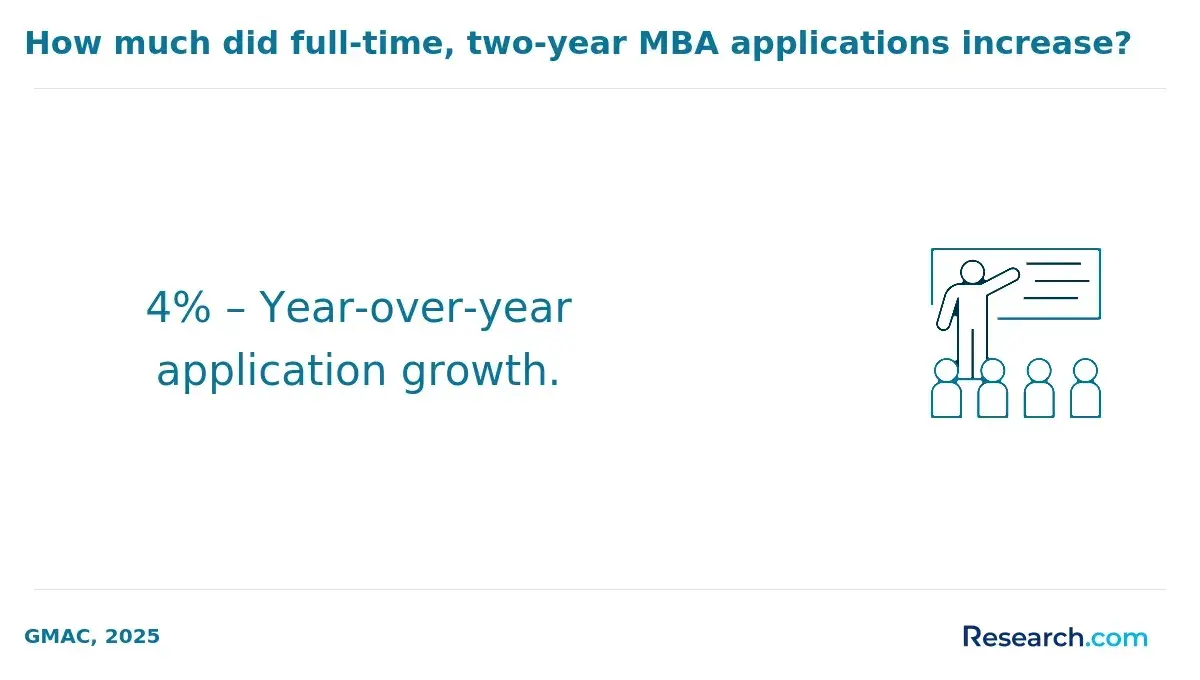
Application volume can also influence how competitive each round feels. According to data from over 1,170 business programs worldwide in 2025, MBA programs had an application volume increase of 13.2%. Meanwhile, this volume continued to grow in 2025, driven by full-time, two-year programs. Applicants considering online MBA USA programs should also note that demand can shift by format, specialization, and school reputation.
A practical MBA timeline should work backward from the deadline. If your goal is a strong business administration career path, do not treat essays, testing, and recommendations as last-minute tasks. The strongest applications usually come from candidates who understand their target schools, can explain their career goals clearly, and have recommenders who can provide specific evidence of leadership and impact.
Summer Before the Application Cycle
Take or schedule the GMAT early. The Graduate Management Admission Test is commonly used by MBA programs to evaluate readiness for graduate-level business coursework. Many applicants take it well before college application deadlines so scores can be reported on time. Taking the GMAT at least two months before your first deadline gives you room for score delivery, school selection, and a possible retake. If Round 1 is your target, starting even earlier is safer.
Build a realistic school list. Use the summer to compare programs by curriculum, career outcomes, location, format, cost, concentrations, and culture. If possible, attend information sessions, visit campus, join virtual events, or speak with current students. Admissions essays are stronger when they show specific reasons for fit rather than generic praise for the school’s reputation.
Talk to alumni and professional contacts. Applicants exploring an MBA for consulting, finance, entrepreneurship, technology management, healthcare leadership, or another field should ask alumni how the program actually supports that path. This is also the right time to identify recommenders. Most programs ask for two to three letters, often from direct supervisors, though strong recommendations can also come from former managers, faculty, clients, or leaders from volunteer or professional settings.
Revise your MBA resume. MBA resumes are not general employment resumes. They should highlight progression, leadership, measurable results, collaboration, analytical ability, and decision-making. Because the resume is used across applications and often guides the interview, update it before essay season begins.
Application Season
Create a deadline and document tracker. List each school, round, deadline, essay prompt, recommendation requirement, test requirement, transcript rule, application fee, and interview process. A balanced list might include several reach programs, several competitive-fit programs, and safer options. Many applicants prioritize top-choice programs in Round 1 and use later rounds for additional schools if needed.
Write the career goals essay first. MBA essays should connect your past experience, the skills you need next, the school’s resources, and your post-MBA goals. Once the goals essay is clear, it becomes easier to answer prompts about leadership, failure, community contribution, teamwork, and personal background.
Submit only when the application is complete and coherent. Collect transcripts, confirm test score reporting, brief your recommenders, proofread all essays, and check each portal before the deadline. Interviews are often by invitation and can signal that the school wants to learn more about your fit. If Round 1 does not produce the results you hoped for, use the feedback from the process to improve Round 2 or Round 3 applications rather than repeating the same materials unchanged.
MBA Application Deadlines
For many applicants, March to April is a sensible time to begin serious preparation for the next admissions cycle. This gives you roughly six months for school research, testing, resume development, recommendation planning, essays, and financial preparation. Universities typically require eight to 10 weeks to process applications, so applicants may receive an admission decision within one to two months from the application deadline, depending on the school’s calendar.
The table below shows application and notification dates for selected leading MBA programs in the United States. Columbia Business School, once ranked as the number one MBA school by Financial Times, offers two MBA entry points, one in August and one in January. For August entry, Round 1 is scheduled in September, Round 2 in January, and Round 3 in April. Other schools follow similar broad patterns, but exact dates, interview processes, and later-round availability vary. Always confirm deadlines on the official admissions website before applying.
| MBA Schools | Application Deadline | Notification | ||||||
| Round 1 | Round 2 | Round 3 | Round 4 | Round 1 | Round 2 | Round 3 | Round 4 | |
| Columbia Business School | September 3, 2025 | January 6, 2026 | March 26, 2026 | - | Mid December | Late March | Early May | - |
| Harvard Business School | September 3, 2025 | January 5, 2026 | - | - | December 10, 2025 | March 25, 2026 | - | - |
| Stanford Graduate School of Business | September 9, 2025 | January 7, 2026 | April 7, 2026 | - | December 10, 2025 | April 2, 2026 | May 28, 2026 | - |
| University of California at Berkeley: Haas | September 11, 2025 | January 8, 2026 | March 31, 2026 | - | December 11, 2025 | March 26, 2026 | May 27, 2026 | - |
| Cornell University: Johnson | September 17, 2025 | January 8, 2026 | April 7, 2026 | - | December 5, 2025 | March 27, 2026 | May 22, 2026 | - |
| Northwestern University: Kellogg School of Management | September 10, 2025 | January 7, 2028 | April 1, 2026 | - | December 10, 2025 | March 25, 2026 | May 13, 2026 | - |
| Yale School of Management | September 10, 2025 | January 6, 2026 | April 14, 2026 | December 4, 2025 | March 19, 2026 | May 14, 2026 | ||
| Duke University’s Fuqua School of Business | September 30, 2025 | January 8, 2026 | February 24, 2026 | April 1, 2026 | December 11, 2025 | March 13, 2026 | April 10, 2026 | May 8, 2026 |
| MIT: Sloan | September 29, 2025 | January 13, 2026 | April 6, 2026 | - | December 11, 2025 | April 2, 2026 | May 15, 2026 | - |
| University of Chicago: Booth | September 16, 2025 | January 6, 2026 | April 2, 2026 | December 4, 2025 | March 26, 2026 | May 21, 2026 | - |
Factors that Affect Application to Business School
The best application round is not the same for every candidate. A rushed Round 1 submission can be weaker than a carefully prepared Round 2 application. At the same time, waiting until a late round can create avoidable disadvantages if your target schools have already filled much of the class.
| Factor | Why It Matters | Best Move |
| School selectivity and ranking | Highly ranked programs often receive large numbers of strong applications, and later rounds can become more constrained. | Apply earlier if your profile is ready and the school is a top priority. |
| Application readiness | Essays, recommendations, scores, and resumes need to work together as one clear story. | Choose Round 2 if extra time will produce a materially better application. |
| International status | Visa processing, documentation, and relocation planning may require additional lead time. | Prioritize Round 1 or Round 2 and verify whether later rounds accept international applicants. |
| Scholarship goals | Funding may be more available earlier in the cycle, depending on the school. | Submit early if scholarship consideration is important and your application is strong. |
| Career timing | Applicants leaving jobs, relocating, or switching industries need time to plan transitions. | Align deadlines with resignation timing, finances, internships, and recruiting cycles. |
- Ranking of the prospect business school. Applicants targeting elite MBA programs should usually avoid waiting until late rounds unless they have a strong reason. Top business schools attract many qualified applicants, and competition can intensify as fewer seats remain in Rounds 3 and 4.
- Application readiness. If your GMAT is complete, your resume is polished, your essays are focused, and your recommenders are prepared, Early Decision or Round 1 may be appropriate. If important pieces are still weak, Round 2 may give you time to submit a more persuasive file.
- International applicant considerations. Many schools encourage international applicants to apply in Round 1 or Round 2 because visas and related procedures can take time. Some programs may not accept international applicants in later rounds, so read each admissions policy carefully before building your timeline.
Common Requirements for MBA Applicants
MBA requirements differ by school, program type, and applicant background, but many leading programs ask for similar materials. In the 2024 to 2025 Academic Year, Harvard received 9,409 applications and enrolled 943 students into the MBA Class of 2027. Applicants should review the exact master degree requirements for each target school because testing policies, transcript rules, English-language requirements, and interview formats can change.
- A four-year bachelor’s degree from a reputable school
- 3.6/4 or 91% GPA score for top MBA universities
- 80 to 100 TOEFL iBT score
- Essays
- GMAT score of 600 or more or GRE equivalent of 155 in each section or more
- Minimum of two years of work experience
- Statement of Purpose for MBA
- Two to three academic and professional letters of recommendation
- Resume
What Admissions Committees Usually Look For
Meeting minimum requirements is not the same as being competitive. MBA admissions committees often evaluate whether the applicant has a clear career direction, evidence of leadership, analytical ability, communication skills, maturity, and a credible reason for choosing that specific program. A strong application connects these elements instead of presenting them as separate documents.
| Application Component | What It Should Prove | Common Weakness to Avoid |
| Resume | Career progression, leadership, measurable results, and scope of responsibility | Listing duties without showing outcomes or impact |
| Essays | Motivation, fit, self-awareness, and post-MBA direction | Writing generic statements that could apply to any school |
| Recommendations | Third-party evidence of performance, leadership, and growth potential | Choosing a famous recommender who cannot provide specific examples |
| Test scores | Readiness for quantitative and analytical coursework | Waiting too long to test and leaving no retake window |
| Interview | Communication ability, judgment, authenticity, and fit with the cohort | Memorizing scripted answers without answering the actual question |
Tips for Successful MBA Application
A successful MBA application strategy balances timing with quality. According to the 2024 Application Trends Survey by the Graduate Management Admission Council, more than half of MBA programs reported growth in applications from women. As applicant pools become broader and more competitive, candidates need applications that are specific, credible, and well timed.
- If scholarships, fellowships, or a highly competitive applicant category are major factors, prepare early enough to submit before the strongest funding opportunities narrow.
- When practical, apply to your priority schools in the same round so admissions decisions and financial aid offers arrive within a comparable window. This can help you make a clearer enrollment decision.
- Do not submit a rushed file just to meet an earlier round. Admissions readers can usually identify essays that lack reflection, recommendations written under pressure, and resumes that have not been tailored for MBA review.
Common MBA Application Mistakes
| Mistake | Why It Hurts | Better Approach |
| Choosing schools based only on rankings | A high rank does not guarantee fit for your industry, learning style, budget, or geography. | Compare curriculum, recruiting outcomes, culture, alumni access, cost, and format. |
| Ignoring accreditation | Accreditation can affect employer recognition, transferability, and perceived academic quality. | Verify the school and program status before applying. |
| Focusing only on tuition | Total cost can include fees, travel, housing, lost income, technology, and relocation. | Build a full cost-of-attendance estimate and compare financial aid options. |
| Assuming online programs are all the same | Online MBAs vary in live sessions, residencies, networking, career services, and rigor. | Ask how the online format supports recruiting, faculty access, and peer interaction. |
| Using vague career goals | Admissions committees need to understand why an MBA is necessary now. | Explain your target role, skills gap, industry direction, and why the school fits. |
| Waiting to contact recommenders | Late requests often lead to generic letters. | Give recommenders time, context, deadlines, and examples of your work. |
Why You Should Apply Early in Business School
Early application can be useful because more seats are available at the start of the cycle, and some schools may have more scholarship flexibility earlier in the process. Round 2 remains a major round at many MBA programs, but later rounds can become harder as classes fill. The key rule is simple: apply early only if early also means excellent.
- Scholarship and fellowship planning. Earlier admission can give you more time to speak with financial aid offices and review external opportunities such as the Goldman Sachs MBA Fellowship.
- Housing and relocation timing. Some admitted students may benefit from earlier access to housing lotteries, relocation planning, and campus preparation.
- Pre-MBA coursework. Early admission can leave time to complete recommended quantitative, accounting, economics, or language coursework before enrollment.
- Visa preparation. International students often need additional time for documentation and visa procedures. Stanford Graduate School of Business, one of the leading business learning institutions in the United States, holds an MBA Class of 2024 with a diverse international student community. With students from various corners of the globe, the class comprises 37% of international students, representing an impressive 56 countries worldwide.
- Admitted-student events. Earlier admits may have more chances to attend admission weekends, meet classmates, explore clubs, and evaluate whether the school feels right before committing.
How can you prepare financially for an MBA program?
An MBA can require a major financial commitment, so applicants should evaluate funding before they are admitted, not after. A realistic plan should include tuition, fees, living expenses, travel, technology, test preparation, application fees, health insurance, and income you may give up if you enroll full time.
- Research scholarships and financial aid early. Many business schools and private organizations offer MBA funding, and some awards have separate deadlines. Some schools consider applicants automatically for merit-based or need-based aid, while others require additional forms.
- Ask about employer sponsorship. Some employers provide tuition reimbursement or sponsorship. Read the conditions carefully because funding may require continued employment for a set period after graduation.
- Compare federal and private loans. Graduate loans can differ in interest rates, repayment terms, deferment options, and borrower protections. Review repayment scenarios before borrowing.
- Estimate living costs honestly. A school in a high-cost city may be more expensive than the tuition figure suggests. Include rent, transportation, food, utilities, relocation, and travel for networking or study opportunities.
- Create a savings cushion. If you plan to study full time, savings can reduce pressure during the first semester and help cover expenses before aid is disbursed.
- Look for income opportunities. Some programs offer assistantships, work-study options, internships, or paid projects. These may help financially and also strengthen your professional network.
Affordable Online MBA Programs and Their Advantages
Online MBA programs can be a strong option for applicants who need flexibility, want to keep working, or cannot relocate. They are not automatically easier, cheaper, or better than campus programs, so the right question is not whether online is good or bad. The better question is whether the specific online MBA provides the curriculum, career support, networking, accreditation, and schedule you need.
Key Benefits of Online MBA Programs
- Cost control. Online study may reduce relocation and commuting expenses, and some programs offer financial aid for online learners.
- Schedule flexibility. Many working professionals choose online MBAs because they can continue earning income while studying.
- Immediate workplace application. Students often apply lessons from finance, analytics, strategy, operations, and leadership courses directly to current roles.
- Virtual networking. Strong online programs use live sessions, residencies, alumni communities, group projects, and career events to help students build relationships.
Students interested in analytics-focused business roles can compare options such as an affordable online MBA in data analytics, especially if they want to build data-driven decision-making skills without stepping away from work completely.
Choosing the Right Program
Before applying to an online MBA, check accreditation, faculty qualifications, course delivery format, required residencies, career services, alumni engagement, employer reputation, and available concentrations. Also ask whether online students receive the same access to recruiting support as campus students.
| Program Feature | Question to Ask | Why It Matters |
| Accreditation | Is the institution and business program properly accredited? | Accreditation supports credibility and may affect employer confidence. |
| Format | Are classes live, asynchronous, hybrid, or residency-based? | The format determines how well the program fits your work and family schedule. |
| Career services | Do online students receive coaching, recruiting access, and interview preparation? | Career support is central to MBA value. |
| Networking | How do students meet faculty, alumni, and peers? | Relationships can influence internships, job referrals, and long-term career growth. |
| Concentrations | Does the program offer coursework aligned with your target field? | Specialization can help you build relevant skills for a defined career path. |
How can you excel in your MBA interview?
An MBA interview is not only a personality check. It is a chance to prove that your career goals, leadership examples, and school choice are consistent. Start by studying the program’s curriculum, clubs, recruiting strengths, values, and student culture. Then prepare concise examples that show how you solve problems, lead teams, manage conflict, learn from setbacks, and make decisions under pressure.
The STAR method can help you organize answers: explain the situation, task, action, and result. Practice with mentors, colleagues, or alumni so your answers sound natural rather than memorized. If your interests involve digital transformation, entrepreneurship, analytics, or remote leadership, reviewing broader business education options such as an online business degree can also help you discuss current business learning formats with more perspective.
How can you evaluate the ROI of an accelerated MBA program?
Return on investment for an accelerated MBA depends on more than tuition. Applicants should compare total program cost, lost income, time away from work, speed of degree completion, career placement, salary growth, alumni strength, and whether the shorter format still provides meaningful recruiting access. A shorter timeline can reduce opportunity cost, but it can also compress networking, internship, and career exploration time.
Programs such as a 12-month MBA online may appeal to students who already know their target career path, have strong professional experience, and want to move quickly. They may be less ideal for applicants who need extensive internship recruiting, a major career reset, or more time to build foundational business skills.
Are online EMBA programs a viable choice for seasoned professionals?
Online executive MBA programs can work well for experienced professionals who want advanced leadership education without pausing their careers. They are typically most relevant for managers, executives, founders, and senior specialists who bring substantial work experience and want to strengthen strategy, finance, organizational leadership, and decision-making skills.
When comparing online EMBA programs, focus on accreditation, cohort quality, faculty access, live interaction, executive coaching, industry partnerships, and alumni engagement. A lower-cost EMBA is only valuable if it offers the leadership development and network access you need.
What are the different types of MBA programs and their application timelines?
MBA formats vary because students have different career stages, work obligations, and time constraints. Full-time MBA programs commonly follow academic-year admissions rounds, while part-time, online, executive, and accelerated programs may use rolling admissions or multiple start dates. Understanding these differences helps you avoid missing a deadline or applying to a format that does not match your life.
| MBA Type | Typical Applicant | Timeline Pattern | Best Fit |
| Full-time MBA | Applicants willing to study intensively and possibly pause full-time work | Usually fall, winter, and spring application rounds | Career switchers, leadership-track professionals, and students seeking immersive recruiting |
| Part-time MBA | Working professionals who want to keep their jobs | May offer flexible or rolling admissions | Applicants advancing within their current industry or employer |
| Executive MBA | Seasoned professionals with substantial leadership experience | Often cohort-based with school-specific deadlines | Managers and executives seeking senior leadership development |
| Online MBA | Students needing location and schedule flexibility | Often multiple starts per year, depending on the school | Working professionals, caregivers, military students, and applicants outside major business hubs |
| Accelerated MBA | Students seeking a shorter completion timeline | Condensed admissions and academic calendars | Applicants with clear goals who can manage an intensive pace |
For a broader comparison of formats, review this guide to the types of MBA programs. The right format should match your career objective, time availability, financial plan, and need for recruiting access.
Could an Accelerated MBA Program Be Your Strategic Advantage?
An accelerated MBA can be a strategic advantage if you want to return to the workforce quickly, already have a defined goal, and can handle a compressed academic schedule. It may be especially useful for professionals seeking promotion, entrepreneurs who want formal business training, or applicants who do not need a summer internship to change careers.
Before choosing this route, compare academic intensity, accreditation, faculty support, specialization options, career coaching, and alumni outcomes. Reviewing online 1 year MBA programs can help you see how schools structure faster pathways while still maintaining graduate-level expectations.
How Can I Evaluate Career Support and Alumni Network Effectiveness?
Career support and alumni access can be just as important as coursework. Ask each MBA program how students receive one-on-one coaching, resume feedback, interview preparation, internship support, employer introductions, and industry-specific advising. Do not rely only on broad placement claims; look for support that matches your target field.
Alumni networks should also be evaluated by activity, not just size. Strong networks include mentorship, regional chapters, industry groups, speaker events, referral culture, and graduates willing to speak with current students. Comparison resources such as quickest online MBA programs can be useful starting points, but applicants should still ask each school direct questions about career outcomes and alumni engagement.
What Are the Emerging Trends in MBA Programs?
MBA programs are adapting to changes in business technology, student expectations, and employer needs. Current program design increasingly emphasizes flexible delivery, analytics, digital strategy, cross-functional leadership, applied projects, and interdisciplinary learning. Some schools are also expanding intensive formats, including the fastest MBA program options, for students who want a shorter route to completion.
Applicants should pay attention to how a program teaches AI-informed decision-making, data analysis, remote collaboration, ethical leadership, and global business issues. A modern MBA should not only cover classic management theory; it should help students make decisions in technology-enabled, fast-changing organizations.
Alternative Pathways to an MBA
A traditional two-year MBA is not the only route into graduate-level business education. Some students may be better served by accelerated MBAs, executive MBAs, specialized master’s degrees, graduate certificates, or combined undergraduate-to-graduate pathways. The best option depends on your experience level, budget, time horizon, and career goal.
Students earlier in their academic journey can also explore an accelerated bachelor's degree business administration pathway, especially if they want to complete undergraduate business preparation more quickly before considering graduate study. These routes may help learners move toward leadership roles faster, but they should still be evaluated for accreditation, cost, academic workload, and career relevance.
Executive MBA programs are another alternative for experienced professionals who want advanced business education without leaving their roles. Weekend, evening, hybrid, and online schedules can make EMBA study more manageable for senior professionals, though the workload remains substantial.
Alternative pathways are not shortcuts by default. They are strategic choices. Use them when the structure supports your goals better than a conventional full-time MBA.
Beat MBA Application Deadlines and Build a Stronger Admissions Strategy
Admission to top MBA programs is competitive, but applicants can improve their position by applying with a clear plan rather than relying on prestige alone. If your goal is a major in business administration master’s program at a selective school, build a balanced school list, prepare early, and show why your experience, goals, and values fit each program.
Timing matters, but timing is not a substitute for quality. Research each school’s MBA application deadlines, prepare every requirement carefully, and choose the round that lets you submit your strongest work. If flexibility is important, compare accredited online MBA programs as well as campus-based options. A well-matched program, realistic financial plan, and organized application calendar can make the MBA process more manageable and more strategic.
Is an MBA Financially Worth the Investment?
An MBA may be financially worthwhile when the degree supports a realistic career move, salary growth, promotion, business launch, or industry transition that justifies the total cost. The calculation should include tuition, fees, living expenses, interest on loans, lost income, relocation, travel, and the time needed to complete the program. It should also include less tangible benefits such as network access, credibility, leadership confidence, and career optionality.
Applicants comparing online and traditional formats should examine the cost of online MBA programs alongside career services, employer recognition, graduation requirements, and networking depth. A lower-cost MBA is not automatically the best value, and a high-cost MBA is not automatically a poor investment. The right question is whether the program’s outcomes, support, and opportunity costs align with your goals.
Key Insights
- Round choice should be strategic. Round 1 is useful for prepared applicants, scholarship seekers, and many international candidates, while Round 2 can be better if extra time improves the application.
- Start earlier than you think. A six-month preparation window helps with testing, essays, recommendations, program research, financial planning, and interview readiness.
- Deadlines vary by school. Even top MBA programs with similar admissions cycles use different application dates, notification dates, interview procedures, and round availability.
- Application quality matters more than speed. A rushed early application can be weaker than a polished Round 2 submission with a clear career story and strong recommendations.
- International applicants need extra lead time. Visa processing and school policies can make Round 1 or Round 2 especially important for students applying from outside the United States.
- Online, executive, and accelerated MBAs require careful comparison. Flexibility and speed are valuable only when the program is accredited, career-relevant, and supported by strong advising and networking.
- ROI depends on total cost and career fit. Evaluate tuition, lost income, loan terms, salary potential, promotion goals, career services, and alumni access before committing.
References:
- B-Schools (2025). MBA Applications Grow Again: U.S. Competition Heats Up After Years of Decline. https://www.bschools.org/blog/mba-application-competition-decreases
- Columbia Business School. (n.d.). MBA Options and Deadlines. https://academics.gsb.columbia.edu/mba/admissions/options-deadlines
- Cornell University Johnson. (n.d). Two-Year MBA Application Deadlines and Important Dates. https://www.johnson.cornell.edu/programs/full-time-mba/admissions/important-dates/
- Duke University Fuqua School of Business. (n.d.) Admission Facts Dates. https://www.fuqua.duke.edu/programs/daytime-mba/admissions-facts-dates
- Graduate Management Admission Council. (2024). Application Trends Survey 2024 The Renaissance of the MBA. GMAC. https://www.gmac.com/-/media/files/gmac/research/admissions-and-application-trends/infographics-application-trends-survey-2024.pdf?rev=416f07f725ea4b02b52108bed99d667e
- Graduate Management Admission Council. (2025). Application Trends Survey 2025 Report. GMAC. https://www.gmac.com/-/media/files/gmac/research/admissions-and-application-trends/2025-application-trends-survey/summary-report.pdf
- Harvard Business School. (n.d.). Admissions Application Dates. https://www.hbs.edu/mba/admissions/Pages/application-dates
- Harvard Business School. (n.d.). Class Profile. https://www.hbs.edu/mba/admissions/class-profile
- Kellogg School of Management at Northwestern University. (n.d). Full Time MBA How to Apply. https://www.kellogg.northwestern.edu/programs/full-time-mba/admissions
- MIT Management Sloan School. (n.d.) MBA. https://mitsloan.mit.edu/mba/admissions/how-to-apply
- Stanford Graduate School of Business. (n.d.). MBA Entering Class Profile. https://www.gsb.stanford.edu/programs/mba/admission/class-profile
- Stanford Graduate School of Business. (n.d.). MBA Program. https://www.gsb.stanford.edu/programs/mba/admission/deadlines
- University of Berkeley Haas. (n.d.). Full Time MBA Program. https://mba.haas.berkeley.edu/admissions
- University of Chicago: Booth. (n.d). Full Time MBA Admissions. https://www.chicagobooth.edu/mba/full-time/admissions
- Yale School of Management. (n.d). MBA Menu. https://som.yale.edu/programs/mba/admissions/application-information
Other Things You Should Know About MBA Deadlines
The MBA application process typically consists of multiple rounds, usually three to four. Round 1 starts in September, Round 2 in December, Round 3 in January, and Round 4 in April. Some schools may also offer an early action round before Round 1 for the fall intake.
Applying early for a 2027 MBA program provides several benefits. Early applicants often face less competition, have a better chance at securing financial aid, and are likelier to be considered for scholarships. Additionally, applying early shows enthusiasm and preparation to admissions committees, which can improve prospects.
In 2027, MBA students can explore various financial aid options such as scholarships, fellowships, employer sponsorships, and student loans. Researching and applying for aid early is crucial, as deadlines may vary across institutions. Many business schools also provide merit-based aid based on application strength.
Common requirements for MBA applications include a four-year bachelor’s degree from a reputable institution, a minimum GPA (usually around 3.0 to 3.5), GMAT or GRE scores, a statement of purpose, two to three recommendation letters, a resume, and proof of work experience. International students may also need to provide TOEFL scores.
To improve your chances, apply early in the application cycle, prepare a strong GMAT score, craft compelling essays, secure strong recommendation letters, and highlight your unique experiences and skills. Additionally, thoroughly research each program to tailor your application to align with their specific requirements and values.
MBA application deadlines are typically divided into three rounds: early, regular, and late. Applying in the early rounds often provides better chances due to higher availability of spots. In later rounds, competition increases as schools move closer to filling their classes.