
2027 How Much Does Nursing School Cost?

Co-Founder and Chief Data Scientist
Choosing a nursing program is partly an academic decision, but it is also a financial one. The advertised tuition rarely shows the full cost of becoming a nurse. Students may also pay for clinical travel, uniforms, textbooks, testing, background checks, health requirements, insurance, licensure, reduced work hours, and extra semesters if credits do not transfer cleanly.
This guide breaks down nursing school costs by credential, including CNA, LPN, ADN, BSN, MSN, DNP, PhD, and bridge pathways. It also explains how online and campus programs compare, what costs students often miss, how to evaluate return on investment, and what questions to ask before committing to a school. It is designed for first-time nursing students, healthcare workers planning to advance, RNs considering graduate study, and families comparing nursing education options for 2026 planning.
Quick answer: how much does nursing school cost?
Nursing school costs can range from a few thousand dollars for shorter entry pathways to six figures for some graduate or private university options. Tuition and fees for some 4-year BSN programs range from $6,000 to more than $60,000, while MSN programs can cost between $12,000 and $100,000. Students should also plan for books, uniforms, shoes, clinical transportation, background checks, health documentation, test preparation, and the National Council Licensure Examination registration fee, which is currently $200 for candidates seeking U.S. licensure.
Key facts about nursing school costs and outcomes
- Tuition and fees for some of the best 4-year BSN programs range from $6,000 to more than $60,000; MSN programs can cost between $12,000 and $100,000.
- Nursing graduates can work in hospitals, outpatient care, home healthcare, public health, research, nursing education, long-term care, and other healthcare settings.
- Registered Nurses in the United States earn an average annual wage of $94,480, equal to $45.42 per hour.
- The highest-paying states for RNs are California, with an annual mean wage of $137,690; Hawaii, with an annual mean wage of $119,710; and Oregon, with an annual mean wage of $113,440.
- Licensure should be included in the budget. The National Council Licensure Examination registration fee for U.S. licensure candidates is $200, and review courses or practice materials can raise the final cost.
- What should students expect in nursing school?
- What careers can a nursing degree support?
- How much do nurses earn?Career settings
- How much does nursing school cost by credential?
- What extra expenses should nursing students plan for?Program expectations
- Which factors affect the total cost of nursing school?
- How can students pay for nursing school?
- Is online nursing school cheaper than campus study?
- What are the usual nursing school admission requirements?
- How should students check accreditation and program quality?
- When do nursing bridge programs make sense?
- How can functional medicine connect to nursing?Bridge pathways
- Can online FNP programs be affordable and clinically strong?
- How should students choose an affordable nursing program?
- What trends are changing nursing careers?
- Which NP programs may be more accessible?
- What are the long-term benefits of a nursing degree?Choosing a school
- How can nursing students reduce costs?
- What healthcare careers can be alternatives to nursing?
- Can an online DNP be a cost-effective next step?
- What financial aid options help pay for nursing school?
What nursing graduates say about the experience
-
: "
Nursing school gave me far more than vocabulary and clinical concepts. Faculty support mattered, but so did the way classmates helped one another through difficult exams, long study sessions, and practical training. The peer network became one of the most valuable parts of the program. - Lance
"
-
: "
The schedule was demanding. There were heavy readings, late nights, and clinical days that required focus and stamina. But working with patients showed me why the training mattered, and I left the program with stronger practical skills and more confidence as I prepared for RN practice. - Louise
"
-
: "
Clinical rotations helped me see how broad nursing really is. Pediatrics, critical care, and other placements taught me different things, but the emergency department captured my interest. The speed of decision-making and the need for calm judgment showed me the specialty I wanted to pursue. - Elyse
"
What should students expect in nursing school?
Nursing school combines science coursework, clinical reasoning, hands-on skill development, and supervised patient care. Students study anatomy, physiology, pharmacology, patient assessment, medical-surgical nursing, care planning, ethics, communication, and safety standards. The purpose is not only to complete a degree; it is to prepare graduates to make safe decisions and meet licensure expectations.
Most programs include classroom instruction, simulation labs, skills checkoffs, and clinical rotations. In these settings, students may practice measuring vital signs, administering medications under supervision, documenting care, educating patients, communicating with families, and responding to changes in a patient’s condition.
The workload can be intense. Nursing students often manage lectures, exams, lab preparation, care plans, clinical shifts, reading assignments, and personal responsibilities at the same time. Early morning, evening, or weekend clinical schedules can also affect work hours, childcare, and transportation.
Students who succeed usually build consistent study routines, seek help early, use faculty feedback, and treat clinical experiences as professional training rather than simple course requirements.
Typical weekly responsibilities in nursing school
| Activity | What students do | Why it affects success |
| Coursework and lectures | Study disease processes, medications, nursing theory, care standards, and patient safety | Creates the knowledge base needed for clinical decisions and licensure exams |
| Skills labs and simulation | Practice procedures, communication, and emergency responses in controlled environments | Builds confidence before students provide supervised care to patients |
| Clinical rotations | Work with patients in approved healthcare settings under faculty or preceptor supervision | Connects classroom learning to real patient care responsibilities |
| Independent study | Review readings, prepare care plans, complete assignments, and study NCLEX-style questions | Helps students retain large volumes of material |
| Licensure preparation | Use practice questions and review core nursing content before graduation | Supports readiness for the required licensing examination |
What careers can a nursing degree support?
A nursing credential can lead to roles across nearly every part of healthcare. Hospitals are a major employer, with nurses working in emergency departments, intensive care, operating rooms, labor and delivery, pediatrics, oncology, medical-surgical units, behavioral health, and specialty services.
Nurses also work in community settings. Employment options may include outpatient clinics, urgent care centers, schools, long-term care facilities, public health departments, correctional facilities, home healthcare agencies, research organizations, insurance companies, and community health programs.
With experience and additional education, nurses may move into advanced practice, leadership, case management, informatics, education, research, policy, public health, quality improvement, or private practice roles where allowed by state law and credentialing rules.
How much do nurses earn?
Nursing pay varies by credential, job title, specialty, employer, shift, experience level, and location. Students should also compare wages against local cost of living because higher salaries in expensive regions may not always translate into higher disposable income.
Registered Nurses earn a mean annual wage of $94,480, or $45.42 per hour. California has the highest annual mean wage for RNs at $137,690, followed by Hawaii at $119,710 and Oregon at $113,440.
These figures are useful planning benchmarks, not guaranteed earnings. A graduate’s first job may pay more or less depending on the local labor market, union agreements, shift differentials, specialty unit, employer budget, and prior healthcare experience.
Salary variables to compare before choosing a nursing pathway
| Factor | Possible effect on earnings | Question to ask |
| Credential level | Higher degrees may qualify nurses for advanced, specialized, or leadership positions | Does my intended role require an ADN, BSN, MSN, DNP, or another credential? |
| Specialty area | Critical care, nurse practitioner roles, nurse midwifery, and anesthesia can have different pay ranges | Which specialties match my interests, strengths, and local hiring demand? |
| Geographic location | Pay differs by state and city because of demand, cost of living, and employer competition | Do I plan to work where the school is located after graduation? |
| Employer type | Hospitals, clinics, government agencies, home health employers, and academic institutions may pay differently | Which employers typically hire this program’s graduates? |
| Experience level | Experienced nurses usually command higher pay than new graduates | What is a realistic entry-level wage in my area? |
How much does nursing school cost by credential?
Nursing is the second most popular major among bachelor’s and associate’s degree holders, but students can enter the field through several routes. Depending on career goals, options may include CNA training, LPN programs, ADN degrees, BSN programs, MSN degrees, DNP programs, PhD programs, and bridge pathways. A student researching labor and delivery nursing careers, for example, may need to compare ADN, BSN, and graduate options before choosing a cost-effective route.
According to Statista data gathered from 2024, the average annual cost to attend university in the U.S. is $14,000 for an in-district public 2-year institution, $24,800 for an in-state public 4-year school, $43,200 for an out-of-state public 4-year institution, and $60,600 for a private nonprofit 4-year school.
The table below compares common nursing education pathways using the cost figures discussed in this guide.
| Pathway | Main purpose | Cost information cited in this guide | Best suited for |
| Certified Nursing Assistant | Short preparation for entry-level patient care support | Average CNA vocational program tuition was $5,150 in A.Y. 2023-2024; CNA undergraduate programs averaged $7,300 in tuition and fees | Students seeking a faster, lower-cost first step into healthcare |
| Licensed Practical Nurse | Practical nursing preparation that may lead to later RN study | Vocational LPN programs averaged $17,842 in tuition for 2024; undergraduate LPN programs averaged $24,561 in tuition and fees | Students who want to enter nursing sooner and may bridge later |
| Associate Degree in Nursing | Common pathway toward RN eligibility | Reviewed ADN programs estimated tuition and fees at $3,000 to $17,000 per year, or $6,000 to $34,000 total | Cost-conscious students seeking a shorter RN route |
| Bachelor of Science in Nursing | Four-year nursing degree often preferred by employers | Some 4-year BSN programs range from $6,000 to more than $60,000 in tuition and fees | Students who want broader mobility and BSN-preferred opportunities |
| Master’s in Nursing | Graduate preparation for advanced practice, leadership, education, or direct-entry nursing study | MSN programs can cost between $12,000 and $100,000 | RNs advancing their roles or non-nurses entering certain graduate nursing pathways |
| Doctorate in Nursing | DNP or PhD preparation for advanced clinical practice, leadership, research, or academia | DNP programs range from $20,000 to $75,000; a PhD now costs an average of $122,000 | Nurses pursuing doctoral-level clinical, executive, academic, or research goals |
Associate Degree in Nursing
An ADN is often a lower-cost path to RN eligibility and typically takes about two years of full-time study. Among the reviewed ADN programs, estimated tuition and fees range from $3,000 to $17,000 per year, or $6,000 to $34,000 total. Private schools and highly selective programs may cost more.
At Copiah-Lincoln Community College, full-time cost of attendance is about $13,500 for in-state students and about $15,000 for out-of-state students. At the University of Massachusetts-Amherst, undergraduate nursing tuition and fees are $15,900 for in-state students, $19,382 for regional students, and $21,222 for out-of-state students.
Bachelor of Science in Nursing
A BSN may be the better choice for students who want a four-year nursing education, stronger long-term mobility, or access to employers that prefer bachelor’s-prepared nurses. Tuition and fees for some of the best 4-year BSN programs range from $6,000 to more than $60,000. Several Florida nursing schools offer comparatively affordable in-state tuition.
South Florida State College lists RN to BSN tuition at $5,771.04 for residents and $21,632.64 for non-residents. The University of Pennsylvania, widely regarded as the current top BSN school in the U.S., lists $58,620 in tuition and $7,484 in fees.
Master’s in Nursing
MSN programs can cost between $12,000 and $100,000. Some direct-entry master’s in nursing programs may be especially expensive because they prepare students who did not previously complete nursing education.
For Columbia University’s A.Y. 2024-2025 Masters Direct Entry program for non-nurses, students paid $93,570 in tuition for the first three semesters, with a total nursing school cost of $144,820.
Less expensive graduate options are available. The University of California, Los Angeles lists total direct graduate costs for its A.Y. 2024-2025 MSN program at $34,500 for residents and $47,600 for non-residents. RNs comparing graduate affordability may also review affordable online MSN programs, especially if online study helps reduce commuting or relocation expenses.
Doctorate in Nursing
Doctoral nursing costs depend heavily on whether a student chooses a Doctor of Nursing Practice or a Doctor of Philosophy in Nursing. A post-MSN DNP may take two years, while a BSN-to-DNP program often takes three to four years. A PhD in Nursing may take about six years.
DNP program costs range from $20,000 to $75,000, although some online programs may cost less. The University of Alabama’s online post-MSN DNP program costs $17,600.
According to Education Data Initiative, 2024, a PhD now costs an average of $122,000. At Johns Hopkins, one of the premier nursing schools in the U.S., PhD tuition for the 2024-2025 academic year is $45,000, and the total cost of attendance is $82,000.
Other nursing entry options
CNA and LPN programs are not nursing degrees, but they can be practical starting points for students who want healthcare experience before committing to a longer RN or BSN pathway. These options may allow students to work, earn income, and test whether patient care is a good fit.
Bridge programs such as LPN to RN and RN to BSN can reduce repeated coursework for students who already hold a nursing credential. Working RNs often compare affordable online RN to BSN programs when they want to finish a bachelor’s degree while remaining employed.
College Tuition Compare reports that the average nursing school cost for a CNA vocational program was $5,150 in tuition for A.Y. 2023-2024, while CNA undergraduate programs averaged $7,300 in tuition and fees. Vocational LPN programs averaged $17,842 in tuition for 2024, while undergraduate LPN programs averaged $24,561 in tuition and fees.
Is nursing school worth the cost?
Nursing school is more likely to be worth the investment when the program is accredited, approved for the student’s licensure goal, reasonably priced, and supported by strong clinical training. It is less likely to be a good financial decision if the school is expensive, weak on clinical placement, unclear about licensure eligibility, or likely to require unmanageable borrowing.
A 2024 Gallup survey found that 82% of adults in the U.S. rank nurses as the profession with the highest honesty and ethical standards. Nursing can also provide solid earnings. Registered Nurses earned a median salary of $80,000 in 2023, according to the U.S. BLS, 2024. Students interested in travel nursing careers, nurse anesthetist roles, nurse midwifery, or nurse practitioner pathways may see higher earning potential; nurse anesthetists, nurse midwives, and nurse practitioners reached median pay of $135,300 in 2024, according to the U.S. BLS, 2024.
Return on investment depends on total cost, debt, local wages, graduation timeline, licensure success, and whether the graduate remains in nursing. The field also offers flexibility. Students may start in support roles, complete medical certificate programs, use work-study or employer benefits, or later move into nursing education, research, policy, public health, advanced practice, community care, or management.
Students should also consider the realities of the work. Nursing can involve long shifts, staffing pressure, fatigue, emotional strain, and burnout. Some nurses remain in the field, including in faith community nursing roles, because the work aligns with service, patient advocacy, and community values. Before enrolling, consider your personal reasons for pursuing nursing, not just projected income.
When nursing school is more likely to be a strong investment
- The school is accredited and approved for licensure in the state where you plan to practice.
- Your expected debt is manageable compared with realistic local nursing wages.
- The program offers organized clinical placements and meaningful licensure exam preparation.
- You understand the schedule, emotional, and physical demands of nursing work.
- The credential fits your target role instead of adding unnecessary cost.
When students should pause before enrolling
- The school cannot clearly explain how clinical placements are secured.
- The price is far higher than comparable accredited programs.
- The main appeal is speed, but the workload or clinical structure seems unrealistic.
- You have not confirmed whether the program meets your state’s licensure requirements.
- You would need to borrow more than you feel comfortable repaying on an entry-level salary.
Do online nursing schools cost less than traditional nursing schools?
Online nursing programs may be cheaper than campus programs, but the format alone does not guarantee savings. Students should compare the full cost of attendance, not only tuition. Online learners may save on commuting, parking, relocation, and housing, but they can still pay technology fees, distance learning fees, lab kit costs, software fees, clinical travel, and local site expenses.
Some online programs require campus visits, in-person skills intensives, simulation sessions, or clinical rotations at approved healthcare sites. If travel is required, expected savings may decrease. Enrollment pace also matters because part-time online study can extend the time before a student earns a higher nursing wage.
| Cost or experience area | Online nursing program | Campus nursing program |
| Tuition | Can be lower, similar, or higher depending on institution pricing | Often depends on school type and residency status |
| Housing and relocation | Often lower if students remain at home | May be high if students need to move near campus |
| Technology | Requires reliable internet, computer access, software, and digital tools | Still required, though campus labs may provide some equipment |
| Clinical education | May be local, school-arranged, student-arranged, or travel-based | Often connected to nearby partner facilities |
| Schedule flexibility | Often better for working adults and caregivers | Usually follows fixed classroom, lab, and clinical schedules |
| Best fit | Independent learners who need flexibility and can manage deadlines | Students who want face-to-face support, structure, and campus resources |
What is the average cost of an affordable online nursing program?
Online nursing program costs vary by credential, institution type, residency policy, credit requirements, and in-person components. Some LPN to RN online programs charge by credit, while others price tuition by semester or by total program.
- ADN: $6,000$30,000+
- BSN: $40,000$80,000+
- MSN: $35,000$70,000+
- DNP: $40,000$80,000+
Students comparing private nursing schools should expect many private institutions to charge higher tuition because they rely heavily on tuition revenue and endowments. Public colleges may offer lower resident rates, while some online schools charge the same tuition to in-state and out-of-state learners.
Depending on degree level, online nursing programs may require 30 to 120 credits. In addition to tuition, students may pay IT fees, digital materials fees, health insurance, immunization costs, uniforms, supplies, at-home lab kits, and technology tools used for remote learning or simulation.
What extra expenses should nursing students plan for?
Tuition is only one line item in a nursing school budget. When comparing programs, students should ask for a full cost estimate that includes program fees, clinical requirements, supplies, testing, and licensure-related expenses.
- Nursing pin for a pinning ceremony: $100 or more
- Nurse scrubs, shoes, and socks: $1,000 a year
- Stethoscope: $100
- Textbooks: $500 to $1,000 per semester
- Health insurance, which some schools include in the total cost of attendance
- Health services fees for blood tests, vaccinations, background checks, and related requirements
- Transportation for on-site clinical education
The NCLEX is another required cost for future nurses. The National Council Licensure Examination is the standardized exam required for professional licensure. The current registration fee for candidates seeking U.S. licensure is $200. Candidates may also pay an international scheduling fee of $150, plus value-added tax where applicable.
Which factors affect the total cost of nursing school?
The final price of nursing school depends on degree level, institution type, location, enrollment pace, program format, clinical placement structure, and the student’s own circumstances. Understanding these variables helps students decide whether to begin with a lower-cost credential, pursue a BSN first, or work before entering graduate study. A student comparing nursing and broader healthcare routes may also consider whether to delay advanced education, such as online PhD programs in public health, until after gaining experience.
- Institution type: Community colleges often cost less than universities for prerequisites and ADN coursework. Public institutions are usually less expensive than private schools because they receive government support.
- School location: Costs differ by state because of public funding, cost of living, and regional pricing. According to the National Center for Education Statistics, Vermont was the most expensive state for undergraduate education in the 2022-2023 academic year, with total cost to attend a 4-year public school at approximately $32,670 for in-state students and around $65,542 for students attending a 4-year private institution. For average yearly tuition and fees at in-state 4-year public institutions, Vermont had the highest cost at $19,290, followed by New Hampshire at $17,498, Illinois at $15,245, and Pennsylvania at $15,212. Florida had the lowest cost at $4,982.
- Residency status: Public colleges and universities often charge non-residents more than in-state students, sometimes double or triple the price. Resident rates are typically lower because state tax support helps fund public institutions.
- Delivery format: Online nursing programs may cost less, the same, or more than campus programs. Some charge distance learning or technology fees, while others reduce certain campus-related expenses.
- Clinical placement model: Programs that help students secure clinical sites can reduce uncertainty and travel costs. Programs that require students to find their own placements may shift logistical responsibility to the learner.
- Program length: Full-time enrollment may lead to faster completion, while part-time study may fit work schedules better but extend tuition payments and delay higher earnings.
How can students pay for nursing school?
Many students ask how much nursing school costs because the cost of college continues to rise. Funding may come from schools, employers, professional associations, government agencies, healthcare systems, and private organizations because high education costs can discourage students from entering needed healthcare roles.
- Scholarships and grants: Nursing schools, associations, charities, healthcare groups, and local governments may offer awards that do not require repayment. The University of Pennsylvania covers full tuition for fellows accepted into the Leonard A. Lauder Community Care Nurse Practitioner Program. The American Association of Colleges in Nursing offers a $2,500 scholarship three times a year to eligible nursing students in baccalaureate, master’s, and doctoral programs who meet school membership, demographic, and academic requirements.
- Tuition reimbursement: Some hospitals and healthcare employers help employees pay for nursing education. These programs often require approval before enrollment and may require the employee to remain with the organization after graduation.
- Government aid: Students should apply for federal, state, and institutional aid for which they qualify. Applying broadly can reduce out-of-pocket costs and limit borrowing.
In A.Y. 2024-2025, undergraduate students in the United States received financial assistance through $63.1 billion in institutional grants, $45.2 billion in federal loans, $29.3 billion in federal Pell Grants, $13.7 billion in state grants, and $13.4 billion in private and employer grants.
Is online nursing school cheaper than campus study?
Online and campus nursing programs often teach similar competencies, but the learning experience and cost structure can differ. Online programs may use learning management systems, recorded lectures, live virtual sessions, discussion boards, simulations, digital textbooks, and remote faculty meetings. This can work well for students who need flexibility because of work or family responsibilities.
Campus programs offer in-person instruction, direct lab access, immediate faculty interaction, peer study opportunities, and a more structured schedule. Students who learn best through face-to-face teaching and hands-on campus support may prefer this format even if commuting or housing costs are higher.
Clinical education is required in both formats. Online students may still need approved local clinical placements, simulation intensives, campus visits, or travel-based requirements. Before enrolling, ask who arranges clinical sites, who approves preceptors, whether travel is expected, and what happens if a local placement cannot be secured.
What are the usual nursing school admission requirements?
Admissions requirements differ by school and degree level, but nursing programs commonly review academic preparation, prerequisite coursework, entrance testing, health documentation, and references. Meeting the minimum standards does not guarantee admission because many nursing programs are competitive.
- High school diploma or equivalent for ADN or BSN entry
- Baccalaureate degree for MSN entry, or master’s degree for DNP or PhD entry
- GPA score of at least 2.0+ for BSN or 3.0+ for MSN/DNP
- Official transcripts
- Prerequisite courses in biology, chemistry, anatomy, physiology, and psychology at some institutions
- Nursing entrance exam
- Letters of recommendation
- Work experience
- Vaccination records
Students applying to undergraduate nursing, direct-entry nursing, bridge, or online Master of Science in Nursing programs should verify requirements with each school. Prerequisites, GPA rules, clinical documentation, and professional experience expectations can vary significantly.
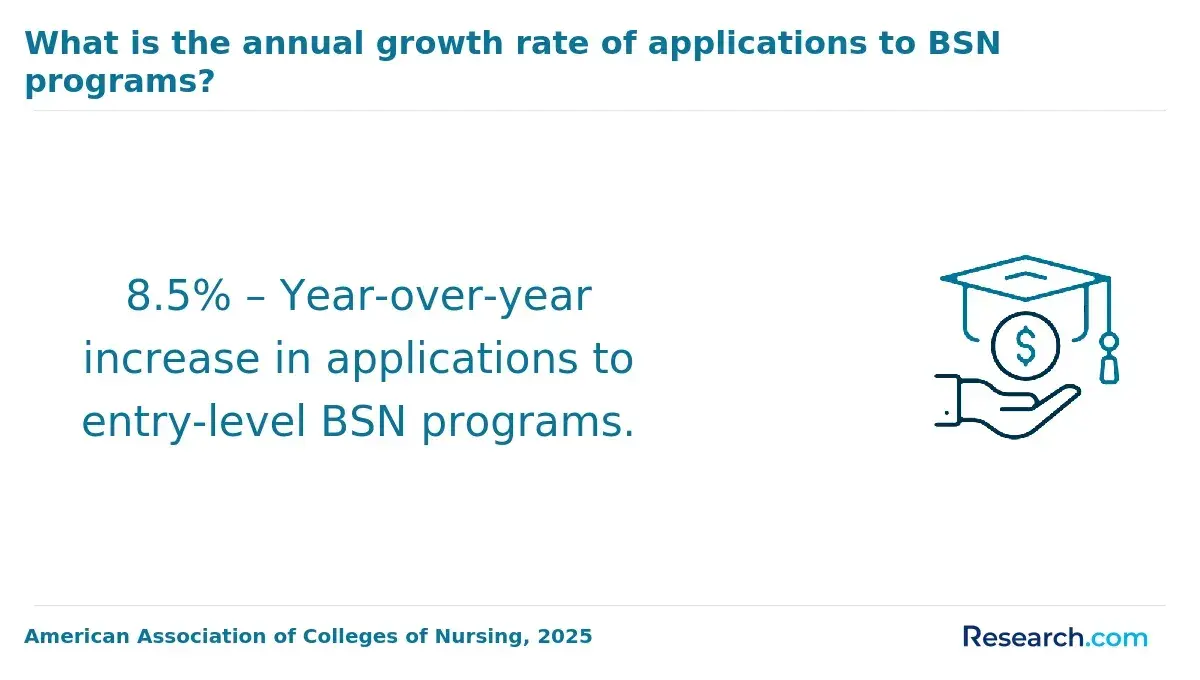
From 2024 to 2025, enrollment in RN to BSN programs declined by 12.5%, according to the American Association of Colleges of Nursing. This was the fourth consecutive year of decline. Even with that trend, online BSN programs remain an option for RNs who want to complete a bachelor’s degree and meet employer preferences.
How should students check accreditation and program quality?
Accreditation is a critical safeguard when evaluating nursing schools. It indicates that a program has been reviewed against recognized standards for curriculum, faculty, clinical education, and student outcomes. Prospective students should confirm whether the program is accredited by a recognized nursing accreditor, such as the Commission on Collegiate Nursing Education or the Accreditation Commission for Education in Nursing.
State approval for licensure is just as important. A program can be affordable and convenient but still create major problems if it does not satisfy the licensing rules in the state where the student plans to practice. Students should also review faculty qualifications, clinical partnerships, graduate outcomes, and licensure pass rates when available. Applicants comparing women’s health nurse practitioner pathways may use resources such as the easiest WHNP online programs to consider admissions flexibility, cost, and quality together.
Accreditation and quality checklist
- Is the nursing program accredited by a recognized nursing accreditor?
- Is the program approved for licensure in the state where you want to work?
- Does the school clearly explain who secures clinical placements?
- Are faculty members appropriately credentialed and clinically experienced?
- Does the school publish licensure pass rates or graduate outcomes?
- Are simulation labs, advising, tutoring, and exam preparation available?
When do nursing bridge programs make sense?
Bridge programs can be a smart option for students who already hold a nursing or healthcare credential and want to move forward without repeating unnecessary coursework. Common examples include LPN to RN, RN to BSN, ADN to MSN, and RN to MSN pathways.
These programs may reduce cost by recognizing prior education and clinical experience, but students should still compare prerequisites, required credits, clinical hours, accreditation, pass rates, and graduate outcomes. Pathways such as ADN to FNP bridge programs may help experienced nurses move toward nurse practitioner preparation while managing time and tuition.
How can functional medicine connect to nursing?
Functional medicine may interest nurses who want to focus on root-cause assessment, individualized care planning, prevention, and integrative approaches. Nurses who pursue this area should still ground their work in evidence-based practice, scope-of-practice rules, and patient-centered communication.
This specialty may require additional training and, in some cases, advanced practice credentials. Nurses exploring the pathway can review how to become a functional medicine nurse practitioner. Before paying for extra education, confirm whether employers in your region recognize the role and whether the credential supports your long-term practice plans.
Can online FNP programs be affordable and clinically strong?
An online family nurse practitioner program can be a sound choice when it is accredited, aligned with certification and licensure requirements, and supported by organized clinical preparation. Low tuition should not be the only deciding factor. A cheap program can become costly if students struggle to find clinical placements or complete required hours.
Prospective FNP students should compare curriculum depth, faculty access, clinical placement expectations, preceptor support, board preparation, and student outcomes. Guides to the cheapest online FNP programs can help students identify lower-cost options while still checking clinical quality.
How should students choose an affordable nursing program?
The most affordable nursing school is not always the one with the lowest tuition. A better choice is a program that meets licensure requirements, provides reliable clinical training, supports students through graduation and exam preparation, and fits the student’s budget without excessive debt.
- Verify accreditation and state approval: Look for programs accredited by the Commission on Collegiate Nursing Education, Accreditation Commission for Education in Nursing, or NLN Commission for Nursing Education Accreditation, and confirm licensure compatibility in your state.
- Ask about clinical placements: Determine whether the school assigns placements, helps students find sites, or leaves the responsibility mostly to the learner.
- Review licensure pass rates: Strong pass rates may suggest that the curriculum and exam preparation align with licensing expectations.
- Look at employer relationships: Hospital partnerships, clinic connections, alumni networks, professional organizations, and healthcare partnerships can support career entry.
- Evaluate student support: Quality programs should provide advising, faculty access, academic help, clear communication, and exam preparation resources.
- Calculate the full cost: Include tuition, fees, textbooks, uniforms, supplies, clinical travel, exam fees, health requirements, and lost income if you reduce work hours.
Questions to ask before enrolling
| Question | Why the answer matters |
| Is the program accredited and approved for my state? | Licensure eligibility depends on meeting program quality and state requirements. |
| Who finds and approves clinical placements? | Clinical placement delays can postpone graduation and increase costs. |
| What is the total estimated cost, including fees and supplies? | Tuition alone can make a program seem cheaper than it really is. |
| Can I transfer credits or receive credit for prior learning? | Transfer-friendly policies can shorten the timeline and reduce tuition. |
| What NCLEX preparation support is included? | Licensure exam readiness is essential for entering practice. |
| What share of students graduate on time? | Extra semesters can increase tuition, fees, and living expenses. |
What trends are changing nursing careers?
Nursing work is changing as healthcare systems use more technology, telehealth, remote monitoring, electronic health records, and data-informed workflows. These tools do not replace clinical judgment, but they do add technical expectations to traditional bedside and patient communication skills.
Population aging is also increasing the need for chronic disease management, home-based care, long-term care, and specialty services. Students who want a lower-cost entry point while exploring the field may compare options such as the cheapest licensed practical nurse degree online before committing to a longer RN or BSN pathway.
Which NP programs may be more accessible?
Some nurse practitioner programs are designed to reduce barriers through flexible admissions policies, online coursework, transfer-friendly structures, or efficient degree plans. Easier admission does not mean lower clinical expectations. Students still need to verify accreditation, certification alignment, clinical hour requirements, and state licensure rules.
Applicants should compare GPA expectations, prerequisites, transfer policies, clinical placement support, and program length. A guide to the easiest nurse practitioner programs can help students find options that better match their academic record, experience, and goals.
What are the long-term benefits of a nursing degree?
A nursing degree can offer long-term value because it provides practical clinical skills and multiple career directions. Entry-level roles can lead to specialty nursing, leadership, education, informatics, public health, research, quality improvement, or advanced practice with the right experience and credentials.
Advanced nursing roles can also improve earning potential. Nurse anesthetists, nurse practitioners, and nurse midwives are among the highest paid nursing careers, and their salaries often exceed entry-level nursing pay.
The flexibility of the profession can make the initial investment more valuable over time. A nurse may begin in hospital care, move into outpatient practice, transition to case management, specialize in pediatrics or critical care, or pursue graduate education for advanced clinical or leadership roles.
How can nursing students reduce costs?
Students can lower the cost of nursing school by combining smart program selection, transfer planning, financial aid, employer support, and careful budgeting.
- Begin at a community college: Completing prerequisites or an ADN at a community college may reduce costs before transferring or entering a bridge program.
- Choose an in-state public option: Resident tuition at public institutions is often lower than out-of-state or private tuition.
- Apply for many scholarships and grants: Nursing schools, hospitals, professional associations, and local organizations may offer awards that reduce borrowing.
- Use employer education benefits: Healthcare employers may provide tuition assistance or reimbursement for employees pursuing nursing credentials.
- Compare accredited online programs carefully: Online study may reduce commuting and housing costs, but students must still account for fees and clinical travel.
- Work in healthcare while studying if realistic: Relevant employment can provide income, experience, and possible access to employer-funded education benefits.
- Protect transfer credits: Confirm in writing which prior courses will count before enrolling, especially when changing schools.
- Control textbook and supply expenses: Rent, buy used, or use approved digital materials when allowed by the program.
Accelerated pathways to nursing degrees
Accelerated nursing programs may help eligible students finish faster by compressing coursework into a shorter schedule. These options can exist at different levels, including BSN and MSN pathways, and are often designed for students with previous college credit, a bachelor’s degree in another field, or prior healthcare experience.
Some students compare 1 year nurse practitioner programs online when they want a faster advanced practice route. A shorter timeline can reduce time away from higher-level earnings, but the pace may be demanding. Students should evaluate workload, clinical requirements, accreditation, certification alignment, and whether the schedule is realistic.
Accelerated programs can improve return on investment only if the student can complete the curriculum successfully while maintaining clinical readiness and licensure preparation.
What healthcare careers can be alternatives to nursing?
Healthcare offers many career options beyond nursing. Students who are unsure about bedside care, shift work, or nursing school intensity may consider diagnostic medical sonography, medical assisting, healthcare administration, public health, health education, medical office administration, and allied health roles.
For example, students comparing allied health options may ask, “How much does a sonogram tech make?” Diagnostic medical sonography may appeal to students who want patient interaction and technical healthcare work without completing a nursing degree. The best alternative depends on preferred duties, education length, salary goals, certification or licensure rules, and local job availability.
Can an online DNP be a cost-effective next step?
An online Doctor of Nursing Practice may be cost-effective for nurses who need doctoral preparation while remaining employed. Online delivery can reduce relocation and commuting expenses, but students should still compare tuition, fees, clinical requirements, faculty access, program reputation, and accreditation.
The decision should be tied to career goals. A DNP may be valuable for nurses pursuing advanced practice preparation, high-level clinical expertise, leadership, or systems improvement roles. It may not be necessary for every nursing career. Cost comparisons for the most affordable DNP program can help students identify lower-cost options while still checking quality and clinical expectations.
What financial aid options help pay for nursing school?
Financial aid can reduce the burden of nursing school, but students should understand how each funding source works. Gift aid does not require repayment, earned aid may require work, employer assistance may include service commitments, and loans must be repaid. The strongest strategy is usually to combine several sources while limiting debt.
- Scholarships and grants: Nursing schools, professional organizations, and local governments may provide awards that do not require repayment. Examples include the American Association of Colleges in Nursing scholarship and the Leonard A. Lauder Community Care Nurse Practitioner Program at the University of Pennsylvania, which covers full tuition for accepted fellows.
- Tuition reimbursement: Hospitals and healthcare facilities may reimburse nursing education costs for employees. These programs often require continued employment after graduation.
- Government financial aid: Federal and state aid may include Pell Grants, federal student loans, and work-study programs. Students typically begin by completing the Free Application for Federal Student Aid.
- Employer assistance: Some employers provide direct education support in exchange for a work commitment, which can reduce out-of-pocket costs and create a clearer employment pathway.
- Affordable online nursing programs: Some online options may reduce commuting, housing, and campus-related costs. Graduate students can compare choices such as the cheapest online nurse practitioner programs while verifying accreditation, clinical support, and state licensure alignment.
Common mistakes to avoid when comparing nursing school costs
- Looking only at tuition: Fees, supplies, clinical travel, and delayed graduation can make a low-tuition program more expensive than expected.
- Skipping accreditation and state approval checks: A program that is not approved for your licensure goal can create serious career barriers.
- Assuming online study is always cheaper: Online students may still pay technology fees, lab costs, travel expenses, and in-person intensive costs.
- Not understanding clinical placement responsibilities: Students who must find their own sites may face delays, extra travel, or limited local options.
- Borrowing without a repayment estimate: Compare expected debt with realistic entry-level wages where you plan to work.
- Relying only on rankings: Rankings can be useful, but accreditation, licensure outcomes, cost, and clinical fit matter more.
- Ignoring transfer credit policies: Lost credits can add semesters, tuition, fees, and living expenses.
- Assuming salary data guarantees your income: Pay varies by role, location, employer, shift, specialty, experience, and local demand.
Key Insights
- Nursing school costs vary widely: shorter pathways may cost a few thousand dollars, while some graduate or private university options can reach six figures.
- The best-value program is not always the cheapest. Accreditation, state licensure approval, clinical placement support, and student outcomes are essential.
- An ADN can be a lower-cost route to RN eligibility, while a BSN may offer broader mobility and stronger access to BSN-preferred roles.
- MSN, DNP, and PhD programs should be chosen only when they clearly support a career goal because they differ in cost, length, and purpose.
- Online nursing programs may reduce commuting or housing expenses, but students must still budget for technology, clinical travel, supplies, and possible campus visits.
- Scholarships, grants, employer reimbursement, community college courses, bridge pathways, and transfer credits can reduce total costs.
- Before enrolling, calculate total cost of attendance, verify accreditation and state approval, ask who arranges clinical placements, and compare expected debt with realistic wages in your area.
References:
- AACN. (2025). 2024-2025 Enrollment and Graduations in Baccalaureate and Graduate Programs in Nursing. https://www.aacnnursing.org/news-data/all-news/schools-of-nursing-enrollment-increases
- AACN. (2025). 2024-2025 Enrollment and Graduations in Baccalaureate and Graduate Programs. https://www.aacnnursing.orgAACN enrollment update
- NurseJournal. (2025). The Top 20 Highest-Paying Nursing Specialties. https://nursejournal.org/articles/best-nursing-specialities-for-the-future/
- Precedence Research. (2025). Healthcare Staffing Market Size to Hit USD 82.47 Bn. https://www.precedenceresearch.com/healthcare-staffing-market
- Education Data Initiative. (2024). Cost of doctoral education. https://educationdata.org/costs-of-doctoral-education
- Gallup. (2024). Honesty and ethics in professions. https://news.gallup.com/poll/XYZismore2043/honesty-ethics-professions.aspx Education Data Initiative doctoral education cost sourceHealthcare staffing market sourceNursing specialty salary contextAACN enrollment source
Other Things You Should Know About Nursing School Cost
In 2027, the average starting salary for nursing graduates varies by location and specialization. However, according to recent estimates, it typically ranges from $60,000 to $85,000 annually. Factors such as regional demand, hospital type, and additional certifications influence these figures.
In 2027, nursing students have access to various financial aid options like federal and state grants, scholarships, and student loans. Many schools offer work-study programs and specific nursing scholarships to help offset costs. Additionally, some hospitals offer tuition reimbursement for nurses who commit to working with them after graduation.
In 2027, the main factors affecting nursing school costs include the type of program (e.g., ADN, BSN), the institution (public vs. private), location, and whether the program is online or in-person. Additional costs may consist of books, uniforms, and clinical fees.
To enroll in a nursing school program in 2027, students typically need a high school diploma or GED, completion of specific courses like biology and chemistry, and sometimes passing an entrance exam. Variations exist between schools, so checking specific program requirements is essential.





