2027 How Much Do Ultrasound Technicians Make?

Co-Founder and Chief Data Scientist
Choosing an ultrasound technician career usually comes down to three practical questions: how much you can earn, how long training takes, and whether the job is stable enough to justify the cost of school. Diagnostic medical sonography can be an attractive healthcare path because many roles require an associate degree, the work is highly technical, and salary potential is strong compared with many other associate-level healthcare careers. This guide explains ultrasound technician salary data, education routes, specializations, work settings, demand, certifications, career-growth strategies, and common mistakes to avoid before enrolling in a sonography program.
Quick Answer: Ultrasound Technician Salary and Career Outlook
- The average ultrasound technician salary is $89,020 per year.
- California reports the highest average pay for ultrasound technicians, at $122,670 per year.
- Among common specializations, cardiac sonographers report one of the strongest average base salaries at $87,803.
- Outpatient care centers are the highest-paying industry setting listed here, with an average salary of $123,020 per year.
- Higher pay is usually tied to experience, location, specialization, employer type, additional certifications, and sometimes earning a bachelor’s degree after an associate degree.
- How much do ultrasound technicians make?
- How do you become an ultrasound technician?
- What ultrasound technician specializations can you choose?
- How should you compare online ultrasound technician programs?
- What jobs can you get with a medical sonography degree?
- Which ultrasound technician specialty pays the most?
- Are ultrasound technicians in demand?
- Is an ultrasound technician degree worth it?
- What are the advantages of becoming an ultrasound technician?
- What are good alternatives to medical sonography?
- What certifications and licenses matter for ultrasound technicians?
- What technology trends are changing ultrasound work?
- Which professional organizations can support your ultrasound career?
- How can public health education help an ultrasound technician?
- What soft skills do ultrasound technicians need?
- How can ultrasound technicians increase their pay?
- Why does continuing education matter in sonography?
- How can you transition into ultrasound technology from another career?
- What other affordable healthcare education options are available?
- What challenges should ultrasound technicians expect?
- Can advanced degrees improve long-term healthcare career options?
What Ultrasound Technicians Say About Their Training
- I was drawn to diagnostic medical sonography because it let me combine science with patient care. The anatomy, imaging, and ultrasound physics courses were demanding, but they helped me understand what I was seeing on the screen. One of the most meaningful parts of the work is being present for important patient moments, including pregnancy scans. -Clara
- The clinical training made the biggest difference for me. Practicing first in labs and then scanning patients under supervision helped me build confidence. I now work in cardiology, where I use ultrasound every day to help physicians evaluate heart conditions. -David
- My sonography program required serious focus, but it prepared me well for the job market. I was hired in a radiology department after graduation, and I like the variety. Some days involve obstetric exams, while others focus on abdominal or vascular imaging. -Dianne
How much do ultrasound technicians make?
According to the United States Bureau of Labor Statistics, the average ultrasound technician salary is $89,020 per year, or $42.80 per hour.
The BLS also reports that the median annual wage for diagnostic medical sonographers was $84,470 as of May 2023. At the lower end, the bottom 10% earned $63,680, while the top 10% earned $116,300.
Your actual pay can be higher or lower than those figures. The biggest salary drivers are usually geographic location, years of experience, specialty area, employer setting, work schedule, and the credentials you hold.
Compared with several other healthcare careers that may be entered with associate-level education or shorter training, sonography often pays well. For example, an EKG technician salary averages $70,270 per year, which is below the ultrasound technician salary of $89,000 cited here. Some people also compare sonography with technology training options such as coding bootcamps online, although outcomes in that field can vary widely by technical skill, employer, and market conditions.
Ultrasound technicians also compare favorably with respiratory therapists on hourly pay in this article’s cited figures. A respiratory therapist salary per hour is about $37.48.
The chart below shows the top-paying states for ultrasound technicians. California leads the list, with an average ultrasound technician salary of $122,670 per year.
What affects an ultrasound technician’s salary?
| Salary factor | Why it matters | What to ask before choosing a path |
| State and local market | Pay often reflects cost of living, employer competition, and regional demand. | What do hospitals, imaging centers, and outpatient clinics pay in the area where I plan to work? |
| Specialization | Cardiac, vascular, OB/GYN, and other specialty areas may have different salary ranges and credential expectations. | Which specialties are hiring locally, and which credentials do employers prefer? |
| Work setting | Outpatient care centers, hospitals, specialty hospitals, and physician practices may offer different compensation and schedules. | Do I value higher pay, predictable hours, emergency coverage, or broad clinical exposure? |
| Experience level | New graduates usually start below experienced sonographers who can scan independently and handle complex cases. | Does the employer provide mentorship for new sonographers? |
| Credentials and education | Additional certifications and higher education can support advancement into lead, teaching, or management roles. | Will this program prepare me for the certifications employers actually request? |
How do you become an ultrasound technician?
The most common route is to complete a diagnostic medical sonography program that includes classroom instruction, scanning labs, and supervised clinical practice. Many entry-level sonography jobs are built around associate degree preparation, although certificates and bachelor’s degrees can also make sense depending on your background and goals.
Ultrasound technician education options compared
| Credential | Average time to complete | Best for | Possible roles |
| Associate Degree in Medical Sonography | 2 years; 6-8 months for some accelerated sonography programs online | Students seeking a direct entry-level route into sonography. | Diagnostic medical sonographer, obstetric and gynecologic sonographer, abdominal sonographer, vascular sonographer. |
| Bachelor’s Degree in Medical Sonography | 4 years | Students who want broader preparation, leadership potential, or a stronger academic foundation. | Lead sonographer, clinical instructor, research sonographer, sonography department manager. |
| Master’s Degree in Medical Sonography | 1-2 years beyond the bachelor’s degree | Experienced professionals interested in advanced practice, research, education, or leadership. | Sonography program director, sonographic researcher, advanced practice sonographer, sonography consultant. |
| Doctoral Degree in Medical Sonography | 3-5 years beyond the master’s degree | Professionals focused on academia, research leadership, policy, or high-level clinical leadership. | Clinical director, research director, educator, consultant. |
| Certificate in Medical Sonography | Varies, typically 12-24 months | Healthcare professionals or imaging workers adding sonography skills or a specialty credential. | Diagnostic medical sonographer, cardiovascular sonographer, obstetric and gynecologic sonographer, musculoskeletal sonographer. |
1. Associate Degree in Medical Sonography
Average time to complete: 2 years; 6-8 months for some accelerated sonography programs online
Program focus: Associate programs typically cover the core knowledge new sonographers need, including ultrasound principles, image interpretation, anatomy and physiology, patient care, and scanning procedures.
Common courses: anatomy and physiology, medical terminology, sonographic physics, obstetric and gynecologic sonography, abdominal sonography, and vascular sonography.
Learning format: Community colleges and vocational schools commonly combine lectures, hands-on labs, and clinical rotations in healthcare settings.
Entry-level jobs: diagnostic medical sonographer, obstetric and gynecologic sonographer, abdominal sonographer, or vascular sonographer.
2. Bachelor’s Degree in Medical Sonography
Average time to complete: 4 years
Program focus: Bachelor’s programs usually go beyond entry-level scanning and may include advanced imaging techniques, research methods, healthcare operations, and leadership preparation.
Common courses: advanced sonographic techniques, sonographic instrumentation, research methods in medical sonography, cross-sectional anatomy, pathophysiology, and healthcare management.
Learning format: Universities may use a mix of didactic coursework, laboratory sessions, clinical internships, and research projects.
Entry-level or advancement roles: lead sonographer, clinical instructor, research sonographer, or sonography department manager.
3. Master’s Degree in Medical Sonography
Average time to complete: 1-2 years beyond the bachelor’s degree
Program focus: Master’s-level study is generally aimed at sonographers who want deeper specialization, leadership responsibilities, research skills, or advanced clinical practice.
Common courses: advanced imaging techniques, clinical decision-making in sonography, evidence-based practice, sonographic education and mentoring, and healthcare policy.
Learning format: Programs may include advanced coursework, research, and clinical practicums. Some options are designed for working professionals through online or part-time formats.
Career paths: sonography program director, sonographic researcher, advanced practice sonographer, or sonography consultant.
4. Doctoral Degree in Medical Sonography
Average time to complete: 3-5 years beyond the master’s degree
Program focus: Doctoral study is typically designed for professionals pursuing advanced research, academic leadership, policy work, or high-level clinical leadership.
Common courses: advanced sonographic research methods, healthcare leadership, advanced clinical practice, health policy analysis, and teaching and curriculum development.
Learning format: Select universities may require advanced research, graduate coursework, clinical experiences, and a dissertation under faculty supervision.
Career paths: clinical or research director, educator, or consultant.
5. Certificate in Medical Sonography
Average time to complete: Varies, typically 12-24 months
Program focus: Certificate programs are usually narrower than degree programs and may be designed for people who already have healthcare education or diagnostic imaging experience.
Common specialty areas: Diagnostic, cardiovascular, obstetrics and gynecology, and musculoskeletal sonography are among the certificate focus areas students may encounter.
Learning format: Most certificate programs include clinical training so students can practice specialty-specific scanning procedures under supervision.
Career paths: diagnostic medical sonographer, cardiovascular sonographer, obstetric and gynecologic sonographer, or musculoskeletal sonographer.
What ultrasound technician specializations can you choose?
Sonography is not one single job. Many technicians develop a specialty based on the body systems they scan, the patients they serve, and the clinical questions physicians need answered.
- Obstetrics and Gynecology (OB/GYN): Focuses on imaging the female reproductive system, monitoring pregnancies, identifying gynecologic concerns, and supporting image-guided procedures.
- Abdomen (AB): Uses ultrasound to evaluate abdominal organs such as the liver, kidneys, spleen, pancreas, and intestines. This work can support diagnosis of conditions such as gallstones, appendicitis, and tumors.
- Echocardiography: Images the heart to assess structure and function and to help identify conditions such as valve abnormalities, heart failure, and coronary artery disease.
- Vascular Technology: Examines arteries and veins throughout the body to help detect blockages, aneurysms, blood clots, and other vascular conditions.
- Pediatrics: Applies ultrasound to infants and children and requires knowledge of pediatric anatomy, physiology, and patient communication.
- Neurosonology: Uses ultrasound to evaluate the brain and nervous system in selected cases, particularly in infants, although X-rays and MRIs are often preferred for many neurological evaluations.
- Musculoskeletal: Images muscles, tendons, ligaments, and joints to support evaluation of sports injuries, arthritis, pain syndromes, and related conditions.
- Small Parts: Focuses on smaller structures such as the breasts, thyroid gland, testicles, and lymph nodes and may support screening, diagnosis, or image-guided biopsies.
Not every school offers every concentration. Before applying, compare the curriculum, clinical rotation sites, specialty tracks, and certification preparation offered by each program.
How should you compare online ultrasound technician programs?
Online ultrasound programs can be useful for students who need flexibility, but sonography cannot be learned entirely through online lectures. Scanning is a hands-on clinical skill, so any serious program should include in-person labs, supervised clinical rotations, or arranged clinical placements. If you are considering an online ultrasound tech school, focus less on convenience alone and more on whether the program can actually prepare you for employment and credentialing.
Online sonography programs commonly allow students to complete some didactic coursework remotely while finishing clinical requirements at approved healthcare sites. This format may work well for students balancing employment, caregiving, or distance from campus.
- Flexible coursework, sometimes including self-paced or asynchronous lessons.
- Digital learning resources such as recorded lectures, interactive modules, and virtual lab tools.
- Clinical placement support that helps students complete supervised scanning experience near where they live.
Questions to ask before enrolling in an online sonography program
| Question | Why it matters |
| Where will I complete clinical rotations? | You need supervised patient-scanning experience, and clinical sites may be limited in some regions. |
| Does the program prepare students for relevant certification exams? | Many employers prefer or expect recognized sonography credentials. |
| What are the total costs beyond tuition? | Fees, books, uniforms, background checks, travel, and clinical requirements can change the real cost. |
| What specialties are covered? | A program focused on one area may not prepare you for every sonography role. |
| What is the schedule for labs and clinical hours? | Even online students may need daytime availability for clinical placements. |
What jobs can you get with a medical sonography degree?
A medical sonography degree, whether completed through a campus program or a sonography degree online with in-person clinical training, most commonly prepares students for ultrasound technician and diagnostic imaging roles. Sonographers work in hospitals, clinics, diagnostic imaging centers, physician offices, and other healthcare environments. According to the linked demographic source, many sonographers work in private healthcare.
If you are exploring how to become a diagnostic medical sonographer, these are common directions to consider:
- Diagnostic Medical Sonographer: Performs ultrasound exams and produces images that physicians use to diagnose, monitor, and treat medical conditions.
- Specialized Sonographer: Builds expertise in an area such as obstetrics and gynecology, abdominal sonography, vascular sonography, cardiac sonography, or musculoskeletal sonography.
- Clinical Instructor: Trains students or newly hired sonographers in scanning technique, patient care, safety, and professional standards.
- Research and Development: Works with clinicians, researchers, or medical technology companies to improve imaging methods and diagnostic tools.
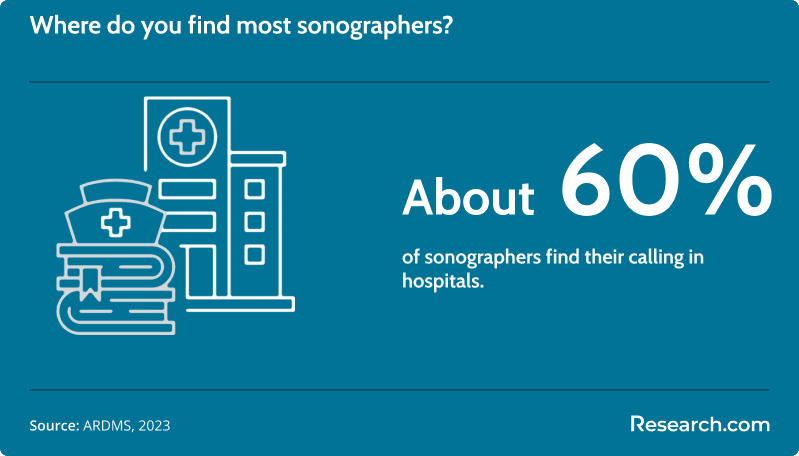
The image below shows that many ultrasound technicians work in hospital settings.
Which ultrasound technician specialty pays the most?
Specialization can influence earning potential. According to Salary.com, OBGYN, cardiac, and vascular ultrasound technicians are among the higher-paid specialization categories cited here. OBGYN sonographers earn an average base salary of $76,197 per year, cardiac sonographers earn $87,803 per year, and vascular sonographers earn $84,015 per year.
These specialized sonography roles can pay more than several other technical healthcare jobs. For comparison, a dialysis technician salary is $44,800 per year, while a medical coder salary is between $32,218 and $42,553.
Employer setting also matters. The highest-paying sonography settings listed here include outpatient care centers, management of companies and enterprises, and specialty hospitals.
The chart below shows the top-paying industries for diagnostic medical sonographers. Outpatient care centers lead this group, with an average salary of $123,020 per year, or $59.15 per hour.
Here is a look at median salary information for sonographers:
Are ultrasound technicians in demand?
Yes. The overall employment of diagnostic medical sonographers is projected to grow 10% from 2022 to 2032, which is much faster than the average for all occupations.
There are expected to be about 9,600 openings for diagnostic medical sonographers, cardiovascular technologists, and technicians each year during that 10-year period. Many openings are expected because workers leave the occupation, move into other roles, or exit the labor force, including through retirement.
The chart below compares projected employment growth for ultrasound technicians with other health-related occupations.
Is an ultrasound technician degree worth it?
An ultrasound technician degree can be worth it for students who want a technical healthcare career, are comfortable with patient interaction, and can complete the required clinical training. The value depends on your total education cost, local job market, ability to meet certification expectations, and whether the work environment fits your strengths.
Program costs vary widely. A five-semester diagnostic medical sonography program at Tarrant County College, a public community college, is $7,319. At Northwestern Medicine, a private, non-profit institution, a diagnostic medical sonography program costs $11,500.
Financial aid, scholarships, employer tuition support, and lower-cost public programs can improve the return on investment. Still, tuition is only one part of the decision. You should also consider transportation to clinical sites, lost work hours, exam fees, equipment requirements, and how quickly graduates in your area get hired.
Who is sonography a good fit for?
- Students who want a patient-facing healthcare role without spending many years in school.
- People who enjoy anatomy, medical technology, problem-solving, and hands-on work.
- Applicants who can handle physically active shifts and careful attention to image quality.
- Workers in adjacent healthcare roles who want to move into diagnostic imaging.
Who should consider a different path?
- Students who want fully remote work, since sonography requires direct patient care and in-person scanning.
- People who are uncomfortable with close patient contact, bodily symptoms, or stressful clinical situations.
- Applicants who cannot commit to clinical schedules, which may be less flexible than online coursework.
- Students who want a broader clinical scope may prefer nursing or another healthcare degree.
What are the advantages of becoming an ultrasound technician?
Diagnostic medical sonography offers several practical benefits for the right student, especially compared with some healthcare paths that require longer education.
- Strong labor-market outlook: The projected job growth cited above suggests steady need for qualified sonographers.
- Competitive pay: Salary data in this guide shows that ultrasound technician earnings compare well with many associate-level healthcare careers.
- Relatively short training: An associate degree can often be completed in about two years, helping students enter the workforce sooner than many longer clinical pathways.
- Meaningful patient-care role: Sonographers help produce images that physicians use in diagnosis and treatment decisions.
- Specialization options: Professionals can focus on areas such as obstetrics, cardiology, vascular technology, pediatrics, or musculoskeletal imaging.
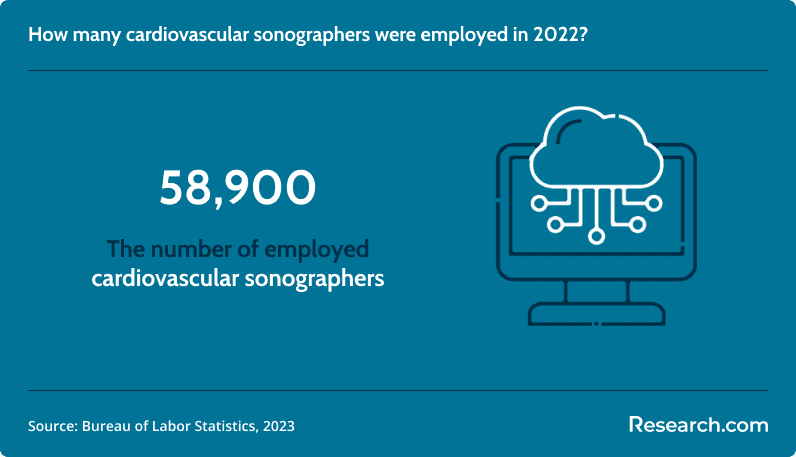
The image below shows that nearly 59,000 ultrasound technicians specialize in cardiovascular sonography and are employed as such, which also illustrates how specialization can shape career direction in this field.
What are good alternatives to medical sonography?
If you like healthcare but are not sure sonography is the right fit, compare it with other programs that have different patient-care responsibilities, schedules, and advancement routes.
- Nursing: An associate’s degree in nursing can lead to registered nurse roles. Nursing may offer broader patient-care responsibilities and academic advancement through bachelor’s, master’s, and doctoral study.
- Radiologic Technologist: Radiologic technologists work with imaging tools such as X-ray and CT equipment. The education route is similar in length, but the equipment and procedures differ. The average rad tech salary is slightly lower than that of medical sonographers in this article’s comparison.
- Medical Assistant: Medical assisting involves a wider mix of administrative and basic clinical tasks, but it is less specialized in imaging technology.
- Respiratory Therapist: Respiratory therapists help patients with breathing problems through oxygen therapy, airway clearance procedures, ventilator support, and related treatments.
- Dialysis Technician: Dialysis technicians operate equipment that filters a patient’s blood when the kidneys cannot do so effectively, while monitoring patient safety and comfort during treatment.
If you are drawn to technical systems and want a career beyond clinical healthcare, engineering may eventually be worth exploring. Some students compare healthcare technology work with options such as the easiest engineering degrees when thinking about long-term mobility and earning potential.
What certifications and licenses matter for ultrasound technicians?
Certification is one of the most important career planning issues in sonography. Even when a state license is not required, employers may prefer or require credentials that show you can perform exams safely and competently. Requirements can vary by state, employer, specialty, and clinical setting, so students should verify expectations before choosing a program.
Licensing rules are not identical across the country. In some locations, sonographers may need to meet state-specific requirements, while in others employer credential preferences drive hiring. If you are looking for a lower-cost way to build healthcare credentials before or alongside sonography, compare relevant medical certificate programs, but make sure they support your actual sonography goals rather than replacing required clinical training.
Certification and licensing checklist
- Ask each program which credentialing exams its graduates are prepared to take.
- Confirm whether the program includes enough clinical hours for your target specialty.
- Check state rules before assuming an online or out-of-state program meets local requirements.
- Review job postings in your area to see which credentials employers repeatedly request.
- Budget for exam fees, continuing education, and credential renewal when calculating program cost.
What technology trends are changing ultrasound work?
Ultrasound technology continues to evolve, and sonographers need to keep pace with new tools while maintaining strong scanning fundamentals. Artificial intelligence is increasingly being used to support image analysis, workflow efficiency, and measurement assistance, but it does not remove the need for skilled professionals who can position patients, capture diagnostic-quality images, recognize artifacts, and communicate findings appropriately to physicians.
Telemedicine and remote consultation models can also affect imaging workflows, especially when specialists review images from different locations. In some settings, sonographers may work more closely with administrative and revenue-cycle teams, making basic familiarity with documentation, coding, and billing processes useful. Professionals who want broader operational knowledge may compare options such as billing and coding classes online, although these courses serve a different purpose than sonography training.
Which professional organizations can support your ultrasound career?
Professional associations can help sonographers stay connected to clinical standards, continuing education, specialty updates, and career opportunities. Groups such as the Society of Diagnostic Medical Sonography and local healthcare associations may offer conferences, practice resources, job boards, mentorship, and networking.
These organizations can also help professionals understand realistic career progression. Comparing healthcare compensation data, including broader benchmarks such as biology major salary, can give students context, but sonography pay should always be evaluated by specialty, region, credential, and employer type.
How can public health education help an ultrasound technician?
Public health education can be useful for sonographers who want to move beyond day-to-day scanning into population health, quality improvement, healthcare administration, or community health programs. It can help imaging professionals understand prevention, epidemiology, healthcare systems, and policy decisions that shape patient care.
This route is not necessary for every ultrasound technician. It makes the most sense for professionals who want leadership, program development, or interdisciplinary healthcare roles. If cost is a concern, you can compare cheap MPH online programs as one possible way to expand your healthcare qualifications.
What soft skills do ultrasound technicians need?
Technical scanning ability is essential, but soft skills strongly influence patient experience and workplace performance. Sonographers often work with patients who are anxious, uncomfortable, pregnant, injured, or waiting on important diagnostic answers.
- Communication: Explaining procedures clearly helps patients cooperate and feel less anxious.
- Empathy: Many exams happen during stressful medical moments, so calm and respectful interaction matters.
- Attention to detail: Small positioning or measurement errors can affect image quality.
- Adaptability: Sonographers must adjust to different patient needs, body types, clinical questions, and equipment.
- Teamwork: Imaging work requires coordination with physicians, nurses, schedulers, and other healthcare staff.
- Professional judgment: Sonographers must know what to communicate, when to escalate concerns, and how to stay within their role.
Professionals who want to move toward supervision or operations may also benefit from broader administrative training, such as a cheapest online healthcare administration degree, depending on their long-term goals.
How can ultrasound technicians increase their pay?
Higher pay in sonography is usually earned through a combination of specialization, credentials, experience, strategic job changes, and sometimes additional education. There is no guaranteed salary increase, but the following steps can improve your position in the job market.
Build the right education and specialty focus
- Consider a bachelor’s degree: An associate degree can be enough for entry-level work, but a bachelor’s degree may support advancement into supervisory, education, or management roles.
- Choose a marketable specialty: Areas such as echocardiography, vascular technology, and neurosonology may require additional training or exams, but specialization can make you more competitive.
Strengthen experience and credentials
- Gain broad clinical experience: Employers value sonographers who can scan independently, handle complex cases, and work efficiently while maintaining quality.
- Earn additional certifications: Specialty credentials can show employers that you have verified skills beyond a general entry-level foundation.
Use location and employer type strategically
- Negotiate based on local data: Before accepting an offer, research pay for your specialty, region, and experience level.
- Compare geographic markets: Salaries can vary substantially by state and city, often reflecting demand and cost of living.
- Evaluate different work settings: Outpatient clinics, private practices, hospitals, and specialty facilities may differ in pay, schedule, call requirements, and benefits.
Add complementary skills
- Learn adjacent clinical skills: Skills such as phlebotomy or broader patient care may make you more useful in certain settings.
- Seek leadership experience: Taking on training, scheduling, protocol improvement, or committee work can support promotion into lead roles.
- Stay current: Conferences, workshops, and continuing education can help you adapt to new equipment, protocols, and specialty expectations.
Why does continuing education matter in sonography?
Continuing education helps ultrasound technicians keep their skills aligned with changing technology, clinical standards, and employer expectations. It can also support certification maintenance and specialty growth.
- Technology updates: Ultrasound systems, software tools, and imaging techniques continue to change, and sonographers need to remain competent with current equipment.
- Expanded expertise: Training in vascular, pediatric, cardiac, or other specialty areas can open additional career options.
- Credential maintenance: Many certifications require ongoing education or renewal activities.
- Professional growth: Workshops, seminars, and conferences help sonographers learn from peers, instructors, and clinical experts.
- Competitiveness: Continuing education can help professionals stay employable as healthcare standards and technology expectations evolve.
How can you transition into ultrasound technology from another career?
Career changers can enter sonography, but the best route depends on whether they already have healthcare experience. People from nursing, radiologic technology, respiratory therapy, or other clinical roles may be able to use prior coursework or patient-care experience, while those from non-healthcare fields may need more foundational science and clinical preparation.
Professionals from adjacent healthcare roles should look for bridge, certificate, or accelerated options designed for applicants who already understand patient care and clinical environments. These programs may focus more directly on sonographic physics, scanning protocols, anatomy, instrumentation, and supervised clinical practice.
People coming from non-healthcare backgrounds should be cautious about choosing the shortest possible program. Short credentials can be useful, and some certificate programs that pay well may improve employability in healthcare, but diagnostic medical sonography requires substantial hands-on training. A certificate that does not include meaningful clinical scanning experience may not be enough for ultrasound technician employment.
To make the transition smoother, gain exposure to healthcare settings before applying. Shadowing, volunteering, entry-level patient-care work, or part-time clinical support roles can help you confirm that you are comfortable with patient interaction, bodily symptoms, and the pace of diagnostic care.
What other affordable healthcare education options are available?
If you want a healthcare career but are not committed to ultrasound technology, compare shorter and lower-cost training options before enrolling. Medical assisting, for example, may provide a quicker entry point into patient care and clinic operations. You can review Affordable online medical assistant programs to explore a different healthcare pathway with potentially lower upfront education costs.
What challenges should ultrasound technicians expect?
Sonography can be rewarding, but it is not an easy desk job. Students should understand the physical, emotional, and clinical demands before committing to a program.
- Physical strain and long shifts: Sonographers may stand for long periods, move equipment, assist patients, and repeat scanning motions throughout the day. Hospital roles may include evenings, weekends, holidays, or emergency coverage. Good ergonomics are important for reducing fatigue and injury risk.
- Emotional pressure: Ultrasound exams may involve serious diagnoses, pregnancy complications, patient pain, or urgent medical concerns. Sonographers must remain calm and professional while supporting patients through stressful moments.
- Need for fast, accurate imaging: Physicians depend on high-quality images. Sonographers must balance efficiency with careful technique, especially in busy departments or urgent situations.
- Difficult patient interactions: Some patients are anxious, uncomfortable, unable to stay still, or confused about the procedure. Patience and clear instructions are essential.
- Burnout risk: Repetitive physical demands, emotional stress, and busy schedules can contribute to burnout. Work-life balance, peer support, and professional development can help.
If the demands of the role still appeal to you, compare programs carefully. Researching the best ultrasound tech schools can help you identify programs with strong training quality and relevant clinical preparation.
Can advanced degrees improve long-term healthcare career options?
Advanced degrees can help some healthcare professionals move into management, research, education, policy, or interdisciplinary clinical roles. For ultrasound technicians, a higher degree may be most useful if the goal is leadership, teaching, program administration, or a broader healthcare career rather than only scanning.
Some professionals eventually diversify into other healthcare disciplines. For example, advanced programs such as a Pharm D degree online represent a very different clinical direction and should be evaluated based on licensing requirements, time commitment, cost, and career goals.
Common mistakes to avoid before becoming an ultrasound technician
| Mistake | Why it can hurt you | Better approach |
| Choosing a program based only on tuition | A cheap program may cost more long term if it lacks clinical placements or credential preparation. | Compare total cost, clinical access, graduate outcomes, and employer reputation. |
| Assuming online means fully remote | Sonography requires in-person scanning practice and supervised clinical experience. | Ask exactly where and when labs and clinical rotations happen. |
| Ignoring certification expectations | Employers may screen applicants based on specialty credentials. | Review job postings and ask programs which exams they prepare students for. |
| Overlooking physical demands | The work can involve standing, reaching, patient positioning, and repetitive movements. | Shadow a sonographer and learn proper ergonomics early. |
| Assuming salary is guaranteed | Pay depends on location, setting, specialty, experience, and credentials. | Research local wages and compare multiple employers before making an ROI decision. |
| Not checking clinical site availability | Limited placements can delay graduation or make a flexible program difficult to complete. | Get written details about clinical placement support before enrolling. |
Key Insights
- Ultrasound technology can offer strong pay for an associate-level healthcare path, with an average ultrasound technician salary of $89,020 per year according to the cited BLS data.
- Location and setting matter. California reports an average salary of $122,670 per year, and outpatient care centers are listed at $123,020 per year.
- Specialization can improve career options. Cardiac sonographers, vascular sonographers, and OBGYN sonographers are among the higher-paid specialty examples cited in this guide.
- The fastest route is often an associate degree, but certificates may work for people with prior healthcare experience, and bachelor’s or graduate degrees may support leadership, education, or research roles.
- Online ultrasound programs should still include in-person labs and clinical rotations. A program that cannot provide supervised scanning experience is unlikely to be enough.
- Before enrolling, verify certification preparation, clinical placement details, state requirements, total cost, and local employer expectations.
- Sonography is best for students who want technical, patient-facing healthcare work. It may not fit those seeking fully remote work, minimal patient contact, or a physically light job.
References:
- United States Bureau of Labor Statistics. (2024, April 3). Occupational Employment and Wages, May 2023: 29-2032 Diagnostic Medical Sonographers. BLS.
- Salary.com. (2024, May 28). Vascular Ultrasound Technician Salaries in the United States. Salary.com.
- Salary.com. (2024). Ob Gyn Ultrasound Technician Salary in the United States. Salary.com.
- Salary.com. (2024). Cardiac Ultrasound Technician Salary in the United States. Salary.com.
- Salary.com. (2024, May 28). Certified Dialysis Technician Salary in the United States. Salary.com.
- Salary.com. (2024, May 28). Medical Scribe Salary in the United States. Salary.com.
Other Things You Should Know About Ultrasound Technician Salary
In 2027, ultrasound technicians' salaries are significantly influenced by their location and level of experience. Technicians in urban areas or locations with a high demand for healthcare tend to earn more. Additionally, those with extensive experience or specialized skills can command higher salaries compared to entry-level technicians.
Entry-level ultrasound technicians in 2027 often start around $60,000 a year, with lower-paid markets closer to the mid-$50,000s. Pay rises with experience, specialty training, and hospital or outpatient setting, and many employers also add shift differentials for evenings, nights, or weekends.