2027 Online Ultrasound Tech Schools

Co-Founder and Chief Data Scientist
Ultrasounds are essential medical tools that allow doctors to examine organs and other structures within our bodies so they can make more accurate diagnoses and treatment plans.
Using ultrasound equipment, however, is more complicated than it seems, so doctors need ultrasound technicians or diagnostic medical sonographers to assist them in conducting and interpreting imaging tests using this tool.
So if you want to become an ultrasound technician, this guide has compiled a list of the top online ultrasound tech schools for you.
What are the benefits of getting an online degree in ultrasound technology?
- An online ultrasound tech degree opens your doors to a wide range of work environments, including hospitals, clinics, doctor’s offices, and imaging centers.
- You can earn an average of $81,350 a year as an ultrasound tech.
- An online program offers you a more flexible pathway but the same quality of education and training as a traditional program.
What can I expect from an online ultrasound tech school?
Being an ultrasound technician requires only an associate degree from in-campus or online ultrasound tech schools.
An online ultrasound tech program provides students who want to work in healthcare with a flexible education pathway. Like a traditional program, the online option also features a blend of didactic coursework and hands-on laboratory skills and is designed to help students become a sonographer or ultrasound technician in one to two years. The online curriculum includes courses that emphasize career-focused knowledge and skills, but you may be required to complete a certain number of clinical hours at a hospital laboratory or other healthcare facility nearby.
After completing the program, you will need to get certified by a board-approved agency. This certification ensures that you have met the minimum eligibility requirements for ultrasound tech jobs and demonstrates your competence in the field.
Where can I work with an online ultrasound tech degree?
With an online ultrasound tech degree, you get to have a diverse range of options when it comes to potential workplaces where you can utilize your skills.
You can work in traditional healthcare settings like hospitals and clinics, doctor’s offices, and imaging centers. These settings offer opportunities for you to perform general scans, cardiac ultrasounds, or specialize in specific areas like OB/GYN or vascular ultrasound.
You can also opt for settings with specialized or niche roles such as mobile ultrasound services, telemedicine and remote consultations, research and development, and education and training. There are also options beyond healthcare, including veterinary clinics, forensic investigations, and ergonomics and workplace safety.
How much can I make with an online ultrasound tech degree?
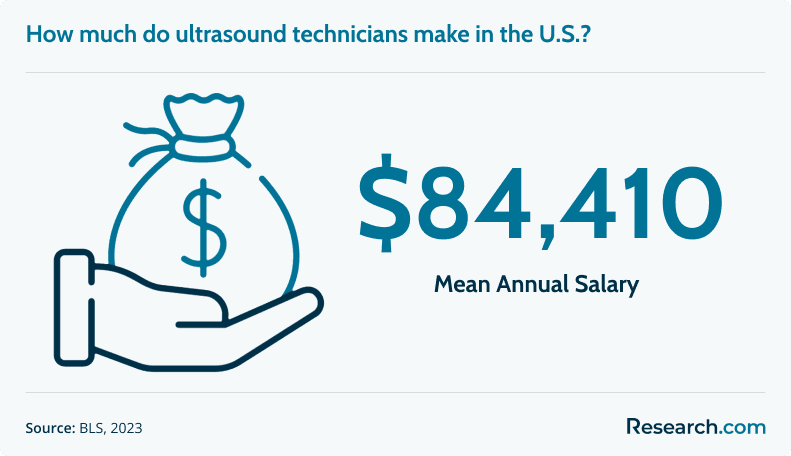
According to the United States Bureau of Labor Statistics, ultrasound technicians or diagnostic medical sonographers earn an average of $84,410 a year, or $40.58 an hour.
The median annual salary for ultrasound techs, on the other hand, was $81,350 in May 2022, which translates to $39.11 per hour.
There are, however, several factors that affect salary. These include location, work setting, and number of years of experience.
- 2027 Best Online Ultrasound Tech Schools List of Schools
- How long does it take to complete an online ultrasound tech school? Completion Time
- How does an online ultrasound tech school compare to an on-campus program? Online vs. On-Campus
- What is the average cost of an online ultrasound tech degree school? Average Cost
- What are the financial aid options for students enrolling in an ultrasound tech school? Financial Aid Options
- What are the prerequisites for enrolling in an online ultrasound tech school? Enrollment Prerequisites
- What courses are typically in an online ultrasound tech school? What courses are typically in an online ultrasound tech school?
- What types of specializations are available in ultrasound tech school? Specializations
- How to pick the right educational program for a fast healthcare career switch? Program Selection Criteria
- What factors determine how much do ultrasound techs make? What factors determine how much do ultrasound techs make?
- Are online ultrasound tech programs military-friendly? Are online ultrasound tech programs military-friendly?
- Can supplementary certifications enhance your ultrasound tech career? Can supplementary certifications enhance your ultrasound tech career?
- How can ultrasound techs advance their careers further? How can ultrasound techs advance their careers further?
- How do online ultrasound tech programs compare to other accelerated healthcare pathways? How do online ultrasound tech programs compare to other accelerated healthcare pathways?
- How to choose the best online ultrasound tech school? How to choose the best online ultrasound tech school?
- What is the job outlook for graduates of online ultrasound tech schools? What is the job outlook for graduates of online ultrasound tech schools?
- What are the benefits of enrolling in an ultrasound tech school? What are the benefits of enrolling in an ultrasound tech school?
- How do emerging technologies enhance online ultrasound tech education? How do emerging technologies enhance online ultrasound tech education?
- What skills are essential to succeed as an ultrasound technician? What skills are essential to succeed as an ultrasound technician?
- How does the ROI of an online ultrasound tech program compare with other healthcare degrees? How does the ROI of an online ultrasound tech program compare with other healthcare degrees?
- Does an online ultrasound tech program provide sufficient hands-on clinical training? Does an online ultrasound tech program provide sufficient hands-on clinical training?
- Is accreditation critical for online ultrasound tech programs? Is accreditation critical for online ultrasound tech programs?
2027 Best Online Ultrasound Tech Schools
Choosing an online ultrasound tech school is not the same as choosing a fully online lecture-based degree. Diagnostic medical sonography is a hands-on healthcare field, so even programs with online coursework still require in-person labs, scanning practice, and supervised clinical training. The right program should help you build imaging skills, meet certification or credentialing expectations, and complete clinical requirements without creating unnecessary cost or travel barriers.
This guide is for prospective students comparing online, hybrid, and completion programs in ultrasound technology, diagnostic medical sonography, cardiovascular sonography, and medical imaging. You will learn which schools offer online or partly online options, how long these programs take, what they cost, how accreditation affects your options, and how to decide whether sonography is the right healthcare path for your goals.
Quick Answer: What Should You Know About Online Ultrasound Tech Schools?
The best online ultrasound tech schools are usually hybrid programs. They may deliver lectures online, but students still complete scanning labs, clinical practicums, internships, or externships in person. Certificate programs may take as little as one year, associate degree programs often take two to three years, and bachelor’s degree programs typically take four years. Before enrolling, confirm accreditation, clinical placement expectations, eligibility for ARDMS or CCI exams, total cost, and whether the program fits your schedule and location.
| Decision Point | What It Means for Students |
| Online format | Most programs combine online coursework with required in-person labs or clinical training. |
| Fastest option | Certificate programs can take as little as one year, but they may not qualify graduates for as many jobs as degree programs. |
| Common degree path | Associate programs usually take two to three years for full-time students. |
| Advanced option | Bachelor’s programs typically take four years and may support advancement or imaging specialization. |
| Most important filter | Accreditation and clinical training quality should come before convenience, cost, or school name. |
How do we rank schools?
Research.com evaluates online ultrasound tech and sonography programs with a focus on factors that matter to students: academic quality, affordability, accreditation, program structure, clinical training expectations, and student outcomes where available. Because sonography requires supervised practice, we also look closely at whether programs are realistic for online learners who need access to labs or clinical sites.
Our ranking process follows Research.com’s established methodology. Program and institutional data are reviewed using sources such as the IPEDS database, Peterson’s database and its Distance Learning Licensed Data Set, the College Scorecard database, and the National Center for Education Statistics.
Best Online and Hybrid Ultrasound Tech Schools
The schools below offer online, hybrid, or online-completion pathways related to ultrasound technology, diagnostic medical sonography, cardiovascular sonography, or medical imaging. Program formats differ significantly. Some are designed for beginners, while others are completion programs for current registered or licensed imaging professionals.
| School | Program Type | Best Fit | Accreditation Listed |
| Washburn University | Online advanced certificate options | Healthcare degree holders seeking general, cardiac, or vascular sonography training | CAAHEP |
| Fort Hays State University | Online BS in Medical Diagnostic Imaging | Students interested in advanced imaging cross-training | Higher Learning Commission of the North Central Association of Colleges and Schools |
| State Fair Community College | AAS in Diagnostic Medical Sonography | Students seeking general or cardiac sonography with online coursework and clinical training | CAAHEP |
| AdventHealth University | AS in Diagnostic Medical Sonography | Full-time students who want structured lab and clinical education | CAAHEP |
| Great Basin College | BS in Comprehensive Medical Imaging with DMS emphasis | Students seeking a sonography-focused bachelor’s pathway | CAAHEP |
| Nebraska Methodist College | BS in Cardiovascular Sonography | Students pursuing cardiovascular sonography through a staged campus, online, and clinical format | CAAHEP |
| Oregon Institute of Technology | Online BS completion program | Registered Diagnostic Sonographers who want to complete a bachelor’s degree | Northwest Commission on Colleges and Universities |
| Concordia University Wisconsin | BS in Diagnostic Medical Sonography completion program | Licensed sonographers seeking bachelor’s completion | Higher Learning Commission |
| Jackson College | Mostly online associate degree options | Students interested in general, cardiac, or vascular sonography with required lab work | CAAHEP |
| The College of Health Care Professions | AAS in Cardiac Sonography | Students seeking blended cardiac sonography training with clinical preparation | ABHES |
1. Washburn University
Washburn University offers an online Diagnostic Medical Sonography pathway for applicants who already hold at least an associate degree in a healthcare field. Students choose one of three advanced certificate tracks: general sonography, vascular sonography, or cardiac sonography. Didactic coursework is completed online, while clinical training is arranged at a facility near the student’s home when possible. The program is structured to prepare graduates to sit for American Registry of Diagnostic Medical Sonography (ARDMS) or Cardiovascular Credentialing International (CCI) exams before or after graduation.
- Location: Topeka, KS
- Program Length: 1 year
- Tracks/concentrations: General Sonography, Cardiac Sonography, Vascular Sonography
- Cost per Credit Hour: $456
- Required Credits to Graduate: General Curriculum: 40 hours |Cardiac Curriculum: 34 hours | Vascular Curriculum: 34 hours
- Accreditation: Commission on Accreditation of Allied Health Education Programs (CAAHEP)
2. Fort Hays State University
Fort Hays State University provides an online Bachelor of Science in Medical Diagnostic Imaging for students who want broader training in advanced imaging. The curriculum includes cross-training opportunities in areas such as cardiovascular interventional technology, mammography, bone densitometry, computer tomography, and magnetic resonance imaging.
- Location: Hays, KS
- Program Length: 4 years
- Cost per Credit Hour: $242.76
- Required Credits to Graduate: 124
- Accreditation: Higher Learning Commission of the North Central Association of Colleges and Schools
3. State Fair Community College
State Fair Community College offers an online diagnostic medical sonography program leading to an Associate of Applied Science in Diagnostic Medical Sonography. Students may select the general track or the cardiac track. Each pathway combines online didactic instruction, an on-campus scanning lab, and internships in assigned clinical settings. The general track covers abdominal, obstetric, gynecologic, small parts, and vascular exams, while the cardiac track focuses on cardiac and vascular imaging.
- Location: Sedalia, MO
- Program Length: 22 months
- Tracks/concentrations: General Sonography and Cardiac Sonography
- Cost per Credit: In-district residents: $351 | Missouri residents: $416 | Non-Missouri residents: $482
- Required Credits to Graduate: 80.5
- Accreditation: CAAHEP
4. AdventHealth University
AdventHealth University offers an Associate of Science in Diagnostic Medical Sonography taught by sonography professionals across multiple disciplines. The program is a full-time, two-year, six-trimester option that blends sonography coursework with weekly clinical education. Students gain increasing exposure to scanning practice through the school’s sonography labs and clinical sites as they move through the curriculum.
- Location: Orlando, FL
- Program Length: 2 years
- Tracks/concentrations: General-Vascular Sonography and Cardiovascular Sonography Track
- Cost per Credit Hour: $555
- Required Credits to Graduate: 72
- Accreditation: CAAHEP
5. Great Basin College
Great Basin College offers a Bachelor of Science in Comprehensive Medical Imaging with an emphasis in Diagnostic Medical Sonography. The program is designed for students from different academic and professional backgrounds and focuses on preparing sonographers for research-informed practice and professional responsibilities. Students admitted to the general GBC track complete didactic instruction on the Elko campus or through interactive video and attend lab sessions on campus.
- Location: Elko, NV
- Program Length: 4 semesters
- Tracks/concentrations: Renown Track and General GBC track
- Tuition (In-state): $16,260
- Required Credits to Graduate: 123
- Accreditation: CAAHEP
6. Nebraska Methodist College of Nursing & Allied Health
Nebraska Methodist College offers several sonography pathways, with the Bachelor of Science in Cardiovascular Sonography including an online component. The first two years are completed on campus. The third year combines online coursework with clinical experiences offered locally and throughout the U.S., and the final year is 100% online.
- Location: Omaha, NE
- Program Length: 4 years
- Cost per Credit Hour: $623
- Required Credits to Graduate: 123
- Accreditation: CAAHEP
7. Oregon Institute of Technology
Oregon Institute of Technology offers an online Bachelor of Science in Diagnostic Medical Sonography completion program that combines medical science, ultrasound coursework, and general education. Admission requires applicants to be Registered Diagnostic Sonographers through the ARDMS in Abdomen and OB/GYN. Students must also be employed in and have access to a full-service, properly equipped laboratory to complete clinical didactic courses and qualify for clinical externship credit.
- Location: San Antonio, TX
- Program Length: 2 years
- Cost per Credit: $308
- Accreditation: Northwest Commission on Colleges and Universities
8. Concordia University Wisconsin
Concordia University Wisconsin offers a Bachelor of Science in Diagnostic Medical Sonography completion program for licensed sonographers who want to finish a bachelor’s degree and strengthen their advancement options. Students may transfer previous credits into the program, which can shorten the time to completion. The format is designed for working professionals who need flexible coursework.
- Location: Mequon, WI
- Program Length: 1.5 years
- Cost per Credit: $475
- Required Credits to Graduate: 120
- Accreditation: Higher Learning Commission
9. Jackson College
Jackson College offers mostly online associate degree programs in general sonography, cardiac sonography, and vascular sonography, each with a required ground-based lab component. The programs prepare students to work as diagnostic medical sonographers and as delegated agents of physicians. Training emphasizes patient care, ethical practice, critical thinking, quality improvement, and technical competency.
- Location: Seminole, FL
- Program Length: 2 years
- Tracks/concentrations: General Sonography, Cardiac Sonography, and Vascular Sonography
- Cost per Billing Contact Hour: In-district: $185 | Out of district: $209 | Oof of state: $277
- Required Credits to Graduate: 74 to 80
- Accreditation: CAAHEP
10. College of Health Care Professions
The College of Health Care Professions offers an Associate of Applied Science in Cardiac Sonography at its Houston-Northwest campus. The program combines online coursework, residential classroom instruction, and hands-on clinical training. Students learn to use hand-held devices to create and record images of heart chambers, valves, and movement.
The college also offers an on-campus Diagnostic Medical Sonography program.
- Location: Houston, TX
- Program Length: 96 weeks
- Total Program Cost: $42,900
- Required Credits to Graduate: 85.5
- Accreditation: Accrediting Bureau of Health Education Schools (ABHES)
What Is an Online Ultrasound Tech Program?
An online ultrasound tech program trains students to create diagnostic images using high-frequency sound waves. The field is also called diagnostic medical sonography. Depending on the program, students may prepare for general sonography, cardiac sonography, vascular sonography, or another imaging concentration.
The word “online” can be misleading in this field. Most programs place lecture-based courses online, but scanning skills must be practiced in person. Expect required labs, clinical practicums, internships, or externships at hospitals, clinics, imaging centers, or approved lab sites. If a program claims to be fully online, ask exactly how it handles scanning practice and clinical competency.
How long does it take to complete an online ultrasound tech school?
The timeline depends on the credential, enrollment pace, clinical schedule, and whether you enter as a new student or as a healthcare professional completing an advanced or bachelor’s pathway. Clinical placement availability can also affect how quickly you progress, especially if you need an approved site near home.
Certificate programs are usually the shortest option and can be completed in as little as one year. However, a certificate alone may not open as many employment doors as an associate degree or bachelor’s degree, particularly if employers prefer graduates from accredited diagnostic medical sonography programs.
Online sonography programs leading to an associate degree typically take two to three years for full-time students. Bachelor of Science programs usually take four years, although completion programs for current sonographers may be shorter.
| Program Type | Typical Time | Who It Usually Fits |
| Certificate | As little as one year | Students with prior healthcare education or professionals adding a sonography specialty |
| Associate degree | Two to three years full-time | New students seeking entry-level diagnostic medical sonography preparation |
| Bachelor’s degree | Typically four years | Students seeking broader education, advancement potential, or a degree-completion route |
How does an online ultrasound tech school compare to an on-campus program?
Online and on-campus ultrasound tech programs can both prepare students for sonography careers, but the learning experience differs. The better choice depends on your location, schedule, learning style, access to clinical sites, and need for in-person support.
| Factor | Online or Hybrid Program | On-Campus Program |
| Course delivery | Lecture-based content may be completed online, often with scheduled deadlines. | Classes are usually held in person on a set weekly schedule. |
| Hands-on training | Still required through labs, clinicals, internships, or externships. | Often integrated more directly with campus labs and nearby clinical partners. |
| Flexibility | Better for students balancing work, family, or travel limitations. | Better for students who prefer a fixed routine and face-to-face instruction. |
| Student interaction | Communication may happen through discussion boards, video meetings, and virtual advising. | Students interact regularly with faculty and peers in classrooms and labs. |
| Cost considerations | May reduce relocation or commuting costs; tuition varies by school and residency. | May include more campus-based fees, commuting, or relocation expenses. |
| Best for | Self-directed students with reliable technology and access to approved clinical training. | Students who want close faculty contact and structured lab access. |
Accredited online ultrasound technician programs can make sonography education more accessible, especially for students who do not live near a campus. They can also encourage independent learning and time management. Some of the best online bachelor degree programs may reduce certain expenses by limiting relocation or campus attendance requirements, although tuition and fees vary widely.
Campus programs offer more predictable in-person access to labs, libraries, faculty, classmates, and student support services. They may also provide earlier exposure to healthcare settings when clinical partners are located close to campus.
Both formats require hands-on clinical experience in healthcare settings such as hospitals, clinics, or diagnostic imaging centers. Do not choose a program based only on online convenience. Ask where you will scan, who supervises you, and how the school verifies clinical competency.
The chart below shows the top 5 states for ultrasound tech salary. California leads the list with an annual mean wage of $114,480.
What is the average cost of an online ultrasound tech school?
The cost of an online or hybrid ultrasound tech program depends on the credential level, public or private school status, residency classification, fees, lab requirements, textbooks, uniforms, equipment, background checks, insurance, and travel for clinical rotations. In-state public options are often less expensive than out-of-state or private programs, while two-year programs usually cost less than four-year bachelor’s degrees.
According to Education Data Initiative, the average annual cost of attending any two-year institution is $13,080. The average cost of attendance for a two-year degree program in community colleges is $8,220 or $2,055 per semester. Attending private two-year institutions can cost an average of $18,110.
Students pursuing a one- to two-year certificate program in sonography may spend $5,000 to $25,000. Associate degree programs for ultrasound techs can cost $6,000 to $40,000. A bachelor’s degree in sonography can cost from $30,000 to $48,000.
If affordability is your main concern, compare certificate and associate options first, especially at public colleges in your state. However, do not choose the lowest tuition without confirming accreditation, certification exam preparation, and clinical placement support.
Program costs also vary by healthcare discipline. For example, online pharmacy tech programs often cost less than ultrasound tech programs because they commonly lead to a certificate or associate degree and may have fewer hands-on clinical requirements. Ultrasound tech programs typically require specialized imaging labs, clinical rotations, and equipment-related expenses.
For students comparing practical, shorter healthcare credentials, diagnostic medical sonography may be worth reviewing alongside other most affordable online degrees that pay well.
| Type of Ultrasound Tech Program | Average Program Length | Cost Range |
| Certificate | 1 year | $5,000-$25,000 |
| Associate's Degree | 2 years | $6,000-$40,000 |
| Bachelor's Degree | 4 years | $30,000-$48,000 |
What are the financial aid options for students enrolling in an ultrasound tech school?
Ultrasound tech education can be a significant investment, especially when clinical travel, lab fees, and equipment costs are included. Students should complete the financial aid process early and compare net price, not just posted tuition.
- Pell Grant. Federal Pell Grants are available to eligible undergraduate students with high financial need. Students pursuing demanding healthcare programs or easy college majors may apply if they meet eligibility rules and have not already earned a bachelor’s, graduate, or professional degree.
- Federal Supplemental Educational Opportunity Grant (SEOG). This need-based grant supports undergraduate students with exceptional financial need.
- Direct Subsidized Loans. Eligible students may use federal loans where the government pays interest while the borrower is enrolled at least half-time.
- Direct Unsubsidized Loans. These federal loans are available to eligible students, but interest accrues during enrollment.
- State and institutional aid. State grants, healthcare workforce scholarships, and school-based awards may reduce out-of-pocket costs. Ask the financial aid office whether awards are available specifically for allied health, imaging, or sonography students.
- Program-specific scholarships. Professional groups such as the Society of Diagnostic Medical Sonographers (SDMS) may offer scholarship opportunities. Some healthcare employers also provide tuition support or reimbursement to students who agree to work for them after graduation.
Before borrowing, ask whether financial aid covers all required terms, including clinical semesters. Some programs have fees or travel requirements that appear later in the program.
What are the prerequisites for enrolling in an online ultrasound tech school?
Admission requirements vary by school and program level. Many programs require a high school diploma or GED and a minimum GPA around 2.0. Selective programs may require college coursework in biology, anatomy, physiology, physics, medical terminology, or related sciences before admission.
Online learners also need reliable internet access, a working computer, and basic technical skills. These are necessary for viewing lectures, completing assignments, communicating with faculty, using learning management systems, and participating in online course activities.
Some schools may ask for a personal statement, letters of recommendation, healthcare experience, an interview, immunization records, background checks, drug screening, CPR certification, or proof of ability to meet physical and clinical requirements. In many cases, no GRE or entrance exams for online ultrasound tech programs are necessary, but requirements should always be verified with the program.
What courses are typically in an online ultrasound tech school?
Ultrasound tech curricula combine classroom-based theory with supervised clinical practice. Online courses build the medical, technical, and professional foundation, while labs and clinicals teach students how to scan safely, position patients, recognize anatomy, and obtain diagnostic-quality images.
- Introduction to Diagnostic Medical Sonography
- Anatomy and Physiology
- Medical Terminology
- Ultrasound Physics
- Abdominal Sonography
- Obstetric and Gynecologic Sonography
- Vascular Sonography
- Introduction to Pathophysiology
- Sonographic Cross-Sectional Anatomy
- Clinical Practicum
- Professional Issues in Sonography
- Quality Assurance in Sonography
Online ultrasound tech programs with clinicals require on-site, hands-on practice at approved healthcare facilities. That clinical component is not optional; it is central to learning the profession.
What types of specializations are available in ultrasound tech schools?
Sonography specializations allow students and working professionals to focus on specific body systems, patient groups, or clinical settings. The right concentration should match your interests, local employer demand, and long-term certification goals.
| Specialization | What It Focuses On |
| Obstetric and Gynecologic Sonography (OB/GYN) | Imaging the female reproductive system, monitoring pregnancy, evaluating fetal development, and assessing gynecologic conditions. |
| Abdominal Sonography | Imaging organs such as the liver, gallbladder, pancreas, kidneys, and spleen; often included in general sonography curricula. |
| Vascular Sonography | Evaluating blood vessels and circulation to assess blood flow, clots, and vascular conditions. |
| Echocardiography | Imaging the heart and assessing function, including adult, pediatric, or fetal echocardiography. |
| Neurosonography | Imaging the brain and nervous system, often in pediatric settings. |
| Breast Sonography | Supporting detection and diagnosis of breast abnormalities through breast tissue imaging. |
| Musculoskeletal Sonography | Imaging muscles, tendons, ligaments, joints, and related structures. |
| Pediatric Sonography | Imaging infants and children while addressing pediatric-specific patient care needs. |
| Emergency or Point-of-Care Ultrasound | Using ultrasound in emergency, urgent, or critical care settings for rapid assessment. |
Some specializations are built into diagnostic medical sonography programs, while others may be offered through postgraduate certificates, advanced training, or employer-supported professional development.
How to pick the right educational program for a fast healthcare career switch?
A career switch into ultrasound technology should be planned around eligibility, clinical access, and credential outcomes, not speed alone. Shorter programs can work well for students who already have healthcare education or related clinical experience, but beginners often need the broader foundation of an associate degree.
If you are comparing accelerated options, resources such as what degree can i get online in 6 months can help you understand how fast online credentials are structured. However, sonography is different from many online programs because scanning competency requires supervised in-person practice.
Give priority to accredited institutions, programs with clear clinical placement procedures, and schools that explain certification exam eligibility. Also review advising, tutoring, career support, and alumni connections. A fast program is only useful if it leads to the credential and clinical competence employers expect.
What factors determine how much do ultrasound techs make?
Ultrasound tech pay can vary by location, work setting, specialization, certification, experience, shift schedule, and employer type. Sonographers with advanced credentials or high-demand specialties may have stronger advancement options, but salary is never guaranteed by a degree alone.
For salary details and comparisons by factor, see Research.com’s guide on how much do ultrasound techs make.
Are online ultrasound tech programs military-friendly?
Some online and hybrid ultrasound tech programs are well suited for military service members, veterans, and military-connected students because they offer flexible course delivery, prior learning reviews, dedicated advising, and support for education benefits. However, clinical scheduling can still be a challenge, especially for students who may relocate or have changing duty obligations.
Before enrolling, ask whether the school evaluates military training for credit, participates in relevant military education benefits, and can support clinical placement in your location. Students comparing military-supportive institutions can also review Research.com’s guide to online colleges for military.
Can supplementary certifications enhance your ultrasound tech career?
Additional credentials can broaden a sonographer’s skill set, especially for professionals who want to move into leadership, workflow coordination, revenue cycle support, or administrative roles. Clinical imaging credentials remain central, but knowledge of documentation, coding, and billing can help professionals understand how imaging departments operate.
If you are considering administrative or revenue-cycle skills alongside sonography, compare the investment carefully. Research.com’s resource on medical coding and billing certification cost can help you evaluate whether an added credential fits your budget and career plan.
How can ultrasound techs advance their careers further?
Ultrasound technicians can advance by earning additional sonography credentials, specializing in areas such as vascular sonography or pediatric sonography, gaining experience in complex imaging environments, training new staff, or moving into supervisory roles. Continuing education also helps professionals keep pace with technology, imaging protocols, and patient care standards.
Some experienced sonographers pursue healthcare administration education to move into department leadership or operations. For example, 1 year MHA programs online may appeal to working imaging professionals who want to manage teams, coordinate clinical services, or transition into healthcare administration.
Professional certification through organizations such as the American Registry for Diagnostic Medical Sonography (ARDMS) can also support career mobility. Before investing in another credential, confirm that it aligns with the jobs you want and is recognized by employers in your market.
How do online ultrasound tech programs compare to other accelerated healthcare pathways?
Online ultrasound tech programs are career-focused and clinically intensive. They can provide a relatively direct route into diagnostic imaging, but they are not purely academic online programs because students must complete hands-on scanning requirements.
Other accelerated healthcare pathways have different goals, timelines, and licensing expectations. For example, accelerated PharmD programs prepare students for pharmacy careers through intensive professional education and clinical experiences. When comparing healthcare options, look at admission requirements, program length, clinical obligations, licensure or certification requirements, tuition, and the jobs each credential actually qualifies you to pursue.
How to choose the best online ultrasound tech school?
The best online ultrasound tech school is the one that fits your credential goals, clinical access, budget, and certification pathway. A program that looks convenient online may become difficult if labs are far away, clinical placements are limited, or the curriculum does not match your intended specialty.
- Accreditation. Look for recognized accreditation, including programmatic accreditation from bodies such as the Commission on Accreditation of Allied Health Education Programs (CAAHEP) when applicable.
- Clinical placement process. Ask whether the school assigns sites, helps students locate sites, or requires students to secure their own clinical placement.
- Certification preparation. Confirm whether the program supports eligibility for relevant ARDMS or CCI exams.
- Program level. Decide whether a certificate, associate degree, bachelor’s degree, or completion program matches your background.
- Specialization. Compare tracks such as general, cardiac, vascular, or cardiovascular sonography.
- Total cost. Include tuition, fees, books, uniforms, supplies, background checks, insurance, travel, and possible relocation.
- Schedule fit. Review deadlines, required live sessions, lab dates, clinical hours, and part-time options.
- Technology and support. Make sure the online platform, faculty access, tutoring, and technical help are strong enough for a demanding healthcare program.
- Reputation and outcomes. Ask about graduation rates, certification exam preparation, employer relationships, and job placement support.
- Transfer policies. If you already have college credit or healthcare experience, ask how much can transfer into the program.
The same decision logic applies to many allied health pathways. For example, students researching how to become a dialysis technician should also check accreditation, hands-on training, costs, certification preparation, and employer expectations.
Questions to Ask Before You Enroll
- Is the sonography program accredited, and by which accrediting body?
- Does the program qualify graduates for the certification exams required by employers in my area?
- Where will I complete scanning labs and clinical rotations?
- Who is responsible for finding and approving my clinical site?
- How many students are competing for available clinical placements?
- What are the total costs beyond tuition?
- Can I attend part-time, or is the program lockstep and full-time?
- What happens if I move during the program?
- What support is available if I struggle with physics, anatomy, or scanning technique?
- What are recent graduate outcomes, including certification exam preparation and job placement support?
Common Mistakes When Choosing an Online Ultrasound Tech School
| Mistake | Why It Can Hurt You | Better Approach |
| Choosing the cheapest program without checking accreditation | You may limit certification or employment options. | Verify accreditation before comparing tuition. |
| Assuming “online” means no campus or clinical visits | Sonography requires in-person scanning practice. | Ask for a written explanation of lab and clinical requirements. |
| Ignoring clinical placement logistics | You may face travel, delays, or placement problems. | Confirm where clinicals occur and who arranges them. |
| Comparing tuition only | Fees, supplies, travel, and lost work hours can change the real cost. | Request a full cost breakdown for every term. |
| Relying only on rankings | A highly ranked program may not fit your location or specialty goals. | Use rankings as a shortlist, then verify fit with your needs. |
| Assuming salary outcomes are guaranteed | Pay depends on market, credentials, specialty, and experience. | Research local job postings and employer requirements. |
What is the job outlook for graduates of online ultrasound tech schools?
The employment outlook for diagnostic medical sonographers and cardiovascular ultrasound technologists and technicians is positive, but job opportunities still depend on credentials, clinical experience, location, and specialty. Many sonographers work full-time in hospitals, physician offices, medical laboratories, or diagnostic imaging centers.
According to the U.S. Bureau of Labor Statistics, overall employment of diagnostic medical sonographers and cardiovascular ultrasound technologists and technicians is projected to grow 10% from 2022 to 2032, which is much faster than the average for all occupations. The BLS also reports about 9,600 openings for these roles each year, on average, during that period. Many openings are expected as workers change occupations or leave the labor force, including retirements.
What are the benefits of enrolling in an ultrasound tech school?
A diagnostic medical sonography program can be a strong option for students who want a patient-facing healthcare role that combines technology, anatomy, and clinical judgment. The work can be meaningful, but it is also physically and mentally demanding.
- Direct patient impact. Sonographers help physicians and other clinicians evaluate medical conditions using diagnostic images.
- Healthcare career entry. Accredited programs can prepare students for imaging roles without requiring medical school.
- Specialization options. Students may focus on general, cardiac, vascular, OB/GYN, or other sonography areas.
- Varied work settings. Sonographers may work in hospitals, clinics, physician offices, imaging centers, or mobile imaging settings.
- Technical skill development. Students learn equipment operation, image optimization, patient positioning, and scanning protocols.
- Clinical reasoning. Sonography requires attention to anatomy, image quality, abnormalities, and physician orders.
- Patient communication. The role involves explaining procedures, easing anxiety, and maintaining professionalism during exams.
- Advancement potential. Experience, specialization, and additional credentials can support leadership or advanced imaging opportunities.
Sonography can also appeal to professionals changing careers from technical fields. For example, someone who completed a 2-year computer science degree online may already have strong problem-solving and technology skills, though they would still need formal sonography training and clinical experience.
As an ultrasound tech, your work can support early detection and diagnosis, guide treatment decisions, and improve patient care.

How do emerging technologies enhance online ultrasound tech education?
Technology is changing how sonography students prepare before they enter clinical settings. Simulation tools, virtual case studies, image review platforms, and telehealth-related learning can help students practice decision-making and understand imaging scenarios before working with patients. These tools can strengthen learning, but they do not replace supervised hands-on scanning.
When comparing programs, ask how virtual labs, simulation, and digital imaging tools are used and how they connect to clinical competency checks. Students comparing technology-supported healthcare programs may also find it useful to review how an online PharmD program structures online learning, clinical education, and professional preparation.
What skills are essential to succeed as an ultrasound technician?
Successful ultrasound technicians need more than the ability to operate imaging equipment. The role requires technical precision, patient care, physical endurance, and good judgment under time pressure.
- Technical expertise. Sonographers must use ultrasound equipment correctly, adjust settings, capture quality images, and follow scanning protocols.
- Attention to detail. Small differences in image quality or anatomy can matter, so careful observation is essential.
- Communication skills. Ultrasound techs explain procedures, collect relevant patient information, and help patients stay calm and positioned correctly.
- Critical thinking. Sonographers often adjust scanning approaches based on patient condition, anatomy, physician orders, or image limitations.
- Physical stamina and manual dexterity. The work can involve long periods of standing, repetitive movements, patient positioning, and coordinated probe control.
- Compassion and professionalism. Patients may be anxious, uncomfortable, or facing serious medical concerns, so respectful care matters.
If you want a full career roadmap, Research.com’s guide on how to become an ultrasound technician explains education, training, and credential steps in more detail.
How does the ROI of an online ultrasound tech program compare with other healthcare degrees?
The return on investment for an online or hybrid ultrasound tech program depends on total cost, time to completion, certification readiness, clinical placement quality, and local job opportunities. Shorter programs may help students enter the workforce sooner, but only if the credential is recognized and the graduate is prepared for employer expectations.
Compared with some four-year healthcare degrees, sonography can offer a more direct clinical pathway. However, students should compare not only potential salary but also tuition, unpaid clinical hours, commuting, certification costs, and advancement options. If you are weighing multiple healthcare paths, review programs connected to the best paying healthcare careers with a bachelor's degree and compare them against sonography based on requirements and realistic outcomes.
Does an online ultrasound tech program provide sufficient hands-on clinical training?
An online ultrasound tech program can provide strong hands-on training only if it has well-organized labs, approved clinical sites, qualified supervision, and clear competency standards. The online portion can teach anatomy, pathology, physics, and professional practice, but scanning skill develops through repeated supervised practice.
Before enrolling, review clinical affiliation details, lab schedules, student feedback, and faculty support. Ask whether clinical placement is guaranteed, assisted, or student-arranged. If you are exploring long-term healthcare education options beyond sonography, comparing clinical structures in programs such as a doctorate in pharmacy online can help you understand how different healthcare fields handle experiential training.
Is accreditation critical for online ultrasound tech programs?
Yes. Accreditation is one of the most important factors when choosing an online or hybrid ultrasound tech program. It signals that the program or institution has been evaluated against established standards for curriculum, faculty qualifications, student support, and clinical training.
Programmatic accreditation, such as CAAHEP accreditation for sonography programs, can affect certification exam pathways and employer confidence. Institutional accreditation also matters for credit transfer and financial aid eligibility. Students interested in healthcare programs with specialized accreditation can compare similar quality checks in fields such as CAHIIM accredited health information management programs online.
References:
- Hanson, M. (2023, October 12). Average Cost of Community College. Education Data Initiative.
- Bureau of Labor Statistics, U.S. Department of Labor. (2023, September 6). Occupational Outlook Handbook, Diagnostic Medical Sonographers and Cardiovascular Technologists and Technicians. BLS.
- Bureau of Labor Statistics, U.S. Department of Labor. (2023, April 25). Occupational Employment and Wages, May 2022: 29-2032 Diagnostic Medical Sonographers. BLS.
Key Insights
- Online ultrasound tech programs are usually hybrid, not fully online, because students must complete in-person scanning labs and clinical training.
- Accreditation should be your first screening factor. It can influence certification eligibility, employer confidence, and educational quality.
- Certificate programs can be completed in as little as one year, associate programs often take two to three years, and bachelor’s programs typically take four years.
- Total cost includes more than tuition. Budget for fees, clinical travel, supplies, background checks, equipment, and possible lost work time.
- The best program for you depends on your current education level, desired specialty, clinical site access, schedule, and certification goals.
- Do not enroll until you know exactly where clinical training happens, who arranges it, and whether the program prepares you for the credentials employers expect.
- Sonography can be a strong healthcare career path for students who want technical work, patient interaction, and diagnostic responsibility, but success requires precision, stamina, communication, and continuous learning.
Other Things You Should Know About Ultrasound Tech Schools
Yes, many 2027 online ultrasound tech programs use local clinical placements instead of a required campus residency. Students still complete supervised scans in approved medical sites, and programs typically require an affiliated clinical coordinator plus documented hours before graduation.
Admission requirements for 2027 online ultrasound tech schools typically include a high school diploma or GED, completion of prerequisite science courses, and submission of official transcripts. Some programs may also require entrance exam scores or a background check for eligibility.