
2027 How to Become a Licensed Counselor (LPC) in Washington

Co-Founder and Chief Data Scientist
Becoming a counselor in Washington is not just a degree decision. It is a licensing, supervision, exam, cost, and career-planning decision. The state uses the Licensed Mental Health Counselor (LMHC) credential for independent clinical counseling practice, while the Licensed Mental Health Counselor Associate (LMHCA) credential is commonly used during the supervised experience stage. If you are comparing counseling graduate programs, changing careers, or planning your supervised hours, the most important question is whether your education and experience will actually move you toward Washington licensure.
This guide explains how to become a licensed counselor in Washington, what education and supervised experience are required, how LMHC work compares with related paths such as marriage and family therapy, where counselors work, how much counselors earn, and how to choose a program without overlooking accreditation, cost, field placement, or licensure alignment.
Quick answer: How do you become a licensed counselor in Washington?
To become a Licensed Mental Health Counselor in Washington, you generally need a qualifying graduate degree in mental health counseling, behavioral science, or a closely related mental health field; passing scores on an approved counseling exam; postgraduate supervised counseling experience; AIDS education and training; and an approved application through the state licensing process. Washington requires a minimum of 36 months of full-time counseling or 4,000 hours of postgraduate mental health counseling, including 1,000 hours of direct counseling with individuals, couples, groups, or families.
The path is worth considering if you want a clinical mental health career with strong demand, direct client impact, and options in private practice, community agencies, hospitals, schools, substance use treatment, and telehealth. It may not be the best fit if you want the shortest possible route into human services work, dislike emotionally intensive client care, or cannot yet commit to graduate study and supervised clinical hours.
Key things you should know about becoming a licensed counselor in Washington
- $63,940 is the annual median wage of licensed professional counselors in Washington.
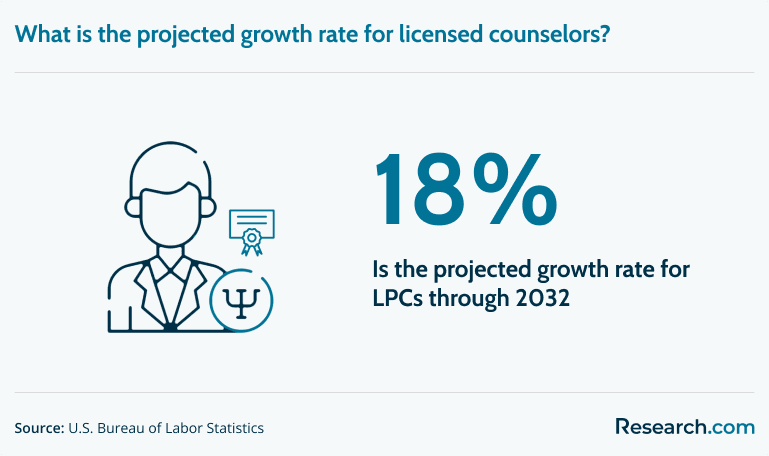
- 18% is the projected employment growth for LPCs through 2032.
- The two credentials most commonly discussed in the Washington counseling pathway are Licensed Mental Health Counselor (LMHC) and Licensed Mental Health Counselor Associate (LMHCA).
- Washington requires at least 36 months of full-time counseling or 4,000 hours of postgraduate mental health counseling, including 1,000 hours of direct counseling with individuals, couples, groups, or families.
- For licensure renewal, applicants must complete 36 hours of continuing education, including six hours in professional law and ethics, plus four hours of AIDS education and training.
- What steps do you need to become an LPC or LMHC in Washington?
- What education do Washington counseling licensure applicants need?
- What counselor licenses does Washington issue?
- What is happening in Washington’s counseling field?
- What is the job outlook for Washington counselors?
- How much do counselors earn in Washington?
- Where can licensed counselors work in Washington?
- What do counselors do day to day?
- Top Counselor Programs in Washington for 2027
- How does marriage and family therapy compare to LPC work in Washington?
- How can I establish a thriving private counseling practice in Washington?
- What additional certifications and professional organizations can enhance my LPC career in Washington?
- What distinguishes LPC licensure from psychology licensure in Washington?
- How can online education enhance your counseling career in Washington?
- What factors should I consider when choosing a counseling program in Washington?
- What challenges do LPC candidates encounter in Washington and how can they overcome them?
- How Can Integrating Behavior Analysis Complement My Counseling Services in Washington?
- How can telehealth transform my counseling practice in Washington?
- How can I transition to becoming a school counselor in Washington?
- How can I best prepare for Washington LPC license requirements?
- What are the continuing education requirements for LPCs in Washington?
- Is a career in counseling in Washington worth it?
- Why is continuing education important for LPCs in Washington?
- What steps can I take to pursue a career as a licensed counselor in Washington?
- What specializations are available for LPCs in Washington?
What steps do you need to become an LPC or LMHC in Washington?
Washington commonly uses the LMHC title for independent mental health counseling practice. Many readers search for “LPC in Washington,” but the practical goal is usually Washington LMHC licensure. As of 2024, there were 483,500 substance abuse, mental health, and behavioral disorder counselors nationwide, which reflects the broader workforce category many LMHCs fall into.
| Step | What to complete | Why it matters |
| 1. Choose the right graduate program | Complete a qualifying master’s or doctoral degree in mental health counseling, behavioral science, or a closely related mental health counseling field. | Your degree must support Washington’s required content areas before you invest time and tuition. |
| 2. Confirm coursework alignment | Review courses in diagnosis, assessment, ethics, law, counseling methods, human development, psychopathology, and research. | Missing required content can delay or complicate licensure review. |
| 3. Pass an approved exam | Complete either the National Counselor Examination for Licensure and Certification (NCE) or the National Clinical Mental Health Counseling Exam (NCMHCE). | Exam completion is a major gatekeeping step for licensure. |
| 4. Build supervised experience | Complete at least 4,000 hours of supervised experience over at least three years, including the required direct counseling hours. | Supervision converts academic training into clinical competence and ethical decision-making. |
| 5. Complete required training | Finish four hours of AIDS education and training. | This is a specific Washington requirement that candidates should not leave until the last minute. |
| 6. Apply and maintain the credential | Submit the required application materials and renew the license with continuing education. | Licensure is not a one-time event; renewal and CE keep the credential active. |
Earn a qualifying graduate degree
Your first major step is a master’s or doctoral degree that matches Washington’s counseling education standards. Some students pursue a mental health counseling degree, while others compare related programs such as behavioral science or specialized counseling options. A program such as an online Christian counseling master's degree may be relevant for students interested in faith-integrated counseling, but you should still verify that the curriculum satisfies Washington’s licensure content requirements.
Pass the counseling examination
Washington candidates need to pass the National Counselor Examination for Licensure and Certification (NCE) or the National Clinical Mental Health Counseling Exam (NCMHCE), both administered through the National Board of Certified Counselors. Choose exam preparation resources based on the exam you plan to take, because the NCE and NCMHCE assess different skill sets.
Complete supervised clinical experience
Washington requires a minimum of 4,000 hours of supervised experience over at least three years. At least 1,000 hours must involve direct supervised counseling with clients, including individuals, couples, families, or groups. Candidates should document supervision carefully from the beginning, because incomplete records can create problems when applying.
Submit your licensure application
After completing the education, examination, supervised experience, and required training components, you can submit your licensure application. Once licensed, you must continue meeting renewal and continuing education requirements to keep the license in good standing.
What education do Washington counseling licensure applicants need?
Based on Integrated Postsecondary Education Data System (IPEDS) data, there were 485 master's in counseling graduates in Washington in 2024. For prospective counselors, the key education decision is not simply whether a program sounds relevant. It is whether the degree, coursework, practicum, and internship structure are acceptable for Washington counseling licensure.
Education for Licensed Mental Health Counselor applicants
The LMHC route requires a master’s or doctoral degree in mental health counseling, behavioral science, or a field related to mental health counseling. A lower-cost program, including one listed among the cheapest CACREP accredited programs online, can be a smart option if it provides the required coursework, supervised field experience, and licensure preparation.
Washington-required content areas include:
- Assessment and diagnosis
- Ethics and law
- Counseling for individuals, groups, couples, and families
- Developmental psychology
- Psychopathology or abnormal psychology
- Research and evaluation
- At least four additional areas from the state’s specified list
Education and associate-level status
The Licensed Mental Health Counselor Associate credential is best understood as part of the pathway toward full independent counseling practice. Candidates should confirm current Washington Department of Health requirements before enrolling, because associate status, supervised practice rules, and educational review are licensing issues, not just school admissions issues. Students who are still exploring the field may begin with psychology, social work, or human services coursework; an option such as the most affordable online psychology degree can help build foundational knowledge, but a bachelor’s degree alone should not be assumed to qualify a person for independent clinical counseling practice.
| Education choice | Best for | Important caution |
| Master’s in clinical mental health counseling | Students aiming directly for LMHC licensure | Verify coursework, practicum, internship, and state alignment before enrolling. |
| Master’s in behavioral science or related mental health field | Students whose program has strong clinical counseling content | Related degrees may require closer transcript review. |
| Psychology bachelor’s degree | Students exploring mental health careers before graduate school | It is usually a starting point, not the final clinical counseling credential. |
| Online counseling program | Working adults and students outside major metro areas | Online format does not remove in-person practicum or internship obligations. |
What counselor licenses does Washington issue?
Based on BLS projections, about 42,000 licensed counselors will be needed to effectively address mental health concerns through 2032. Washington’s counseling pathway is often discussed through two main counselor credentials: LMHC and LMHCA. The difference matters because it affects independence, supervision, job options, and long-term career planning.
Licensed Mental Health Counselor (LMHC)
The LMHC is the full professional counseling credential in Washington. LMHCs may provide clinical mental health counseling services across settings such as private practices, hospitals, community mental health centers, substance use treatment programs, and family service agencies. Many LMHCs also manage caseloads, documentation, billing, referrals, and compliance tasks; for clinicians planning to supervise teams or run a practice, business training such as a cheap project management degree online may be useful as a separate professional development option.
Licensed Mental Health Counselor Associate (LMHCA)
The LMHCA credential is more limited than full LMHC licensure and is typically tied to supervised practice. It can be an important bridge between graduate education and independent professional practice. Candidates should understand exactly what services they may provide, what supervision is required, and how their supervised hours will be documented for future licensure.
| Credential | Typical role | Level of independence |
| LMHC | Provides clinical counseling services within the permitted scope of practice | Can generally practice independently after meeting licensure requirements |
| LMHCA | Works toward full licensure while gaining supervised experience | Requires supervision and has a more limited scope than an LMHC |
What is happening in Washington’s counseling field?
Washington’s counseling workforce is shaped by several connected pressures: increased public need for mental health care, uneven access across communities, workforce shortages in some specialties, and the expansion of telehealth. Reports of high demand for mental health services show why counselor supply matters across the state.
Available data points to a shortage of counselors, especially LMHCs who work in substance abuse, behavioral disorders, and mental health. The need is significant because Washington’s age-adjusted suicide rate is 15.3% compared with the 14.1% national average.
Access is not evenly distributed. Rural communities may have fewer mental health providers, while urban areas may offer more employers, internships, and specialty practices. An aging counselor workforce, including psychologists, may also create openings as experienced professionals retire.
For new counselors, this environment creates opportunity but also responsibility. The best-positioned candidates are those who graduate from licensure-aligned programs, build experience in high-need settings, document supervision carefully, and remain flexible about serving clients through in-person and telehealth formats.
What is the job outlook for Washington counselors?
The outlook for counseling careers in Washington is favorable, especially for professionals serving mental health, substance use, and behavioral disorder needs. The Bureau of Labor Statistics estimates 18% growth through 2032 for LMHCs specializing in mental health, substance abuse, and behavioral disorders. Growth is also expected for school counselors at 15.8% and rehabilitation counselors at 10.3%.
Demand is supported by broader awareness of mental health, increased willingness to seek care, population needs across age groups, and ongoing gaps in access. However, strong demand does not guarantee immediate employment or a specific salary. Outcomes depend on specialization, employer type, licensure stage, geographic location, supervision availability, and the candidate’s clinical readiness.
| Counseling area | Projected growth cited | What this means for candidates |
| Mental health, substance abuse, and behavioral disorder counseling | 18% through 2032 | Strongest fit for candidates interested in clinical treatment, addiction services, and community mental health. |
| School counseling | 15.8% | Relevant for counselors drawn to student development, academic planning, and school-based support. |
| Rehabilitation counseling | 10.3% | Suitable for professionals who want to support clients with disabilities, employment barriers, and independent living goals. |
How much do counselors earn in Washington?
Based on BLS data, licensed professional counselors in Washington, including substance abuse, mental health, and behavioral disorder counselors, earn at least $63,490 annually. The annual median wage cited for licensed professional counselors in Washington is $63,940. Your actual compensation may be higher or lower depending on where you work, your credential level, your caseload, and your specialty.
- License level: Fully licensed LMHCs often have more employment and private practice options than associate-level clinicians.
- Experience: Counselors who have stronger clinical judgment, documentation skills, supervision experience, or specialty training may qualify for better opportunities.
- Employer type: Hospitals, government agencies, schools, community mental health centers, group practices, and private practices may use different pay structures.
- Specialization: Substance use, trauma, crisis care, and other high-need areas may influence hiring demand.
- Location: Urban markets may offer more roles, while rural communities may have fewer providers and different compensation dynamics.
Where can licensed counselors work in Washington?
Washington has 3.46 counselors for every 1,000 individuals, and counselors are employed across clinical, educational, government, nonprofit, and private settings. The right work setting depends on your license status, preferred population, supervision needs, and tolerance for administrative demands.
| Work setting | Typical clients or services | Best fit for counselors who want |
| Private practice | Individual therapy, couples counseling, family therapy, and groups | Autonomy, niche specialization, and business ownership |
| Hospitals and community mental health centers | Depression, anxiety, trauma, crisis needs, substance use, and severe mental health conditions | Team-based care and exposure to complex clinical cases |
| Schools | Student academic, social, emotional, and career needs | Youth development and collaboration with educators and families |
| Government agencies | Justice system, child welfare, public health, and community programs | Public service and systems-level client support |
| Substance abuse treatment centers | Addiction treatment, relapse prevention, and recovery support | Specialized work with substance use disorders |
| Employee assistance programs | Short-term support for workplace stress and personal concerns | Brief counseling models and workplace mental health |
| Residential treatment facilities | Structured care for mental health or addiction needs | Intensive treatment settings and multidisciplinary care |
| Community organizations | Services for veterans, refugees, domestic violence survivors, and other groups | Mission-driven work with specific populations |
LMHCs generally have the broadest range of practice options after full licensure. Associate-level or more limited credentials may require supervision, employer restrictions, or a narrower service scope.
What do counselors do day to day?
Counselors help clients understand patterns, manage symptoms, improve relationships, recover from trauma, make decisions, and build healthier coping strategies. In Washington, the percentage of adults reporting symptoms of anxiety and depressive disorder is slightly higher than the national average at 32.6%, which helps explain why counseling services remain important across communities.
Typical counseling work includes intake assessments, treatment planning, individual therapy, group counseling, family sessions, documentation, referral coordination, crisis support, and collaboration with other health or social service professionals. Counselors may use evidence-informed approaches such as cognitive-behavioral therapy, psychodynamic methods, trauma-informed care, motivational interviewing, or family systems interventions, depending on training and client needs.
The role also includes ethical responsibilities. Counselors must protect client confidentiality, maintain appropriate boundaries, document care accurately, identify risk, follow mandated reporting laws, and refer clients when their needs fall outside the counselor’s competence or scope.
Top Counselor Programs in Washington for 2027
How should you use this list?
A counseling master’s program can determine whether you move smoothly toward licensure or spend extra time correcting gaps later. Use rankings as a starting point, not the final decision. Your best program is the one that fits Washington licensure requirements, your budget, your schedule, your clinical interests, and your ability to complete practicum and internship placements.
How do we rank schools?
Research.com evaluates counseling master’s programs in Washington using a transparent methodology built from multiple data sources. These include the Integrated Postsecondary Education Data System (IPEDS), Peterson's databases, including the Distance Learning Licensed Data Set, and the College Scorecard database from the National Center for Education Statistics. Comparing programs across several data points helps students evaluate cost, format, program structure, and institutional characteristics more effectively.
1. Seattle University
Seattle University offers an online Master of Arts in Education (M.Ed.) in Counseling designed for adults preparing for counseling-related advancement or career change. The program uses both asynchronous and synchronous learning components and is described as one of the first online counseling programs offered in Washington.
- Program Length: 2 to 3 years
- Tracks/concentrations: Counseling
- Cost per Credit: $990
- Required Credits to Graduate: 90 credits
- Accreditation: Council for Accreditation of Counseling and Related Educational Programs
2. Northwest University
Northwest University provides an online Master of Arts in Clinical Mental Health Counseling (CMHC) for students preparing for Licensed Mental Health Counselor work in Washington. Coursework is primarily asynchronous, but students must also complete three on-campus residencies as well as practicum and internship placements.
- Program Length: 2 to 3 years
- Tracks/concentrations: Clinical Mental Health Counseling
- Cost per Credit: $795
- Required Credits to Graduate: 90 credits
- Accreditation: Council for Accreditation of Counseling and Related Educational Programs
3. Walden University
Walden University offers a fully online Master of Science in Clinical Mental Health Counseling for working adults seeking counseling career advancement. The program includes online coursework, asynchronous learning activities, and virtual engagement with faculty and peers.
- Program Length: 2 to 3 years
- Tracks/concentrations: Clinical Mental Health Counseling
- Cost per Credit: $665
- Required Credits to Graduate: 60 credits
- Accreditation: The Higher Learning Commission (HLC)
4. City University of Seattle
City University of Seattle offers an online Master of Arts in Clinical Mental Health Counseling intended to prepare students for Washington LMHC licensure. The format combines asynchronous coursework with interactive online sessions, and students must complete in-person practicum and internship requirements.
- Program Length: 2 to 3 years
- Tracks/concentrations: Clinical Mental Health Counseling, Marriage, Couple and Family Counseling
- Cost per Credit: $585
- Required Credits to Graduate: 60 credits
- Accreditation: Council for Accreditation of Counseling and Related Educational Programs
5. Eastern Washington University
Eastern Washington University offers an online Master of Science in Clinical Mental Health Counseling for students preparing for mental health counseling roles in a range of settings. Coursework is mostly asynchronous with some synchronous elements, and students must complete in-person practicum and internship experiences.
- Program Length: 2 to 3 years
- Tracks/Concentrations: Clinical Mental Health Counseling, School Counseling
- Cost per Credit: $527
- Required Credits to Graduate: 60-72 credits
- Accreditation: Council for Accreditation of Counseling and Related Educational Programs
What graduates say about counseling master’s programs
-
: "
Working with students as a school counselor in Washington has given me a front-row view of how much support adolescents need. The difficult days are real, but helping teenagers build confidence and coping skills makes the work meaningful. Sarah
"
-
: "
Pursuing LMHC licensure in Washington gave me the professional independence I wanted. Running a private practice has required business discipline, but helping adults manage anxiety and depression has been deeply rewarding. David
"
-
: "
Washington’s need for counselors, especially in substance abuse services, has allowed me to do work that feels urgent and useful. In community mental health, I see how recovery changes lives over time. Elena
"
How does marriage and family therapy compare to LPC work in Washington?
Marriage and family therapy and professional counseling overlap, but they are not identical career paths. MFT training focuses heavily on family systems, relationship dynamics, couple interaction, and patterns within family units. LMHC training is usually broader, covering individual mental health conditions, assessment, diagnosis, crisis intervention, group counseling, and treatment planning across different populations.
| Path | Primary focus | Best fit if you want to |
| LMHC or LPC-style counseling pathway | Individual, group, couples, family, and mental health counseling across varied concerns | Treat anxiety, depression, trauma, substance use, adjustment issues, and broad mental health needs |
| Marriage and family therapy | Relationship systems, couple functioning, family conflict, and communication patterns | Work mainly with couples and families through a systemic lens |
If relationship therapy is your primary interest, compare the counseling pathway with the MFT route by reviewing how to become a marriage and family therapist in Washington. If you prefer a broader mental health scope, LMHC preparation may be a better match.
How can I establish a thriving private counseling practice in Washington?
A sustainable private practice requires clinical competence, legal compliance, business planning, and a clear client niche. Before opening your doors, confirm that your license permits independent practice, secure malpractice coverage, understand billing and documentation requirements, and decide whether you will accept insurance, private pay, or a combination.
- Define your ideal client: A focused niche, such as anxiety, trauma, couples work, or addiction recovery, makes referral building easier.
- Create a business plan: Estimate rent, telehealth platform costs, billing tools, marketing, insurance, taxes, supervision, and emergency coverage.
- Build referral relationships: Connect with physicians, schools, attorneys, community organizations, hospitals, and other therapists.
- Protect client privacy: Use secure documentation, informed consent forms, and HIPAA-aligned technology practices.
- Develop business skills: Scheduling, cash flow, measurement-based care, and client communication all affect long-term viability.
Counselors who want to broaden their practice into addiction treatment can also review how to become a substance abuse counselor in Washington.
What additional certifications and professional organizations can enhance my LPC career in Washington?
Licensure establishes baseline authority to practice, but additional training can help counselors serve specific populations more effectively. Common areas for post-licensure development include trauma-informed care, EMDR, substance use counseling, grief counseling, crisis intervention, play therapy, and telebehavioral health.
Professional organizations can also support career growth through continuing education, ethics updates, networking, policy advocacy, supervision resources, and conference access. If you are comparing counseling with other helping professions, Research.com’s guide Is being a social worker worth it? can help clarify how social work education and counseling licensure differ.
What distinguishes LPC licensure from psychology licensure in Washington?
Counseling and psychology both involve mental health care, but the training depth, credential type, and professional emphasis differ. LMHC preparation is typically built around graduate-level counseling practice, supervised clinical hours, and counseling examinations. Psychology licensure generally requires doctoral-level training, more extensive assessment preparation, research training, and different examination requirements.
Choose counseling if your primary goal is therapy, client support, and clinical mental health practice through a master’s-level pathway. Consider psychology if you want doctoral-level training, psychological assessment, research-intensive preparation, or a wider testing-focused scope. For the doctoral psychology route, see how to become a psychologist in Washington.
How can online education enhance your counseling career in Washington?
Online counseling education can make graduate study more accessible for working adults, caregivers, rural students, and career changers. The key is to separate online coursework from clinical placement requirements. Even if classes are online, counseling programs typically require practicum and internship experiences with approved supervision.
Online study can be a strong option when the program is properly accredited, transparent about licensure alignment, clear about residency requirements, and helpful with field placement support. Students considering school-based counseling roles may also compare the most affordable online school counseling degrees.
What factors should I consider when choosing a counseling program in Washington?
Do not choose a counseling program based only on tuition, convenience, or a school’s reputation. The right program must support your licensure goal and your ability to finish clinical training on schedule.
| Question to ask | Why it matters |
| Does the curriculum match Washington LMHC requirements? | Licensure alignment is more important than a general counseling label. |
| Is the program accredited and recognized by employers? | Accreditation can affect transferability, credibility, and licensure review. |
| How are practicum and internship placements arranged? | Clinical placement delays can extend your graduation timeline. |
| What is the total cost, not just tuition? | Fees, residencies, travel, books, supervision, and lost work hours can change affordability. |
| Does the program support exam preparation? | Structured exam support may help you stay on track toward licensure. |
| Are faculty clinically experienced? | Faculty mentorship can shape your professional identity and clinical competence. |
| Does the format fit your life? | Online, hybrid, full-time, and part-time options involve different trade-offs. |
If you are still deciding where to study mental health or behavioral science more broadly, you can compare good colleges for psychology in Washington.
What challenges do LPC candidates encounter in Washington and how can they overcome them?
The Washington counseling pathway is manageable, but candidates often underestimate the coordination required. The hardest parts are usually not classroom assignments; they are documentation, supervision, time management, exam readiness, and cost control.
| Common mistake | Better approach |
| Choosing a program before checking licensure alignment | Compare every required course and field placement requirement against Washington rules before enrolling. |
| Assuming online means fully remote | Ask about residencies, practicum, internship, and local placement expectations. |
| Tracking supervised hours loosely | Use a documentation system from the first week of supervised work. |
| Looking only at tuition | Calculate total program cost, fees, travel, exam costs, supervision, and income changes. |
| Waiting too long to prepare for the NCE or NCMHCE | Create an exam plan early and use practice questions, case simulations, or review workshops. |
| Assuming salary outcomes are guaranteed | Research employer type, license stage, region, specialty, and demand before estimating return on investment. |
Peer support, faculty advising, professional association involvement, and early supervision planning can reduce delays. If you are comparing mental health careers with adjacent fields, the guide on how to become a social worker in Washington may help you evaluate another pathway.
How Can Integrating Behavior Analysis Complement My Counseling Services in Washington?
Behavior analysis can complement counseling when clients need structured interventions for observable behavior patterns, skill development, reinforcement systems, or caregiver-supported treatment plans. Counselors who work with autism spectrum disorders, ADHD, developmental needs, or behavior challenges may benefit from understanding behavior analytic methods, while still staying within their counseling scope of practice.
This does not mean every counselor should become a behavior analyst. It makes the most sense for clinicians whose client population regularly needs measurable behavior intervention plans or interdisciplinary collaboration. To understand the credential pathway, review how to become a behavior analyst in Washington.
How can telehealth transform my counseling practice in Washington?
Telehealth can expand access for clients who face transportation barriers, live in underserved areas, have mobility limitations, or need more flexible scheduling. It can also reduce office overhead for counselors. However, telehealth is still clinical care, which means privacy, informed consent, emergency planning, documentation, identity verification, and secure technology matter.
Before offering telehealth, counselors should review current state rules, payer requirements, HIPAA-related practices, and cross-jurisdiction limitations. Telehealth works best when it is integrated into a thoughtful clinical workflow rather than added as a convenience without safety planning. Readers comparing shorter training routes and service delivery options can review the fastest way to become a counselor in Washington.
How can I transition to becoming a school counselor in Washington?
LMHC training and school counseling overlap in areas such as student mental health, family communication, crisis support, and developmental concerns. Still, school counseling has its own credentialing expectations, school systems knowledge, and responsibilities related to academic planning, student services, and collaboration with teachers and administrators.
If you want to move into schools, review child and adolescent development, educational psychology, school law, crisis intervention, and college or career readiness. Mentorship from experienced school counselors can also clarify the day-to-day realities of the role. For a dedicated pathway, see becoming a school counselor in Washington.
How can I best prepare for Washington LPC license requirements?
The best preparation strategy is to treat licensure as a project with milestones. Start by mapping your education, exams, supervised hours, documentation, AIDS training, and continuing education obligations. Keep copies of syllabi, transcripts, supervision agreements, hour logs, and exam records.
- Confirm state requirements before applying to programs.
- Ask programs how they support Washington licensure specifically.
- Line up practicum and internship planning early.
- Choose supervisors who understand Washington documentation requirements.
- Prepare for the NCE or NCMHCE with a structured timeline.
- Review application instructions before your final supervised hours are complete.
For a more focused overview of documentation and regulatory expectations, review the Washington LPC license requirements.
What are the continuing education requirements for LPCs in Washington?
Continuing education is required to maintain counseling licensure in Washington. LPCs are required to complete 36 hours of continuing education every two years. This total includes six hours in professional law and ethics and four hours of AIDS education and training.
CE should not be treated as a box-checking exercise. The most useful continuing education strengthens your clinical judgment, updates your knowledge of legal and ethical obligations, and helps you serve your actual client population more effectively.
Is a career in counseling in Washington worth it?
A counseling career in Washington can be worth it for people who want meaningful clinical work, are prepared for graduate education, and can manage the emotional demands of helping clients through difficult experiences. Demand is strong in mental health, substance abuse, and behavioral disorder counseling, and the Bureau of Labor Statistics projects significant job growth in these areas.
The trade-off is cost and time. Earning a master’s degree, preparing for exams, completing supervised hours, and paying for licensing-related expenses can be expensive. Students comparing graduate school affordability may want to review master's in psychology online cost as part of a broader cost analysis.
The career may be especially worthwhile if you value direct client impact, flexibility in work settings, and opportunities to specialize in trauma, addiction, family systems, grief, school counseling, or private practice. It may be less attractive if your top priority is a fast credential, predictable hours, low emotional strain, or immediate high earnings. Some counselors later pursue leadership or administrative advancement through options such as the cheapest Ph.D. in organizational leadership.
Why is continuing education important for LPCs in Washington?
Continuing education protects clients and supports professional growth. Counseling standards, ethical guidance, clinical techniques, technology practices, and legal expectations change over time. CE helps licensed counselors stay current instead of relying only on what they learned in graduate school.
- Maintain legal eligibility: Washington requires continuing education for license renewal.
- Strengthen ethics and risk management: Required law and ethics hours help counselors respond to confidentiality, boundaries, documentation, and mandated reporting issues.
- Improve clinical effectiveness: Training in trauma, addiction, grief, crisis care, and evidence-informed therapies can improve client care.
- Support specialization: Counselors can deepen expertise in populations or treatment methods that match their practice goals.
Some counselors also pursue additional academic or faith-integrated training, including options such as a masters in Christian counseling, when it aligns with their professional goals and scope of practice.
What steps can I take to pursue a career as a licensed counselor in Washington?
Start by deciding whether you want independent clinical counseling practice, school-based counseling, substance use counseling, social work, psychology, or another mental health role. Then choose the education pathway that matches that goal. For LMHC practice, you should plan for graduate education, supervised postgraduate counseling experience, exam preparation, and licensure application requirements.
- Research Washington’s current licensure rules before enrolling in a program.
- Choose a qualifying graduate degree with strong clinical training.
- Confirm practicum and internship expectations.
- Build a financial plan that includes tuition, fees, books, supervision, exams, and licensing costs.
- Prepare for the NCE or NCMHCE.
- Complete and document supervised counseling hours.
- Apply for licensure and maintain CE requirements after approval.
For a focused pathway, review how to become a licensed mental health counselor in Washington.
What specializations are available for LPCs in Washington?
Specialization helps counselors build deeper skill in a defined area, attract the right clients or employers, and plan continuing education more strategically. The best specialization depends on the population you want to serve, the type of problems you want to treat, and the settings where you want to work.
1. Mental Health Counseling
Mental health counseling is the broadest and most common specialization. Counselors in this area help clients manage anxiety, depression, trauma, grief, adjustment concerns, stress, and relationship issues. It is a good fit for clinicians who want flexibility across private practice, agencies, hospitals, and community mental health settings.
2. Marriage and Family Therapy
This focus is suited to counselors who want to work with couples, families, communication patterns, conflict, parenting concerns, and relational systems. Washington also has a distinct marriage and family therapy pathway, so students should compare the MFT and LMHC routes before committing.
3. Substance Abuse Counseling
Substance abuse counseling focuses on addiction, recovery, relapse prevention, motivational work, group counseling, and coordination with healthcare or recovery support providers. This can be a strong option in Washington because substance use and behavioral health services remain high-need areas.
4. School Counseling
School counseling is designed for professionals who want to help students with academic, social, emotional, and career development needs. This path may require additional education or credentialing beyond standard clinical counseling preparation.
5. Art Therapy
Art therapy combines counseling principles with creative expression. It may be useful for clients who struggle to communicate through traditional talk therapy, including children, trauma survivors, and people with certain disabilities. Students interested in this specialty can compare the best art therapy programs.
6. Trauma Counseling
Trauma counselors support clients affected by abuse, violence, accidents, combat, loss, or other overwhelming events. This specialization often requires additional training in trauma-informed care and may include methods such as EMDR, depending on the counselor’s training and scope.
7. Grief Counseling
Grief counseling helps clients process bereavement, major life loss, complicated grief, and transitions following death, divorce, illness, or identity changes. It can be emotionally intense but highly meaningful work.
8. Geriatric Counseling
Geriatric counseling focuses on older adults and families navigating aging, loneliness, dementia-related concerns, caregiving stress, retirement, health changes, and end-of-life issues. As Washington’s population ages, this specialty can support both individual clients and family systems.
Key Insights
- Washington’s independent counseling pathway is centered on LMHC licensure; many people use “LPC” as a search term, but candidates should follow Washington’s specific credential requirements.
- The most important early decision is choosing a graduate program that aligns with Washington coursework, practicum, internship, and licensure expectations.
- Washington requires at least 36 months of full-time counseling or 4,000 hours of postgraduate mental health counseling, including 1,000 hours of direct counseling with clients.
- Salary and job outcomes vary by license level, specialty, employer, location, experience, and work setting; the cited Washington figures are useful benchmarks, not guarantees.
- Online programs can be convenient, but students must still plan for clinical placements, supervision, possible residencies, and state licensure alignment.
- Common mistakes include ignoring accreditation, comparing only tuition, assuming online study removes in-person requirements, and failing to document supervised hours carefully.
- Counseling can be a strong career choice in Washington for people who want direct client impact, can manage emotionally demanding work, and are willing to invest in graduate education and supervised practice.
Related Articles for Nearby States
- 2027 How to Become a Licensed Counselor (LPC) in Oregon
- 2027 How to Become a Licensed Counselor (LPC) in Idaho
- 2027 How to Become a Licensed Counselor (LPC) in Montana
- 2027 How to Become a Licensed Counselor (LPC) in California
- 2027 How to Become a Licensed Counselor (LPC) in Nevada
- 2027 How to Become a Licensed Counselor (LPC) in Utah
- 2027 How to Become a Licensed Counselor (LPC) in Wyoming
- 2027 How to Become a Licensed Counselor (LPC) in Arizona
- 2027 How to Become a Licensed Counselor (LPC) in Colorado
- 2027 How to Become a Licensed Counselor (LPC) in New Mexico
References:
- Arizona State University. (2025). Master of Counseling Program Evaluation Outcomes Report. https://cisa.asu.edu/sites/g/files/litvpz691/files/2026-02/MC%20Annual%20Program%20Outcome%20Report%202024-2025.pdf
- North Dakota State University. (2025). Counselor Education Program/Student Outcomes Report. https://www.ndsu.edu/ceduc/about_us/program-quality/counselor-ed-outcomes
- U.S. Bureau of Labor Statistics. (2025). Occupational Outlook Handbook: Marriage and Family Therapists. https://www.bls.gov/ooh/community-and-social-service/marriage-and-family-therapists.htm
- U.S. Bureau of Labor Statistics. (2025). Occupational Outlook Handbook: School and Career Counselors and Advisors. https://www.bls.gov/ooh/community-and-social-service/school-and-career-counselors.htm
- U.S. Bureau of Labor Statistics. (2025). Occupational Outlook Handbook: Rehabilitation Counselors. https://www.bls.gov/ooh/community-and-social-service/rehabilitation-counselors.htm
Other Things You Should Know About How to Become a Licensed Counselor in Washington
Candidates must pass the National Counselor Examination (NCE) to obtain an LPC license in Washington. Administered by the National Board for Certified Counselors (NBCC), the exam evaluates a candidate’s knowledge and skills. Preparation includes studying core counseling principles and practical applications.
To become an LPC in Washington by 2027, you must complete a master's degree in counseling or a related field from an accredited institution, along with at least 60 semester credit hours. Accreditation by recognized bodies, such as the CACREP, is often required.
To become a Licensed Professional Counselor (LPC) in Washington in 2027, candidates must complete 3,000 hours of supervised postgraduate experience. This includes at least 1,200 hours of direct client contact. Supervision must be conducted by a qualified supervisor, such as a licensed mental health counselor.


