
2027 Is a Master of Legal Studies Worth It?

Co-Founder and Chief Data Scientist
Deciding whether a Master of Legal Studies is worth it comes down to one question: will legal knowledge help you move into a better role without becoming a lawyer? For many professionals in compliance, healthcare, finance, human resources, risk management, government, and corporate operations, the answer can be yes. An MLS is not a law degree for practicing attorneys, but it can help workers in regulated fields understand contracts, employment rules, privacy requirements, investigations, policy, and organizational risk. This guide explains what an MLS does and does not do, who benefits most, how it compares with other legal credentials, what careers it can support, and how to judge whether the cost makes sense for your goals.
Quick Answer: Is a Master of Legal Studies Worth It?
- A Master of Legal Studies can be worth it if your current or target role requires legal, compliance, regulatory, policy, contract, or risk-management knowledge but does not require a law license.
- The degree is strongest for professionals in legal-adjacent fields such as compliance, human resources, healthcare administration, finance, public policy, corporate governance, and cybersecurity/data privacy.
- It is not the right choice if your goal is to represent clients, argue cases in court, or sit for the bar exam. For that path, a JD is typically required.
- Salary outcomes vary widely. The average salary for MLS degree holders is $60,327, with reported earnings from $17,500 to $125,000. Compliance officers, one of the most common MLS-aligned roles, earn an average salary of $80,190.
- The compliance labor market is stable rather than explosive. There are 383,620 compliance officers in the US, and compliance officer roles are projected to grow by 5% from 2023 to 2033. Related management roles may offer stronger growth, including medical and health services managers, which are projected to grow by 29%.
- Online MLS programs can make the degree more practical for working professionals, but students should compare accreditation, curriculum, specialization options, tuition, employer recognition, transfer policies, and career support before enrolling.
- Is a Master of Legal Studies worth it in 2026?
- What is a master's in legal studies?
- Who benefits most from a Master of Legal Studies?
- What jobs can you get with a Master of Legal Studies?
- Can you earn a Master of Legal Studies online?
- What courses are included in an MLS curriculum?
- What MLS specializations are available?
- How should you choose an MLS specialization?
- How should you compare MLS programs?
- Can shorter legal studies programs be a smart first step?
- How do MLS programs build practical skills and networks?
- Should criminal justice professionals consider an MLS?
- What trends are changing MLS career opportunities?
- Is an online associate degree useful before an MLS?
- Can law enforcement education pair well with an MLS?
- Can an MLS support homeland security careers?
- How can legal studies and intelligence training work together?
- What long-term career paths are available to MLS graduates?
- How much can you earn with a Master of Legal Studies?
- What is the job market for MLS graduates?Key insights and references
Is a Master of Legal Studies worth it in 2026?
A Master of Legal Studies is worth considering if legal knowledge is becoming a barrier to advancement in your current field. It is commonly viewed as one of the more accessible legal graduate degree options because it is designed for non-lawyers and does not normally require the same professional commitment as law school. The value is clearest when the degree helps you qualify for compliance, regulatory, contracts, HR, healthcare administration, risk, or policy roles where legal interpretation is part of the job.
The MLS is not worth it for everyone. It does not prepare graduates to practice law as attorneys, and it generally will not replace a JD for roles that require bar admission. It also may not pay off if you already have the legal knowledge your employer needs, if the program is too expensive relative to your likely salary change, or if your target jobs prioritize certifications, industry experience, or a different graduate degree.
For professionals in regulated industries, however, the degree can create a useful credential. Many organizations need employees who can understand policies, communicate with legal teams, interpret regulations, and reduce compliance risk. The degree’s appeal is also reflected in legal-adjacent leadership paths: executives account for 31% and financial managers account for 22% of professionals with advanced law degrees.
| Choose an MLS if... | Think twice if... |
| You work with contracts, regulations, employment law, privacy rules, investigations, audits, or compliance policies. | You want to become a licensed attorney, represent clients, or take the bar exam. |
| You already have professional experience and need legal fluency to move into leadership or a specialized role. | You are entering the workforce with no clear target role and expect the degree alone to secure a job. |
| Your employer values legal knowledge in compliance, healthcare, finance, HR, public policy, cybersecurity, or risk management. | Your field rewards technical certifications, clinical licensure, business credentials, or work experience more than legal training. |
| You can compare tuition with realistic salary outcomes in your industry before enrolling. | You would need to borrow heavily without a clear salary increase, promotion path, or employer tuition support. |
What is a master's in legal studies?
A master's in legal studies is a graduate degree for people who need to understand the law in their work but do not plan to become attorneys. Programs typically teach legal reasoning, regulatory systems, contracts, compliance, risk, ethics, policy, and the structure of the US legal system. The goal is practical legal literacy: knowing how legal rules affect organizational decisions.
MLS vs. JD
A JD is the standard professional degree for people who want to become lawyers. JD programs focus heavily on legal doctrine, case analysis, advocacy, litigation, legal writing, and preparation for attorney licensure. An MLS is different. It is usually built for professionals who collaborate with lawyers, manage legal risk, or apply regulations at work, but who do not need to appear in court or provide legal representation.
MLS vs. LLM
An LLM is typically a specialized graduate law degree for people who already hold a JD or an international law degree. It helps trained lawyers deepen expertise in a particular area. An MLS is aimed at non-lawyers who need legal knowledge for business, healthcare, government, compliance, technology, HR, or policy roles.
| Credential | Best for | Typical purpose | Does it lead to attorney licensure? |
| Master of Legal Studies | Non-lawyers in legal-adjacent roles | Apply legal knowledge in compliance, business, HR, healthcare, policy, risk, or regulation | No |
| JD | Future attorneys | Prepare for legal practice and bar admission | Yes, when state requirements are met |
| LLM | Law graduates or practicing attorneys | Specialize further in an area of law | Usually not by itself for US bar eligibility; requirements vary |
Who benefits most from a Master of Legal Studies?
The strongest MLS candidates are professionals who already work near legal issues and want to become more effective in their roles. The degree is especially useful when legal rules directly affect budgets, operations, personnel decisions, contracts, audits, investigations, patient privacy, data governance, or organizational risk.
Compliance and regulatory professionals
Compliance officers often use MLS coursework to strengthen their ability to interpret laws, explain obligations to business teams, document policies, and coordinate with internal or external counsel. This path is common in finance, healthcare, insurance, manufacturing, government, energy, and corporate management.
Human resources and workplace leaders
HR professionals handle sensitive issues involving employment law, discrimination, accommodations, wage and hour rules, benefits, investigations, employee discipline, and workplace policy. Legal studies training can help HR managers understand risk before it becomes a dispute.
Healthcare administrators and policy professionals
Healthcare leaders operate in a highly regulated environment. An MLS with health law or policy coursework can help administrators understand patient rights, privacy duties, ethics, reimbursement issues, and institutional compliance responsibilities.
Business, finance, and contract-focused professionals
Managers, analysts, contract administrators, procurement specialists, real estate professionals, and financial services workers may benefit when they regularly review agreements, manage vendor risk, monitor regulations, or support negotiations.
Public safety, government, and legal-adjacent professionals
People in law enforcement, public administration, journalism, investigations, nonprofit policy, and government affairs may use an MLS to better understand constitutional principles, administrative procedures, evidence standards, ethics, and regulatory enforcement.
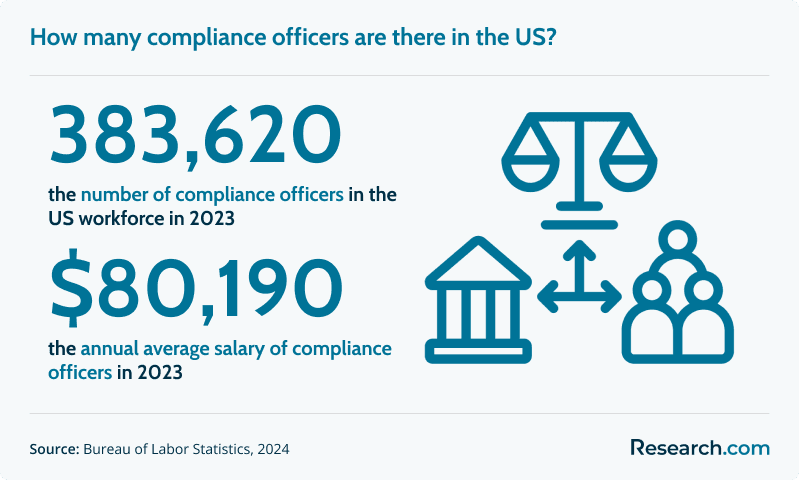
One common MLS-aligned role is compliance officer. In 2023, there were 383,620 compliance officers in the US, earning an average salary of $80,190. This makes compliance one of the clearest labor-market fits for MLS graduates, especially for people who already have industry experience.
Legal knowledge can also support work in related advising and advocacy fields. Professionals exploring client guidance roles may find useful comparisons in Research.com’s guide on starting a career in career counseling, where documentation, ethics, confidentiality, and client rights can also matter.
What jobs can you get with a Master of Legal Studies?
An MLS can support many roles that require legal awareness but not attorney licensure. It is most valuable when paired with industry experience, a relevant specialization, or a role where employers explicitly ask for knowledge of compliance, contracts, policy, investigations, privacy, or risk.
Common MLS-aligned roles
- Compliance officer: Monitors whether an organization follows laws, regulations, internal policies, and industry standards.
- Human resources manager: Applies employment law knowledge to hiring, workplace policy, investigations, labor issues, accommodations, and employee relations.
- Healthcare administrator: Manages operational and compliance responsibilities tied to patient rights, privacy, ethics, and healthcare regulation.
- Contract administrator: Reviews, tracks, negotiates, and coordinates agreements so business terms align with legal and operational requirements.
- Regulatory affairs specialist: Helps organizations meet government rules in fields such as pharmaceuticals, finance, energy, healthcare, or manufacturing.
- Risk manager: Identifies legal, operational, financial, and compliance risks and helps design controls to reduce exposure.
- Paralegal or legal analyst: Supports legal departments through research, document preparation, regulatory analysis, and case or policy support.
| Career area | How an MLS helps | Best-fit background |
| Compliance | Builds knowledge of regulations, enforcement, audits, reporting, and internal controls | Finance, healthcare, insurance, government, operations, risk, auditing |
| Human resources | Strengthens understanding of employment law, workplace policy, investigations, and labor compliance | HR, management, employee relations, benefits, operations |
| Healthcare administration | Supports decisions involving patient privacy, ethics, institutional policy, and regulatory obligations | Healthcare operations, public health, hospital administration, insurance |
| Contracts and procurement | Improves ability to identify legal terms, risk clauses, obligations, and negotiation issues | Business, vendor management, procurement, real estate, project management |
| Cybersecurity and data privacy | Connects technical risk with privacy law, breach response, governance, and compliance expectations | IT, cybersecurity, risk analysis, data governance, compliance |
Government agencies are major compliance employers. Federal, state, and local government agencies employed over 137,000 compliance officers in 2023. For readers interested in analytical roles that intersect with law, testing, research, or policy, Research.com also explains how psychometrician careers work.
Can you earn a Master of Legal Studies online?
Yes. Many schools offer online MLS programs for working adults who need flexibility. Online programs can cover the same core subjects as campus-based programs, including contracts, legal foundations, compliance, employment law, healthcare law, business law, cybersecurity law, and regulatory systems. Students who want a shorter or more practice-oriented legal credential may also compare MLS programs with online paralegal degree options.
Online study can be a strong fit if you are already employed, cannot relocate, or want to apply coursework immediately at work. It can be a poor fit if you need in-person networking, structured classroom accountability, or local legal connections. Before enrolling, confirm whether online students receive the same faculty access, career services, electives, experiential learning, and transcript designation as campus students.
For example, UCLA Law’s Master of Legal Studies program offers flexible formats, including in-person, hybrid, and fully online options. That type of structure can help professionals choose a format that fits work and personal obligations without abandoning a legal graduate education.
| Online MLS | Campus or hybrid MLS |
| Often better for full-time workers, caregivers, and students outside major legal markets | Often better for students who want in-person networking, campus events, and direct access to faculty or peers |
| Requires strong self-management and consistent study habits | Provides more scheduled structure and face-to-face accountability |
| Can make it easier to keep earning income while studying | May offer more local internships, clinics, or employer events depending on the school |
| Quality depends heavily on curriculum design, faculty involvement, and career support | Quality still depends on program reputation, specialization fit, faculty, and outcomes |
What courses are included in an MLS curriculum?
An MLS curriculum usually combines broad legal foundations with industry-focused electives. The goal is not to train students to practice law; it is to help them recognize legal issues, interpret rules, communicate with counsel, and make better organizational decisions. Students comparing campus and affordable online master of legal studies programs should review course lists carefully because program emphasis can vary widely.
- Legal foundations: Introduces the US legal system, legal reasoning, contracts, administrative law, and the role of courts and agencies.
- Regulatory compliance: Covers how organizations identify, interpret, document, and respond to regulatory obligations.
- Business law: Explores contracts, corporate governance, intellectual property, transactions, and legal risk in business decisions.
- Employment and labor law: Reviews employee rights, discrimination law, workplace policy, labor relations, investigations, and employer obligations.
- Health law and policy: Examines privacy, ethics, patient rights, institutional compliance, and healthcare regulation.
- Risk management: Teaches students how to identify legal exposure, build controls, document decisions, and respond to potential disputes or enforcement issues.
Many programs also include electives in cybersecurity law, environmental regulation, dispute resolution, financial regulation, public policy, intellectual property, or criminal justice. In 2022, there were around 425 master's degree in general legal studies awarded in the US, which shows that the credential remains specialized compared with many broader graduate degrees.

What MLS specializations are available?
Specializations matter because the MLS is most valuable when the coursework matches your professional environment. A student in healthcare compliance needs different legal training from a cybersecurity risk manager, HR director, or procurement leader.
- Regulatory compliance: Focuses on laws, rules, audits, reporting, enforcement, and internal controls across regulated industries.
- Business law: Covers contracts, governance, transactions, intellectual property, and legal issues that affect corporate strategy.
- Employment and labor law: Prepares HR and management professionals to understand workplace rights, employment policy, labor rules, discrimination, and investigations.
- Health law and policy: Builds expertise in patient privacy, medical ethics, healthcare regulations, reimbursement concerns, and institutional compliance.
- Cybersecurity and data privacy law: Connects legal requirements with digital security, data governance, privacy obligations, incident response, and technology risk.
- Environmental and energy law: Addresses regulation tied to sustainability, climate issues, energy systems, permitting, and corporate environmental responsibility.
Some schools also offer narrower options such as sports law, entertainment law, dispute resolution, financial regulation, or public policy. As with other graduate fields, choosing a concentration should be career-driven. For comparison, students in social work often evaluate MSW specialization options in a similar way: by matching coursework to the populations, employers, and responsibilities they want after graduation.
Specializations and earning potential
Specializations can influence salary indirectly by positioning graduates for industries where legal complexity is high. Compliance officers in web search portals earned $126,290 in 2023, while those in aerospace product manufacturing earned $118,070. Natural gas distribution also appears among high-paying fields, with compliance professionals earning $110,660. These figures do not guarantee MLS graduate earnings, but they show that legal and regulatory expertise can be especially valuable in complex industries.
How should you choose an MLS specialization?
Choose an MLS specialization by working backward from the jobs you want. A concentration should match your industry, the regulations you deal with, and the problems you want to solve. Some students also compare flexible admissions pathways, including online colleges with open enrollment, but admissions convenience should not outweigh program fit.
| Career goal | Specialization to consider | Why it fits |
| Move into compliance or risk leadership | Regulatory compliance | Directly supports audits, reporting, controls, investigations, and compliance program management |
| Advance in HR or employee relations | Employment and labor law | Builds knowledge of workplace policy, employee rights, investigations, and employer obligations |
| Work in healthcare administration or insurance | Health law and policy | Connects legal requirements with patient privacy, ethics, institutional operations, and healthcare regulation |
| Support corporate decision-making | Business law | Useful for contracts, governance, transactions, intellectual property, and legal risk |
| Work in IT risk, privacy, or security governance | Cybersecurity and data privacy law | Links technical security work with privacy obligations, compliance, breach response, and data governance |
| Focus on sustainability, utilities, or environmental policy | Environmental and energy law | Helps professionals understand permitting, environmental compliance, energy regulation, and sustainability obligations |
- Start with job postings: Review roles you want and note which laws, regulations, systems, and credentials employers mention.
- Look at your current gaps: If you already understand operations but struggle with contracts, choose business law. If you understand technology but not privacy obligations, choose data privacy or cybersecurity law.
- Consider your industry’s risk profile: Healthcare, finance, energy, aerospace, and technology often have different compliance expectations.
- Ask whether the specialization has depth: A single elective is not the same as a full concentration with multiple advanced courses.
- Do not chase salary alone: Earning potential matters, but a concentration only helps if it aligns with your experience and target employers.
How should you compare MLS programs?
Program choice can determine whether an MLS becomes a useful career credential or an expensive line on a resume. Start by checking institutional accreditation, then examine whether the curriculum matches your target role. An MLS for healthcare compliance should not look identical to one designed for corporate leadership, HR, or cybersecurity policy.
| What to check | Why it matters | Questions to ask |
| Accreditation and institutional reputation | Employers and graduate schools are more likely to recognize degrees from properly accredited institutions | Is the institution accredited by a recognized accreditor? How is the law school or legal studies unit regarded? |
| Curriculum fit | The MLS pays off best when coursework maps to your career goals | Are there courses in compliance, contracts, healthcare law, employment law, cybersecurity, policy, or your target area? |
| Faculty experience | Professionally active faculty can bring current regulatory, litigation, corporate, or policy context into coursework | Do faculty members have legal, regulatory, government, compliance, or industry experience? |
| Online support | Flexible delivery is only useful if students receive strong advising, technology, library access, and career services | Do online students receive the same services as campus students? |
| Experiential learning | Projects, simulations, clinics, internships, and case studies can help translate theory into workplace skills | Are there applied projects, capstones, externships, or employer-connected experiences? |
| Total cost | Tuition alone does not show the full financial impact | What are tuition, fees, books, residency costs, travel, and lost work time? |
| Career outcomes | Job titles and salary outcomes vary by background and industry | Where do graduates work, and what career services support MLS students specifically? |
Students considering legal support roles rather than graduate legal studies may also compare MLS programs with ABA-approved online paralegal program options. The right choice depends on whether you need graduate-level legal literacy for an existing profession or practical legal support training for paralegal work.
Can shorter legal studies programs be a smart first step?
Yes, shorter programs can make sense if you are new to legal concepts, unsure about committing to graduate study, or trying to enter a legal support or compliance-adjacent role at lower cost. An associate degree, certificate, or paralegal program may introduce legal research, legal writing, court systems, contracts, and professional ethics before you pursue an MLS.
Shorter credentials are not substitutes for an MLS when employers want graduate-level training, but they can help you test your interest and build vocabulary. Students who want a lower-commitment starting point can compare online 2-year degree options before investing in a master’s program.
How do MLS programs build practical skills and professional networks?
The best MLS programs do more than assign readings about legal doctrine. They give students practice interpreting regulations, writing policy memos, reviewing contract language, evaluating risk, preparing compliance recommendations, and communicating with stakeholders who are not lawyers. Applied projects, capstones, simulations, internships, employer partnerships, and legal clinics can all make the degree more useful.
Networking also matters. Mentors, alumni, guest speakers, career panels, and faculty with industry experience can help students connect legal coursework with real employers. Students who want hands-on legal procedure training may also compare MLS coursework with the best accelerated online paralegal programs, especially if their goal is practical legal support rather than graduate-level compliance or policy work.
Should criminal justice professionals consider an MLS?
An MLS can be useful for criminal justice professionals who want to move into policy, compliance, public safety administration, oversight, investigations, corrections administration, risk management, or regulatory work. Legal studies coursework can strengthen understanding of constitutional issues, due process, administrative rules, ethics, civil liability, and agency policy.
However, students should compare the MLS with criminal justice degrees before deciding. If your goal is law enforcement advancement, corrections leadership, public safety management, or justice administration, an affordable online criminal justice degree may be more directly aligned. If your work increasingly involves regulation, policy review, rights, compliance, or interagency legal questions, an MLS may add more value.
What trends are changing MLS career opportunities?
Legal-adjacent work is being reshaped by technology, privacy regulation, cybersecurity risk, complex compliance obligations, healthcare regulation, and cross-border business operations. Employers increasingly need professionals who can understand rules, translate them into procedures, and coordinate between legal, technical, operational, and executive teams.
AI and automation are also changing the work. Routine document review, policy tracking, contract management, and regulatory monitoring may become more technology-assisted, but organizations still need people who can interpret context, assess risk, communicate trade-offs, and make judgment-based decisions. MLS graduates who combine legal knowledge with data literacy, cybersecurity awareness, project management, or industry experience may be better positioned than those who rely on the degree alone.
For a broader discussion of career possibilities, see Research.com’s guide to what you can do with a master of legal studies.
Is an online associate degree useful before an MLS?
An online associate degree can be helpful if you do not yet have a legal studies background or want to build academic confidence before graduate-level work. It may introduce court systems, legal terminology, research methods, ethics, and basic legal writing. This can make MLS coursework less intimidating, especially for career changers.
That said, an associate degree is not always necessary before an MLS. Many MLS students already have bachelor’s degrees and professional experience. If your main goal is to prepare for a legal-adjacent master’s program, review admissions requirements first, then decide whether an intermediate credential is useful. Research.com’s overview of online associate degree programs in legal studies can help you compare that route.
Can law enforcement education pair well with an MLS?
Yes, law enforcement education can complement an MLS when a professional’s work sits at the intersection of public safety, regulation, investigations, compliance, and policy. A background in policing or enforcement can provide operational context, while legal studies can add deeper knowledge of liability, constitutional rules, administrative law, ethics, and oversight.
Professionals who want both public safety training and legal literacy may compare an MLS with an online law enforcement degree. The stronger option depends on whether the target role emphasizes field operations, management, investigation, compliance, or policy.
Can an MLS support homeland security careers?
An MLS can support homeland security-related careers when legal, regulatory, privacy, emergency management, intelligence oversight, procurement, or risk-management issues are central to the role. Homeland security work often involves coordination among agencies, contractors, public safety entities, and regulated systems, so legal literacy can be valuable.
Still, an MLS should be matched carefully with the role. Some homeland security positions prioritize emergency management, intelligence, cybersecurity, or security operations more than legal coursework. Students may want to compare MLS options with fast online homeland security programs to see which curriculum better fits their target responsibilities.
How can legal studies and intelligence training work together?
Legal studies and intelligence training can be a strong combination for professionals in cybersecurity compliance, corporate risk, national security policy, investigations, threat assessment, fraud prevention, privacy governance, and strategic analysis. Legal training helps professionals understand rules, authorities, liability, and compliance boundaries, while intelligence education strengthens analytical methods and decision-making under uncertainty.
This combination can be especially relevant when organizations need employees who can interpret data, assess threats, protect sensitive information, and stay within legal and ethical limits. Professionals seeking that blend may compare an MLS with an online master's in intelligence program, or consider how the two credentials could support different phases of a career.
What long-term career paths are available to MLS graduates?
MLS graduates often move into roles where legal understanding improves management, compliance, operations, or policy decisions. The degree is most useful when it builds on prior experience rather than replacing it. Some professionals also combine legal studies with business training, such as an online executive MBA program, when their goals involve senior leadership, corporate strategy, governance, or risk oversight.
- Regulatory compliance and risk management: Roles focused on audits, reporting, internal controls, investigations, policy, and regulatory obligations.
- Corporate leadership and operations: Management positions where contracts, employment law, governance, vendor risk, or legal exposure influence decisions.
- Public policy and government affairs: Jobs involving legislation, agency rules, advocacy, government relations, nonprofit policy, or regulatory analysis.
- Healthcare administration and consulting: Leadership and advisory roles involving patient privacy, ethics, compliance, institutional policy, and healthcare regulation.
- Cybersecurity and data privacy strategy: Positions that connect privacy rules, data protection, breach response, compliance reporting, and digital risk.
- Alternative dispute resolution and mediation: Work that helps organizations, employees, or parties resolve disputes without formal litigation.
How much can you earn with a Master of Legal Studies?
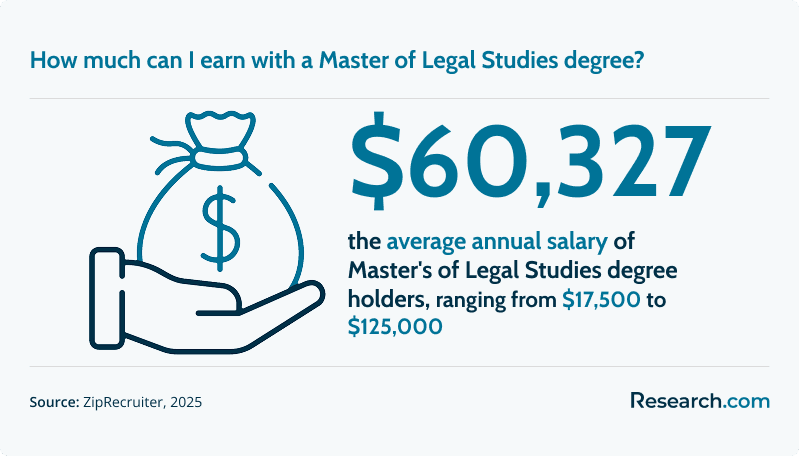
MLS-related earnings depend heavily on job title, industry, location, experience, employer type, and whether the degree leads to a promotion. The average salary for MLS holders is $60,327, with earnings ranging from $17,500 to $125,000. Compliance officers earned an average of $80,190 in 2023, making compliance one of the most concrete salary reference points for MLS-aligned careers.
Some industries pay substantially more for compliance expertise. Compliance officers in web search portals earned $126,290 in 2023, while aerospace product manufacturing paid $118,070 and natural gas distribution paid $110,660. Federal government roles also ranked highly, with average pay of $94,320 annually.
Cost matters just as much as salary. With tuition costs between $20,000 and $50,000, an MLS can be a reasonable investment for professionals who use it to move into better-paid compliance, management, regulatory, or legal-adjacent roles. It may be a weaker investment for students who enroll without a target job, employer support, or a clear promotion path. Students comparing graduate programs by earning potential may also review Research.com’s guide to master’s degrees with strong salary outcomes.
| Salary figure | What it refers to | How to use it when evaluating ROI |
| $60,327 | Average salary for MLS degree holders | Use as a broad benchmark, not a guaranteed outcome |
| $17,500 to $125,000 | Reported salary range for MLS degree holders | Shows how widely outcomes differ by role, experience, and industry |
| $80,190 | Average salary for compliance officers in 2023 | Useful reference for one of the most common MLS-aligned occupations |
| $94,320 | Average federal government salary for compliance professionals | Highlights the value of regulated public-sector roles |
| $126,290 | Compliance officer pay in web search portals in 2023 | Shows the high end of specialized industry opportunities |
| $118,070 | Compliance officer pay in aerospace product manufacturing in 2023 | Useful for students targeting technical or highly regulated industries |
| $110,660 | Compliance officer pay in natural gas distribution | Shows another regulated industry where compliance expertise can command higher pay |
What is the job market for MLS graduates?
The MLS job market is best described as steady and specialized. The degree does not map to one single occupation, so graduates should not evaluate the market by looking only at “legal studies” job titles. Instead, they should examine the occupations where legal knowledge is part of the role, including compliance, management analysis, HR, healthcare administration, contracts, policy, risk, and regulatory affairs.
Compliance officer roles are projected to grow by 5% from 2023 to 2033, with 34,400 average annual job openings. That points to stable demand, especially in regulated industries. Other related occupations may grow faster. Medical and health services managers are projected to grow by 29%, with over 61,000 job openings per year. Human resources management is projected to grow by 6%, while management analysis is projected to grow by 11%.
| Occupation area | Growth or openings stated | MLS relevance |
| Compliance officers | 5% growth from 2023 to 2033; 34,400 average annual job openings | One of the clearest MLS-aligned career paths |
| Medical and health services managers | 29% growth; over 61,000 job openings per year | Strong fit for MLS students focused on health law, privacy, ethics, or healthcare compliance |
| Human resources managers | 6% growth | Useful for professionals applying employment law and workplace policy |
| Management analysts | 11% growth | Relevant for consultants and analysts working on policy, risk, operations, or regulatory change |
The main takeaway is that an MLS can strengthen career prospects in legal-adjacent fields, but it does not guarantee a specific job. Experience, specialization, industry knowledge, networking, and employer demand all affect outcomes.
Common mistakes to avoid before enrolling in an MLS program
- Assuming an MLS lets you practice law: It does not generally qualify graduates for attorney licensure or bar admission.
- Choosing a program based only on convenience: Online flexibility is valuable, but curriculum, faculty, specialization fit, and career support matter more.
- Ignoring total cost: Compare tuition, fees, books, travel, technology, lost work time, and interest if borrowing.
- Skipping accreditation checks: Confirm that the institution is properly accredited before applying.
- Expecting salary guarantees: MLS salary outcomes range widely, and the degree’s value depends on your role, industry, and experience.
- Picking a specialization without checking job postings: Employers tell you what they value through job descriptions. Use those descriptions to guide your concentration.
- Relying only on rankings: A highly visible school may not be the best fit if it lacks your specialization, career support, or workable cost.
- Overlooking employer support: Tuition assistance, promotion pathways, and internal mobility can dramatically change the ROI calculation.
What graduates say about the value of an MLS
- “I chose the MLS because I needed stronger legal knowledge for business leadership. I was already involved with contracts and negotiations, but I often depended on others to explain the legal implications. Courses in business law helped me read agreements more confidently and communicate better with counsel. After finishing the program, I moved into corporate compliance work that would have been difficult to pursue before.” Lee
- “My background was cybersecurity, but data privacy work made it clear that technical skill was only part of the job. I needed to understand the legal rules behind privacy, breach response, and risk decisions. The MLS helped me connect security controls with compliance obligations, and the online format made it possible to keep working while studying.” Ethan
- “I considered law school, but I did not want to become an attorney. I wanted to move from finance into regulatory compliance. The MLS gave me targeted training in financial regulation and compliance policy without taking me out of the workforce for years. It helped me qualify for a compliance analyst role with better pay.” Haley
Key Insights
- An MLS is most valuable for professionals who need legal fluency at work but do not need a law license.
- The degree fits compliance, HR, healthcare administration, finance, public policy, cybersecurity/data privacy, risk management, contracts, and corporate governance better than traditional legal practice.
- Compliance is the clearest career pathway. In 2023, there were 383,620 compliance officers in the US, and they earned an average annual salary of $80,190.
- Salary outcomes vary. MLS holders average $60,327, with earnings ranging from $17,500 to $125,000, so ROI depends on your industry, experience, and career plan.
- High-paying compliance industries can exceed six figures, including web search portals at $126,290 and aerospace product manufacturing at $118,070 in 2023.
- The job market is stable, not automatic. Compliance officer roles are projected to grow by 5% from 2023 to 2033, while medical and health services managers are projected to grow by 29%.
- Online MLS programs can be worthwhile for working professionals, but only if the program has the right accreditation, specialization, faculty, applied learning, and career support.
- The MLS is not a substitute for a JD. If your goal is to become an attorney, represent clients, or take the bar exam, you need a different legal education path.
- The best decision test is practical: identify your target role, compare job requirements, estimate salary change, calculate total cost, and choose a specialization that directly supports your career move.
References:
- Bureau of Labor Statistics. (2024). Human resources managers. Retrieved February 24, 2025, from BLS.
- Bureau of Labor Statistics. (2024). Management analysts. Retrieved February 24, 2025, from BLS.
- Bureau of Labor Statistics. (2024). Medical and health services managers. Retrieved February 24, 2025, from BLS.
- Bureau of Labor Statistics. (2024). Occupational employment and wages, May 2023 - 13-1041 compliance officers. Retrieved February 24, 2025, from BLS.
- Data USA. (2025). General legal studies. Retrieved February 24, 2025, from Data USA.
- ZipRecruiter. (2025). Masters in legal studies salary. Retrieved February 24, 2025, from ZipRecruiter.
Other Things You Should Know About Master of Legal Studies
Most Master of Legal Studies programs do not require GRE or LSAT scores in 2027. Many schools review transcripts, a résumé, a statement of purpose, and sometimes letters of recommendation instead. A few programs waive test scores entirely, while others may request them for conditional admission or scholarship review.
In 2027, Master of Legal Studies graduates can pursue careers in compliance, human resources, and legal consulting. They often work in industries like healthcare, finance, and government, handling regulatory issues and legal affairs, without practicing law as attorneys.





