
2027 Psychometrician Careers: Guide to Career Paths, Options & Salary

Co-Founder and Chief Data Scientist
Becoming a psychometrician is not as straightforward as choosing a single undergraduate major. Most people enter the field through psychology, statistics, education, mathematics, or research-focused programs, then specialize in measurement, testing, and data analysis through graduate study or supervised experience. That makes the career path flexible—but also confusing if you are trying to choose the right degree, certification, or first job.
This guide explains how psychometrician careers work, what education is usually expected, which entry-level roles can help you build experience, and how to decide whether psychometrics is the right fit. You will also learn how salaries, certifications, graduate degrees, ethics, AI, and interdisciplinary training affect long-term career options in education, healthcare, government, business, and research.
Quick Answer: How do you become a psychometrician?
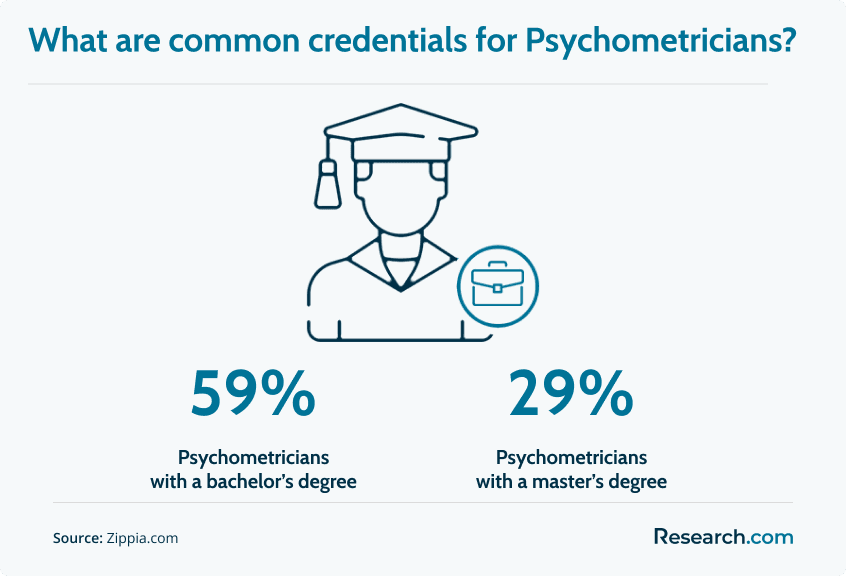
Most psychometricians begin with a bachelor’s degree in psychology, statistics, mathematics, education, engineering, or a related field, then pursue graduate-level training in psychometrics, quantitative psychology, educational measurement, statistics, or research methods. A master’s degree is typically needed for full psychometrician roles, while doctoral training is common for senior research, test development, academic, and leadership positions.
Certification alone usually is not enough to become a psychometrician, but it can strengthen qualifications for assessment administration, scoring, and psychometrist roles. The field offers strong earning potential, with an average salary of $93,290 annually and salaries ranging from $62,000 to $139,000 depending on role, education, experience, and industry.
Key Things You Should Know About Psychometricians
- Psychometrics is a measurement career, not only a psychology career. Psychometricians use statistics, research design, and behavioral science to build and evaluate tests, surveys, assessments, and rating systems.
- Graduate education matters. A master’s or doctorate in quantitative psychology, psychometrics, educational measurement, statistics, or a closely related area is typically important for advancement.
- The average salary is $93,290 per year. Reported salaries range from $62,000 to $139,000, with higher earnings often tied to advanced education, specialized technical skills, and senior roles.
- Government roles are a major employment path. In 2023, the Federal Government’s civilian sector accounted for 58.3% of psychometrician jobs in the United States.
- Projected job growth is 6% from 2018 to 2028. Demand is supported by the need for fair, valid, data-driven assessments in education, healthcare, licensing, employment, and organizational decision-making.
- Why pursue a career in psychometrics?
- What is the career outlook for psychometrics for 2027?
- What certifications can enhance a psychometrician's career?
- How can psychometrics complement counseling and mental health services?
- Should I pursue a PhD or PsyD for my psychometrics career?
- Is an online accelerated psychology degree beneficial for aspiring psychometricians?
- What are the required skills for a psychometrician?
- How to Start Your Career in Psychometrics
- How can I advance my career in psychometrics?
- Can online integrated programs accelerate psychometric career growth?
- How do applied behavior analysis principles influence psychometric assessment development?Graduate advancement options
- How do ethical and legal considerations shape psychometric practices?
- How can interdisciplinary studies enhance psychometric innovation?
- What are the alternative career options for a psychometrician?
- How does continuous education boost psychometric career success?Alternative rolesCareer planning questions
Why pursue a career in psychometrics?
Psychometrics is a strong career choice for people who want to use data to make assessments more accurate, fair, and useful. Psychometricians help create and validate tests used in school admissions, professional certification, employee selection, clinical screening, program evaluation, and research. Their work can affect whether a test measures what it claims to measure, whether results are reliable, and whether decisions based on those results are defensible.
The field is also appealing because it sits at the intersection of psychology, statistics, education, technology, and policy. A psychometrician may work with educators, clinicians, software developers, government agencies, human resources teams, or researchers. In the United States, the Federal Government’s civilian sector employed the largest share of psychometricians in 2023, accounting for 58.3% of jobs in the field.
If you are still early in your education, a 2-year psychology degree online can help you explore psychological theory, research methods, and basic data analysis before committing to a longer pathway.
| Reason to Choose Psychometrics | Why It Matters | Best Fit For |
| Strong connection to real-world decisions | Assessments influence education, employment, licensing, healthcare, and research outcomes. | Students who want analytical work with practical impact |
| Blend of psychology and statistics | The field requires both understanding human behavior and interpreting measurement data. | People who enjoy quantitative reasoning and behavioral science |
| Multiple industry options | Psychometric skills can apply in testing companies, schools, government, healthcare, business, and research organizations. | Professionals who want career flexibility |
| Advanced technical specialization | Graduate study can lead to roles in test development, validation, research, and leadership. | Students willing to pursue master’s or doctoral training |
What is the career outlook for psychometrics for 2027?
Psychometrician roles are projected to grow by 6% from 2018 to 2028. The need for skilled measurement professionals continues as schools, employers, healthcare organizations, and government agencies depend on assessments to support high-stakes decisions. The strongest candidates are usually those who can combine statistical modeling, assessment design, research ethics, and clear communication.
The field is also being reshaped by technology. Computer-based testing, adaptive assessments, automated scoring, digital survey platforms, AI-assisted analytics, and larger behavioral datasets are changing how assessments are built and evaluated. These tools do not remove the need for psychometricians; they increase the need for professionals who understand validity, reliability, fairness, bias, and responsible interpretation.
Psychometricians who want to expand their technical toolkit may benefit from advanced training in machine learning, data modeling, and analytics. A program such as the cheapest online master’s in artificial intelligence can be relevant for professionals who want to connect psychometrics with AI-driven assessment systems.
Current trends affecting psychometrician careers
- AI-assisted assessment is growing. Psychometricians increasingly need to evaluate whether automated tools produce valid, reliable, and fair results.
- Employers expect stronger data skills. Knowledge of statistics, research design, and data visualization can separate competitive candidates from those with only general psychology training.
- Ethics and fairness are central. Bias detection, privacy, consent, accessibility, and defensible test use are major concerns in assessment work.
- Interdisciplinary credentials can help. Training in education, public policy, counseling, behavior analysis, forensic psychology, AI, or business can open specialized career directions.
What certifications can enhance a psychometrician's career?
Certifications can help demonstrate practical competence, especially in test administration, scoring, behavioral assessment, and specialized measurement practices. They are most useful when combined with a degree and supervised experience. For many psychometrician roles, employers still prioritize graduate coursework in statistics, measurement theory, research methods, and test validation.
Certification is particularly valuable for professionals who administer assessments, coordinate testing programs, support clinical or educational evaluators, or want to show commitment to professional standards. Professionals who want to add behavioral assessment expertise may also explore board certified behavior analyst programs online.
| Credential or Training Option | Best Use | Important Limitation |
| Board-level psychometrist certification | Supports roles involving administering and scoring psychological or neuropsychological assessments. | Does not replace graduate preparation for psychometrician-level research and test development roles. |
| Certified Specialist in Psychometry | Can strengthen credibility for professionals working in psychometry under supervision. | Eligibility depends on education and supervised experience requirements. |
| Behavior analysis training | Useful for assessment work involving behavior, intervention planning, and measurable outcomes. | May be complementary rather than central for test development careers. |
| Graduate certificates in statistics or measurement | Helpful for building targeted quantitative skills. | Usually most valuable when attached to a broader graduate degree or relevant work experience. |
How can psychometrics complement counseling and mental health services?
Psychometrics supports counseling and mental health work by improving how practitioners select, interpret, and evaluate assessments. Well-designed instruments can help clinicians identify client needs, track changes over time, evaluate intervention outcomes, and communicate findings more clearly. Psychometricians do not necessarily provide therapy, but their work helps ensure that assessment tools used in therapeutic settings are accurate, appropriate, and responsibly interpreted.
Students who want to combine assessment knowledge with direct client support should understand the counseling pathway separately. Reviewing how do you become a counselor can help you compare counseling licensure, clinical training, and assessment-focused career options.
Should I pursue a PhD or PsyD for my psychometrics career?
A PhD is usually the stronger fit for psychometricians who want to focus on research, statistical modeling, measurement theory, test validation, educational measurement, or academic careers. A PsyD is more clinically oriented and may be useful for professionals who want to apply assessment in mental health, neuropsychology, or clinical service settings. The right choice depends on whether you want to build tests and conduct research or use assessments primarily in clinical practice.
| Degree Path | Primary Focus | Best For | Potential Psychometrics Connection |
| PhD | Research, quantitative methods, theory, and original scholarship | Future researchers, professors, senior psychometricians, and test development leaders | Strongest fit for advanced measurement, statistical modeling, and validation work |
| PsyD | Clinical practice, assessment, diagnosis, and applied psychological services | Future clinicians who want to use assessments with clients | Useful for clinical assessment, but usually less research-intensive than a PhD |
If your interest is clinical practice with flexible study options, compare requirements carefully before choosing among PsyD programs online. Make sure any program you consider aligns with your state’s licensing expectations if you intend to become a licensed psychologist.
Is an online accelerated psychology degree beneficial for aspiring psychometricians?
An online accelerated psychology degree can be useful if you need a faster route to foundational coursework in psychology, research methods, statistics, and human behavior. It may help career changers, working adults, or transfer students move more quickly toward graduate admission requirements.
However, an accelerated psychology degree is usually only the beginning. Psychometrician roles require deeper training in measurement, advanced statistics, test construction, reliability, validity, item analysis, and research design. Before enrolling, check whether the program includes quantitative coursework, faculty research opportunities, transfer credit policies, and preparation for graduate study.
What are the required skills for a psychometrician?
Psychometricians need more than general psychology knowledge. They must be able to design assessments, analyze data, evaluate measurement quality, communicate findings, and identify problems that could make test results unfair or misleading. The strongest professionals combine technical precision with practical judgment.
- Statistical analysis: Psychometricians use methods such as correlation, regression, distributions, reliability analysis, and validity evidence to evaluate assessment quality.
- Measurement theory: Professionals need to understand how tests are built, scored, normed, validated, and interpreted.
- Data management: Clean, organized, secure data is essential because errors can affect scoring, reporting, and decision-making.
- Attention to detail: Small mistakes in item wording, scoring rules, sampling, or analysis can undermine fairness and accuracy.
- Critical thinking: Psychometricians must decide whether an assessment truly measures the intended construct and whether results support the intended use.
- Communication: They often explain technical findings to educators, clinicians, executives, policymakers, or product teams that may not have statistical training.
- Ethical judgment: Confidentiality, informed consent, accessibility, cultural fairness, and bias reduction are central to responsible assessment work.
- Adaptability: Digital testing, AI, adaptive assessment, and new data tools require ongoing learning.
| Skill Area | Why It Matters | How to Build It |
| Statistics | Supports reliability, validity, scoring, and interpretation. | Take coursework in statistics, probability, regression, and research methods. |
| Psychology and behavior | Helps define what an assessment is intended to measure. | Study cognitive, developmental, educational, clinical, or organizational psychology. |
| Research design | Improves the quality of validation studies and assessment development. | Work as a research assistant or join faculty-led research projects. |
| Technical communication | Turns statistical findings into usable recommendations. | Practice writing reports, presenting findings, and explaining methods to non-specialists. |
How to Start Your Career in Psychometrics
Because psychometrics is rarely offered as a standalone undergraduate major, the best starting point is a related bachelor’s degree with strong quantitative coursework. Good options include psychology, statistics, mathematics, education, engineering, data science, or social science research. Look for classes in college algebra, statistics, probability, research methods, psychological testing, experimental design, and advanced mathematics.
Hands-on experience matters early. Try to work in a research lab, testing center, school assessment office, healthcare setting, survey research group, or data-focused internship. These experiences help you learn how assessments are administered, how data is cleaned, and how research findings are interpreted.
| Early-Career Role | What You Do | Median Salary | Why It Helps |
| Research Assistant | Help collect, organize, and analyze data for psychology, education, or social science studies. | $40,000 | Builds research, data, and statistical experience. |
| Data Entry Specialist | Prepare and manage datasets used for analysis and reporting. | $38,000 | Develops accuracy, documentation, and data quality habits. |
| Testing Coordinator | Support test administration in schools, testing centers, or assessment programs. | $42,000 | Introduces testing procedures, compliance, and examinee support. |
If you are interested in assessment work within healthcare or counseling environments, learning about the rehabilitation counselor career path can show how data-informed planning supports clients with functional, vocational, or health-related needs.
What can I do with a Bachelor’s Degree in Psychometrics?
A bachelor’s degree alone may not qualify you for full psychometrician positions, but it can lead to assessment, survey, research, human resources, and data support roles. These jobs can help you decide whether to pursue graduate study and can provide experience that strengthens future applications.
| Bachelor’s-Level Role | Main Responsibilities | Median Salary |
| Assessment Specialist | Support the design, administration, and analysis of assessments used in education, healthcare, or workplace training. | $55,000 |
| Survey Analyst | Collect, clean, and interpret survey data for businesses, government agencies, or research organizations. | $58,000 |
| Human Resources Analyst | Apply assessment and data analysis methods to hiring, training, employee development, and workforce planning. | $60,000 |
Students interested in healthcare assessment, patient outcomes, or administrative evaluation may also consider how a healthcare administration online degree could complement a psychometrics background.
Can you get a psychometrics job with just a certificate?
A certificate can help, but it usually cannot replace a degree for psychometrician roles. Most psychometrician jobs require at least a bachelor’s degree, and many require graduate-level training. Certification is most useful for psychometrist positions, test administration, scoring, and related assessment support roles.
The Board of Certified Psychometrists offers board-level certification for professionals who administer and score psychometric assessments. This credential can signal professional competence, but it does not by itself qualify someone for advanced psychometrician work involving test construction, validation, or statistical modeling.
The National Association of Psychometrists (NAP) requires psychometrists to hold a bachelor’s degree in psychology or a related field from an accredited institution. NAP also recommends Certified Specialist in Psychometry status. Candidates with a bachelor’s degree need at least 3,000 hours of supervised experience in test administration and scoring to qualify for the exam, while candidates with a master’s or doctoral degree need 2,000 hours.
If you want a psychology-adjacent career that applies assessment and personal development tools in a client-facing setting, you may also compare career opportunities in transformational coaching.
How can I advance my career in psychometrics?
Career advancement in psychometrics usually depends on graduate education, stronger quantitative skills, specialized software experience, and a portfolio of applied assessment work. A master’s degree can prepare you for psychometrician, assessment specialist, testing consultant, and measurement roles. A doctorate may be needed for senior research, academic, leadership, and advanced test development positions.
Graduate programs in quantitative psychology, educational measurement, psychometrics, statistics, or research methodology are especially relevant. Look for programs with coursework in item response theory, classical test theory, factor analysis, test equating, validity, reliability, sampling, research design, and statistical computing.
Professionals interested in assessment, evaluation, and decision-making in government or nonprofit settings may also find an online master’s in public policy useful for building policy analysis and program evaluation skills.
What can I do with a Master’s in Psychometrics?
| Master’s-Level Role | What You Do | Median Salary |
| Psychometrician | Develop, evaluate, and validate assessments used in education, healthcare, employment, and research. | $93,000 |
| Assessment and Measurement Specialist | Analyze tests, surveys, and assessment systems for schools, companies, or research organizations. | $85,000 |
| Educational Testing Consultant | Advise schools, testing organizations, and policymakers on standardized tests, assessment design, and curriculum evaluation. | $80,000 |
Some graduate-trained professionals apply psychological measurement in specialized areas of personal development, spirituality, or wellness. The spiritual psychology career guide offers one example of how psychology-based training can be applied in niche practice settings.
What kind of job can I get with a Doctorate in Psychometrics?
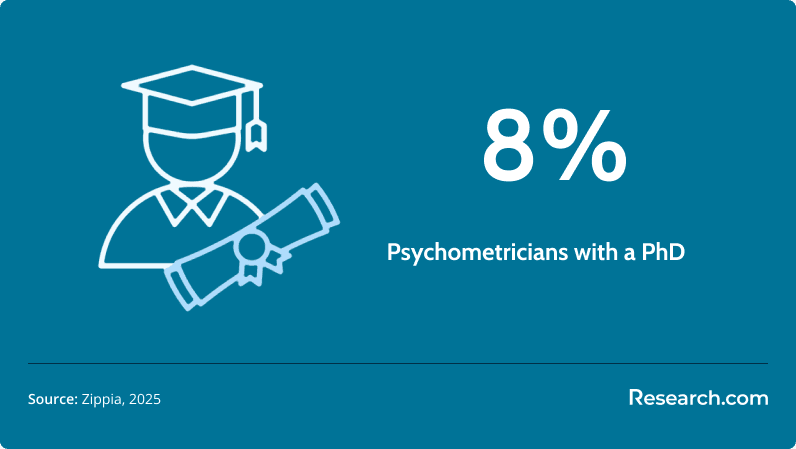
Doctoral training is most valuable if you want to lead assessment design, conduct original research, teach at the graduate level, or work on complex measurement systems. Doctorate-level psychometricians often handle advanced statistical modeling, adaptive testing, large-scale assessment programs, and research leadership.
| Doctorate-Level Role | Typical Work | Median Salary |
| Senior Psychometrician | Lead advanced assessment development using approaches such as item response theory and adaptive testing. | $120,000 |
| Quantitative Research Scientist | Study measurement methods, statistical models, and assessment systems for psychological or educational testing. | $115,000 |
| Professor of Psychometrics | Teach graduate-level courses in measurement, quantitative psychology, and research methods while conducting independent research. | $100,000 |
Doctoral-level psychometricians may collaborate across education, psychology, policy, healthcare, and social services. For a broader view of how professionals work at individual, organizational, and systems levels, see this guide to levels of social work,.
Can online integrated programs accelerate psychometric career growth?
Online integrated programs can help some students move more efficiently from foundational psychology coursework into advanced clinical or research preparation. They may be especially useful for working adults who need flexible scheduling, structured sequencing, and a clear path toward graduate credentials.
For psychometrics, the value of an online integrated program depends on its quantitative depth. A convenient format is not enough. Before enrolling, confirm that the curriculum includes advanced statistics, research design, assessment, measurement, supervised projects, and faculty expertise related to testing or evaluation. Students comparing clinical and assessment-focused routes may want to review masters and PsyD combined programs online.
How do applied behavior analysis principles influence psychometric assessment development?
Applied behavior analysis can strengthen psychometric work when assessments are designed to measure observable behavior, intervention progress, skill acquisition, or functional outcomes. ABA emphasizes measurable behavior and data-based decision-making, which can help psychometricians build tools that are more specific, practical, and useful in educational, clinical, or organizational settings.
Training from ABA therapy programs may be helpful for psychometricians who want to design behavior-focused assessments, evaluate intervention outcomes, or collaborate with clinicians and educators who use behavioral data.
How do ethical and legal considerations shape psychometric practices?
Ethics are central to psychometrics because assessment results can affect people’s education, employment, healthcare access, diagnosis, certification, and services. Psychometricians must consider confidentiality, informed consent, data security, accessibility, fairness, cultural bias, appropriate test use, and clear reporting.
Legal considerations also matter. Assessment programs may need to address non-discrimination requirements, intellectual property, privacy rules, accommodation procedures, and documentation standards. A technically strong test can still create risk if it is used for the wrong purpose, administered inconsistently, or interpreted beyond the evidence available.
Professionals working with children, adolescents, families, or clinical populations may benefit from specialized training such as an affordable master’s in child and adolescent psychology online, especially when assessment decisions must account for development, context, and ethical safeguards.
How can interdisciplinary studies enhance psychometric innovation?
Interdisciplinary training can make a psychometrician more effective by adding context to measurement problems. For example, education helps with classroom and standardized testing, business supports workforce assessment, public policy strengthens program evaluation, AI adds computational methods, and forensic psychology contributes legal and investigative perspectives.
Forensic training can be especially relevant when assessments are used in legal, correctional, investigative, or risk-related contexts. Students interested in that direction may compare options such as a cheap online forensic psychology master's to build domain knowledge alongside measurement skills.
What are the alternative career options for a psychometrician?
Psychometric training is useful beyond traditional testing organizations. Because psychometricians understand surveys, data quality, validity, reliability, and human behavior, they can move into roles involving market research, user research, human resources analytics, training evaluation, business intelligence, and program evaluation.
What else can a psychometrician do?
| Alternative Career | How Psychometric Skills Apply | Best Fit For |
| Market Research Analyst | Design surveys, analyze consumer behavior, and interpret public opinion or purchasing data. | Professionals interested in business, consumer insights, and survey research |
| User Experience Researcher | Study how people interact with products, services, or digital platforms using evidence-based research methods. | Psychometricians who enjoy technology, usability testing, and product design |
| Corporate Training and Development Specialist | Create and evaluate employee assessments, learning outcomes, leadership tools, and competency measures. | Professionals interested in workplace learning and organizational development |
| Business Intelligence Analyst | Analyze trends, performance data, and organizational processes to support strategic decisions. | Data-oriented professionals who want broader business impact |
Psychometricians who want to move into executive decision-making, analytics leadership, or strategy may consider executive MBA programs online to pair quantitative expertise with management training.
How does continuous education boost psychometric career success?
Psychometrics changes as assessment platforms, data tools, AI methods, legal expectations, and ethical standards evolve. Continuous education helps professionals keep their methods current and avoid relying on outdated testing practices. It also makes it easier to move into specialized areas such as clinical assessment, workforce analytics, adaptive testing, behavioral assessment, program evaluation, or educational measurement.
Continuing education does not always mean another full degree. It can include graduate certificates, software training, professional workshops, supervised assessment experience, research collaborations, and conference participation. For professionals who want to connect assessment with family systems, counseling, or mental health services, online masters MFT programs may offer a complementary route.
How to choose the right psychometrics education path
The best path depends on your current education level, career goal, budget, and willingness to complete graduate study. Do not choose a program only because it has “psychology” in the title. Psychometrician roles require measurable quantitative preparation.
- Clarify your target role. Decide whether you want to administer tests, build assessments, analyze large datasets, conduct research, work clinically, or lead testing programs.
- Check the quantitative curriculum. Look for statistics, measurement theory, research design, test construction, psychometrics, and advanced data analysis.
- Review faculty expertise. Faculty research in assessment, quantitative psychology, educational measurement, or statistics is a strong sign of program fit.
- Ask about applied experience. Prioritize programs with research assistantships, internships, practicum opportunities, thesis projects, or assessment labs.
- Compare cost and time carefully. Tuition is only one factor; also consider fees, technology requirements, lost income, transfer credit, and financial aid.
- Confirm accreditation and licensure relevance. Accreditation matters, and clinical routes may have state-specific licensing rules.
- Evaluate outcomes realistically. Ask where graduates work, what roles they hold, and whether the program has a track record in measurement-related careers.
Common mistakes to avoid when planning a psychometrician career
| Mistake | Why It Can Hurt You | Better Approach |
| Choosing a psychology program with little statistics coursework | You may graduate without the quantitative preparation needed for psychometrics. | Choose programs with strong research methods, statistics, and measurement coursework. |
| Assuming a certificate is enough | Certificates can help with psychometrist roles but rarely replace degree requirements for psychometricians. | Use certification to supplement, not replace, degree-based preparation and supervised experience. |
| Focusing only on tuition | A cheaper program may not offer the coursework, faculty, or research experience you need. | Compare curriculum, outcomes, faculty expertise, support services, and total cost. |
| Ignoring accreditation | Unaccredited or poorly recognized programs can limit employment, transfer, financial aid, or licensure options. | Verify institutional accreditation before applying. |
| Assuming online programs all meet professional goals | Some online programs are flexible but not designed for measurement-intensive careers. | Ask whether the program includes psychometrics, advanced statistics, and applied research opportunities. |
| Expecting salary outcomes to be guaranteed | Pay varies by education, employer, location, role, and experience. | Use salary figures as planning benchmarks, not promises. |
Questions to ask before choosing a psychometrics program
- Does the program include coursework in psychometrics, measurement theory, test development, and validation?
- How much advanced statistics training is required?
- Are students able to work on real assessment, survey, testing, or research projects?
- Do faculty members publish or work in quantitative psychology, educational measurement, assessment, or statistics?
- What software, data analysis, or statistical computing tools will I learn?
- Does the program prepare students for master’s-level employment, doctoral study, or both?
- Are internships, assistantships, practicum experiences, or thesis options available?
- What kinds of jobs do graduates enter?
- Is the institution accredited?
- If the program is online, are there any in-person requirements, supervised experience requirements, or state restrictions?
What graduates say about psychometrician careers
-
: "
Psychometrics gave me a way to connect data analysis with decisions that affect real people. The work can be technical, but the goal is practical: better measurement and fairer interpretation. – Nico
"
-
: "
I have worked on projects connected to education, healthcare, and workplace assessment. The variety is one of the best parts of the field, and strong test design skills are useful in many settings. – Carlos
"
-
: "
The job rewards careful thinking. Every assessment project requires precision, collaboration, and the ability to explain complex results in a way other professionals can use. – Bern
"
References:
- U.S. Bureau of Labor Statistics. (2011). You’re a what? Psychometrician. U.S. Department of Labor BLS.
- Careers in Psychology. (n.d.). How to become a psychometrician. CareersInPsychology.org.
- Learn.org. (n.d.). Psychometrician career and salary FAQs. Learn.org.
- All Psychology Schools. (n.d.). Psychometrician careers: What they do and how to become one. AllPsychologySchools.com.
- Zippia. (n.d.). Psychometrician salaries. Zippia.
- Franklin University. (n.d.). What do psychometricians do? Franklin University.
Key Insights
- Psychometrics is best for people who like both data and human behavior. The field combines psychology, statistics, testing, ethics, and research design.
- A bachelor’s degree can open support roles, but advancement usually requires graduate study. Master’s degrees often support psychometrician roles, while doctorates are common for senior research, academic, and leadership positions.
- Certification is useful but limited. It can strengthen psychometrist and assessment support credentials, but it usually does not replace degree and experience requirements for psychometricians.
- Quantitative coursework should drive your program choice. Prioritize statistics, measurement theory, test validation, research methods, and applied data experience over program titles alone.
- Career options extend beyond testing companies. Psychometricians can work in education, government, healthcare, business, market research, UX research, human resources analytics, and program evaluation.
- Ethics and fairness are not optional. Validity, reliability, privacy, accessibility, and bias reduction are central to responsible assessment work.
- AI and digital testing are changing the field. Psychometricians who understand both measurement quality and emerging technology will be better positioned for future opportunities.
Other Things You Should Know about a Psychometrician Career
A strong preparation includes undergraduate courses in psychology, statistics, research methods, and measurement theory. Graduate study in psychometrics, educational measurement, or industrial-organizational psychology usually adds advanced testing, test construction, and data analysis training needed for work in assessment and test development.
In 2027, aspiring psychometricians typically need certifications such as the Certified Specialist in Psychometry (CSP) from the Board of Certified Psychometrists. These qualifications enhance career prospects and validate expertise in psychometric practices. Check specific state or country requirements, as they might vary.





