
2027 Best Accelerated Healthcare Administration Degree Programs Online

Co-Founder and Chief Data Scientist
Healthcare administrators oversee the planning, direction, and coordination of medical and health services. They are crucial in enhancing care coordination, which is essential for team-based care. An accelerated online healthcare administration degree equips you for this in-demand position.
Our research team has examined several accelerated healthcare administration degree programs online, which are tailored for working adults seeking a quicker and more flexible educational route compared to traditional programs. This article lists these programs and provides information on the requirements, benefits, and other aspects of becoming a healthcare administrator.
What are the benefits of getting an online accelerated healthcare administration degree?
- Graduates of online accelerated healthcare administration programs can manage various departments and navigate complex regulations in hospitals, clinics, ambulatory surgical centers, and public health agencies.
- In May 2023, medical and health services managers had a median annual salary of $110,680.
- Online accelerated healthcare administration programs provide a concentrated curriculum tailored for working adults. They enable you to complete your bachelor's degree in a reduced timeframe, typically within one to two years.
What can I expect from an online accelerated healthcare administration degree?
If you are looking to propel your career in healthcare management but traditional degree programs seem too time-consuming, an online accelerated healthcare administration program might be the perfect solution. These programs offer a focused curriculum for working adults, allowing you to earn your bachelor's degree in a shorter timeframe, often within one to two years.
Delivered online, these programs provide flexibility to fit your busy schedule, with asynchronous coursework that lets you study on your terms. Despite the accelerated pace, you will gain a strong foundation in healthcare leadership, finance, operations, and policy, preparing you for a rewarding career in managing hospitals, clinics, or other healthcare settings.
Where can I work with an online accelerated healthcare administration degree?
Graduates of online healthcare administration degree programs find themselves well-positioned for various career paths within the ever-evolving healthcare landscape. Hospitals and health systems naturally represent a large portion of these opportunities. Within these organizations, you could find yourself managing departments like emergency rooms, laboratories, or billing offices.
Beyond hospitals, there is also a growing demand for skilled administrators in clinics, ambulatory surgical centers, and even physician practices. The knowledge gained from these programs can also translate to non-clinical healthcare settings. Insurance firms, pharmaceutical companies, and public health agencies all rely on strong leadership to navigate complex regulations and deliver quality care.
How much can I make with an online healthcare administration degree?
As of May 2023, the median annual salary for medical and health services managers was $110,680. This means that half of the workers in this field earned more than this amount, while the other half earned less. The lowest 10% earned under $67,900, and the top 10% earned over $216,750.
Most medical and health services managers work full-time, with some working more than 40 hours per week. Jobs in healthcare settings like hospitals and nursing homes may require evening or weekend shifts. Additionally, these managers may need to be on call for emergencies.
- 2027 List of the Best Online Accelerated Healthcare Administration Programs Program List
- How long does it take to complete an online accelerated healthcare administration program? How long does it take to complete an online accelerated healthcare administration program?
- How does an online healthcare administration degree compare to an on-campus program? How does an online healthcare administration degree compare to an on-campus program?
- What is the average cost of an online accelerated healthcare administration program? Program Cost
- What are the financial aid options for students enrolling in an online accelerated healthcare administration? Financial Aid
- What are the prerequisites for enrolling in an online accelerated healthcare administration? Program Requirements
- What courses are typically in an online accelerated healthcare administration? What courses are typically in an online accelerated healthcare administration?
- What types of specializations are available in online accelerated healthcare administration programs? What types of specializations are available in online accelerated healthcare administration programs?
- How to choose the best online accelerated healthcare administration programs? How to choose the best online accelerated healthcare administration programs?
- What career paths are available for graduates of online healthcare administration programs? What career paths are available for graduates of online healthcare administration programs?
- What is the job market for graduates of online healthcare administration programs? Job Outlook
- What role does accreditation play in ensuring the quality of healthcare administration programs? What role does accreditation play in ensuring the quality of healthcare administration programs?
- What challenges might students face in online accelerated healthcare administration programs? What challenges might students face in online accelerated healthcare administration programs?
- What professional certifications can advance a career in healthcare administration? Professional Certifications
- What complementary advanced clinical credentials can further elevate healthcare administration? What complementary advanced clinical credentials can further elevate healthcare administration?
- How do regulatory changes and technological innovations influence online accelerated healthcare administration programs? How do regulatory changes and technological innovations influence online accelerated healthcare administration programs?
- How do industry partnerships and interdisciplinary skills boost career prospects? How do industry partnerships and interdisciplinary skills boost career prospects?
2027 Guide to the Best Online Accelerated Healthcare Administration Programs
An online accelerated healthcare administration degree can help working adults move into healthcare management faster than a traditional four-year route, but speed should not be the only factor in your decision. The right program must fit your transfer credits, schedule, budget, career goals, and need for employer-recognized accreditation.
This guide explains how accelerated online healthcare administration programs work, how long they take, what they cost, how to compare schools, and what career outcomes to expect. It also highlights ranked programs, financial aid options, admissions requirements, common courses, specializations, technology trends, and practical questions to ask before enrolling.
Quick Answer: Is an Online Accelerated Healthcare Administration Degree Worth Considering?
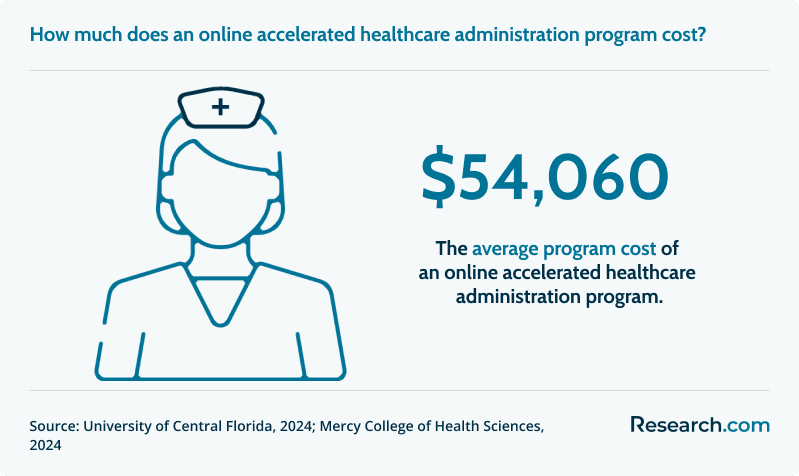
An online accelerated healthcare administration program may be a good fit if you already have college credits, need a flexible format, and want to enter or advance in healthcare management without pausing your career. Full-time accelerated programs commonly take 12-18 months, while part-time options often take 24-30 months. A 120-credit online accelerated healthcare administration program can cost from $21,480 to $86,640, with an average of $54,060.
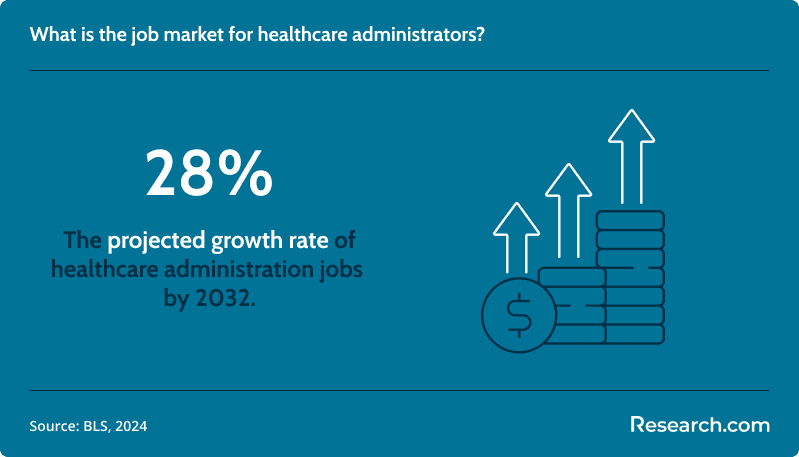
Graduates often pursue roles related to medical and health services management in hospitals, outpatient care centers, physicians’ offices, government agencies, insurance organizations, and long-term care settings. According to the U.S. Bureau of Labor Statistics, employment for medical and health services managers is projected to grow by 28% from 2022 to 2032, with about 54,700 openings each year.
How do we rank schools?
Research.com evaluates online healthcare administration programs with a focus on information that matters to prospective students: program format, completion speed, tuition, accreditation, academic structure, and available concentrations. Because a degree is a major financial and professional commitment, our rankings are designed to help readers compare options more clearly instead of relying on marketing claims alone.
Our ranking process uses a structured research approach and draws from recognized education data sources, including:
- The Integrated Postsecondary Education Data System (IPEDS)
- Peterson's databases, including the Distance Learning Licensed Data Set
- The College Scorecard database
- National Center for Education Statistics (NCES)
Best Online Accelerated Healthcare Administration Programs
The programs below are designed for students who want a faster path to a bachelor’s degree in healthcare administration, health services administration, healthcare leadership, or a closely related management field. Some are degree-completion programs, so your actual timeline may depend heavily on how many credits you can transfer.
| Rank | School and Program | Best Fit | Key Program Details |
| 1 | Mercy College of Health Sciences — online Bachelor of Science (BS) in Healthcare Administration | Students seeking a very fast healthcare administration pathway with an internship and capstone | Program Length: One year; Tracks/Concentrations: Healthcare Delivery, Healthcare Economics, Healthcare Management; Cost per Credit: $722; Required Credits to Graduate: 120; Accreditation: Higher Learning Commission (HLC) |
| 2 | Winona State University — online bachelor’s in healthcare leadership | Students who want a leadership-focused degree-completion program with asynchronous courses | Program Length: Two years; Tracks/Concentrations: Leadership, Management; Cost per Credit: $353; Required Credits to Graduate: 120; Accreditation: HLC |
| 3 | Roberts Wesleyan College — online BS in Health Administration | Students looking for small online classes and an applied research capstone | Program Length: One to two years; Tracks/Concentrations: Business Management, Leadership in Healthcare; Cost per Credit: $617; Required Credits to Graduate: 120; Accreditation: International Accreditation Council for Business Education |
| 4 | Saint Joseph's College of Maine — online BS in Health Administration | Students who want accelerated coursework in healthcare finance and legal issues | Program Length: Two years; Tracks/Concentrations: Healthcare Financial Management, Legal Aspects of Healthcare Administration; Cost per Credit: $378; Required Credits to Graduate: 120; Accreditation: New England Commission on Higher Education (NECHE) |
| 5 | Seton Hill University — online BS in Healthcare Administration | Students interested in business-oriented healthcare courses and a possible accelerated MBA pathway | Program Length: Two years; Tracks/Concentrations: Healthcare Marketing, Human Resource Management, Budgeting and Finance; Cost per Credit: $639; Required Credits to Graduate: 120; Accreditation: Middle States Commission on Higher Education |
| 6 | Southern New Hampshire University — bachelor’s in healthcare administration | Students who need no scheduled class times and want a fully flexible online classroom | Program Length: Two years; Tracks/Concentrations: Technology-Focused Health Information Management, Patient Safety and Quality; Cost per Credit: $330; Required Credits to Graduate: 120; Accreditation: NECHE |
| 7 | Florida International University — online bachelor’s in health services administration | Students preparing for entry-level management work in healthcare organizations | Program Length: Two years; Tracks/Concentrations: Financial Management, Policies and Regulations, Program Planning and Evaluation, Systems Engineering; Cost per Credit: $236 (in-state); $649 (out-of-state); Required Credits to Graduate: 120; Accreditation: Southern Association of Colleges and Schools Commission on Colleges (SACSCOC) |
| 8 | University of Central Florida — online bachelor’s in health services administration | Students who want a public university option with courses in healthcare systems and economics | Program Length: Two years; Tracks/Concentrations: Epidemiology, Healthcare Economics, U.S. Healthcare Systems; Cost per Credit: $179 (in-state); $716 (out-of-state); Required Credits to Graduate: 120; Accreditation: SACSCOC |
| 9 | Colorado State University-Global Campus — bachelor’s in healthcare administration and management | Students who want fixed tuition rates, flexible scheduling, and many optional specializations | Program Length: Two years; Tracks/Concentrations: AI and robotics, Cybersecurity, Emergency Management, Fundraising, Public Relations; Cost per Credit: $350; Required Credits to Graduate: 120; Accreditation: HLC |
| 10 | Trine University-Regional/Non-Traditional Campuses — bachelor’s in healthcare administration | Students seeking asynchronous classes with tracks in healthcare, information systems, or leadership | Program Length: Two years; Tracks/Concentrations: Healthcare, Information Systems, Organizational Leadership; Cost per Credit: $299; Required Credits to Graduate: 120; Accreditation: HLC |
If you already hold a bachelor’s degree and are planning for graduate-level advancement, compare these 1 year MHA programs online before committing to another undergraduate option.
How to Use This Ranking
A ranking can narrow your list, but it should not make the decision for you. Accelerated healthcare administration programs differ in credit transfer rules, internship expectations, course pacing, residency-based tuition, technology requirements, and student support. Before applying, confirm how the program will treat your previous credits and whether the published timeline applies to students in your situation.
- Choose the fastest option only if you can handle the workload. A one-year format may be efficient, but it can be demanding for students working full time.
- Compare total cost, not only cost per credit. Fees, transfer credit limits, books, technology costs, and repeated courses can change the final price.
- Match concentrations to your target role. Informatics, finance, quality improvement, leadership, and policy tracks can lead to different types of work.
- Ask about practical experience. Internships, capstones, applied projects, and employer partnerships can matter when you are trying to move into management.
What Students Often Value in an Online Healthcare Administration Program
Student experiences vary by school and personal circumstances, but online accelerated learners commonly focus on flexibility, faculty access, relevance to healthcare work, and the ability to balance school with employment or family responsibilities.
- Sarah: "I was worried about managing school alongside work and family responsibilities. The accelerated online format made that possible because I could study around my schedule, whether that meant reviewing material during a break or working late in the evening. That flexibility helped me finish the program and prepare for a clinic manager role."
- David: "Returning to college after years away felt intimidating, but the online structure made it manageable. Faculty support, email discussions, virtual office hours, and classmates with similar career goals helped me stay engaged. The degree gave me more confidence to pursue healthcare policy leadership."
- Maria: "The pace was challenging, so I had to become more disciplined with time management. The coursework felt connected to current healthcare issues, including telehealth and data security, and the practical assignments helped me feel more prepared for administrative work."
Key Findings
- Accelerated online healthcare administration programs are often best for transfer students, working adults, and healthcare employees seeking management roles.
- Full-time completion commonly takes 12-18 months, while part-time completion often takes 24-30 months.
- The listed programs require 120 credits to graduate, but transfer credit policies can significantly affect how long you actually study.
- Costs vary widely, from $21,480 to $86,640 for a 120-credit program, with an average of $54,060.
- Healthcare administration graduates can pursue roles in hospitals, government, outpatient care centers, physicians’ offices, long-term care, insurance, and related healthcare organizations.
- Employment for medical and health services managers is expected to grow by 28% from 2022 to 2032, according to BLS data.
How long does it take to complete an online accelerated healthcare administration program?
Completion time depends on the program structure and how many credits you bring with you. As with an accelerated accounting degree, the advertised timeline usually assumes that students meet certain transfer, course load, or full-time enrollment expectations.
- Program structure: Some accelerated formats are built for completion in 12 to 18 months, while others use a steadier pace and take 24 to 30 months.
- Course load: Accelerated programs can require a heavier schedule than traditional formats. Students may need to manage four to six courses per term instead of two to three courses.
- Transfer credits: Prior college coursework, especially from an associate degree or a related healthcare field, may reduce the number of remaining credits.
- Enrollment status: Full-time study moves faster, while part-time study can be more realistic for students with demanding work or family schedules.
The table below summarizes typical accelerated completion ranges.
| Program Type | Program Length |
| Part-time | 24-30 months |
| Full-time | 12-18 months |
How does an online healthcare administration degree compare to an on-campus program?
Online and campus-based healthcare administration programs can lead to similar academic credentials, but the learning experience is different. The better choice depends on your schedule, preferred learning style, budget, and need for in-person networking.
| Factor | Online Accelerated Program | On-Campus Program |
| Flexibility | Often better for working adults because coursework can be completed from any location with internet access. | Usually requires attendance at scheduled class times and may be harder to fit around full-time work. |
| Learning environment | Relies on virtual discussions, online assignments, digital resources, and independent time management. | Provides face-to-face interaction, structured class meetings, and more immediate in-person engagement. |
| Time commitment | Accelerated options can be completed in as little as one to two years, depending on transfer credits and enrollment status. | Traditional timelines may be longer, especially for students starting with few or no transfer credits. |
| Cost considerations | May reduce commuting and housing expenses. Some of the least expensive online bachelor's degree programs can offer lower tuition, though online costs vary by school. | May include added costs for housing, transportation, campus fees, and relocation. |
| Best for | Self-directed learners who need schedule control and can stay organized without frequent in-person reminders. | Students who prefer classroom structure, campus resources, and regular face-to-face interaction. |
What is the average cost of an online accelerated healthcare administration program?
The cost of a 120-credit online accelerated healthcare administration program varies from $21,480 to $86,640, with an average of $54,060. Similar to comparing affordable online masters in healthcare administration, students should evaluate the full cost of attendance rather than tuition alone.
- Institution type: Public universities often charge less than private institutions, but this is not guaranteed for every student.
- Residency status: Public universities may charge different rates for in-state and out-of-state students.
- Per-credit tuition: Some schools charge a fixed per-credit rate, while others vary tuition by residency, program, or course level.
- Additional expenses: Technology fees, textbooks, graduation fees, proctoring fees, and required materials can increase the final cost.
- Transfer credits: Accepted transfer credits can reduce both time and tuition, but policies vary significantly by institution.
What are the financial aid options for students enrolling in an online accelerated healthcare administration?
Students in healthcare administration and affordable online public health degree programs may qualify for several forms of financial support. Eligibility depends on the school, program level, enrollment status, financial need, residency, employer benefits, and military status.
- Free Application for Federal Student Aid (FAFSA): Completing the FAFSA is the first step for students seeking federal financial aid, including federal grants, loans, and some work-study opportunities.
- Federal Pell Grant: This need-based grant is available to qualifying undergraduate students with exceptional financial need and does not have to be repaid.
- Direct Subsidized Loans: These federal loans have fixed interest rates, and the government pays the interest while eligible students are enrolled at least half-time, during grace periods, and during deferment.
- Direct Unsubsidized Loans: These loans begin accruing interest when funds are disbursed, and students are responsible for interest during all periods.
- State grants: Some states provide grants for students pursuing healthcare-related fields, including healthcare administration.
- Institutional scholarships: Colleges may offer scholarships for online learners, transfer students, adult learners, or students in healthcare programs.
- Professional organization scholarships: Healthcare associations and related organizations may provide awards for students preparing for healthcare leadership careers.
- Employer tuition reimbursement: Healthcare employers may help pay for coursework that supports career advancement or internal promotion.
- GI Bill: Veterans and eligible dependents may be able to use education benefits under the GI Bill.
- Payment plans: Many schools let students divide tuition into scheduled installments instead of paying the full term balance upfront.
- Private loans: Private loans may be available, but they often carry different interest rates, repayment protections, and borrower terms than federal loans. Review all lower-cost options first.
What are the prerequisites for enrolling in an online accelerated healthcare administration?
Admissions requirements vary by school, but online accelerated bachelor’s programs in healthcare administration commonly look for academic readiness, transferable credits, and the ability to succeed in a technology-based learning environment.
- High school diploma or GED: Undergraduate programs typically require proof of high school completion or an equivalent credential.
- Standardized test scores: Some competitive universities may ask for test scores, although many online accelerated programs no longer emphasize standardized testing.
- Previous college credit: Degree-completion programs may expect or strongly prefer prior credits, especially in healthcare, business, general education, or related fields.
- Work experience: Some programs may recommend healthcare experience, but it is not always required.
- Technical readiness: Students need reliable internet access, basic computer skills, and comfort using online learning platforms.
If you are not ready for an accelerated healthcare administration program, consider building academic momentum through affordable online degrees or introductory coursework in healthcare management, healthcare finance, business, or healthcare law. Working adults can also compare broader options through the best online degree programs for working adults in US.
What courses are typically in an online accelerated healthcare administration?
Healthcare administration coursework blends business, policy, leadership, finance, operations, ethics, and technology. The goal is to prepare students to manage healthcare teams, budgets, compliance obligations, patient services, and organizational processes.
- Healthcare Leadership: Covers leadership models, team development, conflict management, communication, and workplace culture in healthcare settings.
- Healthcare Systems and Policy: Examines how healthcare delivery is organized and how policies shape access, cost, quality, and administration.
- Healthcare Financial Management: Introduces budgeting, cost analysis, reimbursement, financial planning, and risk management in healthcare organizations.
- Healthcare Human Resource Management: Focuses on recruitment, training, compensation, performance, employee relations, and workforce planning.
- Healthcare Operations Management: Explores quality improvement, resource allocation, workflow design, efficiency, and service delivery.
- Healthcare Law and Ethics: Reviews patient privacy, compliance, liability, ethical decision-making, regulatory issues, and healthcare legal responsibilities.
- Healthcare Informatics and Technology: Addresses electronic health records, data analysis, health information systems, cybersecurity, and technology-supported operations.
- Strategic Planning and Marketing in Healthcare: Helps students understand organizational planning, service positioning, community outreach, and healthcare marketing strategies.
What types of specializations are available in online accelerated healthcare administration programs?
Specializations help students align a broad healthcare administration degree with a more specific career direction. Availability varies by school, so confirm whether a concentration is formally listed on the transcript or simply offered through elective choices.
- Healthcare Informatics: Focuses on health information systems, data management, analytics, and technology-supported decision-making.
- Healthcare Finance: Develops deeper skills in budgeting, reimbursement, financial analysis, and fiscal planning for healthcare organizations.
- Long-Term Care Administration: Prepares students to understand operations in nursing homes, assisted living communities, and related care settings.
- Health Policy and Advocacy: Emphasizes policy analysis, regulation, public programs, and advocacy within the healthcare system.
- Population Health Management: Looks at strategies for improving health outcomes across defined patient or community groups.
- Healthcare Management and Leadership: Builds advanced management skills in change leadership, strategic planning, negotiation, and organizational performance.
How to choose the best online accelerated healthcare administration programs?
The best program is not always the fastest or the cheapest. It is the one that helps you complete the degree efficiently, meet employer expectations, manage debt responsibly, and build skills for the healthcare roles you actually want.
1. Clarify your career goal
- Target role: Decide whether you want to work in hospital administration, clinic management, long-term care, insurance, policy, health information, quality improvement, or another area.
- Preferred work setting: A program strong in informatics may serve different goals than one focused on leadership, finance, or public health.
- Future education plans: If you expect to pursue graduate study, confirm that the bachelor’s degree will support admission to relevant master’s programs.
2. Verify accreditation and transfer policies
- Institutional accreditation: Confirm that the college or university is accredited by a recognized accrediting body.
- Transfer credit review: Ask for a preliminary evaluation before enrolling so you know how many credits will actually count.
- Program expectations: Check whether internships, capstones, proctored exams, or synchronous sessions are required.
3. Compare learning format
- Asynchronous courses: Best for students who need maximum schedule flexibility.
- Synchronous sessions: Useful for students who prefer real-time discussion and instructor interaction.
- Term length: Eight-week courses can help students progress quickly but may feel intense when multiple classes overlap.
- Technology requirements: Make sure you have the software, hardware, internet reliability, and online learning skills required.
4. Calculate the full cost
- Tuition and fees: Add tuition, institutional fees, technology charges, books, supplies, and graduation costs.
- Financial aid: Compare grants, scholarships, employer benefits, federal loans, payment plans, and military education benefits.
- Opportunity cost: Consider whether an accelerated pace could reduce work hours or increase stress during the program.
5. Review student and career support
- Academic advising: Strong advising can be especially important in accelerated formats.
- Career services: Look for resume help, interview preparation, internship support, and job search resources for online students.
- Faculty access: Ask how students communicate with instructors and how quickly feedback is typically returned.
Common Mistakes to Avoid When Choosing a Program
| Mistake | Why It Can Hurt You | Better Approach |
| Choosing only by speed | A very short timeline can become overwhelming if you work full time or have limited transfer credits. | Ask for a personalized degree plan before enrolling. |
| Looking only at tuition per credit | Fees, books, repeated courses, and transfer limits can change the real cost. | Request a full cost estimate for your expected enrollment path. |
| Ignoring accreditation | Accreditation can affect credit transfer, graduate admissions, employer perception, and financial aid eligibility. | Verify institutional accreditation directly before applying. |
| Assuming online means self-paced | Many online programs still use weekly deadlines, fixed terms, and group projects. | Ask whether courses are asynchronous, synchronous, self-paced, or cohort-based. |
| Overlooking practical experience | Graduating without applied projects, internships, or relevant work examples may make career transitions harder. | Prioritize programs with capstones, internships, simulations, or employer-connected assignments. |
| Assuming salary outcomes are guaranteed | Pay depends on experience, location, employer type, job title, and prior healthcare background. | Use labor market data as context, not as a promise of individual earnings. |
What career paths are available for graduates of online healthcare administration programs?
Graduates of online healthcare administration programs often seek administrative, operational, and management roles across healthcare settings. Common employment environments include hospitals, government agencies, outpatient care centers, physicians’ offices, insurance organizations, and long-term care facilities.
Career direction depends on prior experience, specialization, location, and whether the graduate has completed internships or applied projects. The chart below shows median annual wages for healthcare administrators in the industries discussed.
What is the job market for graduates of online healthcare administration programs?
The job market for healthcare administration graduates is supported by continued demand for organized, compliant, technology-enabled healthcare delivery. Employment for medical and health services managers is expected to grow by 28% from 2022 to 2032, which is faster than the average for all occupations. BLS also reports about 54,700 openings each year for these managers, with employment reaching 654,200 by 2032.
Openings are expected to come from both growth and replacement needs as workers retire or move into other occupations. As the baby boom generation ages and uses more healthcare services, organizations will need managers who can coordinate staff, improve operations, oversee medical information, and support team-based care.
Electronic health records also continue to shape the field. Healthcare organizations need administrators who understand health information technology, informatics systems, data workflows, privacy expectations, and the operational challenges of integrating digital records across care settings.
What role does accreditation play in ensuring the quality of healthcare administration programs?
Accreditation helps students identify schools that have been reviewed against recognized academic standards. For healthcare administration students, accreditation can affect federal financial aid access, transfer credit acceptance, graduate school options, and employer confidence.
When reviewing a program, confirm both the institution’s accreditation and any program-specific quality indicators the school advertises. A strong program should show evidence of qualified faculty, relevant coursework, academic support, transparent policies, and learning outcomes connected to healthcare management competencies. Students planning graduate education can also compare master in healthcare administration online programs as a next step.
What challenges might students face in online accelerated healthcare administration programs?
Accelerated online study can be efficient, but it is not easy. Students may need to complete dense reading, frequent assignments, group projects, and exams while continuing to work or manage family obligations. The compressed schedule leaves less room to fall behind.
- Time pressure: Short terms can make each missed deadline more difficult to recover from.
- Self-management: Online learning requires planning, organization, and consistent weekly effort.
- Limited in-person interaction: Students who learn best through face-to-face discussion may need to be intentional about using office hours and discussion boards.
- Technology demands: Coursework may require learning new platforms, digital collaboration tools, and healthcare-related systems.
- Unexpected expenses: Budget for technology, materials, and possible supplemental credentials. Students comparing administrative and revenue-cycle roles may also want to review medical coding certification cost.
What professional certifications can advance a career in healthcare administration?
Professional certifications can help healthcare administrators demonstrate focused knowledge in areas such as operations, compliance, finance, quality improvement, health information, or leadership. They are not a substitute for experience, but they can support advancement when aligned with a specific career goal.
Before pursuing any certification, check eligibility requirements, exam format, renewal rules, continuing education expectations, and whether employers in your target role value the credential. Some professionals who want to combine healthcare leadership with deeper clinical or pharmaceutical knowledge may also explore advanced clinical education pathways, including options to become a pharmacist online.
How do leadership skills contribute to success in healthcare administration?
Healthcare administration is not only about policies, budgets, and systems. Administrators must lead people through staffing pressures, regulatory requirements, patient experience goals, technology changes, and organizational improvement efforts.
Important leadership skills include communication, ethical judgment, conflict resolution, emotional intelligence, team development, change management, and the ability to make decisions with incomplete information. These skills are especially important in healthcare settings where administrative decisions can affect patients, staff, compliance, and financial performance at the same time.
Students aiming for senior leadership may eventually consider executive MHA programs online, which focus more deeply on advanced management practices in healthcare environments.
How does technology impact healthcare administration in accelerated programs?
Technology is now central to healthcare administration education and practice. Accelerated programs often introduce students to the digital systems and data-driven workflows used in hospitals, clinics, insurance organizations, public health agencies, and long-term care settings.
- Healthcare information systems: Students may study electronic health records, patient management software, scheduling tools, and administrative platforms used to coordinate care.
- Telehealth administration: Coursework may address virtual care workflows, staffing, patient access, compliance, and resource coordination.
- Data analytics: Administrators increasingly use data to monitor operations, identify trends, support quality improvement, and allocate resources.
- Cybersecurity and privacy: Programs may cover the need to protect sensitive patient information and understand compliance expectations such as HIPAA.
- Online learning systems: Accelerated online programs use learning management systems for lectures, discussions, assignments, assessments, and sometimes simulations.
- Emerging technologies: Students may encounter discussions of Artificial Intelligence (AI), Machine Learning, Blockchain, automation, and their potential uses in scheduling, billing, supply chain management, and administrative decision-making.
How do internships and practical experience enhance healthcare administration programs?
Practical experience is one of the most valuable parts of a healthcare administration degree because it connects classroom concepts to real organizational problems. Internships, capstones, service-learning projects, and simulations can help students show employers that they can apply management skills in healthcare settings.
What students gain from applied learning
- Real-world application: Students practice concepts such as budgeting, leadership, compliance, quality improvement, and operations management.
- Professional contacts: Internships and projects can introduce students to supervisors, mentors, and potential employers.
- Stronger resumes: Applied projects give students concrete examples to discuss in interviews.
Common internship settings
- Hospital Administration: Students may assist with admissions, billing, departmental coordination, or emergency services administration.
- Public Health Agencies: Placements may involve program planning, reporting, community outreach, or policy implementation.
- Insurance Companies: Students may observe compliance, claims, member services, and administrative workflows.
- Long-term Care Facilities: Internships may involve operations in nursing homes, assisted living communities, or related care environments.
How to make practical experience count
- Choose placements connected to your target career path.
- Ask for projects that let you demonstrate leadership, analysis, and problem-solving.
- Build relationships with supervisors and mentors who can provide feedback or references.
- Document measurable work outcomes for your resume and future interviews.
What career advancement opportunities are available with accelerated MPH programs online?
Some healthcare administration professionals later pursue public health education to expand into population health, policy, research, community programs, or government roles. Accelerated MPH programs online may appeal to working professionals who want advanced public health knowledge without leaving the workforce.
An MPH can complement healthcare administration by adding training in public health principles, health policy, research methods, program evaluation, and community-level health planning. It may be especially relevant for professionals interested in nonprofit leadership, public agencies, health equity initiatives, or population health management.
What is the return on investment of an online accelerated healthcare administration degree?
ROI depends on your total cost, current income, transfer credits, work experience, location, career target, and how quickly the degree helps you qualify for a better role. An accelerated program can improve ROI when it shortens time to graduation and reduces time away from the workforce, but faster completion only helps if the workload is realistic and the program is respected by employers.
Before enrolling, compare tuition against expected career outcomes, available financial aid, employer tuition reimbursement, and the strength of the school’s career support. Avoid assuming that a degree alone guarantees a salary increase. Some students pursuing broader healthcare expertise also compare clinical doctorate pathways, including 3-year accelerated PharmD programs, but those programs serve different professional goals than healthcare administration degrees.
How does a health informatics degree support healthcare administration?
Healthcare administration increasingly depends on data, technology, privacy, and digital workflow management. A health informatics degree online can strengthen an administrator’s ability to oversee systems that affect patient records, reporting, billing, compliance, and operational decisions.
- Health IT systems management: Administrators often work with electronic health records, patient management systems, billing tools, and scheduling platforms.
- Data-informed decisions: Informatics training can help leaders interpret data, identify operational problems, and support quality improvement.
- Privacy and security awareness: Health informatics can deepen understanding of patient data protection, HIPAA-related responsibilities, and secure information workflows.
- Technology-driven innovation: Administrators with informatics knowledge may be better prepared to evaluate telemedicine, AI-supported tools, data integration platforms, and digital process improvements.
What complementary advanced clinical credentials can further elevate healthcare administration?
Healthcare leaders who understand both administration and clinical practice may be better equipped to work across interdisciplinary teams. Advanced clinical credentials can add insight into patient care, medication management, regulatory requirements, and clinical operations.
However, clinical doctorate programs are a major commitment and should be pursued only when they align with your long-term professional goals. Administrators interested in pharmacy leadership, medication systems, or clinical operations may want to compare online doctor of pharmacy programs as a separate pathway from healthcare administration.
How do regulatory changes and technological innovations influence online accelerated healthcare administration programs?
Healthcare administration programs must keep pace with changing regulations, digital systems, privacy expectations, telehealth adoption, cybersecurity risks, and data-driven management practices. Strong programs update coursework so students learn how administrative decisions connect to compliance, quality, cost, access, and patient experience.
Students interested in the data and health information side of administration may also compare CAHIIM approved online health information management programs, especially if their goals involve medical records, coding systems, informatics, or health information governance.
How do industry partnerships and interdisciplinary skills boost career prospects?
Healthcare employers often value graduates who can work across departments, understand business operations, communicate with clinical teams, use data, and adapt to technology. Programs with industry-connected projects, internships, advisory boards, or applied capstones can help students build those skills before graduation.
Interdisciplinary preparation may include financial analysis, healthcare policy, human resources, technology fluency, quality improvement, informatics, and communication. For students comparing broader medical career options, Research.com also reviews high paying medical jobs with bachelor's degree.
Questions to Ask Before Enrolling
- How many of my previous credits will transfer into the program?
- Is the published completion time based on full-time enrollment, transfer credits, or a specific course sequence?
- Are courses asynchronous, synchronous, self-paced, or cohort-based?
- What is the total estimated cost, including fees, books, technology, and graduation expenses?
- Does the program include an internship, capstone, applied project, or simulation?
- What academic support is available to online students?
- What career services are available for students seeking healthcare administration roles?
- Does the school provide job placement data or graduate outcome information?
- Will the degree support admission to graduate programs such as an MHA, MPH, MBA, or related degree?
- What happens if I need to slow down or pause enrollment during the accelerated sequence?
Reference:
- U.S. Bureau of Labor Statistics. (2024). Medical and Health Services Managers: Occupational Outlook Handbook. BLS.
Key Insights
- An accelerated online healthcare administration degree is most useful when it matches your transfer credits, schedule, budget, and target healthcare role.
- Do not choose a program based on speed alone. A 12-18 month full-time pathway can be efficient, but only if you can manage the pace.
- Always verify accreditation, transfer credit rules, total cost, online course format, and student support before applying.
- Healthcare administration programs should build practical skills in leadership, finance, operations, policy, law, ethics, informatics, and technology.
- Applied experience matters. Internships, capstones, projects, and simulations can help you turn the degree into credible career evidence.
- The job outlook is strong, with BLS projecting 28% employment growth for medical and health services managers from 2022 to 2032, but individual outcomes depend on experience, location, employer type, and role.
- The best program is the one that helps you graduate with relevant skills, manageable debt, and a realistic path toward the healthcare management work you want.
Other Things You Should Know About Online Accelerated Healthcare Administration Programs
Prerequisites generally include a high school diploma or equivalent, and some programs may require previous coursework in biology or chemistry. Check specific program requirements for 2027 admission to ensure you meet all prerequisites before applying.
Most online accelerated healthcare administration programs require a reliable computer, current web browser, webcam, microphone, speakers, and stable broadband internet. Some also require Microsoft Office or Google Workspace, plus proctoring software for exams. Schools often publish minimum operating-system and bandwidth standards before enrollment.





