
2027 Fastest Online MPH Programs

Co-Founder and Chief Data Scientist
Finding the fastest online MPH programs can significantly accelerate your career advancement in public health. By completing your degree in a shorter timeframe, you can quickly apply your new knowledge and skills to real-world challenges. This can lead to quicker promotions, higher salaries, and greater opportunities to impact public health issues positively. Additionally, faster programs can save you time and money, allowing you to balance your education with work and personal commitments.
I will explore the top 10 fastest online MPH programs in this guide, considering factors like program length, curriculum, and accreditation. We'll also discuss the benefits of earning an online MPH degree and how to choose the right program for your individual needs.
What are the benefits of getting an MPH degree?
- An MPH degree opens doors to a wide range of careers, including epidemiologist, health policy analyst, public health educator, and global health specialist.
- The median annual salary for MPH graduates can range from $60,000 to $80,000 or more, depending on experience and specialization.
- Online MPH programs offer the flexibility to balance work, family, and education. You can study at your own pace and on your schedule, making it easier to earn your degree while maintaining your current commitments.
What can I expect from an MPH degree?
An MPH degree offers a comprehensive education in public health, equipping you with the knowledge and skills to address complex health issues. You'll delve into core areas like epidemiology, biostatistics, environmental health, health policy, and social and behavioral sciences. This interdisciplinary approach allows you to understand the multifaceted nature of public health challenges and develop effective solutions.
Where can I work with an MPH degree?
An MPH degree opens doors to a diverse range of career opportunities in various sectors. Graduates can work in government agencies, such as local health departments, state health departments, and federal agencies like the CDC, NIH, and FDA, where they can contribute to public health policies, disease control, and research.
How much can I make with an MPH degree?
The salary you can earn with an MPH degree varies based on several factors, including your specific role, experience, location, and employer. However, MPH graduates generally command competitive salaries. Entry-level positions may start in the range of $50,000 to $70,000 per year. As you gain experience and advance in your career, your earning potential can significantly increase.
- List of Fastest Online MPH Programs for 2025 Best Online Programs
- How long does it take to complete an online MPH program? Completion Time
- How does an online MPH program compare to an on-campus program? Online vs. On-Campus
- What is the average cost of an online MPH program? Online Program Cost
- What are the financial aid options for students enrolling in an online MPH program? Financial Aid
- What are the prerequisites for enrolling in an online MPH program? Prerequisites
- What courses are typically in an online MPH program? What courses are typically in an online MPH program?
- What types of specializations are available in online MPH programs? What types of specializations are available in online MPH programs?
- What is the difference between an accelerated MPH program and an accelerated healthcare management degree online? What is the difference between an accelerated MPH program and an accelerated healthcare management degree online?
- How does an online MPH degree differ from other online health degrees? How does an online MPH degree differ from other online health degrees?
- What potential challenges might you face in online MPH programs? What potential challenges might you face in online MPH programs?
- How do employers and accreditation bodies view online MPH degrees? How do employers and accreditation bodies view online MPH degrees?
- How to choose the best online MPH program How to choose the best online MPH program
- What are the key differences between an online MPH and an MHA degree? What are the key differences between an online MPH and an MHA degree?
- What career paths are available for graduates of online MPH programs? What career paths are available for graduates of online MPH programs?
- What is the job market for graduates with an MPH degree? What is the job market for graduates with an MPH degree?
- How can you evaluate the return on investment of an online MPH program? How can you evaluate the return on investment of an online MPH program?
- What are the benefits of integrating an MPH with health information management credentials? What are the benefits of integrating an MPH with health information management credentials?
- How can online MPH programs strengthen your professional network? How can online MPH programs strengthen your professional network?
Fastest Online MPH Programs for 2027: What to Compare Before You Enroll
Choosing an accelerated online Master of Public Health is not just a question of finding the shortest timeline. The right program also needs recognized accreditation, a realistic course load, field experience that fits your schedule, and a cost structure you can manage without overborrowing. This guide is for working adults, recent graduates, healthcare professionals, and career changers who want to earn an MPH online as efficiently as possible while protecting the value of the degree.
You will find a ranked list of fast online MPH programs, a side-by-side comparison of completion time and tuition, guidance on accreditation and admissions, and practical advice for evaluating cost, career outcomes, and return on investment.
Quick Answer: What Is the Fastest Online MPH Program?
Among the programs listed here, Southern New Hampshire University has the shortest stated program length at 10 weeks, though applicants should confirm whether that refers to course length, accelerated pacing, or full degree completion. Several other online MPH options can be completed in about 1 year to 22 months. The best choice depends on whether the program is CEPH-accredited, how many credits are required, whether you can handle the workload, and whether the curriculum matches your public health career goals.
| Program | Stated Program Length | Credits | Estimated Cost per Credit | Accreditation |
| Southern New Hampshire University | 10 weeks | 42 | $637 | Council on Education for Public Health |
| University of San Francisco | 1 year | 45 | $1,200 | Council on Education for Public Health |
| George Washington University | 1 year | 45 | $1,890 | Council on Education for Public Health |
| University of Vermont | 14 months | 42 | $678 | Council on Education for Public Health |
| Liberty University | 15 months | 42 | $565 | Council on Education for Public Health |
| California State University San Marcos | 16 months | 42 | $907 | Council on Education for Public Health |
| University of New England | 18 months | 42 | $830 | Council on Education for Public Health |
| Loyola University Chicago | 18 months | 42 | $1,240 | Council on Education for Public Health |
| Simmons University | 21 months | 42 | $1,125 | Council on Education for Public Health |
| The Dartmouth Institute | 22 months | 42 | $704 | Council on Education for Public Health |
How this list was developed
This list prioritizes online MPH programs with short stated completion timelines while also considering accreditation, credit requirements, student support, program structure, and public health curriculum relevance. Speed alone should not determine your decision. A fast program that lacks advising, practicum support, or a strong public health foundation can create problems later when you apply for jobs or advanced credentials.
Sources used for institutional and program research include:
- Integrated Postsecondary Education Data System, available through the IPEDS database
- Peterson’s database, including distance learning program data
- College Scorecard database
- National Center for Education Statistics
1. Southern New Hampshire University
Southern New Hampshire University (SNHU) offers an online Master of Public Health designed for students who want to address population health problems through prevention, education, policy, and community-level intervention. The curriculum is aligned with standards from the Association of Schools and Programs of Public Health and incorporates core functions associated with the World Health Organization. SNHU also emphasizes online student support, including 24/7 access to learning resources, tutors, academic advisors, and an online library with over 600,000 resources.
- Program length: 10 weeks
- Track/concentration: Public Health
- Estimated cost per credit: $637
- Required credits to graduate: 42
- Accreditation: Council on Education for Public Health
2. University of San Francisco
The online Master of Public Health at the University of San Francisco (USF) prepares students to work on population health problems across communities, organizations, and policy environments. Students study with faculty whose expertise spans health policy, epidemiology, behavioral health, and community organizing, which can be valuable for learners who want a program grounded in applied public health practice.
- Program length: 1 year
- Track/concentration: Public Health
- Estimated cost per credit: $1,200
- Required credits to graduate: 45
- Accreditation: Council on Education for Public Health
3. George Washington University
George Washington University (GWU) offers an online MPH built for students who want a flexible format without giving up structured academic engagement. The program includes collaborative coursework, discussion-based learning, and group projects. Its curriculum covers major public health competencies and gives students opportunities to interact with classmates from varied professional and geographic backgrounds.
- Program length: 1 year
- Track/concentration: Public Health
- Estimated cost per credit: $1,890
- Required credits to graduate: 45
- Accreditation: Council on Education for Public Health
4. University of Vermont
The online MPH at the University of Vermont focuses on improving health outcomes, reducing disparities, and applying evidence-based approaches to public health challenges. Students examine issues such as housing, racism, and other social determinants that shape population health. The program may be a strong fit for students who want an accelerated format with a focus on equity and community impact.
- Program length: 14 months
- Track/concentration: Public Health
- Estimated cost per credit: $678
- Required credits to graduate: 42
- Accreditation: Council on Education for Public Health
5. Liberty University
Liberty University offers an online MPH intended to build core public health knowledge and practical skills. Students complete a practicum that connects classroom learning to public health work in the field. The program also provides academic advising and online learning resources, which can be important for students balancing graduate study with employment or family responsibilities.
- Program length: 15 months
- Track/concentration: Public Health
- Estimated cost per credit: $565
- Required credits to graduate: 42
- Accreditation: Council on Education for Public Health
6. California State University San Marcos
California State University San Marcos (CSUSM) offers an online MPH for students preparing for leadership and applied public health roles in community organizations, healthcare settings, government agencies, and academic environments. The program emphasizes practical competencies, community-based service, and public health research participation, making it relevant for students who want to connect graduate study with local public health workforce needs.
- Program length: 16 months
- Track/concentration: Public Health
- Estimated cost per credit: $907
- Required credits to graduate: 42
- Accreditation: Council on Education for Public Health
7. University of New England
The University of New England (UNE) online MPH includes an Applied Practice Experience that places students in real-world public health settings. UNE also offers a Cross Cultural Health Immersion Experience in Ghana, a two-week opportunity where students can apply public health skills in a global health context while working with local practitioners. The cohort-based online format is designed to support peer collaboration and faculty mentorship.
- Program length: 18 months
- Track/concentration: Public Health
- Estimated cost per credit: $830
- Required credits to graduate: 42
- Accreditation: Council on Education for Public Health
8. Loyola University Chicago
The online MPH at Loyola University Chicago, offered through the Parkinson School of Health Sciences and Public Health, combines public health training with a focus on social justice, health equity, and community engagement. Students can participate in service-learning experiences that help them apply course concepts to public health initiatives outside the classroom.
- Program length: 18 months
- Track/concentration: Public Health
- Estimated cost per credit: $1,240
- Required credits to graduate: 42
- Accreditation: Council on Education for Public Health
9. Simmons University
The online MPH at Simmons University prepares students to work on health inequities at local, national, and global levels. The curriculum emphasizes social justice, health equity, epidemiology, biostatistics, community-based research, and the skills needed for public health practice. Students complete nine core courses covering major public health foundations.
- Program length: 21 months
- Track/concentration: Public Health
- Estimated cost per credit: $1,125
- Required credits to graduate: 42
- Accreditation: Council on Education for Public Health
10. The Dartmouth Institute
The Dartmouth Institute offers an online/hybrid MPH designed for working professionals who want to advance in public health or healthcare improvement. Students complete a practicum project with faculty mentorship, often focused on applied topics such as quality improvement or policy analysis. The program may appeal to professionals who want an MPH connected to healthcare delivery, systems change, and leadership.
- Program length: 22 months
- Track/concentration: Public Health
- Estimated cost per credit: $704
- Required credits to graduate: 42
- Accreditation: Council on Education for Public Health
How Long Does It Take to Complete an Online MPH Program?
Most online MPH programs take about 2 years for full-time students, but accelerated formats may shorten the timeline to about 12 months or slightly longer. Part-time students commonly need 3 years or more, depending on course availability, practicum requirements, and how many credits they take each term.
| Enrollment Path | Typical Timeline | Best For | Trade-Offs |
| Full-time online MPH | About 2 years | Students who can prioritize graduate coursework each term | Faster than part-time study but still requires consistent weekly availability |
| Part-time online MPH | 3 years or more | Working professionals, parents, and students with heavier outside commitments | More manageable pace but longer time before graduation |
| Accelerated online MPH | As little as 12 months in some programs | Students with strong time management skills and the ability to handle intensive coursework | Less scheduling flexibility and a higher risk of burnout if workload is underestimated |
- Full-time enrollment: Many online MPH programs are built around a roughly 2-year timeline. Programs such as those at the University of South Florida and the University of New Mexico follow this general full-time structure.
- Part-time enrollment: A part-time path can be a better fit if you need to keep working while studying. Programs such as Temple University and the University of Maryland offer options that help students balance school with other responsibilities. If your long-term goal is nursing rather than public health, you may also want to compare flexible healthcare pathways such as online WHNP programs with accessible admissions options.
- Accelerated enrollment: Some schools compress coursework so motivated students can finish more quickly, sometimes in as little as 12 months. Nurses considering a shorter undergraduate completion route may also compare fast online RN to BSN programs.
Online MPH vs. On-Campus MPH: Which Format Makes More Sense?
Online and campus-based MPH programs often teach the same core public health competencies, including epidemiology, biostatistics, health policy, environmental health, and social and behavioral sciences. The main difference is how students experience the program. Online MPH programs usually rely on asynchronous modules, live virtual sessions, discussion boards, group assignments, and remote advising. Campus programs generally provide scheduled in-person classes, face-to-face faculty access, and more frequent informal networking.
| Factor | Online MPH | On-Campus MPH |
| Schedule | Usually more flexible and better suited to working adults | Often follows fixed class times and campus-based requirements |
| Networking | Requires intentional participation in virtual events, group projects, and alumni networks | Offers more spontaneous interaction with faculty and peers |
| Practicum | May allow local placement near the student’s home | May rely more heavily on regional partnerships near campus |
| Learning style | Best for self-directed students who can manage deadlines independently | Best for students who prefer in-person structure and immediate classroom discussion |
| Speed | Some programs offer accelerated formats; students comparing healthcare doctoral options may also research the shortest online DNP programs | May be less flexible if courses are tied to campus scheduling |
Choose an online MPH if you need location flexibility, want to continue working, or prefer a program that lets you complete fieldwork near your community. Choose an on-campus MPH if you value in-person mentorship, local networking, and a more structured academic routine. Students comparing access across health professions may also ask which SLP programs are easier to get into, but admissions standards and professional requirements vary widely by field.
What Is the Average Cost of an Online MPH Program?
The cost of an online MPH varies significantly by institution, credit requirement, residency status, fees, and whether the school is public or private. Recent data show that tuition for many top-ranked online MPH programs falls between $60,000 and $85,000 for the full degree. A standard in-person MPH may cost around $70,000 in tuition before housing, fees, and other expenses are included.
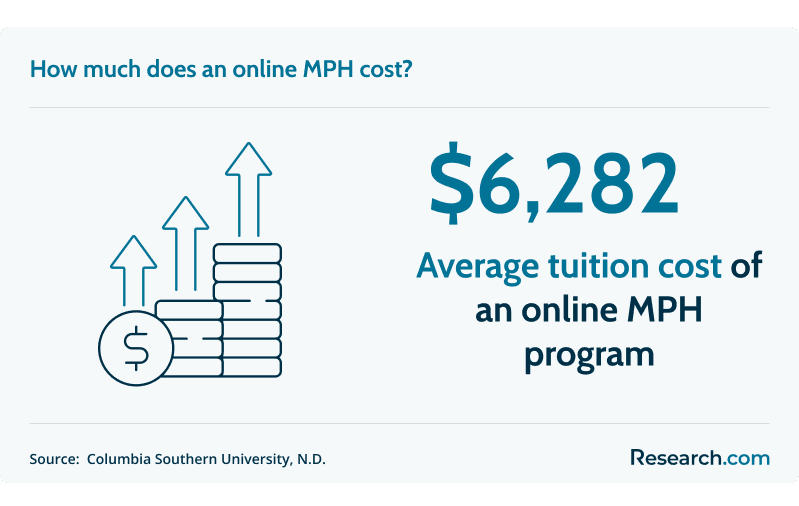
Lower-cost options exist. Some online programs offer tuition below $13,000, and Columbia Southern University charges approximately $6,282 for its MPH program. The median annual tuition for online master’s programs in health-related fields is reported at around $9,310, with public institutions averaging about $7,848 and private nonprofit institutions around $10,500.
When comparing costs, do not look only at the advertised per-credit rate. Multiply tuition by required credits, then add technology fees, practicum costs, books, travel for any campus sessions, graduation fees, and loan interest if you plan to borrow. Students comparing graduate cost across fields may also find it useful to review affordable online doctoral programs in organizational leadership, while career changers outside healthcare may explore what an associate degree in computer science can lead to.
| Cost Factor | Why It Matters | Question to Ask |
| Required credits | A lower per-credit price can still lead to a high total cost if the program requires more credits | How many credits are required for graduation? |
| Fees | Online, technology, practicum, and graduation fees can raise the final price | What fees are mandatory each term? |
| Transfer credits | Accepted graduate credits may reduce time and cost | Does the program accept previous graduate coursework? |
| Practicum expenses | Fieldwork may involve transportation, background checks, or unpaid hours | Can I complete the practicum near where I live? |
| Financial aid | Scholarships, employer benefits, and federal loans can change affordability | What aid is available specifically for online MPH students? |
Financial Aid Options for Online MPH Students
Online MPH students may be eligible for several forms of financial aid, but aid availability depends on the school, enrollment status, citizenship or residency status, and whether the program participates in federal aid programs. Always confirm eligibility with the school’s financial aid office before enrolling.
- FAFSA: The Free Application for Federal Student Aid is the main application for federal graduate aid, including loans and some work-study opportunities.
- Federal Direct Loans: Graduate students may use federal loans to help cover tuition and approved education expenses.
- Federal Pell Grant: Pell Grants are mainly for undergraduate students, although some graduate students with exceptional financial need may qualify in limited circumstances.
- Private student loans: Banks, credit unions, and private lenders offer education loans, but interest rates, repayment rules, and borrower protections vary.
- University scholarships: Some schools provide merit-based, need-based, career-focused, or public service scholarships for online graduate students.
- Employer tuition assistance: Healthcare systems, government agencies, universities, and nonprofit organizations may help employees pay for an MPH if the degree supports job-related advancement.
Online MPH Admissions Requirements and Prerequisites
Admissions requirements differ by university, but most online MPH programs expect applicants to show academic readiness, clear career goals, and the ability to succeed in a graduate-level online environment.
- Bachelor’s degree: Most programs require a bachelor’s degree from an accredited college or university.
- Minimum GPA: A GPA around 3.0 is commonly expected, though requirements vary.
- Official transcripts: Applicants usually submit transcripts from all colleges and universities previously attended.
- Standardized test scores: Some programs may ask for GRE or GMAT scores, but this requirement has become less common in online MPH admissions.
- Letters of recommendation: Schools often request academic or professional references who can speak to your readiness for graduate study.
- Statement of purpose: A personal statement usually explains why you want an MPH, what public health issues interest you, and how the program fits your goals.
- Relevant experience: Public health, healthcare, nonprofit, research, social service, or community work experience may strengthen an application, even when it is not required.
Common Courses in an Online MPH Program
Online MPH programs are built around the core knowledge areas used in public health practice. Students develop a foundation in public health systems and population-level prevention before applying those skills through projects, research, or field experience.
| Course Area | What You Learn | Why It Matters Professionally |
| Foundations of Public Health | History, systems, ethics, and major public health challenges | Provides the baseline vocabulary and framework used across the field |
| Epidemiology | How diseases and health conditions are distributed across populations | Supports outbreak investigation, surveillance, and prevention planning |
| Biostatistics | Statistical methods, data interpretation, and quantitative reasoning | Helps graduates evaluate research and make evidence-based decisions |
| Health Policy and Management | Policy development, healthcare organization, financing, and administration | Prepares students to work in government, healthcare, advocacy, and management settings |
| Social and Behavioral Sciences | Behavior change, health promotion, community engagement, and social determinants of health | Supports program design for real communities rather than abstract populations |
Online MPH Specializations: Which Concentration Fits Your Career Goal?
MPH specializations allow students to focus their degree on a specific public health function or population. An MPH is not simply a matter of finding the easiest master’s degree; the concentration you choose should match the work you want to do after graduation.
- Epidemiology: Best for students interested in disease patterns, outbreak investigation, surveillance, and public health research.
- Biostatistics: Best for students who like quantitative work, data analysis, research methods, and evidence evaluation.
- Health Policy and Management: Best for students who want to influence public health systems, healthcare delivery, policy, or administration.
- Environmental Health: Best for students interested in pollution, occupational health, climate-related risks, hazardous exposure, and environmental regulation.
- Global Health: Best for students who want to work on health challenges that cross national borders or affect underserved international populations.
- Health Promotion and Education: Best for students who want to design community programs, lead prevention campaigns, and improve health behavior.
Accelerated MPH vs. Accelerated Healthcare Management Degree Online
An accelerated MPH and an accelerated healthcare management degree online can both lead to healthcare-related careers, but they prepare students for different kinds of work. An MPH focuses on population health, prevention, epidemiology, biostatistics, environmental health, social determinants of health, and public health policy. By contrast, an accelerated healthcare management degree online emphasizes leadership, operations, finance, compliance, strategic planning, and organizational performance within healthcare settings.
| Degree Path | Main Focus | Best Fit |
| Accelerated MPH | Community health, disease prevention, epidemiology, policy, and health equity | Students who want to improve health outcomes at the population or community level |
| Accelerated healthcare management degree | Healthcare administration, operations, finance, and organizational leadership | Students who want to manage departments, clinics, systems, or healthcare teams |
How an Online MPH Differs From Other Online Health Degrees
An online MPH is a public health degree, not a clinical practice degree. It prepares graduates to analyze health trends, design prevention programs, evaluate policy, manage public health projects, and work with communities. Programs such as online PharmD programs focus much more heavily on pharmacy practice, pharmacology, medication therapy, and patient-centered clinical care. If you want to work with populations, data, policy, and prevention, the MPH is usually the better match. If you want a licensed clinical pharmacy role, a pharmacy-focused pathway is more appropriate.
Challenges of Online MPH Programs
Online MPH programs can be flexible, but they are not automatically easy. Students must manage deadlines, group projects, statistics assignments, research writing, and practicum requirements without the routine of a physical classroom. Technical issues, time-zone differences, and limited informal networking can also affect the experience.
- Time management: Accelerated courses may require substantial weekly study time.
- Digital collaboration: Group projects depend on clear communication through online tools.
- Networking effort: Students may need to actively attend virtual events and contact faculty or alumni.
- Practicum coordination: Online students should confirm how placements are approved and supervised.
- Technology reliability: A stable internet connection and updated computer are essential for live sessions, exams, and collaboration.
Students comparing demanding online healthcare paths may also review online PharmD programs to understand how different health degrees handle clinical, technical, and academic requirements.
How Employers and Accreditation Bodies View Online MPH Degrees
Employers generally focus less on whether an MPH was completed online and more on whether the program is properly accredited, whether the graduate has relevant skills, and whether the student completed meaningful applied experience. CEPH accreditation is especially important because it signals that a public health program meets recognized educational standards.
Graduates can strengthen their marketability by building skills in data analysis, program evaluation, health communication, policy analysis, and community engagement. Some students also add practical healthcare credentials to broaden their options. For example, those interested in administrative or revenue-cycle roles may compare the best accredited online medical billing and coding schools, although those credentials serve a different purpose than an MPH.
How to Choose the Best Online MPH Program
The best online MPH program is the one that fits your career direction, schedule, budget, and learning style while meeting recognized public health education standards. Before applying, review the program carefully rather than relying only on speed or rankings. Start by asking why you want to study public health through an MPH program and what role you want the degree to help you pursue.
| Decision Factor | What to Check | Why It Matters |
| Accreditation | Whether the program is accredited by the Council on Education for Public Health | Accreditation affects credibility, employer confidence, and educational quality |
| Curriculum | Coverage of epidemiology, biostatistics, environmental health, policy, and social determinants | A narrow curriculum may limit your readiness for public health roles |
| Specialization | Whether the concentration matches your intended career path | Specialized skills can help you compete for targeted roles |
| Format | Asynchronous courses, live sessions, campus visits, cohort model, and pacing | The format must fit your work schedule and learning preferences |
| Practicum support | How placements are arranged, approved, and supervised | Field experience is often central to career readiness |
| Faculty expertise | Faculty experience in research, policy, government, healthcare, nonprofit work, or global health | Strong faculty can support mentorship, networking, and applied learning |
| Total cost | Tuition, fees, books, travel, practicum costs, and loan interest | The cheapest or fastest program is not always the best value |
Questions to ask before enrolling
- Is the MPH program accredited by the Council on Education for Public Health?
- Does the stated program length refer to the full degree or to individual course terms?
- Can I complete the practicum in my local area?
- How many live class sessions are required, and when are they held?
- What support is available for online students in statistics, writing, advising, and career planning?
- What percentage of students graduate on time?
- Are scholarships or tuition discounts available for online MPH students?
- Which employers hire graduates from this program?
Online MPH vs. MHA: Key Differences
An online MPH and a Master of Health Administration can both support healthcare careers, but they serve different goals. An MPH is centered on population health, epidemiology, prevention, public health policy, and health equity. An MHA is centered on healthcare leadership, finance, operations, strategy, and organizational management. If you want to design health interventions, study disease trends, or work in public agencies and community health, an MPH is usually a stronger fit. If you want to manage healthcare facilities, departments, or administrative teams, an MHA may be more appropriate. Students focused on management roles can compare affordable online MHA programs.
Career Paths for Online MPH Graduates
Online MPH graduates can pursue roles in government agencies, hospitals, nonprofit organizations, universities, consulting firms, insurance companies, and global health organizations. Some healthcare professionals also combine public health training with clinical or nursing education, including pathways such as online RN to BSN programs without clinicals, depending on their background and goals.
| Career Path | Typical Focus | Good Fit For |
| Epidemiologist | Investigating disease trends, designing studies, analyzing population health data, and supporting outbreak response | Students who enjoy research, data, and disease prevention |
| Public Health Educator | Creating health education materials, leading workshops, and evaluating health promotion programs | Students interested in community outreach and prevention |
| Health Policy Analyst | Researching public health policies, analyzing data, and recommending improvements | Students drawn to policy, advocacy, and systems change |
| Global Health Professional | Addressing health challenges across countries and underserved populations | Students interested in international health and cross-cultural work |
| Health Services Manager | Overseeing healthcare departments, programs, compliance, and operational improvement | Students combining public health with management interests |
| Environmental Health Specialist | Assessing environmental risks such as pollution, hazardous waste, and occupational exposure | Students interested in environment-related health protection |
In May 2023, median annual wages for health education specialists differed by industry. The salary range was broad: the lowest 10% of earners made under $39,630, while the top 10% earned over $107,920 annually. Actual pay depends on role, location, employer type, experience, specialization, and technical skills.
Job Market Outlook for MPH Graduates
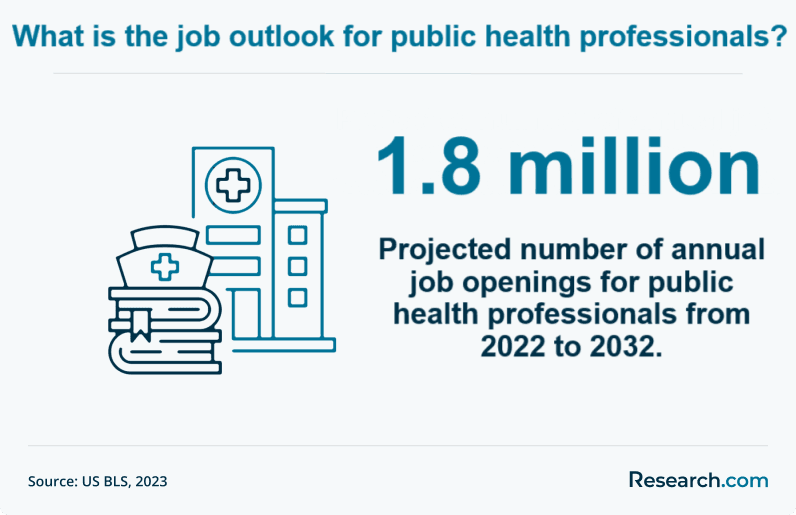
The MPH job market varies by specialization, geography, employer sector, and experience level. Employment in health education and community health worker roles is projected to grow by 7% from 2023 to 2033, which is faster than the average for all occupations. However, public health roles can still be competitive, especially for graduates pursuing positions in the for-profit sector or jobs requiring advanced analytics experience. Some students compare public health careers with advanced nursing options such as post-master’s FNP certificate programs, but these pathways lead to different professional roles.
Employers in insurance, healthcare, and consulting often value MPH graduates with strong technical skills in epidemiology, biostatistics, data analysis, and program evaluation. Community engagement, equity-focused practice, and communication skills also remain important, particularly for roles in local public health, nonprofit organizations, and health education.
What Online MPH Graduates Say About the Experience
- : "The most valuable part of my online MPH was the discussion-based learning. Hearing from classmates with different professional and community backgrounds helped me think more critically about public health problems and solutions. — Benny"
- : "The online format gave me access to graduate-level public health training while I continued working. I could apply what I learned to my job almost immediately, especially in community health planning. — Emily"
- : "Flexibility made the degree possible for me. I needed a program that worked around a full-time job and family obligations, and the online structure allowed me to keep moving toward graduation. — Aliah"
How to Evaluate the Return on Investment of an Online MPH
To evaluate ROI, compare the full cost of the degree with the career outcomes it can realistically support. Start with total tuition and fees, then include lost income if you reduce work hours, loan interest, books, technology, and practicum-related costs. Then compare those costs with your target roles, likely salary range, employer demand, and advancement opportunities.
- Calculate total program cost: Multiply cost per credit by credits required, then add all mandatory fees.
- Compare career alignment: A low-cost program is not a good value if it lacks your needed specialization.
- Review field experience: Practicum quality can affect your portfolio, references, and job readiness.
- Check employer recognition: Ask whether graduates work in the roles and sectors you are targeting.
- Consider complementary credentials carefully: A medical assistant online course may help with clinical support knowledge, but it is not a substitute for MPH-level public health training.
Complementary Certifications That Can Strengthen an MPH
Additional certifications can help MPH graduates demonstrate specialized, job-ready skills. The right credential depends on your career goal. Data-focused students may benefit from analytics training, health education students may pursue health communication or program evaluation credentials, and healthcare operations students may add administrative or quality improvement training. Some learners also explore short clinical support credentials, including accelerated online medical assistant certification options, though those credentials support different roles than an MPH.
Benefits of Combining an MPH With Health Information Management Skills
Public health increasingly depends on accurate data, interoperable health records, privacy-aware information systems, and evidence-based analytics. Combining an MPH with health information management skills can prepare professionals for roles that connect population health strategy with data governance, reporting, quality improvement, and healthcare decision-making. Students interested in that intersection may compare options such as the fastest online health information management bachelor’s degree programs to understand how HIM training differs from graduate public health education.
How Online MPH Programs Can Build Your Professional Network
Online MPH students need to be intentional about networking. Strong programs create connection through faculty mentoring, cohort-based classes, virtual career events, alumni panels, collaborative projects, and practicum partnerships. Students should participate early rather than waiting until graduation. If your interests are technical or research-heavy, you may also explore related interdisciplinary pathways such as an online bioinformatics master’s degree, which can complement public health work in data-intensive environments.
Common Mistakes to Avoid When Choosing a Fast Online MPH
| Mistake | Why It Can Hurt You | Better Approach |
| Choosing only by shortest timeline | An intense pace may be unrealistic with work, family, or practicum requirements | Ask for a sample weekly schedule before enrolling |
| Ignoring accreditation | Non-accredited programs may carry less credibility with employers | Confirm CEPH accreditation before applying |
| Comparing only tuition per credit | Total cost depends on credits, fees, and aid | Calculate the full degree cost |
| Assuming online means self-paced | Many programs have fixed deadlines, live sessions, and cohort requirements | Review course delivery details carefully |
| Overlooking practicum logistics | Field placement can delay graduation if not planned early | Ask how the school helps online students secure placements |
| Relying only on rankings | A highly ranked program may not fit your budget, concentration, or schedule | Compare outcomes, support, cost, and curriculum together |
Key Insights
- The fastest online MPH is not automatically the best choice; accreditation, practicum support, curriculum quality, and total cost matter just as much as speed.
- Several listed programs advertise accelerated timelines ranging from 10 weeks to 22 months, but applicants should verify exactly what each timeline means.
- CEPH accreditation is one of the most important quality signals for an MPH program and should be confirmed before enrollment.
- Online MPH programs are often best for self-directed students who need flexibility, while campus programs may better serve students who want face-to-face networking and structure.
- Costs vary widely, with many top-ranked online MPH programs costing between $60,000 and $85,000, while some lower-cost options fall below $13,000.
- Career outcomes depend heavily on specialization, technical skills, field experience, and employer sector; salary outcomes are not guaranteed by the degree alone.
- Before committing, ask each school about total cost, online student support, practicum placement, graduation timeline, career services, and where graduates are employed.
References:
- De Beaumont Foundation (March 2022). Public Health Workforce Interests and Needs Survey. https://debeaumont.org/wp-content/uploads/dlm_uploads/2022/03/Stress-and-Burnout-Brief_final.pdf
- Korhonene, V. (July 2024). Opinions of online college students on quality of online education U.S. 2022. Statista. https://www.statista.com/statistics/956123/opinions-online-college-students-quality-online-education/
- Hanson, M. (February 2024). Average Cost of a Master’s Degree. Education Data Initiative. https://educationdata.org/average-cost-of-a-masters-degree
- Ma, J. and Pender, M. (2023). Trends in College Pricing and Student Aid 2023. College Board Research. https://research.collegeboard.org/media/pdf/Trends%20Report%202023%20Updated.pdf
- U.S. Bureau of Labor Statistics (April 2024). Community Health Workers. https://www.bls.gov/ooh/community-and-social-service/community-health-workers.htm
- U.S. Bureau of Labor Statistics (April 2024). Epidemiologists. https://www.bls.gov/ooh/life-physical-and-social-science/epidemiologists.htm
- U.S. Bureau of Labor Statistics (April 2024). Health Education Specialists. https://www.bls.gov/ooh/community-and-social-service/health-educators.htm
- U.S. Bureau of Labor Statistics (April 2024). May 2023 National Occupational Employment and Wage Estimates, United States. https://www.bls.gov/oes/current/oes_nat.htm
- Zippia (July 2024). PUBLIC HEALTH ADMINISTRATOR SALARY. https://www.zippia.com/salaries/public-health-administrator
Other Things You Should Know About Fastest Online MPH Programs
Fast-paced online MPH programs offer a quicker path to completion, often taking 12-18 months compared to the typical 2-3 years for traditional programs. They are designed for self-motivated students and rely heavily on digital platforms for coursework and interaction, providing flexibility for working professionals.
In 2027, the fastest online MPH programs can typically be completed in as little as one year. These accelerated programs are designed to provide a comprehensive education in public health while allowing students to enter the workforce quickly.
In 2027, fast-paced online MPH programs are growing due to demand for flexible schedules, incorporating AI-based personalized learning, increasing focus on data analytics skills, and global public health crisis management expertise. These trends cater to diverse career needs and rapidly evolving public health challenges.
The fastest online MPH programs in 2027 are effective due to innovative course delivery methods, experienced faculty, and flexible learning schedules. These programs utilize the latest technology for interactive learning, providing students with accessible resources and networking opportunities, ensuring a comprehensive education in public health.


