
2027 Easiest MPH Online Programs to Get Into

Co-Founder and Chief Data Scientist
The United States offers a growing number of online Master of Public Health (MPH) programs, catering to the needs of busy professionals and those seeking flexible learning options. However, navigating the landscape of online MPH programs can be challenging. Finding accurate and unbiased information can be difficult due to the sheer volume of programs, varying program quality, and the potential for misleading marketing.
We utilized our career planning and research expertise to provide this guide which aims to assist prospective students in their search. This article will provide insights and strategies for identifying reputable and high-quality online MPH programs that align with their individual learning and career goals.
What are the benefits of getting an online MPH degree?
- An online Master of Public Health (MPH) equips students with skills for diverse roles in public health, including healthcare administration, epidemiology, and public health policy. It allows working professionals to advance their education while maintaining full-time employment due to its flexible schedule.
- Online MPH programs often cost less than traditional on-campus options by reducing expenses like commuting and housing. They also provide networking opportunities through virtual collaboration with peers and instructors worldwide.
- Graduates of top programs, such as UC Berkeley's Online MPH, report an average annual salary of $111,830, with roles in sectors like healthcare organizations, government agencies, and non-profits.
What can I expect from an online MPH program?
An online MPH program provides a robust curriculum focusing on public health fundamentals such as epidemiology, biostatistics, and health policy. You’ll gain practical skills in research, project planning, and data analysis. Many programs offer specializations in areas like infectious diseases, health management, or nutrition, which can lead to targeted career opportunities. Additionally, these programs emphasize leadership and community impact, preparing graduates to tackle pressing public health challenges.
Where can I work with an MPH degree?
With an MPH, career opportunities abound in public and private sectors. You could work as an epidemiologist, healthcare consultant, or program coordinator in settings such as hospitals, government agencies, or global health organizations. Specialized roles, like infection control manager or health policy analyst, are also common. Top employers of MPH graduates include institutions like Kaiser Permanente, UCSF, and national health departments.
How much can I make with an MPH degree?
Salaries for MPH graduates vary based on specialization, location, and industry. On average, professionals with an MPH earn $75,000 to $120,000 annually, depending on their roles and experience. For example, epidemiologists earn around $78,520 annually, while public health policy analysts and healthcare consultants may make over $100,000 per year. Graduates from programs like UC Berkeley’s Online MPH often exceed these figures, with an average salary of $111,830.
- Easiest MPH Online Programs to Get Into for 2027 List of Programs
- How long does it take to complete a Master of Public Health degree program? Program Duration
- How does an online Master of Public Health degree compare to an on-campus program? Online vs On-Campus
- What is the average cost of a Master of Public Health degree program? Program Cost
- What are the financial aid options for students enrolling in a Master of Public Health degree program? Financial Aid
- What are the prerequisites for enrolling in a Master of Public Health degree program? Prerequisites
- What courses are typically in a Master of Public Health degree program? What courses are typically in a Master of Public Health degree program?
- What types of specializations are available in Master of Public Health degree programs? What types of specializations are available in Master of Public Health degree programs?
- Is a Master of Public Health worth it? Is a Master of Public Health worth it?
- How do online MPH programs address emerging public health challenges? How do online MPH programs address emerging public health challenges?
- What are the benefits of accelerated programs in healthcare leadership? What are the benefits of accelerated programs in healthcare leadership?
- What are the accreditation standards for online MPH programs? What are the accreditation standards for online MPH programs?
- What challenges might you face during an online MPH program? What challenges might you face during an online MPH program?
- How can interdisciplinary studies enhance your MPH career? How can interdisciplinary studies enhance your MPH career?
- How can online MPH programs effectively integrate practical clinical experiences? How can online MPH programs effectively integrate practical clinical experiences?
- What essential competencies do employers seek in MPH graduates? What essential competencies do employers seek in MPH graduates?
- How do you choose the best Master of Public Health degree program? How do you choose the best Master of Public Health degree program?
- What career paths are available for graduates of Master of Public Health degree programs? What career paths are available for graduates of Master of Public Health degree programs?
- What complementary certifications can enhance your MPH career? What complementary certifications can enhance your MPH career?
- What is the job market for graduates with a Master of Public Health degree? What is the job market for graduates with a Master of Public Health degree?
- What career support and networking opportunities do online MPH programs offer? What career support and networking opportunities do online MPH programs offer?
- Can an online bioinformatics master's degree complement your MPH? Can an online bioinformatics master's degree complement your MPH?
Easiest MPH Online Programs to Get Into for 2026
Choosing an online Master of Public Health program is not only about finding a respected school. For many applicants, the real question is more practical: Which MPH programs offer flexible online learning, reasonable admissions requirements, clear accreditation, and a path that fits work, family, and budget constraints? This guide focuses on online and hybrid MPH options that may be more accessible for applicants because of features such as GRE-optional policies, flexible pacing, multiple start options, broad undergraduate eligibility, or online delivery designed for working adults.
You will learn how to compare online MPH programs, what “easy to get into” should and should not mean, how long these degrees usually take, what they cost, what employers look for, and how to avoid common mistakes when choosing a public health graduate program.
Quick answer: What makes an online MPH program easier to get into?
An online MPH program may be easier to access when it does not require GRE scores, accepts applicants from many undergraduate majors, offers part-time enrollment, provides multiple start dates, or emphasizes professional experience rather than a narrow academic background. However, admissions-friendly does not mean low quality. Students should still prioritize accreditation, practicum support, curriculum fit, cost, and career outcomes before enrolling.
How do we rank schools?
Because graduate school is a major financial and professional commitment, our ranking approach emphasizes transparent, education-focused information rather than promotional claims. We review sources such as the IPEDS database, Peterson's database, including distance learning data, the College Scorecard database, and the National Center for Education Statistics. We also consider public-facing program details such as format, credits, accreditation, concentrations, practicum requirements, and available tuition information. The programs below should be used as a starting point, not as a substitute for confirming current admissions requirements directly with each school.
| School | Online MPH fit | Credits | Program length | Accreditation noted |
| George Washington University | Online MPH with flexible pacing and GRE-optional admission | 45 credits | 12 months to 5 years | CEPH |
| UNC Gillings School of Global Public Health | Online concentrations with GRE not required | 42 | Typically 2 years | CEPH |
| Grand Canyon University | Fully online format for working professionals | 48 credits | Typically 2–2.5 years | Higher Learning Commission; MPH seeking CEPH accreditation |
| Western Kentucky University | Fully online MPH with customizable focus areas | 42 credit hours | Typically 2 years | CEPH |
| University of Montana | Online MPH with applied focus on rural and underserved communities | 42 credits | Typically 2 years full-time | CEPH |
| University of Southern Mississippi | Fully online option that may be completed in as little as 15 months | 42 | 15 months full-time online | CEPH |
| Old Dominion University | Online coursework with practicum-based learning | 43 credit hours | Approximately 2 years full-time | CEPH |
| University of Toledo | Fully online Generalist track | 45 credits | 2 years full-time | CEPH |
| Kansas State University | Online, in-person, or hybrid course options | 42 credit hours | Typically 2 years full-time | CEPH |
| Southern Illinois University Carbondale | Online MPH with multiple admission points | 42 credits | 2 years full-time | CEPH |
| Georgia Southern University | Online and campus coursework with field practicum | 42 credits | Typically 2 years full-time | CEPH |
| MCPHS | Online generalist MPH designed for working professionals | 42 credits | 2 years full-time | NECHE |
| University of South Dakota | Fully online MPH focused on rural and underserved health | 42 credits | 2 years full-time | CEPH |
| George Mason University | Online Public Health Practice option plus campus and hybrid formats | 42 credits | 2 years full-time | CEPH |
| National University | Flexible year-round enrollment for adult learners | 72 quarter units | Approximately 2 years | CEPH |
1. George Washington University
George Washington University (GW) delivers its online MPH through the Milken Institute School of Public Health. The MPH@GW format combines live online sessions with self-paced coursework, which can work well for students who want faculty interaction without relocating. Students complete a 120-hour practicum and can shape their studies around areas such as Global Health, Health Informatics, Women, Youth, and Child Health, or Climate and Health. The program is also flexible in pace, with an accelerated option and a longer part-time route. GRE scores are optional for admission.
- Program length: 12 months (accelerated) to 5 years (part-time).
- Tracks/concentrations: Global Health, Health Informatics, Climate and Health, Women, Youth, and Child Health.
- Tuition cost: $82,575 (total cost, both in-state and out-of-state).
- Required credits to graduate: 45 credits.
- Accreditation: Council on Education for Public Health (CEPH).
2. UNC Gillings School of Global Public Health
The MPH at the UNC Gillings School of Global Public Health is offered in residential and online formats, with online concentrations that serve students seeking a rigorous public health education without moving to Chapel Hill. Online students can choose Applied Epidemiology, Leadership in Practice, or Nutrition. The curriculum includes a 200-hour field practicum, and GRE scores are not required. UNC Gillings also gives students access to a large professional network, including more than 22,000 alumni.
- Program length: Typically 2 years.
- Tracks/concentrations: Applied Epidemiology, Leadership in Practice, Nutrition online; residential options include Health Equity, Environmental Health, and others.
- Tuition cost: Approximately $9,500/year (in-state); $37,500/year (out-of-state).
- Required credits to graduate: 42.
- Accreditation: Council on Education for Public Health (CEPH).
3. Grand Canyon University
The online MPH at Grand Canyon University (GCU) is built for students who want a broad public health curriculum delivered fully online. Coursework covers epidemiology, health policy, community health, and biostatistics, with a practicum and capstone that require students to apply classroom concepts to public health problems. The program includes a Christian worldview component, which may appeal to students seeking an ethics-centered educational environment.
- Program length: Typically completed in 2–2.5 years.
- Tracks/concentrations: General public health with no formal specialization.
- Tuition cost: Approximately $10,000–$11,000/year for online students, depending on enrollment status.
- Required credits to graduate: 48 credits.
- Accreditation: Institutionally accredited by the Higher Learning Commission; the MPH program is seeking accreditation from the Council on Education for Public Health (CEPH).
4. Western Kentucky University
Western Kentucky University offers a fully online MPH for students preparing for roles in public health practice, health services management, community health, and health education. Instead of locking students into formal concentrations, the program allows some customization through public health focus areas. This can be useful for working professionals who already know the population, setting, or public health problem they want to address.
- Program length: Typically 2 years, with timing varying by enrollment status.
- Tracks/concentrations: No formal concentrations; students may personalize coursework through public health focus areas.
- Tuition cost: $607 per credit hour for in-state and out-of-state students.
- Required credits to graduate: 42 credit hours.
- Accreditation: Council on Education for Public Health (CEPH).
5. University of Montana
The University of Montana (UM) offers an online MPH with a strong applied-practice orientation. The program is especially relevant for students interested in rural health, prevention services, community health, and underserved populations. Students complete an applied practical experience and a capstone project, and the curriculum includes areas such as epidemiology, environmental health, biostatistics, health administration, and rural health disparities. UM also offers a dual Master of Arts in Medical Anthropology/MPH for students interested in cultural and social dimensions of health.
- Program length: Typically completed in 2 years full-time; part-time options are available.
- Tracks/concentrations: Generalist program with emphasis on community health and prevention services; dual degree options available.
- Tuition cost: Approx. $4,440/semester (in-state), $15,792/semester (out-of-state).
- Required credits to graduate: 42 credits, including 27 core credits, 6 capstone credits, and 9 elective credits.
- Accreditation: Accredited by the Council on Education for Public Health (CEPH).
6. University of Southern Mississippi
The University of Southern Mississippi offers an MPH focused on Health Policy and Administration. Students can choose fully online, executive, or traditional classroom formats. The online pathway is intensive and can be completed in as little as 15 months when students take 4-5 courses per semester. The program is non-thesis-based, includes comprehensive exams, and requires a 400-hour practicum in a public health organization.
- Program length: 15 months (full-time online).
- Tracks/concentrations: Health Policy and Administration.
- Tuition cost: Approximately $8,786 (resident) per year; same for online students because the out-of-state fee is waived for online programs.
- Required credits to graduate: 42.
- Accreditation: Council on Education for Public Health (CEPH).
7. Old Dominion University (ODU)
Old Dominion University offers an MPH designed around interdisciplinary public health practice and experiential learning. Students complete online coursework while preparing for applied work in communities and public health organizations. The program may be a strong match for students interested in health promotion, epidemiology, healthcare policy, environmental health, or public health data analytics.
- Program length: Approximately 2 years full-time; part-time options available.
- Tracks/concentrations:
- Global Environmental Health.
- Health Behavior and Health Promotion.
- Applied Epidemiology and Public Health Data Analytics.
- Tuition cost: In-state: $571 per credit hour; Out-of-state: $1,394 per credit hour.
- Required credits to graduate: 43 credit hours.
- Accreditation: Council on Education for Public Health (CEPH).
8. University of Toledo
The University of Toledo MPH emphasizes health equity, community engagement, research, and population health. The program originated in 1997 through the Northwest Ohio Consortium for Public Health and moved fully to UToledo in 2018. Students can choose among Environmental & Occupational Health, Health Promotion & Education, Public Health Epidemiology, and a fully online Generalist track. Graduates may pursue roles in government, nonprofits, healthcare, industry, and education.
- Program length: 2 years (full-time).
- Tracks/concentrations: Environmental & Occupational Health, Health Promotion & Education, Public Health Epidemiology, Generalist (online).
- Tuition cost: $611/credit (in-state), $1,051/credit (out-of-state).
- Required credits to graduate: 45 credits.
- Accreditation: Council for Education in Public Health (CEPH).
9. Kansas State University
The MPH at Kansas State University is an interdisciplinary degree that prepares students to work on public health issues at local, national, and global levels. Students choose one of four emphasis areas: Food Safety and Biosecurity, Public Health Nutrition, Public Health Physical Activity, and Infectious Diseases and Zoonoses. The degree includes 15 credits of core public health courses and 27 credits in the selected emphasis area. Courses may be available online, in person, or in hybrid format.
- Program length: Typically 2 years full-time, with part-time options available.
- Tracks/concentrations: Food Safety and Biosecurity, Public Health Nutrition, Public Health Physical Activity, Infectious Diseases and Zoonoses.
- Tuition cost: $312.50 per credit hour (in-state), $841.70 per credit hour (out-of-state).
- Required credits to graduate: 42 credit hours.
- Accreditation: The program is accredited by the Council on Education for Public Health (CEPH).
10. Southern Illinois University
The MPH at Southern Illinois University Carbondale centers on community health education, rural health, and underserved populations. Students study public health foundations, leadership, program planning, analytics, and epidemiology. The online format and multiple admission points can make the program more accessible for applicants who need flexibility. SIU also offers a concurrent MPH/MD degree for students admitted to the School of Medicine.
- Program length: 2 years (full-time).
- Tracks/concentrations: Community Health Education, with a focus on rural and underserved populations.
- Tuition cost: $470.50 per credit hour (in-state); $1,174.50 per credit hour (out-of-state).
- Required credits to graduate: 42 credits.
- Accreditation: Council on Education for Public Health (CEPH).
11. Georgia Southern University
The MPH at Georgia Southern University is offered through the Jiann-Ping Hsu College of Public Health and is designed for broad-based public health practice. Students complete fieldwork, community-based learning, and a 300-hour field practicum. The program serves both full-time students and working professionals through online and on-campus coursework at the Statesboro campus. Its concentration options are broader than many generalist MPH programs.
- Program length: Typically 2 years (full-time).
- Tracks/concentrations: Applied Public Health, Biostatistics, Community Health Education, Environmental Health Sciences, Epidemiology, Health Policy and Management, Public Health Informatics.
- Tuition cost: $2,556 (in-state), $10,440 (out-of-state) per semester.
- Required credits to graduate: 42 credits.
- Accreditation: Council on Education for Public Health (CEPH).
12. Massachusetts College of Pharmacy and Health Sciences (MCPHS)
The online MPH at Massachusetts College of Pharmacy and Health Sciences (MCPHS) is a generalist program for students who want a foundation in epidemiology, biostatistics, health policy, social and behavioral health sciences, and environmental health. The curriculum prepares students to identify public health problems, design interventions, interpret evidence, and contribute to policy or community health work. Its online structure is intended to support working professionals.
- Program length: 2 years (full-time).
- Tracks/concentrations: Generalist MPH.
- Tuition cost: $1,265 per credit, with no distinction between in-state and out-of-state.
- Required credits to graduate: 42 credits.
- Accreditation: New England Commission of Higher Education (NECHE).
13. University of South Dakota
The University of South Dakota offers a fully online MPH and is described as the only program of its kind in South Dakota. Offered in partnership with South Dakota State University (SDSU), the program emphasizes rural and underserved community health. Students study biostatistics, epidemiology, health services administration, social and behavioral sciences, and environmental health through an interprofessional public health lens.
- Program length: 2 years (full-time).
- Tracks/concentrations: No formal tracks; focus on rural and underserved community health.
- Tuition cost: In-state: $470.45 per credit; Out-of-state: $648.45 per credit.
- Required credits to graduate: 42 credits.
- Accreditation: Council on Education for Public Health (CEPH).
14. George Mason University
George Mason University offers an MPH with online, hybrid, and on-campus options. The program focuses on public health problems affecting diverse populations, including underrepresented communities. Students complete a 200-hour practicum and can pursue a wide range of concentrations, including an online Public Health Practice option. The program is ranked among the top public health schools by U.S. News & World Report.
- Program length: 2 years (full-time), with part-time options available.
- Tracks/concentrations: Community Health Promotion, Epidemiology, Food Security and Nutrition, Global Health, Health Equity and Social Justice, Health Policy, Public Health Practice (online).
- Tuition cost: In-state: $12,354/year; Out-of-state: $33,456/year.
- Required credits to graduate: 42 credits.
- Accreditation: Council on Education for Public Health (CEPH).
15. National University
The MPH at National University is designed for adults seeking career advancement or a transition into public health. The program emphasizes leadership, health promotion, disease prevention, public healthcare administration, community mental health, social justice, communication, and applied analysis. Students complete a capstone and internship experience, and the year-round enrollment model may appeal to working professionals who need multiple opportunities to begin.
- Program length: Approximately 2 years, depending on pace and transfer credits.
- Tracks/concentrations: Community Mental Health, Health Promotion, Healthcare Administration.
- Tuition cost: $442 per quarter unit for both in-state and out-of-state students.
- Required credits to graduate: 72 quarter units.
- Accreditation: Council on Education for Public Health (CEPH).
If cost is your main concern, compare these programs with Research.com's guide to the cheapest MPH programs in USA, since some lower-cost options may not appear in this admissions-focused list.
How long does it take to complete a Master of Public Health degree program?
Most MPH programs take about two years of full-time study, but the actual timeline depends on course load, practicum requirements, capstone or thesis expectations, and whether the student enrolls full-time, part-time, or in an accelerated format.
| Study option | Typical timeline | Best for | Trade-off |
| Full-time MPH | Two years or 24-30 months | Students who can prioritize graduate study | Faster completion but heavier weekly workload |
| Part-time MPH | Two to four years or more | Working professionals and caregivers | More manageable schedule but longer time to graduation |
| Accelerated MPH | 12-18 months in some programs | Students with strong time availability and clear goals | Intensive pace and limited room for schedule disruption |
Students should look beyond the advertised program length. A program with more credits, a thesis, extensive fieldwork, or limited course availability may take longer than expected. By contrast, programs with year-round courses, transfer-credit policies, and multiple start dates may help students finish sooner. Applicants comparing healthcare administration pathways may also want to review the easiest online MHA programs, which often offer similar flexibility for working adults.
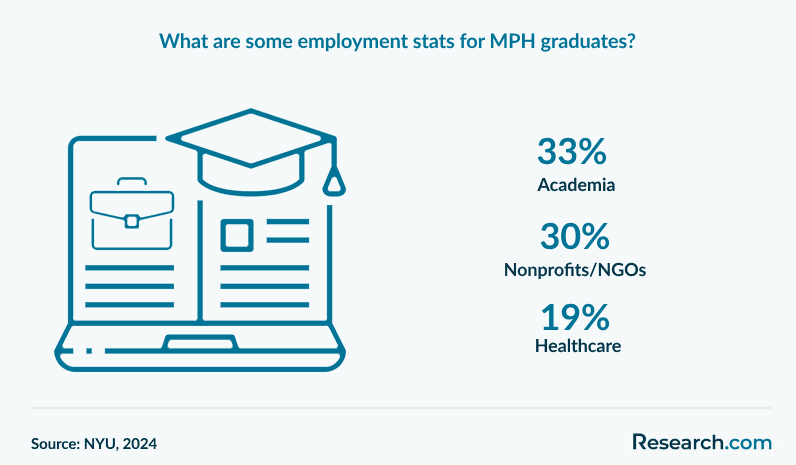
The NYU School of Public Health reported strong outcomes for its 2021 graduating class: 99% were employed within 11 months of graduation, while the remaining 1% pursued additional education. Graduates entered multiple sectors, including academia at 33%, nonprofit/NGO organizations at 30%, healthcare at 19%, government at 9%, and other sectors at 9%, as shown below.
How does an online Master of Public Health degree compare to an on-campus program?
Online and on-campus MPH programs can lead to similar public health careers when they are academically sound, properly accredited, and include meaningful applied experience. The better choice depends on how you learn, where you live, whether you work full-time, and how much in-person networking matters for your goals.
Online MPH programs
- Best for flexibility: Online study allows students to complete coursework from different locations and often makes graduate school realistic for working professionals.
- Reduced commuting burden: Students can avoid relocation and travel time, which can matter as much as tuition for adult learners.
- Stronger digital workflow: Online students often gain experience with virtual collaboration, data tools, and remote communication used in modern public health work.
- Possible cost advantages: Some online programs reduce relocation and commuting costs, though tuition varies widely by institution.
- Main limitation: Students may need to be more intentional about building relationships with classmates, faculty, alumni, and practicum supervisors.
Students comparing flexible healthcare degrees may also explore what are the easiest online neonatal nurse practitioner programs, although nursing practitioner pathways have different clinical and licensure requirements than MPH programs.
On-campus MPH programs
- Best for immersion: Campus-based study can provide a stronger day-to-day academic community.
- More spontaneous networking: Students may find it easier to connect with faculty, research centers, guest speakers, and classmates in person.
- Hands-on access: Some students prefer direct access to campus facilities, labs, libraries, and local partnerships.
- Potentially higher total cost: Housing, relocation, transportation, and campus fees can increase the real cost of attendance.
- Main limitation: Campus schedules can be difficult for students who cannot pause work or move near the university.
If affordability is your top priority, Research.com's guide to the cheapest MPH programs online can help you compare cost-conscious options alongside accreditation, format, and curriculum fit.
What is the average cost of a Master of Public Health degree program?
MPH costs vary widely because tuition depends on public versus private status, residency classification, online fee policies, program length, and whether students must pay for travel, practicum expenses, books, technology, or campus-based living costs.
- Tuition: MPH tuition can range from $10,000 to $70,000 or more per year.
- Fees: Students may pay application fees, technology fees, graduation fees, course fees, or other program-specific charges.
- Living expenses: Campus-based students should budget for rent, food, utilities, and transportation.
- Books and materials: Course readings, software, and exam-related materials can add to the total cost.
- Practicum expenses: Some students may face travel, background check, immunization, or placement-related costs.
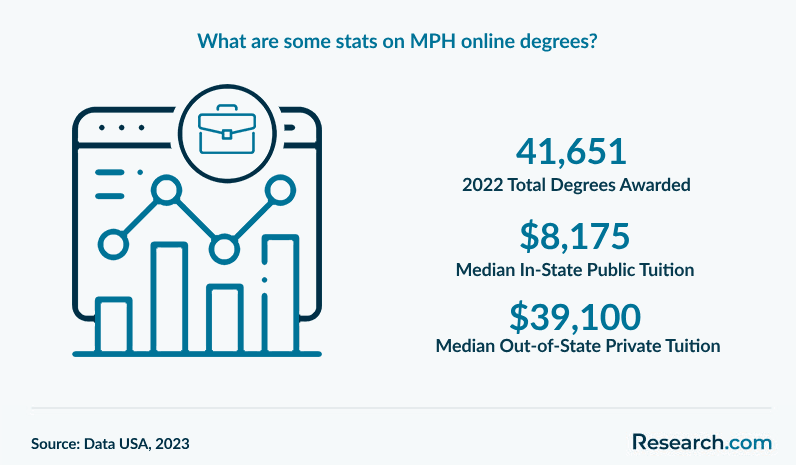
According to Data USA (2023), 41,651 Master of Public Health (MPH) degrees were awarded in 2022. The median in-state tuition for public institutions was $8,175, while the median out-of-state tuition for private institutions was $39,100, as shown below.
The smartest cost comparison is not just tuition per credit. Calculate total credits, mandatory fees, residency rules, expected time to completion, lost income if you reduce work hours, and whether the program supports local practicum placements. Students exploring broader healthcare pathways can also compare the easiest medical degrees to get to determine whether public health, clinical care, administration, or another healthcare path better matches their goals.
What are the financial aid options for students enrolling in a Master of Public Health degree program?
MPH students may be eligible for scholarships, fellowships, assistantships, employer tuition benefits, federal loans, private loans, grants, or work-study. Availability depends on the school, enrollment status, citizenship or residency rules, academic profile, financial need, and program format.
- Scholarships and fellowships: Universities, foundations, professional associations, and public health organizations may offer awards based on merit, need, service background, or career focus.
- Federal and state aid: Students should review official financial aid options and complete required aid applications on time.
- Federal student loans: Graduate students often use Federal Direct Loans or Graduate PLUS Loans to help pay tuition and approved education expenses.
- Private student loans: Private loans can fill funding gaps but often carry different interest rates, repayment terms, and borrower protections.
- Assistantships: Teaching or research assistantships may reduce cost while building academic or research experience.
- Work-study and campus employment: Some students may qualify for part-time work opportunities connected to their university.
- Employer tuition assistance: Healthcare systems, nonprofits, government agencies, and universities may help employees pay for graduate study.
Before accepting an offer, ask whether aid is renewable, whether it applies to summer terms, whether online students qualify, and what GPA or enrollment requirements must be maintained.
What are the prerequisites for enrolling in a Master of Public Health degree program?
Most MPH programs require a bachelor's degree, but many do not require applicants to have majored in public health. Students from biology, sociology, psychology, statistics, nursing, health sciences, social work, business, education, and other fields may be eligible if they can show readiness for graduate-level study.
- Bachelor's degree: A completed undergraduate degree is typically required.
- Relevant coursework: Some programs may prefer or require prior coursework in biology, chemistry, statistics, or social sciences.
- Letters of recommendation: Schools may ask for academic or professional references who can speak to readiness, writing ability, leadership, or service experience.
- Statement of purpose: Applicants usually explain their public health interests, career goals, and reasons for choosing the program.
- Resume or CV: Public health, healthcare, research, community service, policy, nonprofit, or data experience can strengthen an application.
- GRE or standardized tests: Some programs may still request scores, but GRE requirements are becoming less common.
Applicants should not assume one school's requirements apply to another. Review each program's admissions page, deadlines, prerequisite rules, and required application materials before applying.
What courses are typically in a Master of Public Health degree program?
MPH programs usually begin with core public health disciplines before allowing students to specialize through electives, concentrations, fieldwork, or a capstone. The goal is to prepare graduates to assess population health problems, interpret evidence, design interventions, communicate findings, and evaluate public health programs.
- Biostatistics: Statistical reasoning, data interpretation, and quantitative methods used in public health research and practice.
- Epidemiology: Study of disease patterns, risk factors, outbreaks, and health outcomes across populations.
- Environmental health: Examination of how air, water, occupational conditions, climate, and environmental exposures affect health.
- Health policy and management: Analysis of healthcare systems, financing, policy design, program administration, and organizational leadership.
- Social and behavioral sciences: Study of how behavior, culture, income, education, community context, and social structures shape health.
- Global health: Exploration of cross-border health challenges, infectious disease, poverty, access inequities, and global systems.
- Community health: Planning and evaluating programs that improve health at the neighborhood, local, or regional level.
- Public health ethics: Decision-making frameworks for balancing individual rights, community protection, equity, and evidence.
Most programs also include electives, fieldwork, research methods, and a capstone or culminating project. Students who want to move toward advanced nursing practice should compare requirements carefully, since even the cheapest online nurse practitioner programs follow different clinical and licensure pathways than MPH degrees.
A recent study analyzed 70,343 job postings for MPH graduates and found that CEPH competencies generally align with employer expectations. The market was competitive and included substantial activity from for-profit industries at 26%, healthcare/hospitals at 14%, academia/research at 26%, and government agencies at 12%, as shown below.
The same study identified strong demand for technical public health roles, including 1,344 postings for epidemiologists, 1,323 for biostatisticians, and 1,185 for environmental health and safety specialists. Technical and statistical skills appeared often in job postings, while diversity and inclusion, health equity, and policy skills were less prominent. Students should therefore build both data skills and public health practice competencies, because employers may value technical ability while communities still need equity-focused leadership.
What types of specializations are available in Master of Public Health degree programs?
MPH specializations help students connect coursework to a specific career direction. A generalist program can be useful for broad public health practice, while a concentration may be better for applicants targeting a technical, policy, management, or population-specific role.
| Specialization | Best for students interested in |
| Epidemiology | Disease surveillance, outbreak investigation, population health research, and prevention planning |
| Biostatistics | Statistical modeling, data analysis, research design, and evidence evaluation |
| Environmental Health | Environmental exposures, workplace safety, air and water quality, and environmental risk |
| Health Policy and Management | Healthcare systems, policy analysis, leadership, finance, and program administration; students may also compare the cheapest online healthcare administration degree options |
| Global Health | International health systems, infectious disease, poverty, health access, and cross-cultural public health work |
| Maternal and Child Health | Health outcomes for women, infants, children, adolescents, and families |
| Nutrition | Diet, chronic disease prevention, community nutrition, and food systems |
| Health Education and Behavior | Community programs, behavior change, prevention campaigns, and health promotion |
| Health Communication | Public health messaging, risk communication, campaigns, and community engagement |
| Public Health Informatics | Data systems, surveillance tools, digital health infrastructure, and evidence-based decision-making |
When choosing a specialization, start with job descriptions. If employers in your target field ask for SAS, R, GIS, program evaluation, grant writing, policy analysis, or community engagement, choose electives and projects that document those skills.
Is a Master of Public Health worth it?
An MPH can be worth it when the degree clearly supports your career goal, the program is accredited or otherwise appropriate for your target role, the cost is manageable, and you use the degree to build practical skills. It may not be worth it if you enroll only because the program is easy to access, borrow more than your expected earnings can support, or choose a concentration without understanding the job market.
The non-financial value can also be significant. MPH students often gain leadership skills, applied research experience, policy literacy, program evaluation skills, and a network of public health professionals. For a deeper career-focused discussion, see Research.com's guide on is a masters in public health worth it.
How do online MPH programs address emerging public health challenges?
Strong online MPH programs update coursework to reflect the public health problems graduates are likely to face, including pandemic preparedness, climate-related health risks, health inequities, misinformation, data analytics, and emergency response. The best programs do not treat these as isolated topics. They connect them to epidemiology, communication, policy, environmental health, community engagement, and program evaluation.
Look for applied assignments, live case discussions, field-based projects, and faculty or guest speakers with current public health experience. If price is a key factor while comparing modern curricula, review the cheapest MPH programs and confirm that lower cost does not mean weak practicum support or outdated coursework.
What are the benefits of accelerated programs in healthcare leadership?
Accelerated healthcare and public health leadership programs can help experienced professionals move faster into management, policy, or administrative roles. The advantage is speed: students may complete concentrated coursework in leadership, finance, health systems, operations, and innovation in a shorter period. The risk is intensity. These programs require disciplined time management and may not be ideal for students who need a lighter academic load.
Students comparing MPH leadership tracks with administration-focused options can review accelerated healthcare programs to understand how faster programs structure advanced healthcare management education.
What are the accreditation standards for online MPH programs?
For public health degrees, CEPH accreditation is a major quality signal because it indicates that a program has been reviewed against public health education standards. Accreditation can affect employer confidence, eligibility for certain opportunities, and the consistency of curriculum and applied practice requirements. Institutional accreditation also matters because it can affect financial aid eligibility and credit recognition.
Before applying, verify accreditation directly through official sources, not only through marketing pages. Also review faculty qualifications, practicum requirements, student support, career services, and public outcome information. Students who want interdisciplinary healthcare training may also compare related fields such as online pharmacy programs, but pharmacy degrees have different professional expectations and should not be treated as substitutes for an MPH.
What challenges might you face during an online MPH program?
Online MPH study is flexible, but it is not automatically easier. Students must manage deadlines, group projects, fieldwork logistics, technology platforms, and networking without the structure of a traditional campus schedule.
- Isolation: Online students may need to initiate contact with classmates, faculty, alumni, and practicum supervisors.
- Time management: Asynchronous courses require consistent weekly planning, especially for students working full-time.
- Practicum coordination: Students should ask early how local placements are approved and supported.
- Technology demands: Public health coursework may require learning statistical software, dashboards, collaboration tools, or data systems.
- Limited informal networking: Students should take advantage of office hours, virtual events, alumni groups, and professional associations.
Applicants considering other online health pathways can also examine online pharmacy colleges, but should compare the level of clinical training, licensing requirements, and career outcomes before switching fields.
How can interdisciplinary studies enhance your MPH career?
Public health work rarely exists in one discipline. Professionals often need to understand data, healthcare operations, insurance systems, health behavior, policy, communication, and community context. Combining an MPH with targeted coursework in informatics, healthcare administration, data analytics, social work, business, or coding can make graduates more versatile.
For example, students interested in healthcare data flow, claims, reimbursement, or administrative systems may benefit from understanding topics covered by medical billing and coding schools. The goal is not to collect unrelated credentials, but to build a coherent skill set that matches the public health jobs you want.
How can online MPH programs effectively integrate practical clinical experiences?
MPH programs are not clinical degrees in the same way that nursing, medicine, or physician assistant programs are. However, they should include practical public health experience through practicums, field placements, capstones, simulations, case studies, or community-based projects. Online programs can support applied learning by helping students identify approved local sites, using virtual case simulations, and connecting assignments to real organizations.
Students who want direct patient-care skills in addition to public health training may compare options such as clinical medical assistant online programs. Before combining pathways, ask whether the extra credential will meaningfully support your target role or simply add cost and time.
What essential competencies do employers seek in MPH graduates?
Employers often look for MPH graduates who can turn evidence into action. Valuable competencies include data analysis, epidemiologic reasoning, program planning, evaluation, health communication, grant writing, leadership, cultural responsiveness, policy understanding, and digital literacy. Increasingly, public health professionals also need to work across teams that include clinicians, community organizations, policymakers, data analysts, and administrators.
Students aiming for data-heavy roles may benefit from public health informatics or health information management coursework. Research.com's guide to the cheapest HIM degree online can help students compare adjacent training in healthcare data and information systems.
How do you choose the best Master of Public Health degree program?
The best MPH program is the one that fits your career goal, budget, schedule, learning style, and target job market. Rankings can help you discover programs, but they should not make the decision for you.
| Question to ask | Why it matters |
| Is the program CEPH-accredited or appropriately accredited for my goals? | Accreditation affects quality signals, employer confidence, and sometimes eligibility for opportunities. |
| Does the concentration match the jobs I want? | A mismatch can leave you with a degree that does not build the skills employers request. |
| How are online practicums arranged? | Students need clear placement support, especially if they live far from campus. |
| What is the full cost, not just tuition? | Fees, books, travel, fieldwork expenses, and time away from work can change affordability. |
| Are GRE scores required? | GRE-optional or no-GRE policies can make application planning easier. |
| Can I study part-time? | Working adults often need predictable pacing and flexible course loads. |
| What career services are available to online students? | Online learners should have access to advising, networking, resume support, and job-search resources. |
| What skills will I graduate with? | Employers often evaluate software, data, communication, evaluation, and project experience, not only the degree title. |
Common mistakes to avoid when choosing an online MPH
- Choosing only by admissions ease: A program that is easier to enter is not automatically the best investment.
- Ignoring accreditation: Always verify accreditation status through official sources.
- Comparing tuition without total cost: Fees, credits, practicum expenses, and program length can change the real price.
- Assuming online means self-paced: Many online MPH courses still have weekly deadlines, live sessions, group projects, or fixed terms.
- Overlooking practicum logistics: Ask who finds placements, how sites are approved, and whether online students receive equal support.
- Selecting a concentration too early: Review job postings first so your electives match employer expectations.
- Relying only on rankings: Rankings are useful, but fit, cost, accreditation, and outcomes matter more for individual decisions.
What career paths are available for graduates of Master of Public Health degree programs?
MPH graduates work in government agencies, hospitals, health systems, universities, nonprofits, consulting firms, research organizations, community organizations, and private companies. Career options vary by concentration, prior experience, technical skills, geography, and networking.
- Epidemiologist: Studies disease patterns, investigates outbreaks, and supports prevention strategies.
- Biostatistician: Analyzes health data and contributes to research, evaluation, and evidence-based decision-making.
- Health services manager: Coordinates programs, teams, operations, or services within healthcare organizations.
- Public health educator: Designs education and prevention programs for communities and priority populations.
- Environmental health specialist: Assesses environmental risks that affect community or workplace health.
- Global health specialist: Works on international health challenges, access barriers, infectious disease, and health systems.
- Health policy analyst: Studies policy options and develops recommendations for public health or healthcare improvement.
- Health communication specialist: Creates messages, campaigns, and risk communication strategies for public audiences.
- Research scientist: Conducts studies on public health issues such as chronic disease, infectious disease, and health disparities.
- Government public health professional: Supports local, state, or federal programs, surveillance, policy, preparedness, and community health initiatives.
Some MPH graduates later pursue doctoral-level study or adjacent healthcare and behavioral health training. Students considering psychology pathways can compare options such as the cheapest online PsyD programs, but should understand that psychology doctoral programs have different clinical training and licensure implications.
Individuals with an MPH degree frequently pursue careers such as Health Information Technologists and Medical Registrars ($62,990), Occupational Health and Safety Specialists ($77,580), Dietitians and Nutritionists ($69,680), Genetic Counselors ($95,770), Public Health Consultants (typically $60,000 to $100,000), Epidemiologists ($78,830), and Environmental Scientists and Specialists ($76,530), as shown below.
These roles align with many MPH competencies, including population health assessment, prevention planning, research interpretation, health communication, and program evaluation. Students still comparing fields outside healthcare may also find it useful to understand questions such as is there a difference between criminology and criminal justice, since choosing the right graduate path starts with understanding how each field defines problems, evidence, and professional impact.
What complementary certifications can enhance your MPH career?
Certifications can help MPH graduates document specific skills, but they should be chosen strategically. Useful credentials are usually tied to a target role, such as data analysis, health education, project management, emergency preparedness, clinical operations, informatics, or occupational safety. A credential is most valuable when it fills a clear gap in your resume.
For students seeking direct, entry-level clinical exposure, an accelerated option such as medical assistant certification 6 weeks may add practical patient-facing context. However, it should complement a defined goal rather than distract from MPH-level public health preparation.
What is the job market for graduates with a Master of Public Health degree?
The MPH job market is broad, but not every role has the same demand, salary level, or entry requirements. Technical roles in epidemiology, biostatistics, environmental health, informatics, and evaluation may require stronger quantitative skills. Community health and health education roles may emphasize communication, cultural responsiveness, program implementation, and field experience. Policy and management roles often reward writing, analysis, leadership, and knowledge of healthcare systems.
- Public health preparedness: Emerging infectious disease risks and emergency response planning continue to require trained public health workers.
- Chronic disease prevention: Communities need prevention strategies for conditions such as diabetes and heart disease.
- Health equity: Employers increasingly need professionals who can address disparities and work with diverse communities.
- Data and technology: Data science, AI-enabled tools, surveillance systems, and informatics are changing how public health work is performed.
- Aging population: Population aging affects prevention, healthcare access, long-term services, and community health planning.
Healthcare fields outside public health also face workforce needs. For registered nurses exploring graduate advancement, the cheapest RN to MSN online programs may be worth comparing with MPH options, depending on whether the goal is clinical nursing leadership or population health.
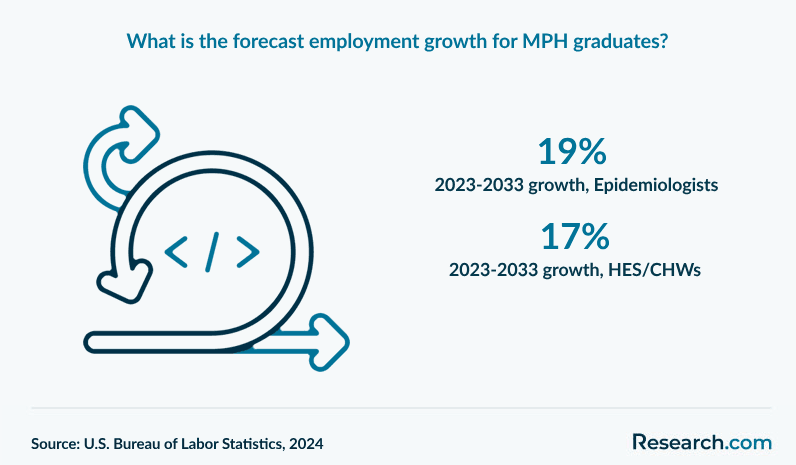
The U.S. Bureau of Labor Statistics (BLS) projects strong job growth for several fields relevant to MPH graduates. Epidemiologists, with a median annual salary of $81,390, are expected to experience 19% job growth from 2023 to 2033, significantly faster than the average for all occupations. Health Education Specialists and Community Health Workers, with a median annual salary of $48,860, are projected to grow 17% during this period, as shown below.
What career support and networking opportunities do online MPH programs offer?
Quality online MPH programs should give distance learners access to career services that are comparable to what campus students receive. Useful support may include resume reviews, practicum advising, virtual career fairs, alumni mentoring, employer webinars, interview preparation, LinkedIn profile guidance, and job boards focused on public health roles.
Students interested in data-centered healthcare roles can also compare public health informatics with programs such as the fastest health information management program online. The right choice depends on whether you want to focus on population health strategy, healthcare information systems, analytics, compliance, or administration.
Can an online bioinformatics master's degree complement your MPH?
Bioinformatics can complement an MPH for students interested in epidemiology, infectious disease surveillance, genomic data, statistical modeling, research, and large-scale health datasets. This combination may be especially useful for roles that require both public health context and advanced data interpretation.
An online bioinformatics master's program may broaden options in research and applied public health settings. Students should compare prerequisites carefully, because bioinformatics programs may expect stronger preparation in biology, statistics, computer science, or programming than generalist MPH programs.
Here’s What Graduates Have to Say About Their MPH Online Degrees
- : "Completing my MPH online allowed me to keep working full-time as a nurse while building a stronger foundation in population health. The flexibility mattered, but so did the access to classmates and faculty from different parts of the country. — Aiden"
- : "The online format was more engaging than I expected. Faculty support, structured discussions, and applied assignments helped me connect public health theory to real workplace problems. — Jasper"
- : "I was concerned that an online MPH would feel disconnected, but the group work and virtual discussions gave me meaningful interaction. The program helped me feel prepared to move forward in public health. — Maria"
References
- Bureau of Labor Statistics. Epidemiologists. U.S. Department of Labor. Bureau of Labor Statistics.
- Bureau of Labor Statistics. Health education specialists and community health workers. U.S. Department of Labor. Bureau of Labor Statistics.
- Bureau of Labor Statistics. Healthcare occupations. Bureau of Labor Statistics.
- Columbia University Mailman School of Public Health. Are MPH graduates aligned with today's job market? Columbia University.
- Data USA. Public health majors. Data USA.
- Krasna, H. Do MPH programs prepare graduates for employment in today's market? Medical Xpress.
- MPH Programs List. What are the public health job trends and MPH degree impact? MPH Programs List. Related coverage is also available from Medical Xpress.
Key Insights
- “Easy to get into” should not mean low standards. Look for admissions-friendly features such as GRE-optional policies, flexible pacing, online delivery, and broad undergraduate eligibility, but do not compromise on accreditation or career fit.
- CEPH accreditation is a major quality marker for MPH programs. Verify accreditation directly before applying, especially for online programs and programs that state they are seeking accreditation.
- Most MPH programs take about two years, but timelines vary. Accelerated options can take 12-18 months, while part-time study may take two to four years or more.
- Total cost matters more than tuition alone. Compare credits, fees, residency rules, practicum expenses, books, technology, and the effect of enrollment pace on your income.
- Choose a concentration by reading job postings first. Epidemiology, biostatistics, informatics, health policy, environmental health, and community health lead to different skill requirements.
- Online MPH students must be proactive. Networking, practicum planning, faculty interaction, and career development require more intentional effort in a virtual format.
- The strongest MPH graduates combine technical and human-centered skills. Data analysis, epidemiology, communication, policy awareness, health equity, and program evaluation all matter in the current public health workforce.
Other Things You Should Know About Master of Public Health Degree Programs
Many accredited online MPH programs in 2027 do not require GRE scores for admission. Schools usually ask for a bachelor’s degree from an accredited institution, a minimum GPA, and transcripts instead. Some programs may still request test scores for applicants with weaker academic records.
Tuition costs for the easiest online MPH programs in 2027 typically range from $20,000 to $40,000. Costs may vary based on the institution, residency status, and additional fees such as technology or course material charges. Financial aid options may also be available.





