2027 Highest Paying Medical Assistant Specialties & Jobs

Co-Founder and Chief Data Scientist
A medical assistant career can be a fast entry point into healthcare, but the best-paying roles usually require more planning than simply finishing the shortest program available. Your specialty, certification, employer type, state, and willingness to build technical skills can all affect how much you earn and how far you can advance.
This guide breaks down the highest-paying medical assistant specialties and jobs for 2027, including what the work looks like, which credentials can help, how hospitals compare with clinics, and how to choose a training path that supports better long-term opportunities. It is written for future medical assistants, current MAs, and healthcare workers who want to move into stronger clinical, administrative, or leadership roles without investing in credentials that do not match their goals.
Quick Answer: Which Medical Assistant Jobs Pay the Most?
The medical assistant jobs with the strongest pay potential are typically in specialty practices and procedure-focused settings. Outpatient surgical assisting, cardiology, oncology, pain management, orthopedics, dermatology, gastroenterology, OB/GYN, podiatry, and endocrinology are among the higher-paying paths covered in this guide. Actual earnings still depend on certification, experience, employer size, location, shift schedule, and the complexity of the work.
Key Things You Should Know About the Highest Paying Medical Assistant Specialties and Jobs
- Specialty medical assistants may earn more than general MAs because they often support technical procedures, higher-acuity patients, or more complex clinical workflows in areas such as cardiology, dermatology, oncology, and outpatient surgery.
- Credentials such as Certified Medical Assistant (CMA), Registered Medical Assistant (RMA), Certified Clinical Medical Assistant (CCMA), and related skills-based certifications can make candidates more competitive, especially with hospitals and specialty employers.
- An associate degree, externship, and specialty training can help medical assistants qualify for lead MA, clinical supervisor, medical office manager, or other advancement-oriented roles.
- Pay varies significantly by geography. California, Washington, Massachusetts, Oregon, Alaska, New York, Minnesota, Connecticut, Colorado, and Hawaii are listed among higher-paying markets, often because of living costs, staffing needs, and large healthcare systems.
- Medical assisting can also be a bridge into nursing, medical billing and coding, healthcare administration, physician assistant education, or practice management, but each path has different training and credential requirements.
- What does a medical assistant do?
- How do you become a medical assistant for 2027?
- Which medical assistant specialties pay the most?
- Do hospitals or private clinics pay medical assistants more?
- Which states pay medical assistants the highest salaries?
- Can certification raise a medical assistant’s income?
- CMA vs. RMA salary: is there a major difference?
- How should you choose a strong training program for advanced medical assisting roles?
- Which affordable advanced degree options can support medical assistant career growth?
- How can medical assistants negotiate better pay?
- Can management skills improve a medical assistant’s career options?
- How can business skills help medical assistants move into leadership?
- Which certifications are best for higher-paying medical assistant jobs?
- What are the best advancement paths for medical assistants?
- What is the job outlook for medical assistants?
- What do professionals say about high-paying medical assistant specialties?
What does a medical assistant do?
A medical assistant is a healthcare support worker who helps medical offices, hospitals, outpatient centers, and specialty practices run smoothly. The job can combine patient-facing clinical tasks with office-based administrative work, depending on the employer and state rules.
Typical duties include recording vital signs, collecting patient histories, preparing exam rooms, assisting during visits, updating medical records, scheduling appointments, supporting billing documentation, and communicating instructions to patients. Medical assistants do not diagnose patients or prescribe treatment, but they help providers stay organized and keep patient visits moving safely and efficiently. Medical assistants held about 783,900 jobs in 2023, of which the offices of physicians had 56% share.
The role can look very different from one workplace to another. A general MA in a small primary care office may handle a wide range of routine duties, while an MA in cardiology, orthopedics, dermatology, or outpatient surgery may perform more specialized tasks that require additional training and confidence.
| Medical assistant work area | Common responsibilities | Why it matters for pay |
| Administrative duties | Appointment scheduling, patient communication, records updates, billing support, insurance paperwork | Administrative strength can lead toward billing, office coordination, or practice management roles. |
| Clinical duties | Vitals, rooming patients, specimen handling, exam preparation, medication documentation, patient instructions | Reliable clinical skills are often expected in hospitals, urgent care centers, and specialty clinics. |
| Specialty duties | EKGs, wound care support, procedure setup, surgical assistance, dermatology prep, chronic care coordination | More technical assignments can support higher pay because they increase your value to providers. |
| Leadership duties | Training staff, organizing workflow, monitoring compliance, supporting provider schedules | Supervisory experience can open doors to lead MA, clinical supervisor, or office manager positions. |
Medical assistants work across several healthcare industries, and the setting can affect pay, benefits, schedule stability, and promotion options. The chart below shows top employers by industry.
How do you become a medical assistant for 2027?
Most people enter medical assisting by earning a high school credential, completing a medical assistant program, pursuing certification, and gaining supervised clinical experience. Some employers still train workers on the job, but formal education and a recognized credential can improve your chances of qualifying for better roles.
1. Finish high school or earn a GED
A high school diploma or GED is the standard starting requirement for most certificate, diploma, and associate degree programs in medical assisting. Courses or skills in biology, basic math, communication, computer use, and health science can make the transition into training easier.
2. Choose a medical assistant training program
Medical assistant students commonly enroll in a certificate, diploma, or associate degree program offered by a school with appropriate accreditation or recognized approval. Program timelines often fall into these ranges:
- 9–12 months for a certificate or diploma
- 18–24 months for an associate degree
Coursework usually covers anatomy, medical terminology, infection control, clinical procedures, phlebotomy fundamentals, electronic health records, patient interaction, and front-office workflow. If you need a flexible option, compare affordable online medical assistant programs, but verify whether labs, externships, or in-person clinical requirements are included.
3. Decide whether certification fits your goals
Certification is not mandatory for every medical assistant position, but many hospitals, health systems, and specialty practices prefer or require it. Common options include:
- Certified Medical Assistant (CMA) from AAMA
- Registered Medical Assistant (RMA) from AMT
- National Certified Medical Assistant (NCMA) from NCCT
- Certified Clinical Medical Assistant (CCMA) from NHA
Eligibility rules often depend on finishing an approved program and passing an exam. Before choosing a school, confirm which certification exam its curriculum supports and whether employers in your area prefer a specific credential.
4. Use externships and entry-level jobs to build real experience
Classroom training can teach core concepts, but externships and clinical practicums show you how patient flow, documentation, provider support, and team communication work in real settings. Experience in a specialty clinic can also help you move toward higher-paying fields such as cardiology, dermatology, orthopedics, oncology, gastroenterology, or outpatient surgery.
5. Think beyond the first job
Medical assisting can be a long-term occupation, but it can also be the first step toward nursing, medical billing and coding, physician assistant education, healthcare administration, or clinical leadership. The right next move depends on whether you prefer direct patient care, operations, records and reimbursement, technology, or management.
Which medical assistant specialties pay the most?
The better-paying medical assistant specialties tend to involve procedure support, complex documentation, chronic disease care, or technical clinical tasks. The roles below show strong earning potential, but salaries are not guaranteed and can change based on experience, certification, employer type, state, city, and shift expectations.
| Specialty | Salary range | Best fit for medical assistants who... |
| Outpatient surgical medical assistant | $47,000 – $60,000 per year | Work well under pressure and want pre-op, post-op, sterile setup, and procedure-support responsibilities. |
| Oncology medical assistant | $46,000 – $60,000 per year | Can combine accuracy with compassion while supporting patients during difficult treatment journeys. |
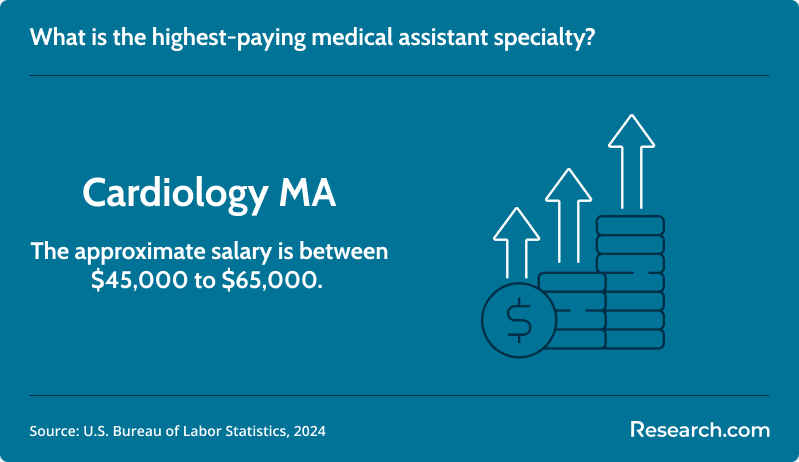
| Cardiology medical assistant | $45,000 – $65,000 per year | Are interested in EKGs, cardiovascular monitoring, stress test support, and heart-care workflows. |
| Pain management medical assistant | $45,000 – $59,000 per year | Can handle high-volume visits, documentation, procedure preparation, and coordinated chronic pain care. |
| Orthopedic medical assistant | $44,000 – $58,000 per year | Enjoy hands-on work with injuries, braces, casts, sutures, imaging prep, and mobility concerns. |
| Dermatology medical assistant | $43,000 – $57,000 per year | Want exposure to medical skin care, biopsies, cosmetic services, and procedure-based visits. |
| Gastroenterology medical assistant | $43,000 – $56,000 per year | Are comfortable with digestive health procedures, patient preparation, and detailed instructions. |
| Obstetrics and gynecology medical assistant | $43,000 – $55,000 per year | Communicate well and want to support women’s health, prenatal care, and sensitive patient visits. |
| Podiatry medical assistant | $42,000 – $55,000 per year | Are interested in wound care, diabetic foot checks, orthotics, and foot or ankle procedures. |
| Endocrinology medical assistant | $42,000 – $54,000 per year | Want to support patients with diabetes, thyroid disorders, chronic disease education, and lab coordination. |
Cardiology Medical Assistant
Salary Range: $45,000 – $65,000 per year
Cardiology MAs support heart-care providers by performing or preparing patients for EKGs, helping with stress test workflows, recording vital signs, completing intake, and documenting follow-up details. The specialty can pay more because small errors in cardiac care can have serious consequences, so employers value precision and technical comfort.
Podiatry Medical Assistant
Salary Range: $42,000 – $55,000 per year
Podiatry medical assistants work with patients who have foot, ankle, and lower-leg conditions. Duties may include wound care support, diabetic foot screening, minor procedure assistance, orthotic preparation, and patient education.
Dermatology Medical Assistant
Salary Range: $43,000 – $57,000 per year
Dermatology MAs help with skin exams, biopsy preparation, acne treatment support, laser procedure setup, and cosmetic service workflows. Clinics that offer both medical and aesthetic dermatology may provide a wider range of duties and stronger earning opportunities.
Oncology Medical Assistant
Salary Range: $46,000 – $60,000 per year
Oncology medical assistants assist cancer care teams with intake, medication tracking, treatment-related documentation, patient preparation, and care coordination. This environment requires empathy, emotional steadiness, and careful attention to clinical details.
Orthopedic Medical Assistant
Salary Range: $44,000 – $58,000 per year
Orthopedic MAs support providers who treat bone, joint, muscle, and injury-related conditions. Depending on the clinic, they may assist with casts, suture removal, brace fitting, X-ray preparation, surgery scheduling, and recovery instructions.
Obstetrics and Gynecology (OB/GYN) Medical Assistant
Salary Range: $43,000 – $55,000 per year
OB/GYN medical assistants support women’s health visits, prenatal appointments, Pap smear preparation, ultrasound room setup, patient education, and sensitive conversations. Privacy, professionalism, and clear communication are especially important in this specialty.
Endocrinology Medical Assistant
Salary Range: $42,000 – $54,000 per year
Endocrinology MAs work with patients managing hormone-related conditions, including diabetes and thyroid disorders. Their responsibilities often include lab coordination, medication documentation, chronic care follow-up, and patient education support.
Pain Management Medical Assistant
Salary Range: $45,000 – $59,000 per year
Pain management MAs help providers care for patients with chronic or severe pain. The work may involve procedure setup, medication documentation, patient tracking, referrals, and coordination across complex treatment plans.
Gastroenterology Medical Assistant
Salary Range: $43,000 – $56,000 per year
Gastroenterology medical assistants support digestive health practices by preparing patients, rooms, and equipment for procedures such as endoscopies and colonoscopies. This role requires careful documentation, patient instruction, and attention to safety protocols.
Surgical Medical Assistant (Outpatient)
Salary Range: $47,000 – $60,000 per year
Outpatient surgical MAs work in ambulatory surgery centers and procedure-heavy clinics. They may assist with pre-op intake, sterile room setup, minor procedure support, post-op instructions, and follow-up documentation.
Do hospitals or private clinics pay medical assistants more?
Hospitals often pay more than small private clinics, but salary should not be the only factor in your decision. Hospitals may offer higher compensation, stronger benefits, and more internal mobility, while private clinics may provide steadier weekday schedules and closer working relationships with patients and providers.
Average salary comparison
- Hospitals (state, local, or private): $42,000 – $50,000/year
- Private Clinics and Physician Offices: $36,000 – $44,000/year
Why hospital roles may pay more
- Hospitals often have larger budgets and may offer shift differentials for evenings, weekends, overnight hours, or holidays.
- Medical assistants in hospital settings may support larger teams, faster workflows, and more complex patient care environments.
- Medical assistant benefits may be more robust in health systems, including possible health insurance, retirement plans, tuition assistance, and promotion ladders.
Trade-offs to consider
- Private clinics may offer more predictable hours, a smaller team environment, and less schedule disruption.
- Hospitals may provide better pay and advancement potential, but they can also involve rotating shifts, weekends, holidays, and a faster pace.
| Work setting | Potential advantages | Possible drawbacks | Best for |
| Hospital | Higher salary range, stronger benefits, internal transfer options, exposure to complex care | Shift schedules, weekends, holidays, heavier pace | Medical assistants focused on income growth and advancement |
| Private clinic | More predictable routine, smaller team, often calmer work environment | Lower salary range, limited promotion levels in smaller practices | Medical assistants who value schedule stability and work-life routine |
| Specialty clinic | Skill specialization, better pay potential than some general offices, focused patient population | May require certification, experience, or procedure-specific training | Medical assistants who want to become experts in one clinical area |
Which states pay medical assistants the highest salaries?
Where you work can change your earning potential as much as your specialty. States with high living costs, large healthcare networks, staffing pressure, or dense urban medical markets often offer higher pay. Completing medical assistant trade school programs can prepare you for entry-level employment, but local demand still plays a major role in compensation.
The states below are listed with estimated salary ranges and common market factors that may contribute to higher wages.
| State | Average salary | Why pay may be higher |
| California | $47,000 – $58,000/year | High living costs and strong demand in areas such as Los Angeles, San Diego, and San Francisco. |
| Washington | $45,000 – $55,000/year | Large healthcare employers and higher state minimum wages, especially near Seattle. |
| Massachusetts | $44,000 – $54,000/year | Major hospitals and research-focused medical centers create steady demand for trained staff. |
| Oregon | $43,000 – $53,000/year | A competitive healthcare market and rising living costs, particularly in Portland, can support higher wages. |
| Alaska | $45,000 – $52,000/year | Remote locations and limited healthcare staffing can push compensation upward. |
| New York | $42,000 – $51,000/year | Dense metro areas such as NYC and Long Island have higher costs and substantial healthcare demand. |
| Minnesota | $41,000 – $50,000/year | Strong healthcare networks around Minneapolis and St. Paul help support competitive pay. |
| Connecticut | $41,000 – $49,000/year | Access to major medical centers, including Yale New Haven Hospital, contributes to stronger wages. |
| Colorado | $40,000 – $49,000/year | Population growth and expanding healthcare systems increase staffing needs. |
| Hawaii | $43,000 – $50,000/year | High living costs and island-region staffing challenges affect pay levels. |
Can certification raise a medical assistant’s income?
Certification can improve your earning outlook because it gives employers evidence that you completed structured training and passed a competency-based exam. It is especially useful when applying to hospitals, specialty practices, and larger health systems with formal hiring standards. If you are comparing credential pathways, see Research.com’s guide on how to become a certified medical assistant.
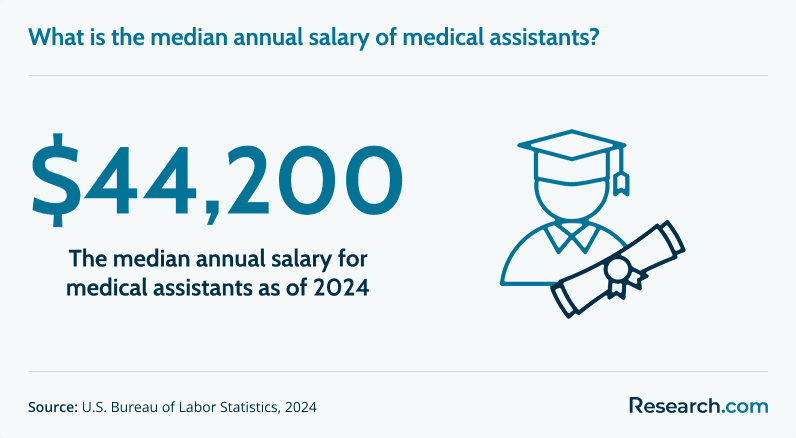
As of May 2024, the median annual salary for medical assistants was $44,200, meaning half of all workers in the field earned more than that amount, while the other half earned less. The bottom 10% earned below $35,020, whereas the top 10% made over $57,830 annually.
Salary comparison by certification status
- Certified Medical Assistants (CMA): $42,000 – $58,000/year
- Non-Certified Medical Assistants: $36,000 – $47,000/year
Why certification can lead to better pay
- Stronger employer trust: A recognized credential shows that your training and knowledge have been evaluated through an exam process.
- More job options: Some employers require or strongly prefer certification, particularly for hospital-based or specialty roles.
- Promotion readiness: Certified MAs may be better positioned for lead, specialty, or higher-responsibility assignments.
Benefits beyond salary
- Recognized credentialing: Certifications from organizations such as the AAMA or AMT help employers quickly understand your preparation.
- Greater hiring confidence: Verified training can make you appear less risky to employers than an uncertified applicant with limited experience.
- Better career mobility: Certification can help when changing employers, moving to another state, or applying for specialty openings.
CMA vs. RMA salary: is there a major difference?
There is usually no dramatic salary difference between the Certified Medical Assistant (CMA) and Registered Medical Assistant (RMA) credentials. Both are widely accepted, and pay is typically shaped more by experience, specialty, employer, state, and work setting than by the credential title alone. For broader wage context, review Research.com’s guide to medical assistant salary.
| Credential | Awarding organization | Average salary | Important consideration |
| Certified Medical Assistant (CMA) | American Association of Medical Assistants (AAMA) | $42,000 – $58,000/year | Frequently recognized by larger healthcare systems and employers with formal credential preferences. |
| Registered Medical Assistant (RMA) | American Medical Technologists (AMT) | $40,000 – $56,000/year | Nationally recognized and accepted by many employers for both clinical and administrative roles. |
How to choose between CMA and RMA
- Review local job postings and track which credential appears most often.
- Ask each school which certification exam its curriculum is designed to support.
- Match the credential to your target workplace; large systems may state preferences, while smaller offices may accept several options.
- Avoid choosing based only on the salary range. Specialty experience, employer type, and location often have a larger effect on pay.
How should you choose a strong training program for advanced medical assisting roles?
A strong medical assistant program should prepare you for certification, hands-on work, and the type of employer you want to pursue. Speed and low tuition can be helpful, but they should not outweigh accreditation, externship access, lab quality, faculty experience, certification preparation, and graduate career support.
If you are leaning toward office administration, billing, coding, or health records, a program with coursework in revenue cycle, coding, compliance, and electronic records may be useful. Students interested in that direction can compare accredited medical billing and coding programs as a related pathway.
Questions to ask before enrolling
- Is the program accredited or otherwise accepted for certification eligibility?
- Which certification exam does the curriculum prepare students to take?
- Is a supervised externship or clinical practicum included?
- Are required labs completed on campus, online, or through a hybrid format?
- What job search support is available, including resume help, interview coaching, and employer connections?
- Can credits transfer into an associate or bachelor’s degree later?
- Does the program teach electronic health records, phlebotomy basics, medical terminology, clinical procedures, and specialty exposure?
Which affordable advanced degree options can support medical assistant career growth?
Medical assistants who want to move beyond entry-level MA work may consider additional education in health science, public health, nursing, healthcare administration, or business. These fields can support roles in operations, supervision, patient services, population health, compliance, or broader healthcare leadership.
Cost matters, especially if you plan to keep working while studying. Research.com’s resource on the cheapest online health science degree can help learners compare affordable pathways that may align with wider healthcare career plans.
When an advanced degree makes sense
- You want to move into healthcare administration, practice operations, or public health.
- You are targeting leadership roles that require broader knowledge than medical assisting alone.
- You want a degree that may support future graduate-level healthcare education.
- You are ready to spend more time in school in exchange for greater long-term mobility.
How can medical assistants negotiate better pay?
Medical assistants have a stronger case for higher pay when they can show measurable value. Before asking for a raise or accepting an offer, document your certification, specialty skills, attendance record, cross-training, patient communication strengths, workflow improvements, and experience with high-demand procedures.
Review local job postings, compare salaries for similar roles, and prepare examples of how your work supports providers, patients, and daily operations. If you are thinking about leadership later, explore career paths connected to the best paying jobs in healthcare administration.
What to bring to a salary conversation
- A summary of certifications, continuing education, and specialty skills
- Examples of responsibilities you handle beyond your original job description
- Evidence of cross-training in EHR systems, billing support, phlebotomy, procedure preparation, or patient coordination
- Local salary examples from comparable job postings
- A specific request, such as a higher hourly rate, shift differential, promotion, tuition support, or improved schedule
Can management skills improve a medical assistant’s career options?
Yes. Medical assistants who understand patient flow, scheduling, staff coordination, compliance, and daily clinic operations can become stronger candidates for lead MA, clinical supervisor, or practice management roles. These skills are especially valuable in urgent care centers, specialty clinics, and high-volume practices where efficiency affects provider productivity and patient experience.
Some healthcare workers also look at adjacent areas such as sports medicine operations, rehabilitation services, or athletic health settings. An affordable sports management degree online may be relevant for professionals interested in sports-related healthcare environments, athletic clinics, rehabilitation operations, or customer-facing health services.
How can business skills help medical assistants move into leadership?
Business skills can help medical assistants understand the full operation of a healthcare practice, not just the exam room. Knowledge of budgeting, staffing, revenue cycle, compliance, customer service, and process improvement can support transitions into office management, operations coordination, or healthcare administration.
For working medical assistants who want a faster route to management knowledge, an accelerated business program may provide structured training in operations and leadership that complements clinical experience.
Which certifications are best for higher-paying medical assistant jobs?
The best certification depends on the position you want next. If your goal is a clinical role, prioritize credentials recognized by local hospitals and specialty practices. If you prefer front-office work, billing, records, or compliance, administrative or coding-related credentials may fit better. The most useful credential is the one employers in your target setting actually value.
| Certification | Awarded by | Average salary | Best for |
| Certified Medical Assistant (CMA) | American Association of Medical Assistants (AAMA) | $42,000 – $58,000/year | Broad clinical and administrative roles in hospitals, outpatient clinics, and specialty practices. |
| Registered Medical Assistant (RMA) | American Medical Technologists (AMT) | $40,000 – $56,000/year | Medical assistants seeking a nationally recognized credential across many employer types. |
| Certified Clinical Medical Assistant (CCMA) | National Healthcareer Association (NHA) | $40,000 – $55,000/year | Patient-facing roles involving clinical care, lab tasks, and procedure support. |
| Certified Phlebotomy Technician (CPT) | National Healthcareer Association (NHA), American Society for Clinical Pathology (ASCP) | $45,000 – $58,000/year (with additional phlebotomy duties) | Medical assistants who want to add blood draw skills and become more clinically versatile. |
| Certified Medical Administrative Assistant (CMAA) | National Healthcareer Association (NHA) | $38,000 – $53,000/year | Administrative roles involving scheduling, billing support, compliance, records, and office workflow. |
Certified Medical Assistant (CMA)
The CMA is a widely recognized credential because it covers both clinical and administrative medical assisting duties. It can be a strong choice for candidates who want flexibility across hospitals, clinics, and private practices.
Registered Medical Assistant (RMA)
The RMA is another respected national credential. It verifies that a medical assistant has met training and competency standards for both patient care and office-based responsibilities.
Certified Clinical Medical Assistant (CCMA)
The CCMA focuses heavily on direct patient care and clinical support. It may fit urgent care centers, specialty practices, and other hands-on environments. In a CCMA vs CMA comparison, the CCMA is commonly linked to patient-facing clinical work.
Certified Phlebotomy Technician (CPT)
Phlebotomy can be a valuable add-on skill for medical assistants in clinics, labs, and specialty offices. CPT certification may strengthen your resume when employers need staff who can perform blood draws in addition to standard MA duties.
Certified Medical Administrative Assistant (CMAA)
The CMAA is most useful for medical assistants who prefer front-desk operations, scheduling, patient records, billing support, and compliance. It can support a move into office coordination or practice management.
What are the best advancement paths for medical assistants?
Medical assistants can advance by specializing, earning additional credentials, completing more education, or moving into leadership and administrative work. The best route depends on whether you want to remain close to patient care, manage office operations, or pursue a higher-level clinical profession.
| Advancement path | What the role involves | What you may need |
| Medical Office Manager | Manages scheduling, billing workflow, staff coordination, patient communication, and day-to-day practice operations. | Administrative experience, leadership ability, billing knowledge, and strong organization. |
| Clinical Supervisor | Oversees medical assistants, trains staff, monitors clinical workflow, and supports provider teams. | Clinical experience, certification, leadership skills, and often completion of medical assistant training. |
| Physician’s Assistant (PA) | Works with physicians to evaluate patients, diagnose conditions, prescribe medications, and perform procedures. | Additional college education, prerequisite coursework, and admission to a PA program. |
| Nurse Practitioner (NP) | Provides advanced patient care, diagnosis, treatment planning, and medication prescribing. | Nursing education, licensure, graduate study, and clinical training. |
| Medical Billing and Coding Specialist | Converts healthcare services into billing codes for insurance reimbursement and medical records. | Coding coursework and certifications such as Certified Professional Coder, CPC. |
Medical Office Manager
Medical office managers oversee the business side of a healthcare practice. This path suits medical assistants who understand patient flow, communicate well, and want more responsibility without leaving the healthcare setting.
Clinical Supervisor
Clinical supervisors guide medical assistant teams, train new staff, monitor workflows, and help providers maintain efficient patient care. Some workers begin with medical assistant programs and then gain experience before moving into supervisory positions.
Physician’s Assistant (PA)
Becoming a physician assistant requires much more education, but medical assisting can provide useful patient-care exposure before applying. This path fits people who want a broader clinical scope and are prepared for additional years of school.
Nurse Practitioner (NP)
Nurse practitioners complete advanced nursing education and have a much larger clinical role than medical assistants. Some MAs first move into practical nursing through options such as medical assistant to LPN programs before continuing toward advanced nursing credentials.
Medical Billing and Coding Specialist
Medical assistants who enjoy documentation, insurance processes, and healthcare systems may find billing and coding a good fit. This transition often requires specialized coursework and coding certification, but it can be a strong option for people who prefer administrative healthcare work.
Common mistakes to avoid when planning advancement
- Choosing the lowest-cost program without confirming accreditation, certification eligibility, or employer recognition.
- Assuming every online program provides the hands-on experience needed for clinical employment.
- Comparing tuition only while overlooking exam fees, books, uniforms, transportation, supplies, and lost work time.
- Believing that certification guarantees a specific wage.
- Selecting a specialty only because it pays more, without considering stress level, patient population, and daily tasks.
- Ignoring transfer credit policies if you may later pursue nursing, health science, public health, business, or healthcare administration.
- Relying only on rankings instead of reviewing externships, outcomes, employer relationships, and graduate support.
What is the job outlook for medical assistants?
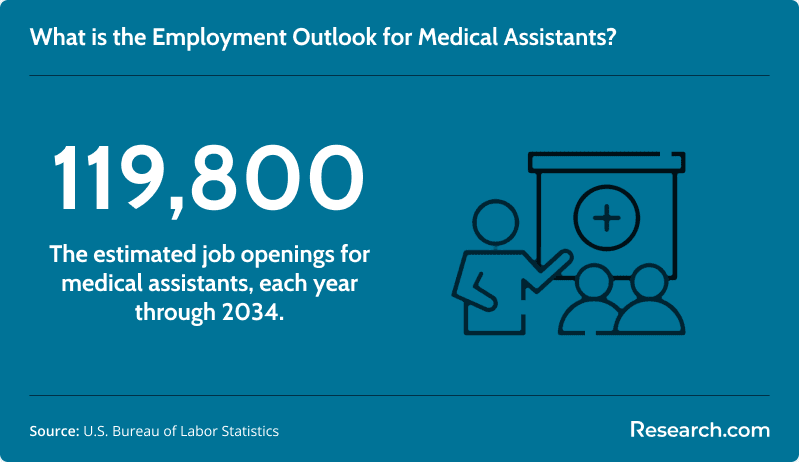
The labor market outlook for medical assistants is favorable. According to the U.S. Bureau of Labor Statistics, employment is projected to grow by 15% from 2023 to 2033, which is much faster than the average for all occupations. The occupation is also projected to have approximately 119,800 job openings each year, reflecting growth and replacement needs as workers retire or move into other careers.
Demand is connected to expanded healthcare services, preventive care needs, and the medical needs of an aging population. Medical assistants help practices manage patient flow, documentation, routine clinical support, and provider efficiency, making them important in many care settings.
Technology is changing the job but not eliminating the need for human support. Electronic health records, patient portals, telehealth processes, automated scheduling, and digital documentation tools mean employers increasingly value MAs who are comfortable with both clinical care and health technology. AI may reduce some repetitive administrative work over time, but patient interaction, in-person clinical assistance, and care coordination still require human judgment and communication.
Medical assistants considering a move into coding or administrative healthcare should understand the difference between CPC and CCS certifications. If coding is your goal, also review certified professional coder requirements, including training, coursework, and the AAPC certification exam.
What do professionals say about high-paying medical assistant specialties?
Medical assisting helped me enter healthcare in a practical way. I get to use clinical skills, work with patients every day, and still see room to grow. Jasmine
After earning my associate degree, I started full time in a busy cardiology office. The work is demanding, but the experience and steady employment have been important for my family. Carlos
Becoming a medical assistant let me start in healthcare without spending years in school first. Dermatology keeps the work interesting, and I like helping patients feel more comfortable and confident. Lena
Key Insights
- Medical assisting is projected to grow by 15% from 2023 to 2033, making it a strong healthcare entry path for people who want clinical and administrative work.
- The field is projected to create approximately 119,800 job openings each year because of both employment growth and worker turnover.
- Medical assistants held about 783,900 jobs in 2023, of which the offices of physicians had 56% share.
- As of May 2024, the median annual salary for medical assistants was $44,200, while the bottom 10% earned below $35,020 and the top 10% made over $57,830 annually.
- The highest-paying MA opportunities are usually tied to specialty skills, certification, hospital or specialty clinic experience, leadership ability, and location rather than general entry-level work alone.
- CMA and RMA credentials are both credible; the better choice depends on local employer preferences, program eligibility, and your target work setting.
- Hospitals may provide higher wages and stronger benefits, while clinics may offer steadier schedules and a more predictable routine.
- Before enrolling in a program, verify accreditation, certification preparation, externship access, total cost, transfer options, and alignment with your long-term career plan.
References:
- American Association of Medical Assistants. (n.d.). Medical assisting educator compensation and benefits report.
- Bureau of Labor Statistics. (2024). Medical assistants. U.S. Department of Labor.
- O*NET OnLine. (n.d.). Medical assistants.
- PayScale. (n.d.). Medical assistant hourly pay.
- Pearl Talent. (2024). Medical assistant salary: State-by-state breakdown & highest paying roles.
Other Things You Should Know About the Highest Paying Medical Assistant Specialties and Jobs
Outpatient specialties with the strongest pay often include dermatology, cardiology, orthopedics, and surgical subspecialties. These roles may require certification such as CMA, RMA, or CCMA, plus 1 to 2 years of hands-on clinical experience and strong skills in EHR systems, phlebotomy, and procedure support.
Certifications such as the Certified Medical Assistant (CMA) from the American Association of Medical Assistants or the Registered Medical Assistant (RMA) from the American Medical Technologists enhance salary prospects for medical assistants in 2027 by demonstrating specialized skills and expertise in the field.