2027 Best Accelerated Business Degree Online Programs

Co-Founder and Chief Data Scientist
Choosing an accelerated online business degree is usually a time-and-money decision: you want a recognized bachelor’s credential, but you do not want to spend four more years in school if you already have college credits, work experience, or an associate degree. Business remains one of the most common undergraduate fields, with 391,375 undergraduate degrees awarded in 2020-2021, and the appeal is clear: a business curriculum can apply to management, marketing, finance, operations, analytics, entrepreneurship, nonprofit work, and graduate study.
This guide explains how accelerated online business programs work, who they are best for, what they may cost, how transfer credits affect completion time, and how to compare programs without relying only on rankings. It also reviews selected accelerated online business degree options and outlines career, salary, and job-market considerations so you can decide whether this path fits your goals.
Quick answer: Is an accelerated online business degree a good option?
An accelerated online business degree can be a practical option if you already have transferable credits, need a flexible schedule, and want a broad credential that can support roles in business development, marketing, finance, operations, analytics, or management. The format is not automatically easier than a traditional program. Because courses are compressed, students need strong time management, consistent weekly study time, and comfort with online learning platforms.
What are the main benefits of earning an accelerated business degree online?
- Accelerated online business degree programs are often flexible, frequently asynchronous, and designed for adults who are balancing school with work or family responsibilities.
- Business graduates can pursue roles across many sectors, including business development, marketing, finance, consulting, operations, human resources, and nonprofit administration.
- Professionals with a bachelor’s in business make an average of $78,000, while MBA holders earn around $97,000, according to Payscale data cited in this guide.
- Transfer credits, credit for prior learning, and shorter terms can reduce both completion time and total cost for eligible students.
- The degree is broad enough to support immediate employment or later graduate study, including an MBA, DBA, or another specialized master’s degree.
What can I expect from an accelerated online business program?
An accelerated online business program delivers the major requirements of a business degree in a compressed format. Instead of following a traditional semester calendar, many programs use shorter terms, self-paced modules, cohort formats, or intensive courses that move quickly through core topics. Students usually complete coursework online, and many programs allow asynchronous participation, meaning lectures, assignments, and discussions can be completed within weekly deadlines rather than at a fixed class time.
The trade-off is workload intensity. A shorter calendar does not mean less academic content. Students may need to read, participate in discussions, complete projects, and prepare for exams at a faster pace than they would in a standard 15-week course. This format works best for students who can plan ahead, meet deadlines without constant reminders, and communicate proactively with instructors.
Who is a strong fit for this type of program?
- Adults with an associate degree or substantial prior college credit
- Working professionals who need an online schedule
- Students who want a broad business credential rather than a narrow technical major
- Career changers who need foundational training in management, accounting, finance, marketing, and operations
- Students planning to move into an MBA or other graduate business program later
Who should be cautious?
- Students who need frequent in-person support or a highly structured classroom environment
- Applicants with few or no transfer credits who assume “accelerated” always means substantially shorter
- Students who cannot set aside regular weekly study time
- Anyone choosing a program before checking accreditation, total cost, transfer rules, and career support
Where can I work with a business degree?
A business degree is useful because nearly every organization needs people who understand budgets, customers, operations, data, people, and strategy. Graduates may work in corporate offices, startups, healthcare organizations, financial services firms, government agencies, consulting firms, nonprofits, retail companies, or technology-driven organizations.
Typical roles may include marketing coordinator, business analyst, operations specialist, human resources specialist, financial services representative, project coordinator, sales manager trainee, or management analyst after gaining experience. A graduate could work in marketing for a nonprofit, help a consulting firm evaluate operations, or support data-informed decisions in a business development team.
How much can I make with a business degree?
Business-related roles vary widely by title, employer, industry, location, experience, and whether the position requires specialized analytical or financial skills. According to the Bureau of Labor Statistics (BLS), professionals in business and financial operations jobs earned an average of $79,050 in May 2023. The national average wage for all occupations was $48,060.
Payscale data also shows a difference by degree level: professionals with a bachelor’s in business make an average of $78,000, while MBA holders make $97,000. These figures are useful benchmarks, not salary guarantees. Your actual earnings will depend on your role, region, experience, internships, certifications, networking, and performance.
- 2027 list of accelerated online business degree programs
- How long does an accelerated online business program take?
- Online vs. on-campus business programs
- Average cost of an accelerated online business program
- Financial aid for accelerated online business students
- Admissions requirements and prerequisites
- Common courses in accelerated online business programs
- Specializations and concentration options
- Factors to compare before choosing a programSpecialization details
- How to choose the best accelerated online business program
- International business preparation
- Challenges in accelerated online business programs
- How transfer credits shorten completion time
- Online DBA options after a business degree
- Technology and market trends in business programs
- Using an accelerated degree for advanced academic opportunities
- Career paths for accelerated online business graduates
- Job market for business degree holders
- Potential salary ranges after graduation
- Is an accelerated online business degree worth it?Salary considerations
- Skills you can build in an accelerated online business programJob-market contextKey insights
2027 List of the Best Accelerated Business Degree Online Programs
How do we rank schools?
Accelerated online business programs vary in structure, price, credit-transfer flexibility, accreditation, and student support. To identify strong options, Research.com evaluates programs using indicators related to academic quality, institutional reputation, and student outcomes. Data sources include the IPEDS database, Peterson’s database, the Distance Learning Licensed Data Set from the College Scorecard database, and the National Center for Education Statistics. For more detail on ranking criteria, review our methodology page.
| School | Best for | Cost information listed | Credit requirement listed | Accreditation listed |
| Asbury University | Students seeking a business management program with Christian values and an MBA pathway | $399 per credit hour | 124 | Southern Association of Colleges and Schools Commission on Colleges (SACSCOC) |
| Baker College | Transfer students who may bring in up to 90 credits or seek credit for work experience | $450 per credit hour | 120 | International Accreditation Council for Business Education (IACBE) |
| Bellevue University | Associate degree holders or students with 60 credits who prefer a cohort model | $449 per credit | 127 | Higher Learning Commission (HLC) |
| Purdue University | Self-paced learners interested in the ExcelTrack® format | $2,500 tuition rate per term | 180 | Accreditation Council for Business Schools and Programs (ACBSP) |
| Cambridge College Global | Students seeking multiple concentration choices and a possible BBA-to-master’s pathway | $1,506 cost per course | 120 credits (40 courses) | New England Commission of Higher Education (NECHE) |
| Concordia University-Wisconsin | Students who want 6-week courses and the option to transfer up to 84 credits | $475 per credit | 120 | Higher Learning Commission (HLC) |
| DeSales University | Students who want business administration with a Data Analytics option | $575 per credit | 120 | Accreditation Council for Business Schools and Programs (ACBSP) |
| Liberty University | Students seeking many concentration options and a generous transfer-credit policy | $390 per credit | 120 | Accreditation Council for Business Schools and Programs (ACBSP) |
| DePaul University | Working adults seeking business administration with a completion timeline as few as two years | $796 per credit hour | 114 | Association to Advance Collegiate Schools of Business (AACSB) |
| Regis University | Students who want five- and eight-week terms and several specialization choices | $589 per credit hour | 73-120 | Higher Learning Commission (HLC) |
1. Asbury University
Asbury University offers an online Bachelor of Science in Business Management for students who want to strengthen leadership, management, and decision-making skills. The curriculum combines business fundamentals such as accounting and marketing with Christian ethics and values. Students learn alongside other experienced adults, which can make the program especially relevant for working professionals. The degree can also support a streamlined move into an MBA program.
- Program Length: Varies
- Tracks/concentrations: None specified
- Estimated Cost: $399 per credit hour
- Required Credits to Graduate: 124
- Accreditation: Southern Association of Colleges and Schools Commission on Colleges (SACSCOC)
2. Baker College
Baker College offers an accelerated online business administration program that may be especially attractive to students with previous college coursework. The school allows students to transfer up to 90 credits, and applicants with relevant professional experience may request credit for that experience. Coursework includes subjects such as international business and marketing management, and the program ends with a capstone project focused on strategic development and implementation.
- Program Length: As few as two years
- Tracks/concentrations: None specified
- Estimated Cost: $450 per credit hour
- Required Credits to Graduate: 120
- Accreditation: International Accreditation Council for Business Education (IACBE)
3. Bellevue University
Bellevue University provides an accelerated business degree option built around applied business skills. The program includes an accelerated cohort option for students who already hold an associate degree or have 60 credits. In the cohort model, students progress online with the same peer group, which can create more continuity, accountability, and professional networking than a fully independent course sequence.
- Program Length: Varies
- Tracks/concentrations: None specified
- Estimated Cost: $449 per credit
- Required Credits to Graduate: 127
- Accreditation: Higher Learning Commission (HLC)
4. Purdue University
Purdue University offers the ExcelTrack® option for its online BSBA, a self-paced format intended for students who can move efficiently through material they already understand. The curriculum emphasizes management fundamentals, communication, teamwork, and problem-solving. Students complete 174 single-credit courses and finish with a 6-credit capstone project.
- Program Length: Self-paced
- Tracks/concentrations: None specified
- Estimated Cost: $2,500 tuition rate per term
- Required Credits to Graduate: 180
- Accreditation: Accreditation Council for Business Schools and Programs (ACBSP)
5. Cambridge College Global
Cambridge College Global offers an online Bachelor of Business Administration designed to build communication, critical thinking, and foundational business knowledge. Students can tailor the program through one of eleven concentrations. Qualified students may also use the program as part of a pathway to complete both a BBA and a master's degree in five years or less.
- Program Length: Varies
- Tracks/concentrations: Accounting, Banking, Finance, General Management, Healthcare Reimbursement, Human Resources, International Business, Marketing, Medical Office Administration, Quality Systems and Improvement Management, Social Entrepreneurship
- Estimated Cost: $1,506 cost per course
- Required Credits to Graduate: 120 credits (40 courses)
- Accreditation: New England Commission of Higher Education (NECHE)
6. Concordia University-Wisconsin
Concordia University-Wisconsin offers an accelerated business management program that connects management theory with practical applications in accounting, economics, and finance. Courses are delivered in a fast-paced 6-week format, and students may transfer up to 84 credits. The school also offers a pathway for qualified students to earn a bachelor’s in business and an MBA within five years.
- Program Length: Varies
- Tracks/concentrations: None specified
- Estimated Cost: $475 per credit
- Required Credits to Graduate: 120
- Accreditation: Higher Learning Commission (HLC)
7. DeSales University
DeSales University offers an accelerated business administration program that allows students to apply up to 75 existing credits toward the degree. The program includes online and on-campus learning options and covers administration, marketing, finance, and management. Students can also pursue a Data Analytics track and work with faculty mentors throughout the program.
- Program Length: Varies
- Tracks/concentrations: Data Analytics
- Estimated Cost: $575 per credit
- Required Credits to Graduate: 120
- Accreditation: Accreditation Council for Business Schools and Programs (ACBSP)
8. Liberty University
Liberty University offers an online Bachelor of Science in Business Administration and Data Analysis with eight-week courses. The school allows students to transfer credits to cover up to 75% of the degree. The curriculum includes business fundamentals, accounting, finance, marketing, data analysis, leadership, management, and human resources, with many concentration options for students who want a more specialized path.
- Program Length: As few as three and a half years
- Tracks/concentrations: Automotive Dealership Management, Communications, Data Analytics, Digital Marketing and Advertising, Economics, Entrepreneurship, Finance, Financial Planning, Green and Sustainable Management, Healthcare Management, Human Resource Management, International Business, Leadership, Marketing Analytics, Music Business, Project Management, Public Administration, Real Estate Finance, Sales Management and Professional Selling, Strategic Marketing Management
- Estimated Cost: $390 per credit
- Required Credits to Graduate: 120
- Accreditation: Accreditation Council for Business Schools and Programs (ACBSP)
9. DePaul University
DePaul University offers a business administration program designed for working adults who want to move toward leadership or management roles. Coursework covers business technology, project management, marketing, operations, and other practical business functions. Students with prior college credit may be able to complete the program in as few as two years.
- Program Length: As few as two years
- Tracks/concentrations: None specified
- Estimated Cost: $796 per credit hour
- Required Credits to Graduate: 114
- Accreditation: Association to Advance Collegiate Schools of Business (AACSB)
10. Regis University
Regis University offers an online BS in Business Administration with five- and eight-week terms. The program emphasizes core business knowledge, practical problem-solving, and critical thinking. Students can select from several specializations and transfer up to 84 credits. Through the Regis FastForward program, qualified students may work toward a bachelor’s and master’s degree at the same time.
- Program Length: Varies
- Tracks/concentrations: Finance, General Business, International Business, Management, Marketing, Project Management, Double Specialization
- Estimated Cost: $589 per credit hour
- Required Credits to Graduate: 73-120
- Accreditation: Higher Learning Commission (HLC)
What graduates say about accelerated online business degrees
-
: "
“My accelerated online business program helped me build practical skills quickly and gave me enough confidence to pursue an entry-level marketing role. The online lectures and assignments kept me engaged without requiring me to be on campus.” - Emily
"
-
: "
“After finishing college with significant student debt, I wanted a lower-cost path to improve my career options. The online format cost less than a traditional route for me, and the accelerated schedule helped me finish sooner.” - Jessica
"
-
: "
“Managing work, family, and school was demanding, but online courses let me study during open blocks in my schedule. The program was challenging, but it helped me earn a promotion.” - Vince
"
Key Findings
- Accelerated online business degree programs typically last between 12 to 18 months, much shorter than traditional four-year undergraduate programs for students who can transfer enough credits.
- Costs for accelerated online business programs in this guide range from $390 to $796 per credit.
- Transfer credits can make the biggest difference in both time to completion and total cost.
- Undergraduate accelerated programs are less likely than master’s programs to offer extensive specialization tracks, although some schools provide multiple concentrations or electives.
- Business and financial occupations are projected to grow faster than average from 2022 to 2032, with an estimated 911,400 job openings annually.
How long does it take to complete an accelerated online business program?
Completion time depends mainly on how many credits you already have, whether the program is self-paced or cohort-based, and how many courses you can realistically take at once. Many accelerated online business programs are designed for students with prior college coursework. Students often spend between 12 and 18 months in these programs, compared with four years in a traditional undergraduate program.
If you already have an associate degree in a related field or a bachelor’s degree in another discipline, you may be able to transfer credits and skip some general education or elective requirements. If you enter with few credits, your timeline may be longer even if the program uses accelerated terms.
| Student situation | Likely impact on completion time | What to verify before enrolling |
| Associate degree holder | May enter with many lower-division requirements completed | Whether credits apply to major, general education, or electives |
| Some college, no degree | May shorten the timeline depending on credit acceptance | Minimum grade requirements and age limits on prior coursework |
| Relevant work experience | May qualify for prior learning assessment at some schools | Portfolio, exam, or certification-credit rules |
| No previous college credit | May still study online, but acceleration may be limited | Total credits required and maximum course load per term |
How does an online business program compare to an on-campus program?
Online business programs are usually more flexible than campus-based programs because students can often access materials, submit assignments, and participate in discussions without commuting. Unlike some fields that may require frequent labs, placements, or clinical components, business programs are commonly suited to online delivery. Other online degrees can have different hands-on expectations; for example, students comparing formats may find different requirements in fields such as online masters in exercise science programs.
The main advantage of online study is convenience. Students may save time and money by avoiding relocation, parking, commuting, and some campus-based fees. The main disadvantage is that online programs require more independent planning. You must create your own study rhythm, keep track of deadlines, and seek help early when you fall behind.
| Factor | Online accelerated business program | On-campus business program |
| Schedule | Often asynchronous or built around short terms | Usually tied to scheduled class meetings |
| Location | No relocation or regular commute in many programs | Requires campus attendance |
| Networking | Virtual discussions, online groups, cohort models, career platforms | Face-to-face student groups, campus events, in-person career fairs |
| Best fit | Working adults, transfer students, self-directed learners | Students who want in-person structure and campus life |
| Main risk | Falling behind because of fast pacing and limited structure | Less scheduling flexibility and potentially higher relocation costs |
What is the average cost of an accelerated online program?
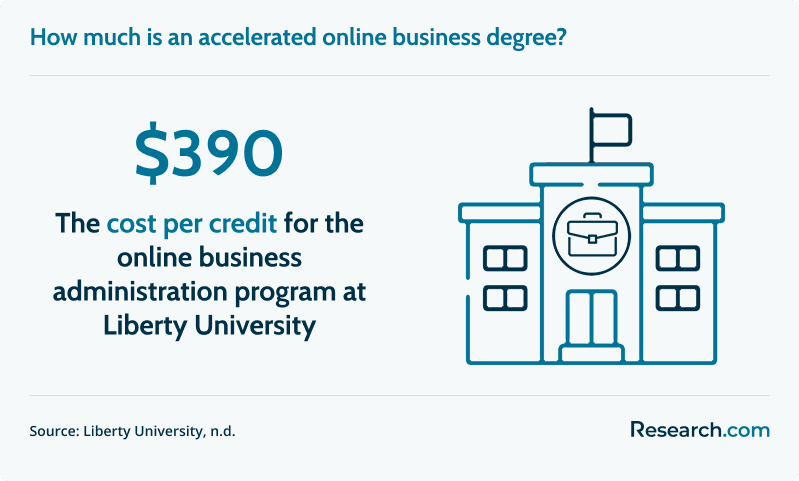
Among the accelerated online business programs listed here, tuition ranges from $390 to $796 per credit. Based on the listed figures, Liberty University has the lowest per-credit cost in the ranking at $390 per credit, which amounts to $46,800 for a 120-credit program. DePaul University lists $796 per credit hour and 114 required credits, which may total about $90,744.
However, per-credit tuition is only one part of the cost. Students should also ask about technology fees, course materials, graduation fees, portfolio-assessment fees, transfer-credit evaluation fees, and whether tuition is charged by credit, course, or term. Online programs often use one tuition rate for students regardless of state residency, but policies vary by school. Students comparing affordability across online fields may notice similar cost questions when reviewing topics such as criminal justice degree online cost.
| Cost factor | Why it matters | Question to ask |
| Per-credit tuition | Determines the base cost for credit-based programs | Is tuition the same for online students in every state? |
| Required credits | A lower per-credit rate may not be cheaper if the program requires more credits | How many credits will I personally need after transfer evaluation? |
| Transfer credits | Accepted credits can reduce tuition and time | How many of my credits apply to degree requirements? |
| Fees and materials | Non-tuition charges can change the real price | What is the estimated total program cost, not just tuition? |
| Financial aid | Grants, scholarships, loans, and employer benefits may reduce out-of-pocket costs | Can online accelerated students receive the same aid as other students? |
What are the financial aid options for students enrolling in an accelerated online business program?
Students in eligible accelerated online business programs may be able to use federal financial aid, institutional scholarships, private scholarships, grants, employer tuition assistance, military education benefits, and low-cost loans. The first step for most students is completing the Free Application for Federal Student Aid (FAFSA). After that, ask each school whether accelerated online students qualify for the same aid opportunities as campus-based students.
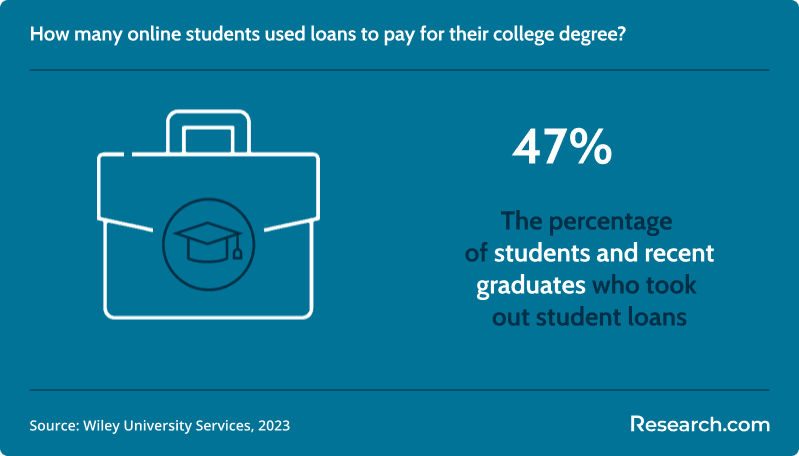
A 2023 Wiley report found that many online students and recent graduates received support through scholarships (26%), tuition discounts (25%), and free textbooks (20%). For payment methods, students reported using loans (47%) and grants (30%). Some institutions allow students to combine multiple forms of aid, which can reduce the final online business degree cost.
Ways to reduce the cost before you enroll
- Request an official transfer-credit review before committing to a school.
- Ask whether the school awards credit for certifications, military training, standardized exams, or professional experience.
- Compare total program cost, not only the advertised tuition rate.
- Confirm whether scholarships apply to accelerated, online, part-time, and transfer students.
- Check whether your employer reimburses tuition for business-related coursework.
- Avoid borrowing the maximum loan amount unless you have a clear repayment plan.
What are the prerequisites for enrolling in an accelerated online business program?
Accelerated online business programs often target students who already have college experience. Some programs expect applicants to hold an associate degree, while others accept applicants with a certain number of transferable credits. Because many accelerated degree-completion programs reduce or bypass general education coursework, admissions teams may look closely at your prior transcripts.
Common admissions requirements may include:
- Associate’s or bachelor’s degree
- GPA of at least 3.0
- College transcripts
- Work experience
- Completion of prerequisite courses like accounting or statistics
Not every school requires every item on this list. Before applying, ask whether your previous credits meet prerequisite requirements and whether you need to complete any foundation courses before entering the business major.
What courses are typically in an accelerated online business program?
Accelerated online business programs usually cover the functional areas that organizations rely on: accounting, finance, marketing, management, operations, analytics, ethics, strategy, and communication. The goal is to help students understand how decisions affect customers, employees, budgets, processes, and long-term performance.
Because business is a broad field, the skills can transfer to many roles and may also support later graduate study, including non-business options such as a masters in forensic psychology online for students who decide to combine business training with another discipline.
Common courses include:
- Organizational Behavior
- Project Management
- Business Strategy
- Financial Management
- Marketing Management
- Human Resource Management
- Business Ethics and Corporate Social Responsibility
What types of specializations are available in accelerated online business programs?
Many accelerated bachelor’s programs prioritize speed and core requirements, so they may offer fewer concentrations than traditional bachelor’s or graduate business programs. This is also common in related fast-track undergraduate options, including accelerated marketing programs online and some lower-cost finance pathways such as the cheapest finance degree online. Instead of a formal concentration, some schools let students personalize the degree with electives.
Students who want a broad and manageable undergraduate path may also compare options like the easiest business degree, but “easy” should not be the only criterion. A program should still match your career goals, learning style, and transfer-credit situation. Specializations are often more common at the graduate level. Common graduate business concentrations include:
- Finance
- Accounting
- Marketing
- Entrepreneurship
- IT Management
- International Business
A specialization can help when it aligns with a specific career target. For example, finance may fit students interested in financial analysis, while marketing analytics may suit students interested in consumer data and digital strategy. A corporate recruiter survey from GMAC shows that consulting is the top hiring industry for MBAs, followed by technology and finance/accounting firms, as shown below.
What factors should I consider when selecting an accelerated online business program?
The best accelerated online business program is not simply the fastest or cheapest one. It is the program that gives you a recognized credential, accepts the right credits, fits your schedule, provides enough support, and connects to the career outcomes you want.
| Factor | Why it matters | Red flag |
| Institutional accreditation | Helps protect credit transfer, financial aid eligibility, and employer recognition | The school is vague about accreditation or uses unfamiliar claims without clear agency details |
| Business accreditation | AACSB, ACBSP, or IACBE recognition may signal additional business-program review | The program markets prestige but does not state which programmatic accreditation it holds |
| Transfer-credit policy | Transfer acceptance can determine whether the program is truly accelerated for you | The school gives only a general estimate before you enroll |
| Schedule format | Six-week, eight-week, cohort, and self-paced formats require different study habits | The school does not clearly explain weekly workload or course pacing |
| Career services | Resume help, internships, employer connections, and interview preparation can affect outcomes | Career support is limited to generic online resources |
| Curriculum fit | Courses should match your target role, such as analytics, marketing, finance, or management | The program is broad but lacks electives in your area of interest |
| Total cost | Tuition, fees, books, and remaining credits determine real affordability | The school emphasizes per-credit cost but avoids a full cost estimate |
If your goal is management or leadership, compare business administration programs with more focused online business management degree options to see which curriculum better matches the roles you want.
How to choose the best accelerated online business program?
Start with accreditation. Whether you are evaluating a business degree, an online MFA, or another online credential, accreditation is one of the most important quality checks. Look for institutional accreditation and, when relevant, business-school accreditation from organizations such as AACSB or ACBSP. Accreditation can affect employer confidence, transfer credit, graduate school eligibility, and access to federal financial aid.
Next, confirm how many credits you can transfer. Regis University allows students to transfer up to 84 credits, while Liberty University accepts transfer credits for up to 75% of the degree. These policies can make a major difference, but the actual number of accepted credits depends on your transcript, grades, course age, and program requirements.
Step-by-step selection process
- Define your goal. Decide whether you want career entry, promotion, a career change, entrepreneurship training, or a pathway to graduate school.
- Check accreditation. Verify institutional accreditation and any business-specific accreditation listed by the school.
- Request a transfer evaluation. Do this before comparing completion timelines.
- Calculate total cost. Include tuition, fees, books, technology charges, and any PLA fees.
- Review course format. Decide whether you can handle self-paced, cohort-based, six-week, or eight-week courses.
- Ask about support. Look for advising, tutoring, library access, technical support, and career services for online students.
- Match electives to your career plan. Choose analytics, finance, marketing, international business, project management, or leadership options only if they support your goals.
- Compare outcomes carefully. Do not assume a ranking, salary average, or advertised timeline applies to every student.
Can accelerated online business programs prepare me for international business challenges?
Some accelerated online business programs include global trade, international management, cross-cultural communication, and regulatory topics. These courses can help students understand how business decisions change across countries, currencies, supply chains, legal systems, and cultural expectations. Students specifically interested in global roles should compare the curriculum with dedicated best online international business degree options, which may offer deeper coverage of international markets.
What challenges might I face in an accelerated online business program?
The biggest challenge is pace. Accelerated programs compress readings, assignments, discussions, exams, and projects into shorter windows. Students who are working full time may find that one accelerated course feels manageable, while two or more at once can become difficult. Online students also need to stay engaged without the routine of commuting to class.
Before enrolling, review whether the school offers academic advising, tutoring, technical support, faculty access, online library resources, and virtual networking. Students who want the quickest possible completion path should compare options carefully using resources such as the fastest business administration degree online guide, but speed should be balanced with support and academic quality.
Common mistakes to avoid
- Choosing only by speed. A fast program is not helpful if you cannot manage the workload.
- Ignoring accreditation. Accreditation can affect financial aid, graduate school admission, and employer recognition.
- Looking only at tuition. Fees, books, remaining credits, and transfer policies affect the real price.
- Assuming all credits transfer. Schools may reject credits because of grade, age, course content, or accreditation source.
- Overloading your schedule. Accelerated courses can be demanding even when they are online.
- Skipping career planning. A broad business degree works best when paired with internships, projects, networking, or a targeted specialization.
How do transfer credits save time in accelerated programs?
Transfer credits are often the main reason an accelerated online business degree can be completed quickly. If a school accepts credits from previous college coursework, you may be able to skip courses you have already completed and focus on remaining major requirements. Some schools also use prior learning assessments to evaluate work experience, professional training, military experience, certifications, or standardized exams.
Understanding transfer credit policies
Many accelerated programs accept a large number of transfer credits. Regis University and Liberty University allow students to transfer up to 75–84% of the total credits required for a degree. This can substantially reduce time to graduation for students with an associate degree or significant prior coursework.
Before relying on transfer credits, confirm that the credits:
- Come from an accredited institution.
- Match your new program’s general education, elective, prerequisite, or major requirements.
- Meet the school’s grade requirements.
- Fall within any time limits the program applies to older coursework.
Using prior learning assessments
Prior learning assessments can benefit adults with relevant professional experience. Schools may award credit when students can prove college-level learning outside the classroom. Common PLA methods include:
- Portfolio assessments: Students document work projects, training, responsibilities, and competencies related to business coursework.
- Standardized exams: Some schools award credit for exams such as CLEP (College-Level Examination Program) or DSST.
- Certifications: Industry-recognized credentials in areas such as project management or finance may qualify for credit if the school accepts them.
How to get started
Ask each admissions office for a written transfer-credit estimate and a clear explanation of prior learning assessment options. Many schools provide transfer advisors or online tools that estimate credit acceptance. If your main priority is speed, compare programs that are built for degree completion and review our guide to the fastest bachelor's degree programs.
What are the benefits of pursuing an online DBA after an accelerated business degree?
An online Doctor of Business Administration may appeal to professionals who want to move into senior leadership, consulting, applied research, or business education. A DBA typically builds on management experience and focuses on advanced decision-making, organizational strategy, research methods, and problem-solving for complex business issues.
A DBA is not the automatic next step for every business graduate. It usually makes more sense after professional experience and a clear leadership or consulting goal. If cost is a major concern, compare accredited options using resources such as the cheapest online DBA programs.
How do accelerated online business programs integrate innovative technology to adapt to market trends?
Business education is changing as employers expect graduates to understand digital collaboration, analytics, automation, artificial intelligence tools, customer data, and remote work environments. Many accelerated online business programs now use learning management systems, virtual teamwork platforms, simulations, data dashboards, and cloud-based tools to make coursework more practical.
The best programs do not treat technology as a separate topic. They integrate it into projects involving business decisions, marketing campaigns, financial analysis, operations planning, and strategic recommendations. Students interested in advanced business technology and leadership may also compare faster graduate options such as the fastest MBA programs online.
How can my accelerated online business degree position me for advanced academic opportunities?
An accelerated online business degree can provide the undergraduate foundation needed for graduate business study. Some schools offer built-in pathways that allow qualified students to move into graduate coursework, reduce duplicated requirements, or plan a bachelor’s-to-master’s sequence. Students who already know they want a graduate credential should compare schools that offer advising for MBA preparation, graduate transfer policies, and combined-degree options.
For students who want to continue quickly, an accelerated MBA degree program may be a logical next step. This route can be useful for professionals seeking leadership, consulting, operations, analytics, or strategic management roles, but it should be evaluated against cost, work experience requirements, and career goals.
What career paths are available for graduates of accelerated online business programs?
Graduates can apply business training in many entry-level and mid-career roles. A typical curriculum develops knowledge in accounting, finance, marketing, human resources, management, operations, communication, and business strategy. These areas are relevant across industries, which is why business degrees can support both specialist and generalist career paths.
Business degrees can also support advancement. Entry-level roles may lead to supervisory, project management, operations management, or general management positions with experience. Some graduates later pursue a specialized master’s degree, such as an online communications masters, to combine business training with another professional focus.
Students interested in global companies should pay attention to international business coursework. Many business programs include international business concepts because organizations increasingly operate across borders, supply chains, and markets. If you are exploring global business careers, review the skills and expectations connected to highest-paying jobs with international business degree pathways.
| Career direction | Relevant business coursework | Good fit for students who like |
| Marketing and sales | Marketing management, consumer behavior, digital marketing, analytics | Communication, persuasion, customer research, campaign planning |
| Finance and accounting support | Financial management, accounting, economics, budgeting | Numbers, reporting, forecasting, financial decisions |
| Operations and project coordination | Operations, project management, supply chain, process improvement | Planning, workflows, timelines, team coordination |
| Human resources | Organizational behavior, employment law, leadership, HR management | People operations, training, recruiting, workplace policy |
| Business analytics | Statistics, data analysis, management information systems | Data, dashboards, performance metrics, problem-solving |
| Management and entrepreneurship | Strategy, leadership, finance, marketing, ethics | Decision-making, innovation, supervision, business planning |
What is the job market for graduates with a business degree?
The job market for business degree holders is broad because business and financial skills are needed in many sectors. The Bureau of Labor Statistics projects business and financial occupations to grow faster than average from 2022 to 2032, resulting in an estimated 911,400 job openings annually over the decade.
Graduates with a bachelor’s in business may qualify for analyst, coordinator, specialist, or trainee roles depending on their experience and coursework. Among related roles, market research analysts are projected to have a job growth rate of 13%. The chart below compares projected job growth rates for selected business and finance occupations.
What are the potential salary ranges for graduates of accelerated online business programs?
Salary outcomes vary by job title, location, industry, experience, and whether the graduate has specialized skills in finance, analytics, marketing, operations, or management. According to various sources, including Research.com’s guide to masters in business salary, business graduates often see competitive salary potential. Graduates with a bachelor's degree in business can expect to earn an average salary of around $60,000 per year, while those with a master's degree can expect to earn an average salary of around $80,000 per year. Some fields, including finance and consulting, can offer higher salary ranges, with some graduates earning upwards of $100,000 per year.
These figures should be treated as broad estimates. A degree can help you qualify for opportunities, but it does not guarantee a specific salary. Internships, prior work experience, location, employer type, networking, certifications, and demonstrated technical skills can all affect pay.
Is an accelerated online business degree worth the investment?
An accelerated online business degree may be worth it if it helps you finish a recognized credential faster, reduces your remaining tuition through transfer credits, and supports a realistic career goal. The return on investment is strongest for students who already have credits, choose an accredited program, avoid unnecessary borrowing, and use the degree to pursue specific roles or promotions.
It may be less worthwhile if the program accepts few of your credits, costs more than comparable options, lacks career support, or does not align with your intended role. Students deciding between undergraduate completion and graduate study should compare alternatives such as online MBA programs to determine which credential better matches their current education level and career plan.
Questions to ask before enrolling
- Is the institution accredited, and is the business program accredited by AACSB, ACBSP, IACBE, or another recognized body?
- How many of my credits will transfer into the degree after an official review?
- What is my estimated total cost after transfer credits and financial aid?
- Are courses asynchronous, synchronous, self-paced, or cohort-based?
- How many hours per week should I expect to study?
- What career services are available specifically for online students?
- Can I pause or reduce my course load if work or family obligations change?
- Does the program offer electives, concentrations, or projects related to my career goal?
What skills can I gain from an accelerated online business program?
Accelerated online business programs are designed to build practical workplace skills quickly. Students comparing the easiest business degree options should still look for programs that develop real capabilities employers value, not just a fast path to graduation.
Key skills include:
- Leadership and management: Students learn how to guide teams, allocate resources, make decisions, and understand organizational behavior.
- Financial and analytical thinking: Courses in accounting, finance, economics, and statistics help students interpret data, evaluate budgets, and make evidence-based recommendations.
- Communication and collaboration: Business programs emphasize writing, presentations, negotiation, teamwork, and professional communication across departments.
- Marketing and customer insight: Students study branding, consumer behavior, market research, and digital marketing strategies.
- Problem-solving and adaptability: Accelerated coursework requires students to analyze problems quickly, adjust to changing information, and apply concepts to real business situations.
- Technology and data fluency: Many programs now incorporate spreadsheets, analytics tools, collaboration platforms, and digital business systems.
References
- National Center for Education Statistics. (n.d.). Table 325.25.: Degrees in business conferred by postsecondary institutions, by level of degree and sex of student: Selected academic years, 1955-56 through 2020-21. National Center for Education Statistics. Retrieved May 28, 2024, from https://nces.ed.gov/programs/digest/d22/tables/dt22_325.25.asp
- Payscale. (2024, April 23). Bachelor's Degree, Business Administration Salary | PayScale. Payscale. Retrieved May 26, 2024, from https://www.payscale.com/research/US/Degree=Bachelor%27s_Degree%2C_Business_Administration/Salary
- Payscale. (2024, May 6). Master of Business Administration (MBA) Salary | PayScale. Payscale. Retrieved May 26, 2024, from https://www.payscale.com/research/US/Degree=Master_of_Business_Administration_(MBA)/Salary
- U.S. Bureau of Labor Statistics. (2024, April 17). Budget Analysts : Occupational Outlook Handbook: : U.S. Bureau of Labor Statistics. Retrieved May 28, 2024, from https://www.bls.gov/ooh/business-and-financial/budget-analysts.htm
- U.S. Bureau of Labor Statistics. (2024, April 17). Business and Financial Occupations : Occupational Outlook Handbook: : U.S. Bureau of Labor Statistics. Retrieved May 26, 2024, from https://www.bls.gov/ooh/business-and-financial/home.htm
- U.S. Bureau of Labor Statistics. (2024, April 17). Financial Analysts : Occupational Outlook Handbook: : U.S. Bureau of Labor Statistics. Retrieved May 28, 2024, from https://www.bls.gov/ooh/business-and-financial/financial-analysts.htm
- U.S. Bureau of Labor Statistics. (2024, April 17). Management Analysts : Occupational Outlook Handbook: : U.S. Bureau of Labor Statistics. Retrieved May 28, 2024, from https://www.bls.gov/ooh/business-and-financial/management-analysts.htm
- U.S. Bureau of Labor Statistics. (2024, April 17). Market Research Analysts : Occupational Outlook Handbook: : U.S. Bureau of Labor Statistics. Retrieved May 28, 2024, from https://www.bls.gov/ooh/business-and-financial/market-research-analysts.htm
- U.S. Bureau of Labor Statistics. (2024, April 17). Project Management Specialists : Occupational Outlook Handbook: : U.S. Bureau of Labor Statistics. Retrieved May 28, 2024, from https://www.bls.gov/ooh/business-and-financial/project-management-specialists.htm
Key Insights
- An accelerated online business degree is most valuable for students with transferable credits; without them, the program may not be dramatically shorter than a traditional pathway.
- Costs in the listed programs range from $390 to $796 per credit, but your true cost depends on accepted transfer credits, fees, books, and financial aid.
- Accreditation should be non-negotiable. Verify institutional accreditation and look for business accreditation such as AACSB, ACBSP, or IACBE when relevant.
- Online flexibility comes with responsibility. Accelerated courses require disciplined scheduling, regular participation, and comfort with digital learning tools.
- Business is a versatile degree, but career outcomes improve when students choose electives, projects, internships, or concentrations tied to a specific goal.
- Salary averages are useful for context, not promises. Location, experience, role, industry, and specialized skills strongly influence earnings.
- Before enrolling, request a written transfer-credit evaluation, calculate total program cost, compare support services, and ask how the curriculum connects to your intended career path.
Other Things You Should Know About Accelerated Business Degree Online Programs
Yes. Many accelerated online business programs accept up to 90 transfer credits toward a 120-credit bachelor’s degree, which can cut completion time by one to two years. Schools usually require official transcripts and a minimum grade of C, often higher for major courses.
To gain admission to the best accelerated business degree online programs in 2027, you typically need a high school diploma or equivalent, a minimum GPA (often around 2.5), and standardized test scores, such as the SAT or ACT, unless stated otherwise by the program.