
2027 What You Need to Know About Becoming an International Business Major

Co-Founder and Chief Data Scientist
Choosing an international business major means deciding whether you want a business education built around cross-border trade, global markets, currency risk, international regulation, and working with people across cultures. It can lead to roles in supply chain, finance, marketing, compliance, consulting, and global operations, but it is not simply a “travel-focused” degree. The strongest programs prepare students to solve business problems when laws, languages, customer expectations, logistics systems, and political conditions differ from one country to another.
This guide explains what an international business major covers, how it compares with a general business degree, what careers it can support, how much graduates may earn, and how to choose a program that fits your goals. It also covers online options, specializations, employer expectations, advancement routes, common mistakes, and trends reshaping global business careers.
Quick answer: Is an international business major a good choice?
An international business major can be a strong option if you want a business career connected to global trade, multinational companies, international finance, market expansion, supply chains, or cross-cultural management. It is especially useful for students who want business training plus global context, language exposure, and international case studies. Starting salaries for international business graduates can range from $66,691 to $89,000 per year, while experienced professionals can earn from $100,000 to $175,544 per year or higher depending on role, industry, location, education, and experience.
The major is less ideal if you want a narrowly technical accounting, domestic finance, or local small-business career and do not plan to work with global markets. In that case, a more specialized business degree may offer a clearer route.
Key things to know before choosing this major
- It is a business degree with a global lens. You still study finance, marketing, accounting, management, and economics, but the coursework focuses on how those fields work across borders.
- Employers value practical global skills. Intercultural communication, negotiation, adaptability, compliance awareness, data analysis, and foreign market research can make graduates competitive for international roles.
- Career paths are broad. Graduates may work in import/export, global marketing, international finance, global supply chain management, consulting, trade compliance, development organizations, or multinational operations.
- Online programs can work well for the right student. An online international business major may be a practical choice for working adults, transfer students, military learners, or students who need a flexible route into global business.
- What is an international business major?
- What do international business majors do after graduation?
- What do students study in an international business program?
- International business major vs. general business major
- Admissions and educational requirements
- Common international business specializations
- International business major salary expectations
- Where international business graduates work
- Job outlook for international business majors
- How to choose the right international business program
- Skills international business professionals need
- How to evaluate top international business degree programs
- Is an international business career worth it?
- What employers look for in international business candidates
- When a doctoral degree in international business makes sense
- Challenges in international business careers and how to manage them
- Practical ways to advance in international business
- Can healthcare administration skills strengthen global business strategy?
- Trends shaping international business careers
- How economics studies can support an international business career
- Can affordable online programs prepare students for global business?
What is an international business major?
An international business major is an undergraduate business program designed for students who want to understand how companies operate across national borders. It combines standard business subjects—such as management, accounting, marketing, finance, and operations—with international trade, global strategy, cultural analysis, foreign exchange, international law, and cross-border logistics.
This major is not usually grouped among the easy business degrees because it requires students to connect business fundamentals with legal, economic, cultural, and political differences across markets. International business bachelor's degrees were awarded to 5,473 students in 2021.
Students typically learn how trade agreements affect business decisions, how companies manage currency changes, how global marketing differs from domestic marketing, and how legal requirements can change from one country to another. Many programs also emphasize negotiation, communication across cultures, and decision-making in unfamiliar environments.
Graduates leave with a mix of business judgment and international awareness. That combination can be useful in multinational companies, logistics firms, financial institutions, government trade offices, consulting firms, nonprofits, and companies expanding into foreign markets.
If you want a more specialized business path, common alternatives include accounting, marketing, finance, supply chain management, and economics. Students more interested in financial analysis than global operations may want to compare international business with cheap accredited online finance degree options.
| International business is a good fit if you... | You may prefer another major if you... |
| Want to work with foreign markets, global teams, trade, logistics, or multinational strategy | Want a highly specialized domestic accounting, finance, or operations role |
| Enjoy learning about culture, regulation, economics, and international events | Prefer a narrower curriculum with fewer global policy or cultural components |
| Are willing to build communication, research, data, and negotiation skills | Want a degree that directly prepares for one clearly defined licensed profession |
| May study a foreign language, complete an internship, or pursue study abroad | Do not want global case studies, international travel exposure, or cross-cultural work |
What do international business majors do after graduation?
International business graduates help organizations buy, sell, finance, ship, market, and manage products or services across countries. Their work often sits at the intersection of business strategy, compliance, customer behavior, logistics, finance, and cultural communication.
In 2023, global trade executives identified the top three industries needing more international business professionals as consumer products (37%), industrial products (20%), and energy and resources (15%). Common roles include the following:
- Import/export specialist: Coordinates the movement of goods across borders, works with customs documentation, monitors shipping requirements, and helps organizations comply with trade regulations.
- International marketing manager: Adapts products, messages, pricing, and campaigns for customers in different regions. This role requires market research and sensitivity to local culture and consumer behavior.
- International finance specialist: Supports cross-border transactions, reviews currency exposure, analyzes foreign exchange issues, and helps reduce financial risk in international operations.
- Global supply chain manager: Oversees sourcing, production, transportation, inventory, and distribution across multiple countries. These professionals often coordinate suppliers, manufacturers, freight partners, and internal teams.
- Management consultant: Advises organizations on international expansion, market entry, global operating models, supply chain resilience, and trade-related business challenges.
- Trade compliance analyst: Reviews import/export activity, documentation, sanctions concerns, tariffs, and internal controls to help companies meet regulatory obligations.
| Career area | Typical work | Best-fit students |
| Global marketing | Market research, localization, campaign planning, customer analysis | Students interested in culture, communication, branding, and consumer behavior |
| International finance | Currency risk, cross-border payments, investment analysis, financial reporting | Students comfortable with numbers, risk, economics, and financial systems |
| Trade and compliance | Customs rules, documentation, trade controls, tariff review, regulatory monitoring | Students who are detail-oriented and interested in law, policy, and operations |
| Global supply chain | Sourcing, logistics, transportation, supplier coordination, inventory planning | Students who like operations, analytics, problem-solving, and process improvement |
| Consulting and strategy | Market entry, expansion planning, risk assessment, organizational change | Students with strong research, presentation, analysis, and client-service skills |
What do students study in an international business program?
An international business curriculum builds standard business knowledge while teaching students to apply it in global settings. Programs often draw on the essential international business skills associated with cross-cultural communication, global strategy, finance, analytics, negotiation, and market awareness.
Most programs include these core areas:
- International trade: Students study how goods and services move across borders, including trade agreements, tariffs, import/export regulations, customs processes, and trade finance. Students focused on logistics may also compare this path with a cheap online supply chain management degree.
- Global marketing: Coursework examines how companies adapt products, pricing, promotion, and distribution for customers in different countries. Students interested in campaign strategy may also consider an accelerated marketing degree online.
- International finance: This area covers foreign exchange, international investments, global financial institutions, cross-border transactions, and strategies for managing currency and country risk.
- International law and regulation: Students learn how contracts, intellectual property, trade rules, dispute resolution, and compliance obligations vary in global commerce.
- International management: Coursework focuses on leading global teams, managing across cultures, designing multinational operations, and adapting leadership practices to different business environments.
- Economics and global markets: Many programs include macroeconomics, emerging markets, political economy, and regional business analysis to help students interpret global conditions.
- Data and business analytics: Students increasingly need to interpret trade data, market data, supply chain metrics, and financial indicators to support international decisions.
International business major vs. general business major
Both majors teach business fundamentals, but they prepare students for different environments. A general business major usually gives students a broad foundation for domestic business roles. An international business major takes many of the same core subjects and asks how they change when companies operate across borders.
A student in a general business program, including an accelerated business degree online, may take broad coursework in accounting, finance, marketing, management, operations, and business law. An international business student typically studies those same disciplines with additional emphasis on trade policy, foreign markets, cultural differences, international legal systems, exchange rates, global supply chains, and multinational strategy.
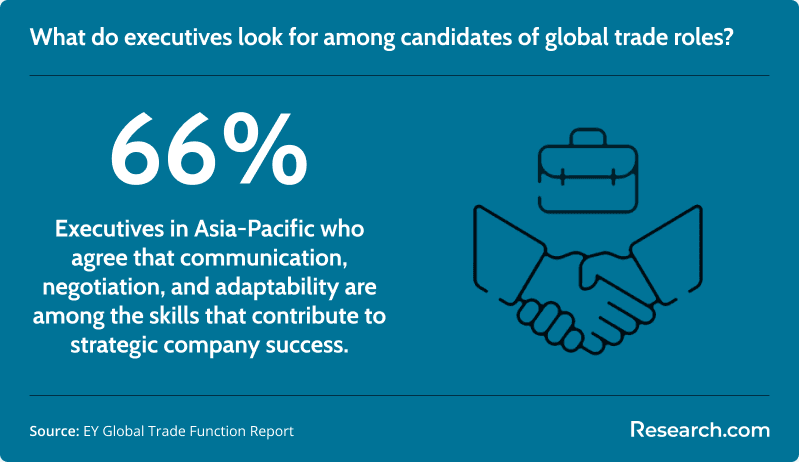
The skill emphasis also differs. Both majors develop communication, critical thinking, teamwork, and problem-solving. International business programs add heavier focus on intercultural communication, global negotiation, foreign market research, and adaptability. These skills matter because 66% of executives in Asia-Pacific, 64% in the United Kingdom and Ireland, and 57% in MENA nations believe that these abilities contribute to strategic company success.
| Comparison point | General business major | International business major |
| Main focus | Broad business operations, often with a domestic orientation | Business decisions across countries, cultures, regulations, and markets |
| Typical courses | Accounting, finance, marketing, management, business law, operations | Core business courses plus international trade, global marketing, international finance, global strategy, and cross-cultural management |
| Best for | Students who want flexible business training for many domestic roles | Students aiming for global companies, trade, logistics, international finance, consulting, or market expansion |
| Helpful additions | Internships, analytics tools, industry-specific electives | Foreign language study, study abroad, international internship, trade compliance exposure |
| Potential limitation | May not go deeply into global trade or cross-border regulation | May be broader than needed for students who want a narrow technical specialty |
Admissions and educational requirements
Admission requirements vary by school and program format, but most undergraduate international business programs expect applicants to meet standard college admissions criteria. Requirements commonly include:
- High school diploma or GED: This is the basic requirement for entry into most bachelor’s degree programs.
- Minimum GPA: Colleges often set a minimum GPA for first-year or transfer admission. Depending on the institution, the requirement can range from 2.0 to 3.5 or higher.
- SAT or ACT scores: Some schools remain test-optional, while others may still request standardized test scores. Strong scores can help an application when required or considered.
- College-preparatory coursework: Math, writing, economics, social science, and foreign language courses can support readiness for international business study.
- Transfer credits: Transfer students should ask how prior business, economics, statistics, or language credits apply to the major before enrolling.
Some affordable online colleges may require or recommend algebra, pre-calculus, statistics, or similar quantitative coursework because international finance, business analytics, and economics rely on numerical reasoning.
Foreign language proficiency is not always required, but it can be a major advantage. Students who want to work in specific regions should consider language study aligned with their career interests. Graduate education is not mandatory for every role, but it can support advancement. In 2021, a total of 1,672 master's degrees in international business were conferred based on NCES data.
Typical timeline for becoming an international business professional
| Stage | What to focus on | Why it matters |
| High school or pre-college | Math, writing, economics, language study, business clubs, global current events | Builds readiness for business coursework and international topics |
| Years 1-2 of college | Business core, economics, accounting, communication, statistics, introductory language courses | Creates the foundation for advanced global business classes |
| Years 3-4 of college | International trade, global marketing, finance, law, supply chain, internship, study abroad if possible | Connects classroom learning to specific career paths |
| Entry-level career | Trade support, analyst roles, logistics coordination, marketing research, finance operations, compliance support | Provides practical experience employers often value more than coursework alone |
| Career advancement | Certifications, MBA or master’s degree, regional expertise, leadership experience, data skills | Helps professionals move into management, consulting, strategy, or specialized roles |
Common international business specializations
Specializations help students turn a broad international business degree into a more targeted career path. Among global trade executives, 69% identified supply chain disruption as the top concern, and they would choose to add additional resources to the related functions anytime.
Trade and operations specializations
- International trade: Focuses on customs rules, trade agreements, import/export procedures, trade finance, compliance, and global trade policy.
- Global supply chain management: Covers sourcing, logistics, production networks, transportation, supplier relationships, and cross-border distribution.
- International procurement: Trains students to evaluate global suppliers, negotiate contracts, monitor quality, manage risk, and follow trade regulations.
Marketing and customer-focused specializations
- Global marketing: Teaches students to adapt brand strategy, research customer behavior, localize campaigns, and manage market entry decisions.
- Digital marketing for international business: Focuses on digital channels, online customer acquisition, regional platform differences, analytics, and international e-commerce strategy.
- International sports marketing: Applies global marketing principles to sports brands, events, sponsorships, athletes, and fan engagement across regions.
Finance specializations
- International finance: Examines exchange rates, cross-border investment, foreign financial institutions, global capital markets, and currency risk.
- International banking: Covers banking products, international payment systems, trade finance, financial regulation, and risk management in global banking.
- Financial technology for international business: Looks at cross-border payments, digital finance tools, blockchain applications, trade finance platforms, and technology-driven risk controls.
Management and industry specializations
- International management: Often also available through an affordable executive MBA, this concentration focuses on multinational leadership, global HR, organizational strategy, and cross-cultural management.
- International entrepreneurship: Prepares students to build or scale ventures that sell, source, hire, or operate across borders.
- International hospitality management: Applies global business principles to hotels, resorts, travel companies, tourism operations, and international service brands.
| If your goal is... | Consider this specialization | Useful complementary skills |
| Working with global logistics or sourcing | Global supply chain management or international procurement | Analytics, ERP systems, negotiation, compliance basics |
| Helping brands enter foreign markets | Global marketing or digital marketing for international business | Market research, localization, consumer analytics, language study |
| Managing cross-border money flows | International finance, international banking, or FinTech | Financial modeling, economics, risk analysis, currency knowledge |
| Leading multinational teams | International management | Leadership, HR knowledge, conflict resolution, cultural intelligence |
| Starting a global venture | International entrepreneurship | Business planning, export knowledge, digital commerce, financing strategy |
International business major salary expectations
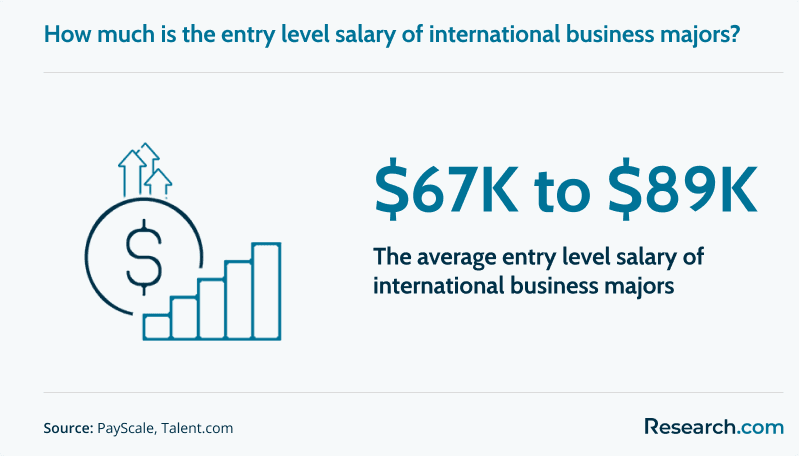
International business salaries differ widely because the major can lead to many occupations. According to various sources like Payscale and Talent.com, starting salaries for international business graduates can range from $66,691 to $89,000 per year.
Pay can rise with experience, advanced education, industry specialization, location, and management responsibility. Experienced international business professionals can earn anywhere from $100,000 to $175,544 per year or even higher depending on a variety of factors.
Entry-level workers usually earn less than professionals who manage accounts, teams, markets, budgets, or global operations. Industry also matters. Finance, consulting, technology, energy, and complex supply chain roles may pay differently from nonprofit, public-sector, or entry-level trade support positions.
Graduate education can strengthen earning potential for some professionals, especially when paired with relevant work experience. Students comparing graduate options may want to review MBA programs under 10k if cost is a major factor.
| Factor | How it can affect salary |
| Job title | Analyst, coordinator, specialist, manager, consultant, and director roles usually have different pay ranges. |
| Experience | Professionals who manage larger markets, teams, client portfolios, or compliance responsibilities often command higher pay. |
| Industry | Compensation can vary across finance, consulting, manufacturing, consumer products, energy, government, and nonprofits. |
| Location | Major metropolitan areas may offer higher salaries, although cost of living can also be higher. |
| Education | A master’s degree, MBA, or specialized credential may help for management, consulting, finance, and strategy roles. |
| Technical skills | Data analytics, financial modeling, supply chain systems, foreign language ability, and compliance knowledge can improve competitiveness. |
Where international business graduates work
An international business degree can apply across many sectors because nearly every industry faces some combination of global sourcing, international customers, foreign competitors, cross-border regulation, or distributed teams. Based on a survey, 40% of current global trade executives cited functions associated with data analytics as their top priority in support of their business strategies, while 38% cited trade process and controls, and 25% for strategy and planning.
- Multinational corporations: Large companies with operations in multiple countries hire international business graduates for global marketing, finance, supply chain, trade operations, procurement, and regional management roles.
- Government agencies: Trade, commerce, foreign affairs, and economic development agencies may employ graduates to support export promotion, trade analysis, market research, policy work, and international partnerships.
- Nonprofit and development organizations: NGOs, humanitarian groups, and international development organizations need professionals who can manage cross-border programs, funding relationships, local partnerships, and project logistics.
- International trade organizations: These groups support global commerce through policy analysis, member services, dispute support, research, events, and trade facilitation.
- Financial institutions: Banks, investment firms, and financial consulting companies need talent familiar with foreign exchange, international payments, global investment risk, and trade finance.
- Consulting firms: Consulting teams help companies expand internationally, redesign supply chains, manage risk, and address cross-cultural organizational challenges. Students interested in the people side of global operations may also explore an affordable HR degree online.
Job outlook for international business majors
The outlook for international business graduates is generally positive because companies continue to operate in a world economy is becoming increasingly interconnected. Organizations need professionals who understand market expansion, trade compliance, global supply chains, foreign customers, cross-border finance, and international risk.
In 2023, 33% of multinational corporations surveyed by Deloitte cited inadequate personnel in compliance functions as a significant obstacle. That creates opportunities for graduates who can combine business knowledge with regulatory awareness, documentation accuracy, and process controls.
E-commerce also expands the need for international business skills. Companies can now reach buyers across borders more easily, but they still need people who understand payments, customs, shipping, returns, consumer protection rules, localization, and regional marketing.
Emerging economies such as China, India, and Brazil also create opportunities for professionals who can research local markets, communicate across cultures, interpret regulations, and support expansion decisions. Still, students should remember that a degree alone does not guarantee a job. Internships, technical skills, networking, language ability, and industry-specific experience can be decisive.
How to choose the right international business program
The best international business program is not always the highest ranked or most expensive option. It is the program that matches your career target, budget, schedule, transfer situation, and preferred learning format while offering credible academic quality and career support.
1. Confirm accreditation first
Look for institutional accreditation and, when available, business-specific accreditation from organizations such as the Association to Advance Collegiate Schools of Business (AACSB) or the Accreditation Council for Business Schools and Programs (ACBSP). Accreditation helps signal that the school meets recognized academic standards and may affect credit transfer, graduate admission, and employer confidence.
2. Review the curriculum, not just the degree title
Some programs emphasize trade and supply chain, while others focus on global strategy, marketing, finance, or management. Check whether the program includes international trade, global finance, international law, cross-cultural management, business analytics, and region-specific electives.
3. Look for language and cultural learning
Foreign language study may not be required everywhere, but it can strengthen your profile. Cultural studies, regional business courses, and international case projects can also help you develop practical judgment for global work.
4. Evaluate study abroad and international exposure
Study abroad is not the only route to global experience, but it can be valuable when affordable and well-structured. Also look for virtual international projects, exchange partnerships, global internships, and courses with international company case studies.
5. Compare online, hybrid, and campus formats
Online and hybrid programs can be useful for students who work, care for family, live far from campus, or need scheduling flexibility. Graduate students who need flexible admission routes may compare international business concentrations with an online MBA no GMAT.
6. Ask about internships and employer connections
Internships are especially important in international business because employers want proof that you can apply classroom concepts to real operations. Ask whether the school has relationships with multinational companies, logistics firms, trade offices, banks, consulting firms, or nonprofits.
7. Calculate total cost
Do not compare schools by tuition alone. Include fees, technology costs, textbooks, travel, study abroad costs, housing, lost wages, and time to completion. Ask about scholarships, transfer credits, employer tuition assistance, and whether online students pay different rates.
8. Review career outcomes carefully
Look at career services, alumni networks, internship placement support, employer events, and job-search coaching. If a school publishes outcomes, read the details and avoid assuming that broad business salary numbers apply to every graduate.
| Question to ask | Why it matters |
| Is the institution accredited, and does the business school hold specialized accreditation? | Accreditation can affect quality assurance, transferability, financial aid eligibility, and employer confidence. |
| Which international business courses are required? | The course list reveals whether the program truly emphasizes global business or only offers a few international electives. |
| Are internships, study abroad, or global projects built into the program? | Applied experience can make a graduate more competitive than coursework alone. |
| Can I transfer previous credits? | Transfer policies affect cost, time to graduation, and whether you repeat coursework. |
| What career support is available to online and campus students? | Some programs offer stronger advising, employer access, and networking than others. |
| What is the total estimated cost through graduation? | Fees, books, travel, and delayed completion can change the real price of a degree. |
Skills international business professionals need
Successful international business professionals combine business fundamentals with cultural intelligence, analytical ability, and practical communication skills. They must understand global markets, trade rules, customer differences, political risk, and supply chain realities while working with colleagues, suppliers, regulators, and clients who may not share the same assumptions or communication style.
Key skills include cross-cultural communication, negotiation, market research, financial analysis, data interpretation, trade compliance awareness, project management, adaptability, and ethical decision-making. Students interested in the intersection of business, government, and global policy may also build useful context through an online masters in public policy.
| Skill | How to build it | Where it helps |
| Intercultural communication | Language study, study abroad, international team projects, cultural training | Negotiation, management, marketing, client relationships |
| Trade and compliance knowledge | International trade courses, compliance internships, customs documentation practice | Import/export, logistics, regulated industries, global operations |
| Data analysis | Statistics, Excel, business intelligence tools, supply chain analytics, market research projects | Strategy, trade operations, finance, consulting, market entry |
| Financial judgment | International finance, economics, currency risk analysis, budgeting experience | Banking, corporate finance, investment analysis, global planning |
| Adaptability | Rotational roles, global projects, internships, problem-based coursework | Emerging markets, crisis response, multinational teams, travel-heavy roles |
How to evaluate top international business degree programs
Students often look for rankings when comparing programs, but rankings should be a starting point, not the final decision. A strong international business program should have credible accreditation, relevant global coursework, experienced faculty, flexible learning options, applied projects, career support, and connections to employers or international experiences.
Resources that compare the best online international business degree options can help students identify programs with online flexibility, curriculum depth, and student-focused support. Use those lists alongside your own review of cost, transfer policies, internships, faculty expertise, and course requirements.
Is an international business career worth it?
An international business career can be worth it if you want work that connects business decisions with global markets, culture, trade, finance, logistics, and strategy. It can offer variety, international exposure, and career mobility, but it also requires resilience, continuous learning, and comfort with uncertainty.
International business can be especially appealing to students who enjoy complex problems. You may deal with new regulations, regional customer expectations, geopolitical shifts, supplier disruptions, currency issues, or market-entry decisions. From 2022 to 2032, employment of logisticians, which is a key role in international business, is anticipated to increase by 18 percent.
The degree can also support career growth because global companies need people who understand both business fundamentals and international context. Students who want to strengthen data skills for global trade, analytics, or strategy may consider cheap MS in data science courses in USA.
The trade-off is that the career path is less linear than some majors. You may need internships, language skills, certifications, regional expertise, or a graduate degree to reach more advanced roles. The major provides a foundation, but your specialization and experience shape your outcomes.
| Pros | Cons |
| Broad career options across trade, marketing, finance, logistics, consulting, and management | Career paths can be less direct than accounting, nursing, engineering, or other profession-specific majors |
| Useful skills for multinational companies and global teams | Some roles require experience, language skills, travel flexibility, or specialized credentials |
| Exposure to international markets, cultures, and business strategy | Global work can involve time zones, regulation changes, political risk, and operational uncertainty |
| Potential for advancement with experience, analytics skills, and graduate education | Salary outcomes vary widely by role, location, employer, and industry |
What employers look for in international business candidates
Employers usually want more than a degree title. They look for candidates who can show academic preparation, practical experience, communication ability, and readiness for complex global environments. Internships, study abroad, language skills, regional knowledge, technical tools, and certifications can help demonstrate that readiness.
For many roles, employers value cross-cultural communication, trade compliance awareness, data skills, problem-solving, and the ability to adjust when markets or regulations change. A specialized graduate credential, such as the cheapest MBA option with a global focus, may help experienced professionals stand out when moving into management or strategy roles.
Common mistakes students should avoid
- Choosing a program without checking accreditation. Always verify institutional accreditation and any business-school accreditation before enrolling.
- Assuming the major alone guarantees international work. Employers often expect internships, technical skills, language ability, or industry knowledge.
- Ignoring total cost. Tuition is only one part of the financial decision; fees, books, travel, and delayed graduation can matter.
- Overlooking transfer credit rules. A low-cost school may become expensive if it accepts few prior credits.
- Relying only on rankings. Rankings may not reflect your career goals, schedule, location, financial situation, or preferred specialization.
- Assuming every online program offers global exposure. Review whether online students receive internships, networking, international projects, and career services.
- Neglecting analytics. Data skills are increasingly important in global trade, supply chain, finance, marketing, and strategy roles.
When a doctoral degree in international business makes sense
A doctoral degree is not necessary for most international business jobs, but it can be useful for experienced professionals aiming for senior consulting, executive leadership, applied research, or academic roles. A Doctor of Business Administration (DBA) is usually practice-oriented and focuses on applying research to real organizational problems, while a PhD is often more research-intensive and academic in focus.
Professionals considering doctoral study should weigh cost, time, research expectations, career goals, and whether the degree will realistically improve opportunities. Those looking for a lower-cost online route can compare cheap DBA online programs.
Challenges in international business careers and how to manage them
International business careers can be rewarding, but they also come with pressure. Professionals may need to manage different regulatory systems, cultural misunderstandings, shifting tariffs, sanctions, currency changes, supply disruptions, political risk, and technology-driven change.
The best way to reduce these risks is to keep learning. Professionals should build compliance knowledge, follow global news, strengthen data skills, seek mentors, complete relevant certifications, and pursue practical training when needed. Students who want a faster undergraduate route into business fundamentals may compare an accelerated bachelor's degree business administration with a dedicated international business program.
| Challenge | Why it matters | How to prepare |
| Regulatory complexity | Rules can vary by product, country, industry, and transaction type | Study trade compliance, documentation, contracts, and international law basics |
| Cultural differences | Miscommunication can harm negotiations, teams, and customer relationships | Build language skills, cultural intelligence, and experience with diverse teams |
| Geopolitical risk | Sanctions, tariffs, conflict, and policy changes can affect operations | Follow global business news and learn risk assessment methods |
| Supply chain disruption | Delays and shortages can affect costs, customers, and revenue | Develop logistics knowledge, supplier analysis, and contingency planning skills |
| Technology change | Automation, analytics, and digital trade tools are changing job expectations | Learn analytics platforms, digital marketing tools, and business technology systems |
Practical ways to advance in international business
Career growth in international business usually comes from combining education, experience, specialization, and a strong professional network. The easiest path depends on your current role and career target.
1. Earn a specialized master’s degree
After a bachelor’s degree, some professionals pursue an MBA with an international business concentration or a master’s in international business. These programs can deepen knowledge in global strategy, finance, trade, law, and management while expanding professional networks.
Specialized master’s programs may focus on international marketing, global supply chain management, international finance, or related areas. Many take 1-2 years to complete, and online formats can help working professionals continue gaining experience while studying.
2. Add role-specific certifications
Certifications can be useful when they align with a clear job goal. Credentials in global supply chain management, international trade, human resources, finance, project management, or compliance may help professionals show specialized competence.
3. Use online learning strategically
Online programs can help working adults advance without relocating or leaving a job. Students comparing flexible business routes may review the easiest management degree options, including online MBAs and management master’s programs with international or global business coursework.
4. Consider executive education
Short executive programs can be useful for mid-career professionals who need focused training in global leadership, negotiation, market entry, supply chain risk, or international strategy without committing to a full degree.
5. Seek international or rotational experience
Rotational programs at multinational companies can expose early-career professionals to different departments, countries, functions, and business challenges. These experiences can accelerate learning and help employees identify a specialization.
6. Build a strong professional network
International business opportunities often come through relationships. Conferences, trade associations, alumni groups, regional business councils, professional organizations, and mentors can help professionals find openings and understand market trends.
Can healthcare administration skills strengthen global business strategy?
Healthcare is a highly regulated global industry, so healthcare administration skills can complement international business careers in specific contexts. Professionals working with medical devices, pharmaceuticals, hospital systems, health technology, insurance, humanitarian programs, or global health operations may benefit from understanding healthcare regulation, quality control, cost management, and cross-border service delivery.
Students interested in combining healthcare management with business strategy can compare an accelerated healthcare administration degree online with international business coursework or graduate business options.
Trends shaping international business careers
Global business is changing quickly. Students choosing an international business major should understand the trends that influence hiring, curriculum design, and long-term career opportunities.
Sustainability and ethical sourcing
Companies face growing pressure to reduce environmental harm, monitor labor practices, and source responsibly across global supply chains. Businesses incorporating green initiatives gain competitive advantages, especially as 73% of millennials report that they prioritize sustainable brands.
Digital transformation
Artificial intelligence, blockchain, the Internet of Things, and advanced analytics are changing how companies forecast demand, monitor suppliers, manage cross-border payments, evaluate customers, and detect risk. International business students should expect employers to value data and technology skills.
Emerging market growth
Markets in Southeast Asia, Africa, Latin America, and other developing regions continue to attract attention from companies seeking new customers, suppliers, and partners. Success in these markets requires local research, cultural awareness, regulatory knowledge, and patience.
Remote and distributed global teams
Remote work has made it easier for companies to build teams across countries. That creates opportunities for global collaboration but also requires clear communication, strong project management, time-zone coordination, and cultural sensitivity.
Geopolitical and economic uncertainty
Trade policies, sanctions, tariffs, political instability, and currency volatility can reshape business decisions quickly. According to a 2023 global trade survey, 45% of respondents cited geopolitical risk monitoring as a top priority in their international business operations.
More demanding global customers
Customers increasingly expect localized, convenient, and personalized experiences. International marketers and business strategists must understand local preferences, digital platforms, price sensitivity, languages, and customer service expectations.
Students who want a broader accredited business foundation before specializing can compare online business degree programs accredited by recognized institutions.
How economics studies can support an international business career
Economics can strengthen an international business background by helping students interpret inflation, interest rates, exchange rates, trade policy, labor markets, and economic growth. This knowledge is useful for market entry, risk analysis, pricing, sourcing, and investment decisions.
Students who want stronger quantitative and policy analysis skills may consider an affordable degree in economics online as a complement to business coursework or as a related alternative.
What international business professionals say about their careers
-
: "
My international business degree challenged me, but it also changed how I saw global problems. Trade disputes, market changes, and cultural differences stopped feeling abstract. They became real business situations where negotiation, research, and cultural awareness could help companies find practical solutions. - Sandra
"
-
: "
After graduation, travel became more than visiting new places. Every market had its own business rhythm. Whether I was learning about trade rules in Tokyo or studying consumer behavior in Rio, my background helped me understand how culture and commerce fit together. - David
"
-
: "
The work moves fast, but the most meaningful part is the impact. International business has allowed me to support ethical sourcing, sustainable development, and stronger relationships across borders. That responsibility keeps the career interesting and worthwhile. - Mitch
"
Can affordable online programs prepare students for global business?
Affordable online programs can prepare students for international business careers when they offer accredited instruction, current coursework, applied projects, faculty support, and career services. The format matters less than the quality of the curriculum and the student’s ability to gain experience while studying.
Prospective students should verify accreditation, review course requirements, ask about online student access to internships and networking, and compare total cost. Exploring the best affordable online business schools can help students find flexible programs that match their financial and professional goals.
Key Insights
- An international business major is best for students who want business careers with a global dimension. It blends business fundamentals with trade, finance, law, culture, and multinational strategy.
- The major can lead to many roles, but specialization matters. Supply chain, trade compliance, global marketing, international finance, and consulting each require different skills and experience.
- Salary outcomes vary by role and background. Starting salaries for international business graduates can range from $66,691 to $89,000 per year, while experienced professionals can earn from $100,000 to $175,544 per year or higher depending on multiple factors.
- Employers value applied experience. Internships, study abroad, global projects, language study, analytics skills, and certifications can make a candidate more competitive than coursework alone.
- Online programs can be worthwhile if they are accredited and career-focused. Students should compare curriculum, total cost, transfer credit, internships, faculty support, and career services before enrolling.
- Do not choose a program based only on rankings or tuition. The best choice is the one that fits your target career, budget, schedule, specialization, and need for practical experience.
- Global business careers require continuous learning. AI, analytics, sustainability, geopolitical risk, e-commerce, and supply chain disruption are reshaping what international business professionals need to know.
References:
- Deloitte. (n.d.). Untapped Potential: U.S. Global Trade Automation Survey Report.
- Ernst & Young (2023). EY Global Trade Function Report.
- International Institute of Business Analysis (2023). The Global State of Business Analysis 2023.
- National Center for Education Statistics (NCES). (2022). Digest of Education Statistics 2022 (Table 318.30).
- Thomson Reuters. (2023). Corporate Global Trade Survey Report 2023.
Other Things You Should Know About Becoming an International Business Major
International business majors work in diverse roles such as import/export specialists, international marketing managers, international finance specialists, global supply chain managers, and management consultants. They handle tasks ranging from negotiating trade deals and managing international logistics to developing marketing strategies for foreign markets and overseeing financial transactions across borders.
Core areas of study include international trade, global marketing, international finance, international law, and international business management. These subjects provide a comprehensive understanding of the complexities involved in global commerce, from trade agreements and foreign exchange management to cross-cultural leadership and global human resource management.
While both majors cover fundamental business principles, an international business major focuses specifically on global operations. It includes courses on international trade, global marketing, and international finance, emphasizing the skills needed to operate in diverse cultural and regulatory environments. In contrast, a general business major covers a broader range of domestic business topics.
Specializations include international trade, global supply chain management, international procurement, global marketing, digital marketing for international business, international sports marketing, international finance, international banking, FinTech for international business, international management, international entrepreneurship, and international hospitality management. Each track provides targeted skills for specific aspects of global business.
Career opportunities exist in multinational corporations, government agencies, non-profit organizations, international trade organizations, financial institutions, and consulting firms. Roles can include import/export management, global marketing, international finance, global supply chain management, and management consulting, among others.
The job outlook is positive, driven by the increasing interconnectedness of the global economy and the growth of e-commerce. There is a strong demand for professionals who can navigate international trade, manage global business operations, and understand emerging markets. This trend is expected to continue, providing ample opportunities for international business graduates.
A career in international business is worth it for those who enjoy dynamic work environments, cultural diversity, and global travel. The field offers good job opportunities, competitive salaries, and the potential for growth. It also allows professionals to contribute to global economic development, promote sustainable trade practices, and bridge cultural divides.


