2027 Most Affordable Online Master’s in Public Policy

Co-Founder and Chief Data Scientist
Pursuing a master’s degree in public policy can be a game-changer for professionals looking to influence social, economic, or governmental change. However, the cost of higher education is often a major hurdle. Tuition fees for traditional on-campus programs can run into tens of thousands of dollars, placing a heavy financial burden on many prospective students.
In this guide, we listed online master’s in public policy programs, highlighting the costs, available specializations, and the accreditations of each school. We also focused on programs that offer flexible learning at a reasonable price to help you choose a degree that fits your career aspirations without breaking the bank. Whether you are concerned about affordability, program reputation, or specialization options, this article will give you the tools to make an informed decision..
What are the benefits of getting an online master’s degree in public policy?
- Online programs allow you to balance coursework with professional and personal commitments, offering the ability to study from anywhere and at your own pace.
- With an online master’s degree in public policy, you can work as a public relations and fundraising manager and earn around $130,480.
- A master’s in public policy opens doors to leadership roles in government, nonprofits, and private sectors, helping you influence policy decisions and drive social impact.
What can I expect from an online master’s in public policy degree program?
An online master’s in public policy program typically offers a comprehensive curriculum that blends theory with practical skills, focusing on policy analysis, public administration, economics, and law. You can expect to engage with real-world case studies, learn to evaluate policy outcomes, and develop solutions to complex social, economic, and political issues. Many programs offer specializations such as environmental policy, healthcare policy, or international relations, allowing you to tailor your studies to your career interests. Online programs are designed to be flexible, with asynchronous coursework, discussion forums, and virtual collaboration tools, enabling you to balance your studies with other commitments.
Where can I work with an online master’s in public policy degree?
With an online master’s in Public Policy, you can pursue a variety of careers across government, nonprofit organizations, and the private sector. In government, you might work as a policy analyst, legislative aide, or public affairs specialist at the local, state, or federal level. Nonprofit organizations often seek professionals for roles in advocacy, research, and program management, focusing on issues like healthcare, education, or the environment. The private sector offers opportunities in corporate social responsibility, consulting, or think tanks, where you can help businesses navigate regulatory environments or influence policy decisions. Additionally, international organizations and NGOs may offer roles in global policy and development.
How much can I make with an online master’s degree in public policy?
With an online master’s degree in public policy, your salary can vary widely depending on the career path you choose and the sector in which you work. Some of the common roles include being a public relations specialist which earns about $66,750 and being a PR and fundraising manager which earns about $130,480. Those in leadership roles, like political scientists or policy advisors in government or nonprofits, can earn upwards of $120,000 or more. Working in specialized areas like healthcare, environmental policy, or consulting can also lead to higher salaries.
- List of the Best Online Master’s in Public Policy Programs for 2027 List of Programs
- How long does it take to complete an online master’s in public policy program? How long does it take to complete an online master’s in public policy program?
- How does an online master’s in public policy program compare to an on-campus program? How does an online master’s in public policy program compare to an on-campus program?
- What is the average cost of an online master’s in public policy program? Program Cost
- What are the financial aid options for students enrolling in an online master’s in public policy program? Financial Aid Options
- What are the prerequisites for enrolling in an online master’s in public policy degree program? What are the prerequisites for enrolling in an online master’s in public policy degree program?
- What courses are typically in an online master’s in public policy program? What courses are typically in an online master’s in public policy program?
- What types of specializations are available in an online master’s in public policy program? What types of specializations are available in an online master’s in public policy program?
- How do I choose the best online master’s in public policy program? How do I choose the best online master’s in public policy program?
- How can a master’s in public policy advance your career goals? How can a master’s in public policy advance your career goals?
- How do online master’s in public policy programs stay current with emerging industry trends? How do online master’s in public policy programs stay current with emerging industry trends?
- What career paths are available for graduates of online master’s in public policy degree programs? Career Paths
- What is the job market for graduates with an online master’s degree in public policy? Job Market
- Does an online master’s in public policy pave the way for further academic research opportunities? Does an online master’s in public policy pave the way for further academic research opportunities?
- How do the costs and benefits of an online master’s in public policy compare to other graduate degrees? How do the costs and benefits of an online master’s in public policy compare to other graduate degrees?
- What career support and job placement services do online master’s in public policy programs offer? What career support and job placement services do online master’s in public policy programs offer?
- Can online master’s in public policy programs be completed on an accelerated timeline? Can online master’s in public policy programs be completed on an accelerated timeline?
- How are experiential learning and networking opportunities integrated into online master’s in public policy programs? How are experiential learning and networking opportunities integrated into online master’s in public policy programs?
- How do online master’s in public policy programs address diversity, equity, and inclusion? How do online master’s in public policy programs address diversity, equity, and inclusion?
- How do you assess the accreditation and quality standards of an online master’s in public policy program? How do you assess the accreditation and quality standards of an online master’s in public policy program?
- What challenges should you consider before enrolling in an online master’s in public policy program? What challenges should you consider before enrolling in an online master’s in public policy program?
- Is an online master’s in public policy suitable for non-traditional students? Is an online master’s in public policy suitable for non-traditional students?
- How do online master’s in public policy programs integrate emerging technologies into policy education? How do online master’s in public policy programs integrate emerging technologies into policy education?
- How does an online master's in public policy program prepare you for leadership roles? How does an online master's in public policy program prepare you for leadership roles?
- What is the long-term return on investment of pursuing an online master’s in public policy? What is the long-term return on investment of pursuing an online master’s in public policy?
- What are the alumni success metrics and career advancement rates in online master’s in public policy programs? What are the alumni success metrics and career advancement rates in online master’s in public policy programs?
- Is the admission process for online master’s in public policy competitive? Is the admission process for online master’s in public policy competitive?
- How do online master’s in public policy programs foster student engagement and community building? How do online master’s in public policy programs foster student engagement and community building?
- How do online master’s in public policy programs compare to similar degrees in healthcare administration? How do online master’s in public policy programs compare to similar degrees in healthcare administration?
- What digital resources and support systems are available for online master’s in public policy students? What digital resources and support systems are available for online master’s in public policy students?
Best Online Master’s in Public Policy Programs for 2027
Choosing an online master’s in public policy is not just a question of finding a flexible graduate program. The bigger decision is whether a specific degree will help you build the policy analysis, leadership, budgeting, research, and communication skills needed for work in government, nonprofits, consulting, advocacy, public affairs, or regulated industries.
This guide is designed for working professionals, career changers, public-sector employees, nonprofit staff, military-affiliated students, and recent graduates comparing online public policy programs. You will find a ranked list of programs, key cost and credit details, admissions expectations, online-versus-campus trade-offs, career outcomes, specialization options, financial aid routes, and practical questions to ask before enrolling.
Quick answer: What is the best online master’s in public policy program?
The best online master’s in public policy program depends on your career target, budget, schedule, and preferred specialization. Oregon State University, Liberty University, George Mason University, the University of Maryland, Eastern Illinois University, Empire State University, the University of New Mexico, American Public University, Colorado State University, and Regent University are among the programs reviewed in this guide. Students should compare accreditation, required credits, tuition, policy concentrations, faculty expertise, career support, and whether the program emphasizes quantitative policy analysis, public administration, advocacy, law, or social policy.
How Research.com evaluates schools
Research.com uses our methodology to organize school information in a way that helps readers compare programs more clearly. For online master’s in public policy rankings, the review process considers publicly available institutional details, program structure, cost information, accreditation, and distance-learning data from sources such as:
- IPEDS database
- Peterson's database, including the Distance Learning Licensed Data Set
- College Scorecard database
- National Center for Education Statistics
Online master’s in public policy programs at a glance
| School | Degree or program focus | Program length | Credits | Tuition or cost listed | Accreditation listed |
| Oregon State University | Online Master of Public Policy | Two to four years | 54 | $571 per credit | Northwest Commission on Colleges and Universities (NWCCU) |
| Liberty University | Online Master of Arts in Public Policy | Two Years | 36 | $565 (full-time), $615 (part-time), $275 (military graduate) | Southern Association of Colleges and Schools Commission on Colleges (SACSCOC) |
| George Mason University | Master of Public Policy | Two to four years | 40 | $589 (in-state), $1,520 (out-of-state) | SACSCOC |
| University of Maryland | Master of Public Policy | Two Years | 48 | $844 (in-state), $1,841 (out-of-state) | NASPAA Commission on Peer Review |
| Eastern Illinois University | Online MA in political science with public policy option | 12 months to two years | 33 | $14,300 in total | HLC |
| Empire State University | MA in Social and Public Policy | Two Years | 30 | $681 (in-state), $775 (out-of-state) | Middle States Commission on Higher Education (MSCHE) |
| University of New Mexico | Master of Public Policy | Two Years | 43 | $10,800 per year (in-state), $29,714.96 per year (out-of-state) | Higher Learning Commission (HLC) |
| American Public University | Online Master of Public Policy | Two Years | 36 | $455 | HLC |
| Colorado State University | Online master of public policy and administration | Two to four years | 36 | $638 (in-state), $1,565 (out-of-state) | HLC |
| Regent University | Online MA in government, law and public policy concentration | Two Years | 33 | $695 | SACSCOC |
1. Oregon State University
Oregon State University offers an online Master of Public Policy through its School of Public Policy. The program is built for students who want a fully online route into policy research, public management, and evidence-based decision-making. Coursework supports policy work in areas such as environmental policy, social policy, rural policy, energy policy, and international policy, making it a strong fit for students who want quantitative and research-oriented training.
- Program Length: Two to four years
- Tracks/concentrations: economic policy, energy policy, international policy, social policy, and more.
- Cost per Credit/Tuition: $571 per credit
- Required Credits to Graduate: 54
- Accreditation: Northwest Commission on Colleges and Universities (NWCCU)
2. Liberty University
Liberty University provides an online Master of Arts in Public Policy for students seeking graduate study in public service, government, policy advocacy, and related roles. The curriculum includes topics such as political philosophy, economic policy, strategic intelligence, public administration, bureaucracy, and government functions. Students can select from several specialization areas, including international affairs, public administration, leadership, policy advocacy, campaigns and elections, and Chinese affairs.
- Program Length: Two Years
- Tracks/concentrations: campaigns and elections, Chinese affairs, leadership, public administration, and many more.
- Required Credits to Graduate: 36
- Cost per Credit/Tuition: $565 (full-time), $615 (part-time), $275 (military graduate).
- Accreditation: Southern Association of Colleges and Schools Commission on Colleges (SACSCOC)
3. George Mason University
The Master of Public Policy at George Mason University is structured for students who need professional flexibility, with delivery primarily online and in the evening. The program prepares students to analyze, manage, implement, and evaluate policy change across public, private, and nonprofit settings. Students who want a faster or broader academic path may also examine George Mason University’s dual-degree and accelerated master’s options.
- Program Length: Two to four years
- Tracks/concentrations: N/A
- Cost per Credit/Tuition: $589 (in-state), $1,520 (out-of-state).
- Required Credits to Graduate: 40
- Accreditation: SACSCOC
4. University of Maryland
The University of Maryland offers a Master of Public Policy with training in policy analysis, leadership, economics, public management, and program evaluation. The program is available both on-campus and online, and students can pursue focus areas such as environmental policy, health policy, international development, leadership and management, and social policy. Its location near Washington, D.C., may be especially valuable for students seeking exposure to policy networks, internships, and public-sector professionals.
- Program Length: Two Years
- Tracks/concentrations: environmental policy, international development policy, leadership and management, social policy, and many more.
- Cost per Credit/Tuition: $844 (in-state), $1,841 (out-of-state).
- Required Credits to Graduate: 48
- Accreditation: NASPAA Commission on Peer Review
5. Eastern Illinois University
Eastern Illinois University offers an online MA in political science with a public policy option. This path may appeal to students who want policy training grounded in political science, public budgeting, program evaluation, policy design, and applied research. Its flexible online structure is designed for students balancing graduate school with work or other obligations.
- Program Length: 12 months to two years
- Tracks/concentrations: public policy
- Cost per Credit/Tuition: $14,300 in total
- Required Credits to Graduate: 33
- Accreditation: HLC
6. Empire State University
The MA in Social and Public Policy at Empire State University is an online program for students interested in public problems affecting communities, families, health, housing, and social systems. The degree allows students to use electives to align the curriculum with career goals, and the final project requires a policy memorandum that draws on prior coursework and addresses a community-focused issue.
- Program Length: Two Years
- Tracks/concentrations: child and family policy, community advocacy, housing and social policy, health policy, and more.
- Cost per Credit/Tuition: $681 (in-state), $775 (out-of-state).
- Required Credits to Graduate: 30
- Accreditation: Middle States Commission on Higher Education (MSCHE)
7. University of New Mexico
The University of New Mexico offers a Master of Public Policy focused on preparing analysts who can use data, academic research, and community knowledge to develop policy solutions. Graduates are prepared to support policy development and program evaluation in national, state, and local government agencies, as well as nonprofit and private-sector organizations.
- Program Length: Two Years
- Tracks/concentrations: education policy, environmental policy, health policy, crime and justice policy, and many more.
- Cost per Credit/Tuition: $10,800 per year (in-state), $29,714.96 per year (out-of-state).
- Required Credits to Graduate: 43
- Accreditation: Higher Learning Commission (HLC)
8. American Public University
American Public University offers a 100% online Master of Public Policy for students who want to study policy development, social problem-solving, and strategic decision-making without relocating. The program does not require the GRE/GMAT and has no application fees, which may make it appealing to working professionals seeking a more accessible admissions process.
- Program Length: Two Years
- Tracks/concentrations: N/A
- Cost per Credit/Tuition: $455
- Required Credits to Graduate: 36
- Accreditation: HLC
9. Colorado State University
The online master of public policy and administration at Colorado State University combines policy study with public administration and leadership preparation. Students can choose from three specializations and develop technical competencies for delivering public services at federal, state, or local levels of government.
- Program Length: Two to four years
- Tracks/concentrations: public management, public policy, and international policy and management specialization.
- Cost per Credit/Tuition: $638 (in-state), $1,565 (out-of-state).
- Required Credits to Graduate: 36
- Accreditation: HLC
10. Regent University
Regent University offers an online MA in government with a law and public policy concentration. The program is designed for students interested in policy, law, competitive politics, regulation, advocacy, and organizational change. Graduates may pursue roles related to public policy advocacy, writing and research, lobbying, and nonprofit management.
- Program Length: Two Years
- Tracks/concentrations: law and public policy
- Cost per Credit/Tuition: $695
- Required Credits to Graduate: 33
- Accreditation: SACSCOC
What online public policy students say about the experience
- Camila: "Completing my master’s in public policy online helped me keep my full-time position while moving forward academically. The format gave me room to manage my schedule, and I was able to use what I learned almost immediately in local government work. The degree helped me build confidence and strengthen my professional direction."
- Ronald: "The online structure worked well for me as a parent and working professional. I valued assignments that connected directly to real policy problems, and discussions with classmates from different backgrounds made the experience stronger. The program helped prepare me for a leadership role in policy advocacy."
- Joe: "I was unsure whether an online graduate program would feel connected, but the experience was more interactive than I expected. Virtual discussions, online tools, and access to professionals in the field helped me stay engaged. I gained flexibility without feeling that the academic quality was reduced."
How long does it take to finish an online master’s in public policy?
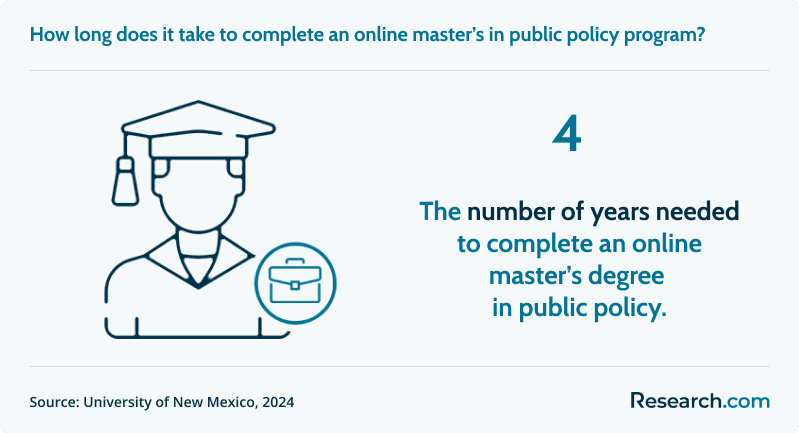
Most online master’s in public policy programs take about two years, although the timeline varies by credit load, calendar format, transfer policy, and whether the student enrolls full time or part time. Some students finish in 18 to 24 months, while flexible part-time options may take longer. Accelerated programs may be completed in as little as 12 months.
Students comparing graduate timelines may notice similar flexibility in unrelated fields, such as a masters exercise science online program, where completion time also depends heavily on enrollment pace and program structure.
| Study format | Typical fit | Potential advantage | Potential drawback |
| Full-time online | Students who can prioritize coursework | Faster completion, often within 18 to 24 months | Heavier weekly workload |
| Part-time online | Working professionals and caregivers | More manageable schedule | May extend time to graduation |
| Accelerated online | Students ready for intensive study | May finish in as little as 12 months | Less time for internships, networking, or reflection |
Online vs. on-campus master’s in public policy: which format is better?
An online master’s in public policy can offer the same core academic training as a campus-based program, but the learning experience is different. The better choice depends on your schedule, location, networking needs, learning style, and career goals.
| Factor | Online master’s in public policy | On-campus master’s in public policy |
| Flexibility | Best for students balancing work, family, military service, or relocation limits | Best for students who can attend classes at set times and use campus resources regularly |
| Networking | Often built through virtual discussions, online events, group projects, and alumni platforms | Often stronger for spontaneous in-person networking, campus events, and local internships |
| Cost considerations | May reduce commuting, housing, and relocation expenses | May offer more campus-based assistantships or local networking advantages |
| Learning environment | Requires self-direction, written communication, and comfort with digital platforms | Provides face-to-face classroom interaction and immediate access to campus offices |
- Choose online if you need schedule control, live far from campus, or want to continue working while enrolled.
- Choose campus-based if you want daily in-person engagement, local policy internships, and direct access to campus events.
- Choose hybrid if you want some face-to-face contact while keeping part of the program online.
How much does an online master’s in public policy cost?
Costs vary by school, residency status, credit requirements, program length, and financial aid. Among the programs reviewed here, an online MPP at OSU can cost around $25,695, while Eastern Illinois University lists an online MA in political science with a public policy focus at around $14,300. Liberty University lists a military graduate tuition rate that may place the cost of its MPP program around $10,000. Empire State University lists its online MA in Social and Public Policy at $20,430 (in-state) and $23,250 (out-of-state).
Public universities may charge lower in-state tuition, while private universities may use one tuition rate or offer discounts for certain groups. Students should compare total program cost, not just per-credit tuition, because fees, required credits, books, residency requirements, and travel can change the final price.
| Cost item | Why it matters | Question to ask |
| Per-credit tuition | It is the base price but not always the full cost | Is tuition different for full-time, part-time, in-state, out-of-state, or military students? |
| Required credits | A lower per-credit price can still be expensive if the program requires more credits | How many credits are required to graduate? |
| Fees | Technology, registration, and online learning fees can add to the total | Are fees included in the published tuition estimate? |
| Time to completion | Longer enrollment can increase living and opportunity costs | Can I finish part time without paying extra terms or fees? |
| Financial aid | Scholarships, employer support, and federal loans can affect affordability | What aid is available specifically for online graduate students? |
What financial aid can online public policy master’s students use?
Online master’s students may be eligible for several funding sources, but availability depends on the school, enrollment status, citizenship or residency status, academic progress, and program eligibility. Start with the Free Application for Federal Student Aid (FAFSA) if you plan to use federal aid.
- Federal student aid: Eligible graduate students may use federal loans and other aid options after submitting the FAFSA.
- Institutional scholarships and grants: Schools may offer merit-based, need-based, public-service, or program-specific awards.
- Employer tuition reimbursement: Government agencies, nonprofits, and private employers may help pay for graduate education that supports job duties.
- Private loans: Private borrowing can fill funding gaps, but students should compare interest rates, repayment terms, and borrower protections carefully.
- Assistantships, fellowships, and work opportunities: Some programs may provide graduate assistantships, research roles, fellowships, or part-time campus employment.
- Military and veteran benefits: Active-duty personnel, veterans, and eligible family members should ask about military tuition rates, GI Bill benefits, and school-specific support.
If cost is your top concern, compare public policy programs against other affordable online graduate options. Research.com also reviews programs in other fields, including the cheapest online master's degree in early childhood education, but students should only use those comparisons to understand pricing patterns, not as substitutes for policy-specific research.
What are the common admission requirements for an online master’s in public policy?
Admissions standards vary, but most online master’s in public policy programs expect applicants to show academic readiness, writing ability, and a clear reason for pursuing graduate policy study. A related undergraduate major can help, but many programs also consider applicants from other backgrounds if they have relevant experience or strong academic preparation.
- Bachelor’s degree: Applicants typically need a completed undergraduate degree from an accredited institution. Political science, economics, public administration, sociology, and social sciences are common backgrounds, although other degrees, including an affordable Christian counseling degree, may be considered depending on the school.
- GPA requirements: Many programs look for a minimum GPA, often around 3.0, though policies differ.
- Relevant experience: Some schools prefer or require professional experience in government, nonprofits, advocacy, research, public administration, or related fields.
- Standardized tests: Many programs are test-optional, but some may request GRE scores or other standardized test results.
- Letters of recommendation: Programs often ask for two or three recommendations from academic or professional contacts.
- Statement of purpose: Applicants usually submit an essay explaining their policy interests, career goals, and fit with the program.
- Writing sample or resume: Some programs request evidence of analytical writing or professional accomplishments.
What courses are usually included in an online master’s in public policy?
An online master’s in public policy usually combines analytical methods, economics, public administration, law or governance, research, and applied policy work. The strongest programs help students move beyond opinion and learn how to evaluate evidence, compare policy alternatives, measure outcomes, and communicate recommendations to decision-makers.
- Introduction to public policy: Explores how policy problems are defined, debated, adopted, implemented, and evaluated.
- Economics for public policy: Applies economic reasoning to public finance, budgeting, regulation, labor markets, taxation, and resource allocation.
- Quantitative methods: Builds statistical and data-analysis skills used in policy evaluation. Students may encounter similar quantitative expectations in other programs, including some of the cheapest online elementary education degree options.
- Public administration: Examines public organizations, ethics, management, bureaucracy, and administrative decision-making.
- Policy analysis: Trains students to compare policy options, estimate consequences, and prepare evidence-based recommendations.
- Research methods: Covers research design, data collection, interpretation, and application in policy settings.
- Leadership and ethics: Focuses on responsible governance, public accountability, equity, and leadership in complex institutions.
- Capstone or policy memo: Many programs require a final applied project that addresses a real or simulated policy problem.
What public policy specializations can online students choose?
Specializations help students connect the degree to a specific policy field. Before choosing one, review the required courses, faculty expertise, internship options, capstone topics, and career outcomes connected to that concentration.
| Specialization | What it usually covers | Best fit for students interested in |
| Environmental Policy | Sustainability, climate-related policy, natural resources, regulation, and environmental protection | Environmental agencies, advocacy organizations, sustainability roles, and natural resource policy |
| Healthcare Policy | Health systems, access, quality, public health, regulation, and healthcare financing | Health agencies, hospitals, health nonprofits, and roles connected to the most affordable online MHA programs |
| Urban and Regional Policy | Housing, transportation, zoning, economic development, and metropolitan planning | Urban planning offices, local government, community development, and regional agencies |
| International Policy | Global governance, international relations, development, security, and cross-border policy problems | International organizations, NGOs, global policy research, and diplomacy-related work |
| Nonprofit Management | Nonprofit leadership, fundraising, advocacy, program management, and public-private partnerships | Nonprofit leadership, grant-funded programs, advocacy campaigns, and community organizations |
| Economic Policy | Taxation, labor markets, economic development, public finance, and regulation | Budget offices, economic development agencies, think tanks, and consulting |
| Social Policy | Education, poverty, child and family policy, social welfare, housing, and inequality | Social service agencies, education policy, advocacy, and community-centered policy work |
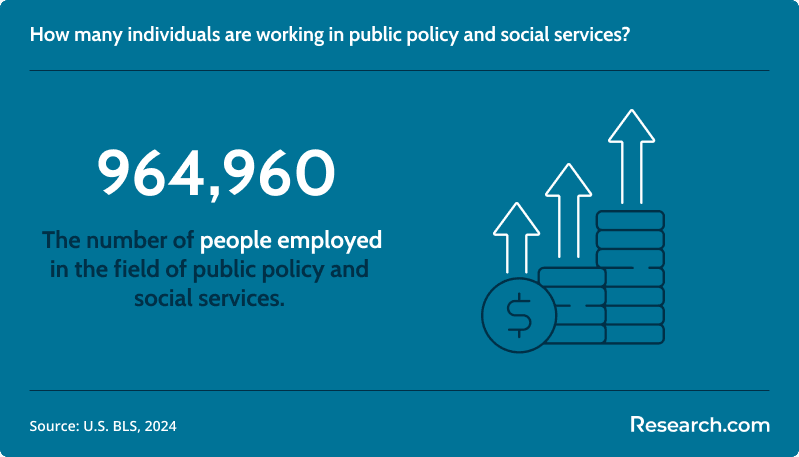
According to statistics, there are 964,960 individuals employed in the field of public policy and social services as of 2022. A graduate degree and a targeted specialization may help students build stronger credentials for policy-related roles, although salaries and advancement depend on experience, employer, location, and job function. Students interested in adjacent policy fields can also review options connected to the best-paying criminal justice jobs.
How should students compare financial aid packages for online public policy programs?
Financial aid can make two programs with similar sticker prices very different in practice. Students should compare total net cost after scholarships, tuition discounts, employer support, military benefits, and loan eligibility. Online students should also confirm that their program is eligible for aid and that enrollment intensity meets aid requirements.
Federal aid typically begins with the FAFSA, and enrolling in FAFSA approved online colleges can help students identify institutions that participate in federal student aid programs. However, FAFSA eligibility does not automatically mean a program is affordable; students still need to review borrowing limits, repayment obligations, and completion timelines.
University scholarships, fellowships, assistantships, and public-service awards may be available, but online graduate students should ask whether those awards are open to distance learners. Employer tuition reimbursement can also be useful if the degree supports the employee’s current role or future responsibilities. Veterans and active-duty military personnel should review GI Bill eligibility, military tuition rates, and any school-specific benefits.
How do you choose the best online master’s in public policy program?
The best program is the one that fits your policy goals, budget, schedule, and learning needs. Do not choose based only on a ranking, a single tuition number, or a recognizable university name. Compare the full student experience and the career outcomes that matter to you.
- Accreditation: Confirm institutional accreditation and, when relevant, programmatic accreditation. Agencies such as the Higher Learning Commission (HLC) and SACSCOC evaluate academic quality at the institutional level.
- Curriculum alignment: Match the program’s courses to your target career. A student interested in healthcare policy needs a different curriculum than someone pursuing environmental policy or legislative work.
- Faculty expertise: Review faculty research, professional backgrounds, and policy connections. Faculty experience can influence capstone options, mentoring, and networking.
- Online format: Check whether classes are asynchronous, synchronous, or mixed. A flexible program is only useful if its format matches your weekly schedule.
- Total cost: Compare tuition, fees, credits, books, technology charges, travel, and lost work time.
- Career support: Look for policy-specific advising, resume help, interview preparation, internship support, alumni connections, and job boards.
- Student services: As with practical online programs such as affordable medical billing and coding programs online, online public policy students should verify advising, tutoring, library access, technical support, and accessibility services before enrolling.
| Before enrolling, ask this | Why it matters |
| Is the institution accredited? | Accreditation affects aid eligibility, transferability, employer recognition, and academic quality assurance. |
| Does the curriculum include quantitative policy analysis? | Many policy roles require data interpretation, evaluation, budgeting, and research skills. |
| Are online students eligible for the same career services? | Career support can be especially important when networking remotely. |
| Can I complete an internship, practicum, or capstone near my location? | Applied experience helps connect coursework to real policy problems. |
| What are the total costs after fees and aid? | The advertised tuition rate may not show the full price. |
| Are classes live, self-paced, or scheduled by cohort? | The format affects work-life balance and weekly availability. |
How can a master’s in public policy support career advancement?
A master’s in public policy can help students develop the skills needed to analyze public problems, interpret data, design policy options, manage programs, and communicate recommendations to stakeholders. Graduates may pursue advancement into roles such as policy advisor, program director, analyst, public affairs specialist, legislative staff member, nonprofit manager, or consultant.
Public policy careers are not limited to government. Graduates also work in nonprofits, think tanks, advocacy organizations, consulting firms, foundations, and private companies that need regulatory, social impact, or public affairs expertise. Students exploring role options can use Research.com’s guide to careers in public policy to compare possible pathways.
Career value depends on how intentionally students use the program. Strong outcomes often come from choosing a relevant specialization, building a portfolio of policy memos or research projects, networking with faculty and alumni, completing applied projects, and seeking internships or workplace projects tied to policy goals.
How do online public policy programs stay current with policy and labor market trends?
Strong online public policy programs update coursework as public-sector work changes. Current areas of emphasis often include digital governance, data analytics, climate policy, regulatory complexity, program evaluation, equity-focused policy design, and public communication. The rise of data tools and AI-supported research also makes analytical judgment more important, not less; policy professionals still need to question assumptions, interpret evidence, explain trade-offs, and understand community impact.
Students should ask schools how often courses are reviewed, whether faculty are active in policy research or practice, and whether capstones use current policy problems. Cost should also remain part of the decision. Students comparing broader online affordability trends can consult Research.com’s guide to the cheapest online colleges.
What jobs can you get with an online master’s in public policy?
Graduates of online master’s in public policy programs can pursue roles that involve policy analysis, program management, research, public communication, advocacy, regulation, and organizational leadership. Exact job eligibility depends on experience, specialization, location, employer expectations, and whether the role requires additional credentials.
- Policy Analyst: Studies policy problems, evaluates options, analyzes evidence, and prepares recommendations for agencies, think tanks, nonprofits, or consulting organizations.
- Public Affairs Specialist: Manages communication between organizations, communities, policymakers, and the public. Students comparing communication-oriented graduate paths may also encounter adjacent programs such as the cheapest online LPC programs, though the professional goals are different.
- Program Manager: Oversees public, nonprofit, or grant-funded programs and tracks whether they meet goals.
- Legislative Aide: Supports elected officials through research, constituent communication, briefing materials, and policy development.
- Nonprofit Manager: Leads programs, fundraising, advocacy efforts, budgets, and community partnerships.
- Urban Planner: Develops plans and policies related to land use, zoning, housing, transportation, and community development.
- Consultant: Advises organizations on policy design, compliance, program implementation, or strategic planning.
- Public Health Administrator: Manages health-related programs and policies in public agencies, healthcare organizations, or community health settings.
Public policy is also connected to roles that appear in broader lists of the highest-paying master's degrees. For example, a political scientist can earn $132,350, a sociologist can earn $101,770, an urban and regional planner can earn around $81,800, and an economist can earn $115,730. These figures are examples of salaries in related career areas and should not be treated as guaranteed outcomes for every graduate.
What is the job market for online master’s in public policy graduates?
The job market for public policy graduates is shaped by demand for professionals who can analyze complex problems, evaluate programs, interpret data, and communicate policy choices. Graduates may find opportunities in federal, state, and local government, nonprofits, think tanks, consulting firms, public affairs offices, advocacy organizations, and private-sector teams focused on regulatory compliance or social responsibility.
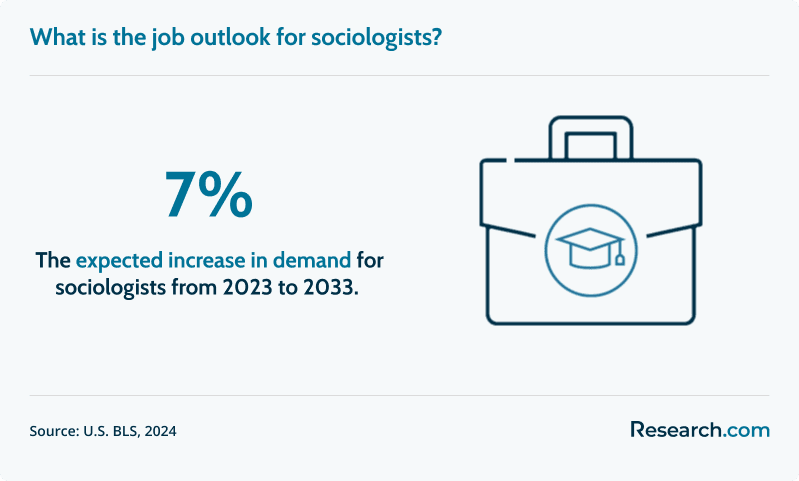
The demand for sociologists is expected to increase by 7%, while the demand for political scientists is expected to grow by 3% from 2023 to 2033. Students comparing policy-adjacent graduate options may also review fields such as law and regulation through resources on the cheapest master of legal studies online programs.
Can an online master’s in public policy lead to doctoral study or research roles?
Yes, an online master’s in public policy can support later doctoral study, especially if the program includes research methods, statistics, policy evaluation, faculty mentoring, and a strong capstone or thesis option. Students interested in academic research, think tank work, or advanced policy evaluation should look for programs with research-active faculty and opportunities to produce rigorous written work.
Some graduates continue into public policy, political science, public administration, sociology, economics, or related doctoral programs. Students interested in shorter doctoral timelines can compare options such as a short PhD program, while remembering that program length is only one factor; research fit, faculty expertise, funding, and dissertation expectations matter more for long-term academic success.
How does an online master’s in public policy compare with other graduate degrees?
A master’s in public policy is best for students who want to analyze, design, evaluate, and communicate policy across multiple sectors. It overlaps with public administration, political science, legal studies, healthcare administration, and public health, but it has a distinct emphasis on evidence-based policy decisions and trade-offs.
| Degree | Main focus | Best for | When to choose a different path |
| Master’s in Public Policy | Policy analysis, economics, research, program evaluation, governance, and public decision-making | Students who want analytical policy roles in government, nonprofits, consulting, or advocacy | Choose another degree if you mainly want healthcare operations, clinical leadership, or legal practice |
| Master’s in Public Administration | Public management, budgeting, leadership, personnel, and implementation | Students seeking agency management or public-sector leadership roles | Choose public policy if you want heavier analytical and evaluation training |
| Master of Public Health | Population health, epidemiology, health promotion, and public health systems | Students targeting public health agencies or health-focused nonprofits | Compare costs and outcomes with the cheapest MPH programs if health is your primary focus |
| Master’s in Legal Studies | Law, compliance, regulation, and legal systems for non-lawyers | Students working in regulated industries or compliance roles | Choose public policy if you want broader policy design and evaluation training |
What career support should online public policy programs provide?
Career services can make a major difference for online students because networking may not happen naturally through campus life. Look for programs that offer policy-specific advising rather than only general graduate career support.
- Resume and cover letter reviews tailored to government, nonprofit, consulting, and advocacy roles
- Interview preparation for policy analyst, program manager, public affairs, and legislative positions
- Access to internship listings, government job boards, fellowship opportunities, and alumni networks
- Virtual employer events, speaker series, and networking sessions
- Capstone support that helps students create portfolio-quality policy work
- Advising for doctoral or research pathways, including options such as inexpensive PhD programs
Can you finish an online master’s in public policy faster?
Some schools offer accelerated options that shorten time to completion through intensive courses, year-round enrollment, summer sessions, or compressed terms. This can be useful for students who need a credential quickly, but speed has trade-offs. A faster program may reduce time for internships, relationship-building, research assistantships, and deeper exploration of policy areas.
Students who value speed should compare workload expectations, weekly time requirements, and capstone structure. To understand how accelerated education models work in other contexts, see Research.com’s guide to the fastest online bachelor degree options.
How do online public policy programs provide experiential learning and networking?
Quality online programs build applied learning into the curriculum instead of relying only on lectures and readings. Common formats include policy memos, simulations, data-analysis projects, group consulting projects, virtual capstones, internships, and partnerships with public or nonprofit organizations.
Networking may happen through live sessions, alumni panels, online discussion groups, professional association events, mentorship programs, and collaborative assignments. Students who want broader academic grounding in government and institutions may also consider how a political science degree compares with public policy training.
How do online public policy programs address diversity, equity, and inclusion?
Public policy decisions affect communities differently, so strong programs teach students to examine who benefits, who bears costs, and how historical or structural inequities shape outcomes. DEI-related learning may appear in courses on social policy, urban policy, healthcare policy, education policy, public ethics, program evaluation, and community engagement.
Students should look for programs that use real policy cases, include diverse perspectives, and train students to evaluate distributional impact rather than treating equity as a separate topic. For readers still comparing academic directions, Research.com’s overview of college majors and careers may help clarify long-term fit.
How do you verify accreditation and program quality?
Accreditation should be checked before applying. Institutional accreditation helps confirm that a college or university meets recognized academic standards and may affect federal financial aid, credit transfer, employer recognition, and eligibility for further study. Some public policy programs may also hold specialized recognition, such as NASPAA-related accreditation, depending on the institution and program.
- Verify the school’s accreditation through the accreditor’s website or the institution’s official accreditation page.
- Confirm that the online program is covered under the institution’s accreditation.
- Ask whether the public policy program has separate programmatic accreditation or external review.
- Review faculty qualifications, course requirements, student outcomes, and capstone expectations.
- Be cautious with programs that make vague promises, do not disclose cost clearly, or avoid answering accreditation questions.
Students comparing trustworthy online institutions can also review Research.com’s guide to non profit online universities.
What challenges should you consider before enrolling?
Online public policy programs offer flexibility, but they also require planning and self-discipline. Before enrolling, be honest about your time, writing ability, quantitative readiness, internet reliability, and comfort with independent learning.
| Common mistake | Why it can hurt you | Better approach |
| Choosing only by tuition | The cheapest program may lack the specialization, support, or network you need | Compare net cost, curriculum, outcomes, career services, and faculty fit |
| Ignoring accreditation | Accreditation affects aid, recognition, and transfer options | Verify institutional and, when relevant, programmatic accreditation before applying |
| Assuming online means easy | Graduate policy work often requires heavy reading, writing, and quantitative analysis | Ask about weekly workload and review sample syllabi if available |
| Overlooking networking | Remote students may miss informal career connections | Use virtual events, faculty office hours, alumni networks, and internships intentionally |
| Relying only on rankings | A high-ranked program may not match your career goal or budget | Use rankings as a starting point, then evaluate personal fit |
| Assuming salary outcomes are guaranteed | Pay varies by job, location, employer, prior experience, and specialization | Review role-specific data and ask programs for alumni outcome information |
Students comparing broad online degree value may also review Research.com’s guide to top paying online degrees, while remembering that public policy ROI depends strongly on career direction and experience.
Is an online master’s in public policy a good fit for non-traditional students?
Online public policy programs can work well for non-traditional students, including mid-career professionals, career changers, working parents, military-affiliated learners, and older students returning to school. Asynchronous coursework, modular calendars, and part-time options can make graduate study more realistic for people who cannot relocate or attend daytime classes.
Non-traditional students should prioritize programs with responsive advising, clear technology support, flexible pacing, practical assignments, and career services that understand career transitions. Learners focused on later-career education may also find useful context in Research.com’s guide to online school for seniors.
How are AI, analytics, and digital tools changing public policy education?
Public policy programs increasingly use data tools, digital collaboration platforms, simulations, and AI-supported research workflows. These tools can help students test policy scenarios, analyze datasets, draft policy briefs, and collaborate remotely. However, technology does not replace policy judgment. Students still need to understand research limitations, bias, ethics, community impact, and political feasibility.
Students who feel underprepared for technical coursework should ask whether the program offers statistics refreshers, software tutorials, library research support, or tutoring. Those seeking a fast foundation before graduate study may also compare options such as an associates degree online fast, although a short associate pathway is not a substitute for graduate-level policy training.
How does an online master’s in public policy prepare students for leadership?
An online master’s in public policy can support leadership development when the curriculum combines analysis, communication, ethics, management, and applied decision-making. The strongest programs teach students not only how policy is made, but how to lead teams, interpret evidence, manage trade-offs, and communicate with stakeholders.
- Policy analysis and decision-making: Students learn to evaluate evidence, weigh alternatives, and make recommendations based on data, community needs, costs, and expected outcomes.
- Strategic planning and implementation: Coursework in budgeting, program design, public administration, and evaluation helps students understand how policies move from proposal to practice.
- Communication and advocacy: Policy leaders need to write briefs, present findings, explain trade-offs, and persuade audiences with different priorities.
- Ethical leadership and governance: Programs often examine accountability, transparency, equity, legality, and responsible use of public power.
- Collaboration and teamwork: Group projects and simulations help students practice managing disagreement and building workable policy solutions.
- Global perspective: Programs with international policy coursework can prepare students to understand cross-border issues, global development, international law, and multinational institutions.
- Networking and mentorship: Online forums, guest speakers, alumni events, and faculty relationships can help students build professional connections.
Students seeking faster and lower-cost routes to graduate credentials can compare public policy programs with Research.com’s cheapest quickest online master's degree resources, while still confirming that the curriculum supports leadership goals.
What is the long-term ROI of an online master’s in public policy?
The return on investment of an online master’s in public policy depends on total cost, borrowing, prior experience, target role, employer, location, and how well the program connects to career advancement. The degree may improve credibility for policy, management, research, or advocacy roles, but it does not guarantee a specific salary.
To evaluate ROI, compare tuition and fees against expected career movement, not just average salary figures. Ask whether graduates move into higher-level roles, whether the alumni network is active, and whether the program helps students build tangible work products such as policy memos, evaluation reports, data projects, or capstones. Students earlier in their education planning may also compare broader affordability routes such as cheap online bachelor's degree programs.
What alumni outcomes should applicants review?
Applicants should look for transparent outcome information, including graduation rates, employment outcomes, salary progression, job titles, sectors represented, and time to employment when available. If a school does not publish detailed outcomes, ask admissions or career services for examples of recent graduate placements and common career paths.
Outcome data should be interpreted carefully. A program serving mid-career professionals may show different salary patterns than one serving recent college graduates. Students comparing long-term education value may also review lower-cost entry points such as the cheapest online associate's degree, while recognizing that associate, bachelor’s, master’s, and doctoral credentials serve different career purposes.
Is admission to an online master’s in public policy competitive?
Admissions competitiveness varies widely. Some programs are designed for accessibility and evaluate applicants holistically, while others may place more weight on GPA, writing ability, quantitative readiness, professional experience, recommendations, and policy-related goals. Test-optional policies do not necessarily mean low academic expectations.
Applicants can improve their profile by writing a focused statement of purpose, explaining their policy interests clearly, choosing recommenders who can speak to analytical ability, and addressing any academic weaknesses directly. Students looking for broader comparisons can review easy masters programs to get into, but should not assume that easier admission equals better fit.
How do online public policy programs build student engagement?
Engagement in an online program is usually intentional rather than automatic. Strong programs use live webinars, small-group projects, policy simulations, discussion forums, peer review, mentoring, and faculty feedback to create a professional learning community.
Before enrolling, ask whether online students work in cohorts, whether classes include live sessions, how group projects are managed across time zones, and whether alumni remain connected after graduation. Students interested in how accelerated online programs structure community can also explore accelerated online bachelor's programs.
How does an online master’s in public policy compare with healthcare administration?
An online master’s in public policy and a master’s in healthcare administration can both lead to leadership roles, but they prepare students for different kinds of work. Public policy programs focus on policy design, evaluation, governance, economics, public decision-making, and cross-sector analysis. MHA programs focus more directly on healthcare operations, clinical systems, finance, quality improvement, compliance, and managing health organizations.
Choose public policy if you want to work across policy areas or influence health policy from a governmental, nonprofit, advocacy, or research perspective. Choose healthcare administration if your goal is to manage hospitals, clinics, health systems, or healthcare operations. For a deeper look at healthcare leadership outcomes, see Research.com’s guide to the career outlook for MHA graduates.
What digital resources should online public policy students expect?
Online public policy students should expect more than recorded lectures. A strong online learning environment includes a reliable learning management system, digital library access, policy databases, research tools, video conferencing, discussion boards, technical support, tutoring, writing support, accessibility services, and secure tools for submitting assignments.
Students should also ask whether the program provides software or training for statistics, data visualization, survey design, qualitative analysis, or policy simulation. Those still building foundational academic skills can compare related online pathways such as accredited bachelor degrees online.
Key insights
- An online master’s in public policy is best for students who want to analyze public problems, evaluate evidence, design policy options, and communicate recommendations across government, nonprofit, advocacy, consulting, or regulated private-sector settings.
- Program fit matters more than ranking alone. Compare accreditation, curriculum, specializations, cost, required credits, faculty expertise, online format, career support, and applied learning opportunities.
- Costs can differ substantially. Examples in this guide range from $455 per credit to $1,841 for out-of-state tuition in some programs, and total listed costs include figures such as $14,300, $20,430, $23,250, and around $25,695.
- Most programs take around two years, but completion can range from 12 months to four years depending on enrollment pace and program structure.
- Public policy graduates may pursue roles such as policy analyst, legislative aide, program manager, public affairs specialist, nonprofit manager, consultant, urban planner, or public health administrator.
- Salary outcomes are not guaranteed. Related examples include political scientist at $132,350, sociologist at $101,770, urban and regional planner at around $81,800, and economist at $115,730.
- Before applying, verify accreditation, ask for total cost after fees, review online student support, check whether career services are available to distance learners, and confirm that the curriculum matches your intended policy field.
References:
- Eastern Illinois University. (2024). Cost and Funding. https://www.eiu.edu/poliscigrad/funding.php
- Empire State University. (2024). Tuition and Fees (Graduate). https://catalog.sunyempire.edu/graduate/tuition-fees
- Liberty University. (2024). Tuition & Aid. https://www.liberty.edu/online/government/masters/public-policy/#program-parent-tuition-and-aid
- Oregon State University. (2024). Tuition and fees calculator. https://ecampus.oregonstate.edu/online-degrees/tuition/?p=history-ma-ms
- University of New Mexico. (2024). MPP Curriculum. https://mpp.unm.edu/prospective-students/curriculum/index.html
- U.S. Bureau of Labor Statistics. (2024). Field of degree: Public policy and social services. https://www.bls.gov/ooh/field-of-degree/public-policy-and-social-services/public-policy-and-social-services-field-of-degree.htm
Other Things You Should Know About Online Public Policy Programs
To enroll in a 2027 online Master’s in Public Policy program, candidates typically need a bachelor's degree from an accredited institution. Some programs might require a minimum GPA, relevant coursework in economics or statistics, and specific professional experience. Additional materials like a statement of purpose, letters of recommendation, and a resume may also be needed.
Many affordable online MPP programs require a minimum 3.0 undergraduate GPA for admission. Some schools review applicants below that mark through holistic review and may ask for a statement of purpose, transcripts, and two letters of recommendation.