
2027 Best Online Criminal Justice Certificate Programs

Co-Founder and Chief Data Scientist
Choosing what to do after high school can feel overwhelming. You want a path to a stable, exciting career, but the idea of spending four years at a university—and taking on massive student debt—might not feel right for you. You need a faster, more affordable way to start your professional life.
This is where a specialized credential can be a game-changer. This guide is your roadmap, created by career planning experts with over 10 years of experience. We'll show you how an online criminal justice certificate can be the most direct path to a rewarding first career, breaking down everything from costs to job opportunities to help you make a confident decision.
What are the benefits of getting an online criminal justice certificate?
- Provides a direct and accelerated path to qualifying for foundational jobs in the criminal justice field, such as correctional officer or bailiff.
- Opens the door to stable careers with competitive starting salaries, often in the $46,000 to $60,000 range, plus strong government benefits.
- Offers the flexibility to learn from anywhere, allowing you to balance your studies with a part-time job or other responsibilities.
What can I expect from an online criminal justice certificate?
You can expect a focused academic program that delivers college-level coursework in about six to 12 months. These programs are designed to teach you the foundational knowledge of the criminal justice system, from law and procedure to the theories behind criminal behavior.
It’s important to understand that online learning requires real self-discipline. While the format is flexible, the coursework is just as serious as an on-campus class. You’ll need to manage your own time effectively to keep up with readings, assignments, and exams.
While an associate's or bachelor's degree provides a broad, multi-year education, a certificate is designed to give you specific, job-ready skills in under a year. This makes an online criminal justice certificate a powerful and efficient first step toward your career.
Where can I work with an online criminal justice certificate?
An online criminal justice certificate opens doors to foundational roles in public safety and legal support. These positions are concentrated in government agencies that form the backbone of the justice system. According to the U.S. Bureau of Labor Statistics, as of 2024, the primary employers for these roles include:
- State and Local Government (Corrections): This is the largest sector, employing over 387,500 correctional officers and jailers. These roles are focused on maintaining safety and security within correctional facilities.
- State and Local Government (Courts): This sector employs around 19,000 bailiffs and court security officers. Their primary responsibility is ensuring order and security within the courtroom.
- Public Safety and Emergency Services: This includes vital roles like 911 dispatchers and emergency communications operators, who serve as the first point of contact in a crisis.
- Private Security Services: Many graduates find opportunities protecting corporate, industrial, or residential properties as security officers, a field that offers a wide variety of work environments.
How much can I make with an online criminal justice certificate?
An online criminal justice certificate provides a direct path to stable government jobs with competitive salaries. This credential can help you build a strong financial foundation early in your career, especially when considering the full compensation package.
As of May 2024, the median annual salaries for key entry-level roles show this potential (U.S. BLS, 2024):
- Correctional Officers and Jailers: $57,580 per year
- Bailiffs: $49,370 per year
- List of the Best Online Criminal Justice Certificate Programs for 2027 List of Programs
- How long does it take to complete an online criminal justice certificate program? Completion Time
- How does an online criminal justice certificate program compare to an on-campus program? How does an online criminal justice certificate program compare to an on-campus program?
- What is the average cost of an online criminal justice certificate program? Program Cost
- What are the financial aid options for students enrolling in an online criminal justice certificate program? Financial Aid
- What are the prerequisites for enrolling in an online criminal justice certificate program? What are the prerequisites for enrolling in an online criminal justice certificate program?
- What courses are typically in an online criminal justice certificate program? What courses are typically in an online criminal justice certificate program?
- What types of specializations are available in an online criminal justice certificate program? Specializations
- How to Choose the Best Online Criminal Justice Certificate Program How to Choose the Best Online Criminal Justice Certificate Program
- What career paths are available for graduates of an online criminal justice certificate program? Career Paths
- What is the job market for graduates of an online criminal justice certificate program? Job Market
Best Online Criminal Justice Certificate Programs for 2027: What Students Should Compare Before Enrolling
An online criminal justice certificate can be a practical first credential if you want to enter corrections, court services, private security, or law enforcement-adjacent roles without committing immediately to a full degree. The key decision is not simply which program is fastest or cheapest. You need to know whether the school is accredited, whether the credits can transfer, whether the certificate aligns with your target job, and whether the program is eligible for the financial aid you plan to use.
This guide is designed for working adults, recent high school graduates, career changers, and current public safety employees who want a shorter academic pathway into criminal justice. You will find ranked program options, cost and timeline comparisons, admissions expectations, common courses, specialization choices, career paths, and the questions to ask before you enroll.
Quick answer: Is an online criminal justice certificate worth it?
An online criminal justice certificate can be worth it if you need a focused, lower-cost credential that introduces the justice system and helps you qualify for entry-level or advancement opportunities. It is not a substitute for a police academy, agency-specific training, a background check, or a bachelor’s degree when those are required. The best use of this credential is as a career entry point, a résumé booster, or a transferable step toward an associate or bachelor’s program.
How we evaluate schools
Because certificate costs, credit transfer policies, and institutional quality vary widely, Research.com reviews programs using transparent education data and school-reported information. Our ranking process draws from sources including the IPEDS database, Peterson's database, the College Scorecard database, and The National Center for Education Statistics.
These sources help us compare criminal justice certificate programs using consistent indicators, including cost, accreditation, program structure, and student-relevant outcomes where available. For a fuller explanation of our process, review Research.com’s methodology page.
Program comparison at a glance
| School and program | Credits or units | Published cost | Accreditation listed | Best fit |
| Thomas Edison State University – Undergraduate Certificate in Criminal Justice | 18 credits | $440 per credit | Middle States Commission on Higher Education (MSCHE) | Students who want a certificate that can connect to a bachelor’s degree path |
| Liberty University – Undergraduate Certificate in Criminal Justice | 18 credits | $390 per credit | Southern Association of Colleges and Schools Commission on Colleges (SACSCOC) | Learners seeking criminal justice coursework taught from a Christian worldview |
| California Coast University – Undergraduate Certificate in the Fundamentals of Criminal Justice | 12 semester units | $2,040 total tuition | Distance Education Accrediting Commission (DEAC) | Students who need a self-paced and fully online option |
| Colorado Christian University – Online Criminal Justice Certificate | 12 credits | $494 per credit | Southern Association of Colleges and Schools Commission on Colleges (SACSCOC) | Learners who prefer accelerated 5-week courses and a faith-based framework |
| Washington Technical Institute – Criminal Justice Certificate | 18 credits | $2,900 total tuition | Middle States Association Commissions on Elementary and Secondary Schools (MSA-CESS) | Students looking for an 8-month, skills-oriented certificate |
| Regent University – Undergraduate Certificate in Criminal Justice | 12 credits | $395 per credit | Southern Association of Colleges and Schools Commission on Colleges (SACSCOC) | Adults who want to reskill or add a focused justice-system credential |
| Indiana Wesleyan University – Certificate in Criminal Justice | 15 credits | $405 per credit | Higher Learning Commission (HLC) | Students seeking a 6-month Christian-centered route into criminal justice study |
| Wilmington University – Undergraduate Certificate in Criminal Justice | 30 credits | $429 per credit | Middle States Commission on Higher Education (MSCHE) | Students who want a broader certificate with credits that may support bachelor’s completion |
1. Thomas Edison State University – Undergraduate Certificate in Criminal Justice
Thomas Edison State University offers an 18-credit online certificate that introduces the major parts of the criminal justice system while keeping future degree completion in mind. Students who finish the certificate may be able to apply the coursework toward the university’s bachelor’s degree in Criminal Justice, which makes it a useful option for learners who want a shorter credential now and a degree pathway later.
- Required Credits to Graduate: 18
- Cost per Credit: $440
- Accreditation: Middle States Commission on Higher Education (MSCHE)
2. Liberty University – Undergraduate Certificate in Criminal Justice
Liberty University’s undergraduate certificate is built for students who want criminal justice fundamentals in a faith-based academic setting. The curriculum can support civilians preparing for public safety careers as well as current law enforcement personnel who want a credential that strengthens communication, justice-system knowledge, and professional preparation.
- Required Credits to Graduate: 18
- Cost per Credit: $390
- Accreditation: Southern Association of Colleges and Schools Commission on Colleges (SACSCOC)
3. California Coast University – Undergraduate Certificate in the Fundamentals of Criminal Justice
California Coast University’s certificate emphasizes flexibility through a fully online, self-paced format. The program covers foundational topics such as legal procedure and investigative concepts, making it a candidate for students who need to study around work, family, or rotating schedules.
- Required Semester Units to Graduate: 12
- Total Tuition: $2,040
- Accreditation: Distance Education Accrediting Commission (DEAC)
4. Colorado Christian University – Online Criminal Justice Certificate
Colorado Christian University delivers its criminal justice certificate through accelerated 5-week courses. The program combines core justice-system topics with an evangelical Christian perspective and may work either as a standalone credential or as an addition to another academic plan.
- Program Format: Accelerated 5-week courses
- Required Credits to Graduate: 12
- Cost per Credit: $494
- Accreditation: Southern Association of Colleges and Schools Commission on Colleges (SACSCOC)
5. Washington Technical Institute – Criminal Justice Certificate
Washington Technical Institute offers an 8-month certificate focused on practical preparation for justice-related and security-related work. Students study areas such as criminal law, workplace communication, and services for security-conscious corporate clients.
- Program Length: 8 months
- Required Credits to Graduate: 18
- Total Tuition: $2,900
- Accreditation: Middle States Association Commissions on Elementary and Secondary Schools (MSA-CESS)
6. Regent University – Undergraduate Certificate in Criminal Justice
Regent University’s certificate is aimed at adult learners who want to re-skill, continue their education, or build a stronger foundation in the U.S. justice system. Coursework introduces criminology, criminal law, and the agencies that operate within criminal justice.
- Required Credits to Graduate: 12
- Cost per Credit: $395
- Accreditation: Southern Association of Colleges and Schools Commission on Colleges (SACSCOC)
7. Indiana Wesleyan University – Certificate in Criminal Justice
Indiana Wesleyan University’s certificate provides a fast, faith-based introduction to law enforcement, courts, corrections, and criminal justice ethics. The 6-month structure may appeal to students who want an initial credential before moving into a broader degree program.
- Program Length: 6 Months
- Required Credits to Graduate: 15
- Cost per Credit: $405
- Accreditation: Higher Learning Commission (HLC)
8. Wilmington University – Undergraduate Certificate in Criminal Justice
Wilmington University offers a 30-credit undergraduate certificate taught by instructors with field experience. The curriculum covers law enforcement, corrections, and the court system, and the larger credit load may be attractive to students who want certificate coursework that can support future bachelor’s degree progress.
- Required Credits to Graduate: 30
- Cost per Credit: $429
- Accreditation: Middle States Commission on Higher Education (MSCHE)
How Long Does It Take to Complete an Online Criminal Justice Certificate?
Most online criminal justice certificate programs are designed for relatively quick completion, often within six to 12 months. Shorter timelines usually depend on course availability, transfer credit, the number of required credits, and whether the school uses accelerated terms.
Graduation is not the same as being hired. Many criminal justice and public safety employers require additional steps after the certificate, including applications, interviews, background investigations, physical exams, drug screening, agency training, or academy admission.
Certificate vs. associate degree vs. bachelor’s degree
| Path | Typical time commitment | What it is best for | Important limitation |
| Online criminal justice certificate | Six to 12 months for many programs | Fast entry into foundational study, résumé development, or a transfer-friendly starting point | May not meet requirements for jobs that require a degree, academy training, or licensure |
| Associate's degree | About two years | Students who want broader general education plus criminal justice coursework | Takes longer and usually costs more than a certificate |
| Bachelor's degree | Four years | Students aiming for roles where a full degree improves competitiveness or advancement options | Requires a larger time and financial commitment |
When a faster credential makes sense
A certificate can be a smart first move if your goal is to start working sooner, test your interest in the field, or build academic credit before committing to a degree. Similar accelerated education models exist in other public service fields, including the shortest online military studies degree programs, where students often look for a faster path to structured career preparation.
The trade-off is depth. A short certificate can introduce criminal justice theory and systems, but it will not provide the same breadth as a full degree or the hands-on training required by many agencies.
Online vs. On-Campus Criminal Justice Certificates: Which Format Is Better?
The better format depends on how you learn, how much structure you need, and how much control you need over your schedule. Online criminal justice certificates usually offer more flexibility and may reduce commuting costs. On-campus programs may provide more direct access to instructors, classmates, campus resources, and scheduled accountability.
Neither format is automatically superior. The right choice is the one you are most likely to finish while meeting your career and transfer goals.
Online and campus program comparison
| Factor | Online certificate | On-campus certificate |
| Schedule | Often more flexible, especially for working adults | Usually follows set class times |
| Learning environment | Requires self-direction and strong time management | Provides more built-in structure |
| Networking | May rely on discussion boards, virtual advising, and online career services | Can offer easier face-to-face interaction |
| Cost considerations | May reduce commuting and campus-related expenses | May involve transportation, parking, or relocation costs |
| Best for | Students balancing school with work, family, or shift schedules | Students who perform better with in-person support and fixed routines |
How to choose your format
Choose online learning if you can manage deadlines independently, communicate with instructors before problems grow, and create a weekly study routine without a campus schedule. Choose an on-campus option if you need regular in-person reminders, direct classroom discussion, or stronger local networking.
If you are still comparing related fields, reviewing the easiest criminology degrees may help you understand how criminology programs differ from criminal justice certificates in workload, focus, and academic expectations.
How Much Does an Online Criminal Justice Certificate Cost?
Based on the programs reviewed, total tuition for an online criminal justice certificate typically ranges from $2,040 to $12,870. The final amount you pay can vary depending on the number of credits, per-credit tuition, fees, textbooks, technology charges, and whether you qualify for institutional discounts or aid.
Do not compare schools by per-credit tuition alone. A lower per-credit price can still produce a higher total cost if the program requires more credits. The clearest comparison is total tuition plus mandatory fees.
Cost factors to check before enrolling
| Cost item | Why it matters | Question to ask |
| Tuition | This is usually the largest expense and may be charged per credit or as total program tuition. | What is the full tuition for the certificate from start to finish? |
| Fees | Application, registration, technology, graduation, or online learning fees can increase the real price. | Which fees are mandatory, and when are they charged? |
| Books and course materials | Digital textbooks and access codes may not be included in tuition. | Are learning materials included, rented, or purchased separately? |
| Transfer credit | Accepted credits can reduce both cost and time. | Can prior college credits or training apply to this certificate? |
| Future degree pathway | A certificate is more valuable if credits can apply to a later degree. | Will every certificate credit transfer into an associate or bachelor’s program? |
How to think about return on investment
A certificate can be financially appealing because it usually costs less than beginning a traditional four-year degree. For students seeking affordable education routes in public safety, resources such as easiest law enforcement degrees can also help compare broader degree options against shorter certificate programs.
Still, salary outcomes are never guaranteed. Your earnings will depend on location, employer type, union or civil service rules, overtime availability, prior experience, and whether the role requires academy completion or additional training.
Financial Aid Options for Online Criminal Justice Certificate Students
Financial aid may include federal aid, scholarships, grants, employer assistance, military or public service benefits, and school payment plans. The most important rule is that not every certificate program qualifies for federal student aid, even if the school itself is accredited.
Before you enroll, ask the financial aid office whether the exact certificate program—not just the institution—is eligible for the aid you plan to use.
Federal aid and the FAFSA
If the certificate qualifies for federal aid, you can begin with the Free Application for Federal Student Aid (FAFSA). The FAFSA is used to determine eligibility for federal grants and federal student loans. Grants generally do not require repayment, while loans must be repaid according to their terms.
Scholarships and grants
Some schools, private organizations, government entities, and public safety groups offer scholarships or grants for students preparing for criminal justice careers. These awards can reduce out-of-pocket costs, but they may have deadlines, enrollment requirements, or service-related conditions.
Payment plans and employer support
Many institutions offer monthly payment plans for students who do not use loans or who need to spread tuition across a term. If you already work in security, corrections, military service, or a public agency, ask your employer whether tuition assistance is available for job-related education.
Admissions Requirements for Online Criminal Justice Certificate Programs
Most undergraduate criminal justice certificate programs require a high school diploma or GED. That makes admission relatively accessible, but employment standards in criminal justice are often much stricter than school admission requirements.
If you are interested in careers that combine public safety, technology, and science, you may also want to compare adjacent academic options such as the easiest STEM majors, especially if digital evidence, cybersecurity, forensics, or data analysis interests you.
Common school and employment requirements
| Requirement | Usually needed for school admission? | Often needed for employment? |
| High school diploma or GED | Yes | Yes, for many entry-level roles |
| Minimum age | Sometimes | Often 18 or 21 years old, depending on the role |
| U.S. citizenship | Not always | Typically required for many government law enforcement or corrections positions |
| Background check | May be required in limited cases | Common, and often extensive |
| Physical fitness standard | Usually no | Common for correctional, law enforcement, or public safety roles |
What to confirm before you apply
- Academic eligibility: Ask what documents are required to prove high school completion or equivalent preparation.
- Career restrictions: Review whether your background, age, citizenship status, or physical requirements could affect hiring in your target role.
- Transfer policies: Confirm whether the certificate can lead into a degree without losing credits.
- State or agency rules: Check requirements for the specific jurisdiction or employer where you plan to work.
Typical Courses in an Online Criminal Justice Certificate
Most online criminal justice certificates focus on academic foundations rather than tactical job training. You can expect courses that explain how police, courts, corrections, law, and criminological theory fit together.
Technology is also changing the field. Digital records, surveillance systems, data tools, online investigations, and AI-assisted workflows increasingly affect how justice professionals work. Students who want to build technical skills alongside criminal justice may compare options such as the best artificial intelligence bootcamps, although these are separate from criminal justice certificate programs.
Courses you are likely to see
- Introduction to Criminal Justice: A broad survey of law enforcement, courts, corrections, and the agencies that connect them.
- Criminology: A study of theories that explain criminal behavior through social, psychological, environmental, and institutional factors.
- Criminal Law and Procedure: An overview of legal principles, constitutional protections, evidence rules, and the steps involved in criminal cases.
- Ethics in Criminal Justice: A course focused on professional judgment, authority, discretion, accountability, and ethical dilemmas in justice work.
The value of these courses is context. They help you understand why procedures exist, how justice agencies interact, and what ethical responsibilities come with public safety work. Specialized job skills usually come later through employer training, academy instruction, or niche preparation. For example, someone interested in K-9 work would typically pursue agency-specific training after building a foundation; unrelated resources such as online dog obedience classes show how specialized training can differ from academic criminal justice study.
Common Specializations in Online Criminal Justice Certificate Programs
Some certificate programs offer a general curriculum, while others allow you to focus on a specific part of the justice system. The best specialization is the one that matches your target employer and your tolerance for the realities of the work.
Law enforcement foundations
This track is a broad starting point for students interested in policing, investigations, court security, or private security. It can help you speak more confidently about criminal procedure, ethics, and justice-system operations before applying to an academy or entry-level role.
Corrections
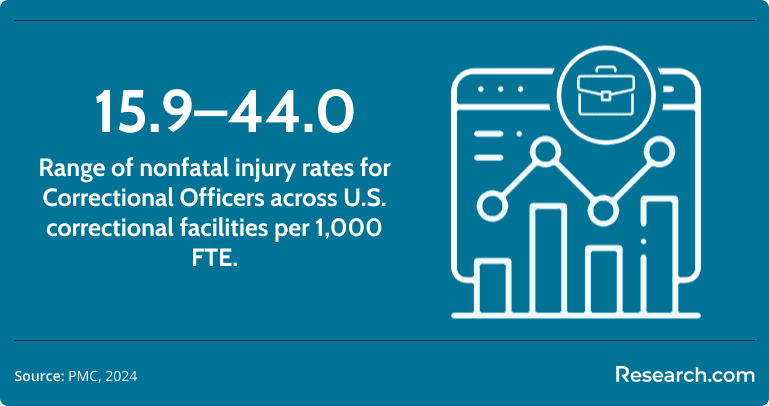
A corrections focus prepares students to understand facility operations, supervision, inmate management, and rehabilitation concepts. It can be a practical option because correctional agencies frequently need qualified applicants, but the work can be stressful and physically demanding. Research cited in this guide notes nonfatal injury rates ranging from 15.9 to 44.0 per 1,000 workers, along with a low but real risk of fatal injury.
Homeland security
Homeland security coursework may address counter-terrorism, border security, emergency response, and large-scale risk management. It may be a useful foundation for students interested in government contractors, private security, emergency management support, or future study. Students who want a more advanced national security academic pathway may later compare options such as a military science degree online.
Which specialization should you choose?
| Goal | Best-aligned focus | Why it fits |
| Apply for correctional officer or jailer roles | Corrections | Directly connects to facility operations, supervision, and inmate management |
| Prepare for policing or court security | Law enforcement foundations | Builds broad knowledge of procedure, policing, and justice agencies |
| Work in security, emergency response, or government contracting | Homeland security | Introduces broader threat prevention and emergency management topics |
| Keep future options open | General criminal justice | Provides a flexible foundation if you have not chosen a specific career path |
How to Choose the Best Online Criminal Justice Certificate Program
The most important checkpoint is accreditation. Accreditation helps show that a school has been reviewed by a recognized quality assurance body. It can also affect credit transfer, employer acceptance, and eligibility for certain types of financial aid.
- Verify accreditation before comparing anything else. Confirm the school’s status through an agency recognized by the U.S. Department of Education or the Council for Higher Education Accreditation.
- Calculate the total price. Compare total tuition, required fees, textbooks, and technology costs—not just the advertised per-credit rate.
- Check transferability. Ask whether the credits apply directly to an associate or bachelor’s degree if you continue your education.
- Match courses to your career goal. A corrections-focused student, a future court officer, and a private security employee may need different course mixes.
- Confirm financial aid eligibility. Make sure the specific certificate program qualifies for the aid you intend to use.
- Review student support. Look for academic advising, career services, online tutoring, library access, and technical support.
- Ask about employer recognition. If you have a target agency or employer, ask whether graduates from the program have been hired into similar roles.
Common mistakes to avoid
| Mistake | Why it can hurt you | Better approach |
| Choosing only the cheapest program | The lowest tuition may not offer the best transfer value, support, or employer recognition. | Compare total cost against accreditation, credit transfer, and career fit. |
| Assuming online means easier | Online courses still require deadlines, reading, writing, and independent study. | Build a weekly schedule before classes begin. |
| Ignoring employment requirements | A certificate does not override age, citizenship, background, fitness, or agency training rules. | Research hiring standards before enrolling. |
| Not checking federal aid eligibility | Some certificate programs are not eligible for federal grants or loans. | Get confirmation from the financial aid office in writing when possible. |
| Assuming credits will transfer automatically | Transfer rules vary by school and degree program. | Ask for a written credit pathway into a degree if that is your plan. |
Career Paths After an Online Criminal Justice Certificate
A criminal justice certificate can support entry into roles in corrections, court services, and security. It can also help current workers demonstrate commitment to the field or prepare for further education.
Think of the certificate as a starting credential, not a final career destination. Many public safety careers use structured promotion systems, and advancement often depends on experience, performance, agency training, exams, and sometimes additional college education.
Correctional officer
Correctional officers help maintain safety and order in jails, prisons, and detention facilities. With experience, an officer may pursue supervisory positions such as correctional sergeant or use corrections experience as a foundation for parole, probation, or related justice roles.
Bailiff or court officer
Bailiffs and court officers support safety and order in courtrooms and courthouse settings. This role can provide direct exposure to legal proceedings and may help students decide whether to move toward court administration, legal support, or additional paralegal training.
Security professional
Security roles may include corporate security, facility protection, loss prevention, or private security operations. Experience can lead to supervisory or management responsibilities, especially for workers who combine field experience with communication, reporting, and leadership skills.
Career path comparison
| Career area | Typical starting focus | Potential next step | Certificate value |
| Corrections | Facility safety, supervision, and inmate management | Correctional sergeant, parole-related roles, probation-related roles | Shows preparation in justice-system basics and corrections concepts |
| Courts | Courtroom order, courthouse security, and legal process support | Court administration or legal support with additional training | Builds understanding of procedure, ethics, and court operations |
| Private security | Loss prevention, access control, corporate security, or site safety | Security supervisor or security manager | Strengthens knowledge of law, communication, and professional conduct |
| Law enforcement preparation | Pre-academy academic foundation | Academy application or agency hiring process | Helps demonstrate early commitment and familiarity with criminal justice topics |
Students comparing long-term options can also review Research.com’s guide to the best criminology jobs, since some careers overlap with criminal justice but may require broader education.
Job Market for Online Criminal Justice Certificate Graduates
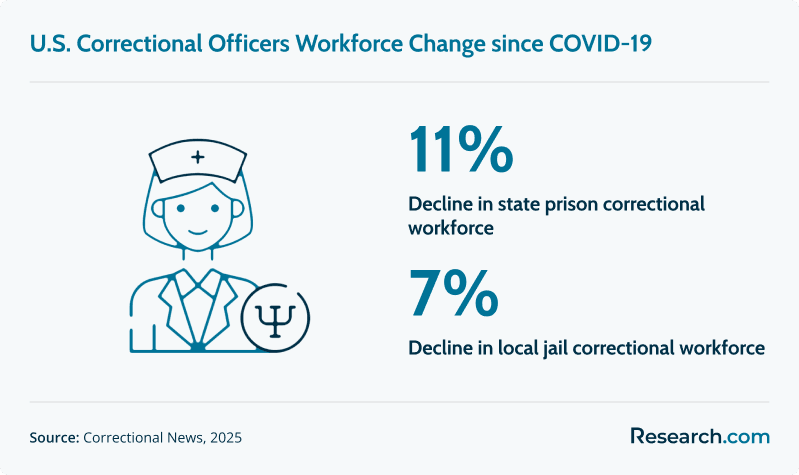
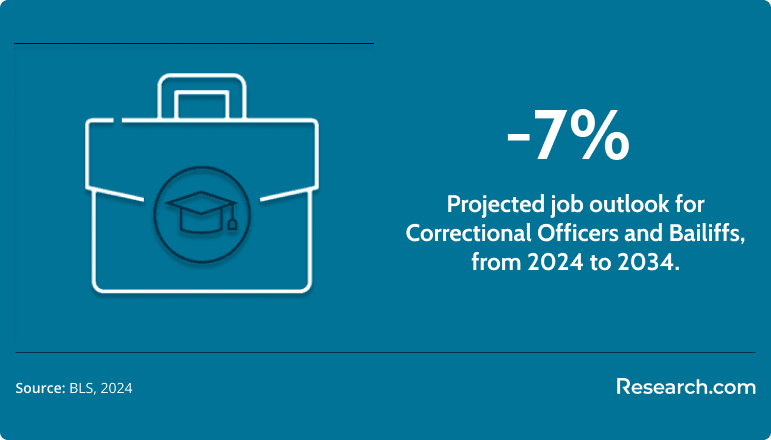
The market for entry-level criminal justice and protective service roles is best understood as stable but uneven. Some occupations may show projected declines in total employment, while agencies still need new workers because employees retire, transfer, or leave the field.
For students, the practical takeaway is that openings can exist even when headline projections look cautious. Local conditions matter. Hiring demand depends on state budgets, county staffing needs, public safety priorities, turnover, and the competitiveness of applicant pools.
How to interpret labor market data
Government projections can show long-term changes in total jobs, but they do not always reflect replacement hiring. A field can shrink overall and still produce regular openings because workers leave. This is especially important in corrections and local law enforcement, where staffing needs can remain persistent.
Recruiting challenges may also create opportunities for prepared applicants. In Michigan, a 2024 survey found that nearly 75% of local governments reported difficulty recruiting qualified law enforcement personnel. A certificate will not guarantee hiring, but it can help you present yourself as a candidate who has already studied the system and taken a deliberate first step.
This is one of the practical benefits of college certificate programs in job search: a focused credential can make your application more targeted when employers need applicants who understand the field.
What Graduates Say About Online Criminal Justice Certificate Programs
- : "I did not want to spend four years taking on debt before I could start working. The certificate gave me a direct way to study criminal justice while keeping my job. Being able to complete the coursework online made the decision realistic, and I now have a government position with benefits. — Zane"
- : "My family worried that an online certificate would not feel like real college. The courses were more demanding than they expected, and the instructors brought real professional experience into the class. I finished in ten months and was hired in the court system before many of my friends had finished their second year of college. — Merritt"
- : "I knew law enforcement applications could be competitive, so I wanted something that showed I was serious before applying. The certificate helped me understand criminology, procedure, and ethics well enough to discuss them in interviews. That preparation made me more confident and helped me stand out. — Javier"
Questions to Ask Before You Enroll
- Is the school accredited by a recognized accreditor? Do not rely on marketing language alone.
- Is the certificate eligible for federal student aid? Confirm the exact program, not just the institution.
- What is the total cost? Include tuition, fees, books, technology charges, and graduation costs.
- Can credits transfer into a degree? Ask which degree, how many credits apply, and whether transfer is guaranteed.
- Does the curriculum match your target job? Corrections, courts, policing preparation, and homeland security may require different course choices.
- What hiring requirements exist in your state or agency? Age, citizenship, background checks, physical standards, and academy requirements can matter more than the certificate itself.
- What support is available online? Look for advising, technical help, tutoring, library access, and career services.
References
- Bureau of Labor Statistics. Correctional officers and bailiffs. U.S. Department of Labor. Retrieved October 3, 2025, from https://www.bls.gov/ooh/protective-service/correctional-officers.htm
- Bureau of Labor Statistics. Employment of bailiffs by state, May 2023. U.S. Department of Labor. Retrieved October 3, 2025, from https://www.bls.gov/oes/2023/may/oes333011.htm
- Bureau of Labor Statistics. Employment of correctional officers and jailers by state, May 2023. U.S. Department of Labor. Retrieved October 3, 2025, from https://www.bls.gov/oes/2023/may/oes333012.htm
- Bureau of Labor Statistics. Fatal and non-fatal violence to police officers during 2012–2022. U.S. Department of Labor. Retrieved October 3, 2025, from https://www.bls.gov/opub/ted/2024/fatal-and-non-fatal-violence-to-police-officers-during-2012-2022.htm
- Correctional News. Correctional staff wellness: An overlooked crisis in corrections. Retrieved October 3, 2025, from https://correctionalnews.com/2025/03/04/correctional-staff-wellness-an-overlooked-crisis-in-corrections
- CLOSUP. Michigan local governments report increased challenges with law enforcement recruitment and retention. Center for Local, State, and Urban Policy – University of Michigan. Retrieved October 3, 2025, from https://closup.umich.edu/michigan-public-policy-survey/126/michigan-local-governments-report-increased-challenges-law-enforcement-recruitment-retention
- Data USA. Bailiffs. Retrieved October 3, 2025, from https://datausa.io/profile/soc/bailiffs
- Data USA. Correctional officers and jailers. Retrieved October 3, 2025, from https://datausa.io/profile/soc/correctional-officers-and-jailers
- National Library of Medicine. Correctional officer safety and nonfatal injury rates. National Center for Biotechnology Information. Retrieved October 3, 2025, from https://pmc.ncbi.nlm.nih.gov/articles/PMC11641701
- ONET OnLine. Bailiffs. National Center for ONET Development. Retrieved October 3, 2025, from https://www.onetonline.org/link/summary/33-3011.00
- ONET OnLine. Correctional officers and jailers. National Center for ONET Development. Retrieved October 3, 2025, from https://www.onetonline.org/link/summary/33-3012.00
- ZipRecruiter. Bailiff salary. Retrieved October 3, 2025, from https://www.ziprecruiter.com/Salaries/Bailiff-Salary#TableView
- ZipRecruiter. Correctional officer salary. Retrieved October 3, 2025, from https://www.ziprecruiter.com/Salaries/Correctional-Officer-Salary#TableView
- ZipRecruiter. Prison officer salary. Retrieved October 3, 2025, from https://www.ziprecruiter.com/Salaries/Prison-Officer-Salary#TableView Additional occupational context is available from the Bureau of Labor Statistics at https://www.bls.gov/ooh/protective-service/correctional-officers.htm
Key Insights
- A criminal justice certificate is a starting credential. It can help you build foundational knowledge, but many jobs still require background checks, physical standards, academy training, or agency-specific hiring steps.
- Accreditation should be your first filter. It affects credibility, transfer options, and sometimes financial aid eligibility.
- Costs vary by credit load as much as tuition rate. Programs reviewed range from $2,040 to $12,870 in total tuition, so compare the full program price rather than only the cost per credit.
- Online learning is best for disciplined students. Flexibility is useful, but success depends on time management, communication, and consistent study habits.
- Career outcomes depend on more than the certificate. Location, employer rules, experience, civil service systems, and additional training all influence hiring and advancement.
- The best program is the one that fits your next step. Choose a certificate that matches your target role, supports transfer if you plan to earn a degree, and meets the employment realities in your state or agency.
Other Things You Should Know About Online Criminal Justice Certificate Programs
Prerequisites for 2027 online criminal justice certificate programs typically include a high school diploma or GED. Some programs may also require background checks or prior coursework in related fields, such as sociology or legal studies, depending on the institution's specific requirements.
Yes, many credits can transfer to an associate or bachelor’s degree if the school is regionally accredited and the receiving college approves them. Most programs award 12 to 18 semester credits, but transfer rules are set by the destination institution, not the certificate provider.


