2027 Most Affordable Online Bachelor's in Emergency Management Programs

Co-Founder and Chief Data Scientist
Choosing the most affordable online bachelor's in emergency management is not just a tuition comparison. Students also need to confirm accreditation, total fees, transfer-credit rules, online course format, and whether the curriculum matches the emergency management roles they want after graduation. A low advertised price can become less affordable if credits do not transfer, courses are not offered frequently, or the program does not provide the planning, response, recovery, and leadership training employers expect.
This guide is for students, working public safety professionals, military-affiliated learners, first responders, and career changers who want an online emergency management bachelor's degree without overpaying. It explains what these programs cover, how online study compares with campus-based learning, what costs to expect, which affordable programs stand out, and how to judge whether a degree is worth the investment.
Quick Answer: What is the most affordable online bachelor's in emergency management?
The most affordable online bachelor's in emergency management depends on residency, transfer credits, and whether you already hold an associate degree. Based on the programs reviewed here, public colleges with low in-state tuition, upper-division completion formats, and regional accreditation often provide the strongest affordability. Indian River State College, Miami Dade College, Truckee Meadows Community College, and Georgia Military College are examples of lower-cost options listed in this guide.
Before enrolling, compare total program cost, not only yearly tuition. Ask each school about online fees, transfer-credit limits, course availability, internship or fieldwork expectations, and whether tuition differs for in-state, out-of-state, or fully online students.
What are the benefits of getting an online bachelor's in emergency management?
- Career access in public safety and resilience: Graduates may pursue roles such as emergency management director, emergency planner, homeland security professional, disaster recovery specialist, and business continuity planner.
- Solid salary potential: Professionals with a bachelor's degree in emergency management can expect a median annual salary in the range of $79,000 to $86,000 as of May 2024, although pay varies by role, employer, location, experience, and credentials.
- Flexibility for working adults: Online study can make the degree more manageable for students balancing shift work, public safety jobs, military service, caregiving, or other responsibilities.
- Practical crisis-management skills: Students learn how to assess hazards, coordinate resources, communicate during emergencies, and support communities before, during, and after disasters.
What can I expect from an online Bachelor's in Emergency Management degree?
An online bachelor's in emergency management prepares students to plan for, respond to, recover from, and reduce the impact of disasters and large-scale disruptions. Programs usually combine public administration, homeland security, public health, risk analysis, crisis communication, leadership, and technology used in emergency operations.
Students should expect applied coursework rather than purely theoretical study. Many programs use case studies, tabletop exercises, scenario-based assignments, simulations, and planning projects that mirror real emergency management tasks. Common topics include incident command, disaster mitigation, continuity planning, resource coordination, infrastructure protection, and interagency collaboration.
| What You Study | Why It Matters in Emergency Management |
| Risk assessment and hazard analysis | Helps identify threats, prioritize resources, and reduce community or organizational vulnerability. |
| Disaster planning and preparedness | Builds the ability to create emergency operations plans, continuity plans, and training exercises. |
| Crisis communication | Prepares graduates to communicate with the public, media, agencies, and internal teams during high-pressure events. |
| Response and recovery operations | Develops knowledge of coordination, logistics, resource allocation, and post-disaster restoration. |
| Homeland security and public policy | Explains the legal, administrative, and security frameworks that shape emergency management decisions. |
Where can I work with an online Bachelor's in Emergency Management degree?
Emergency management graduates work in organizations that need structured plans for hazards, disruptions, public safety threats, and recovery operations. Government remains a major employer, but the degree also applies to healthcare systems, colleges, utilities, transportation agencies, nonprofits, consulting firms, and private companies with business continuity needs.
- Federal, state, and local government: Emergency management offices, public safety departments, homeland security agencies, and agencies such as FEMA.
- Healthcare and public health: Hospitals, health systems, emergency preparedness offices, and public health departments.
- Private sector: Corporations, utilities, logistics companies, security firms, and business continuity teams.
- Nonprofit and humanitarian organizations: Disaster relief organizations, community resilience groups, and emergency response nonprofits.
- Education and critical infrastructure: Colleges, school districts, transportation systems, energy providers, and infrastructure operators.
How much can I make with an online Bachelor's in Emergency Management degree?
Emergency management salaries vary widely because job titles, employers, locations, and experience levels differ. Professionals with an online bachelor's in emergency management may earn competitive salaries because the work supports public safety, organizational continuity, and disaster readiness. The median annual income typically ranges from $79,000 to $86,000 as of May 2024. Entry-level roles may start between $50,000 and $65,000, while experienced professionals and leaders can earn $90,000 to $120,000+.
Students should treat salary figures as benchmarks, not guarantees. Emergency management director roles often require a bachelor's degree plus significant related experience, while entry-level planning or coordinator roles may pay less but can build the experience needed for advancement.
- Most Affordable Online Emergency Management Degree Programs for 2027
- How long does it take to complete an online emergency management degree program?
- How does an online emergency management degree compare to an on-campus program?
- What is the average cost of an online emergency management degree program?
- What are the financial aid options for students enrolling in an online emergency management degree program?
- What are the prerequisites for enrolling in an online emergency management degree program?
- What courses are typically in an online emergency management degree program?
- What types of specializations are available in an online emergency management degree program?
- Is an online emergency management degree a worthwhile investment?
- Can integrating business and healthcare strategies enhance emergency management careers?
- How does interdisciplinary education elevate emergency management effectiveness?
- How does an interdisciplinary approach enrich an online emergency management degree?
- Do online emergency management degree programs offer comprehensive career support and networking opportunities?
- How does one choose the best online emergency management degree program?
- What career paths are available for graduates of an online emergency management degree program?
- What is the job market for graduates with an online emergency management degree?
Most Affordable Online Emergency Management Degree Programs for 2027
How do we rank schools?
Because affordability depends on reliable cost and institutional data, this ranking draws on established education databases and school-published program information. Students should still verify tuition, fees, residency rules, and online program availability directly with each institution before applying.
Sources used in the ranking process include the IPEDS database, Peterson's database including its Distance Learning Licensed Data Set, the College Scorecard database, and the National Center for Education Statistics.
| Rank | School | Program Length | Estimated Tuition Cost | Required Credits | Accreditation |
| 1 | Indian River State College | Typically 4 years | In-state: Approx. $2,764/year; Out-of-state: Approx. $10,201/year | 120 | SACSCOC |
| 2 | John Jay College of Criminal Justice | 4 years | In-state: $305/credit; Out-of-state: $350/credit | 120 | MSCHE |
| 3 | Miami Dade College | 2 years upper division, after associate degree | In-state: Approx. $3,084/year; Out-of-state: Approx. $12,001/year | 60 upper division; total degree typically 120 | SACSCOC |
| 4 | Truckee Meadows Community College | 2 years upper division, after associate degree | In-state: Approx. $3,293/year; Out-of-state: Approx. $10,493/year | 120, including 60 upper division | NWCCU |
| 5 | Utah Valley University | 4 years | In-state: Approx. $6,010/year; Out-of-state: Approx. $17,174/year | 120 | NWCCU |
| 6 | Georgia Military College | 2 years upper division, after associate degree | In-state: Approx. $5,472/year; Out-of-state: Approx. $5,472/year | 180 quarter credits, equivalent to 120 semester credits | SACSCOC |
| 7 | Northeastern State University | 4 years | In-state: Approx. $7,115/year; Out-of-state: Approx. $15,800/year | 120 | HLC |
| 8 | Arizona State University | 2 years upper division, after associate degree | In-state: Approx. $10,978/year; Out-of-state: Approx. $13,698/year | 120, including 60 upper division | HLC |
| 9 | Indiana University-Purdue University-Indianapolis | 4 years | In-state: Approx. $9,944/year; Out-of-state: Approx. $31,410/year | 120 | HLC |
| 10 | Post University | 4 years | Approx. $16,610/year | 120 | NECHE |
1. Indian River State College
Indian River State College offers an Emergency Administration and Management program built around an all-hazards framework. The program prepares students to work across different types of emergency situations rather than focusing on a single disaster category. Coursework uses resources from the Federal Emergency Management Agency and the Department of Homeland Security, and students may benefit from experiential learning opportunities with community agencies, trainings, workshops, and exercises involving emergency response professionals. The degree is offered in person and online, with recorded lectures available for remote learners. Students can review additional Indian River State College program details.
- Program Length: Typically 4 years, full-time
- Tracks/Concentrations: Not specified
- Tuition Cost: In-state: Approx. $2,764/year; Out-of-state: Approx. $10,201/year, estimated and subject to college updates
- Required Credits to Graduate: 120
- Accreditation: Southern Association of Colleges and Schools Commission on Colleges (SACSCOC)
2. John Jay College of Criminal Justice
The Emergency Services Administration BS at John Jay College of Criminal Justice is designed for students interested in leadership across fire services, emergency management, and emergency medical services administration. Students study emergency services administration and select from three specializations. The degree also includes a capstone research project that connects learning across the specialization areas. Students with advanced EMT certifications may be eligible for elective credit. Program requirements are available in the John Jay undergraduate catalog.
- Program Length: 4 years, full-time
- Tracks/Concentrations: Three specializations, with details provided in the college catalog
- Tuition Cost: In-state: $305/credit; Out-of-state: $350/credit
- Required Credits to Graduate: 120
- Accreditation: Middle States Commission on Higher Education (MSCHE)
3. Miami Dade College
Miami Dade College offers a Bachelor of Applied Science in Public Safety Management with an Emergency Management track. The program is structured for workforce preparation and emphasizes critical thinking, communication, research, and public safety readiness. The Emergency Management track focuses on reducing hazards and community vulnerability. Applicants need an associate degree before entering the upper-division portion and must complete 60 upper-division credits, including five core emergency management courses. The program is designed for completion in two years of full-time study. Students can also review Miami Dade College emergency management information.
- Program Length: 2 years, upper division after associate degree
- Tracks/Concentrations: Emergency Management, plus other public safety options
- Tuition Cost: In-state: Approx. $3,084/year; Out-of-state: Approx. $12,001/year, estimated
- Required Credits to Graduate: 60 upper division; total degree typically 120
- Accreditation: Southern Association of Colleges and Schools Commission on Colleges (SACSCOC)
4. Truckee Meadows Community College
The fully online Bachelor of Applied Science in Emergency Management and Homeland Security at Truckee Meadows Community College covers disaster planning, homeland security policy, terrorism preparedness, risk management, crisis management, and public health in disasters. The program is intended for students who already hold an associate degree and want upper-division training that prepares them to develop and implement emergency plans for public and private organizations. Additional catalog information is available through TMCC's Emergency Management and Homeland Security BAS listing.
- Program Length: 2 years, upper division after associate degree
- Tracks/Concentrations: Not specified
- Tuition Cost: In-state: Approx. $3,293/year; Out-of-state: Approx. $10,493/year, estimated
- Required Credits to Graduate: 120, including 60 upper division
- Accreditation: Northwest Commission on Colleges and Universities (NWCCU)
5. Utah Valley University
Utah Valley University offers a BS in Emergency Services Administration for students preparing for first responder, public safety, emergency services, and disaster management roles. The curriculum covers mitigation, preparedness, response, and recovery, giving students a broad foundation for administrative and management responsibilities in emergency services. Students can consult the Utah Valley University catalog for detailed requirements.
- Program Length: 4 years, full-time
- Tracks/Concentrations: Not specified
- Tuition Cost: In-state: Approx. $6,010/year; Out-of-state: Approx. $17,174/year, estimated
- Required Credits to Graduate: 120
- Accreditation: Northwest Commission on Colleges and Universities (NWCCU)
6. Georgia Military College
Georgia Military College provides a fully online Bachelor of Applied Science in Homeland Security and Emergency Management. The curriculum includes emergency management response, terrorism, interagency disaster management, incident command, disaster recovery, volunteer management, cybersecurity, and legal and ethical issues. It can serve both entry-level students and professionals in fire science, homeland security, EMT administration, and related fields. More information is available on the Georgia Military College degree page.
- Program Length: 2 years, upper division after associate degree
- Tracks/Concentrations: Homeland Security and Emergency Management
- Tuition Cost: In-state: Approx. $5,472/year; Out-of-state: Approx. $5,472/year, online and estimated
- Required Credits to Graduate: 180 quarter credits, equivalent to 120 semester credits
- Accreditation: Southern Association of Colleges and Schools Commission on Colleges (SACSCOC)
7. Northeastern State University
Northeastern State University offers a BS in Homeland Security and Emergency Management with a multidisciplinary structure. Students study topics such as American law, intelligence analysis, risk assessment, terrorism, public health preparedness, and emergency planning. The major requires students to complete a minor, which can help broaden their preparation for law enforcement, security, emergency management, or public health preparedness roles. Program details are listed in the Northeastern State University catalog.
- Program Length: 4 years, full-time
- Tracks/Concentrations: No formal tracks; minor required
- Tuition Cost: In-state: Approx. $7,115/year; Out-of-state: Approx. $15,800/year, estimated
- Required Credits to Graduate: 120
- Accreditation: Higher Learning Commission (HLC)
8. Arizona State University
Arizona State University offers a BAS in Emergency Management for students seeking preparation in emergency management, homeland security, and disaster response leadership. Coursework typically includes risk assessment, disaster planning, public health emergencies, and crisis communication. The program is online and is designed for students with an associate degree or equivalent coursework.
- Program Length: 2 years, upper division after associate degree
- Tracks/Concentrations: Not specified
- Tuition Cost: In-state: Approx. $10,978/year; Out-of-state: Approx. $13,698/year, online and estimated
- Required Credits to Graduate: 120, including 60 upper division
- Accreditation: Higher Learning Commission (HLC)
9. Indiana University-Purdue University-Indianapolis
Indiana University-Purdue University-Indianapolis (IUPUI) offers a BS in Criminal Justice with a concentration in Public Safety Management. The program combines criminal justice foundations with public safety, emergency management, leadership, policy, risk management, and emergency response coursework. It may suit students who want emergency management preparation within a broader criminal justice degree.
- Program Length: 4 years, full-time
- Tracks/Concentrations: Public Safety Management
- Tuition Cost: In-state: Approx. $9,944/year; Out-of-state: Approx. $31,410/year, estimated
- Required Credits to Graduate: 120
- Accreditation: Higher Learning Commission (HLC)
10. Post University
Post University offers an online BS in Emergency Management and Homeland Security. Students study emergency planning, disaster response, public safety leadership, and homeland security policy. The online format is intended to support working professionals and students seeking roles in public-sector and private-sector emergency preparedness.
- Program Length: 4 years, full-time
- Tracks/Concentrations: Not specified
- Tuition Cost: Approx. $16,610/year, online and estimated
- Required Credits to Graduate: 120
- Accreditation: New England Commission of Higher Education (NECHE)
These programs show that accredited online emergency management education can be affordable, especially for students who qualify for in-state tuition, transfer substantial credit, or enter an upper-division completion program. However, tuition changes frequently. Confirm current rates, fees, modality, and transfer policies with the school before making a final decision.
How long does it take to complete an online emergency management degree program?
Most online bachelor's degrees in emergency management require 120 credits and take about four years of full-time study. However, many affordable options are degree-completion programs for students who already have an associate degree; these may take about two years because students enter with lower-division coursework completed.
| Enrollment Path | Typical Timeline | Best For |
| Traditional full-time bachelor's pathway | Four years | Students starting college with little or no transfer credit. |
| Upper-division completion program | 2 years after associate degree | Students who already completed lower-division credits or an associate degree. |
| Accelerated online study | Shorter than the standard timeline; some students may finish in as little as two to three years | Highly motivated students who can manage heavier course loads or intensive terms. |
| Part-time online enrollment | Longer than four years | Working adults, shift workers, parents, and military-affiliated students needing a lighter schedule. |
| Transfer-heavy pathway | Reduced timeline depending on accepted credits | Students with prior college coursework, emergency services training, or applicable certifications. |
Ask each school how many credits you can transfer, whether professional training can count toward electives, and how often required emergency management courses are offered. A low-cost program can take longer and cost more overall if required courses are not available when you need them.
According to the National Centers for Environmental Information in 2025, between 1980 and 2024 the United States experienced 403 weather and climate-related disasters, each causing damages surpassing $1 billion. These events included 32 droughts, 45 floods, 9 freezes, 203 severe storms, 67 tropical cyclones, 23 wildfires, and 24 winter storms. Across the full period, the average number of billion-dollar disasters was 9.0 per year when adjusted for inflation. During the most recent five-year span from 2020 to 2024, the average annual frequency increased to 23.0 events, adjusted for inflation. These figures are shown in the graph below.
The rise in high-cost disasters helps explain why emergency planning, mitigation, communication, and recovery skills are increasingly relevant across government, healthcare, infrastructure, and private-sector organizations.
How does an online emergency management degree compare to an on-campus program?
Online and on-campus emergency management programs usually cover similar academic content, but the student experience can differ substantially. Online programs are often better for working adults and students outside commuting distance, while campus programs may offer more face-to-face networking and structured schedules.
| Factor | Online Emergency Management Degree | On-Campus Emergency Management Degree |
| Schedule | Often more flexible, especially when courses are asynchronous. | Usually follows set class times and campus schedules. |
| Location | Accessible to students who cannot relocate or commute. | Requires regular campus attendance. |
| Learning style | Requires independence, organization, and comfort with digital platforms. | Provides more in-person structure and immediate classroom interaction. |
| Hands-on learning | May use simulations, virtual exercises, case studies, and local field experiences. | May provide in-person drills, labs, campus events, and local agency connections. |
| Cost considerations | Can reduce commuting and housing costs, though online fees may apply. | May involve housing, transportation, parking, and campus fees. |
| Networking | Depends heavily on virtual events, faculty access, alumni groups, and internships. | Can offer easier face-to-face networking with classmates, faculty, and local agencies. |
Choose online if flexibility, affordability, and location independence are top priorities. Choose campus if you learn best through in-person interaction, want local agency networking, or prefer a highly structured academic routine.
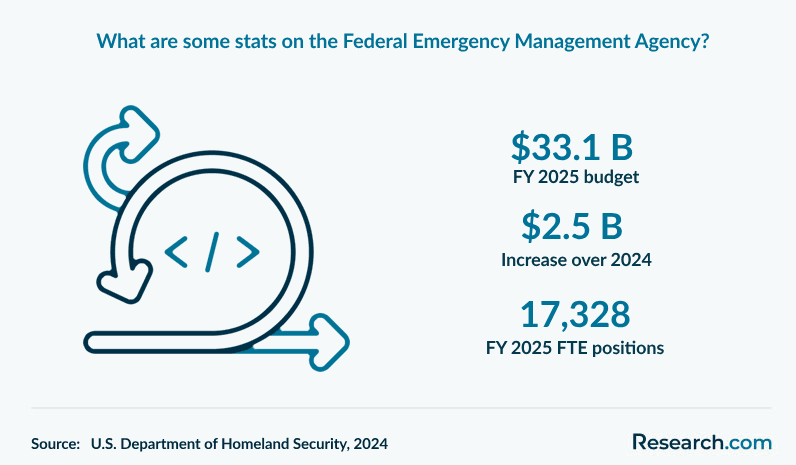
In fiscal year 2025, FEMA's budget totals $33.1 billion, a $2.5 billion increase from the preceding year. This budget supports 17,328 full-time equivalent positions within the agency. The increase reflects a growing financial commitment to federal emergency management operations, preparedness, and response capacity. The related graphic appears below.
What is the average cost of an online emergency management degree program?
The cost of an online bachelor's in emergency management can vary by institution type, residency status, transfer credits, and fee structure. Public in-state options are often the most affordable, while private universities and out-of-state tuition can raise the total cost substantially.
| School Type | Typical Annual Tuition and Fee Range | What to Watch For |
| Public universities, in-state | Approximately $8,000 to $15,000 per year | Residency rules, online fees, course availability, and transfer-credit acceptance. |
| Public universities, out-of-state | $15,000 to $30,000 or more per year | Whether online students pay a separate online rate or standard out-of-state tuition. |
| Private universities | $25,000 to $40,000 or more per year | Institutional scholarships, tuition discounts, and total debt after graduation. |
| Full four-year online bachelor's estimate | $32,000 to over $160,000 total | Total cost after transfer credits, grants, employer aid, and required fees. |
When comparing programs, request a full cost breakdown. Include tuition, technology fees, course materials, proctoring fees, graduation fees, transcript fees, and any travel required for internships, orientations, or campus intensives.
Students comparing affordable public-service degrees may also review the most affordable online bachelor's degree in sustainability. Sustainability is not the same field as emergency management, but both areas can appeal to students interested in resilience, public impact, environmental risk, and long-term community planning.
What are the financial aid options for students enrolling in an online emergency management degree program?
Online emergency management students may qualify for many of the same financial aid options as campus-based students if they attend an eligible institution and meet aid requirements. The key first step is completing the Free Application for Federal Student Aid (FAFSA).
- Federal grants: Pell Grants and Federal Supplemental Educational Opportunity Grants (FSEOG) are need-based and generally do not require repayment.
- Federal student loans: Direct Subsidized Loans, Direct Unsubsidized Loans, and Direct PLUS Loans must be repaid with interest.
- State aid: State grants and loan programs may be available, often with residency requirements.
- Institutional scholarships: Colleges may offer merit-based, need-based, transfer, military, public safety, or adult learner scholarships.
- Private scholarships: Foundations, professional associations, civic groups, and employers may fund students in public safety and emergency services fields.
- Military and veteran benefits: Active-duty service members, veterans, and eligible dependents may qualify for education benefits or tuition assistance.
- Employer tuition reimbursement: Public safety agencies, hospitals, government offices, and private employers may help pay for job-related education.
How to reduce the cost of an online emergency management degree
- Start at a regionally accredited community college if you need lower-division credits.
- Choose a bachelor's completion program if you already hold an associate degree.
- Ask whether EMT, fire service, military, law enforcement, or emergency services training can count for credit.
- Compare total cost after grants and scholarships, not only published tuition.
- Avoid programs that make it difficult to transfer credits or require extra coursework that delays graduation.
What are the prerequisites for enrolling in an online emergency management degree program?
Admission requirements vary by school and by whether the program is a full four-year bachelor's degree or an upper-division completion program. In general, applicants need proof that they are ready for college-level study, plus any transfer or associate-degree requirements specified by the institution.
- High school diploma or GED: Most bachelor's programs require high school completion or an equivalent credential.
- Official transcripts: Schools usually request high school transcripts and transcripts from all previously attended colleges.
- Minimum GPA: Some programs set a minimum GPA for admission, transfer, or major entry.
- Application and fee: Applicants generally complete an online application and may pay a non-refundable application fee.
- Letters of recommendation: More selective programs may request recommendations from teachers, supervisors, counselors, or public safety professionals.
- Personal statement: Some schools ask applicants to explain their career goals and interest in emergency management.
- Standardized tests: SAT or ACT scores are less common than in the past, but some institutions may still request them for recent high school graduates.
- Associate degree: Upper-division BAS or completion programs often require an associate degree or a defined number of transferable credits.
Students planning long-term movement into administration, budgeting, or executive leadership may later compare emergency management study with graduate business options such as online MBA no GMAT programs. This is not required for entry into emergency management, but it can be relevant for professionals seeking management-focused advancement.
Applicants should read each program's admission page carefully and contact admissions before applying if they have prior college credits, public safety training, military experience, or certifications they hope to transfer.
Students interested in technical emergency management roles may also consider targeted IT credentials. For example, most affordable online CompTIA network training bootcamps can support foundational networking knowledge for students interested in cybersecurity, emergency communications, infrastructure resilience, or technology-enabled response systems.
What courses are typically in an online emergency management degree program?
Emergency management is interdisciplinary, so degree plans often combine public safety, policy, leadership, technology, risk management, and communication. Course titles differ by school, but many programs include the following areas.
| Course Area | Typical Focus |
| Introduction to Emergency Management | History, core principles, agencies, stakeholders, and phases of emergency management. |
| Disaster Planning and Preparedness | Emergency operations plans, preparedness activities, training, exercises, and planning cycles. |
| Risk Assessment and Analysis | Hazard identification, vulnerability analysis, mitigation strategies, and decision-making under uncertainty. |
| Crisis Communication | Public alerts, media communication, stakeholder messaging, and communication during evolving incidents. |
| Emergency Response Operations | Coordination, command structures, logistics, resource allocation, and operational response. |
| Disaster Recovery and Mitigation | Recovery planning, community restoration, resilience, and strategies to reduce future losses. |
| Homeland Security | National security threats, terrorism, infrastructure protection, intelligence, and security policy. |
| Public Policy and Emergency Management | Legal frameworks, government authority, intergovernmental coordination, and public administration. |
| Leadership and Management in Emergency Services | Team leadership, personnel management, ethics, budgeting, and decision-making in crisis settings. |
| Technology in Emergency Management | GIS, communications systems, data tools, emergency notification systems, and digital coordination platforms. |
Some students also add complementary certificates or electives to strengthen their work with specific populations. For example, psychology certificate programs may be relevant for professionals interested in trauma-informed communication, behavioral health coordination, or community recovery support, although they are not a replacement for an emergency management degree.
Communication and documentation skills also matter in disaster work. Students focused on public information, field documentation, or visual reporting may find the most affordable online digital photography degree useful as a separate creative or communications pathway, though it should be evaluated as a complement rather than a core emergency management credential.
What types of specializations are available in online emergency management degree program?
Not every emergency management bachelor's degree offers formal concentrations, but many programs let students use electives to build focused expertise. The right specialization depends on the setting where you want to work.
| Specialization | Best For Students Interested In |
| Homeland Security | Terrorism, intelligence analysis, national security, and infrastructure protection. |
| Business Continuity and Disaster Recovery | Corporate preparedness, continuity plans, operational resilience, and private-sector risk management. |
| Public Health Emergency Preparedness | Pandemic planning, bioterrorism, hospital readiness, and public health response coordination. |
| Information Technology in Emergency Management | Data systems, emergency communications, cybersecurity, GIS, and technology-assisted response. |
| Urban Search and Rescue Management | Technical rescue coordination, logistics, specialized response teams, and large-scale search operations. |
| Environmental Hazards Management | Hurricanes, floods, wildfires, earthquakes, climate-related hazards, and mitigation planning. |
| Critical Infrastructure Protection | Energy, transportation, communications, water systems, and continuity of essential services. |
Students considering homeland security or infrastructure protection may also compare emergency management coursework with the cheapest online cyber security degree options. Cybersecurity is a separate field, but it can strengthen preparation for roles involving critical infrastructure, cyber incidents, and technology-dependent emergency operations.
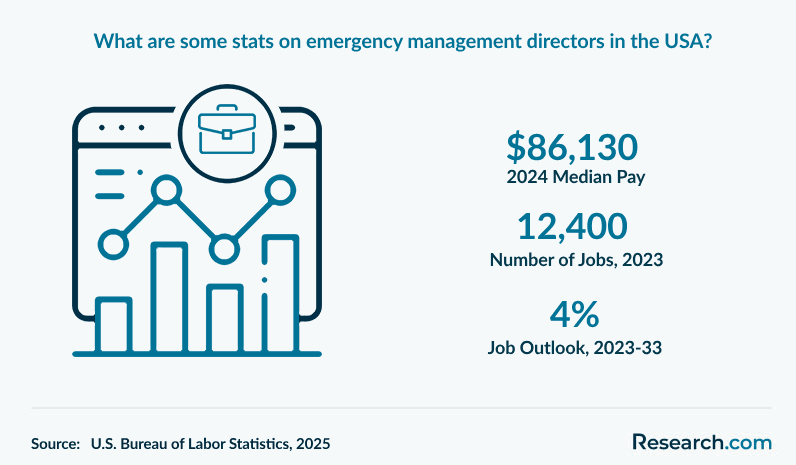
According to the U.S. Bureau of Labor Statistics in 2024, the median pay for Emergency Management Directors was $86,130 per year, or $41.41 per hour. A bachelor's degree is typically the entry-level education required for this role, along with five years or more of related work experience; on-the-job training is generally not provided. The number of jobs in 2023 was 12,400, and the job outlook from 2023 to 2033 is projected to grow at an average rate of 4%, resulting in an expected employment change of 500 new positions over that decade. This data, shown in the graphic below, points to a profession with steady growth and meaningful experience expectations.
Is an online emergency management degree a worthwhile investment?
An online emergency management degree can be worth it when the program is accredited, affordable, transfer-friendly, and aligned with the student's career target. It is a stronger investment for students who already work in public safety, emergency services, healthcare, government, security, or military roles because related experience is often important for advancement.
The degree may be less cost-effective if a student chooses an expensive program without a clear career plan, borrows heavily for an entry-level role, or assumes the bachelor's degree alone will lead directly to a director position. Leadership roles usually require experience in addition to education.
| Choose This Degree If... | Consider Another Path If... |
| You want roles in disaster planning, preparedness, response, recovery, homeland security, or business continuity. | You mainly want clinical healthcare, counseling, IT, or law enforcement training without emergency planning responsibilities. |
| You can attend an accredited program at a manageable total cost. | The only available option requires high debt with uncertain career benefit. |
| You have public safety, military, emergency services, healthcare, or security experience to build on. | You expect a director-level role immediately after graduation without related experience. |
| You value an online format because you need to continue working while studying. | You need hands-on, face-to-face instruction for motivation, networking, or field practice. |
Professionals interested in executive leadership, budgeting, operations, or private-sector continuity roles may later consider an online MBA affordable program. An MBA is not necessary for every emergency management career, but it can add business strategy and management training for some advancement goals.
Can integrating business and healthcare strategies enhance emergency management careers?
Yes, but the value depends on the role. Emergency management increasingly requires coordination across public agencies, hospitals, nonprofits, utilities, schools, and private companies. Business coursework can help with budgeting, continuity planning, project management, and executive communication. Healthcare coursework can help students understand hospital emergency operations, public health preparedness, patient surge issues, and community health risks.
Students who want to move into health system preparedness or administrative leadership may compare emergency management study with the most affordable online MBA programs with healthcare concentration. This type of graduate business option is most relevant for professionals pursuing healthcare administration, strategic planning, or senior management responsibilities.
How does interdisciplinary education elevate emergency management effectiveness?
Emergency managers rarely work in isolation. They coordinate with public health officials, law enforcement, fire services, hospitals, transportation providers, utilities, technology teams, elected officials, and community organizations. Interdisciplinary education can improve how professionals evaluate complex incidents, communicate across sectors, and design practical response plans.
Some students may explore advanced healthcare or clinical pathways, such as a Pharm D program online, if their long-term goals involve pharmaceuticals, public health emergencies, medication access, or healthcare response systems. This is a specialized route and should be evaluated based on licensure requirements, career goals, and program structure.
How does an interdisciplinary approach enrich an online emergency management degree?
An interdisciplinary approach helps students connect emergency planning with the realities of community health, infrastructure, communication, logistics, human behavior, and technology. For example, public health knowledge can support pandemic planning, technology skills can improve incident monitoring, and nutrition knowledge can matter in sheltering, population health, and disaster recovery contexts.
Students interested in community health and emergency nutrition planning may explore a bachelor of science in nutrition online. This degree is not a substitute for emergency management training, but it can be relevant for students focused on food security, public health, shelters, and community resilience.
Do online emergency management degree programs offer comprehensive career support and networking opportunities?
Many accredited online programs provide career support, but services vary significantly. Stronger programs may offer resume reviews, career coaching, virtual career fairs, alumni networks, internship guidance, faculty mentoring, and connections with public safety or emergency management agencies. Students should not assume all online programs provide the same level of support.
Ask whether online students have equal access to career services, internship postings, faculty office hours, professional association guidance, and alumni events. If you want to work in hospitals or health system readiness, compare emergency management coursework with a healthcare administration degree online to determine which path better fits your target role.
How does one choose the best online emergency management degree program?
The best online emergency management degree is the one that fits your career goals, budget, schedule, and transfer situation while meeting recognized accreditation standards. Rankings can help narrow the list, but they should not replace your own program-by-program review.
Key factors to compare before applying
- Accreditation: Confirm that the institution is accredited by a recognized accrediting body. Students comparing institutional options may also review nationally accredited online universities, while also checking whether regional accreditation is important for transfer, graduate study, or employer recognition.
- Total cost: Compare tuition, online fees, books, course materials, and the number of credits you still need.
- Transfer policy: Ask how many credits transfer and whether prior emergency services, military, EMT, fire, or law enforcement training can count.
- Curriculum fit: Make sure the program includes planning, mitigation, response, recovery, crisis communication, technology, and leadership.
- Online format: Determine whether courses are synchronous, asynchronous, accelerated, self-paced, or cohort-based.
- Faculty background: Look for instructors with emergency management, public safety, homeland security, healthcare preparedness, or disaster response experience.
- Career support: Confirm access to internships, employer connections, resume help, professional networking, and alumni contacts.
- Student support: Check tutoring, advising, technical help, library access, and support for online learners.
- Outcomes: Review graduation rates, retention, and career-placement data if the school publishes them.
Questions to ask admissions advisors
- What is the full estimated cost to finish the degree based on my transfer credits?
- Are online students charged in-state, out-of-state, or separate online tuition?
- How many credits can I transfer into the program?
- Do you award credit for military, EMT, fire service, law enforcement, or FEMA-related training?
- Are any courses synchronous, or can I complete work asynchronously?
- Are internships, practicums, or field experiences required?
- What career services are available specifically to online students?
- Which emergency management software, simulations, or planning tools are used in coursework?
Common mistakes to avoid
| Mistake | Better Approach |
| Choosing the lowest tuition without checking fees. | Ask for a full cost estimate through graduation. |
| Ignoring accreditation. | Verify institutional accreditation before applying. |
| Assuming every online program accepts all transfer credits. | Request an official transfer evaluation early. |
| Relying only on rankings. | Use rankings as a starting point, then compare curriculum, cost, support, and outcomes. |
| Expecting a director job immediately after graduation. | Build related experience through public safety, planning, coordination, internships, or entry-level roles. |
| Overlooking course format. | Confirm whether deadlines, live sessions, or accelerated terms fit your work schedule. |
What career paths are available for graduates of online emergency management degree program?
An online bachelor's in emergency management can lead to roles in planning, coordination, preparedness, response, recovery, business continuity, and homeland security. Exact job eligibility depends on experience, location, agency requirements, and employer expectations.
| Career Path | Typical Responsibilities |
| Emergency Management Director | Leads preparedness, response, recovery, and coordination activities for agencies or organizations. |
| Emergency Planner | Creates emergency operations plans, conducts drills, analyzes hazards, and updates preparedness procedures. |
| Homeland Security Specialist | Assesses threats, supports security planning, coordinates protective measures, and analyzes risks. |
| Disaster Recovery Specialist | Supports communities or organizations after disasters, including recovery planning and resource coordination. |
| Business Continuity Planner | Develops strategies to keep operations running during and after disruptions. |
| EMS Manager | Coordinates emergency medical services operations, staffing, procedures, and readiness. |
| Public Health Preparedness Coordinator | Plans for pandemics, disease outbreaks, bioterrorism, and other health emergencies. |
| Security Manager | Develops safety and security protocols that may include emergency response procedures. |
| Risk Management Analyst | Identifies risks, analyzes vulnerabilities, and recommends mitigation strategies. |
| Logistics Coordinator | Manages resources, supplies, transportation, and personnel movement during incidents. |
Some emergency management professionals work closely with behavioral health and recovery services after disasters. Students interested in addiction, trauma, or community support roles may review substance abuse counselor certification requirements as a separate career direction that can intersect with disaster recovery and public health work.
Emergency management graduates often work in government, healthcare, nonprofit, and public safety settings. Students who want frontline healthcare support experience may also explore the cheapest online certified nursing assistant programs. CNA training is not an emergency management bachelor's degree, but it can support students interested in healthcare operations, patient care environments, or crisis response settings.
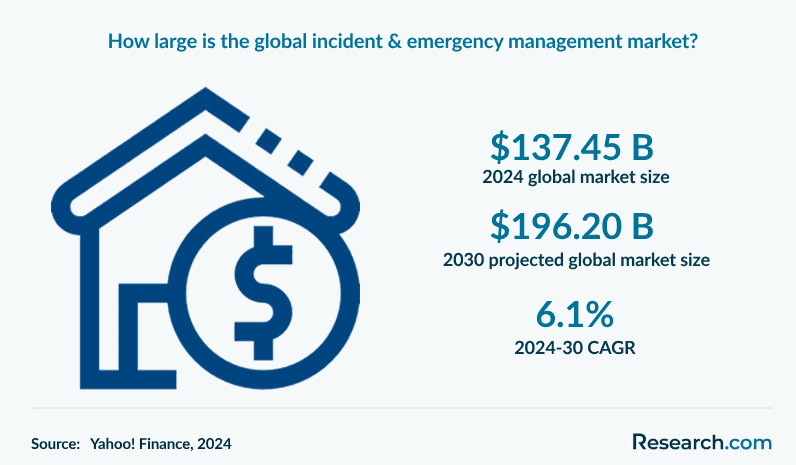
The global incident and emergency management market is anticipated to grow from an estimated USD 137.45 billion in 2024 to USD 196.20 billion by 2030, representing a Compound Annual Growth Rate (CAGR) of 6.1% over the forecast period. This growth is linked to increasing urbanization, greater disaster risk concentration, and the use of technologies such as AI, IoT, and machine learning for prediction, real-time monitoring, and automated response. The graphic below shows these figures.
What is the job market for graduates with an online emergency management degree?
The job market for emergency management graduates is stable but competitive. The field needs trained professionals, yet many higher-level roles require experience beyond the bachelor's degree. Students improve their prospects by combining education with public safety work, internships, military experience, volunteer disaster response, healthcare preparedness, security work, or technical skills.
- Government: Federal agencies such as FEMA and the Department of Homeland Security, along with state and local emergency management agencies, employ emergency management professionals.
- Private sector: Companies need continuity plans, crisis communication procedures, risk assessments, and resilience strategies.
- Healthcare: Hospitals and health systems need preparedness staff for disasters, pandemics, mass casualty events, and continuity planning. Students targeting health administration may compare this degree with the cheapest online healthcare management degree programs.
- Nonprofit organizations: Disaster relief groups, including the American Red Cross, use emergency management skills in response, recovery, logistics, and volunteer coordination.
- Technology-driven roles: AI, IoT, machine learning, GIS, and data tools are increasingly relevant in incident monitoring, alerting, and response coordination.
In 2025, Payscale.com data showed a range of average salaries for emergency management occupations in the United States. Directors of emergency management had an average salary of $80,092. Emergency management specialists earned an average of $67,966, while emergency management specialists at FEMA averaged $70,696. Location also affected pay: emergency managers in Austin, TX, averaged $58,255, while emergency managers in San Diego, CA, averaged $85,000. Emergency preparedness coordinators had an average salary of $51,707. These salary differences show why experience, responsibility level, employer, and geography matter.
Overall, an online emergency management bachelor's degree can provide useful preparation for a field where planning, coordination, communication, and resilience are central. The strongest outcomes usually come from pairing the degree with relevant experience, professional networking, and targeted skills in areas such as public health, business continuity, GIS, cybersecurity, or logistics.
Here's What Graduates Say About Their Online Bachelor's in Emergency Management Degrees
The online emergency management program helped me keep working while building knowledge I could use immediately in my local response office. The flexibility mattered, but the biggest benefit was learning how planning, communication, and coordination fit together during real incidents. Ivy
The simulations and case-based assignments made the online format more practical than I expected. Faculty with field experience helped connect course concepts to disaster relief work, which prepared me to serve with a national response organization. Jack
I was worried about balancing family responsibilities with school, but the online structure made the degree manageable. The program gave me a clearer path into homeland security work and strengthened my confidence in crisis planning. Josephina
Key Insights
- Affordability depends on more than tuition: Compare total cost, fees, transfer credits, residency rules, and time to completion before choosing a program.
- Accreditation is essential: Verify institutional accreditation before enrolling, especially if you plan to transfer credits, pursue graduate school, or use financial aid.
- Experience matters for advancement: Emergency management director roles typically require a bachelor's degree plus five years or more of related work experience.
- Public-sector and private-sector demand both matter: Government agencies, healthcare systems, nonprofits, and companies all need emergency planning and continuity expertise.
- Disaster frequency supports the field's relevance: The U.S. experienced 403 weather and climate disasters exceeding $1 billion in losses from 1980 to 2024, and the annual average rose to 23.0 events during 2020 to 2024.
- Career outcomes vary by role and location: In 2024, BLS reported median annual pay of $86,130 for Emergency Management Directors, while 2025 Payscale.com averages varied by job title and city.
- Technology is reshaping emergency management: AI, IoT, machine learning, GIS, and real-time monitoring tools are increasingly important in preparedness and response.
- The best program is the best fit: Choose a degree that matches your target role, schedule, budget, transfer profile, and preferred specialization.
References:
- PayScale. (2025). Director of Emergency Management Salary. PayScale.
- PayScale. (2025). Emergency Management Specialist Salary. PayScale.
- PayScale. (2025). Emergency Management Specialist Salary at Federal Emergency Management Agency (FEMA). PayScale.
- PayScale. (2025). Emergency Manager Salary in Austin, Texas. PayScale.
- PayScale. (2025). Emergency Manager Salary in San Diego, California. PayScale.
- PayScale. (2025). Emergency Preparedness Coordinator Salary. PayScale.
- U.S. Bureau of Labor Statistics. (2025, April). Emergency management directors. U.S. Department of Labor. U.S. Bureau of Labor Statistics.
- U.S. Department of Homeland Security. (2024, April). Federal Emergency Management Agency: Fiscal Year 2025 Congressional Justification. U.S. Department of Homeland Security.
- Yahoo Finance. (2024, December 1). Fortune Business Insights. Incident and emergency management market worth $196.20 billion by 2030. Yahoo Finance.
- National Centers for Environmental Information. (2025). U.S. billion-dollar weather and climate disasters: State summary. National Oceanic and Atmospheric Administration. National Centers for Environmental Information.
Other Things You Should Know About Online Emergency Management Degree Programs
Most online bachelor’s in emergency management programs require about 120 semester credits. Students usually complete general education, emergency planning, disaster response, homeland security, and elective courses, plus any required capstone or internship. Transfer credits from accredited schools can reduce the total remaining coursework.
In 2027, financial aid such as grants, scholarships, student loans, and work-study programs can significantly reduce the cost of an online Bachelor's in Emergency Management. Choosing a program with strong financial aid options can make education more accessible and affordable for students.