2027 Most Affordable Online Master's Degree in Homeland Security Programs

Co-Founder and Chief Data Scientist
Choosing an online master’s degree in Homeland Security is usually a career decision, not just an academic one. The right program can help you move into emergency management, intelligence, cybersecurity, public safety leadership, or federal security work; the wrong program can leave you with debt, limited career support, or coursework that does not match your target role.
Homeland security continues to matter because threats now cross physical, digital, environmental, and geopolitical boundaries. The global homeland security market was valued at $556.40 billion in 2022 and is anticipated to grow at a compound annual growth rate (CAGR) of 5.8% from 2023 to 2030 (Grand View Research, 2023). That growth reflects investment in cybersecurity, border control, aviation safety, critical infrastructure protection, and disaster preparedness.
This guide explains what to expect from an online master’s in Homeland Security, how to compare affordable programs, what costs and admissions requirements to plan for, and which career paths may fit your goals. It is designed for working professionals, military-affiliated students, emergency responders, law enforcement personnel, cybersecurity workers, and career changers who want a practical way to evaluate graduate programs.
Quick answer: Is an online master’s in Homeland Security worth it?
An online master’s in Homeland Security can be worth it if you want to qualify for leadership, policy, emergency management, intelligence, cybersecurity, or public safety roles and need a flexible format that fits around work. It is especially useful for professionals who already work in government, military, law enforcement, emergency response, cybersecurity, or risk management and want to move into higher-responsibility positions.
It may be less useful if your target job requires a specific technical credential, security clearance, law enforcement academy training, or hands-on cyber experience more than a graduate degree. Before enrolling, confirm that the program is accredited, check total tuition and fees, compare specializations, and ask whether the curriculum aligns with the agencies or industries where you want to work.
What are the benefits of getting an Online Master's Degree in Homeland Security?
- Broader career options: Graduates can pursue work in cybersecurity, emergency management, intelligence analysis, and public safety. The Department of Homeland Security (DHS) has over 220,000 employees working in various roles (DHS, n.d.), giving students a sense of the scale of the federal homeland security workforce.
- Competitive earning potential: Professionals with this degree earn a median salary of $87,000, depending on the role and location (Payscale, 2025). Individual salaries can vary widely by employer, experience, clearance level, geography, and specialization.
- Flexible study format: Online programs allow students to complete graduate coursework while continuing to work, serve in the military, support family obligations, or live far from campus.
What can I expect from an Online Master's Degree in Homeland Security?
An online master’s degree in Homeland Security typically combines national security policy, emergency preparedness, risk analysis, intelligence, cyber defense, and critical infrastructure protection. The goal is to help students understand how agencies, private organizations, and communities prepare for and respond to complex threats.
- Core coursework: Most programs cover homeland security strategy, terrorism and counterterrorism, risk assessment, emergency management, cybersecurity, intelligence analysis, and public policy.
- Applied learning: Students often complete case studies, scenario-based assignments, simulations, research projects, or a capstone that requires them to solve a real-world security or emergency management problem.
- Specialized electives: Depending on the school, you may be able to focus on emergency management, cybersecurity, intelligence studies, counterterrorism, border security, or public health preparedness.
- Online delivery: Many programs use asynchronous courses, meaning students can review lectures and complete assignments on a schedule that works around professional responsibilities.
Where can I work with an Online Master's Degree in Homeland Security?
Graduates may work in federal, state, local, private-sector, nonprofit, and international security settings. Federal employers may include:
- Department of Homeland Security (DHS)
- Federal Emergency Management Agency (FEMA)
- Transportation Security Administration (TSA)
- Central Intelligence Agency (CIA)
- Federal Bureau of Investigation (FBI)
Other employment options include state emergency management offices, local law enforcement agencies, cybersecurity firms, private security companies, hospitals, transportation organizations, utilities, consulting firms, and international security organizations. Common functions include threat assessment, disaster planning, policy analysis, cyber risk management, continuity planning, intelligence support, and emergency response coordination.
How much can I make with an Online Master's Degree in Homeland Security?
Pay depends heavily on job title, employer, experience, location, credentials, and whether the position requires a clearance or specialized technical background. Salaries vary depending on the role, experience, and location but typically range between $70,000 and $110,000 annually. Federal jobs may offer structured pay, benefits, and advancement systems, while private-sector cybersecurity and consulting roles may provide higher earning potential for candidates with strong technical skills.
- Most affordable online master's in Homeland Security programs
- How long does an online master's in Homeland Security take?
- Online vs. on-campus Homeland Security master's programs
- Average cost of an online master's in Homeland Security
- Financial aid options for Homeland Security graduate students
- Admissions requirements for master's in Homeland Security programs
- Courses and specializations in Homeland Security master's programs
- Why accreditation matters for Homeland Security programs
- How legal studies can strengthen Homeland Security training
- Practical training in Homeland Security programs
- Professional certifications for Homeland Security careers
- Dual-degree options in Homeland Security
- How to choose the best master's in Homeland Security program
- Career paths for Homeland Security master's graduates
- Job market outlook for Homeland Security graduates
Top 10 Most Affordable Master's in Homeland Security Programs
How do we rank schools?
Affordability matters because graduate school can affect your finances for years after enrollment. This ranking is designed to help you compare online Homeland Security master’s programs using cost, program structure, academic credibility, and career relevance rather than name recognition alone.
Research.com uses a detailed ranking methodology based on established education data sources, including the IPEDS database, Peterson’s database, College Scorecard database, and the National Center for Education Statistics. The goal is to make program comparison more transparent for students evaluating cost, quality, and fit.
| Rank | School | Program length | Tracks or concentrations | Cost per credit | Credits | Accreditation |
| 1 | Arkansas Tech University | Approximately 2 years | Emergency Management, Cybersecurity | $375 | 36 | Higher Learning Commission (HLC) |
| 2 | Sam Houston State University | 2 years (full-time) | Homeland Security Policy, Emergency Management | $385 | 36 | Southern Association of Colleges and Schools Commission on Colleges (SACSCOC) |
| 3 | Columbia Southern University | 18-24 months | Emergency Management, Criminal Justice | $348.95 | 36 | Distance Education Accrediting Commission (DEAC) |
| 4 | Northwestern State University of Louisiana | Approximately 2 years | Homeland Security, Emergency Management | $395 | 36 | Southern Association of Colleges and Schools Commission on Colleges (SACSCOC) |
| 5 | University of Management and Technology | 18-24 months | Homeland Security, Emergency Management | $423 | 36 | Middle States Commission on Higher Education (MSCHE) |
| 6 | Auburn University at Montgomery | 2 years | Emergency Management, Homeland Security Policy | $426 | 36 | Southern Association of Colleges and Schools Commission on Colleges (SACSCOC) |
| 7 | University of Alaska Fairbanks | 2 years (flexible pacing available) | Arctic Security, Emergency Management | $449 | 36 | Northwest Commission on Colleges and Universities (NWCCU) |
| 8 | American Public University System | 2 years | Counterterrorism, Cybersecurity, Emergency Management | $425 | 36 | Higher Learning Commission (HLC) |
| 9 | Arizona State University, Online | 1.5–2 years | Homeland Security, Emergency Management, Community Resilience | $528 | 33 | Higher Learning Commission (HLC) |
| 10 | Liberty University | 1.5–2 years | Emergency Management, Public Administration, Criminal Justice | $565 | 36 | Southern Association of Colleges and Schools Commission on Colleges (SACSCOC) |
How to use this affordability ranking
The lowest cost per credit is only one part of the decision. A program with a slightly higher tuition rate may still be a better value if it offers the specialization, faculty background, career services, military benefits, or internship connections you need. Compare total program cost, not just per-credit tuition, and ask whether fees, textbooks, technology charges, and graduation costs are included.
1. Arkansas Tech University
Arkansas Tech University offers an online Homeland Security master’s option built for professionals who want graduate-level preparation in emergency management, cyber defense, and national security policy. Its applied format may appeal to students who want case-based coursework and a schedule that can fit around employment.
- Program Length: Approximately 2 years
- Tracks/Concentrations: Emergency Management, Cybersecurity
- Cost per Credit: $375
- Required Credits to Graduate: 36
- Accreditation: Higher Learning Commission (HLC)
2. Sam Houston State University
Sam Houston State University provides an online master’s program that blends security theory with applied study in intelligence, crisis response, terrorism, risk analysis, and homeland security leadership. It may be a good fit for students who want policy and emergency management preparation in a flexible graduate format.
- Program Length: 2 years (full-time)
- Tracks/Concentrations: Homeland Security Policy, Emergency Management
- Cost per Credit: $385
- Required Credits to Graduate: 36
- Accreditation: Southern Association of Colleges and Schools Commission on Colleges (SACSCOC)
3. Columbia Southern University
Columbia Southern University delivers a fully online program focused on leadership, disaster response, emergency management, and risk assessment. Its flexible structure is designed for adult learners who need graduate coursework that can fit around professional obligations.
- Program Length: 18-24 months
- Tracks/Concentrations: Emergency Management, Criminal Justice
- Cost per Credit: $348.95
- Required Credits to Graduate: 36
- Accreditation: Distance Education Accrediting Commission (DEAC)
4. Northwestern State University of Louisiana
Northwestern State University of Louisiana offers online graduate study in homeland security with attention to strategic planning, cybersecurity, and critical infrastructure protection. The program is structured for students seeking public safety and security leadership preparation without relocating.
- Program Length: Approximately 2 years
- Tracks/Concentrations: Homeland Security, Emergency Management
- Cost per Credit: $395
- Required Credits to Graduate: 36
- Accreditation: Southern Association of Colleges and Schools Commission on Colleges (SACSCOC)
5. University of Management and Technology
The University of Management and Technology offers an online master’s program emphasizing risk analysis, intelligence, and emergency management. Students who value applied projects, research assignments, and advising support may find the format useful for career-focused graduate study.
- Program Length: 18-24 months
- Tracks/Concentrations: Homeland Security, Emergency Management
- Cost per Credit: $423
- Required Credits to Graduate: 36
- Accreditation: Middle States Commission on Higher Education (MSCHE)
6. Auburn University at Montgomery
Auburn University at Montgomery offers an online Master of Science in Homeland Security and Emergency Management that connects public administration, crisis management, and security studies. The degree may suit law enforcement, emergency response, military, and public service professionals seeking applied graduate training.
- Program Length: 2 years
- Tracks/Concentrations: Emergency Management, Homeland Security Policy
- Cost per Credit: $426
- Required Credits to Graduate: 36
- Accreditation: Southern Association of Colleges and Schools Commission on Colleges (SACSCOC)
7. University of Alaska Fairbanks
The University of Alaska Fairbanks offers an online Master’s in Security and Disaster Management with emphasis on arctic security, emergency preparedness, leadership, and interagency coordination. It may be especially relevant for students interested in regional security, disaster planning, and public safety operations.
- Program Length: 2 years (flexible pacing available)
- Tracks/Concentrations: Arctic Security, Emergency Management
- Cost per Credit: $449
- Required Credits to Graduate: 36
- Accreditation: Northwest Commission on Colleges and Universities (NWCCU)
8. American Public University System
American Public University System offers a customizable online Homeland Security master’s program with electives in counterterrorism, cybersecurity, and emergency management. Its range of course options may help students tailor their studies toward government, law enforcement, emergency services, or national security roles.
- Program Length: 2 years
- Tracks/Concentrations: Counterterrorism, Cybersecurity, Emergency Management
- Cost per Credit: $425
- Required Credits to Graduate: 36
- Accreditation: Higher Learning Commission (HLC)
9. Arizona State University, Online
Arizona State University, Online offers an online Master of Arts in Emergency Management and Homeland Security that draws from policy, science, technology, and community resilience. It may be a strong choice for students who want an interdisciplinary approach to preparedness and security challenges.
- Program Length: 1.5–2 years
- Tracks/Concentrations: Homeland Security, Emergency Management, Community Resilience
- Cost per Credit: $528
- Required Credits to Graduate: 33
- Accreditation: Higher Learning Commission (HLC)
10. Liberty University
Liberty University offers an online master’s in Homeland Security and Emergency Management with an emphasis on ethics, leadership, service, and decision-making in security and disaster response settings. Its eight-week courses and multiple start dates may work well for students who need frequent enrollment options.
- Program Length: 1.5–2 years
- Tracks/Concentrations: Emergency Management, Public Administration, Criminal Justice
- Cost per Credit: $565
- Required Credits to Graduate: 36
- Accreditation: Southern Association of Colleges and Schools Commission on Colleges (SACSCOC)
How long does it take to complete an Online Master's Degree in Homeland Security Programs?
Most online master’s in Homeland Security programs take 18 to 24 months for full-time students. Program length depends on required credits, course load, term structure, transfer credit policy, and whether the student chooses an accelerated, full-time, or part-time pace. Many programs require 30 to 36 credits.
Part-time students and working professionals may take 3 or even 4 years, especially if they enroll in one course at a time or pause during busy work periods. Some schools allow academic breaks, often up to one full academic year, but policies differ, so students should confirm leave-of-absence rules before enrolling.
11.1% of employees at the Department of Homeland Security hold a master’s degree (Zippia, n.d.). A graduate degree is not automatically required for every homeland security job, but it may strengthen a candidate’s preparation for leadership, specialized policy work, emergency management administration, intelligence roles, or advancement within an agency.
| Student pace | Typical completion time | Best for | Trade-off |
| Accelerated or heavy course load | 18 to 24 months | Students who can manage intensive graduate coursework | Less room for work, family, or deployment disruptions |
| Full-time | 18 to 24 months | Students who want a predictable timeline | Requires consistent weekly study time |
| Part-time | 3 or even 4 years | Working professionals, parents, military students, and shift workers | Longer time before graduation and career return on investment |
How does an Online Master's Degree in Homeland Security Programs compare to an on-campus program?
Accredited online and on-campus Homeland Security master’s programs often cover similar academic content, but the learning experience is different. Online programs are usually better for students who need schedule flexibility, live far from campus, or want to keep working full time. On-campus programs may be better for students who value face-to-face networking, structured class times, and immediate access to campus-based resources.
| Factor | Online master's in Homeland Security | On-campus master's in Homeland Security |
| Schedule | Often asynchronous or flexible, making it easier to study while employed | Usually follows set class times and campus schedules |
| Location | Allows students to enroll without relocating | Requires commuting or living near campus |
| Cost considerations | May reduce commuting, housing, and some campus-related expenses | May involve housing, transportation, parking, or campus fees |
| Networking | Depends on virtual events, faculty access, alumni groups, and discussion boards | Often provides more in-person networking and informal relationship-building |
| Learning style | Best for independent learners who can manage deadlines | Best for students who prefer live discussion and classroom structure |
| Career resources | May be remote, appointment-based, or program-specific | May include easier access to campus career centers, seminars, and employer events |
When comparing formats, ask whether online students receive the same faculty access, career advising, internship support, library access, and alumni services as campus students. The degree format matters less than accreditation, curriculum quality, practical training, and whether the program supports your target career path.
What is the average cost of an Online Master's Degree in Homeland Security Programs?
The average cost of an Online Master's Degree in Homeland Security typically ranges from $10,000 to $18,000, depending on the institution. Most programs charge between $300 and $500 per credit hour, and total required credits usually fall between 30 and 36. These figures generally refer to tuition and may not include every fee.
Students should request a full cost sheet from each school before applying. Some universities include online course access, digital library services, academic advising, and technical support in tuition, while others charge separate fees for technology, proctored exams, graduation, or student services.
Online programs may be more affordable than campus programs for students who can avoid relocation, commuting, and housing costs. They can also make it easier to keep earning income while enrolled. However, affordability should be evaluated through total cost, available aid, employer reimbursement, military benefits, transfer credit, and time to completion.
Students comparing graduate tuition across fields may also find it helpful to review the most affordable online data analytics degree programs, especially if they want another example of how online program costs, credits, and value can be evaluated.
What are the financial aid options for students enrolling in a Master's Degree in Homeland Security Programs?
Graduate students in Homeland Security programs may be able to reduce out-of-pocket costs through federal aid, institutional scholarships, employer support, military benefits, and program-specific opportunities. Eligibility varies by school and student circumstances, so it is important to confirm requirements directly with the financial aid office.
- Federal Student Aid: Graduate students can complete the Free Application for Federal Student Aid (FAFSA) to be considered for unsubsidized Direct Loans. These loans accrue interest from disbursement but may offer repayment flexibility.
- Department of Homeland Security (DHS) Programs: DHS offers student-facing opportunities such as internships and training programs in areas including intelligence analysis, cybersecurity, and law enforcement. These programs can provide exposure to the department’s national security mission, though they should not be assumed to pay for a degree unless the specific opportunity states that funding is available.
- FEMA's Homeland Security Grant Program (HSGP): The HSGP primarily supports state, local, tribal, and territorial governments. Students may benefit indirectly if universities receive grant-supported resources, training opportunities, or program enhancements.
- University Scholarships and Fellowships: Schools may offer merit-based, need-based, service-based, or program-specific awards for homeland security, emergency management, public administration, or criminal justice students.
- Employer Tuition Assistance: Public-sector employers, defense contractors, law enforcement agencies, emergency services organizations, and cybersecurity firms may reimburse or subsidize graduate study that supports the employee’s role.
- Military and Veteran Benefits: Active-duty service members, veterans, and eligible dependents may qualify for GI Bill® benefits, Tuition Assistance, or other education support programs.
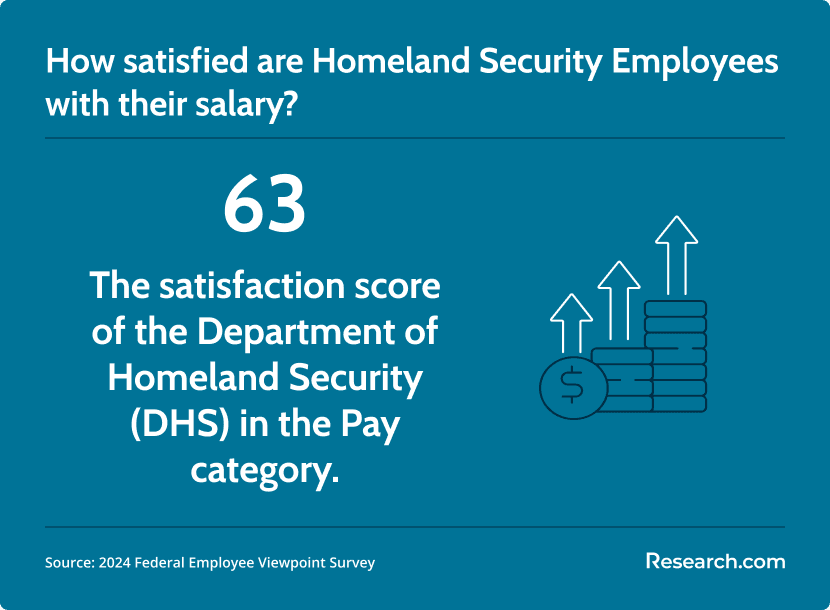
In 2024, the Department of Homeland Security ranked 6th among federal agencies in employee satisfaction with pay, earning a score of 63.0 in that category. This does not guarantee a specific salary or return on investment, but it can be one useful data point for students considering federal employment after graduation.
| Funding option | Who should investigate it | What to ask |
| Federal loans | Graduate students who need broad financing access | What will my monthly payment look like after graduation? |
| University scholarships | Students with strong academics, service experience, or financial need | Is the scholarship renewable, and does it require full-time enrollment? |
| Employer tuition assistance | Working professionals in relevant roles | Do I need to stay with the employer for a certain period after reimbursement? |
| Military and veteran benefits | Service members, veterans, and eligible dependents | How much of this specific program will my benefits cover? |
| DHS or FEMA-related opportunities | Students seeking agency exposure or applied experience | Is this a paid opportunity, a training program, an internship, or a grant-funded resource? |
What are the prerequisites for enrolling in a Master's Degree in Homeland Security Programs?
Admissions standards for Homeland Security graduate programs are more advanced than basic security guard education requirements. Most programs expect applicants to have completed a bachelor’s degree, and many look for academic or professional experience related to public safety, criminal justice, government, military service, emergency response, public administration, or cybersecurity.
- Bachelor’s Degree: Applicants generally need a bachelor’s degree from an accredited institution. Common undergraduate backgrounds include criminal justice, public administration, political science, emergency management, business, cybersecurity, and related fields, though many programs accept students from other majors.
- Minimum GPA: Many programs require an undergraduate GPA of 2.75 to 3.0, while more selective schools may use higher standards or holistic review.
- Professional Experience: Work experience is often optional but helpful. Applicants from law enforcement, military service, emergency medical services, fire services, government, security, or cybersecurity may be able to connect their background directly to graduate goals.
- Letters of Recommendation: Programs commonly ask for two to three recommendations from supervisors, faculty members, or professional mentors who can speak to the applicant’s readiness.
- Statement of Purpose: A personal essay usually explains the applicant’s career goals, interest in homeland security, and reason for choosing the program.
- Resume or CV: Schools typically request a current resume showing education, work history, certifications, military service, public safety experience, and leadership responsibilities.
- Standardized Test Scores: GRE requirements vary, and many online graduate programs have made the test optional or removed it from admissions requirements.
Some internships, agency partnerships, or field experiences may require a background check or security clearance. These requirements are separate from admission to the academic program, so students seeking federal or intelligence-related experience should ask early about eligibility rules.
If you want to understand how graduate admissions criteria compare across online fields, reviewing the most affordable online master's in instructional design can provide useful context on bachelor’s degree expectations, professional experience, and application materials.
There is no age requirement for enrolling in a Master’s Degree in Homeland Security. Department of Homeland Security workforce demographics are also broad: approximately 44% of employees are aged 20-30, 26% are 30-40, and 23% are 40 and older, while no employees are under 18 (DHS data). Age alone should not prevent a student from applying or pursuing advancement in the field.
What courses and specializations are offered in a Master's Degree in Homeland Security?
A master’s degree in Homeland Security usually starts with core courses in national security, emergency management, terrorism, risk analysis, intelligence, cybersecurity, and critical infrastructure. Many programs also require a capstone, thesis, or applied research project that asks students to evaluate a real security or preparedness challenge.
| Course or specialization | What students learn | Career fit |
| Risk Assessment | How to identify, evaluate, prioritize, and communicate threats and vulnerabilities | Risk management, emergency planning, infrastructure protection |
| Critical Infrastructure Protection | How transportation, energy, water, communications, and other systems are secured | Infrastructure security, public utilities, federal or state agencies |
| Intelligence and Homeland Security | How intelligence supports prevention, response, and strategic decision-making | Intelligence analysis, law enforcement support, federal agencies |
| Cybersecurity Fundamentals | How digital systems, networks, and data are protected from cyber threats | Cybersecurity, cyber policy, critical infrastructure defense |
| Emergency Management | How organizations prepare for, respond to, recover from, and mitigate disasters | Emergency management, disaster response, continuity planning |
| Counterterrorism | How terrorism is analyzed, prevented, and addressed through policy and operations | Counterterrorism analysis, security policy, law enforcement support |
Common specialization options include:
- Cybersecurity: This track focuses on protecting networks, systems, and critical infrastructure from cyberattacks, cybercrime, and digital espionage. Students interested in starting a career in information security may want to pair this specialization with technical coursework, labs, or certifications.
- Emergency Management: Students learn to plan, lead, coordinate, and evaluate response and recovery operations for disasters and complex emergencies.
- Counterterrorism: Coursework examines terrorist behavior, threat analysis, prevention strategies, and security policy.
- Border Security: This area covers immigration policy, border operations, international coordination, and cross-border security challenges.
- Public Health Preparedness: Students study how biological threats, disease outbreaks, public health emergencies, and emergency response systems intersect.
- Intelligence Studies: This specialization prepares students to assess information, interpret threat data, and support strategic decisions in public or private organizations.
DHS employee education backgrounds reflect the interdisciplinary nature of the field. Based on the chart below, the top majors among DHS personnel are Criminal Justice (25.8%), Business (21.4%), Political Science (6.8%), Psychology (4.7%), and Law (3.5%).
Those backgrounds connect closely to Homeland Security graduate coursework, which draws from law, public administration, behavioral analysis, security management, political systems, technology, and emergency response. Students should look for programs that let them build on their prior academic or professional strengths while developing a more specialized graduate focus.
How does accreditation influence the quality of a Homeland Security program?
Accreditation is one of the first things students should verify before applying. It indicates that a college or university has been reviewed by a recognized accrediting body for academic standards, faculty qualifications, student support, governance, and learning outcomes. Accreditation can also affect transfer credit, employer recognition, and eligibility for federal financial aid.
For Homeland Security students, accreditation is especially important because many graduates seek government, public safety, cybersecurity, or policy roles where credibility matters. Students who want additional grounding in legal systems may also review the top online associate degree programs in legal studies to understand how legal education can support security-related decision-making.
How can legal studies complement a Master's in Homeland Security Programs?
Legal knowledge can strengthen Homeland Security training because many security decisions involve constitutional limits, privacy rules, emergency powers, administrative law, immigration policy, criminal procedure, procurement rules, and interagency authority. A professional who understands both security operations and legal constraints is better prepared to evaluate policy, manage risk, and communicate with legal counsel or compliance teams.
This is particularly relevant for students interested in policy advising, law enforcement administration, emergency management leadership, border security, intelligence oversight, or private-sector compliance. Students who want focused exposure to legal research and procedure may find it useful to compare online paralegal programs as a complementary academic pathway.
What practical training opportunities are available in Homeland Security Programs?
Practical training is important because homeland security work is based on judgment under pressure, coordination across agencies, and applied problem-solving. Strong programs may include simulations, emergency response exercises, cyber defense scenarios, policy memos, intelligence briefings, tabletop exercises, internships, field placements, or capstone projects with public safety partners.
Before enrolling, ask whether online students can access the same practical learning opportunities as campus students. Students aiming for intelligence or federal security careers should also review how to get into the CIA to understand how competitive agency pathways, background expectations, and specialized preparation may differ from general homeland security roles.
Which Professional Certifications Can Enhance Career Readiness in Homeland Security?
Certifications can help students demonstrate focused expertise beyond the master’s degree, especially in cybersecurity, emergency management, crisis leadership, risk management, and intelligence-related work. They are not a substitute for experience, clearance eligibility, or technical ability, but they can make a candidate’s skill set easier for employers to evaluate.
Students should choose certifications based on their target role. A cybersecurity-focused student may need different credentials than an emergency management professional or policy analyst. Those interested in intelligence and security management may also compare an online intelligence masters degree as an alternative or complementary graduate path.
Are there dual-degree options available with Homeland Security programs?
Some universities offer dual-degree options that combine Homeland Security with related fields. Examples include St. John’s University and American Military University (AMU). Common pairings include Homeland Security with Criminal Justice, Public Administration, Cybersecurity, or Emergency Management. Students comparing justice-focused pathways may also want to review the cheapest criminal justice degree online.
Dual-degree programs typically work by allowing selected courses to count toward both credentials. This can reduce the total number of credits and shorten completion time compared with earning two degrees separately. Instead of 4–5 years for two degrees, a dual-degree program might take 2.5 to 3.5 years.
A dual-degree program is different from a continuous combined master’s and PsyD program. In a Homeland Security dual-degree structure, students usually pursue two separate graduate degrees at the same time, not one integrated clinical or professional sequence.
This option may be worth considering if your career goal requires cross-functional knowledge, such as emergency management leadership, cybersecurity management, intelligence analysis, policy advising, or law enforcement administration. It may not be the best choice if you need to graduate quickly, limit tuition costs, or develop a very specialized technical skill set.
Dual-degree and specialization formats also appear in adjacent graduate fields. For example, some of the most affordable online master's in multilingual learner education programs use paired specializations to support interdisciplinary career goals.
How to choose the best Master's Degree in Homeland Security Programs?
A master’s degree is not automatically required for every homeland security, cybersecurity, law enforcement, or federal agency position. For example, FBI agent education requirements involve specific eligibility standards beyond graduate education. Still, a Homeland Security master’s can help students deepen their knowledge of national security, emergency management, policy, leadership, and risk.
The best program is the one that matches your career goal, budget, schedule, and professional background. Use the following criteria before applying:
| Selection factor | Why it matters | Question to ask the school |
| Accreditation | Supports degree credibility, financial aid eligibility, and employer recognition | Which recognized accrediting body accredits the institution? |
| Specialization options | Helps align coursework with cybersecurity, emergency management, intelligence, policy, or public safety goals | Can I choose electives that match my target role? |
| Online flexibility | Determines whether the program fits around work, military duty, or family responsibilities | Are courses asynchronous, synchronous, or mixed? |
| Faculty background | Practitioner experience can add practical insight to policy and operations topics | Do faculty have experience in law enforcement, military, emergency management, cybersecurity, or federal agencies? |
| Total cost | Tuition alone may not reflect the full price of the degree | What is the complete cost including fees, books, and graduation charges? |
| Career support | Internships, advising, and employer connections can affect post-graduation opportunities | What career services are available to online graduate students? |
| Practical learning | Scenario work, simulations, and capstones help translate theory into workplace skills | Does the program include applied projects, fieldwork, or agency partnerships? |
Common mistakes to avoid when choosing a Homeland Security master's program
- Choosing only by tuition: A lower-cost program is not always the best value if it lacks the specialization, support, or credibility you need.
- Ignoring accreditation: Always verify institutional accreditation before applying or borrowing money.
- Assuming online means easier: Online graduate programs still require research, writing, discussion, and disciplined time management.
- Overlooking career alignment: A counterterrorism-heavy curriculum may not help much if your goal is cybersecurity management, and a cyber-focused program may not be ideal for emergency management leadership.
- Not asking about online student support: Career services, library access, faculty advising, and internship support should be available in a format online students can actually use.
- Assuming the degree guarantees federal employment: Government hiring often depends on experience, eligibility, background checks, clearances, location, veterans’ preference, and agency needs.
What career paths are available for graduates of a Master's Degree in Homeland Security Programs?
Graduates with a Master’s Degree in Homeland Security can pursue roles in government, public safety, cybersecurity, consulting, emergency management, infrastructure protection, and nonprofit disaster response. Career outcomes depend on prior experience, technical skills, clearance eligibility, location, and the specialization chosen during the program.
| Career path | What the role does | Best-fit specialization or background |
| Emergency Management Director | Plans and coordinates preparedness, response, recovery, and mitigation efforts for disasters and emergencies | Emergency Management, public administration, public safety |
| Intelligence Analyst | Collects, evaluates, and interprets threat information to support security and law enforcement decisions | Intelligence Studies, counterterrorism, political science |
| Cybersecurity Specialist or Manager | Protects systems, networks, data, and critical infrastructure from cyber threats | Cybersecurity, information technology, risk management |
| Homeland Security Policy Advisor | Develops, reviews, or evaluates policies related to security, preparedness, and public safety | Policy, public administration, legal studies, political science |
| Law Enforcement Administrator | Manages personnel, budgets, operations, and strategic initiatives in police or security agencies | Criminal justice, law enforcement, leadership |
| Public Safety Director | Leads safety planning and emergency coordination for communities or organizations | Emergency management, public safety, administration |
| Disaster Response Coordinator | Coordinates logistics, communication, personnel, and relief resources during emergencies | Emergency management, disaster response, nonprofit operations |
| Federal Agency Program Manager | Oversees programs, grants, compliance, and operational initiatives in federal settings | Public administration, policy, homeland security leadership |
Law Enforcement Administrator is among the jobs you can get with a law enforcement degree and a master’s degree in homeland security, especially for professionals who want to move from frontline roles into management, policy, or agency operations.
Homeland security graduates often apply leadership, risk management, and crisis planning skills across sectors. For a broader look at how business and risk skills transfer into other industries, students may also review the cheapest online entertainment business degree programs.
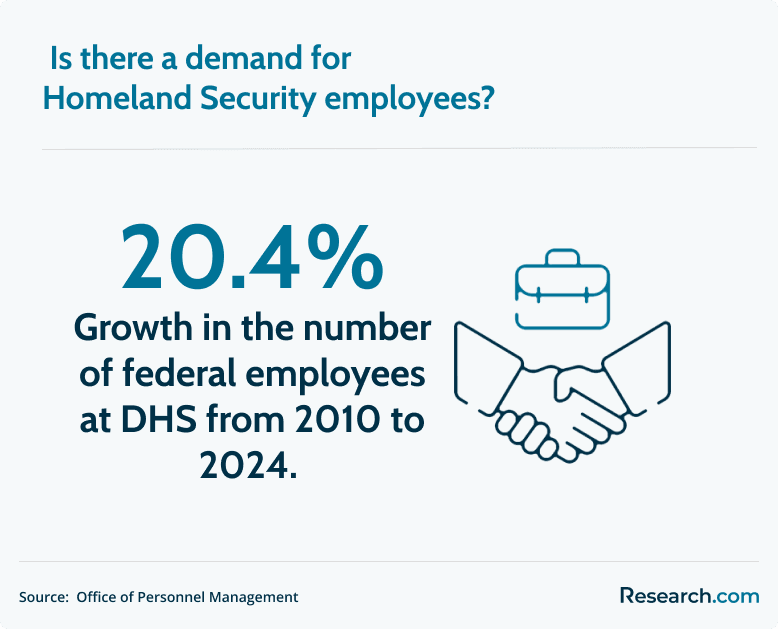
Within the government sector, the Department of Homeland Security (DHS) accounts for 9.9% of the entire federal workforce. The number of federal employees at DHS has grown by 20.4%, from 188,983 in 2010 to 227,566 in 2024, showing the scale and growth of the agency workforce over that period (Office of Personnel Management, 2024).
What is the job market for graduates with a Master's Degree in Homeland Security Programs?
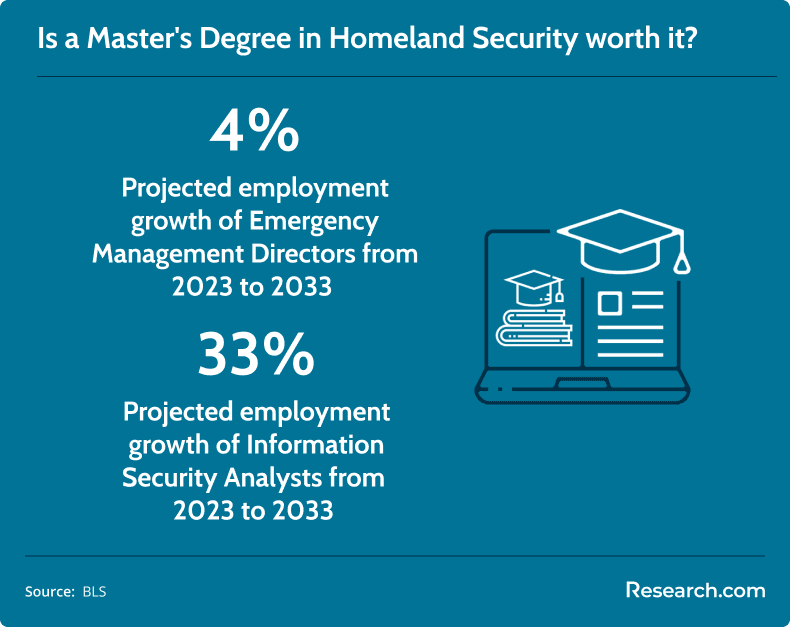
The job market for Homeland Security graduates is strongest in areas connected to cybersecurity, emergency preparedness, risk management, public safety, and infrastructure protection. Demand varies by occupation. According to the U.S. Bureau of Labor Statistics (BLS, 2023), Emergency Management Directors are projected to see a 4% growth in employment from 2023 to 2033, while Information Security Analysts are projected to see 33% growth over the same period.
Emergency Management Directors are needed by government agencies, healthcare systems, colleges and universities, utilities, and private organizations that must prepare for disasters, public health crises, terrorism, severe weather, and operational disruptions. About 1,000 job openings are projected annually, mainly due to replacement needs as workers retire or move into other roles.
Information Security Analysts are employed across finance, healthcare, energy, technology, government, and defense-related organizations. Federal agencies such as the Department of Homeland Security, the FBI, and the Department of Defense also hire cybersecurity professionals. Approximately 17,300 annual job openings are projected for this occupation, reflecting the growing importance of protecting data, networks, and critical infrastructure.
Graduates may also pursue border security, counterterrorism, intelligence support, law enforcement administration, private risk assessment, or emergency response coordination. A master’s degree can support advancement, but students should build relevant experience, technical ability, professional networks, and credentials while enrolled.
Key Insights
- An online master’s in Homeland Security is best for students who want flexible graduate training in security, emergency management, intelligence, cybersecurity, policy, or public safety leadership.
- Program quality depends on accreditation, curriculum fit, applied training, faculty experience, career support, and total cost—not just the school’s name or tuition rate.
- Most programs take 18 to 24 months full time, while part-time students may take 3 or even 4 years.
- The average cost of an Online Master's Degree in Homeland Security typically ranges from $10,000 to $18,000, with many programs charging between $300 and $500 per credit hour.
- Career outcomes vary by specialization. Cybersecurity-focused students may pursue information security roles, while emergency management students may move toward preparedness, response, and continuity leadership.
- A master’s degree can improve readiness for advancement, but it does not guarantee federal employment, a clearance, or a specific salary.
- Before enrolling, ask every school about accreditation, total fees, transfer credit, online student services, capstone or internship options, and whether the curriculum matches your target career.
References:
- Bureau of Labor Statistics. (2023). Emergency management directors. https://www.bls.gov/ooh/management/emergency-management-directors.htm
- Department of Homeland Security. (n.d.). About DHS. https://www.dhs.gov/about-dhs
- Department of Homeland Security. (n.d.). Homeland security careers for students. https://www.dhs.gov/homeland-security-careers/students
- Grand View Research. (2023). Homeland security market size, share & trends analysis report. https://www.grandviewresearch.com/industry-analysis/homeland-security-market
- Indeed. (n.d.). Chief information security officer salaries. https://www.indeed.com/career/chief-information-security-officer/salaries
- Office of Personnel Management. (n.d.). Homepage. https://www.opm.gov/
- Payscale. (n.d.). U.S. Department of Homeland Security salaries. https://www.payscale.com/research/US/Employer=U.S._Department_of_Homeland_Security/Salary
- St. John's University. (n.d.). Master of professional studies in homeland security and criminal justice leadership. https://www.stjohns.edu/academics/programs/homeland-security-and-criminal-justice-leadership-master-professional-studies
- The Best Places to Work. (n.d.). Pay and benefits rankings. https://bestplacestowork.org/rankings/categories/
- Zippia. (n.d.). Department of Homeland Security careers demographics. https://www.zippia.com/department-of-homeland-security-careers-54042/demographics
Other Things You Should Know About Master's Degree in Homeland Security Programs
Prior work or military experience is typically not a requirement for enrolling in the most affordable online Master's degree in Homeland Security programs in 2027. However, candidates with relevant backgrounds may find the coursework more relatable and may benefit from networking opportunities within the field.
Most affordable programs do not require prior work or military experience for enrollment, but it might be beneficial. Relevant experience can enhance applications and provide practical insights, aiding academic success and career opportunities.
The affordability of online Master's degrees in Homeland Security in 2027 is influenced by factors such as the institution's tuition fees, available financial aid and scholarships, program length, and any additional costs related to technology or course materials. Public universities often offer more competitive rates compared to private institutions.