2027 How To Become a CIA Officer

Co-Founder and Chief Data Scientist
Becoming a CIA officer is not a typical government career choice. It requires U.S. citizenship, a lengthy security investigation, strong judgment, discretion, and the ability to work on problems where the stakes may involve national security, foreign policy, cyber threats, terrorism, counterintelligence, or covert operations. For candidates considering this path in 2027, the main question is not only “How do I get hired?” but also “Am I prepared for the demands, limits, and responsibilities of intelligence work?”
This guide explains what CIA officers do, which qualifications matter most, how the application process works, what training may involve, how salaries vary by role, and how to decide whether this career fits your education, temperament, skills, and long-term goals. It also covers practical preparation steps, common mistakes applicants make, and alternative intelligence-related paths for candidates who want national security work but may not fit a CIA role.
Quick answer: How do you become a CIA officer?
To become a CIA officer, you generally need to be a U.S. citizen or dual-national U.S. citizen, be at least 18 years old, apply from within the United States or its territories, meet the qualifications for a specific CIA job, pass interviews and assessments, complete a security clearance process, take a polygraph, and pass medical and psychological evaluations. Many CIA officer positions require a bachelor’s degree and a 3.0 GPA, although some CIA jobs may be available to candidates with different education levels.
Strong candidates usually combine academic preparation, clean personal conduct, sound judgment, foreign language ability, technical or analytical skills, and a willingness to undergo a hiring process that can take about a year. Entry-level CIA officer salaries commonly fall between $50,000 and $100,000 depending on the role, while senior positions can exceed $100,000.
What are the main benefits of becoming a CIA officer?
- Meaningful public service: CIA officers support national security by helping U.S. leaders understand foreign threats, opportunities, and risks.
- Competitive federal compensation: CIA officers earn $50,000 to $80,000 at the entry level, with senior roles reaching $100,000+ and additional bonuses. Pay rises with experience, responsibility, and specialization (CIA, n.d).
- Complex, mission-driven work: Officers may work on terrorism, cyber threats, counterintelligence, foreign political developments, military support, or emerging global risks.
- Federal retirement benefits: Officers receive retirement benefits through the Federal Employees Retirement System (FERS), including a pension, Social Security, and a Thrift Savings Plan, with early retirement after 20 years in some positions (CIA, n.d).
- Specialized training and career mobility: CIA roles can offer advanced professional development, technical training, leadership preparation, and opportunities to move across mission areas.
- What is a CIA officer?
- Why are jobs in the CIA important?
- Do I need a degree to become a CIA officer?
- What are the application requirements to become a CIA agent in 2027?
- What skills does a CIA agent need?
- Do CIA officers need to be physically fit?
- What steps are involved in the CIA hiring process?
- What to expect during CIA officer job training?
- What is the average salary of a CIA officer?
- What is the work-life balance like for CIA officers?
- What additional non-monetary benefits do CIA officers receive?
- What legal and ethical frameworks guide CIA operations?
- How do CIA officers collaborate with other agencies?
- What are the challenges of working as a CIA officer?
- How do CIA officers progress in their careers over time?
- What is the job outlook for CIA agents?
- How can additional academic training boost a CIA officer's career?
- How does mentoring accelerate career advancement for CIA officers?
- How can advanced technological skills elevate operational effectiveness?
What is a CIA officer?
A CIA officer is an employee of the Central Intelligence Agency, which is part of the 18-member U.S. Intelligence Community. The agency collects, evaluates, and shares foreign intelligence to help U.S. policymakers make national security decisions.
CIA work is broader than the “spy” image shown in movies. Some officers operate overseas and help collect human intelligence. Others analyze foreign governments, terrorist networks, military developments, cyber activity, economic risks, or scientific and technological issues. Technical specialists build tools, secure systems, support surveillance capabilities, and protect sensitive information.
Common CIA career tracks include operations, analysis, science and technology, digital innovation, security, business support, language services, and mission management. For candidates comparing investigative careers, reviewing criminalist job requirements can also be useful because both fields reward analytical precision, careful documentation, and strong attention to detail, even though the work environments are very different.
| Common CIA role area | What the work may involve | Best-fit candidate profile |
| Operations | Collecting foreign intelligence, managing sensitive relationships, supporting covert work, and operating in complex environments | Adaptable, discreet, persuasive, resilient, and comfortable with ambiguity |
| Analysis | Studying intelligence from multiple sources and preparing assessments for decision-makers | Strong researcher, excellent writer, careful thinker, and comfortable with incomplete information |
| Cyber and technology | Supporting cyber operations, technical collection, secure systems, data analysis, and emerging technology missions | Technically skilled, detail-oriented, creative, and current on digital threats |
| Security | Protecting personnel, facilities, classified information, and sensitive operations | Disciplined, observant, physically capable when required, and risk-aware |
| Business and mission support | Providing logistics, analytics, finance, human resources, project management, and operational support | Organized, service-minded, reliable, and able to work in classified settings |
Why are jobs in the CIA important?
CIA jobs matter because foreign intelligence helps the United States anticipate threats, understand adversaries, support allies, and make more informed policy choices. The work may influence counterterrorism, cyber defense, military planning, counterintelligence, diplomatic strategy, and crisis response.
The need for intelligence professionals is tied to a changing global risk environment. According to the Global Risks Report 2025, state-based armed conflict accounts for 23% and extreme weather events account for 14% among the listed concerns. Intelligence agencies need people who can interpret these developments, separate credible information from noise, and explain what the risks may mean for U.S. interests.
- National security: CIA officers help identify foreign threats before they directly affect the United States, its citizens, its military, or its allies.
- Policy support: Intelligence assessments inform leaders who must make decisions about diplomacy, defense, sanctions, humanitarian crises, and international partnerships.
- Counterintelligence: Officers help detect and counter foreign efforts to steal secrets, manipulate institutions, or compromise sensitive systems.
- Cybersecurity: Cyber-focused officers and analysts help track foreign cyber actors and support responses to digital threats against U.S. systems and infrastructure.
- Crisis awareness: Intelligence work helps decision-makers respond to fast-moving international events with better context and fewer blind spots.
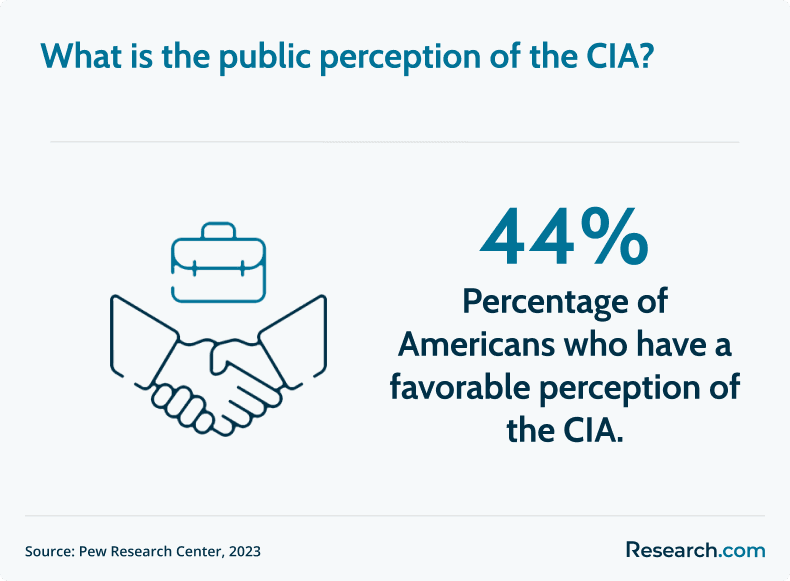
Public opinion about intelligence agencies is mixed. In a 2024 Pew Research Center study, 44% of Americans had a favorable view of the CIA, while 51% viewed the FBI favorably. Even with varied public trust levels, intelligence work remains central to national security. If you are weighing related law enforcement paths, the bounty hunter career path offers a very different model focused on fugitive recovery rather than foreign intelligence.
Do I need a degree to become a CIA officer?
Some CIA jobs may not require a degree, and candidates can qualify for certain roles with a high school diploma, GED, or other education background. However, CIA officer positions commonly require a 4-year or bachelor’s degree and a 3.0 GPA. If cost is a major concern, comparing options such as the cheapest online bachelor’s degree can help you plan a more affordable route.
The best degree depends on the job you want. The CIA hires for many mission areas, so there is no single “CIA major.” Instead, choose a field that builds a clear skill set and gives you evidence of academic discipline, writing ability, research strength, technical knowledge, or language proficiency.
| Degree area | Why it can help | CIA-related roles it may support |
| International relations or political science | Builds knowledge of foreign governments, diplomacy, conflict, and global institutions | Political analysis, regional analysis, operations support, policy-focused intelligence |
| Criminal justice or law | Develops understanding of investigations, legal systems, security processes, and evidence-based reasoning | Counterintelligence, security, compliance, investigative support |
| Computer science, cybersecurity, or artificial intelligence | Prepares candidates for cyber threats, systems work, analytics, and technical intelligence missions | Cyber operations, cyber threat analysis, data analytics, technical collection |
| Linguistics or foreign language | Supports translation, cultural understanding, source communication, and regional expertise | Language officer, operations, analysis, foreign media review |
| Engineering or science | Builds technical problem-solving skills for surveillance, systems, cryptography, and applied research | Technical operations, science and technology roles, security systems |
Technology-focused candidates may consider programs related to cybersecurity, computer science, or an online master's in AI. Candidates interested in technical mission support may also benefit from an online engineering degree. The key is to match your academic background with a specific CIA job family rather than assuming any degree will carry equal weight.
The CIA seeks people with different areas of expertise because global risks are not limited to one discipline. The Global Risks Report 2025 identifies state-based armed conflicts at 23%, extreme weather events at 14%, geoeconomic confrontations at 8%, and misinformation and disinformation at 7%. These issues require analysts, language specialists, technologists, regional experts, scientists, and operations professionals who can evaluate complex information from multiple angles.
The chart below presents the ranking of global risks according to the 2025 World Economic Forum.
What are the application requirements to become a CIA agent in 2027?
CIA applicants must satisfy strict eligibility and suitability standards because officers may handle classified information, represent U.S. interests, and work in sensitive environments. Review the agency’s job postings carefully because requirements vary by role, and consult this overview of CIA agent qualifications for a focused explanation of baseline expectations.
- U.S. citizenship: Applicants must be U.S. citizens or dual-national U.S. citizens.
- Minimum age: Candidates must be at least 18 years old when they apply.
- Application location: Applicants must be physically located in the United States or its territories when submitting their resumes.
- Education and GPA: Many officer roles require a bachelor’s degree and a 3.0 GPA, although some CIA positions have different education requirements.
- Background investigation: The CIA reviews personal, professional, financial, and behavioral history to determine whether a candidate can be trusted with classified work.
- Polygraph examination: Candidates must complete a polygraph as part of the security process.
- Medical and psychological evaluation: Applicants are assessed for physical and mental fitness for the demands of the position.
- Selective Service registration: Male applicants between the ages of 18 and 25 must be registered with the Selective Service System.
- Integrity and candor: Full honesty is essential. Omissions, misleading answers, or inconsistent disclosures can damage an application more than the underlying issue.
- Drug and alcohol history: The CIA reviews illegal drug use and alcohol-related conduct because substance-related risks can affect judgment, reliability, and security eligibility.
These requirements are not just administrative hurdles. They are designed to determine whether a candidate can be trusted with sensitive information, maintain sound judgment under pressure, and comply with legal and ethical obligations. CIA officer positions are not considered entry-level jobs in the casual sense, but the agency does hire both outside applicants and current employees who are ready to move into more demanding roles.
What skills does a CIA agent need?
CIA officers need more than academic credentials. The strongest candidates can interpret uncertain information, communicate clearly, protect sensitive details, and adapt to unfamiliar situations. The exact skill mix depends on whether the role is operational, analytical, technical, security-focused, or administrative.
- Analytical judgment: Officers must evaluate incomplete, conflicting, or sensitive information and identify what matters most.
- Clear writing and briefing ability: Intelligence is useful only when it can be explained accurately to the people who need it.
- Problem-solving under pressure: CIA work often involves uncertainty, time constraints, and changing conditions.
- Technical capability: Cyber threats, surveillance tools, data systems, and digital information are now central to intelligence work. A computer science online degree can help candidates build relevant technical foundations.
- Foreign language and cultural competence: Language skills can strengthen operations, analysis, translation, and regional expertise. Candidates interested in this direction can explore a broader linguistics career.
- Discretion: Officers must protect classified information and avoid careless disclosures in professional and personal settings.
- Integrity: Reliability, honesty, and ethical judgment are essential because intelligence work depends on trust.
- Adaptability: Officers may face changing assignments, overseas environments, new technologies, and evolving threats.
| Skill | How to build it before applying | How to demonstrate it |
| Analysis | Take research-heavy courses, write policy briefs, study regional issues, and practice evidence-based reasoning | Strong writing samples, academic performance, internships, research projects |
| Cyber or technical ability | Study programming, networks, cybersecurity, data analysis, or AI-related tools | Projects, certifications where relevant, technical internships, portfolio work |
| Language proficiency | Complete advanced coursework, study abroad when appropriate, and practice professional translation or interpretation | Language testing, transcripts, immersion experience, regional expertise |
| Communication | Practice concise writing, briefing, public speaking, and structured argumentation | Writing samples, presentations, leadership roles, interview performance |
| Integrity and discretion | Maintain clean conduct, manage finances responsibly, and be truthful in all application materials | Consistent disclosures, strong references, stable personal record |
Do CIA officers need to be physically fit?
CIA officers need to meet medical and fitness standards, but the level of physical demand varies widely by role. Not every CIA officer conducts covert field activity, carries a weapon, or works in hostile environments. Analysts, technologists, security officers, operations officers, and support personnel can face very different physical requirements.
Some positions require stronger physical readiness because officers may travel frequently, work long hours, operate in high-risk settings, or respond to unpredictable conditions. Candidates may face physical evaluations that assess endurance, strength, agility, and flexibility through activities such as running, push-ups, and timed exercises. These expectations are comparable in principle to other federal enforcement roles, including DEA agent job requirements, where physical readiness can be part of mission effectiveness.
Fitness also supports mental performance. Good physical conditioning can help officers manage stress, recover from demanding schedules, and stay alert during long assignments. Candidates should view fitness as a readiness habit, not merely a test to pass.
What steps are involved in the CIA hiring process?
The CIA hiring process is intentionally selective and can take about a year. The agency evaluates whether candidates meet job qualifications, can receive a security clearance, and are suitable for sensitive work. Applicants should be patient, accurate, and responsive throughout the process.
- Submit a resume through MyLINK: Start by applying through the CIA’s official job portal and selecting roles that match your background.
- Wait for an invitation to apply: If your profile fits an agency need, you may be invited to submit a formal application for a specific position.
- Complete interviews, screening, and assessments: This stage may include interviews, testing, skill reviews, and evaluations of your motivation and fit for the work.
- Receive a Conditional Offer of Employment: A COE means you are being considered seriously, but it is not a final offer.
- Submit COE paperwork: Candidates complete detailed documentation, including the SF-86 security clearance questionnaire, which covers personal, employment, financial, travel, and other history.
- Complete security and medical reviews: The CIA conducts a background investigation, polygraph, medical assessment, and psychological evaluation.
- Receive an official job offer: If you pass all required reviews, the agency may issue a final offer with compensation, benefits, and onboarding details.
- Begin onboarding: New employees complete orientation, role-specific administrative steps, and initial training requirements.
| Common applicant mistake | Why it can hurt your chances | Better approach |
| Applying to every CIA job without targeting fit | Generic applications may not show the qualifications needed for a specific role | Match your resume to positions where your degree, experience, skills, and interests align |
| Leaving gaps or vague details in paperwork | Security reviews depend on complete and consistent information | Keep accurate records of work, addresses, foreign contacts, travel, and finances |
| Minimizing past conduct instead of being candid | Dishonesty can be more damaging than an issue disclosed clearly | Answer all questions truthfully and consistently |
| Assuming the process will be fast | The screening process can take about a year | Continue building skills and pursuing other appropriate opportunities while waiting |
| Ignoring role-specific requirements | Physical, language, technical, or education expectations vary by job | Read each posting carefully before applying |
What to expect during CIA officer job training?
CIA training depends on the directorate and job function. Operations officers, analysts, cyber specialists, security personnel, and mission support staff do not all receive the same preparation. Training is designed to teach agency standards, role-specific methods, security rules, operational discipline, and professional expectations.
Within the Directorate of Operations, new officers may enter either the Clandestine Service Trainee program or the Professional Trainee program. The Clandestine Service Trainee program is for candidates with three or more years of professional experience, while the Professional Trainee program is for candidates with less than three years of experience.
Directorate of Operations officers learn operational fundamentals through classroom instruction, practical exercises, team-based work, and interim assignments. The number of interim assignments depends on the program. Some officers also receive physical preparation that may include fitness evaluation, self-defense concepts, and weapons-related instruction, depending on job requirements.
What is the average salary of a CIA officer?
CIA officer pay varies by position, grade, qualifications, location, and experience. In general, entry-level CIA officer salaries range from $50,000 to $100,000, while senior roles can earn over $100,000 annually. Highly specialized or executive-level roles can pay more, but they also require significant experience, leadership responsibility, and mission accountability.
Examples of CIA salary ranges listed on the CIA’s official website include:
| CIA role | Salary range | What the role focuses on |
| Cyber Operations Officer | $72,965 - $181,216 | Uses advanced methods and tools to gather intelligence from adversary systems and support cyber-related missions |
| Cyber Threat Analyst | $61,933 - $153,354 | Analyzes foreign cyber capabilities, intent, and threats to U.S. national security |
| Physical and Technical Security Officer | $68,405 - $128,956 | Protects facilities, systems, and personnel from terrorism and foreign threats, sometimes with domestic or international travel |
| Paramilitary Operations Officer | $77,840 - $128,956 | Leads or supports covert action and intelligence collection in dangerous or austere environments |
| Business Analytics Officer | $72,965 - $153,354 | Transforms data into decision-support insights for agency leaders |
Candidates interested in analytics-heavy roles may benefit from business, statistics, data visualization, or decision science training. For example, pursuing an affordable online MBA in Business Analytics can help build skills in data interpretation, communication, and strategic decision-making.
Compensation can increase substantially at higher levels. For example, the Managing Director earns $859,129, while the Chief Information Officer earns $336,266 (Salary.com, 2024). These leadership roles require extensive experience and the ability to make decisions that affect complex national security missions.
What is the work-life balance like for CIA officers?
Work-life balance at the CIA depends heavily on the role, directorate, location, and assignment. Some jobs may resemble demanding professional office work with classified constraints. Others may involve irregular schedules, overseas travel, long hours, extended deployments, or short-notice mission needs.
The most important trade-off is privacy and flexibility. Officers may not be able to discuss details of their work with family or friends, and some assignments can disrupt personal routines. The agency provides support systems such as counseling and wellness resources, but candidates should still think carefully about whether they can handle secrecy, stress, and uncertain schedules over the long term.
If you are building a broader security or justice career plan, an option such as the cheapest criminal justice degree online may support alternative pathways outside intelligence work.
What additional non-monetary benefits do CIA officers receive?
CIA officers receive more than salary. Benefits may include federal health coverage, retirement programs, paid leave, training, professional development, leadership preparation, and access to wellness resources. For many officers, the strongest non-monetary benefit is the opportunity to work on difficult problems with national significance.
Training is also a major advantage. Officers can develop operational, analytical, technical, language, management, and security skills that are hard to gain in ordinary civilian roles. Compared with many public safety or justice occupations, CIA careers can offer a distinctive combination of federal benefits, classified mission work, and long-term professional development. Candidates comparing compensation across related fields can review criminal justice jobs salary data to understand how intelligence careers fit into the broader security labor market.
What legal and ethical frameworks guide CIA operations?
CIA officers work within legal and ethical limits established by U.S. law, executive orders, internal policies, and oversight structures. Intelligence work may be secret, but it is not meant to be lawless. Officers must understand what they are authorized to do, what they must report, and how to balance national security objectives with legal restrictions and human rights concerns.
Oversight can include congressional review, internal compliance processes, legal counsel, and executive branch controls. Officers must be trained to protect classified information, avoid unauthorized activity, and follow approved procedures. Candidates interested in the legal side of intelligence work may compare the master of legal studies online cost when evaluating graduate education that strengthens legal literacy without necessarily becoming an attorney.
How do CIA officers collaborate with other agencies?
The CIA rarely works in isolation. Intelligence missions often require coordination with agencies such as the FBI, NSA, military organizations, the State Department, law enforcement partners, and allied intelligence services. Collaboration helps agencies combine human intelligence, signals intelligence, law enforcement information, diplomatic context, and technical data.
Effective collaboration requires strict information-sharing rules, classification controls, legal agreements, and clear mission boundaries. Mistakes can compromise sources, operations, or investigations. Professionals with legal or compliance training can help support this work, and programs such as ABA-approved paralegal programs may be relevant for candidates interested in legal support roles connected to national security.
What are the challenges of working as a CIA officer?
CIA careers can be rewarding, but they are not suited to everyone. The same features that make the work meaningful can also make it stressful, restrictive, and personally demanding.
- High pressure: Intelligence work can involve urgent decisions, sensitive information, and consequences that extend beyond one office or agency.
- Personal risk: Some roles involve hostile environments, dangerous travel, or contact with adversarial actors.
- Irregular schedules: Mission needs may require long hours, sudden changes, or availability outside normal work routines.
- Emotional strain: Officers may deal with disturbing information, moral complexity, secrecy, or separation from familiar support networks.
- Limits on disclosure: Officers cannot freely discuss classified work, which can create distance from friends and family.
- Competitive hiring: Meeting minimum requirements does not guarantee selection because the agency hires based on mission needs and candidate suitability.
Despite these demands, the Intelligence Community, including the CIA, ranked 4th in the 2024 “Best Places to Work in the Federal Government” with a score of 75.6 (Partnership for Public Service, 2024). The ranking suggests that many employees view the workplace positively even though the work can be demanding.
The chart below shows the top agencies in the ranking, with the National Aeronautics and Space Administration in first place, followed by the Environmental Protection Agency.
How do CIA officers progress in their careers over time?
CIA officers typically advance by demonstrating strong performance, reliability, leadership potential, mission expertise, and sound judgment. Career growth may involve promotion within one specialty, movement into management, lateral transfer to another directorate, overseas assignments, or deeper specialization in a technical or regional area.
Graduate education can strengthen advancement prospects when it directly supports mission needs. A master’s degree or PhD in cybersecurity, international relations, public policy, data science, leadership, law, or area studies may help officers qualify for more complex responsibilities. For leadership-focused roles, an online PhD in Organizational Leadership may be relevant because it emphasizes strategy, organizational behavior, and executive decision-making.
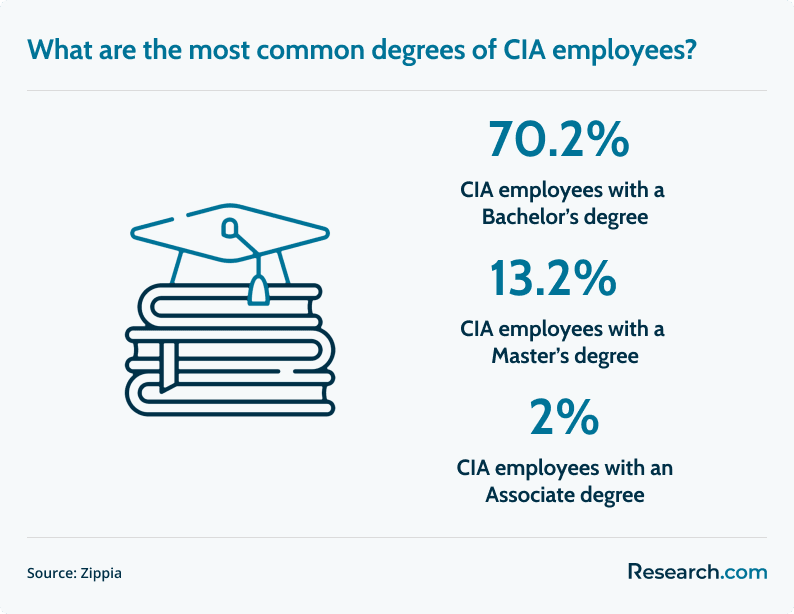
According to Zippia, 70.2% of CIA employees hold bachelor’s degrees, 13.2% hold master’s degrees, and 10.2% hold associate degrees (Zippia, 2023). These figures show that formal education is common in the CIA workforce, but education alone is not enough. Advancement also depends on performance, clearance eligibility, leadership behavior, and the agency’s changing workforce needs.
What is the job outlook for CIA agents?
The CIA does not publicly disclose detailed hiring numbers, so candidates should be cautious about any source claiming exact recruitment projections. The overall outlook is best described as stable but competitive. The agency continues to recruit for mission-critical needs, especially in areas such as cybersecurity, data analysis, foreign languages, international relations, technical operations, security, and regional expertise.
Demand is shaped by persistent global issues such as cyber threats, terrorism, geopolitical competition, foreign espionage, disinformation, and conflict. However, getting hired is not automatic, even for qualified candidates. Security suitability, timing, job match, and agency needs all matter.
Candidates who want intelligence or security work but are not selected by the CIA can also consider contractors, private intelligence firms, cybersecurity companies, risk consulting, federal law enforcement, defense contractors, think tanks, and corporate security roles. The global private security market, which includes private intelligence services, was valued at $235.37 billion in 2023 and is projected to grow to $385.32 billion by 2032, with a compound annual growth rate (CAGR) of 5.7% (Fortune Business Insights, 2023).
How can additional academic training boost a CIA officer's career?
Additional education can help current or aspiring CIA officers when it fills a real skill gap. The most useful programs are those that improve job-relevant capabilities such as cyber defense, foreign language fluency, regional knowledge, legal analysis, data analytics, leadership, or investigative reasoning.
Legal and compliance knowledge can be especially useful in roles involving interagency coordination, oversight, counterintelligence, or operational support. Candidates interested in faster legal support training may compare 2 year paralegal programs as one way to build practical knowledge of legal documents, research, and procedure.
How does mentoring accelerate career advancement for CIA officers?
Mentorship can help CIA officers understand career options, strengthen decision-making, identify skill gaps, and prepare for leadership responsibilities. A mentor can also explain how to navigate performance expectations, training opportunities, rotational assignments, and the cultural demands of classified work.
For applicants, mentorship can come from professors, veterans, language instructors, cybersecurity professionals, public service leaders, or former federal employees who can provide realistic preparation advice. For a focused overview of academic preparation, review what degree is needed to be a CIA agent.
How can advanced technological skills elevate operational effectiveness?
Technology now affects nearly every part of intelligence work. Cyber operations, data analytics, artificial intelligence, secure communications, digital forensics, foreign cyber activity, and misinformation analysis all require officers who understand both mission context and technical systems.
Advanced technological skills can help officers identify patterns, interpret large volumes of information, protect systems, support cyber missions, and brief technical risks to nontechnical leaders. Candidates seeking graduate-level intelligence and technology preparation may consider an online masters artificial intelligence pathway if it aligns with their career goals and target roles.
How to decide if a CIA officer career is right for you
A CIA career can be a strong fit for people who want public service, complex problem-solving, and national security work. It can be a poor fit for people who need predictable schedules, public recognition, full openness about their work, or a fast hiring process.
| This path may fit you if... | You may want another path if... |
| You are comfortable with secrecy and classified work | You want to openly discuss your projects and achievements |
| You can tolerate a hiring process that can take about a year | You need immediate employment or a guaranteed timeline |
| You have strong judgment and a clean, transparent personal record | You are not prepared for deep background review and polygraph screening |
| You want mission-driven work tied to national security | You prefer lower-stress work with clearer boundaries |
| You have or are building specialized skills in analysis, technology, languages, security, or international affairs | You are applying mainly because the job sounds exciting but have not matched your skills to a role |
Practical steps to prepare for a CIA officer application
- Choose a target job family: Decide whether you are aiming for operations, analysis, cyber, security, language, science and technology, or support work.
- Build a strong academic record: If your target role requires a bachelor’s degree and a 3.0 GPA, treat academic performance as part of your application strategy.
- Develop a scarce skill: Foreign language proficiency, cybersecurity, data analytics, regional expertise, engineering, and advanced writing ability can all strengthen competitiveness.
- Keep your personal record organized: Maintain accurate details about addresses, jobs, travel, foreign contacts, finances, and legal history because clearance paperwork is detailed.
- Protect your digital footprint: Use sound judgment online, avoid careless disclosures, and behave consistently with a career that requires discretion.
- Practice concise communication: CIA roles require clear writing and briefing. Learn to summarize complex issues without exaggeration or unnecessary detail.
- Stay physically and mentally prepared: Even if your target role is not field-heavy, health, resilience, and stress management matter.
- Apply only when you can be fully candid: Do not guess, hide, or reshape facts during the application process. Honesty is central to suitability.
Questions to ask before applying to the CIA
- Which CIA job family best matches my degree, experience, and strongest skills?
- Am I willing to go through a hiring process that can take about a year?
- Can I discuss my personal, financial, travel, and professional history with complete honesty?
- Do I have the temperament for classified work and limited public recognition?
- Would I be comfortable with irregular hours, travel, or overseas assignments if my role required them?
- What specific skill can I build over the next year to become a stronger candidate?
- If I am not selected, what related careers in federal service, cybersecurity, private intelligence, defense, or risk consulting would still fit my goals?
Key Insights
- Becoming a CIA officer requires more than interest in intelligence work; candidates must meet strict citizenship, age, location, clearance, medical, polygraph, and suitability standards.
- Many CIA officer roles require a bachelor’s degree and a 3.0 GPA, but the best major depends on the position. International relations, political science, criminal justice, law, computer science, cybersecurity, AI, linguistics, engineering, and science can all be relevant.
- The CIA hiring process is competitive and can take about a year, so applicants should prepare for detailed screening rather than expecting a quick federal hiring timeline.
- Salary varies widely by role. Listed examples include Cyber Operations Officer at $72,965 - $181,216, Cyber Threat Analyst at $61,933 - $153,354, and Paramilitary Operations Officer at $77,840 - $128,956.
- Work-life balance depends on assignment. Some roles involve office-based analytical or technical work, while others may require travel, irregular schedules, secrecy, or higher personal risk.
- Technology skills are increasingly valuable. Cybersecurity, data analytics, artificial intelligence, secure systems, and digital threat analysis can strengthen both applications and career progression.
- Education can support advancement, but it should be targeted. Graduate study is most useful when it builds mission-relevant expertise in leadership, law, cyber, language, regional affairs, or analytics.
- The CIA does not publish exact hiring projections, so candidates should treat the outlook as stable but highly selective and maintain alternative plans in related intelligence, security, federal, or private-sector roles.
References:
- Best Places to Work. (2024). Best places to work in the federal government: Rankings. https://bestplacestowork.org/rankings/overall/
- Central Intelligence Agency. (n.d.). How we hire. https://www.cia.gov/careers/how-we-hire/
- Central Intelligence Agency. (n.d.). CIA careers. https://www.cia.gov/careers/
- Salary.com. (2024). Central Intelligence Agency salary research. https://www.salary.com/research/company/central-intelligence-agency-salary
- World Economic Forum. (2025). Global risks report 2025: Digest. https://www.weforum.org/publications/global-risks-report-2025/digest/
- Zippia. (2023). Central Intelligence Agency demographics: The employee statistics & diversity report. https://www.zippia.com/central-intelligence-agency-careers-1417701/demographics/
Other Things You Need To Know About CIA Officers
CIA officer applicants must pass a full-scope background investigation and be eligible for a security clearance. The agency reviews foreign contacts, finances, drug use, criminal history, and personal conduct. Applicants also undergo polygraph screening before any final job offer is made.
To become a CIA officer in 2027, candidates must pass a rigorous physical fitness test, including assessments of cardiovascular endurance, muscular strength, and flexibility. These tests ensure that officers can handle the physical demands of high-pressure situations.