
2027 What Is the Average Salary Outlook for CIA Agents?

Co-Founder and Chief Data Scientist
Many people search for “CIA agent salary” expecting one clear number. The reality is more complicated. The Central Intelligence Agency does not employ just one type of “agent.” It hires operations officers, intelligence analysts, cyber specialists, language professionals, security officers, technical experts, and other mission-focused employees. Pay varies by role, grade, step, location, experience, clearance requirements, specialized skills, and assignment conditions.
This guide breaks down CIA compensation in practical terms: what the jobs actually are, how pay ranges work, which roles tend to pay more, how CIA salaries compare with FBI salaries, and what candidates should weigh before pursuing an intelligence career. It is designed for students, career changers, veterans, cybersecurity professionals, language specialists, and anyone comparing CIA work with federal law enforcement, defense contracting, national security consulting, or private-sector security roles.
Quick Answer: How Much Do CIA Agents Make?
CIA officer pay is commonly connected to federal salary structures, especially grade and step levels, but the final amount depends on the position and assignment. Entry-level intelligence officers are often linked with GS-10 to GS-12 pay levels, around $56,000 to $96,000 per year. More experienced officers at GS-13 to GS-15 can earn up to $160,000 or more per year. Some cyber, technical, language, and high-risk overseas roles may also receive locality pay, hardship pay, danger pay, language incentives, or other assignment-based compensation.
The short answer is that there is no single CIA agent salary. Two people with similar degrees may receive different offers because the agency considers the role, duty location, experience, training path, mission need, technical skill level, language proficiency, and eligibility for special pay.
Key Things You Should Know About CIA Agent Salary
- “CIA agent” is not usually the formal job title. In intelligence usage, an “agent” often means a recruited source. CIA employees are more commonly officers, analysts, or specialists.
- Pay depends on the career track. Operations, cyber, language, targeting, security, technical, and collection-management roles have different expectations and salary ranges.
- Federal pay grades are important. Many CIA jobs align with the federal General Schedule, where grade and step increases influence salary growth.
- Hard-to-find skills can improve earning potential. Cybersecurity, foreign language fluency, financial intelligence, counterterrorism, engineering, data analysis, and operational experience may make candidates more competitive.
- Location and assignment risk can affect total pay. Employees in high-cost areas, hardship locations, overseas posts, or dangerous environments may qualify for added compensation or allowances.
- Benefits matter when comparing compensation. Health insurance, retirement plans, paid leave, training, tuition-related support, and federal employment stability can add significant value beyond salary.
- Long-term earnings usually rise through progression. Promotions, advanced training, leadership roles, and mission-critical expertise are the main routes into higher salary bands.
- What is a CIA agent?
- What types of CIA officers are there?
- What is the average CIA agent salary for different officer roles in 2027?
- How do you get a job as a CIA officer?
- What are the benefits of working for the CIA?
- What are the drawbacks of a CIA career?
- How is the CIA different from the FBI?
- How can further education support advancement for CIA officers?
- How does CIA agent salary compare with FBI agent salary?
- How can advanced legal studies help CIA officers?
- What legal safeguards affect CIA careers?
- How can CIA officers manage stress and protect mental health?
- What are the CIA entry requirements?
- How can continuous learning and networking improve intelligence careers?
- How can CIA officers increase their earning potential?
- What retirement benefits do CIA officers receive?
- What jobs can former CIA officers pursue after leaving the agency?
What is a CIA Agent?
A CIA agent, as the public usually uses the phrase, is a professional associated with the Central Intelligence Agency, the U.S. agency responsible for gathering and analyzing foreign intelligence for national security decision-making. The term is imprecise, however. Inside intelligence work, an “agent” typically refers to a human source who provides information. The CIA employees who direct, analyze, secure, and support intelligence work are more accurately described as officers, analysts, and specialists.
CIA personnel work in many mission areas. Some collect human intelligence overseas. Others analyze political, military, economic, cyber, and security developments abroad. Technical officers design or adapt tools that support intelligence collection. Cyber professionals protect classified systems or support digital intelligence operations. Security officers safeguard people, facilities, information, and operations.
The work demands confidentiality, sound judgment, emotional discipline, and the ability to handle classified material responsibly. Depending on the assignment, a CIA officer may produce intelligence assessments, brief senior officials, evaluate foreign sources, manage operational risk, support covert activity, analyze cyber threats, or protect agency infrastructure and personnel.
If you are interested in analytical public-service careers but want a different mission focus, Research.com also explains how to become an environmental engineer, a career centered on environmental protection, infrastructure, science, and public health.
What are the different types of CIA agents or CIA officers?
The CIA recruits for multiple intelligence career paths. Before choosing a degree, building experience, or applying, candidates should understand which track best fits their strengths. Someone who enjoys field operations may need a different preparation strategy than someone aiming for cyber defense, language work, technical operations, or intelligence analysis.
| CIA Role | Primary Focus | Best Fit For |
| Operations Officer | Collects human intelligence, works with foreign sources, and supports overseas operational activity. | Applicants with strong interpersonal judgment, cultural awareness, adaptability, discretion, and comfort with uncertainty. |
| Collection Management Officer | Matches intelligence requirements with collection priorities so information supports policymaker needs. | People who can organize competing priorities, identify intelligence gaps, and communicate requirements clearly. |
| Staff Operations Officer | Coordinates and supports sensitive operations from headquarters or other non-frontline settings. | Detail-oriented candidates who can manage complex workflows, operational documentation, and strategic coordination. |
| Specialized Skills Officer | Applies military, technical, financial, aviation, communications, or other specialized experience to intelligence missions. | Professionals with mission-relevant experience that is difficult to train quickly. |
| Targeting Officer | Uses research, data, and pattern analysis to identify threats, opportunities, and intelligence leads. | Investigative thinkers who enjoy complex research, data connections, and problem solving. |
| Directorate of Operations Language Officer | Provides translation, interpretation, cultural expertise, and language support for operational needs. | Fluent speakers of critical languages who can work accurately and discreetly under pressure. |
| Multi-Discipline Security Officer | Protects personnel, facilities, classified information, and operations through security and risk-management work. | Candidates interested in counterintelligence, personnel security, physical security, cyber protection, or emergency coordination. |
| Technical Operations Officer | Develops, adapts, and deploys technology that supports intelligence collection and operational activity. | Engineers, scientists, programmers, inventors, and technical problem solvers. |
| Cyber Security Officer | Defends CIA networks, systems, data, and digital infrastructure from cyber threats. | Cybersecurity, computer science, IT, and computer engineering candidates with strong defensive skills. |
| Cyber Exploitation Officer | Uses advanced cyber methods and digital intelligence techniques to support national security missions. | Applicants with offensive cyber operations, coding, penetration testing, digital forensics, or advanced technical experience. |
Readers comparing intelligence analysis with other data-centered careers may find Research.com’s guide to environmental data analyst salary useful. It shows how research, analytics, and evidence-based decision-making can transfer into a different public-interest field.
What is the average CIA agent salary for various types of officers in 2027?
CIA pay ranges differ because the agency hires across operational, analytical, technical, cyber, language, and security functions. Many positions are connected to the federal General Schedule, but actual compensation may also reflect grade, step, duty location, incentives, hardship conditions, and specialized skills. Public salary ranges are best used as planning estimates, not guaranteed offers, because classified assignments and internal compensation decisions are not fully visible to applicants.
CIA Officer Salary Ranges by Role
| CIA Job Title | Average Annual Salary Range | Common Qualification Emphasis |
| Operations Officer | $60,000 - $91,000 | Bachelor's degree from an accredited university or college, minimum GPA of 3.0, strong communication, adaptability, and foreign language ability preferred. |
| Collection Management Officer | $60,000 - $91,000 | Bachelor's degree from an accredited university or college, minimum GPA of 3.0, analytical thinking, writing, briefing, and the ability to assess intelligence priorities. |
| Staff Operations Officer | $60,000 - $91,000 | Bachelor's degree from an accredited university or college, minimum GPA of 3.0, organization, strategic planning, problem solving, and careful attention to operational detail. |
| Targeting Officer | $60,000 - $91,000 | Bachelor's degree from an accredited university or college, minimum GPA of 3.0, research skill, data analysis, pattern recognition, and ability to use intelligence-related software. |
| Specialized Skills Officer | $66,000 - $91,000 | Bachelor's degree from an accredited university or college, minimum GPA of 3.0, plus mission-relevant expertise such as tactical experience, foreign weapons training, forensic accounting, social media, crisis communication, technology development, business, finance, counterintelligence, military psychological operations, or military aviation. |
| Directorate of Operations Language Officer | $66,000 - $109,000 | Bachelor's degree from an accredited university or college, minimum GPA of 3.0, translation, interpretation, cultural expertise, pressure-tested communication, and fluency in critical languages such as Arabic, Chinese, Russian, or Farsi. |
| Multi-Discipline Security Officer | $54,000 - $109,000 | Bachelor's degree from an accredited university or college, minimum GPA of 3.0, security risk assessment, counterintelligence awareness, emergency coordination, and preferred certifications in personnel security, cyber protection, physical security, or acquisition disciplines. |
| Technical Operations Officer | $58,000 - $153,000 | Preferably a traditional or online engineering degree, or a bachelor's degree in physics, biology, chemistry, computer science, mathematics, statistics, or a related technical field. |
| Cyber Security Officer | $82,000 - $145,000 | A degree in cyber security, computer science, information technology, or computer engineering is preferred, along with network security, encryption, hunt operations, public key infrastructure, security event management, and penetration testing skills. |
| Cyber Exploitation Officer | $69,000 - $110,000 | An accelerated computer science degree, or a bachelor’s or master’s degree in computer science, computer engineering, information security, data analysis, telecommunications, cyber operations, or digital forensics; offensive cyber operations experience preferred. |
How CIA Compensation Is Built
Base pay is only one piece of CIA compensation. Depending on the position and assignment, an officer may also receive locality pay, hazard pay, hardship or danger-related compensation, language incentives, bonuses, retirement benefits, tuition assistance, and healthcare coverage. Employees working in high-cost areas such as Washington, DC may receive locality adjustments that raise pay above the base schedule.
According to the CIA, most officers enter at the entry level. Because the training pipeline is extensive, many new officers must agree to a five-year contract term. The first two years typically include classroom instruction, practical exercises, and interim assignments. After that foundation, officers move into advanced training specific to their role.
If you are comparing intelligence careers with science-based public-sector or research roles, the environmental biologist career path offers another example of work that combines analysis, field knowledge, evidence, and policy relevance.
How Applicants Should Interpret CIA Salary Ranges
- Entry-level roles can still involve high responsibility. New officers may start in structured training, but the job can quickly involve sensitive information, complex judgment, and national security consequences.
- Technical and cyber roles often have broader ranges. These positions may require specialized education, advanced tools, or experience that is difficult to recruit.
- Language ability is valuable only when it fits mission needs. Fluency is strongest when it matches an agency priority and can be used professionally in operational or analytical contexts.
- Published ranges are not guaranteed offers. Final pay depends on grade, step, location, experience, assignment, benefits eligibility, and hiring decisions.
How do I get a job as a CIA agent or officer?
Getting hired by the CIA is selective and time-intensive. Candidates should expect academic and skills screening, interviews, a security clearance investigation, polygraph procedures, psychological evaluation, and extensive background review. This is not a fast private-sector hiring process, so applicants should plan early and build a strong backup career strategy while they wait.
Step 1: Confirm Basic Eligibility
- Citizenship: Applicants must be U.S. citizens.
- Age: Some internship opportunities may be open at 18 years or older, while many officer positions require applicants to be 21+.
- Education: Many roles require at least a bachelor’s degree, while cyber, technical, language, legal, and specialized roles may prefer advanced degrees, certifications, or direct experience.
- Background: Candidates must be able to pass a detailed investigation and show strong ethical judgment.
- Mobility: Some positions require relocation to Washington, DC, overseas service, or willingness to accept mission-driven assignments.
Step 2: Match Your Degree to the CIA Role You Want
| Career Goal | Useful Academic Background | Why It Helps |
| Operations or intelligence analysis | International relations, political science, national security, area studies, or history. | Builds knowledge of governments, conflict, global systems, regional dynamics, and policy decisions. |
| Cyber or technical operations | Cybersecurity, computer science, information technology, computer engineering, engineering, mathematics, or statistics. | Provides the technical base for cyber defense, exploitation, systems analysis, and technical collection support. |
| Language officer or region-focused role | Foreign languages, regional studies, linguistics, or international affairs. | Supports translation, interpretation, cultural analysis, document review, and source evaluation. |
| Security or counterintelligence | Criminal justice, law, security studies, psychology, or public policy. | Develops risk assessment, investigative thinking, policy awareness, and security operations knowledge. |
| Financial or specialized intelligence | Accounting, finance, business, forensic accounting, economics, or data analytics. | Supports work involving illicit finance, corruption, sanctions, networks, and complex records. |
Step 3: Build Experience Before You Apply
- Military or law enforcement experience can strengthen applications for operations, security, counterintelligence, or specialized roles when the experience directly matches the job.
- Foreign language proficiency can be a major advantage if the language is mission-relevant and professionally usable.
- Cybersecurity and technical ability are especially important for cyber security, cyber exploitation, and technical operations jobs.
- Writing and briefing skills matter because intelligence professionals must explain complex information clearly and concisely.
- Composure under pressure is essential because many roles require careful judgment with incomplete information.
Step 4: Apply Through the Official CIA Careers Website
The official place to apply is the CIA careers website. Candidates should avoid unofficial application routes, vague third-party recruiter claims, or anyone suggesting they can bypass normal hiring procedures.
- Choose the right opening. Apply strategically to roles that match your education, experience, and long-term career goal.
- Write a targeted resume. Highlight measurable skills, language proficiency, technical tools, leadership, research experience, writing ability, and discretion.
- Prepare for a deep background review. Investigators may examine criminal history, employment, finances, foreign contacts, travel, and other security-relevant matters.
- Expect polygraph and psychological screening. These steps assess honesty, reliability, judgment, and suitability for classified work.
- Plan for delays. Top Secret/SCI clearance can take several months to over a year.
Step 5: Complete CIA Training
Selected new officers in operational tracks complete extensive preparation, often associated with “The Farm,” a covert training facility in Virginia near the Washington, D.C. area. Training may cover tradecraft, operational security, surveillance awareness, self-defense, cyber skills, language and cultural preparation, technical support, and role-specific instruction.
What are the benefits of being a CIA agent?
A CIA career can appeal to people who want mission-centered work, federal benefits, structured advancement, and specialized training. The value of the job is not only salary; it also includes professional development, security-cleared experience, and the opportunity to support national security.
- Competitive pay with possible added compensation: Entry-level salaries can range from $60,000 to $90,000, and experienced officers can earn $100,000+. Some employees may qualify for hazard pay, locality adjustments, language incentives, or assignment-related allowances.
- Federal benefits package: CIA employees may receive health, dental, and vision insurance, retirement benefits through the Federal Employees Retirement System, paid leave, sick leave, federal holidays, tuition reimbursement, and student loan assistance.
- Clear career-development structure: Officers can move through higher GS grades, pursue specialized assignments, complete agency training, and compete for leadership roles.
- Purpose-driven work: CIA personnel contribute to foreign intelligence, counterterrorism, cyber defense, counterintelligence, policy support, and national security decision-making.
- Marketable post-agency experience: A high-level clearance and sensitive mission experience can support later opportunities in government, contracting, cybersecurity, risk management, and consulting.
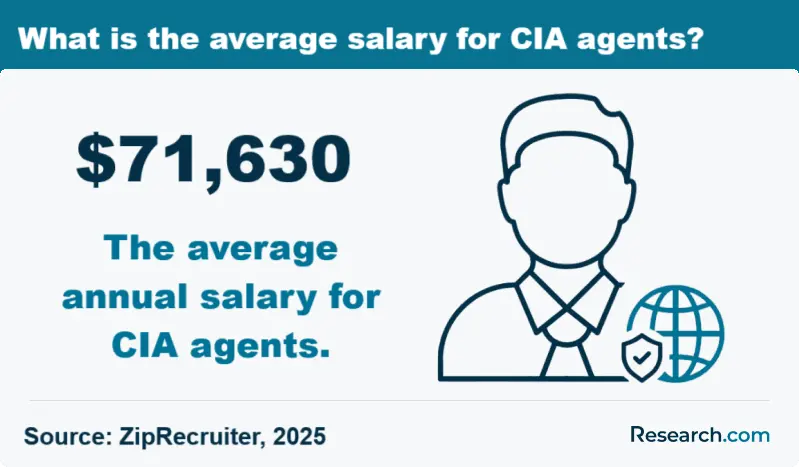
The image below shows how CIA work can be financially rewarding. It reflects base salary only and does not include benefits, incentives, or assignment-based compensation.
What are the drawbacks of being a CIA agent?
CIA work is not the right fit for every candidate. The secrecy, pressure, clearance obligations, travel demands, and operational risk that make the career distinctive can also create personal strain and difficult trade-offs.
- High-stakes pressure: Officers may work with classified information, urgent threats, covert activity, cyber incidents, or counterterrorism issues where errors can carry serious consequences.
- Limited ability to talk about work: Employees often cannot share details of assignments with family or friends, which can feel isolating.
- Long hiring and clearance timeline: Background investigations, polygraphs, psychological evaluations, and clearance reviews can take six months to over a year.
- Unpredictable schedules: Some jobs involve long hours, travel, holidays, weekends, or overseas assignments in unstable or dangerous locations.
- Emotional and ethical difficulty: Intelligence work can involve stressful information, traumatic material, hard choices, and competing mission pressures.
- Restrictions after leaving: Former officers remain bound by classification rules, nondisclosure agreements, and limits on public discussion of past work.
Students who enjoy field-based science but want a less secretive career may want to review what education do you need to be an aquatic biologist, a path focused on aquatic ecosystems, conservation, research, and environmental management.
Annual Leave Accrual for CIA Employees
CIA assignments can be demanding, but employees accrue annual leave based on total federal service. This is one reason applicants should compare the full compensation package rather than focusing only on base salary.
| Years of Service | Hours/Pay Period | Days/Year |
| Less than 3 | 4 | 13 |
| 3 but less than 15 | 6 | 20 |
| 15 or more | 8 | 26 |
What is the difference between the CIA and the FBI?
The CIA and FBI both support U.S. national security, but they do not do the same work. The CIA’s core mission is foreign intelligence. The FBI is a federal law enforcement agency with domestic investigative authority.
| Category | CIA | FBI |
| Main mission | Collects and analyzes foreign intelligence related to national security. | Investigates federal crimes and domestic security threats. |
| Primary jurisdiction | Works mainly outside the United States and does not perform domestic law enforcement. | Works primarily inside the United States, with some international investigative activity. |
| Common roles | Operations officers, analysts, linguists, cybersecurity experts, technical specialists, and security officers. | Special agents, analysts, forensic professionals, cybercrime investigators, and support specialists. |
| Typical work | Foreign intelligence collection, covert operations, national security analysis, and counterintelligence involving foreign threats. | Criminal investigations, arrests, evidence collection, counterterrorism, cybercrime, public corruption, and espionage cases. |
| Training | Some officers complete extensive training associated with The Farm. | Special agents complete a 20-week training program at the FBI Academy in Quantico, Virginia. |
| Public visibility | Often highly classified, with many missions never becoming public. | More visible through investigations, prosecutions, court proceedings, and law enforcement partnerships. |
How can further education drive career advancement for CIA agents?
Further education can strengthen a CIA officer’s promotion prospects when the program builds skills the agency can use. Useful areas may include intelligence analysis, cybersecurity, foreign languages, international relations, law, finance, data analysis, public policy, and regional studies. A degree by itself does not guarantee higher pay or advancement, but relevant education combined with strong performance and clearance suitability can improve competitiveness.
Candidates interested in investigations, justice, and security policy may consider an affordable option such as the cheapest online criminal justice degree. The most important step is to choose a program that fits the role you want, not simply a degree that sounds generally connected to intelligence.
What is the difference between CIA agent salary and FBI agent salary?
CIA and FBI salaries can overlap, especially at mid-career and senior levels, but the pay structures are not identical. CIA compensation is generally connected to intelligence and federal pay systems, with possible locality, language, hardship, danger, overseas, or technical-skill factors. FBI special agents receive law enforcement-specific compensation, including Law Enforcement Availability Pay.
Base Salary Comparison
| Career Stage | CIA Officer Salary | FBI Agent Salary |
| Entry-level | $56,000 - $96,000 per year, often associated with GS-10 to GS-12. | $81,000–$110,000 per year, including Law Enforcement Availability Pay. |
| Mid-career | $90,000 - $130,000+ per year, often associated with GS-13 to GS-14. | $110,000–$140,000 per year. |
| Senior level | $150,000+ per year for some senior intelligence officers and specialized positions. | $150,000+ per year for some senior agents and supervisors. |
| Special pay factors | May include locality pay, language incentives, danger pay, hardship-related compensation, and technical or mission-critical skill considerations. | Includes LEAP, which adds 25% more than base salary because of mandatory overtime requirements, plus locality and possible hazard duty pay. |
Which Pays More: CIA or FBI?
FBI special agents often show higher entry-level compensation because LEAP is built into the role. At mid-career and senior levels, both paths can exceed $150,000. CIA officers in cyber, technical, paramilitary, overseas, or high-risk assignments may narrow or exceed the difference depending on incentives and responsibilities. The better career choice should come from mission fit, not salary alone. The FBI is better aligned with domestic law enforcement and investigations. The CIA is better aligned with foreign intelligence, analysis, cyber intelligence, language work, and overseas-focused national security missions.
General Schedule Pay Scale Reference
The table below shows the Grade 1 to 15 General Schedule salary range effective January 2024. Each grade has 10 steps, so the listed range runs from Step 1 through Step 10.
| Grade | Step 1-10 Salary Range |
| 1 | $21,986 - $27,502 |
| 2 | $24,722 - $31,114 |
| 3 | $26,975 - $35,066 |
| 4 | $30,280 - $39,361 |
| 5 | $33,878 - $44,039 |
| 6 | $37,765 - $49,096 |
| 7 | $41,966 - 54557 |
| 8 | $46,475 - $60,416 |
| 9 | $51,332 - $66,731 |
| 10 | $56,528 - $73,484 |
| 11 | $62,107 - $80,737 |
| 12 | $74,441 - $96,770 |
| 13 | $88,520 - $115,079 |
| 14 | $104,604 - $135,987 |
| 15 | $123,041 - $159,950 |
How can advanced legal studies benefit CIA agents?
Legal training can help intelligence professionals understand oversight rules, compliance obligations, privacy issues, national security authorities, international legal concerns, and ethical boundaries. This can be especially useful for officers working with interagency partners, sensitive operations, counterintelligence, policy, compliance, or risk management.
Candidates or officers who want legal knowledge without necessarily becoming attorneys may compare legal studies programs online. The value is strongest when coursework supports national security law, intelligence oversight, compliance, risk analysis, or another practical mission area.
What legal measures safeguard CIA agents’ careers?
CIA employment is governed by strict requirements involving classified information, confidentiality, federal conduct standards, operational behavior, and ethics. These safeguards protect national security while clarifying what officers may and may not do during service and after leaving government employment.
Legal awareness also matters during career transitions because former officers must continue to follow nondisclosure agreements and classification restrictions. Candidates interested in compliance, legal support, or investigative documentation may explore online ABA approved paralegal programs as a complementary education option.
How can CIA agents manage work-related stress and maintain mental health?
CIA roles can involve secrecy, pressure, irregular schedules, operational risk, ethical complexity, and exposure to difficult information. Officers need practical routines for sleep, fitness, stress management, family communication within security limits, and confidential support when necessary. Counseling resources, peer support, resilience training, and attentive supervision can help reduce burnout and support better judgment.
Some professionals eventually move toward less operational work while keeping their research, writing, and legal-analysis strengths. A paralegal accelerated program may appeal to career changers who want a structured law-adjacent path with more predictable responsibilities.
What are the CIA entry requirements?
CIA candidates generally need U.S. citizenship, strong academic performance, sound judgment, integrity, and the ability to qualify for a security clearance. Many roles require a bachelor’s degree, while cyber, technical, language, and specialized positions may prefer advanced education, certifications, or directly relevant experience. Applicants should also be ready for background investigations, polygraph procedures, psychological evaluation, and strict ethical expectations.
For a more detailed role-by-role breakdown, see Research.com’s guide to CIA entry requirements.
How can continuous learning and networking enhance career progression in intelligence?
Intelligence work changes as technology, foreign policy, cyber threats, data tools, and analytic methods evolve. Officers who keep learning are better positioned for advancement. Development may include maintaining language skills, earning technical certifications, completing graduate study, taking agency training, finding mentors, improving analytical writing, building leadership skills, and developing professional networks within appropriate security boundaries.
For candidates aiming at advanced analysis or leadership, an intelligence masters degree online may provide formal study in intelligence methods, national security strategy, threat assessment, and emerging technologies.
How do you increase your earning potential as a CIA agent or officer?
The best way to improve CIA earning potential is to become more useful to the mission while progressing through grade, step, responsibility, and leadership levels. Credentials can help, but only when they build skills the agency can apply directly.
Practical Ways to Improve CIA Earning Potential
- Develop mission-critical language ability. Proficiency in languages such as Arabic, Mandarin, Russian, or Farsi may support operational and analytical roles and may qualify officers for language-related incentives.
- Build advanced cyber and technical skills. Ethical hacking, cyber exploitation, network defense, encryption, programming, digital forensics, and technical surveillance knowledge can strengthen specialized career prospects.
- Consider difficult assignments when appropriate. Overseas, hardship, high-risk, or mission-critical assignments may provide additional compensation and stronger advancement opportunities.
- Compete for leadership roles. Senior positions such as Senior Intelligence Officer or Operations Chief can move compensation past $150,000+ per year.
- Pursue relevant graduate education. A master’s in international affairs, intelligence studies, cybersecurity, or a political science degree pathway may support advancement when paired with strong performance.
- Earn job-specific certifications. Cybersecurity officers may benefit from credentials such as Certified Information Systems Security Professional, while financial intelligence professionals may consider Certified Fraud Examiner.
- Maintain clearance reliability. Honesty, financial responsibility, sound judgment, and security compliance are essential for remaining eligible for sensitive assignments.
Common Mistakes That Can Hurt CIA Career and Salary Growth
| Mistake | Why It Matters | Better Approach |
| Choosing a degree before checking role requirements. | A program may be interesting but poorly matched to the CIA position you want. | Review current CIA job postings and align your education with a specific role. |
| Assuming salary ranges are firm offers. | Actual pay depends on grade, step, location, experience, hiring decision, and assignment. | Treat salary ranges as planning estimates, not guaranteed compensation. |
| Ignoring clearance suitability. | Background concerns can block a candidacy even when academic credentials are strong. | Be truthful, manage finances responsibly, and learn clearance expectations early. |
| Looking only at base salary. | Benefits, retirement, locality pay, leave, training, and incentives can change total value. | Compare total compensation, not salary alone. |
| Underdeveloping writing and communication skills. | Intelligence work depends on concise analysis, clear briefings, and careful documentation. | Practice analytical writing and oral presentation alongside technical or language skills. |
| Choosing programs based only on prestige or rankings. | A well-known school is not automatically the best fit for intelligence work. | Prioritize accreditation, curriculum, faculty expertise, cost, and career relevance. |
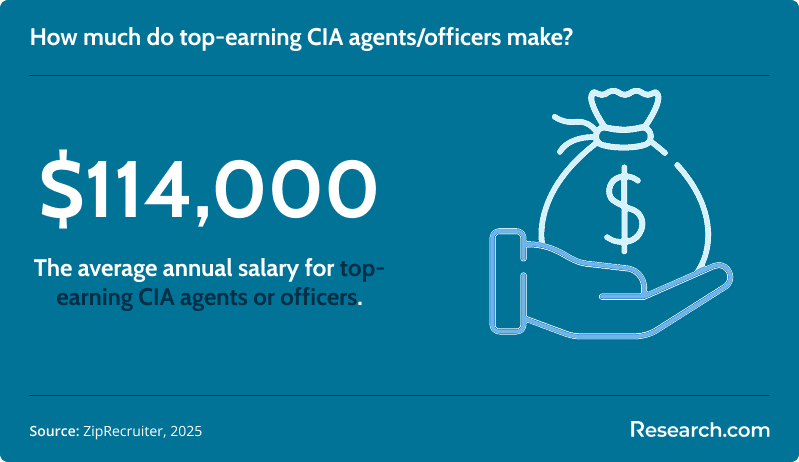
The image below shows the average base salary for top-earning CIA agents or officers.
What retirement benefits do CIA agents receive?
CIA officers are federal employees, so retirement benefits are an important part of total compensation. Eligible employees may participate in defined benefit pension structures and the federal Thrift Savings Plan, which includes matching contributions. Long-term benefits may also include healthcare-related advantages that continue into retirement, depending on eligibility and federal rules.
Because CIA careers can involve secrecy, travel, risk, and unusual work demands, officers should plan financially throughout their service. Some also compare post-agency paths in federal law enforcement, contracting, consulting, and security leadership. Research.com’s overview of criminal justice degree jobs salar can help readers examine earnings across broader justice and public-safety careers.
What are the alternative job options for CIA agents who want to leave the agency?
Former CIA officers often bring transferable strengths in analysis, writing, leadership, risk assessment, cyber operations, security, language, crisis response, and classified-program discipline. The best next step depends on the officer’s agency role, transferable skills, clearance status, and post-employment restrictions.
Common Career Paths After the CIA
| Career Area | Example Roles | Why CIA Experience Transfers |
| Private-sector intelligence and security | Corporate security consultant, risk management specialist, threat intelligence analyst. | Organizations need expertise in geopolitical risk, insider threats, travel security, and crisis management. |
| Cybersecurity | Cybersecurity analyst, threat hunter, penetration testing specialist, security operations leader. | Cyber officers may bring experience in network defense, malicious actor tracking, and classified systems. |
| Federal law enforcement and government | FBI, Secret Service, DHS analyst, State Department Diplomatic Security roles. | National security experience, intelligence tradecraft, and interagency familiarity can be useful in public-sector roles. |
| Consulting and contracting | Strategic intelligence consultant, security advisor, crisis management advisor, defense contractor. | Government contractors and global firms often need people with classified-program experience and national security expertise. |
| Academia and think tanks | Professor, researcher, policy analyst, national security fellow. | Former officers can contribute practical knowledge of intelligence, foreign policy, cybersecurity, and risk. |
| Media and writing | Intelligence analyst for news organizations, author, commentator, journalist. | Some former officers explain global security issues to public audiences while staying within classification limits. |
Former intelligence professionals who want domestic investigative work may also explore careers in criminology, especially if they are interested in crime analysis, investigations, law enforcement support, or policy work.
Here’s What CIA Agents Say About Their Salary
- As a Cyber Operations Officer, I deal with digital threats most people never encounter. The salary reflects the technical demands, mission pressure, and training required. The work is challenging, but the mix of pay, purpose, and professional growth makes the career worthwhile. Danny
- As an Operations Officer, I have to adapt quickly, evaluate risk, and make careful decisions in unpredictable situations. Salary, hazard pay, and advancement matter, but the deeper reward is knowing the work supports national security. Alexis
- As a Multi-Discipline Security Officer, I help protect classified information and support sensitive missions behind the scenes. The benefits and salary are strong, and the responsibility is serious. The secrecy can be hard, but the mission gives the job meaning. Lawrence
References
- Central Intelligence Agency. (n.d.). CIA Careers. CIA.gov.
- Federal Bureau of Investigation. (n.d.). FAQs: How does the FBI differ from the Central Intelligence Agency? FBI.gov.
- National Archives. (2025, March 24). Code of Federal Regulations | Law Enforcement Availability Pay. ECFR.gov.
- ZipRecruiter. (2025, March 27). CIA Agent Salary. ZipRecruiter.com.
Key Insights
- CIA agent salary is more accurately understood as CIA officer compensation, because most CIA employees are officers, analysts, or specialists rather than “agents” in the technical intelligence sense.
- Commonly cited entry-level CIA officer salary ranges fall around $56,000 - $96,000 per year, often tied to role and federal pay grade.
- Specialized roles can have higher or wider salary bands: Cyber Security Officers are listed at $82,000 - $145,000, Technical Operations Officers at $58,000 - $153,000, and Directorate of Operations Language Officers at $66,000 - $109,000.
- Total compensation is broader than base salary. Locality pay, hazard pay, language incentives, healthcare, retirement, leave, training, and tuition-related support can change the real value of the job.
- FBI agents may show stronger starting pay because Law Enforcement Availability Pay adds 25% for mandatory overtime, but senior CIA officers in cyber, technical, overseas, or high-risk roles can also reach $150,000+.
- The strongest applicants choose a specific CIA role, build matching education and experience, develop mission-relevant language or technical skills, and prepare for a long clearance process.
- A CIA career can offer meaningful work and stable federal benefits, but candidates should be realistic about secrecy, stress, limited personal disclosure, possible travel, and strict clearance obligations.
- Former CIA officers may transition into cybersecurity, corporate security, federal law enforcement, defense contracting, consulting, academia, think tanks, risk management, or policy work, depending on their background and restrictions.
Other Things You Should Know About CIA Agent Salary
In 2027, CIA agent salaries generally compare favorably with other federal law enforcement jobs, with average salaries ranging from $56,000 to $123,000 depending on experience and responsibility levels, while other agencies like the FBI range from $50,000 to $120,000.
CIA employees can receive federal benefits such as health insurance, retirement coverage under the Federal Employees Retirement System, paid leave, and Thrift Savings Plan matching. Many jobs also include locality pay or special pay allowances, which can raise total compensation above base salary.


