2027 How To Become an Environmental Biologist? Salary & Career Paths

Co-Founder and Chief Data Scientist
If you want a science career that combines fieldwork, data analysis, conservation, and environmental problem-solving, environmental biology can be a strong fit. The path is not always obvious, however. Students often need to choose between biology, ecology, environmental science, sustainability, and related degrees while also thinking about internships, GIS skills, certifications, graduate school, and long-term salary potential.
This guide explains how to become an environmental biologist, what the work looks like, how long the process usually takes, what skills employers look for, and how to compare education options. It is written for high school students, college students, career changers, and early-career science professionals who want a practical roadmap before committing time and money to this field.
Quick answer: how do you become an environmental biologist?
Most environmental biologists start with a bachelor's degree in environmental biology, biology, ecology, environmental science, or a closely related field. They build experience through fieldwork, internships, lab research, GIS projects, or environmental consulting assignments. A master's degree or Ph.D. is not always required, but it can help with research, leadership, university teaching, specialized consulting, and policy-focused roles.
Key things you should know about becoming an environmental biologist:
- A bachelor's degree in environmental biology, ecology, biology, or environmental science is the usual entry point, while graduate education can improve access to advanced research and management roles.
- Environmental biologists are employed by government agencies, environmental consulting firms, research organizations, conservation groups, nonprofits, and private companies.
- The average salary for an environmental biologist in the U.S. is around $89,403 per year, though pay depends heavily on role, employer type, location, education, and experience.
- What does an environmental biologist do?
- How much do environmental biologists earn for 2027?
- Environmental biology vs. ecology vs. environmental science
- Step-by-step path to becoming an environmental biologist
- How long does it take to enter the field?
- Technical skills environmental biologists need
- Best-paying environmental biology career paths
- How environmental policy affects career growth
- Career advancement options for environmental biologists
- Can you become an environmental biologist through an online degree?Career growth planning
- How urban planning can strengthen an environmental biology career
- Useful certifications for environmental biologists
- Job demand and employment outlook
- Can affordable sustainability graduate programs improve career options?
- Current trends shaping environmental biology
- How to choose an environmental biology degree program
- Should you combine environmental biology with engineering?Program selection checklistTrends to watch
What does an environmental biologist do on a daily basis?
An environmental biologist studies how living organisms interact with their surroundings and how human activity affects ecosystems. The work can be highly varied: one week may involve collecting water samples in the field, while the next may focus on writing a technical report, analyzing GIS data, or helping a client meet environmental regulations.
| Core responsibility | What it usually involves | Why it matters |
| Field research | Collecting soil, water, plant, animal, or habitat data; conducting species surveys; documenting ecosystem conditions | Provides the evidence needed to understand environmental change and recommend action |
| Laboratory work | Testing environmental samples for pollutants, chemical composition, biological indicators, or genetic material | Turns field samples into measurable findings that can support research, compliance, or restoration work |
| Data analysis | Using spreadsheets, statistical tools, GIS platforms, and modeling software to interpret ecological patterns | Helps identify trends, risks, and relationships that are not visible from observation alone |
| Environmental reporting | Preparing research summaries, technical reports, environmental impact assessments, and compliance documentation | Communicates findings to agencies, employers, clients, policymakers, or the public |
| Compliance and planning | Evaluating whether projects meet environmental rules, permit conditions, and sustainability requirements | Helps organizations reduce environmental harm and avoid regulatory problems |
| Collaboration and outreach | Working with scientists, engineers, planners, government staff, community groups, and conservation organizations | Environmental problems are usually interdisciplinary and require coordinated solutions |
Students who enjoy aquatic ecosystems may also compare this career with marine biology career paths. Marine biology is more focused on ocean, coastal, and aquatic environments, while environmental biology usually covers a wider range of terrestrial, freshwater, urban, and managed ecosystems.
How much do environmental biologists earn on average for 2027?
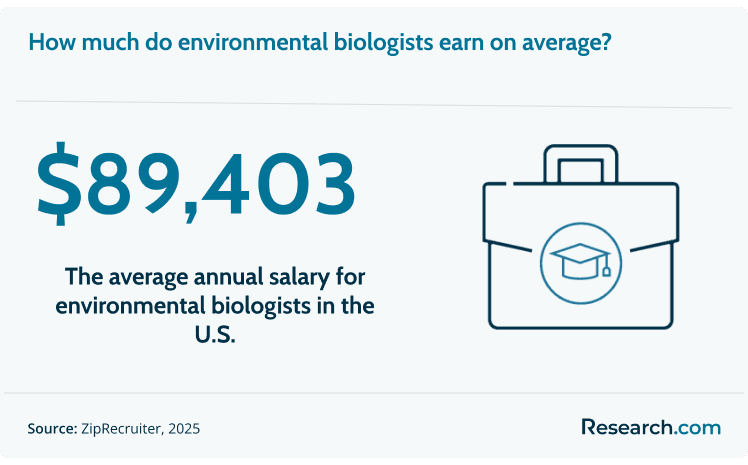
The average salary for an environmental biologist in the United States is approximately $89,403 per year. Actual compensation can be lower or higher depending on the job title, employer, location, years of experience, graduate education, technical specialization, and whether the role is in government, nonprofit work, consulting, research, or private industry.
Private environmental consulting, compliance, biotechnology, energy, and corporate sustainability roles may offer higher pay than some nonprofit or entry-level government positions. Advanced degrees can also matter, especially for research design, policy leadership, university teaching, and senior environmental management roles. If you are comparing education investments broadly, it can be useful to review degree options that may lead to higher-paying careers, but salary should never be the only factor in choosing a science pathway.
| Factor | How it can affect salary |
| Education level | A bachelor's degree may qualify you for entry-level roles; a master's or Ph.D. can support advancement into research, leadership, or specialized positions. |
| Technical skills | GIS, statistical analysis, environmental compliance, laboratory methods, and environmental impact assessment skills can improve competitiveness. |
| Employer type | Consulting firms, private industry, government agencies, universities, nonprofits, and research institutes often have different pay structures. |
| Location | Pay often varies by region because of cost of living, local environmental regulations, industry presence, and public-sector funding. |
| Experience | Senior scientists, project managers, principal consultants, and program leaders usually earn more than field technicians or research assistants. |
How does environmental biology differ from ecology and environmental science?
Environmental biology, ecology, and environmental science overlap, but they are not identical. The best choice depends on whether you want to focus mainly on living organisms, ecosystem relationships, or broader environmental systems that include chemistry, geology, policy, and resource management.
| Field | Main focus | Common coursework | Typical career direction |
| Environmental biology | Living organisms, biodiversity, habitat health, conservation, and biological responses to environmental change | Biology, ecology, conservation biology, genetics, environmental chemistry, field methods | Conservation biology, environmental consulting, wildlife work, restoration, habitat assessment |
| Ecology | Relationships among organisms and ecosystems, including populations, communities, energy flow, and ecological processes | Ecology, statistics, population biology, ecosystem science, evolution, field research | Ecological research, restoration ecology, biodiversity assessment, academic or agency research |
| Environmental science | Environmental problems using multiple scientific disciplines, including biology, chemistry, geology, physics, and policy | Environmental chemistry, geology, hydrology, biology, policy, environmental law, sustainability | Pollution control, environmental assessment, compliance, sustainability planning, resource management |
Environmental biology is a strong fit if you are most interested in organisms and ecosystems. Ecology may be better if you want a research-heavy path centered on ecosystem relationships. Environmental science may be the broader choice if you want to work on pollution, water systems, climate issues, environmental policy, or regulatory compliance. If you are still comparing career requirements across very different public-service fields, reviewing guides such as K9 officer education requirements can also show how training expectations differ by profession.
What is the step-by-step process of becoming an environmental biologist?
The route into environmental biology is flexible, but employers usually look for a combination of science education, field experience, technical ability, and evidence that you can communicate findings clearly. The following sequence can help you plan your path.
- Choose a relevant undergraduate major. Start with environmental biology, biology, ecology, environmental science, conservation biology, wildlife biology, or a closely related degree. If you study online, confirm that the institution is recognized and review regionally accredited online schools before enrolling.
- Prioritize the right coursework. Look for classes in ecology, biology, chemistry, environmental science, statistics, conservation biology, GIS, environmental policy, and field methods.
- Build field and lab experience early. Internships, summer research programs, volunteer field surveys, campus labs, park service opportunities, and conservation projects can make your resume much stronger.
- Learn GIS and data analysis. Many roles require mapping, spatial analysis, statistical interpretation, and clear data visualization. Skills in R, Python, Excel, GIS software, or remote sensing tools can set you apart.
- Create a portfolio of applied work. Save examples of field reports, maps, research posters, lab projects, environmental assessments, or data analyses that show what you can do.
- Consider certification when it matches your role. Certifications may help in environmental consulting, hazardous materials work, GIS, compliance, sustainability, or wildlife biology. They are most useful when aligned with job postings in your target area.
- Apply for entry-level roles. Common starting positions include environmental technician, biological technician, research assistant, field biologist, conservation technician, habitat restoration assistant, or environmental compliance assistant.
- Decide whether graduate school is necessary. A master's degree or Ph.D. may be valuable if you want to lead research, teach at the university level, manage complex programs, or specialize deeply.
- Keep learning as regulations and technology change. Continuing education through short courses, certificates, professional associations, and graduate study can help you stay competitive. You can also compare flexible institutions through a list of online colleges if you need additional coursework while working.
How long does it take to become an environmental biologist?
For most entry-level roles, the shortest common route is a bachelor's degree, which typically takes four years to complete. During that time, students usually study biology, ecology, chemistry, environmental science, statistics, and field methods while gaining experience through internships, research projects, volunteer work, or seasonal positions.
A master's degree can add two to three years. A Ph.D. may require four to six years of graduate study and research. Certifications, specialized field training, hazardous materials training, or GIS credentials can add several months to a few years depending on the role. Some students also consider flexible online degree options, but they should make sure the program includes enough science rigor and practical experience for environmental work.
| Career goal | Typical preparation time | Best next step |
| Field technician or biological technician | Often possible after a bachelor's degree, with relevant field or lab experience | Get internships, seasonal fieldwork, GIS experience, and strong references |
| Environmental biologist or environmental scientist | Usually begins after a bachelor's degree; advancement improves with experience | Build a technical portfolio and target agencies, consulting firms, labs, or conservation groups |
| Project manager or senior consultant | Often requires several years of experience and may benefit from graduate education | Develop compliance, budgeting, client communication, and team leadership skills |
| Research scientist or professor | Often requires a master's degree or Ph.D., depending on role | Choose a research specialization and work with faculty or research mentors early |
Planning early matters. Similar to mapping the steps required for a juvenile probation officer career, environmental biology becomes easier to navigate when you know which education level, field experience, and credentials your target jobs require.
What technical skills are required for environmental biologists?
Environmental biologists need more than general interest in nature. Employers often want candidates who can gather reliable data, analyze it correctly, follow safety and regulatory procedures, and explain conclusions to technical and nontechnical audiences.
| Skill area | Examples | Why employers value it |
| Field methods | Species surveys, habitat assessments, water sampling, soil sampling, vegetation plots, population monitoring | Accurate field data is the foundation of conservation, restoration, and environmental assessment work. |
| Laboratory analysis | Pollutant testing, chemical analysis, genetic markers, spectrophotometry, chromatography | Lab results help confirm environmental conditions and identify possible sources of harm. |
| GIS and spatial analysis | Mapping habitat, tracking species distribution, analyzing land use, interpreting satellite or drone data | Spatial tools help environmental teams understand where risks, resources, and ecological changes are occurring. |
| Statistics and data tools | Excel, R, Python, statistical modeling, trend analysis, data cleaning | Environmental decisions often depend on patterns in complex datasets. |
| Environmental regulations | Impact assessment, permitting, compliance documentation, environmental law basics | Many roles require translating science into decisions that meet legal and agency requirements. |
| Scientific communication | Technical writing, presentations, maps, reports, public explanations | Strong findings have limited value if they are not communicated clearly to decision-makers. |
Analytical and documentation skills are useful across many technical fields. For example, healthcare career guides often discuss how data, certification, and location influence outcomes such as hospice nurse salary; environmental biology uses similar evidence-based thinking, but applies it to ecosystems, compliance, and conservation problems.
What are the best-paying career paths for environmental biologists?
Environmental biology can lead to several related careers. Pay depends on specialization, employer, location, graduate education, and whether the position includes management, consulting, regulatory, or research responsibilities.
| Career path | Average salary stated | What the role usually focuses on |
| Environmental Manager | $112,353 per year | Leads sustainability programs, environmental compliance, conservation initiatives, and organizational environmental strategy. |
| Environmental Biologist | $89,403 per year | Studies ecosystems, conducts field or lab research, evaluates environmental impacts, and supports conservation or compliance work. |
| Environmental Scientist | $78,980 per year | Investigates pollution, conservation, resource management, and environmental risks for agencies, firms, or research organizations. |
| Marine Biologist | $78,004 per year | Researches ocean ecosystems, marine organisms, coastal habitats, and environmental changes affecting aquatic systems. |
| Environmental Consultant | $77,773 per year | Helps clients evaluate environmental risks, meet regulations, complete assessments, and manage sustainability or remediation projects. |
| Wildlife Biologist | $70,600 per year | Studies animal populations, habitat conditions, conservation needs, and species management plans. |
| Ecologist | $66,133 per year | Analyzes ecosystems, biodiversity, species relationships, restoration needs, and ecological change. |
| Biological Technician | $51,430 per year | Supports scientists through field sampling, laboratory work, data entry, specimen handling, and research assistance. |
Professionals aiming for higher-level management roles often strengthen their qualifications with graduate education in sustainability, environmental management, policy, or applied science. Some compare flexible options such as 1-year master's programs online, but it is important to verify program quality, workload, accreditation, and whether the curriculum matches your career target.
The chart below shows the average salary for selected career paths related to environmental biology:
How do environmental policies influence career growth in environmental biology?
Environmental policy affects where environmental biologists are hired and what type of work they do. Regulations related to land use, water quality, endangered species, waste management, environmental impact review, climate adaptation, and conservation can create demand for professionals who understand both science and compliance.
Biologists who can interpret regulations, support permit applications, prepare environmental assessments, and communicate with agencies may have stronger opportunities in consulting, government, renewable energy, infrastructure planning, and corporate sustainability. Policy knowledge can also help professionals move beyond field data collection into project management, environmental review, and advisory roles. If policy-driven sustainability work interests you, explore broader sustainability career opportunities as well.
What are the career advancement opportunities for environmental biologists?
Environmental biologists often advance by combining technical depth with project leadership. Early roles may focus on sampling, field surveys, lab work, and data entry. Mid-career positions may involve writing reports, managing field teams, coordinating permits, designing studies, or interacting with clients and agencies. Senior roles may include principal scientist, program manager, environmental manager, policy advisor, research director, or consultant lead.
| Career stage | Common responsibilities | How to move forward |
| Entry level | Field sampling, lab support, GIS support, data entry, technician work | Document your projects, improve technical tools, and seek varied field experience. |
| Early professional | Report writing, data analysis, environmental assessment support, compliance documentation | Build writing skill, learn regulations, and develop a specialty such as wetlands, wildlife, water, or GIS. |
| Mid-career | Project coordination, client or agency communication, field team supervision, study design | Add management experience, certifications, or graduate coursework if required for your goals. |
| Senior level | Program leadership, policy advising, research direction, consulting strategy, staff management | Develop leadership credibility, publish or present work, and manage complex interdisciplinary projects. |
Some professionals broaden their scope by moving into an environmental scientist career path, which can include wider responsibilities in pollution control, policy, resource management, and multidisciplinary environmental analysis.
Is pursuing an environmental science degree online a viable pathway?
An online environmental science or environmental biology-related degree can be useful for students who need flexibility, especially working adults or career changers. However, online study works best when the program includes strong science coursework, access to lab experiences, field components, research opportunities, and faculty support.
Before enrolling, confirm accreditation, science requirements, lab expectations, transfer policies, internship support, and whether the degree title aligns with your intended jobs. A program such as an online environmental science degree may be a practical route if it combines academic flexibility with hands-on preparation.
| Online degree may work well if... | Be cautious if... |
| You need scheduling flexibility because of work, family, or location. | The program has limited lab work, field training, or research opportunities. |
| You already have access to local internships, conservation work, or field experience. | The school is unclear about accreditation or transfer credit policies. |
| The curriculum includes GIS, data analysis, environmental policy, and applied projects. | The degree is marketed broadly but does not prepare students for science-based roles. |
| You are using the program to complete a degree or add credentials while working. | You assume online coursework alone will replace field experience. |
How can urban planning complement an environmental biology career?
Urban planning can strengthen an environmental biology career because many environmental challenges happen where development, infrastructure, water systems, transportation, housing, and habitat protection intersect. Environmental biologists with planning knowledge can contribute to land-use decisions, green infrastructure, stormwater management, habitat corridors, urban biodiversity, and climate-resilient communities.
This combination is especially useful for professionals interested in environmental impact review, municipal sustainability, watershed planning, restoration in developed areas, and consulting projects involving zoning or infrastructure. If you want to add planning knowledge without leaving your current job, a town planning degree online may help you connect ecological science with urban development decisions.
What are the best certifications for environmental biologists?
Certifications are not always required, but they can help in certain roles. The best certification depends on whether you work in ecology, wildlife, consulting, hazardous materials, GIS, sustainability, or environmental compliance. Before paying for any credential, compare it with job postings in your target area.
| Certification | Provider | Best fit |
| Certified Environmental Scientist (CES) | National Registry of Environmental Professionals (NREP) | Professionals who want to demonstrate knowledge of environmental science, sustainability, and pollution-related work. |
| Certified Ecologist (CE) | Ecological Society of America (ESA) | Ecology-focused professionals working in conservation, habitat restoration, biodiversity, or ecosystem research. |
| Certified Wildlife Biologist (CWB) | The Wildlife Society | Biologists focused on animal populations, wildlife management, and habitat conservation. |
| Certified Environmental Professional (CEP) | Academy of Board Certified Environmental Professionals (ABCEP) | Experienced professionals involved in environmental management, policy, assessment, and regulatory compliance. |
| Hazardous Waste Operations and Emergency Response (HAZWOPER) Certification | OSHA-related training providers | Professionals who may work around hazardous substances, cleanup sites, or emergency response settings. |
| Geographic Information Systems (GIS) Certification | Organizations such as Esri or the GIS Certification Institute (GISCI) | Environmental biologists who use spatial data, mapping, remote sensing, and land-use analysis. |
| LEED Green Associate or LEED AP Certification | U.S. Green Building Council | Professionals interested in sustainability, green infrastructure, environmental planning, or built-environment projects. |
What is the job demand for environmental biologists?
Environmental biologists are part of a broader labor market that includes environmental scientists and specialists. According to the U.S. Bureau of Labor Statistics, the number of environmental scientists and specialists was 84,600 in 2023 and is projected to reach 90,700 by 2033, reflecting a 7% growth rate.
Demand is influenced by environmental regulations, climate-related planning, conservation needs, pollution control, water resource management, renewable energy projects, corporate sustainability work, and environmental consulting. Entry-level candidates can improve their odds by gaining field experience, learning GIS, building technical writing skills, and completing targeted training. Short programs, such as 6-month certificate programs, may be useful when they teach job-relevant skills like GIS, environmental law, sustainability, or compliance.
Job opportunities are commonly found in environmental consulting firms, government agencies, conservation organizations, research institutions, renewable energy, water resource management, and pollution control. The chart below shows employment projection numbers for environmental scientists and specialists, including environmental biologists:
Can affordable advanced degrees in sustainability enhance your career?
An advanced sustainability degree can help environmental biologists who want to move into leadership, climate strategy, corporate sustainability, policy, environmental management, or interdisciplinary planning. The value depends on the curriculum, faculty expertise, employer recognition, cost, and whether the program teaches practical skills such as project management, data analysis, policy interpretation, and sustainability reporting.
Affordability matters because graduate school can affect return on investment. If you are considering this route, compare tuition, fees, financial aid, course format, internship opportunities, and career services. Reviewing options such as the cheapest masters in sustainability can help you identify programs that may expand your skills without creating unnecessary financial pressure.
What are the emerging trends in environmental biology?
Environmental biology is changing as technology, climate risks, land-use pressures, pollution concerns, and sustainability expectations evolve. These trends do not replace core scientific training, but they do affect which skills are most valuable.
- Climate change adaptation and mitigation: Environmental biologists are studying ecosystem resilience, habitat shifts, restoration strategies, carbon storage, and conservation approaches that respond to changing climate conditions.
- Remote sensing and GIS: Satellite imagery, drones, mapping platforms, and spatial analysis tools are increasingly important for monitoring habitats, land use, species distribution, and environmental change.
- AI-assisted analysis: Machine learning and automated image or acoustic analysis can support species identification, habitat monitoring, and large-scale environmental data review, though scientific judgment remains essential.
- Biotechnology in conservation: Genetic tools, including CRISPR-related research, are being explored for biodiversity protection, endangered species work, and ecosystem restoration.
- Microplastics and pollution research: Concerns about microplastics in water, soil, oceans, and food systems are expanding research and monitoring needs.
- Urban ecology and green infrastructure: Cities are increasing interest in green roofs, urban forests, stormwater systems, habitat connectivity, and biodiversity-friendly planning.
- Ecological restoration and rewilding: Restoration of degraded ecosystems and reintroduction of native species continue to shape conservation practice.
- Sustainable agriculture and soil health: Regenerative farming, soil microbiomes, pest management, and agricultural runoff are important areas for applied environmental biology.
Which factors should you consider when choosing an environmental biology degree program?
The best environmental biology program is not simply the cheapest, highest-ranked, or most convenient. It should match your career goal, provide rigorous science training, and give you opportunities to practice field, lab, GIS, and research skills.
| Question to ask | Why it matters |
| Is the institution properly accredited? | Accreditation affects transfer credit, graduate school eligibility, employer confidence, and financial aid access. |
| Does the curriculum include biology, ecology, chemistry, statistics, GIS, and field methods? | Environmental biology roles require a strong scientific and technical foundation. |
| Are fieldwork, lab work, or internships built into the program? | Employers often value applied experience as much as classroom knowledge. |
| Do faculty members have expertise in your area of interest? | Faculty specialization can affect research opportunities, mentorship, and graduate school preparation. |
| Does the program support career placement? | Internship connections, agency partnerships, alumni networks, and career advising can improve your transition into work. |
| What are the total costs beyond tuition? | Fees, travel, lab costs, field equipment, software, and lost work time can affect affordability. |
| Will online or hybrid coursework meet your goals? | Online flexibility can be helpful, but science careers still require hands-on preparation. |
If you need a flexible format, compare online environmental science degree programs carefully. Focus on accreditation, science rigor, field experience, faculty support, and whether the program can realistically prepare you for your target role.
Common mistakes to avoid when planning this career
| Mistake | Better approach |
| Choosing a program only because it is inexpensive or convenient | Compare cost with accreditation, science depth, fieldwork, lab access, and career outcomes. |
| Assuming any environmental degree leads to the same jobs | Match the degree title and coursework to your preferred roles in biology, ecology, policy, consulting, or sustainability. |
| Waiting until senior year to get experience | Start internships, volunteer fieldwork, research projects, or seasonal positions as early as possible. |
| Ignoring GIS and data skills | Build mapping, statistics, and data visualization skills before graduation. |
| Assuming salary outcomes are guaranteed | Use salary data as a planning tool, but consider location, employer type, experience, and specialization. |
| Overlooking graduate school requirements | If you want research, teaching, or senior scientific roles, check whether a master's degree or Ph.D. is expected. |
Is combining environmental biology with engineering a strategic advantage?
Combining environmental biology with engineering can be valuable for students who want to work on applied environmental problems such as water treatment, pollution control, habitat restoration design, renewable energy impacts, ecological infrastructure, or remediation. Biology helps you understand ecosystems; engineering helps you design, test, and implement technical solutions.
This combination is especially useful in consulting, environmental remediation, water resources, infrastructure planning, and sustainability projects that require collaboration between scientists and engineers. If you want to add technical design and systems knowledge to your biology background, comparing options such as the cheapest online environmental engineering degree may help you evaluate a cost-conscious interdisciplinary route.
Is becoming an environmental biologist worth it?
Environmental biology can be worth it if you enjoy science, fieldwork, environmental problem-solving, and long-term learning. It is a particularly good fit for people who are comfortable working outdoors, analyzing data, writing technical reports, and collaborating with professionals from different fields.
It may be less ideal if you want a career with highly predictable office hours, immediate high pay after graduation, or minimal science coursework. Entry-level work can involve physically demanding field tasks, seasonal assignments, travel, repetitive sampling, and detailed documentation. The strongest candidates usually combine passion for conservation with practical skills that employers can use right away.
| Choose environmental biology if you... | Consider another path if you... |
| Enjoy biology, ecology, conservation, and applied science | Prefer work that is unrelated to lab, field, or data tasks |
| Are willing to build technical skills such as GIS and statistics | Want to avoid quantitative analysis or technical reporting |
| Can handle outdoor conditions and field schedules when required | Need a highly predictable indoor-only work environment |
| Want to contribute to conservation, restoration, compliance, or sustainability | Are mainly motivated by quick salary growth without graduate study or specialization |
Key Insights
- Environmental biology is a science-based career focused on organisms, ecosystems, conservation, and environmental change. It overlaps with ecology and environmental science but has a stronger biological emphasis.
- A bachelor's degree is the standard starting point for many entry-level roles, while a master's degree or Ph.D. can support research, leadership, teaching, and specialized consulting careers.
- The average salary for environmental biologists is around $89,403 per year, but pay varies by job title, employer, experience, location, education, and technical specialization.
- Technical skills matter. GIS, field methods, laboratory analysis, statistics, environmental compliance, and scientific writing can significantly improve job readiness.
- Employment for environmental scientists and specialists was 84,600 in 2023 and is projected to reach 90,700 by 2033, reflecting a 7% growth rate.
- Online and hybrid degrees can be viable, but only if they are accredited, academically rigorous, and supported by fieldwork, labs, internships, or applied projects.
- The best program is the one that fits your target career, not simply the one with the lowest tuition or most convenient schedule.
- Emerging areas such as climate adaptation, GIS, AI-assisted monitoring, biotechnology, microplastics research, urban ecology, and ecological restoration are shaping future opportunities in the field.
Resources:
- Glassdoor. (2025). Salary: Environmental Consultant in the United States. https://www.glassdoor.com
- Indeed Editorial Team. (2025). What Is an Environmental Scientist? And How To Become One. https://www.indeed.com
- U.S. Bureau of Labor Statistics. (2024). Occupational Outlook Handbook: Environmental Scientists and Specialists. https://www.bls.gov
- ZipRecruiter. (2025). Salary: Environmental Biologist (Mar, 2025) United States. https://www.ziprecruiter.com
Other Things You Should Know About How To Become an Environmental Biologist
Environmental biologists are hired by the U.S. Environmental Protection Agency, the U.S. Fish and Wildlife Service, the National Park Service, and state departments of natural resources. These employers usually require a bachelor’s degree in biology, ecology, or environmental science, and many research roles prefer a master’s degree.
In 2027, obtaining certifications like the Certified Environmental Professional (CEP) or specific GIS certifications can enhance your employability as an environmental biologist. These credentials demonstrate expertise in critical tools and methodologies important for the field.
To excel as an environmental biologist in 2027, crucial skills include data analysis, field research, GIS proficiency, and knowledge of biodiversity conservation. Strong communication and problem-solving abilities are vital for addressing ecological challenges and collaborating with interdisciplinary teams.