2027 How To Become an Environmental Scientist

Co-Founder and Chief Data Scientist
Choosing a career in environmental science means preparing for work that connects field research, data analysis, regulation, public health, and sustainability. Environmental scientists help identify environmental risks, measure pollution, evaluate land and water conditions, and recommend practical solutions to agencies, companies, communities, and policymakers.
This guide explains how to become an environmental scientist, what the job involves, how long the path usually takes, which degrees and certifications can help, where jobs are concentrated, and how to compare career options. It is written for students considering an environmental science major, career changers exploring sustainability-related roles, and early-career professionals deciding whether additional credentials are worth the investment.
Quick Answer: How Do You Become an Environmental Scientist?
Most environmental scientists start with a bachelor's degree in environmental science or a related discipline such as biology, chemistry, geology, ecology, or sustainability. They then build practical experience through internships, fieldwork, research projects, or entry-level environmental roles. Many professionals later add certifications, GIS training, compliance knowledge, or a graduate degree to qualify for specialized or senior positions.
- Environmental scientists use scientific methods to protect ecosystems, natural resources, and human health.
- The states with the highest employment levels for environmental scientists are California (12,590), Florida (5,210), Washington (4,100), North Carolina (3,940), and New York (3,680).
- The typical preparation timeline is four to six years, depending on degree length and experience requirements.
- 81% of environmental scientists earned a bachelor's degree.
- The employment of environmental scientists is projected to grow by 7% from 2033 to 2033.
- The average annual salary for environmental scientists in the United States is $86,710, and the median annual salary is $78,980.
- What does an environmental scientist do?
- How do you become an environmental scientist?
- How long does it take to become an environmental scientist?
- How can students find environmental science internships?
- What skills do environmental scientists need?
- Which certifications are useful for environmental scientists?
- How can you manage the cost of environmental science education?
- What trends are changing environmental science careers?
- Can an online associate degree help you start in environmental science?
- How can environmental scientists move into higher-level roles?
- What continuing education options are useful for environmental scientists?
- What career paths can environmental science graduates pursue?
- What is the job outlook for environmental scientists?
- How much do environmental scientists earn?
- What challenges do environmental scientists face?
- How can advanced degrees affect long-term career options?
- How can networking support career growth in environmental science?
- Are online degrees credible for environmental science careers?
- Which undergraduate programs can give environmental science students a strong start?
- How do environmental scientists influence public policy?
- Key insights for future environmental scientists
What does an environmental scientist do?
An environmental scientist studies how natural systems are affected by pollution, development, resource use, climate conditions, and human activity. The work often combines outdoor sampling, laboratory testing, data interpretation, regulatory review, technical writing, and communication with clients or public agencies.
In practice, environmental scientists may test soil near a redevelopment site, monitor water quality, assess air pollution, evaluate habitat conditions, prepare environmental impact reports, help organizations comply with regulations, or recommend ways to reduce environmental harm. The role is scientific, but it is also applied: the goal is to turn evidence into decisions that protect people, land, water, air, and wildlife.
Common responsibilities include:
- Investigating environmental conditions: Environmental scientists examine issues such as contamination, climate effects, conservation needs, land use, waste management, and resource protection by collecting samples and reviewing scientific data.
- Identifying risks and causes: They analyze soil, water, air, and biological information to determine where environmental problems originate and how those problems may affect communities or ecosystems.
- Recommending practical solutions: Their findings may support pollution controls, remediation plans, sustainability strategies, conservation programs, or policy recommendations.
- Monitoring environmental change: Scientists track conditions over time to evaluate regulatory compliance, measure the success of environmental programs, and assess the effects of natural events or human activities.
- Explaining technical findings: They prepare reports, presentations, maps, publications, and briefings that help agencies, employers, clients, and the public understand scientific results.
Based on 2024 United States Bureau of Labor Statistics (BLS) data, the states employing the largest numbers of environmental scientists are California (12,590), Florida (5,210), Washington (4,100), North Carolina (3,940), and New York (3,680).
How do you become an environmental scientist?
The most common route is to complete a relevant bachelor's degree, gain hands-on experience, and build technical skills that match the type of environmental work you want to do. Some roles are accessible with a bachelor's degree and field experience, while research-heavy, policy-focused, or leadership roles may favor candidates with graduate education or specialized credentials.
- Choose a relevant undergraduate major. Environmental science is the most direct option, but employers may also consider degrees in biology, chemistry, geology, ecology, environmental studies, sustainability, or related fields. Coursework in ecology, statistics, chemistry, environmental policy, geology, hydrology, and data analysis can be especially useful. Environmental scientist is also among the career options connected to sustainability management training.
- Build field and laboratory experience early. Internships, faculty research, volunteer monitoring programs, conservation projects, and entry-level technician roles help you learn how to collect samples, document conditions, use equipment, and follow safety procedures.
- Develop technical tools employers recognize. GIS, remote sensing, environmental sampling, technical writing, regulatory compliance, environmental modeling, and data analysis are frequently valuable. Students who want stronger analytics preparation may also compare online data science programs.
- Learn environmental regulations and compliance basics. Many jobs involve permitting, reporting, audits, site assessments, or remediation support. Understanding how science connects to regulation can make a candidate more useful in consulting, government, and corporate roles.
- Consider certification when it fits your target role. Credentials such as Certified Environmental Professional (CEP), LEED Green Associate, GISP, or HAZWOPER-related training can strengthen a resume, but the best choice depends on whether you want to work in consulting, GIS, green building, compliance, climate, or environmental health and safety.
- Use graduate school strategically, not automatically. A master's or doctoral degree may help if you want to specialize in climate science, environmental policy, restoration ecology, environmental law, research, or teaching. It is not required for every environmental scientist role.
- Apply broadly across sectors. Environmental scientists work in government agencies, consulting firms, nonprofits, utilities, energy companies, engineering firms, research institutions, and sustainability departments. Tailor your resume to show fieldwork, data skills, regulatory knowledge, and communication ability.
If your strongest science interest is biochemistry, you can begin with a biochemistry-focused online degree pathway and later add environmental science electives, certifications, fieldwork, or a specialized master's degree.
Environmental Scientist Preparation Path
| Step | What to Focus On | Why It Matters |
| Bachelor's degree | Environmental science, biology, chemistry, geology, ecology, sustainability, or a related field | Provides the scientific foundation most employers expect |
| Internship or fieldwork | Sampling, lab methods, site documentation, monitoring, research support | Turns classroom knowledge into job-ready experience |
| Technical skill building | GIS, data analysis, remote sensing, compliance, technical reports | Helps candidates qualify for more specialized and better-aligned roles |
| Certification | CEP, GISP, LEED Green Associate, CEA, CC-P, or related credentials | Signals role-specific expertise when matched to employer needs |
| Graduate study | Research, policy, climate, restoration, law, management, or advanced analytics | Can support advancement, specialization, or leadership opportunities |
How long does it take to become an environmental scientist?
Most people need four to six years to prepare for an environmental scientist role. That timeline usually includes a bachelor's degree completed in three to four years, followed by one to two years of internships, research, fieldwork, or entry-level experience. Some students move directly into assistant or technician-level environmental roles after graduation, while others need more experience before qualifying for scientist-level positions.
A master's degree can add one to two years of specialized study. It may be useful for roles in research, policy analysis, environmental consulting leadership, climate adaptation, ecological restoration, or advanced technical work, but it is not mandatory for every environmental science career. Students comparing graduate options may also review online master's degree formats if flexibility is important.
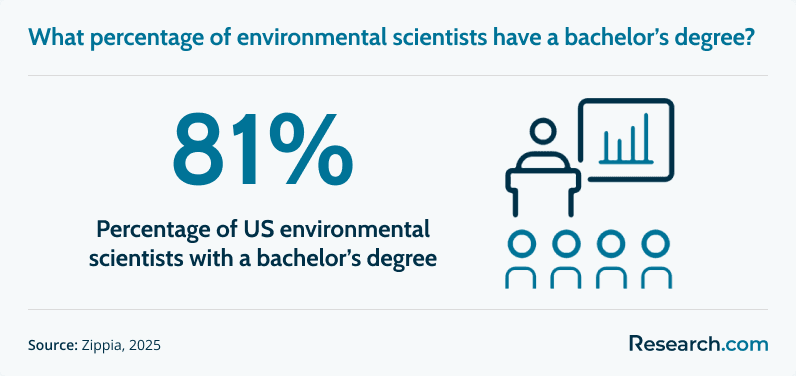
According to 2025 data from Zippia, 81% of environmental scientists earned a bachelor's degree, 12% have a master's degree, 5% earned an associate degree, and 1% have a doctorate degree.
| Education Level | Share of Environmental Scientists | How to Interpret It |
| Bachelor's degree | 81% | The bachelor's degree is the dominant entry credential in the field. |
| Master's degree | 12% | Graduate education may be useful for specialization or advancement. |
| Associate degree | 5% | An associate degree may support entry-level technical work or transfer into a bachelor's program. |
| Doctorate degree | 1% | A doctorate is usually most relevant for advanced research or academic paths. |
How can students find environmental science internships?
Internships matter because they show employers that you can work safely in the field, collect reliable data, follow protocols, and communicate results. Finding one requires more than submitting applications to large job boards. Students should use campus resources, faculty contacts, local agencies, nonprofits, consulting firms, and direct outreach.
- Search job boards with specific keywords. Use terms such as environmental science intern, environmental technician intern, GIS intern, sustainability intern, conservation intern, water quality intern, environmental compliance intern, and field technician intern.
- Use your college career center. Career offices can help with resume formatting, interview preparation, employer contacts, and internship listings. This is especially useful for students who have limited professional experience.
- Ask faculty and lab supervisors. Professors often know about research assistant roles, field projects, local conservation groups, agency partnerships, and alumni working in environmental careers.
- Contact organizations directly. If a consulting firm, watershed group, city department, state agency, or nonprofit does work that interests you, send a concise email explaining your background, availability, and the type of experience you want.
- Look beyond paid internships. Volunteer monitoring programs, habitat restoration days, university research projects, and citizen science programs can help you build credible experience if paid openings are limited.
- Consider remote or international options carefully. Remote internships may be useful for GIS, data analysis, policy research, or sustainability reporting. International experiences can broaden perspective, but students should evaluate cost, supervision, safety, and academic credit before committing.
As with comparing an LPN training cost, students should look beyond the headline opportunity and consider total expenses, travel requirements, schedule flexibility, supervision quality, and whether the internship builds skills employers actually request.
What to Look for in an Environmental Science Internship
| Internship Feature | Why It Helps | Questions to Ask |
| Fieldwork exposure | Builds sampling, documentation, safety, and observation skills | Will I collect samples, visit sites, or assist with monitoring? |
| Technical tools | Strengthens employability in GIS, databases, lab methods, or reporting | Which software, instruments, or methods will I use? |
| Mentorship | Helps students understand professional standards and career paths | Who will supervise me, and how often will I receive feedback? |
| Deliverables | Creates portfolio material for future applications | Will I contribute to reports, maps, datasets, presentations, or research summaries? |
| Safety training | Prepares students for field and lab conditions | What safety procedures or training are required before field assignments? |
What skills do environmental scientists need?
Environmental scientists need a mix of scientific judgment, technical ability, field readiness, and communication skill. Employers often look for people who can collect dependable data, interpret it correctly, explain findings clearly, and connect science to regulatory or operational decisions.
- Analytical thinking: Environmental problems are rarely simple. Scientists must evaluate patterns, compare evidence, identify uncertainty, and recommend reasonable next steps.
- Research and data analysis: Field studies, lab tests, surveys, monitoring programs, and statistical analysis help scientists draw defensible conclusions.
- Laboratory and technical methods: Many roles require familiarity with sampling equipment, environmental monitoring tools, lab protocols, and quality control procedures.
- GIS and remote sensing: Spatial analysis helps professionals map contamination, model habitat change, assess land use, and communicate environmental conditions visually.
- Regulatory and compliance knowledge: Understanding environmental laws, reporting requirements, permits, and agency expectations is essential in consulting, government, and industry roles.
- Technical writing and presentation: Reports must be accurate, organized, and understandable to audiences that may include scientists, attorneys, business leaders, regulators, and community members.
- Problem-solving: Environmental scientists must recommend solutions that are scientifically sound, financially realistic, and practical for the site or organization involved.
- Field observation: Site assessments require attention to terrain, weather, safety, sampling conditions, habitat features, and evidence that may not appear in a dataset.
- Project coordination: Many assignments involve schedules, budgets, permits, vendors, field crews, clients, and reporting deadlines. Students more interested in management-heavy roles can compare affordable online project management degree options.
- Collaboration: Environmental work often includes engineers, planners, agency staff, community representatives, attorneys, executives, and other scientists.
A Zippia report identifies the most common skills appearing on environmental scientist resumes in the United States as environmental compliance (5.3%), data collection (5.2%), GIS (5.1%), OSHA (5%), technical reports (4.8%), oversight (4.7%), and HAZWOPER (4.3%).
The chart below shows the US states that furnish the highest average annual salaries to environmental scientists.
Which certifications are useful for environmental scientists?
Certifications are not a substitute for scientific training or field experience, but they can strengthen a resume when they match the role. A compliance-focused consultant, for example, may benefit from different credentials than a GIS analyst, sustainability specialist, or climate professional.
- Certified Environmental Professional (CEP): The CEP certification is designed for experienced environmental professionals and signals broad knowledge of environmental practice.
- Registered Environmental Manager (REM): This National Registry of Environmental Professionals credential is intended for professionals involved in environmental health, safety, and management responsibilities. Candidates need a bachelor's degree and at least five years of experience.
- Geographic Information Systems Professional (GISP): This credential can be valuable for professionals whose work depends heavily on mapping, spatial analysis, and environmental data visualization.
- Certified Environmental Auditor (CEA): This option is most relevant for professionals who conduct compliance audits or review environmental management systems.
- LEED Green Associate: This credential demonstrates knowledge of green building, sustainable design, and energy-conscious development practices.
- Certified Climate Change Professional (CC-P): Offered by the Association of Climate Change Officers, this certification focuses on climate adaptation and mitigation knowledge.
- Associate Environmental Professional (AEP): This entry-level credential may help recent graduates demonstrate foundational knowledge of environmental regulations and professional practice.
- Sustainability Excellence Associate (SEA): Offered by the International Society of Sustainability Professionals, this credential introduces core sustainability concepts for people entering the field.
| Certification | Best Fit | When It May Be Worth Considering |
| CEP | Experienced environmental professionals | When you want to demonstrate broad professional competence |
| REM | Environmental health, safety, and management roles | When your work includes oversight of environmental programs |
| GISP | GIS analysts and mapping-focused environmental roles | When spatial data is central to your job target |
| CEA | Compliance auditing and environmental management | When you want to conduct or lead environmental audits |
| LEED Green Associate | Green building, urban planning, sustainability, construction-adjacent roles | When your work connects to buildings, design, or sustainable development |
| CC-P | Climate change, adaptation, mitigation, resilience planning | When you want to focus on climate-related work |
| AEP | Recent graduates and early-career professionals | When you want an entry-level credential to support job applications |
| SEA | New sustainability professionals | When your target roles emphasize organizational sustainability |
How can you manage the cost of environmental science education?
The cost of becoming an environmental scientist depends on school type, residency status, transfer credits, program length, field course fees, lab requirements, commuting, housing, books, and whether you study online or on campus. Tuition is only one part of the total cost, so students should compare the full price of attendance and the likely value of the program's field experiences, faculty support, and employer connections.
Start by completing financial aid forms, comparing scholarships and grants, asking about paid research or campus jobs, and checking whether prior credits can transfer. Students considering online programs should verify accreditation, lab or field requirements, internship support, and eligibility for federal aid. Reviewing lower-cost online colleges that accept FAFSA can be useful for students who need flexibility and want to reduce borrowing.
Ways to Reduce Education Costs
| Cost Strategy | How It Helps | What to Confirm |
| Transfer credits | Can shorten time to completion | Whether the environmental science department accepts the credits toward major requirements |
| Community college start | May lower the cost of general education and introductory science courses | Whether courses transfer cleanly into a bachelor's program |
| Online or hybrid study | May reduce commuting or relocation costs | How labs, fieldwork, and internships are handled |
| Paid internships or research | Builds experience while helping cover expenses | Whether the role provides relevant environmental science skills |
| Scholarships and grants | Reduce out-of-pocket cost and borrowing | Application deadlines, renewal rules, and eligibility requirements |
What trends are changing environmental science careers?
Environmental science careers are being shaped by stronger use of data, mapping tools, environmental compliance systems, climate-related planning, and sustainability reporting. Employers increasingly value professionals who can combine scientific understanding with technical tools and the ability to communicate risk clearly.
GIS, remote sensing, environmental modeling, and data analytics continue to expand how scientists monitor change, map risk, and evaluate interventions. Renewable energy development, sustainable infrastructure, corporate sustainability programs, and public-sector resilience planning are also creating specialized work for professionals who understand both science and implementation. Students who need a flexible undergraduate route can compare accessible bachelor degree options, but they should still prioritize programs with strong science coursework and hands-on learning.
Current Career Trends to Watch
- More data-driven environmental work: Employers increasingly expect comfort with datasets, mapping, monitoring platforms, and analytical software.
- Greater attention to climate adaptation: Public agencies and private employers need professionals who can assess vulnerability and support resilience planning.
- Interdisciplinary hiring: Environmental scientists often work with engineers, planners, attorneys, health professionals, and business teams.
- Compliance and reporting demand: Organizations need help interpreting requirements, preparing documentation, and managing environmental risk.
- Technology-supported fieldwork: Drones, remote sensing, mobile data collection, and advanced GIS tools are changing how environmental information is gathered and visualized.
Can an online associate degree help you start in environmental science?
An associate degree can be a practical starting point for students who want a lower-cost introduction to science coursework or who plan to transfer into a bachelor's program. It may also support entry-level technician, lab assistant, field assistant, or conservation-related roles, depending on local employer requirements.
However, students should be realistic: many environmental scientist positions expect at least a bachelor's degree. If you begin with an associate degree, choose courses that transfer into a four-year environmental science, biology, geology, or chemistry program. Flexible online associate degree options can help students manage work and school, but science students must check how labs and field requirements are completed.
When an Associate Degree Makes Sense
- You want to reduce the cost of your first two years of college.
- You plan to transfer into a bachelor's program with a clear credit pathway.
- You want exposure to biology, chemistry, geology, statistics, or environmental studies before committing to a four-year degree.
- You are targeting entry-level support roles while continuing your education.
When You May Need a Bachelor's Degree First
- You want to apply directly for environmental scientist or specialist roles.
- Your target employers require advanced lab, field, GIS, or regulatory coursework.
- You want stronger access to internships, research projects, or federal and state agency pathways.
- You plan to pursue graduate school later.
How can environmental scientists move into higher-level roles?
Career advancement usually comes from combining experience, specialized technical skills, stronger communication, and evidence that you can manage projects or advise decision makers. Environmental scientists who want to move beyond entry-level roles should identify whether they are aiming for technical expertise, project management, policy influence, research leadership, or sustainability strategy.
- Build a specialization. Focus areas may include GIS, remediation, water quality, air quality, climate resilience, environmental health and safety, ecological restoration, permitting, or sustainability reporting.
- Document project results. Keep a record of reports, maps, datasets, fieldwork, compliance support, presentations, or research contributions you can discuss in interviews.
- Add certifications selectively. Choose credentials that align with your target role instead of collecting unrelated certifications.
- Improve writing and client communication. Senior environmental roles often require explaining complex findings to nontechnical audiences.
- Consider graduate education when it supports a defined goal. Flexible options, including accelerated master's programs, may help some professionals move into specialized or leadership positions.
- Seek mentorship and cross-functional projects. Working with engineers, planners, legal teams, public officials, or community groups can broaden your professional range.
What continuing education options are useful for environmental scientists?
Continuing education helps environmental scientists keep pace with new tools, regulations, methods, and employer expectations. The most useful options are usually targeted: a GIS workshop, a regulatory update, a sampling-method course, a technical writing seminar, a climate adaptation certificate, or training tied to workplace safety and compliance.
Professionals can look to universities, professional associations, government agencies, software providers, environmental conferences, and accredited online programs. If you are comparing enrollment options, resources on accredited online colleges with no application fee may help reduce application friction, but program quality and relevance should remain the priority.
High-Value Continuing Education Topics
- GIS, remote sensing, and spatial analysis
- Environmental compliance and regulatory updates
- Technical report writing
- Water, soil, and air sampling methods
- Environmental impact assessment
- Climate adaptation and resilience planning
- Environmental health and safety
- Data analysis and visualization
What career paths can environmental science graduates pursue?
Environmental science graduates can work in many roles depending on their coursework, field experience, technical skills, and preferred work environment. Some jobs are science-heavy, while others focus more on policy, communication, consulting, education, sustainability, or data analysis. Like a project manager career path, advancement may depend on experience, specialization, and the ability to coordinate complex projects.
- Environmental scientist: Studies environmental problems, collects and analyzes data, prepares reports, and recommends solutions related to pollution, resource use, ecosystems, or public health.
- Environmental consultant: Advises organizations on site assessments, compliance, environmental impact, permitting, remediation, and sustainability practices.
- Environmental engineer: Designs systems or infrastructure solutions for issues such as waste treatment, pollution control, water management, and sustainable development.
- Wildlife biologist: Studies animal populations, habitats, behavior, and conservation needs to support wildlife management decisions.
- Sustainability specialist: Helps organizations reduce environmental impact through energy efficiency, waste reduction, responsible sourcing, reporting, and resource management. Students interested in business-focused sustainability roles can explore MBA in sustainability degree programs.
- Environmental policy analyst: Reviews scientific evidence, evaluates policy options, and supports environmental regulation or advocacy work in government, nonprofit, or research settings.
- Natural resource manager: Oversees sustainable use of land, water, forests, minerals, or wildlife resources while balancing conservation and human needs.
- Marine biologist: Studies marine organisms, ecosystems, ocean conditions, and human impacts on coastal and ocean environments.
- Environmental educator: Teaches communities, students, organizations, or the public about environmental issues and responsible action.
- GIS specialist: Uses mapping and spatial data to support conservation, land planning, environmental monitoring, risk assessment, and resource management.
Career Path Comparison
| Career Path | Best For People Who Like | Useful Skills |
| Environmental scientist | Fieldwork, research, applied science, problem-solving | Sampling, data analysis, technical writing, compliance |
| Environmental consultant | Client work, site assessments, varied projects | Regulations, reports, project coordination, field methods |
| GIS specialist | Mapping, spatial data, technology | GIS software, remote sensing, visualization, databases |
| Sustainability specialist | Business impact, resource efficiency, organizational change | Reporting, metrics, communication, strategy |
| Policy analyst | Research, law, public decision-making | Policy analysis, writing, evidence review, stakeholder communication |
| Wildlife or marine biologist | Ecology, species, habitats, conservation | Field observation, population studies, research design |
What is the job outlook for environmental scientists?
Students often ask, what can an environmental science degree do for employment prospects? According to the BLS, the employment of environmental scientists is projected to grow by 7% from 2033 to 2033, faster than the national average of 4%. This would increase employment from 84,600 in 2023 to about 90,700 by 2033.
Across the same period, aspiring and current professionals can expect around 8,500 job openings for environmental scientists and closely related roles each year. Indeed currently lists over 7,000 environmental scientist jobs in the country, not including every related job title in consulting, GIS, sustainability, policy, and environmental health and safety.
Job outlook can vary by region, industry, specialization, and public or private investment. Candidates who combine scientific training with GIS, compliance, data analysis, fieldwork, and strong writing are generally better positioned than those with classroom experience alone.
How much do environmental scientists earn?
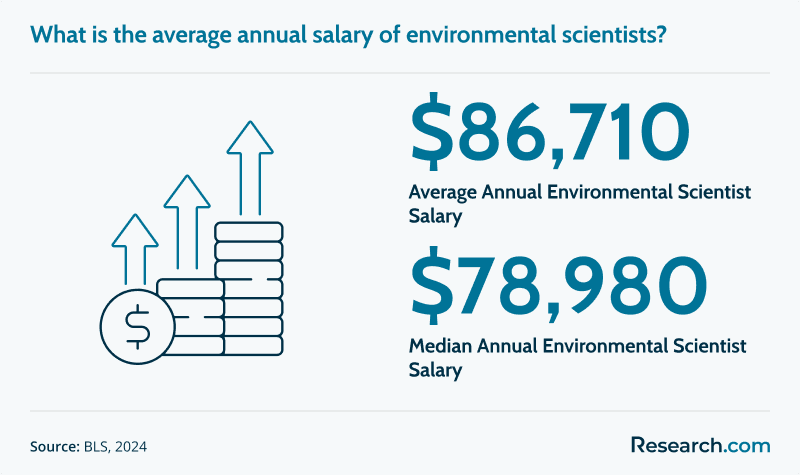
According to the BLS, environmental scientists in the United States have an average annual salary of $86,710 and a median annual salary of $78,980. These figures are higher than the collective median annual salary of all jobs in the country ($48,060) and are within range of the average speech pathologist salary.
Pay can differ substantially by location, employer type, specialization, experience, and whether the role involves consulting, energy, compliance, data analysis, or management responsibilities. The states with the highest average annual salaries for environmental scientists are the District of Columbia ($115,910), Connecticut ($109,710), Massachusetts ($102,700), California ($102,350), and Colorado ($102,250).
The highest-paying sectors shown in the chart below are wholesale trade agents and brokers ($193,120), merchant wholesalers of nondurable goods ($175,740), petroleum and coal products manufacturing companies ($143,450), natural gas distribution companies ($131,650), and pipeline transportation of crude oil ($128,130). These industries may offer higher compensation, but candidates should also consider job duties, environmental impact, travel, safety requirements, and long-term career fit.
Salary Factors to Compare Before Choosing a Job
| Factor | Why It Affects Pay | What to Evaluate |
| Location | Some states and metro areas pay more because of demand, cost of living, and industry mix | Compare salary with housing, transportation, and taxes |
| Industry | Energy, manufacturing, consulting, government, and nonprofit roles can differ widely | Look at responsibilities, hours, travel, and advancement paths |
| Technical specialization | GIS, remediation, compliance, climate, and data skills can improve competitiveness | Match training to job postings in your target region |
| Experience level | Senior roles often involve project leadership, client communication, or regulatory responsibility | Ask how promotions and salary growth are structured |
| Credentials | Relevant certifications or graduate study may support advancement | Choose credentials tied to a clear career objective |
What challenges do environmental scientists face?
Environmental scientists work on problems that are technically difficult, politically sensitive, and often constrained by budgets, timelines, data gaps, and competing stakeholder priorities. Understanding these challenges helps students decide whether the field matches their temperament and career goals.
- Limited funding and resources: Environmental research and long-term monitoring can require specialized equipment, travel, staff time, and repeated sampling, which may be restricted by budget limits.
- Political and economic pressure: Scientific recommendations can conflict with short-term economic interests or policy priorities, making communication and evidence-based advocacy difficult.
- Public understanding and trust: Environmental findings may be misunderstood or contested, so scientists must explain uncertainty, risk, and evidence clearly.
- Incomplete data: Environmental systems are complex, and scientists may need to make recommendations with limited historical data, inconsistent records, or difficult sampling conditions.
- Difficult field conditions: Fieldwork may involve remote sites, bad weather, rough terrain, contaminated locations, and safety risks.
- Interconnected problems: Pollution, land use, climate, biodiversity, public health, and economics often overlap, making simple solutions rare.
- Safety concerns: In some situations, professionals working on controversial environmental issues may face hostility, especially when research affects powerful interests or community disputes.
How can advanced degrees affect long-term career options?
Advanced degrees can help environmental scientists move into specialized, research-intensive, policy-focused, or leadership roles. A graduate program may provide deeper training in methods, modeling, environmental law, climate adaptation, restoration, toxicology, public health, or management. It can also support career changes within the field, such as moving from field technician work into consulting leadership or policy analysis.
That said, a graduate degree should be chosen with a clear purpose. Before enrolling, compare tuition, employer tuition support, opportunity cost, program reputation, faculty expertise, internship or research access, and whether the degree is actually requested in job postings. Students comparing graduate ROI may find it helpful to review programs associated with high-paying master's degree fields, while remembering that salary outcomes are never guaranteed.
How can networking support career growth in environmental science?
Networking can help environmental scientists learn about unadvertised opportunities, understand employer expectations, meet mentors, find collaborators, and stay current with regulations and tools. Professional associations, conferences, local environmental groups, alumni networks, webinars, agency meetings, and volunteer projects can all create useful connections.
Networking is most effective when paired with demonstrated skills. A credential such as a fast online associate degree pathway may support an early education plan, but long-term credibility usually comes from practical experience, reliable work, strong references, and the ability to explain what you can contribute.
Networking Actions That Actually Help
- Ask professionals what skills their organization struggles to find.
- Attend public meetings or webinars related to local environmental issues.
- Join student chapters or professional associations connected to your target specialty.
- Request informational interviews rather than asking immediately for a job.
- Share concise examples of projects, maps, reports, fieldwork, or research you have completed.
Are online degrees credible for environmental science careers?
Online degrees can be credible if they come from accredited institutions and include the science, lab, field, and technical requirements needed for your career goal. Employers generally care about whether graduates can do the work: collect data, understand environmental systems, use relevant tools, follow regulations, write reports, and communicate findings.
Online learning can work especially well for students who need flexibility, already have field access through an employer, or plan to complete internships locally. However, environmental science is a hands-on field, so students must ask how the program handles labs, field methods, internships, research, and equipment-based learning. Programs listed among the best degrees to get online may be worth exploring, but students should judge each option by accreditation, curriculum depth, support services, and career alignment.
Questions to Ask Before Choosing an Online Environmental Science Program
- Is the institution accredited?
- How are laboratory courses completed?
- Does the program include fieldwork, internships, or local site-based projects?
- Which GIS, data, or technical tools are taught?
- Do faculty have environmental science research or industry experience?
- Are graduates prepared for the roles I want in my state or region?
- What career services, internship support, and employer connections are available?
Which undergraduate programs can give environmental science students a strong start?
A strong undergraduate program should provide more than broad environmental awareness. Look for science depth, fieldwork, laboratory training, statistics or data analysis, GIS exposure, technical writing, and opportunities to complete internships or research projects. The best fit depends on whether you want to work in consulting, conservation, policy, sustainability, GIS, public health, or research.
Students who need a faster route can compare accelerated online bachelor's degree programs, but speed should not come at the expense of required science labs, transferability, accreditation, or career preparation.
Program Features That Matter
- Accredited institution
- Strong biology, chemistry, geology, ecology, and statistics coursework
- GIS, remote sensing, or data analysis options
- Field methods and lab courses
- Internship, research, or capstone opportunities
- Faculty with environmental research or professional experience
- Advising for graduate school, certification, or career placement
How do environmental scientists influence public policy?
Environmental scientists influence policy by converting research findings into evidence that agencies, lawmakers, courts, organizations, and communities can use. Their work may support environmental impact statements, public health advisories, land-use decisions, permitting, conservation plans, climate resilience strategies, pollution limits, or remediation requirements.
The most effective policy-oriented environmental scientists can explain technical findings in plain language, identify uncertainty, compare options, and clarify likely consequences. Advanced targeted programs, including one-year online master's programs, may help professionals develop analytical and communication skills for roles that bridge research and decision-making.
Common Mistakes to Avoid When Planning an Environmental Science Career
| Mistake | Why It Can Hurt You | Better Approach |
| Choosing a program without checking accreditation | Credits, financial aid eligibility, and employer recognition may be affected | Verify institutional accreditation before enrolling |
| Focusing only on tuition | Lab fees, travel, field courses, housing, and lost wages can change the true cost | Compare total cost of attendance and available aid |
| Assuming online programs automatically provide field experience | Environmental science employers often value hands-on preparation | Ask how labs, internships, and field methods are completed |
| Ignoring GIS and data skills | Many modern environmental roles use mapping, monitoring, and analysis tools | Add coursework or projects involving GIS, data, or remote sensing |
| Collecting unrelated certifications | Credentials cost money and may not improve your target applications | Choose certifications that match job postings and career goals |
| Relying only on rankings | A highly ranked program may not fit your budget, location, schedule, or specialization | Compare outcomes, curriculum, field access, cost, and support services |
| Assuming salary outcomes are guaranteed | Pay varies by location, experience, employer, and specialization | Review job postings in your target region and compare salary with cost of living |
What do environmental scientists say about their work?
-
: "
"As an environmental scientist, I work where research, practical problem-solving, and advocacy meet. The most meaningful part of the job is seeing scientific evidence support decisions that protect communities and ecosystems." - Michelle
"
-
: "
"This career lets me contribute to issues such as climate change, habitat loss, and sustainability while collaborating with people from many disciplines. The work can be demanding, but it feels purposeful." - Pam
"
-
: "
"Environmental science keeps me thinking critically because the problems are complex and the solutions must be grounded in data. I value that the work combines analysis with a real-world mission." - Grace
"
Key Insights for Future Environmental Scientists
- A bachelor's degree is the standard starting point for most environmental scientist roles, with 81% of environmental scientists having earned one.
- Hands-on experience is not optional. Internships, fieldwork, lab projects, GIS work, and technical reports often separate competitive candidates from applicants with coursework alone.
- The best degree path depends on your target role. Consulting, conservation, GIS, policy, sustainability, and research careers require overlapping but different skill sets.
- Certifications are most valuable when they match your specialty. CEP, GISP, LEED Green Associate, CEA, CC-P, AEP, and SEA serve different career purposes.
- Salary and job opportunities vary by state, industry, experience, and specialization. The national average annual salary is $86,710, while the median annual salary is $78,980.
- Online and associate degree pathways can be useful, but students should verify accreditation, lab requirements, fieldwork access, transfer policies, and employer expectations.
- Environmental science is a practical decision-making field. The strongest professionals can collect reliable data, interpret it responsibly, and explain what the evidence means for real environmental choices.
References:
- BLS (2024, April 3). 19-2041 Environmental Scientists and Specialists, Including Health. BLS
- BLS (2024, September 30). Environmental Scientists and Specialists. BLS
- Christensen, J. (2023, April 19). A quarter of Americans live with polluted air, with people of color and those in Western states disproportionately affected, report says. CNN
- Zippia (2025, January 8). Environmental Scientist Education Requirements. Zippia
Other Things You Should Know About Becoming an Environmental Scientist
To become an environmental scientist in 2027, you typically need a bachelor's degree in environmental science, biology, chemistry, or a related field. Advanced positions may require a master's degree or higher. Specializations and certifications may enhance career prospects.
To become an environmental scientist in 2027, you typically need a bachelor's degree in environmental science or a related field such as biology, chemistry, or geology. Advanced positions may require a master's degree or higher. Coursework often includes ecology, environmental laws, and data analysis.
In 2027, starting a career as an environmental scientist without a degree may require practical experience in environmental roles, certifications in specialized areas such as Geographic Information Systems (GIS), and participation in volunteer work or internships to build relevant skills and demonstrate expertise to potential employers.