2027 Best Careers to Pursue with a Sustainability Management Degree

Co-Founder and Chief Data Scientist
Sustainability management is no longer a niche career path for people who simply “care about the environment.” It is becoming a business, policy, finance, operations, and risk-management function. Organizations need professionals who can reduce environmental impact, meet reporting expectations, manage climate-related risks, improve resource efficiency, and connect sustainability goals to measurable business outcomes.
For students and working professionals, the key question is practical: What jobs can you actually get with a sustainability management degree, and which roles offer the best career return? This guide explains the degree, the strongest career paths, salary ranges, entry-level options, certifications, skills, job outlook, and ways to make your education more valuable in the labor market.
The field is growing because employers across major sectors are adapting to climate risk, stakeholder pressure, supply chain scrutiny, energy transition goals, and new sustainability reporting expectations. Recent projections indicate that approximately 213.4 million green jobs will be added across major sectors between 2020 and 2030 (Statista, 2021). That growth creates opportunities, but it also raises the bar: employers increasingly want candidates who can combine environmental knowledge with data, finance, communication, project management, and regulatory awareness.
Quick answer: Is a sustainability management degree worth it?
A sustainability management degree can be worth it if you want to work at the intersection of business, environmental strategy, compliance, corporate responsibility, energy, consulting, finance, or public-sector planning. The strongest career outcomes usually go to graduates who pair the degree with practical experience, data skills, industry knowledge, and relevant certifications such as LEED Green Associate, Certified Energy Manager, Sustainability Excellence Associate, or Sustainability and Climate Risk.
The degree is most valuable for people targeting roles such as sustainability analyst, ESG analyst, sustainability manager, environmental specialist, CSR program manager, sustainable operations manager, or chief sustainability officer. It may be less suitable if you want a purely scientific laboratory role, a licensed engineering role, or a technical environmental role that requires a separate specialized credential.
What are the main benefits of a sustainability management career?
- Strong earning potential: Many sustainability management positions offer salaries ranging from $80,000 to $100,000 or higher, depending on role, sector, experience, location, and level of responsibility.
- Growing labor-market relevance: By 2050, the pool of talent in the green industry will have doubled, which points to expanding opportunities for professionals with sustainability expertise.
- Transferable business skills: A sustainability management background builds leadership, project management, communication, strategic planning, data interpretation, and stakeholder-management skills that apply across industries.
- Mission-driven work with business impact: Professionals in this field can help organizations reduce waste, manage energy use, strengthen community programs, improve reporting, and respond to environmental and social risks.
- What is a sustainability management degree?
- What are the highest-paying jobs for sustainability management graduates for 2027?
- What are the best entry-level jobs for sustainability management graduates for 2027?
- What corporate and government jobs can I pursue with a sustainability management degree?
- What jobs can I get in environmental sustainability?
- What jobs can I get in energy and agriculture?
- What roles can I get in urban planning?
- What challenges do sustainability management professionals face?
- Can further education accelerate career prospects in sustainability management?
- How can practical experience boost my sustainability management career?
- What are the key competencies for excelling in sustainability management careers?
- How Can I Finance My Sustainability Management Education?
- What advanced degree options can accelerate my sustainability management career?
- How Can Further Academic Research Elevate My Sustainability Management Career?
- Which College Majors Best Prepare Me for a Career in Sustainability Management?
- How Can I Build a Strong Professional Network in Sustainability Management?
- How Can Emerging Technologies Enhance Sustainability Management Careers?
- What jobs can I get in CSR?
- What is the job outlook for sustainability management careers?
- What certifications are recommended for sustainability management professionals?
- What are the career progression paths in sustainability management?
What is a sustainability management degree?
A sustainability management degree teaches students how to help organizations operate responsibly while balancing environmental, financial, social, and regulatory priorities. The coursework typically blends business management, environmental science, public policy, ethics, economics, operations, and corporate social responsibility.
Unlike a traditional environmental science degree, sustainability management usually places heavier emphasis on organizational decision-making. Students learn how to build sustainability plans, evaluate environmental impact, work with stakeholders, manage projects, support compliance, analyze resource use, and communicate results to executives, regulators, investors, employees, and the public.
Students who prefer flexible study options can also explore online business degree programs accredited by recognized organizations, especially if they want a business foundation with sustainability-focused electives or concentrations.
| Degree level | Typical length and credits | What you study | Common career direction |
| Associate degree | About 60 credits; usually two years | Environmental policy, resource management, sustainable business basics, energy efficiency, waste reduction, and corporate social responsibility | Environmental technician, conservation worker, EHS assistant, or other support roles |
| Bachelor’s degree | Typically 120 credits; usually four years | Climate change mitigation, renewable energy, sustainable supply chains, environmental regulations, business strategy, and sustainability reporting | Sustainability analyst, CSR specialist, environmental specialist, ESG analyst, or project coordinator |
| Master’s degree | Typically 30 to 60 credits; usually one to two years of full-time study | Sustainability consulting, global economic trends, economic analysis and policies, sector-specific sustainability strategy, and leadership | Sustainability manager, sustainability consultant, ESG manager, policy analyst, or director-track roles |
| Doctoral degree | Typically 60 to 90 credits; often three to six or more years | Advanced research, environmental economics, environmental risk and impact assessment, social ethics, and organizational strategy | Chief sustainability officer, researcher, senior consultant, academic role, or executive leadership |
Graduate business programs can be especially useful for professionals who already have work experience and want to move into strategy, consulting, operations, or executive leadership. Some schools offer flexible formats, including one year MBA programs online. If you are comparing graduate options specifically in this field, review Research.com’s guide to the best MBA in sustainability degree programs.
Who should consider this degree?
- Students who want a business career with environmental and social impact.
- Professionals in operations, finance, supply chain, HR, compliance, engineering, construction, or public administration who want to specialize in sustainability.
- Career changers who want to move into ESG, corporate responsibility, environmental compliance, energy management, or sustainability consulting.
- People who enjoy solving complex problems that involve trade-offs among cost, regulation, community impact, and environmental performance.
Who may need a different or additional credential?
- Students who want to become licensed engineers may need an engineering degree that meets professional licensure expectations.
- Those seeking scientific research roles may need a stronger environmental science, biology, chemistry, geography, or data science background.
- Professionals targeting high-level finance or climate-risk roles may need additional training in accounting, financial modeling, economics, or risk management.
- People interested in urban planning may need planning-specific coursework or credentials depending on employer requirements.
What are the highest-paying jobs for sustainability management graduates for 2027?
The highest-paying sustainability management degree careers are usually leadership, operations, finance, compliance, consulting, or research roles. These jobs require more than interest in sustainability. Employers often look for a record of managing projects, interpreting data, influencing stakeholders, improving systems, and connecting sustainability work to organizational goals. Salary data are sourced from the U.S. Bureau of Labor Statistics, PayScale, and ZipRecruiter.
| Role | Average annual income | Minimum education level | Best fit for |
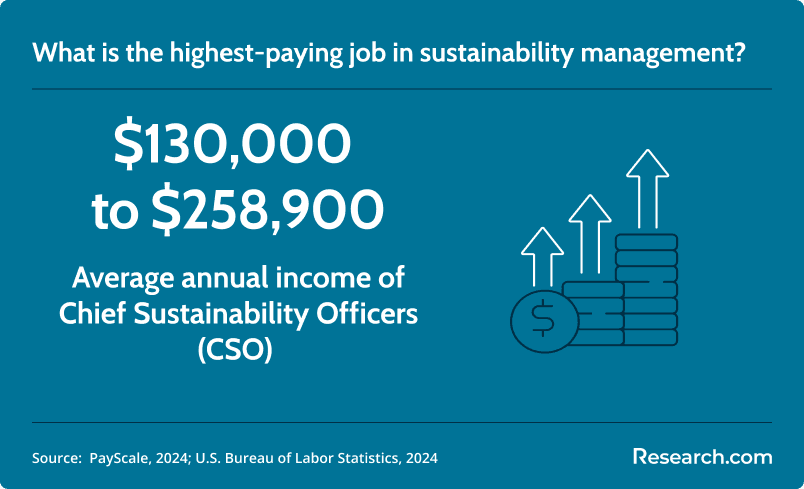
| Chief Sustainability Officer | $120,000 to $258,900 | Bachelor’s degree | Experienced leaders who can set enterprise-wide sustainability strategy |
| Sustainability Director | $130,000 to $176,000 | Bachelor’s degree | Managers who can lead teams, budgets, programs, and reporting initiatives |
| Sustainability Manager | $92,000 to $136,000 | Bachelor’s degree | Professionals who can implement sustainability plans across departments |
| Research Scientist | $84,000 to $123,000 | Master’s or doctoral degree | Analytical professionals focused on evidence-based environmental solutions |
Chief Sustainability Officer
- Average Annual Income: $120,000 to $258,900
- Minimum Education Level: Bachelor’s degree
- Job Description: Chief sustainability officers lead an organization’s overall sustainability agenda. They may set carbon-reduction goals, guide climate-risk strategy, oversee reporting, advise executives, coordinate compliance efforts, and make sure sustainability initiatives support broader business priorities.
Sustainability Director
- Average Annual Income: $130,000 to $176,000
- Minimum Education Level: Bachelor’s degree
- Job Description: Sustainability directors supervise programs, teams, budgets, and cross-functional initiatives. Their work may include energy-efficiency projects, waste-reduction programs, supplier engagement, ESG reporting, employee training, and corporate responsibility strategy.
Sustainability Manager
- Average Annual Income: $92,000 to $136,000
- Minimum Education Level: Bachelor’s degree
- Job Description: Sustainability managers turn goals into operating plans. They track metrics, coordinate departments, manage vendors, support compliance, reduce resource use, prepare reports, and help leadership understand the business case for sustainability improvements.
Research Scientist
- Average Annual Income: $84,000 to $123,000
- Minimum Education Level: Master’s or doctoral degree
- Job Description: Research scientists study environmental challenges, test solutions, analyze data, and evaluate the impact of policies, technologies, and organizational practices. Their findings help companies, governments, and nonprofits make evidence-based sustainability decisions.
What are the best entry-level jobs for sustainability management graduates for 2027?
Entry-level sustainability jobs help graduates build the experience employers expect for management roles. The best first job depends on your strengths. If you are strong in data, consider analyst roles. If you prefer fieldwork, look at technician or compliance positions. If you enjoy coordination, project support roles can lead toward management.
| Entry-level role | Average annual income | Minimum education level | Career-building value |
| Sustainability Project Manager | $112,000 to $151,500 | Bachelor’s degree | Builds project planning, budgeting, stakeholder coordination, and implementation experience |
| Environmental Engineering Technologists | $58,780 to $84,640 | Associate degree | Develops technical knowledge in pollution control, waste systems, and environmental equipment |
| Environmental Technician | $57,470 to $67,000 | Associate degree | Provides field and lab experience in monitoring, sampling, documentation, and compliance support |
| Environmental Health & Safety (EHS) Assistant | $43,000 to $52,000 | Associate degree | Introduces workplace safety, inspections, reporting, and environmental regulatory procedures |
| Conservation Worker | $36,860 to $51,300 | Associate degree | Offers hands-on experience with land stewardship, habitat protection, and public education |
Sustainability Project Manager
- Average Annual Income: $112,000 to $151,500
- Minimum Education Level: Bachelor’s degree
- Job Description: Sustainability project managers coordinate initiatives such as energy audits, waste reduction, supplier improvements, emissions tracking, and employee engagement programs. A background similar to a project management major can be useful because the role depends heavily on timelines, budgets, scope control, and communication.
Environmental Engineering Technologists
- Average Annual Income: $58,780 to $84,640
- Minimum Education Level: Associate degree
- Job Description: Environmental engineering technologists assist engineers with systems that address pollution, waste management, water quality, and resource use. They may test equipment, troubleshoot technical problems, document procedures, and help organizations meet environmental requirements.
Environmental Technician
- Average Annual Income: $57,470 to $67,000
- Minimum Education Level: Associate degree
- Job Description: Environmental technicians collect samples, monitor pollution levels, support lab and field studies, and help scientists or engineers evaluate environmental conditions. Environmental science and protection technician roles are also discussed in Research.com’s guide to the best careers with environmental science degree.
Environmental Health & Safety (EHS) Assistant
- Average Annual Income: $43,000 to $52,000
- Minimum Education Level: Associate degree
- Job Description: EHS assistants help organizations maintain safer and more environmentally responsible workplaces. They may assist with inspections, incident reports, training records, compliance documents, and programs designed to reduce hazards and environmental impact.
Conservation Worker
- Average Annual Income: $36,860 to $51,300
- Minimum Education Level: Associate degree
- Job Description: Conservation workers help protect forests, parks, watersheds, habitats, and public lands. Their duties may include reforestation support, invasive-species control, trail maintenance, habitat restoration, and community education.
These roles can become stepping stones into sustainability management if you document measurable results. Track projects you supported, reports you prepared, regulations you worked with, software you used, and improvements you helped deliver.
This chart displays the average wages of the jobs mentioned above, along with other entry-level jobs in sustainability.
What corporate and government jobs can I pursue with a sustainability management degree?
Corporate and government employers need sustainability professionals for different reasons. Companies often focus on compliance, cost reduction, reporting, reputation, risk, operations, and investor expectations. Government agencies may focus on public programs, environmental protection, community planning, infrastructure, grant administration, and policy implementation.
Industrial Production Manager
- Average Annual Income: $125,900 to $190,480
- Minimum Education Level: Bachelor’s degree
- Job Description: Industrial production managers oversee manufacturing systems and production teams. In sustainability-focused settings, they may reduce waste, improve energy use, lower emissions, strengthen quality controls, and integrate sustainable practices without disrupting production targets.
Sustainable Finance Managers
- Average Annual Income: $88,000 to $118,000
- Minimum Education Level: Bachelor’s or master's degree
- Job Description: Sustainable finance managers and analysts evaluate investments, funding strategies, and financial models tied to renewable energy, conservation, climate risk, and other sustainability-related initiatives. They help organizations balance financial viability with environmental and social value.
Environmental Public Affairs Officer
- Average Annual Income: $77,720 to $126,220
- Minimum Education Level: Bachelor’s degree
- Job Description: Environmental public affairs officers, also known as public relations officers, explain environmental policies, programs, and initiatives to stakeholders. They prepare messaging, manage public communication, coordinate with media, and help organizations build trust around sustainability work.
If you want to enter these sectors quickly, a flexible business pathway may help you build the management foundation employers expect. Research.com’s guide to the fastest business degree online can help you compare accelerated options.
| Career setting | What employers usually value | Good fit if you enjoy |
| Corporate sustainability | Business strategy, reporting, cost savings, compliance, operations, stakeholder communication | Working across departments and translating sustainability goals into business action |
| Government sustainability | Policy knowledge, public accountability, grants, community engagement, regulatory processes | Serving public interests and supporting environmental or community programs |
| Consulting | Client communication, analysis, project delivery, frameworks, industry research | Solving different problems for multiple organizations |
| Nonprofit and community roles | Program design, fundraising, outreach, impact measurement, partnership-building | Connecting sustainability to equity, education, and local development |
What jobs can I get in environmental sustainability?
Environmental sustainability roles focus on protecting natural systems, reducing pollution, improving resource use, and helping organizations comply with environmental rules. These jobs are a strong match for students who want applied environmental work but also want to understand business decisions.
Environmental Specialist
- Average Annual Income: $86,710 to $133,660
- Minimum Education Level: Bachelor’s degree
- Job Description: Environmental specialists assess risks, monitor compliance, conduct inspections, recommend improvements, and help organizations reduce environmental harm. They may work on waste systems, emissions reduction, site assessments, reporting, or energy-efficiency initiatives.
Environmental, Social, and Governance (ESG) Analyst
- Average Annual Income: $71,000 to $123,000
- Minimum Education Level: Bachelor’s degree
- Job Description: ESG analysts review how companies manage environmental, social, and governance risks. They gather data, evaluate performance, prepare reports, study industry benchmarks, and provide insights that may support investor communication, compliance, strategy, or internal improvement.
Environmental Planner
- Average Annual Income: $71,000 to $96,000
- Minimum Education Level: Bachelor’s degree
- Job Description: Environmental planners assess how development projects affect land, water, air, ecosystems, and communities. They work with developers, agencies, and local stakeholders to balance growth with environmental protection and sustainability standards.
Technical fluency matters in these careers. Professionals often need to understand data collection, environmental regulations, risk assessment, mapping tools, reporting frameworks, and basic scientific methods. Microsoft reported in 2022 that 29% of companies cite data collection and management using technologies such as AI, big data analytics, and machine learning as one of the top skills in sustainability work.
Successful sustainability professionals also need judgment. They must explain complex findings clearly, choose realistic recommendations, persuade decision-makers, and manage competing priorities. This holistic green skill set is crucial for success in the field (O’Dell, 2024).
This chart displays the priority skills required in sustainability work.
What jobs can I get in energy and agriculture?
Energy and agriculture are central to sustainability because they affect emissions, land use, water consumption, food systems, logistics, and long-term resource security. Sustainability management graduates in these fields may work on efficiency, renewable energy, resilient supply chains, conservation, sustainable farming practices, or environmental compliance.
Sustainable Operations Manager
- Average Annual Income: $129,330 to $232,110
- Minimum Education Level: Bachelor’s degree
- Job Description: Sustainable operations managers embed sustainability into day-to-day operations. They may improve energy efficiency, reduce emissions, adopt renewable energy technologies, monitor performance, set targets, manage compliance, and align operational improvements with financial and environmental goals.
Transportation, Storage, and Distribution Manager
- Average Annual Income: $111,870 to $175,530
- Minimum Education Level: Bachelor’s degree
- Job Description: These managers oversee logistics networks and distribution systems. A sustainability-focused version of the role may involve route optimization, lower-emission vehicles, packaging reduction, warehouse efficiency, supplier coordination, and supply-chain performance tracking.
Agricultural Manager
- Average Annual Income: $90,160 to $136,410
- Minimum Education Level: Associate or bachelor’s degree
- Job Description: Agricultural managers supervise farming operations and resource use. Sustainability-related responsibilities may include soil health, water efficiency, conservation practices, crop planning, livestock management, equipment use, and long-term environmental stewardship.
Environmental Compliance Specialist
- Average Annual Income: $80,190 to $123,710
- Minimum Education Level: Bachelor’s degree
- Job Description: Environmental compliance specialists help organizations follow environmental laws and internal sustainability standards. In energy and agriculture, they may inspect operations, review permits, document compliance, monitor environmental impact, and recommend corrective actions.
What roles can I get in urban planning and design?
Urban planning and design careers connect sustainability to buildings, transportation, land use, public spaces, resilience, and community development. These roles suit graduates who want to shape the physical environments where people live and work.
Environmental Health and Safety (EHS) Manager
- Average Annual Income: $98,000 to $139,500
- Minimum Education Level: Bachelor’s degree
- Job Description: EHS managers oversee environmental and safety practices for workplaces, construction projects, and facilities. In urban development, they help reduce hazards, support compliance, protect workers and communities, and integrate safer, more sustainable procedures into projects.
Sustainability Consultant
- Average Annual Income: $74,000 to $105,000
- Minimum Education Level: Bachelor’s degree
- Job Description: Sustainability consultants evaluate current practices, identify gaps, recommend improvements, and help clients implement sustainability strategies. In planning and design, they may advise on energy use, materials, green building practices, reporting, or environmental performance.
Environmental Designer
- Average Annual Income: $63,000 to $73,000
- Minimum Education Level: Bachelor’s degree
- Job Description: Environmental designers incorporate sustainability into public spaces, buildings, landscapes, and community environments. Their work may involve green spaces, energy-efficient design, sustainable materials, walkability, and improved quality of life in urban areas.
What challenges do sustainability management professionals face?
Sustainability work can be rewarding, but it is not simple. Professionals often need to manage competing priorities: reducing environmental impact while staying within budget, meeting regulatory expectations while maintaining operations, and communicating long-term risks to leaders focused on short-term results.
- Changing regulations and reporting expectations: Sustainability teams must keep up with rules, standards, disclosures, and stakeholder demands that can vary by industry and location.
- Data quality problems: Many organizations struggle to collect consistent, reliable sustainability data across facilities, suppliers, departments, and regions.
- Stakeholder resistance: Some sustainability initiatives require changes in purchasing, operations, travel, energy use, construction, logistics, or employee behavior.
- Budget pressure: Professionals often need to prove the financial value of sustainability projects through cost savings, risk reduction, compliance, brand value, or operational resilience.
- Technology learning curves: New tools for emissions tracking, analytics, reporting, and resource monitoring can improve results, but they require ongoing upskilling.
Students comparing this field with other green career options can explore Research.com’s broader guide to careers in sustainability.
Can further education accelerate career prospects in sustainability management?
Further education can help, but it should match your target role. A master’s degree may be useful for consulting, ESG, management, public policy, sustainable finance, or executive-track positions. Shorter certificates may be enough if you already have strong work experience and only need a sustainability specialization.
Working adults should compare cost, flexibility, accreditation, employer tuition benefits, and expected career outcomes before enrolling. If schedule flexibility is a priority, Research.com’s guide to the best online colleges for working adults can help you evaluate practical options.
How can practical experience boost my sustainability management career?
Practical experience is often the difference between having a sustainability degree and being competitive for a sustainability job. Employers want evidence that you can work with real data, real stakeholders, and real operational constraints.
- Complete internships with companies, government agencies, nonprofits, utilities, consulting firms, or campus sustainability offices.
- Volunteer for projects involving waste audits, energy tracking, community gardens, conservation, climate education, or environmental reporting.
- Build a portfolio with sample dashboards, carbon-accounting exercises, ESG summaries, policy briefs, project plans, or case studies.
- Learn tools used in data analysis, reporting, project management, mapping, and environmental monitoring.
- Document measurable outcomes, such as reduced resource use, improved reporting accuracy, completed audits, or stakeholder participation.
If you are still choosing an academic path, Research.com’s guide to the best online degrees to get may help you compare programs that combine employability with flexible study.
What are the key competencies for excelling in sustainability management careers?
The best sustainability professionals are not only environmentally aware. They are translators: they connect science, business, policy, finance, operations, and human behavior.
| Competency | Why it matters | How to build it |
| Data analysis | Sustainability decisions depend on credible measurement, tracking, and reporting | Practice spreadsheets, dashboards, emissions calculations, survey analysis, and reporting tools |
| Regulatory literacy | Organizations need to understand environmental obligations and compliance risks | Study environmental policy, permits, industry standards, and compliance documentation |
| Project management | Sustainability initiatives require budgets, timelines, teams, vendors, and accountability | Manage campus, volunteer, internship, or workplace projects with measurable deliverables |
| Stakeholder communication | Programs fail when employees, executives, communities, or suppliers do not understand the goal | Practice presentations, reports, policy briefs, training materials, and executive summaries |
| Business judgment | Recommendations must be realistic, cost-aware, and aligned with organizational priorities | Take courses in finance, operations, economics, accounting, and strategy |
| Systems thinking | Environmental issues are connected to supply chains, communities, energy, design, and behavior | Use case studies to map causes, impacts, trade-offs, and unintended consequences |
For students building foundational credentials before a bachelor’s degree, Research.com’s guide to fast associate degree programs online may help identify shorter pathways into business, environmental, or technical study.
How Can I Finance My Sustainability Management Education?
Before enrolling, compare the full cost of attendance, not just tuition. Include fees, books, travel, technology requirements, internship costs, lost work hours, and the time it will take to complete the program.
- File for federal aid if eligible: Federal aid can include grants, loans, and work-study depending on your circumstances and program eligibility.
- Ask about institutional scholarships: Some schools offer merit, need-based, transfer, adult learner, military, or sustainability-related awards.
- Check employer tuition support: Working professionals should ask whether their employer funds degrees, certificates, or job-related training.
- Consider online or hybrid formats: Flexible formats may reduce relocation or commuting costs, though fees and quality vary.
- Maximize transfer credits: Transfer policies can affect both total cost and time to graduation.
- Compare outcomes: Ask programs for career services information, internship access, alumni outcomes, and employer partnerships.
Students who want flexible programs that may support financial aid can review Research.com’s guide to online schools with financial aid.
What advanced degree options can accelerate my sustainability management career?
Advanced degrees can be valuable when they sharpen a clear career direction. A sustainability-focused MBA may suit someone pursuing corporate strategy or operations. A public policy master’s may fit government or nonprofit work. A data-focused program may help ESG analysts or climate-risk professionals. A doctoral program may be best for research, teaching, or senior thought leadership.
| Advanced option | Best for | Decision point |
| MBA with sustainability concentration | Corporate sustainability, operations, leadership, consulting, and finance-oriented roles | Choose this if you need stronger business training and want management responsibility |
| Master’s in sustainability management | Sustainability strategy, ESG, reporting, policy, and program leadership | Choose this if you want a specialized sustainability curriculum |
| Master’s in environmental policy or public administration | Government, nonprofit, planning, and regulatory roles | Choose this if you want to shape programs, policy, or public-sector initiatives |
| Doctoral degree | Research, academia, high-level consulting, or executive expertise | Choose this if your goals require advanced research and long-term specialization |
If speed is a major factor, Research.com’s guide to the best 1 year masters programs can help you compare accelerated graduate options.
How Can Further Academic Research Elevate My Sustainability Management Career?
Academic research can strengthen a sustainability career when your goal involves policy design, scientific analysis, consulting credibility, university teaching, or senior advisory work. Research training helps professionals evaluate evidence, design studies, interpret complex systems, and avoid unsupported claims in sustainability planning.
A doctoral pathway may be worth considering if you want to lead original research, become a subject-matter expert, publish, teach, or influence high-level strategy. Cost still matters, so candidates should compare funding, dissertation support, faculty expertise, completion expectations, and program reputation. Research.com’s guide to affordable online PhD programs can help you begin that comparison.
Which College Majors Best Prepare Me for a Career in Sustainability Management?
There is no single required major for every sustainability management job. The best choice depends on whether you want to work in business, science, policy, energy, finance, agriculture, planning, or communications.
| Major | Why it helps | Potential sustainability direction |
| Sustainability management | Directly combines business, environment, policy, and organizational strategy | Sustainability analyst, manager, consultant, or CSR specialist |
| Business administration | Builds skills in management, finance, operations, and strategy | Corporate sustainability, sustainable operations, ESG, or CSR |
| Environmental science | Strengthens scientific and field-based understanding of environmental systems | Environmental specialist, technician, planner, or compliance role |
| Economics or finance | Supports cost-benefit analysis, sustainable finance, and climate-risk work | ESG analyst, sustainable finance manager, or policy analyst |
| Public policy or public administration | Prepares students for regulation, public programs, and stakeholder governance | Government sustainability, environmental public affairs, or nonprofit leadership |
| Urban planning or design | Connects sustainability to land use, infrastructure, housing, and transportation | Environmental planner, sustainability consultant, or environmental designer |
Students still deciding on an undergraduate path can review Research.com’s guide to the best majors for the future to compare broader career-aligned options.
How Can I Build a Strong Professional Network in Sustainability Management?
Networking is especially important in sustainability because job titles vary widely and many roles sit inside departments such as operations, compliance, facilities, finance, procurement, communications, or strategy. A strong network helps you learn where opportunities actually exist.
- Join professional associations related to sustainability, energy, ESG, environmental management, planning, or corporate responsibility.
- Attend conferences, webinars, employer panels, and local climate or sustainability events.
- Ask alumni and professionals for informational interviews focused on skills, hiring expectations, and career paths.
- Use LinkedIn to follow sustainability leaders, companies, recruiters, and professional groups.
- Build relationships with faculty, internship supervisors, volunteer coordinators, and project partners.
- Share portfolio work, such as reports, dashboards, project summaries, or case studies, when appropriate.
If you are starting with a shorter credential before transferring into a bachelor’s program, Research.com’s guide to affordable online associate degree programs may help you evaluate lower-cost pathways.
How Can Emerging Technologies Enhance Sustainability Management Careers?
Technology is changing how organizations measure, report, and manage sustainability performance. AI, big data analytics, machine learning, sensors, and digital reporting systems can improve resource tracking, emissions estimates, risk analysis, supply-chain visibility, and compliance documentation.
Technology does not replace sustainability judgment. It makes technical and ethical judgment more important. Professionals need to understand what data means, where it came from, how reliable it is, and how it should be communicated. Those who combine environmental knowledge with data literacy will be better prepared for roles in ESG, climate risk, operations, energy management, and reporting.
For professionals who want graduate-level training but need a manageable academic path, Research.com’s guide to the easiest masters degree can help compare flexible options, though students should still evaluate quality, curriculum fit, and career relevance.
What jobs can I get in CSR?
Corporate social responsibility, or CSR, focuses on how organizations affect employees, communities, suppliers, customers, and the environment. CSR careers are a strong fit for people who are interested in sustainability but also want to work in communications, community partnerships, ethics, philanthropy, workforce programs, or social impact.
Community Economic Development Manager
- Average Annual Income: $103,000 to $155,000
- Minimum Education Level: Bachelor’s degree
- Job Description: Community economic development managers design and coordinate programs that support local economic growth, sustainability, and access to opportunity. They may work with local governments, businesses, nonprofits, and residents. Students interested in the economic side of this work can compare the cheapest online economics degree programs.
Social and Community Service Manager
- Average Annual Income: $83,400 to $127,550
- Minimum Education Level: Bachelor’s degree
- Job Description: Social and community service managers supervise programs that address community needs. They manage staff, coordinate outreach, secure funding, measure outcomes, and report results to stakeholders.
Corporate Social Responsibility Program Manager
- Average Annual Income: $81,000 to $114,000
- Minimum Education Level: Bachelor’s degree
- Job Description: CSR program managers develop initiatives that align company practices with ethical, social, and environmental goals. Their work may include community investment, ethical sourcing, employee engagement, carbon-reduction programs, supplier standards, or sustainability communication.
Nonprofit Organization Program Manager
- Average Annual Income: $50,000 to $68,000
- Minimum Education Level: Bachelor’s degree
- Job Description: Nonprofit program managers design, fund, implement, and evaluate programs related to environmental protection, community development, education, or social responsibility. They often manage budgets, partnerships, volunteers, grants, and outcome reporting.
CSR roles can lead to broader sustainability management careers because they build experience in stakeholder engagement, program design, reporting, and organizational change. Professionals who want stronger business training may also consider the cheapest AACSB accredited online MBA options.
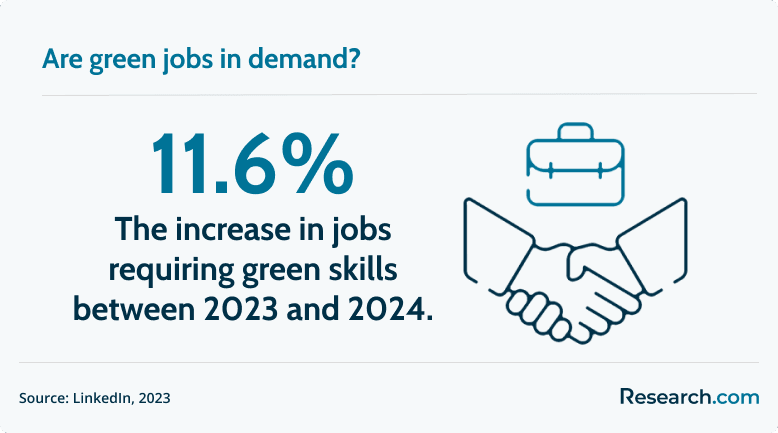
A LinkedIn report (2024) shows that global demand for jobs requiring green skills increased by 11.6% from 2023 to 2024, while the supply grew only by 5.6%. The same report shows that the hiring rate for candidates with green skills or experience is 54.6% higher than the overall hiring rate for other jobs. For students, this signals opportunity, but also competition for the best roles. Building demonstrable skills is essential.
What is the job outlook for sustainability management careers?
The outlook for sustainability management careers is positive because more industries are responding to climate risk, resource constraints, stakeholder expectations, and the need for a green transition (Economist Impact, 2024). Opportunities are not limited to environmental organizations. Sustainability roles appear in energy, transportation, finance, technology, construction, retail, education, consulting, insurance, government, and the military.
Based on BLS data, the job outlook of environmental specialists from 2023 to 2033 is 7.3%, which yields around 8,500 annual new openings. Other management and high-level roles connected to sustainability also show positive growth over the decade, including transportation and distribution managers (9%), social and community service managers (8.2%), project management specialists (7.2%), and operations managers (5.8%).
These figures do not guarantee a job or salary for any individual graduate. Outcomes depend on location, experience, industry, internships, technical skills, employer demand, and how well a candidate can show measurable impact. Students who want to compare sustainability-adjacent management careers can also review Research.com’s article on how much money can you make with a construction management degree.
This chart displays the increase in employment for various sustainability careers.
What certifications are recommended for sustainability management professionals?
Certifications can help sustainability professionals prove specialized knowledge, especially when changing careers or moving into a more technical role. They are most useful when paired with experience, a relevant degree, and a clear career target. They should not be treated as automatic shortcuts to higher pay.
Some sustainability credentials may also appear among the highest paying certifications depending on role, industry, and employer needs.
| Certification | Best for | What it signals |
| Sustainability Excellence Associate (SEA) | Early-career sustainability professionals | Foundational understanding of sustainability and corporate responsibility |
| Sustainability Excellence Professional (SEP) | Experienced sustainability practitioners | Ability to integrate sustainability into organizational strategy and operations |
| LEED Green Associate | Students and professionals interested in buildings, construction, facilities, or design | Knowledge of green building practices and sustainability principles |
| Certified Energy Manager (CEM) | Energy management and efficiency professionals | Competence in energy audits, sustainable energy systems, and energy-efficiency practices |
| Sustainability and Climate Risk (SCR®) Certificate | Finance, risk, ESG, and strategy professionals | Knowledge of sustainability and climate-related risk assessment |
| Certified Climate Change Professional® (CC-P®) | Professionals focused on climate strategy, policy, or adaptation | Advanced knowledge of climate change science, policy, and adaptation strategy |
- Sustainability Excellence Associate (SEA): Offered by the International Society of Sustainability Professionals (ISSP), this credential is designed for professionals beginning their sustainability careers.
- Sustainability Excellence Professional (SEP): Also offered by ISSP, this advanced certification is intended for practitioners with more sustainability management experience.
- LEED Green Associate: Offered by the U.S. Green Building Council (USGBC), this entry-level credential is useful for those interested in green building and sustainable design.
- Certified Energy Manager (CEM): Offered by the Association of Energy Engineers (AEE), this certification is relevant for professionals working in energy management, audits, and efficiency.
- Sustainability and Climate Risk (SCR®) Certificate: Offered by the Global Association of Risk Professionals (GARP), this credential supports professionals who evaluate climate and sustainability risks.
- Certified Climate Change Professional® (CC-P®): Offered by the Association of Climate Change Officers (ACCO), this certification is built for professionals working on climate science, policy, and adaptation.
What are the career progression paths in sustainability management?
Sustainability careers usually progress from support and analysis roles into program ownership, team leadership, strategy, and executive decision-making. The timeline depends on the industry and the professional’s ability to show measurable results.
| Career stage | Common titles | What to focus on |
| Entry level | Environmental technician, sustainability coordinator, EHS assistant, analyst, conservation worker | Build technical skills, learn regulations, support projects, collect data, and document outcomes |
| Early to mid-career | Sustainability analyst, ESG analyst, environmental specialist, project manager, compliance specialist | Own workstreams, improve reporting, manage stakeholders, and demonstrate measurable impact |
| Management | Sustainability manager, EHS manager, CSR program manager, sustainable operations manager | Lead programs, supervise teams, manage budgets, align sustainability with business goals |
| Senior leadership | Sustainability director, head of ESG, director of corporate responsibility | Set strategy, influence executives, manage enterprise-wide initiatives, and communicate results |
| Executive or expert track | Chief sustainability officer, senior consultant, researcher, academic expert | Shape long-term strategy, advise leadership, publish research, manage risk, and drive organizational transformation |
Advanced credentials may support progression, but they should fit the role. A doctoral credential, such as a 1 year doctorate degree, may be relevant for some senior academic, research, consulting, or executive goals, but it is not necessary for every sustainability management career.
Common mistakes to avoid when choosing a sustainability management path
- Choosing a program without checking accreditation: Accreditation affects credit transfer, financial aid eligibility, graduate school options, and employer confidence.
- Looking only at tuition: Total cost includes fees, materials, transportation, technology, internship expenses, and time away from work.
- Assuming all sustainability degrees lead to the same jobs: A business-focused program, an environmental science program, and a policy program may lead to very different outcomes.
- Ignoring practical experience: Internships, projects, fieldwork, and portfolios can matter as much as coursework.
- Relying only on rankings: Rankings can be useful, but curriculum fit, faculty expertise, employer connections, cost, and career support are more important for your personal goals.
- Skipping data skills: ESG, reporting, energy, compliance, and climate-risk roles increasingly require comfort with data collection, analysis, and communication.
- Assuming salary ranges are guaranteed: Pay varies by employer, region, experience, industry, and job scope.
Questions to ask before enrolling in a sustainability management program
- Is the institution properly accredited?
- Does the curriculum include business, environmental policy, data analysis, project management, and sustainability reporting?
- Are internships, capstones, consulting projects, or field experiences built into the program?
- Which employers hire graduates from the program?
- Does the program prepare students for certifications such as LEED Green Associate, CEM, SEA, SEP, SCR®, or CC-P®?
- Can working students study part time, online, or in hybrid formats?
- What career services are available for sustainability-specific roles?
- How many credits can you transfer?
- What is the full cost, including fees and required materials?
- Does the program match your target sector: corporate, government, nonprofit, consulting, energy, finance, agriculture, or planning?
Here’s What Professionals Have to Say about Their Careers in Sustainability Management
- "Pursuing a career in sustainability management has allowed me to align my work with my passion for protecting the environment. Every day, I get to develop strategies that reduce waste and promote clean energy, knowing I’m making a tangible difference. It’s incredibly fulfilling to be part of a global movement for change." – Sandra
- "As a sustainability manager, I’ve had the opportunity to work with diverse teams, from engineers to policymakers, to create impactful projects. Seeing how our efforts help companies save money while reducing their carbon footprint is both rewarding and motivating. This career constantly challenges me to innovate for a better world." – Khalil
- "I’ve always wanted a career that merges business with purpose, and sustainability management is exactly that. Leading corporate initiatives to embrace sustainable practices has not only advanced my career but also given me a sense of pride and hope for the future. It's a journey I’m truly grateful for." – Norma
Key Insights
- A sustainability management degree is strongest when it combines environmental knowledge with business strategy, data analysis, project management, and stakeholder communication.
- The highest-paying sustainability management degree careers include chief sustainability officer, sustainability director, sustainability manager, and research scientist, with average incomes ranging between $84,000 and $258,900.
- Entry-level candidates should prioritize hands-on experience through internships, fieldwork, reporting projects, campus sustainability work, volunteer programs, or portfolio-building assignments.
- Microsoft reported that 29% of companies cite data collection and management using AI, big data analytics, and machine learning as one of the top skills in sustainability work.
- LinkedIn reported that global demand for jobs requiring green skills increased by 11.6% from 2023 to 2024, while supply grew only by 5.6%.
- LinkedIn also reported that the hiring rate for candidates with green skills or experience is 54.6% higher than the overall hiring rate for other jobs.
- BLS data show that the job outlook of environmental scientists and specialists from 2023 to 2033 is 7.3%, or around 8,500 annual openings throughout the decade.
- Certifications can strengthen your profile, but they work best when aligned with a specific role, such as green building, energy management, ESG, climate risk, or corporate sustainability.
- Before choosing a program, compare accreditation, total cost, transfer credit, curriculum fit, internship access, career support, and whether the degree matches your target industry.
References:
- LinkedIn. (2023). Global Green Skills Report 2023. https://economicgraph.linkedin.com/content/dam/me/economicgraph/en-us/global-green-skills-report/green-skills-report-2023.pdf
- LinkedIn. (2024, September). Global Climate Talent Stocktake. https://economicgraph.linkedin.com/content/dam/me/economicgraph/en-us/PDF/linkedIn-global-climate-talent-stocktake-sept-2024.pdf
- Microsoft. (2022, November 2). Closing the Sustainability Skills Gap: Helping businesses move from pledges to progress. https://blogs.microsoft.com/on-the-issues/2022/11/02/closing-sustainability-skills-gap
- Statista. (2021, January). Green employment opportunities in emerging markets* across key sectors between 2020 and 2030, by region. https://www.statista.com/statistics/1257893/new-direct-jobs-by-region
- U.S. Bureau of Labor Statistics. (2024, August 29). Occupational projections, 2023–33, and worker characteristics, 2023. Employment Projections. https://www.bls.gov/emp/tables/occupational-projections-and-characteristics.htm
Other Things You Should Know About Sustainability Management Careers
Industries such as renewable energy, corporate sustainability, environmental consulting, and sustainable urban planning offer excellent career prospects for sustainability management graduates. These sectors are actively seeking professionals who can develop and implement sustainable practices, making them ideal for those with the necessary expertise.
In 2026, graduates with a sustainability management degree can expect an average starting salary of around $55,000 to $65,000 annually. This range may vary based on the specific industry, location, and the graduate's level of experience and skills.