
2027 Is a Two-Year Degree in Cybersecurity Worth It?

Co-Founder and Chief Data Scientist
A two-year cybersecurity degree can be a practical entry point into security work, but it is not the right choice for every student or every career goal. The real question is not simply whether the degree is “worth it.” It is whether an associate-level cybersecurity program gives you enough hands-on training, employer-recognized preparation, transfer flexibility, and certification support to compete for entry-level roles without overpaying for school.
This guide explains what a two-year cybersecurity degree covers, what jobs it can lead to, how much it may cost, what salaries are commonly associated with cybersecurity and related IT roles, and how to compare a degree with boot camps, certificates, bachelor’s programs, and other technology majors. It is designed for students, career changers, military learners, working adults, and IT beginners who want a faster route into cybersecurity while keeping long-term advancement options open.
Quick Answer: Is a Two-Year Cybersecurity Degree Worth It?
A two-year cybersecurity degree can be worth it if you want an affordable, structured path into entry-level cybersecurity or IT security-adjacent work. It is especially useful when the program is accredited, includes hands-on labs, prepares you for certifications such as CompTIA Security+, and allows credits to transfer into a bachelor’s degree later. However, the degree alone may not be enough for more advanced cybersecurity roles. Most students improve their job prospects by combining the degree with certifications, internships, home labs, networking experience, and a portfolio of security projects.
Key Things You Should Know About a Two-Year Degree in Cybersecurity
- A two-year cybersecurity program is usually built for entry-level roles such as cybersecurity analyst, IT support specialist, network support specialist, or junior network administrator.
- Community college and online associate programs are often less expensive than four-year pathways, but students should compare total cost, fees, technology requirements, and certification exam expenses.
- Employers often look for proof of applied ability, so labs, internships, security projects, and certifications can matter as much as the diploma itself.
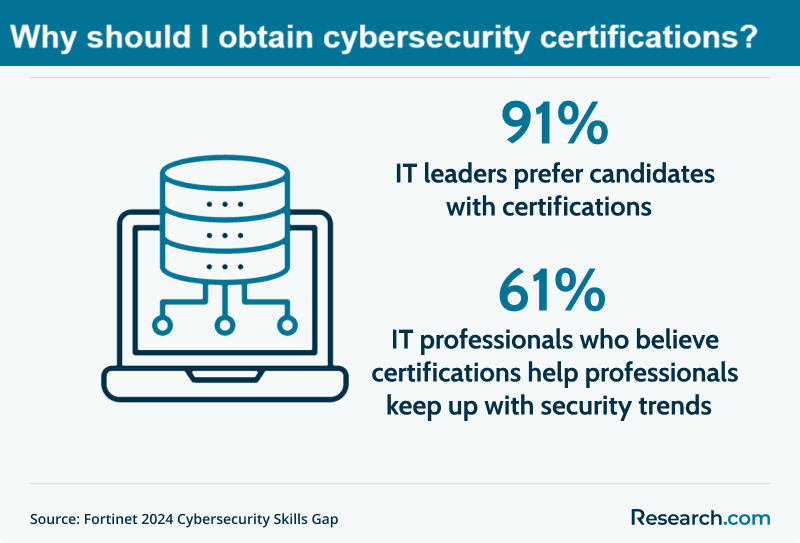
- Credentials such as CompTIA Security+, Certified Ethical Hacker, Cisco credentials, or other role-specific certifications can strengthen an associate degree graduate’s resume.
- Many associate programs are designed with transfer pathways, giving students the option to continue into a bachelor’s degree if they want broader career mobility.
- Strong programs emphasize practical work: configuring networks, analyzing threats, responding to incidents, working with security tools, and documenting findings.
- The degree can open the door, but advancement usually depends on experience, specialization, continued training, and the ability to communicate security risks clearly.
- What is cybersecurity?
- What can I do with a two-year degree in cybersecurity?
- How much does a two-year degree in cybersecurity cost?
- How much do cybersecurity professionals earn?
- What courses are included in a two-year degree in cybersecurity program?
- What skills can I develop in a two-year degree in cybersecurity program?
- What are the prerequisites for enrolling in a two-year cybersecurity degree program?
- What challenges might I encounter during a two-year cybersecurity program?
- Is a two-year cybersecurity degree worth the investment compared to other tech degrees?
- What emerging trends are shaping two-year cybersecurity programs?
- Should I pursue an advanced degree after a two-year cybersecurity program?
- Are cybersecurity boot camps a viable alternative to a two-year degree?
- How do I choose the best two-year degree in cybersecurity program?
- How can interdisciplinary learning enhance cybersecurity skills?
- What is the job market for those with a two-year degree in cybersecurity?
- What student support services can enhance my cybersecurity education?
- How can artificial intelligence enhance a two-year cybersecurity education?
- What is the job placement rate for cybersecurity graduates?
- What are the career advancement opportunities for those with a two-year degree in cybersecurity?
- What soft skills do employers value in cybersecurity roles?
- What accreditation and quality standards should I consider in a cybersecurity program?
- What questions should I ask before enrolling?
What is cybersecurity?
Cybersecurity is the practice of protecting computer systems, networks, applications, devices, and data from unauthorized access, misuse, theft, disruption, or destruction. It includes the tools, policies, technical controls, monitoring practices, and response procedures organizations use to reduce digital risk.
Cybersecurity is not one single job function. It covers several related areas:
- Network security: Protecting wired, wireless, cloud-connected, and internal networks from unauthorized access and attack.
- Information security: Preserving the confidentiality, integrity, and availability of sensitive information.
- Endpoint security: Securing laptops, servers, mobile devices, workstations, and other devices connected to an organization’s systems.
- Application security: Finding and reducing software weaknesses before attackers can exploit them.
- Incident response: Detecting, investigating, containing, and documenting security events.
- Governance, risk, and compliance: Helping organizations follow security policies, privacy rules, and industry requirements.
For students, this matters because cybersecurity careers sit at the intersection of technology, risk management, law, communication, and business operations. A strong two-year program should teach more than technical vocabulary. It should help students understand how attackers think, how systems fail, how to document evidence, and how to recommend security improvements that real organizations can act on.
Students comparing delivery formats often ask whether online college degrees are respected. In cybersecurity, the answer depends heavily on accreditation, curriculum quality, lab access, certifications, and whether graduates can demonstrate practical skill. An accredited online program with strong technical support and hands-on assignments can be a reasonable option for working adults and remote learners.
What can I do with a two-year degree in cybersecurity?
A two-year cybersecurity degree most commonly prepares students for entry-level cybersecurity, networking, and IT support roles. Many associate degree graduates do not start in a high-level security position immediately. Instead, they often begin in help desk, technical support, network support, systems administration, or junior security operations roles and build toward more specialized cybersecurity work.
| Role | What you may do | Why it fits associate degree graduates |
| Cybersecurity analyst | Monitor alerts, review suspicious activity, document incidents, and help apply security controls. | Programs with security labs, incident response practice, and certification preparation can align well with junior analyst duties. |
| IT support specialist | Troubleshoot hardware, software, access, account, and user issues while applying basic security practices. | This can be a realistic first role for students who need practical IT experience before moving deeper into security. |
| Computer network support specialist | Help maintain networks, diagnose connectivity problems, and support secure network operations. | Cybersecurity relies on networking knowledge, so network support experience can be a strong foundation. |
| Network and computer systems administrator | Manage servers, user permissions, backups, patches, and network services. | Security-focused administration experience can lead toward security engineering or operations roles. |
| Digital forensics or incident response assistant | Support investigations, preserve evidence, review logs, and follow documentation procedures. | Programs with forensics, legal, and evidence-handling coursework may help students prepare for these specialized paths. |
Some students use the associate degree as a direct employment credential. Others use it as the first step toward a bachelor’s degree, similar to how students might use a 2 year computer science degree to build a foundation before moving into broader computing roles. Students who want cybersecurity plus management, entrepreneurship, or operations knowledge may also compare the path with an online business associate's degree, especially if they plan to work in risk, compliance, or IT management later.
How much does a two-year degree in cybersecurity cost?
The cost of a two-year cybersecurity degree depends on the school type, residency status, online or campus format, fees, technology requirements, and whether certification exams are included. According to Education Data, the annual cost of attendance at any two-year institution is nearly $13,000. Tuition alone averages $3,780 for in-district community college students, while out-of-state community college tuition is close to $9,000. Private institutions offering two-year degrees often average $18,300.
Students comparing online cybersecurity degrees should look beyond advertised tuition. Online learners may save on commuting or housing, but they may still pay technology fees, proctoring fees, lab platform charges, books, software, equipment costs, and certification exam fees.
| Cost factor | Why it matters | What to ask before enrolling |
| Tuition and fees | The lowest tuition is not always the lowest total cost if fees are high. | What is the full cost for the complete program, not just one term? |
| Residency status | In-district, out-of-district, and out-of-state tuition can differ substantially. | Do online students pay in-state, out-of-state, or a separate online rate? |
| Certification exams | Security certifications can improve employability but may require separate exam fees. | Are exam vouchers included, discounted, or entirely out of pocket? |
| Technology and lab access | Cybersecurity courses may require a reliable computer, virtualization capability, and access to lab environments. | What hardware, software, and internet requirements will I need? |
| Transfer pathway | A low-cost associate degree can lose value if credits do not transfer efficiently. | Which bachelor’s programs have formal transfer agreements with this school? |
| Financial aid | Grants, scholarships, employer tuition assistance, work-study, and federal student loans may reduce upfront cost. | Is the program eligible for federal financial aid, and what cybersecurity scholarships are available? |
Students who already know they want advanced technical or leadership roles should also compare the long-term cost of stopping at an associate degree versus transferring later. For example, learners exploring senior security jobs may eventually research what jobs can you get with a master's in cyber security. The same decision principle applies in other professional fields: students asking whether online nursing degrees are respected need to verify accreditation, hands-on requirements, and employer acceptance before enrolling.
How much do cybersecurity professionals earn?
Cybersecurity compensation varies by role, region, employer, clearance requirements, experience, certifications, and technical specialization. It is also important to separate cybersecurity-specific roles from broader IT jobs that may serve as stepping stones into security. Computer-related fields are often discussed among the highest paying degrees, but individual outcomes are not guaranteed and depend on the role a graduate actually obtains.
Existing salary references commonly place entry-level cybersecurity analyst earnings in the $60,000 to $80,000 range, depending on location and employer. Mid-level roles such as penetration tester or network security engineer are often described in the $85,000 to $120,000 range. Senior positions such as cybersecurity manager or chief information security officer can exceed $150,000 annually, particularly in sectors with high security requirements. These figures should be treated as career-context estimates rather than guaranteed associate degree outcomes.
The table below lists salary figures for cybersecurity and related IT occupations:
| Professionals | Average Annual Salary | Average Hourly Salary |
| Information security analysts | $124,740 | $59.97 |
| Computer support specialists | $66,450 | $31.95 |
| Computer network support specialists | $78,640 | $37.81 |
| Database administrators | $104,810 | $50.39 |
| Network and computer systems administrators | $100,580 | $48.36 |
Certifications can influence salary potential when they match the job. CompTIA Security+ is often used for entry-level security validation, while credentials such as CISSP or CEH may be more relevant after students gain experience or move into specialized roles. The strongest salary strategy is not collecting random credentials; it is aligning coursework, certification, projects, and job applications with a specific role target.
What courses are included in a two-year degree in cybersecurity program?
A two-year cybersecurity curriculum usually blends core IT coursework with applied security training. The best programs do not treat cybersecurity as an isolated topic. They first teach how operating systems, networks, databases, users, and applications work, then show how those systems can be attacked, monitored, hardened, and restored.
Common traditional and online cybersecurity courses may include:
- Networking fundamentals: Students learn how devices communicate, how networks are configured, and where common weaknesses appear.
- Operating systems: Coursework may cover Windows, Linux, user permissions, system services, patching, and basic administration.
- Introduction to cybersecurity: Students study threat types, attack methods, security frameworks, and defensive strategies.
- Network security: This area covers firewalls, secure protocols, segmentation, monitoring, and network hardening.
- Ethical hacking or penetration testing: Students practice approved testing methods to identify vulnerabilities and recommend fixes.
- Cryptography: Coursework introduces encryption, hashing, certificates, and secure communications.
- Digital forensics: Students may learn evidence handling, log review, disk images, and investigation basics.
- Incident response: Training focuses on identifying, containing, documenting, and recovering from security events.
- Cybersecurity law and ethics: Students learn why authorization, privacy, compliance, and professional conduct matter.
- Capstone, internship, or lab project: Strong programs require students to apply skills in realistic scenarios before graduation.
Before enrolling, review the catalog carefully. A program with only broad computer literacy courses may not provide enough security depth, while a program that jumps straight into hacking tools without networking and systems fundamentals may leave beginners with gaps that hurt them in interviews.
What skills can I develop in a two-year degree in cybersecurity program?
A good associate degree should help students build job-ready technical skills and the professional habits needed to work on security teams. Employers do not hire graduates only because they know terminology. They want candidates who can investigate problems, follow procedures, explain findings, and continue learning as threats change.
| Skill area | What students should learn | How to prove it to employers |
| Networking | Understand IP addressing, routing, switching, protocols, wireless networks, and secure configuration. | Build a home lab, document network diagrams, and complete networking labs. |
| Threat detection | Recognize suspicious behavior, review logs, and connect alerts to possible attack patterns. | Create sample incident reports and practice with SIEM-style tools when available. |
| System administration | Manage users, permissions, patches, backups, and basic operating system hardening. | Show Linux and Windows administration projects in a portfolio. |
| Vulnerability assessment | Scan systems, interpret findings, prioritize risk, and recommend remediation. | Document a lab-based vulnerability assessment from discovery to remediation plan. |
| Incident response | Follow a response process, contain threats, preserve evidence, and communicate next steps. | Use capstone projects or simulations to demonstrate response workflows. |
| Security communication | Translate technical problems into clear explanations for managers, users, and teammates. | Include concise written reports and presentation examples with coursework projects. |
| Ethical judgment | Understand authorization, privacy boundaries, legal responsibilities, and professional conduct. | Be prepared to explain safe testing practices and responsible disclosure in interviews. |
What are the prerequisites for enrolling in a two-year cybersecurity degree program?
Most two-year cybersecurity programs are designed for beginners, but that does not mean the coursework is effortless. Cybersecurity may feel like one of the easiest degree to get only for students who enjoy computers, troubleshooting, logic, and continuous technical practice. Applicants should expect standard community college or associate degree admission requirements, plus placement or readiness expectations in math and computing.
- High school diploma or GED: Most associate degree programs require proof of high school completion or an equivalent credential.
- Basic computer literacy: Students should be comfortable using computers, managing files, installing software, and troubleshooting simple problems.
- Math readiness: Programs may require placement testing or developmental coursework if students are not ready for college-level math.
- Application materials: Schools may require an application form, transcripts, and in some cases a personal statement.
- Placement tests: Some institutions use SAT, ACT, or institutional placement exams to determine course readiness.
- Introductory IT coursework: Students without prior experience may need to complete basic computer science, IT, or networking classes before advanced security courses.
- Optional work experience: Prior help desk, networking, systems, military, or technical experience can make the transition easier, but it is not always required.
What challenges might I encounter during a two-year cybersecurity program?
The biggest challenge is pace. A two-year program has limited time to cover networking, operating systems, security concepts, tools, law, ethics, and applied projects. Students without a technical background may need extra practice outside class to become comfortable with command-line tools, logs, networking concepts, and troubleshooting.
Common challenges include:
- Learning technical fundamentals quickly: Cybersecurity depends on understanding how systems work before learning how to protect them.
- Balancing theory and practice: Reading about threats is not enough; students need repeated lab practice to build confidence.
- Keeping up with changing tools: Security platforms, attack methods, and defensive techniques evolve, so students must learn how to keep learning.
- Building job evidence: Graduates may struggle if they finish with a transcript but no projects, internship, certification, or portfolio.
- Managing time: Working adults and online learners need programs with predictable schedules, responsive instructors, and accessible technical support.
If you want a more guided or beginner-friendly path, compare programs carefully and review easiest cybersecurity degree options, but do not choose a program only because it appears simple. In cybersecurity, easier is not always better if the program lacks labs or employer relevance.
Is a two-year cybersecurity degree worth the investment compared to other tech degrees?
A two-year cybersecurity degree may be a strong investment when your goal is fast entry into IT security, network support, or security operations work at a lower upfront education cost. It is less ideal if you want a broad computing foundation, software engineering depth, research preparation, or access to roles that commonly prefer a bachelor’s degree.
| Path | Best fit | Main trade-off |
| Two-year cybersecurity degree | Students who want structured, affordable, hands-on preparation for entry-level security and IT roles. | May require certifications, experience, and later education for advanced roles. |
| Bachelor’s degree in cybersecurity or computer science | Students seeking broader career mobility, deeper theory, and access to roles that prefer four-year credentials. | Usually requires more time and higher total cost than an associate pathway. |
| IT certificate program | Learners who need targeted technical preparation or a faster credential. | May not provide the same transfer value or general education foundation as a degree. |
| Cybersecurity boot camp | Career changers or IT professionals who need intensive skill development in a narrow area. | Quality, accreditation, depth, and employer recognition vary widely. |
| Computer science degree | Students who want software, algorithms, systems, and broader computing opportunities. | May include less applied security training unless the student selects security electives or projects. |
If you are unsure whether to specialize in cybersecurity immediately or study computing more broadly, compare the associate pathway with the question of whether is computer science still a good major. Cybersecurity is more focused; computer science can provide broader technical flexibility.
What emerging trends are shaping two-year cybersecurity programs?
Cybersecurity programs are adapting because employers now expect graduates to understand modern infrastructure, not just traditional networks. Strong associate programs increasingly expose students to cloud environments, identity and access management, endpoint detection, security automation, privacy requirements, and the security implications of artificial intelligence.
- Cloud security: Organizations store and process more data in cloud environments, so students need to understand shared responsibility, access controls, monitoring, and configuration risk.
- AI-supported security work: Security teams use automation and AI-enabled tools for alert triage, anomaly detection, and workflow support, but students must also understand the risks of overreliance.
- Hands-on cyber ranges: Simulated environments help students practice response, investigation, and defense without harming real systems.
- IoT and device security: Connected devices create more endpoints and more potential weaknesses.
- Compliance and risk awareness: Employers need security professionals who can connect technical findings to business, legal, and operational consequences.
Students interested in long-term earning potential should remember that many highest paying computer science jobs require deeper technical experience, specialized knowledge, or advanced credentials beyond the first two-year degree.
Should I pursue an advanced degree after a two-year cybersecurity program?
You do not need to decide on graduate school before beginning an associate degree. The more immediate question is whether your two-year program leaves the door open for future education. If you may want management, architecture, research, policy, or senior technical roles later, choose a program with transferable credits and clear articulation agreements.
After completing a two-year program, students commonly consider one of three next steps:
- Enter the workforce first: This is practical if you need income, want experience, or can earn certifications while working.
- Transfer into a bachelor’s program: This can help if job postings in your target market frequently prefer four-year degrees.
- Plan for graduate study later: A master’s degree can make sense after you have clarified your specialization and career goals.
For students who want advanced computing depth in addition to security knowledge, an online MS in computer science may be useful later, particularly for roles involving systems design, research, cloud infrastructure, software security, or advanced technical leadership.
Are cybersecurity boot camps a viable alternative to a two-year degree?
Cybersecurity boot camps can be useful for some learners, but they are not a direct replacement for an accredited associate degree in every situation. A boot camp may work well for someone who already has IT experience and wants focused training in security tools, penetration testing, or analyst workflows. A two-year degree may be better for beginners who need structured fundamentals, general education, transfer credit, financial aid eligibility, and a recognized academic credential.
| Decision factor | Two-year cybersecurity degree | Cybersecurity boot camp |
| Structure | Broader curriculum with networking, systems, security, and general education. | Condensed training focused on specific tools or job tasks. |
| Credential type | Academic degree from a college or technical institution. | Non-degree credential, certificate of completion, or vendor-aligned training. |
| Transfer value | Credits may apply toward a bachelor’s degree if transfer agreements exist. | Usually limited transfer value, depending on provider and school policies. |
| Best for | Beginners, working adults seeking a formal credential, and students who may continue to a bachelor’s degree. | Experienced IT professionals or career changers who need concentrated skill development. |
| Main risk | Program may be too theoretical if it lacks labs, internships, or certification alignment. | Quality and employer recognition can vary; some learners may finish without enough foundational knowledge. |
If you are weighing formal education against alternative credentials, review whether do you need a degree for cyber security applies to your target roles, local employers, and long-term career plan.
How do I choose the best two-year degree in cybersecurity program?
The best two-year cybersecurity program is not necessarily the most famous or the cheapest. It is the one that matches your background, budget, schedule, career target, and transfer plans while giving you enough practical experience to compete for entry-level work.
- Verify accreditation: Confirm that the institution is accredited and that credits are likely to be recognized by employers and transfer schools.
- Check the curriculum sequence: Look for networking, operating systems, security fundamentals, incident response, cyber law, and hands-on labs.
- Look for certification alignment: Ask whether courses prepare students for CompTIA Security+, CEH, Cisco, or other relevant credentials.
- Evaluate hands-on training: Prioritize programs with virtual labs, cyber ranges, simulations, capstones, internships, or employer projects.
- Ask about transfer agreements: If a bachelor’s degree is possible later, confirm which schools accept the credits and how many apply to the major.
- Review career services: Strong programs should offer resume help, interview preparation, employer connections, internship support, and job search guidance.
- Compare total cost: Include tuition, fees, books, software, hardware, lab platforms, certification exams, and lost work time.
- Assess online support: Online students should ask about tutoring, instructor response time, lab access, help desk availability, and cohort interaction.
How can interdisciplinary learning enhance cybersecurity skills?
Cybersecurity is technical, but it is not only technical. Security professionals also need to understand human behavior, design, communication, business risk, law, and training. Interdisciplinary learning can help students design better awareness campaigns, create realistic simulations, write clearer reports, and understand why users make risky decisions.
For example, knowledge from game design colleges online can support cybersecurity training simulations, capture-the-flag exercises, and scenario-based learning. Business coursework can help students explain risk in financial terms. Writing and communication courses can improve incident documentation. Psychology and sociology can help students understand phishing, social engineering, and user behavior.
What is the job market for those with a two-year degree in cybersecurity?
The cybersecurity labor market is strong, but entry-level competition can still be challenging. Many employers need security talent, yet they may prefer candidates who have a combination of education, certifications, experience, and demonstrated technical projects. A two-year degree can help, but students should not wait until graduation to build a resume.
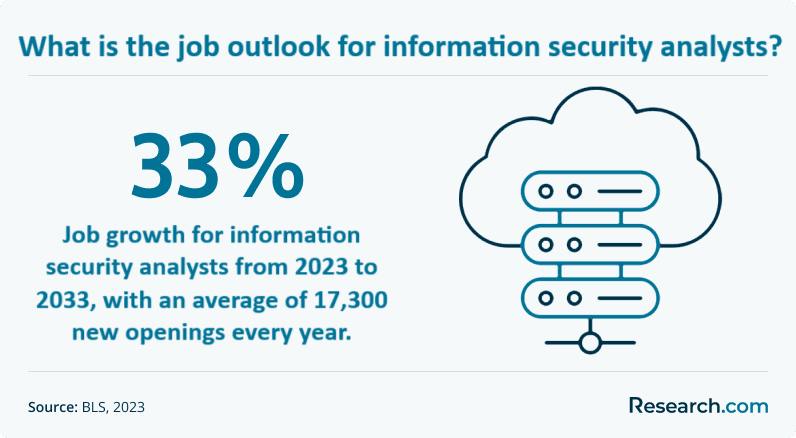
According to recent data from the U.S. Bureau of Labor Statistics, employment of information security analysts is projected to grow 33% from 2023 to 2033, with about 17,300 openings projected each year, on average, over this 10-year period. Cybersecurity jobs, in general, are projected to grow by 35% through 2031, much faster than the average for other occupations.
Associate degree graduates may find opportunities in technology, finance, healthcare, government, retail, education, and other sectors that depend on secure systems and protected data. However, job titles vary widely. Some graduates may begin in technical support, network support, or systems administration before moving into a dedicated security analyst role.
Reported entry-level cybersecurity roles may range from $50,000 to $80,000 annually depending on position and location. Students should treat salary ranges as market context, not promises. Local employer demand, internship experience, clearance eligibility, certifications, and technical interview performance can all affect outcomes.
What student support services can enhance my cybersecurity education?
Student support can make the difference between finishing a cybersecurity program with confidence and struggling through technical coursework alone. This is especially important for online students, working adults, first-generation college students, and learners new to IT.
- Technical help desk: Cybersecurity labs often require virtual machines, specialized platforms, or remote access tools. Fast support matters.
- Academic advising: Advisors should help students plan prerequisites, course loads, transfer options, and certification timing.
- Tutoring and lab assistance: Networking, scripting, and systems courses can be difficult without hands-on help.
- Career services: Resume reviews, mock interviews, internship leads, and employer events can improve job readiness.
- Mentorship: Faculty, alumni, and industry mentors can help students choose specializations and avoid unrealistic expectations.
- Online community: Discussion forums, study groups, and project teams help remote learners stay engaged.
Students comparing technical online programs can also review how support is discussed in other applied fields, such as the most affordable accredited engineering online colleges, where lab access, advising, and academic support also play a major role in student success.
How can artificial intelligence enhance a two-year cybersecurity education?
Artificial intelligence is changing how cybersecurity students learn and how security teams work. In education, AI can support threat detection labs, anomaly analysis exercises, automated feedback, simulated phishing scenarios, and adaptive practice. It can also help students understand how attackers may use automation, generated content, and large-scale scanning to increase the speed of attacks.
AI should not replace fundamentals. Students still need networking, systems, scripting, ethics, and careful human judgment. The best programs teach AI as a tool that can assist analysis, not as a shortcut that removes the need to understand what is happening. Learners who want a deeper technology foundation may explore an online degree AI as a complementary pathway, especially if they are interested in security automation, machine learning risk, or AI governance.
What is the job placement rate for cybersecurity graduates?
There is no single job placement rate that applies to all two-year cybersecurity graduates. Placement outcomes vary by school, region, labor market, student experience, internship participation, certification completion, and how the institution defines “placement.” Some schools count related IT jobs; others may count only cybersecurity-specific roles. Some report employment within a specific time window, while others do not publish audited data.
Before trusting a placement claim, ask the school for details:
- What percentage of cybersecurity graduates found employment?
- Were the jobs cybersecurity-specific, IT-related, or unrelated?
- What time frame was used to measure placement?
- How many graduates were included in the calculation?
- Were part-time, contract, military, self-employed, or continuing-education students counted?
- Are placement results verified by an external source?
- Which employers have recently hired graduates?
Students interested in specialized sectors should also consider interdisciplinary pathways. For example, online health informatics degrees may be relevant for learners who want to work where cybersecurity, healthcare data, privacy, and information systems overlap.
What are the career advancement opportunities for those with a two-year degree in cybersecurity?
A two-year cybersecurity degree can be the first stage of a longer career ladder. Advancement usually comes from combining work experience with certifications, specialization, further education, and a record of solving real security problems.
- Earn role-aligned certifications: Credentials such as CompTIA Security+, Certified Ethical Hacker, Cisco Certified Network Associate, or other security and networking certifications can help validate skills. Cybersecurity and IT credentials are often discussed among online certifications that pay well, but the value depends on employer demand and role fit.
- Build experience in adjacent IT roles: Help desk, systems administration, and network support jobs can provide the practical foundation needed for security operations.
- Specialize strategically: Cloud security, penetration testing, incident response, digital forensics, compliance, and identity management can lead to more focused career paths.
- Transfer to a bachelor’s degree: A bachelor’s program may help with roles that require broader theory, leadership preparation, or advanced technical depth.
- Document measurable projects: Keep a portfolio of labs, reports, scripts, network diagrams, incident response exercises, and capstone work.
- Develop leadership ability: Security teams need people who can coordinate response, prioritize risk, and communicate with nontechnical stakeholders.
- Stay current: Continuous learning is part of the job because tools, threats, compliance expectations, and infrastructure change quickly.
What soft skills do employers value in cybersecurity roles?
Technical ability gets attention, but soft skills often determine whether a candidate can succeed on a security team. Cybersecurity work requires judgment, restraint, accuracy, and communication under pressure.
- Critical thinking: Security professionals must separate false alarms from serious risks and avoid jumping to unsupported conclusions.
- Clear communication: Analysts need to explain technical findings to managers, users, auditors, and other IT teams.
- Attention to detail: Small configuration errors, missed alerts, or unclear documentation can create larger problems.
- Ethical responsibility: Security work involves access to sensitive systems and data, so trustworthiness is essential.
- Collaboration: Cybersecurity teams work with IT, legal, compliance, operations, and business leaders.
- Adaptability: Threats change quickly, and professionals must keep learning without becoming overwhelmed.
- Problem-solving: Employers value candidates who can troubleshoot methodically instead of only following memorized steps.
Students who enjoy hardware, systems, and applied technical problem-solving may also find useful perspective in fields such as electrical engineering trade school programs, though cybersecurity careers require their own specialized security training.
What accreditation and quality standards should I consider in a cybersecurity program?
Accreditation is one of the most important quality checks for a two-year cybersecurity degree. It can affect financial aid eligibility, credit transfer, employer recognition, and whether your education is accepted by future schools. Students should verify institutional accreditation through official sources rather than relying only on marketing language.
Quality also depends on what happens inside the program. Look for current coursework, qualified faculty, lab access, certification alignment, employer partnerships, internship opportunities, and transparent outcome data. A low-cost program can be a smart choice if it is properly accredited and academically strong. Students comparing budget-conscious technology pathways may also review a cheap online information technology degree to understand how IT and cybersecurity options differ in scope and career focus.
What questions should I ask before enrolling?
Before committing to a two-year cybersecurity degree, ask direct questions that reveal whether the program is practical, credible, and aligned with your goals.
- Is the institution accredited, and by whom?
- Does the program prepare students for CompTIA Security+, CEH, Cisco, or other relevant certification exams?
- Are certification vouchers included in tuition or paid separately?
- How much hands-on lab time is required?
- Do students complete a capstone, internship, cyber range, or employer project?
- Which courses transfer into bachelor’s programs, and which schools have articulation agreements?
- What hardware and software will I need as an online or campus student?
- What percentage of graduates work in cybersecurity-specific roles versus general IT roles?
- Which employers have hired recent graduates?
- How quickly do instructors and technical support respond to online students?
- Can I attend part time if I work?
- What is the total program cost, including fees, books, labs, and exams?
Common Mistakes to Avoid
- Choosing a school without verifying accreditation: Accreditation affects transfer credit, aid eligibility, and employer confidence.
- Looking only at tuition: Fees, software, hardware, certification exams, and transportation can change the true cost.
- Assuming the degree alone guarantees a cybersecurity job: Projects, labs, certifications, internships, and interview skills matter.
- Ignoring networking fundamentals: Cybersecurity students who skip the basics often struggle with real troubleshooting.
- Collecting certifications without a plan: Credentials should match the job you want, not simply fill a resume.
- Choosing an online program without checking lab access: Cybersecurity cannot be learned well through readings alone.
- Failing to ask about transfer credits: If you later pursue a bachelor’s degree, weak transfer policies can cost time and money.
- Relying only on rankings or marketing claims: Always compare curriculum, outcomes, support, and employer connections.
Key Insights
- A two-year cybersecurity degree can be a cost-conscious and practical route into entry-level cybersecurity and related IT work, especially when the program includes labs, certification preparation, and career support.
- The strongest associate degree graduates usually combine the credential with hands-on projects, internships, certifications, and experience in networking or systems support.
- Reported costs vary widely: the annual cost of attendance at any two-year institution is nearly $13,000, average in-district community college tuition is $3,780, out-of-state community college tuition is close to $9,000, and private two-year institutions often average $18,300.
- Cybersecurity and related IT salaries can be competitive, but outcomes depend on role, location, experience, certifications, and employer requirements. Students should not treat salary ranges as guarantees.
- The job outlook for information security analysts is strong, with projected growth of 33% from 2023 to 2033 and about 17,300 openings projected each year, on average, over that period.
- A boot camp may be useful for focused upskilling, but an accredited associate degree usually offers broader fundamentals, transfer value, and a more structured pathway for beginners.
- Students who may want advanced roles should choose a two-year program with transferable credits and a clear path to a bachelor’s degree.
- The best program is not simply the cheapest or fastest. It is the one that is accredited, affordable, hands-on, certification-aware, transfer-friendly, and transparent about graduate outcomes.
References:
- Glassdoor. (2024, June 6). Cyber Security Salaries - How much does a Cyber Security make? Glassdoor.
- Payscale. (n.d.). Average Cyber Security Analyst Salary. Payscale.
- U.S. Bureau of Labor Statistics. (2024, April 3). Occupational Employment and Wage Statistics | May 2023 National Occupational Employment and Wage Estimates. BLS.
- U.S. Bureau of Labor Statistics. (2024, August 29). Occupational Outlook Handbook: Information Security Analysts. BLS.
- U.S. Bureau of Labor Statistics. (2024, April 3). Occupational Employment and Wage Statistics: 15-1212 Information Security Analysts. BLS.
Other Things You Should Know About a Two-Year Degree in Cybersecurity
Most two-year cybersecurity degrees require college algebra or statistics, plus basic logic for security analysis. Some programs ask for one to three mathematics courses before graduation. Students who plan to transfer often need the math to match associate degree or state university requirements.
To enroll in a two-year cybersecurity degree in 2027, students typically need a high school diploma or equivalent. Some programs may also require a basic understanding of computer science or mathematics, demonstrated through prior coursework or placement tests.


