
2027 Highest Paying Computer Science Jobs and Careers

Co-Founder and Chief Data Scientist
Choosing a computer science career is no longer just a question of “Can I code?” The better question is which technical path fits your strengths, income goals, education budget, and tolerance for constant change. High-paying computer science jobs in the United States now span artificial intelligence, cybersecurity, cloud architecture, software engineering, data science, DevOps, and big data infrastructure. Each path requires a different mix of programming ability, systems thinking, communication, math, business judgment, and hands-on project experience.
This guide is for students comparing majors, career changers entering technology, early-career developers planning a specialization, and experienced professionals deciding whether an advanced degree or certification is worth the investment. You will learn which computer science roles currently show the strongest salary potential, what each job actually does, which skills and credentials matter, how much computer science degrees can cost, and how to make a practical career plan without relying only on salary headlines.
Quick Answer: Which Computer Science Jobs Pay the Most?
The highest-paying computer science jobs listed in this guide include principal software engineer, software architect, cloud architect, software engineer, big data engineer, DevOps engineer, data scientist, artificial intelligence engineer, cybersecurity engineer, and information security analyst. Among the roles covered here, principal software engineer has the highest listed median salary at $162,070, followed by software architect and cloud architect at $141,955, and software engineer at $133,310. Actual pay can vary widely by location, employer, experience, specialization, industry, and negotiation.
Why Computer Science Remains a Strong Career Field
- Broad employer demand: Computer science graduates can work in technology companies, finance, healthcare, education, government, defense, retail, manufacturing, consulting, research, and startups. The degree can also support entrepreneurship or freelance work.
- Flexible education formats: Online computer science programs may help students reduce commuting and relocation costs while studying around work or family commitments. Students should still compare tuition, fees, accreditation, transfer policies, and career support before enrolling.
- Strong wage potential: Computer science degree holders have a median annual salary of $104,420 in May 2023, more than double the median for all other jobs. Higher earnings are possible in senior, specialized, or leadership roles, although no degree guarantees a specific salary.
- What are the top 10 highest-paying computer science jobs for 2027?
- What are the essential skills required to succeed in computer science jobs?
- How much do computer science degrees typically cost?
- What certifications are available for computer science jobs?
- What programming languages are most in demand for high-paying jobs?
- How can I improve my problem-solving and analytical skills for a computer science career?
- What is the job outlook for computer science professionals in the next decade?
- What are the average salaries for the highest-paying computer science jobs?
- What emerging trends will impact computer science jobs in the coming years?
- What career opportunities are available for computer science graduates in emerging fields?
- What are the most affordable education options for aspiring computer science professionals?
- Is computer science still a good major?
- How can I effectively negotiate my computer science salary and benefits?
- What are some common myths and misconceptions about computer science jobs?
- How to transition into computer science from a non-tech background?
- What challenges do computer science professionals typically face in their careers?
- How can advanced education boost my career prospects in computer science?
- Is specializing in cybersecurity a smart move for my career?
- Can combining computer science with design studies expand career horizons?
- How can I select the best online program for bioinformatics?
- Is an online AI master's degree the catalyst for career transformation?
- How can I strategically plan a sustainable long-term career in computer science?
- Can a foundation in biotechnology amplify my computer science career?
- How can leveraging data science expertise enhance my computer science career?
- Can integrating bioinformatics into my skill set unlock new career opportunities?
- Is an online MS in bioinformatics worth pursuing for career advancement?
- How can professional networking and mentorship boost my computer science career?
- How can integrating game development skills elevate my computer science career?
- How can blending technical skills with management expertise propel my career advancement?
- How can practical project experience boost my computer science career?
What are the top 10 highest-paying computer science jobs for 2027?
The following roles represent a practical cross-section of high-paying computer science careers in the United States. They are not the only lucrative technology jobs, but they show where advanced programming, architecture, security, data, and infrastructure skills can lead. Salary figures should be treated as planning benchmarks, not guaranteed outcomes.
| Rank | Role | Average or median salary listed | Best fit for professionals who enjoy |
| 1 | Artificial Intelligence Engineer | $122,093 | Machine learning, model building, algorithms, experimentation |
| 2 | Data Scientist | $124,222 | Statistics, analytics, prediction, business problem-solving |
| 3 | Software Architect | $141,955 | System design, technical strategy, scalability, platform decisions |
| 4 | Principal Software Engineer | $162,070 | Senior engineering leadership, complex codebases, mentoring |
| 5 | Cybersecurity Engineer | $102,965 | Security controls, threat defense, secure infrastructure |
| 6 | Software Engineer | $133,310 | Building, testing, and improving applications and systems |
| 7 | Information Security Analyst | $91,233 | Risk monitoring, incident response, security analysis |
| 8 | Big Data Engineer | $128,667 | Data pipelines, distributed systems, large-scale processing |
| 9 | Cloud Architect | $141,955 | Cloud platforms, infrastructure design, cost optimization |
| 10 | DevOps Engineer | $126,835 | Automation, deployment pipelines, reliability, operations |
1. Artificial Intelligence Engineer
- What the role does: Designs AI-enabled systems, develops algorithms, trains machine learning models, evaluates model performance, and applies AI methods to difficult business or research problems.
- Average salary: $122,093. Pay is often strong because employers need professionals who can combine programming, applied math, data handling, and model deployment skills.
- Good fit if: You like experimentation, statistics, Python-based development, and working with uncertain or evolving technical requirements.
2. Data Scientist
- What the role does: Interprets large datasets, builds predictive models, communicates findings to decision-makers, and helps organizations turn raw information into usable strategy.
- Average salary: $124,222. Candidates with strong analytics, programming, data storytelling, and business context tend to be more competitive.
- Education path to consider: If graduate training fits your goals and budget, compare the most affordable online data science master's programs before committing to a program.
3. Software Architect
- What the role does: Plans the structure of complex software systems, selects technical patterns, reviews trade-offs, and makes decisions that affect scalability, reliability, performance, and maintainability.
- Average salary: $141,955. Compensation reflects the role’s influence on product direction, development efficiency, and long-term technical risk.
- Education path to consider: Students aiming for architecture roles can compare affordable online software engineering degrees to build a formal foundation in software design and engineering practices.
4. Principal Software Engineer
- What the role does: Leads high-impact engineering work, mentors developers, sets technical standards, solves difficult production problems, and guides major software initiatives.
- Average salary: $162,070. This is one of the highest salaries in the list because the role combines deep engineering expertise with technical leadership.
- Education path to consider: A strong engineering background matters. For cost-conscious learners, low-cost online software engineering degree options can be part of a long-term plan.
5. Cybersecurity Engineer
- What the role does: Builds and improves defenses for networks, applications, cloud environments, and systems; implements security controls; investigates threats; and supports incident response.
- Average salary: $102,965. Demand remains strong because organizations face persistent risks involving data breaches, ransomware, compliance, and cloud security.
- Training path to consider: Shorter credentials can help with targeted skills, so review online cybersecurity courses with certificates if you want a focused entry point.
6. Software Engineer
- What the role does: Writes, tests, debugs, maintains, and improves software. Depending on the employer, the work may involve web applications, mobile apps, backend systems, APIs, embedded systems, or internal tools.
- Average salary: $133,310. Pay can shift substantially based on experience, company size, technical stack, location, and product complexity.
- Good fit if: You want a broad, flexible path that can later branch into architecture, management, AI, cloud, security, or product engineering.
7. Information Security Analyst
- What the role does: Monitors systems for threats, evaluates security risks, supports incident response, documents findings, and helps organizations maintain safer technology environments.
- Average salary: $91,233. Specialized experience in areas such as penetration testing, security operations, governance, or incident response may improve competitiveness.
- Good fit if: You prefer investigation, risk analysis, documentation, and operational security over full-time software development.
8. Big Data Engineer
- What the role does: Designs and maintains data pipelines, supports large-scale data processing, manages storage and transformation workflows, and enables analysts and data scientists to work with reliable datasets.
- Average salary: $128,667. Employers value this role because advanced analytics and AI projects depend on clean, scalable, well-governed data infrastructure.
- Good fit if: You enjoy backend engineering, distributed systems, databases, automation, and performance tuning.
9. Cloud Architect
- What the role does: Designs cloud environments, chooses services and deployment models, manages infrastructure strategy, improves reliability, and helps control cloud spending.
- Average salary: $141,955. Pay is often competitive for professionals with strong platform experience in AWS, Azure, and GCP, especially when paired with security and cost-management skills.
- Good fit if: You like infrastructure, systems design, automation, networking, security, and business-aware technical planning.
10. DevOps Engineer
- What the role does: Connects software development and IT operations by automating builds, tests, deployments, monitoring, and infrastructure workflows.
- Average salary: $126,835. DevOps skills are valued because fast, reliable software delivery is central to modern engineering teams.
- Good fit if: You like scripting, cloud tools, CI/CD, containers, observability, troubleshooting, and reducing manual work.
Computer science careers are also supported by broader labor-market demand. Overall employment in computer and information technology occupations is projected to grow by 14.6% from 2021 to 2031, resulting in about 682,800 new jobs. Information security analysts are expected to see a growth of 34.7%, while web developers are projected to grow by 30.3%. Software developers are anticipated to grow by 26%, and computer and information research scientists are expected to grow by 21.3%. These figures help explain why many students still view computer science as a high-opportunity field, though competition for top roles can remain intense.
What are the essential skills required to succeed in computer science jobs?
High-paying computer science roles usually require more than one programming language. Employers look for people who can understand systems, solve ambiguous problems, write maintainable code, communicate trade-offs, and keep learning as tools change. Creative technology paths also exist; for example, students interested in technical art, interactive media, or game production may compare the best online video game design degree programs alongside traditional computer science programs.
| Skill area | Why it matters | Examples |
| Programming | Core software, data, cloud, and AI work depends on writing and understanding code. | Python, Java, C++, JavaScript, C# |
| Algorithms and data structures | These skills help you write efficient solutions and perform well in technical interviews. | Arrays, linked lists, trees, graphs, searching, sorting |
| Systems thinking | Senior roles require understanding how applications, databases, networks, and infrastructure interact. | Operating systems, APIs, distributed systems, cloud architecture |
| Data and databases | Most modern applications depend on storing, querying, securing, and analyzing data. | SQL, relational databases, data pipelines, analytics workflows |
| Communication | Technical workers must explain decisions to engineers, managers, clients, and nontechnical stakeholders. | Documentation, presentations, code reviews, requirements discussions |
| Adaptability | Frameworks, platforms, security risks, and employer expectations change quickly. | Continuous learning, experimentation, professional development |
Technical skills to build first
- Programming languages: Learn at least one general-purpose language deeply before collecting many surface-level skills. Python, Java, C++, JavaScript, and C# are common starting points.
- Data structures and algorithms: Understand arrays, linked lists, trees, graphs, sorting, searching, recursion, and complexity analysis.
- Debugging and testing: Employers value developers who can isolate defects, write reliable tests, and improve existing code without breaking production systems.
- Databases: SQL, schema design, indexing, data modeling, and basic database administration are useful across many roles.
- Operating systems and networking: Linux, Windows, macOS, processes, memory, permissions, APIs, HTTP, DNS, and network basics become increasingly important in cloud, security, and DevOps roles.
Professional skills that affect promotion
- Clear communication: Strong engineers explain trade-offs, write useful documentation, and translate technical issues into business impact.
- Collaboration: Software products are built by teams. Code reviews, planning meetings, design discussions, and cross-functional work are normal parts of the job.
- Time management: Technical work often includes deadlines, production incidents, and changing requirements. Prioritization matters.
- Creativity: Computer science is not just implementation. It often involves finding new ways to solve constraints involving cost, speed, quality, and usability.
- Ethical judgment: AI, cybersecurity, privacy, accessibility, and data governance all require professionals who can recognize downstream consequences.
How much do computer science degrees typically cost?
The price of a computer science degree depends on degree level, school type, residency status, online or campus format, fees, living expenses, transfer credits, and financial aid. For a bachelor's degree, annual tuition typically ranges from approximately $6,000 to $40,000 or more. Students considering adjacent creative technology fields can also compare the most affordable online video game design degree programs if game design is part of their career plan.
| Education option | Cost information listed | Decision point |
| Bachelor's degree in computer science | Annual tuition typically ranges from approximately $6,000 to $40,000 or more. | Compare total cost, graduation rates, transfer credit rules, and internship access. |
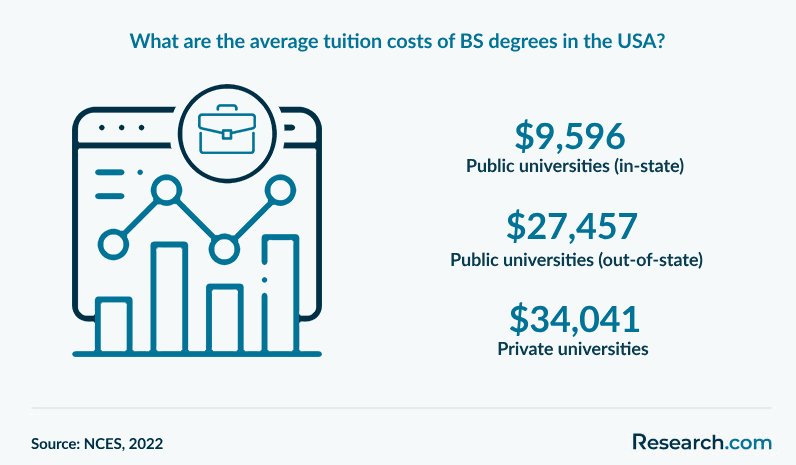
| Public university, in-state | In-state tuition averages around $9,596. | Often a lower-cost route if the program has strong employer connections. |
| Public university, out-of-state | Out-of-state students may pay about $27,457. | Check whether the higher price is justified by outcomes, location, or specialization. |
| Private institution | Private institutions average around $34,041 annually. | Review scholarships, net price, career outcomes, and debt expectations. |
| Master's degree in computer science | Tuition often falls between $20,000 and $40,000. | Best suited when it supports specialization, career change, or advancement. |
| Average annual tuition reported by NCES | The average annual tuition for a bachelor's degree in computer science was about $17,545 during the 2020-2021 academic year. | Use averages only as a starting point; your actual cost may differ. |
Tuition is only one part of the cost. Students should also budget for room and board, books, transportation, technology, certification exams, application fees, and the opportunity cost of reducing work hours. Online programs may reduce some costs, but they are not automatically cheaper; always compare the full net price after aid.
What certifications are available for computer science jobs?
Certifications can help validate specialized skills, especially in cloud computing, cybersecurity, DevOps, agile development, and data platforms. They are usually most valuable when paired with projects, work experience, or a degree. A certification alone rarely replaces the need to demonstrate practical competence.
Cloud computing certifications
- AWS Certified Solutions Architect: Signals knowledge of designing and implementing solutions on Amazon Web Services.
- Azure Certified Solutions Architect: Demonstrates ability to plan and build solutions using Microsoft Azure.
- Google Cloud Certified Professional Cloud Architect: Supports roles involving architecture and deployment on Google Cloud Platform.
Data science and machine learning certifications
- Certified Data Scientist (CDS): Offered by the Data Science Council of New York and intended to validate data science and analytics expertise.
- Certified Machine Learning Scientist (CMLS): Offered by the Machine Learning Institute and focused on machine learning and artificial intelligence knowledge.
- Cloudera Certified Data Scientist: Designed for professionals using Cloudera's data platform for analytics and data science work.
Cybersecurity certifications
- Certified Information Systems Security Professional (CISSP): A widely recognized credential for experienced information security professionals.
- Certified Ethical Hacker (CEH): Focuses on identifying and testing vulnerabilities in systems.
- Certified Information Security Manager (CISM): Supports professionals managing security programs and governance.
Software development and agile certifications
- Certified Software Development Professional (CSDP): Offered by the International Software Certification Board for software development knowledge.
- Certified ScrumMaster (CSM): Useful for professionals working in Scrum-based agile environments.
- Certified Scrum Product Owner (CSPO): Relevant for product ownership and agile planning responsibilities.
DevOps certifications
- Certified DevOps Professional (CDP): Offered by DevOps Institute and focused on DevOps practices and tools.
- Certified Kubernetes Administrator (CKA): Validates knowledge of Kubernetes cluster administration.
If your career goal includes technical leadership, people management, or project ownership, a business-oriented program may complement your technical background. For example, a low-cost online BS in organizational leadership can help some professionals build communication, decision-making, and management skills alongside technical experience.
Before paying for any credential, ask three questions: Is it recognized in job postings for your target role? Does it require hands-on skills that employers can verify? Will the cost and study time produce a better outcome than a portfolio project, internship, or degree course?
What programming languages are most in demand for high-paying jobs?
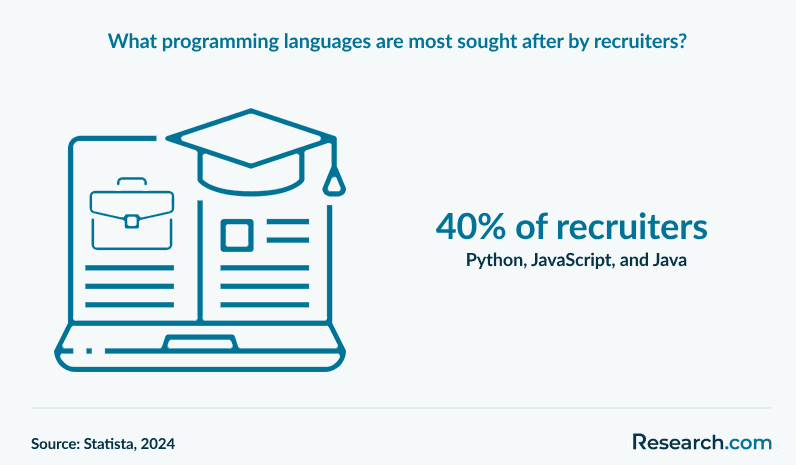
In 2024, the programming languages most sought after by recruiters were Python, JavaScript, and Java, with approximately 40% of recruiters seeking candidates who possess these skills, as shown in the graphic below.
The best language to learn depends on the role you want. AI and data roles often emphasize Python. Enterprise software roles frequently use Java and C#. Web development relies heavily on JavaScript. Systems, performance, and game-related work may require C++, Rust, or C#.
| Language | Common uses | Tools and frameworks listed |
| Python | Data science, machine learning, automation, web development, scientific computing | NumPy, Pandas, Matplotlib, TensorFlow, PyTorch |
| Java | Enterprise software, Android development, backend services, web applications | IntelliJ IDEA, Eclipse, Spring Framework, Maven |
| JavaScript | Front-end development, back-end development, full-stack web applications | React, Angular, Vue, Node.js |
| C++ | Systems programming, game development, performance-sensitive software | Visual Studio, GCC, CMake |
| C# | Windows development, game development, web development | Visual Studio, .NET Framework, Unity |
| Go | Cloud services, scalable backend systems, concurrent applications | GoLand, Visual Studio Code, Docker |
| Rust | Systems programming, secure and high-performance software | Rustup, Cargo |
| Swift | iOS and macOS application development | Xcode |
Developer tools that employers expect
- GitHub: A code hosting and collaboration platform that can also serve as a public portfolio for projects, contributions, and documentation.
- GitLab: A similar platform used by teams for repositories, version control, CI/CD, and collaboration.
- Bitbucket: An Atlassian-owned code hosting platform often used in enterprise environments.
- Stack Overflow: A programmer Q&A resource that helps with troubleshooting, learning, and understanding common development patterns.
Some professionals combine computing with design-heavy fields. If that intersection interests you, online interior design degree programs can be compared with technical coursework to understand how software tools, visualization, spatial thinking, and user-centered design may overlap.
How can I improve my problem-solving and analytical skills for a computer science career?
Problem-solving is built through repeated practice, feedback, and reflection. The goal is not just to solve coding puzzles quickly; it is to learn how to define a problem, choose an approach, test assumptions, handle edge cases, and explain your reasoning.
A practical skill-building routine
- Pick one language for daily practice: Use Python, JavaScript, Java, or another language tied to your target role.
- Study core data structures: Work through arrays, hash maps, stacks, queues, linked lists, trees, graphs, and heaps.
- Practice coding challenges: Use LeetCode, HackerRank, Codeforces, or similar platforms, but focus on learning patterns instead of memorizing answers.
- Break problems into smaller parts: Identify inputs, outputs, constraints, edge cases, and the simplest possible working version.
- Learn multiple approaches: Compare brute force, optimized, recursive, iterative, and data-structure-based solutions.
- Debug systematically: Trace execution, inspect variables, write test cases, and isolate the smallest failing example.
- Ask for code review: Feedback from peers, mentors, instructors, or open-source communities can reveal habits you may not notice alone.
- Build real projects: Projects teach architecture, debugging, deployment, documentation, and maintenance in ways that isolated exercises cannot.
Common mistake to avoid
Do not treat interview practice as a substitute for engineering experience. Coding problems can sharpen logic, but employers also want to see that you can build, maintain, test, and explain real software.
What is the job outlook for computer science professionals in the next decade?
The employment outlook for computer science and information technology professionals remains favorable in the data cited here, but the opportunity is not evenly distributed across every role or skill level. Specialized areas such as security, software development, research, cloud, and data continue to stand out.
Growth rate
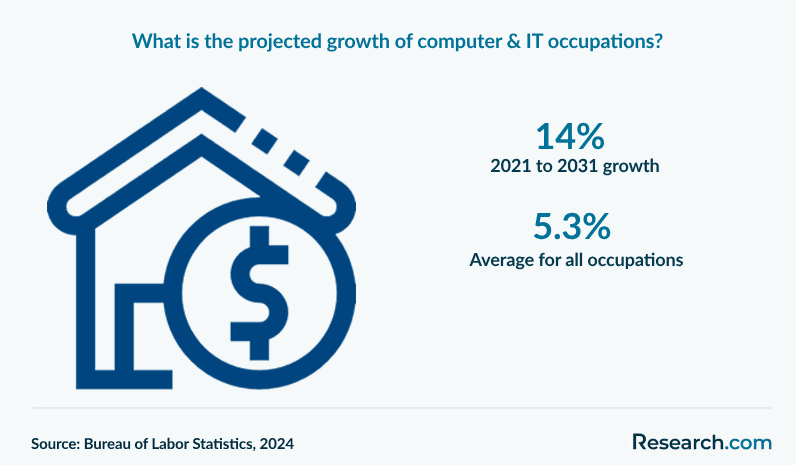
- Employment in computer and information technology occupations is projected to grow by 14% from 2021 to 2031, significantly faster than the average for all occupations, which is around 5.3%. These figures are shown in the graphic below.
Roles with notable projected demand
- Information security analysts: Expected growth of 34.7%.
- Web developers: Projected growth of 30.3%.
- Software developers: Anticipated growth of 26%.
- Computer and information research scientists: Expected growth of 21.3%.
Annual wages
The median annual wage for computer and IT occupations was around $104,420 in May 2023, which is more than double the median for all jobs.
What this means for students
Demand is strongest for candidates who can demonstrate job-ready skills, not just coursework. Cloud computing, artificial intelligence, cybersecurity, software engineering, data infrastructure, and automation are especially important areas to watch. If cybersecurity is your target, compare program costs carefully using resources such as affordable online cybersecurity degree options.
What are the average salaries for the highest-paying computer science jobs?
Salary comparisons are useful only when you consider role level, industry, location, and required experience. For example, “software engineer” can include entry-level developers, specialized backend engineers, senior engineers, and highly compensated technical experts. The figures below summarize the salary data cited in this guide.
| Computer science role | Median or average salary listed | Salary range listed |
| Artificial Intelligence Engineer | $122,093 | $102,852 to $138,556 |
| Data Scientist | $124,222 | $97,000 to $159,000 |
| Software Architect | $141,955 | $95,362 to $211,311 |
| Principal Software Engineer | $162,070 | $107,390 to $244,593 |
| Software Engineer | $133,310 | $74,230 $192,400 |
| Cybersecurity Engineer | $102,965 | $63,767 to $166,258 |
| Information Security Analyst | $91,233 | $62,118 to $133,992 |
| Big Data Engineer | $128,667 | $82,984 to $199,577 |
| Cloud Architect | $141,955 | $95,362 to $211,311 |
| DevOps Engineer | $126,835 | $114,000 to $141,000 |
Artificial intelligence engineers have a median salary of $122,093, while data scientists are listed at $124,222. Software architects and cloud architects are both listed at $141,955. Principal software engineers show the highest figure in this guide at $162,070. Cybersecurity engineers, information security analysts, big data engineers, software engineers, and DevOps engineers also show strong compensation potential, especially for candidates with specialized experience.
When comparing salaries, avoid choosing a path solely because one number is higher. A role that fits your strengths, learning style, and work preferences may produce better long-term results than a higher-paid role you dislike or cannot sustain.
What emerging trends will impact computer science jobs in the coming years?
Computer science is shaped by technology shifts, business needs, regulation, security risks, and the cost of computing infrastructure. The trends below are especially relevant for career planning because they influence which skills employers seek and which roles may evolve.
1. Artificial intelligence and machine learning
- Related roles: AI engineers, machine learning engineers, data scientists.
- Career impact: AI is changing product development, analytics, automation, search, customer service, software engineering workflows, and decision support. Professionals who understand both model behavior and software deployment will be better positioned.
2. Quantum computing
- Related roles: Quantum computer scientists, quantum software developers, quantum algorithm researchers.
- Career impact: Quantum computing may affect cryptography, materials science, drug discovery, and advanced research, but many roles require advanced mathematical and scientific preparation.
3. Cybersecurity
- Related roles: Cybersecurity analysts, penetration testers, ethical hackers.
- Career impact: Security is becoming a core requirement across cloud, software, data, AI, finance, healthcare, and government systems.
4. Internet of Things
- Related roles: IoT developers, IoT security experts, IoT data analysts.
- Career impact: Connected devices create demand for embedded systems, networking, real-time data processing, and device security expertise.
5. Blockchain technology
- Related roles: Blockchain developers, blockchain architects, smart contract developers.
- Career impact: Blockchain skills can apply to decentralized finance, supply chain systems, identity, digital contracts, and secure transaction models.
6. Edge computing
- Related roles: Edge computing engineers, edge data analysts.
- Career impact: Edge computing increases the need for professionals who can design distributed systems that process data closer to where it is generated.
7. Bioinformatics and computational biology
- Related roles: Bioinformatics scientists, computational biologists.
- Career impact: Biology, medicine, and data science increasingly intersect. A computer science background can be valuable in analyzing biological data and building computational models.
- Interdisciplinary option: Professionals who want to work across technology and healthcare administration can also review affordable online master's in healthcare administration programs.
8. Augmented reality and virtual reality
- Related roles: AR/VR developers, AR/VR designers.
- Career impact: Immersive technologies require real-time graphics, interaction design, performance optimization, and user experience expertise.
9. Low-code and no-code development
- Related roles: Low-code/no-code developers, citizen developers.
- Career impact: These tools may automate simple application development, but professional developers remain important for complex systems, integrations, security, scalability, and governance.
10. Ethical AI and data privacy
- Related roles: AI ethicists, data privacy specialists.
- Career impact: As organizations use more data and AI systems, they need professionals who can address bias, privacy, transparency, compliance, and responsible deployment.
What career opportunities are available for computer science graduates in emerging fields?
Emerging fields can be attractive because they combine technical challenge with new market demand. They can also be risky if you specialize too narrowly before a field matures. A balanced strategy is to build durable computer science fundamentals first, then add a targeted specialty. For professionals who want technology leadership training, an affordable online MBA in Information Technology may be worth comparing with technical graduate programs.
| Emerging field | Example roles | What to learn |
| Artificial intelligence and machine learning | Machine Learning Engineer, AI Researcher, AI Product Manager | Python, statistics, machine learning, model evaluation, data engineering |
| Blockchain and cryptocurrency | Blockchain Developer, Smart Contract Engineer, Cryptocurrency Analyst | Distributed systems, cryptography basics, smart contracts, security |
| Quantum computing | Quantum Computing Researcher, Quantum Software Developer, Quantum Algorithm Specialist | Algorithms, linear algebra, quantum mechanics foundations |
| Augmented and virtual reality | AR/VR Developer, Game Developer, AR/VR Product Designer | Graphics, 3D development, real-time performance, interaction design |
| Robotics | Robotics Engineer, Automation Developer, Robotics Research Scientist | Software engineering, hardware basics, control systems, automation |
| Cybersecurity | Cybersecurity Architect, Ethical Hacker, Security Analyst | Networks, secure coding, threat modeling, incident response |
| Internet of Things | IoT Developer, IoT Security Engineer, IoT Product Manager | Embedded systems, networking, data collection, device security |
What are the most affordable education options for aspiring computer science professionals?
Affordable computer science education can include community college transfer pathways, public universities, online bachelor's programs, employer tuition assistance, certificates, bootcamps, self-paced learning, and graduate programs with strong financial aid. The best option depends on whether you need a first degree, a career-change credential, a specialization, or a promotion pathway. Students who want a technology foundation at a lower cost can compare the cheapest online IT degree options as part of their research.
How to reduce education costs without weakening outcomes
- Start with transfer credits: Completing general education or introductory programming courses at a lower-cost institution can reduce total tuition.
- Compare net price, not sticker price: Scholarships, grants, employer benefits, and residency status can change the real cost.
- Check accreditation: Accreditation affects credit transfer, financial aid eligibility, and employer confidence.
- Prioritize career services: Internships, employer partnerships, portfolio support, and alumni networks can matter as much as course titles.
- Avoid paying for duplicate credentials: If you already have a strong degree and experience, a focused certificate or project portfolio may be more efficient than another full degree.
Is computer science still a good major?
Computer science can still be a good major for students who enjoy logical problem-solving, continuous learning, and technical work that changes over time. It is less ideal for students who want a stable body of knowledge that rarely shifts or who dislike debugging, independent practice, and abstract thinking. The strongest return on investment usually comes when students combine coursework with internships, projects, networking, and a clear specialization plan.
Before enrolling, compare program cost against likely career pathways, local employer demand, graduation outcomes, and your willingness to keep learning after the degree. For a deeper decision-focused discussion, review Research.com's guide on whether computer science is still a good major.
How can I effectively negotiate my computer science salary and benefits?
Salary negotiation works best when you combine market evidence with a clear explanation of your value. Research pay ranges for your role, level, location, and industry before discussing compensation. Use reliable salary references, including computer science salary data, to support your expectations.
Negotiation checklist
- Know your target range: Prepare a minimum acceptable offer, a realistic target, and an ideal outcome.
- Quantify your impact: Mention measurable achievements such as performance improvements, cost savings, security improvements, successful launches, or reduced downtime.
- Consider the whole package: Base pay matters, but bonuses, equity, remote work, health benefits, retirement contributions, paid time off, relocation support, and training budgets can also affect value.
- Time the conversation carefully: Negotiate after an offer or during a structured review, not before the employer understands your fit.
- Stay professional: Frame your request around mutual value, not personal need alone.
What are some common myths and misconceptions about computer science jobs?
Myth 1: Computer science professionals work alone all day
Reality: Many technology roles require constant collaboration with engineers, designers, product managers, security teams, business leaders, clients, and users.
Myth 2: Every computer science job is just coding
Reality: Coding is important, but many roles also involve architecture, planning, testing, security analysis, documentation, research, data interpretation, and stakeholder communication.
Myth 3: Tech jobs are automatically easy to get
Reality: Demand is strong in many areas, but attractive roles can be competitive. Employers often expect portfolios, internships, interview preparation, and evidence of practical skill.
Myth 4: Only young people can enter computer science
Reality: Career changers can move into technology by building fundamentals, using transferable skills, earning targeted credentials, and developing projects that prove ability.
Myth 5: All computer science jobs pay extremely high salaries
Reality: Many roles pay well, but compensation varies by experience, location, employer, specialization, industry, and economic conditions.
Myth 6: Mathematics is the only path into computer science
Reality: Math helps, especially in AI, graphics, research, and algorithms, but communication, creativity, systems thinking, and persistence also matter.
Myth 7: Once you learn one technology, you are set
Reality: Computer science careers require ongoing learning because frameworks, infrastructure, security threats, AI tools, and employer expectations keep changing.
How to transition into computer science from a non-tech background?
Moving into computer science from another field is realistic, but it requires structure. The fastest progress usually comes from combining transferable skills with focused technical training and a portfolio that shows what you can build.
- Identify transferable strengths: Analytical thinking, writing, project management, customer knowledge, operations experience, finance, healthcare, education, and design skills can all support a tech transition.
- Learn programming fundamentals: Start with Python or JavaScript, then practice variables, functions, control flow, data structures, APIs, and debugging.
- Choose a target role early: Software engineering, data analytics, cybersecurity, cloud support, QA testing, and technical product roles require different preparation.
- Use credentials strategically: Certificates, bootcamps, or online degrees can help if they match your target role. If you are comparing degree prices, review how much a computer science degree can cost.
- Build portfolio projects: Create applications, dashboards, scripts, security labs, data analyses, or cloud deployments that demonstrate practical ability.
- Network before you apply widely: Join meetups, online communities, alumni groups, open-source projects, and LinkedIn conversations to learn what employers actually expect.
- Apply for bridge roles: Technical support, QA analyst, junior developer, data analyst, and cloud support roles can provide entry points while you continue developing deeper skills.
What challenges do computer science professionals typically face in their careers?
Computer science careers can be rewarding, but the work is not effortless. Knowing the likely challenges helps students and professionals prepare before they are under pressure.
| Challenge | Why it matters | How to manage it |
| Rapid technology change | Tools, frameworks, threats, and best practices evolve quickly. | Set a regular learning plan and focus on fundamentals that transfer across tools. |
| Complex problems and deadlines | Important systems often involve ambiguity, dependencies, and time pressure. | Break work into milestones, document assumptions, and communicate blockers early. |
| Security responsibility | Small mistakes can expose data, disrupt systems, or create compliance problems. | Learn secure design habits and involve security review before production release. |
| Burnout risk | Production incidents, long projects, and constant learning can become exhausting. | Protect recovery time, improve estimation, and seek teams with sustainable practices. |
| Cross-functional communication | Technical decisions affect nontechnical teams and customers. | Translate technical details into risk, cost, user impact, and business value. |
| Competitive job market | High-opportunity roles often attract many qualified applicants. | Build a portfolio, network consistently, and specialize with intention. |
| Ethical decisions | AI, data, privacy, and automation can affect people at scale. | Ask who is affected, what data is used, and how harm can be reduced. |
| Legacy systems | Older codebases can be difficult to understand, test, or modernize. | Document behavior, add tests before changes, and modernize incrementally. |
If you need a structured path to build credentials quickly, a fast track computer science degree may be worth evaluating, especially if the program has strong academic support and realistic pacing.
What can student and graduate experiences teach you about computer science careers?
Individual stories vary, but successful computer science graduates often mention the same themes: they benefited from hands-on projects, learned to collaborate, struggled through difficult debugging, and gained confidence by solving real problems. The most useful lesson is that the degree alone is rarely the full story. Internships, portfolios, mentorship, and repeated practice often determine how smoothly a graduate moves into the workforce.
How can advanced education boost my career prospects in computer science?
Advanced education can help when it builds specialized expertise, opens access to research, supports a career change, or prepares you for senior technical leadership. It is especially relevant for fields such as artificial intelligence, computer science research, cybersecurity leadership, data science, and complex systems architecture. An online master of computer science may be useful for professionals who want graduate-level depth without leaving the workforce, but the value depends on cost, curriculum, faculty, flexibility, and career outcomes.
Is specializing in cybersecurity a smart move for my career?
Cybersecurity can be a smart specialization for professionals who enjoy risk analysis, investigation, systems thinking, and continuous learning. It is also a field where credentials, labs, hands-on practice, and experience with real tools can matter significantly. Before choosing a program, compare curriculum depth, lab access, certification alignment, and employer connections at each cyber security school you are considering.
Can combining computer science with design studies expand career horizons?
Combining technical and design training can lead to roles in user experience, visualization, simulation, game development, spatial computing, product design, and creative technology. Design knowledge can help computer science professionals build systems that are not only functional but also usable and visually coherent. If you want to explore a design-adjacent graduate path, compare affordable online master's in architecture programs with your technical goals before enrolling.
How can I select the best online program for bioinformatics?
Bioinformatics programs should be evaluated differently from general computer science programs because they combine computing, statistics, biology, and research methods. Look for accreditation, rigorous coursework, qualified faculty, project or capstone requirements, access to relevant tools, and career support tied to healthcare, biotechnology, or research employers. Cost also matters; compare options such as MS bioinformatics online programs if affordability is a priority.
Is an online AI master's degree the catalyst for career transformation?
An online AI master's degree can support career transformation when it fills a real skills gap and connects directly to your target role. It may be most useful for professionals moving from general software development, data analysis, or IT into machine learning engineering, AI product work, applied research, or advanced analytics. Compare curriculum, math prerequisites, model deployment content, faculty experience, project requirements, and total cost. Cost-conscious students can review online AI master's programs before deciding.
How can I strategically plan a sustainable long-term career in computer science?
A sustainable computer science career should balance specialization with adaptability. Build a durable foundation in programming, algorithms, systems, databases, and communication, then layer on a specialty such as AI, cloud, cybersecurity, data engineering, software architecture, or product-focused engineering. Revisit your plan every year as employer demand changes.
Long-term career planning steps
- Choose a primary track: Decide whether you are aiming for software, data, security, cloud, research, management, or interdisciplinary technology.
- Map required skills: Compare job postings and identify repeated tools, languages, credentials, and project types.
- Build proof: Use internships, open-source work, freelance projects, labs, capstones, and certifications to demonstrate ability.
- Develop mentors: Seek guidance from professionals one or two levels ahead of you, not only executives.
- Control education costs: A lower-cost program, such as one of the cheapest online master's in artificial intelligence options, may make sense if it still delivers the skills and credibility you need.
- Protect against burnout: Choose teams, companies, and roles that support sustainable work, documentation, and realistic planning.
Can a foundation in biotechnology amplify my computer science career?
Biotechnology can expand a computer science career for professionals interested in healthcare innovation, genomics, computational biology, laboratory automation, and data-intensive research. This path is strongest for people who are willing to learn scientific context in addition to algorithms and software. An affordable online biotechnology master's degree may be useful if your target roles require life science knowledge as well as computing expertise.
How can leveraging data science expertise enhance my computer science career?
Data science can make a computer science background more versatile by adding statistical modeling, machine learning, visualization, experimentation, and decision support. Software professionals who understand data can contribute to analytics platforms, AI products, recommendation systems, business intelligence tools, and automation projects. To understand the broader field, review Research.com's overview of data science career prospects.
Can integrating bioinformatics into my skill set unlock new career opportunities?
Bioinformatics combines computer science with biological data analysis, making it relevant for healthcare, biotechnology, pharmaceuticals, research institutions, and precision medicine. The field rewards professionals who can work with algorithms, databases, statistics, and domain-specific scientific data. If you want a structured path into this specialty, compare the best online bioinformatics master's programs with your career goals and prerequisite background.
Is an online MS in bioinformatics worth pursuing for career advancement?
An online MS in bioinformatics may be worth pursuing if your career goal requires both computing skill and life science fluency. It can help software developers, data analysts, or biology graduates move toward roles involving genomic data, computational biology, biomedical analytics, or research computing. Before enrolling, compare curriculum, faculty expertise, research opportunities, tuition, and employer relevance across online MS in bioinformatics options.
How can professional networking and mentorship boost my computer science career?
Networking and mentorship can shorten the learning curve by helping you understand which skills are valued, how hiring decisions are made, and where opportunities are emerging. Strong professional relationships can lead to referrals, project collaboration, conference opportunities, technical feedback, and better career decisions. Mentors can also help you decide whether a credential, such as one of the fastest online master's in AI programs, fits your timeline and goals.
How can integrating game development skills elevate my computer science career?
Game development can strengthen a computer science portfolio because it involves real-time systems, graphics, physics, user interaction, performance optimization, and creative problem-solving. These skills can transfer to simulation, AR/VR, training technology, visualization, and interactive applications. If you want formal training, compare the best online game development degree programs with general computer science and software engineering options.
How can blending technical skills with management expertise propel my career advancement?
Technical expertise can get you into computer science roles, but management skill can help you lead projects, influence strategy, coordinate teams, and translate engineering work into business outcomes. This combination is useful for engineering managers, technical program managers, product leaders, architects, and senior engineers who guide cross-functional work. Programs such as accelerated master's in engineering management options may be relevant if you want formal training in project oversight, finance, leadership, and technical decision-making.
How can practical project experience boost my computer science career?
Practical project experience is one of the clearest ways to prove that you can apply computer science concepts outside the classroom. Employers can evaluate your code, documentation, design decisions, testing habits, deployment choices, and ability to solve real problems. Strong projects are especially valuable for students, career changers, and professionals moving into a new specialization.
Projects that can strengthen a computer science portfolio
- Software engineering: Build a full-stack application with authentication, database integration, tests, and deployment.
- Data science: Complete an end-to-end analysis that includes data cleaning, modeling, visualization, and interpretation.
- Cybersecurity: Document a lab environment, vulnerability assessment, or incident response workflow using ethical and legal methods.
- Cloud and DevOps: Deploy an application with CI/CD, monitoring, infrastructure automation, and cost-aware design.
- AI: Train, evaluate, and deploy a model while explaining limitations, bias risks, and performance metrics. Structured programs such as the cheapest master's in artificial intelligence options may include applied project components.
Common Mistakes to Avoid When Planning a Computer Science Career
| Mistake | Why it can hurt you | Better approach |
| Choosing a program without checking accreditation | Credits may not transfer, financial aid eligibility may be affected, and employers may question quality. | Verify institutional accreditation and, when relevant, program-level quality indicators. |
| Focusing only on tuition | A cheap program with weak support or poor completion outcomes may cost more in the long run. | Compare net price, graduation support, career services, internships, and alumni outcomes. |
| Assuming salary outcomes are guaranteed | Published salaries do not account for your location, experience, employer, or negotiation. | Use salary data as a benchmark and build skills that support your target role. |
| Learning too many languages superficially | Employers usually prefer depth and problem-solving ability over a long list of beginner-level tools. | Master one language, then add others based on role requirements. |
| Ignoring projects and internships | Coursework alone may not show job readiness. | Build a portfolio and seek practical experience as early as possible. |
| Following trends without fundamentals | Specialized tools change quickly, and narrow skills can become outdated. | Build strong foundations in algorithms, systems, data, communication, and software quality. |
Key Insights
- Principal software engineer is the highest-paid role in this guide: It has a listed median salary of $162,070, reflecting the value of senior technical leadership and deep engineering expertise.
- Computer science offers several high-paying tracks: AI, data science, software architecture, cloud architecture, cybersecurity, DevOps, and big data engineering all show strong salary potential, but each requires different strengths.
- Job growth supports the field, but competition still matters: Employment in computer and information technology occupations is projected to grow by 14% from 2021 to 2031, while overall employment in these occupations is projected to grow by 14.6% from 2021 to 2031, resulting in about 682,800 new jobs.
- Security-related roles stand out for growth: Information security analysts are expected to see growth of 34.7%, reflecting the increasing importance of protecting systems and data.
- Computer science education costs vary widely: Bachelor's degree tuition typically ranges from $6,000 to $40,000 or more annually, while master's degrees often cost between $20,000 and $40,000.
- Programming language choice should match your goal: In 2024, Python, JavaScript, and Java were the programming languages most sought after by recruiters, with approximately 40% of recruiters seeking candidates with these skills.
- Degrees and certifications are tools, not guarantees: The strongest candidates combine formal learning with projects, internships, certifications when relevant, and clear evidence of practical skill.
- Long-term success requires adaptability: AI, cloud computing, cybersecurity, data privacy, edge computing, low-code tools, and interdisciplinary fields such as bioinformatics will keep reshaping computer science careers.
References:
- Bureau of Labor Statistics. (2024). Computer and information research scientists. Bureau of Labor Statistics.
- Bureau of Labor Statistics. (2024). Computer and information technology. Bureau of Labor Statistics.
- Bureau of Labor Statistics. (2024). Employment projections for software developers and related roles (2022-32). Bureau of Labor Statistics.
- Boston University. (2024). Computer science career outlook. Boston University.
- Hamilton College. (2024). Job outlook for computer science. Hamilton College.
- Indeed. (2024). Data engineer salaries. Indeed.
- Indeed. (2024). Data scientist salaries. Indeed.
- Indeed. (2024). DevOps engineer salaries. Indeed.
- Indeed. (2024). Information security analyst salaries. Indeed.
- Indeed. (2024). Software architect salaries. Indeed.
- Salary.com. (2024). Artificial intelligence engineer salary. Salary.com.
- Salary.com. (2024). Cloud architect salary. Salary.com.
- Salary.com. (2024). Cybersecurity engineer salary. Salary.com.
- Salary.com. (2024). Principal software engineer salary benchmark. Salary.com.
- Statista. (2024). Programming languages demanded by recruiters 2024. Statista.
- Salary.com. (2024). Software engineer salary. Salary.com.
- Southern Illinois University. (2024). Jobs vs. grads: Computer science. Southern Illinois University.
- U.S. Department of Education, National Center for Education Statistics. (2024). Price of attending an undergraduate institution. U.S. Department of Education.
Other Things You Should Know About Highest Paying Computer Science Jobs and Careers
Employers often prefer the AWS Certified Security – Specialty, Microsoft Certified: Azure Security Engineer Associate, or Google Professional Cloud Security Engineer. These certifications show practical skills in identity management, encryption, and incident response, which are key requirements for senior cloud security and platform engineering jobs.
In 2027, the industries offering the highest-paying computer science jobs include technology, finance, and healthcare. These sectors often seek professionals skilled in artificial intelligence, cybersecurity, data science, and software development, presenting lucrative opportunities for computer science experts.


