
2027 How To Become a Video Game Designer: Salary & Career Paths

Co-Founder and Chief Data Scientist
Becoming a video game designer is not just about having game ideas. It requires knowing how players think, how interactive systems work, how teams build games, and how to turn a concept into a playable experience. For 2027, the strongest candidates combine design judgment, technical fluency, communication skills, and a portfolio that proves they can build, test, and improve game concepts.
This guide is for students, career changers, artists, writers, programmers, and gamers who want a realistic path into game design. You will learn what video game designers actually do, which degrees and tools can help, how salaries vary by experience, what skills employers look for, how to build a portfolio, and which trends are changing the field.
Quick Answer: How do you become a Video Game Designer?
To become a video game designer, start by learning game design fundamentals, build small playable projects, become comfortable with tools such as Unity or Unreal Engine, and create a portfolio that shows your design process. A degree in game design, computer science, animation, interactive media, or a related field can help, but employers often care most about evidence that you can design systems, levels, mechanics, interfaces, or narratives that work in real games.
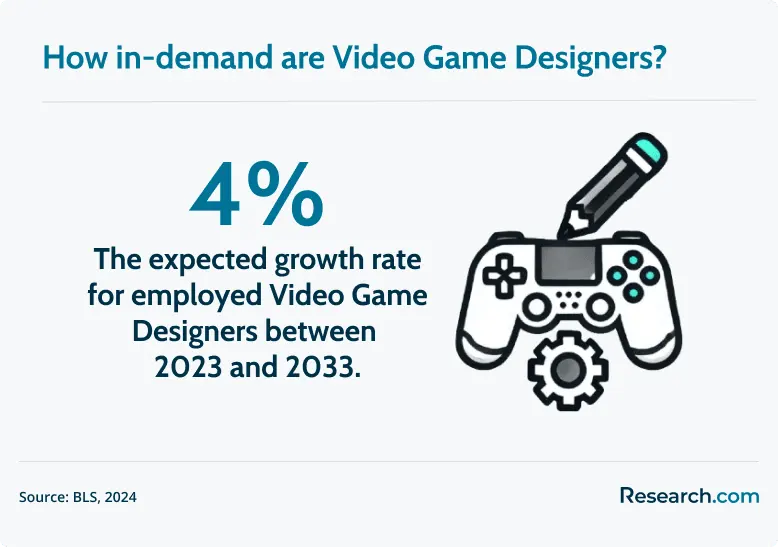
The career can be financially attractive, but it is competitive. The demand for Video Game Designers is expected to increase by 4% between 2023 and 2033 (BLS, 2024), and Salary.com reports an average annual salary of approximately $109,950 for Video Game Designers in the US. Remote and hybrid opportunities exist in some studios and indie teams, but flexibility depends heavily on the employer, production schedule, and project role.
Is becoming a Video Game Designer worth it?
| Choose this path if... | Think carefully if... |
| You enjoy analyzing why games work, not just playing them. | You want a job where creativity alone is enough. |
| You are willing to build prototypes, test ideas, and revise based on feedback. | You dislike technical tools, documentation, or team-based production. |
| You can develop a portfolio before expecting full-time studio work. | You expect a degree by itself to guarantee a design role. |
| You are comfortable collaborating with artists, programmers, producers, writers, and QA teams. | You prefer working alone and do not want your ideas challenged or changed. |
- What does a Video Game Designer do?
- How to become a Video Game Designer for 2027?
- What are the best degree programs for aspiring Video Game Designers?
- What skills do you need to become a Video Game Designer?
- What certifications do I need to become a Video Game Designer?
- What software should I learn as a Video Game Designer?
- What is the average salary of a Video Game Designer?
- Can pursuing an accelerated CS degree enhance your career prospects?
- How can I build a standout portfolio as a Video Game Designer?
- How can interdisciplinary expertise elevate video game design?
- How can artificial intelligence and emerging technologies transform video game design?
- Can Data Science Drive Innovation in Video Game Design?
- How Can Networking and Collaboration Accelerate a Video Game Designer’s Success?
- Can Video Game Design skills translate into success in other industries?
- Can cybersecurity expertise enhance video game design outcomes?
- What are the career pathways for a Video Game Designer?
- How do I advance my career as a Video Game Designer?
- What are the biggest trends you need to know as a Video Game Designer?
What does a Video Game Designer do?
A video game designer plans the interactive experience of a game. That may include rules, levels, progression systems, story structure, player goals, user interface flow, rewards, challenges, and the way players move through the game world. The designer’s job is to make the game understandable, engaging, balanced, and playable.
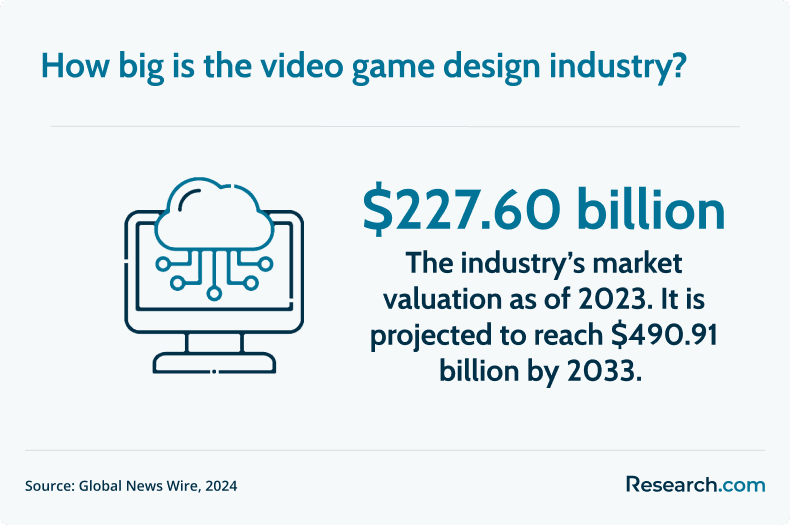
The broader games market continues to expand. According to GlobeNewswire, the global video game market was valued at $227.60 billion in 2023, with projections reaching $490.81 billion by 2033 at a CAGR of 7.99%. Growth does not mean every applicant will easily find a design role, but it does show why studios need people who can create strong player experiences across console, PC, mobile, VR, and online platforms.
Game design overlaps with several creative and technical disciplines. For example, someone exploring an animation career may move toward game design by adding level design, engine skills, or interactive storytelling to their visual background.
Common responsibilities of Video Game Designers
- Concept design: Turning an initial idea into a playable premise, including genre, audience, setting, characters, core loop, and player goals.
- Gameplay mechanics: Defining how players interact with the game, including movement, combat, puzzles, controls, progression, rewards, and difficulty.
- Level design: Creating spaces, challenges, encounters, pacing, and navigation paths that support the game’s intended experience.
- Prototyping: Building simple versions of systems or levels to test whether the idea is fun, clear, and feasible.
- Playtesting and iteration: Collecting feedback, finding friction points, and improving the design before release.
- Team collaboration: Working with programmers, artists, animators, writers, audio designers, QA testers, and producers to keep the game coherent.
- UX and interface planning: Designing menus, tutorials, controls, feedback systems, and navigation so players understand what to do.
- Narrative design: Shaping dialogue, quests, character arcs, branching paths, worldbuilding, and environmental storytelling when the game depends on story.
| Design focus | What the designer improves | Typical portfolio evidence |
| Level design | Flow, pacing, encounters, exploration, objectives, and environmental readability. | Playable level, annotated map, before-and-after iteration notes. |
| Systems design | Rules, progression, balance, economies, abilities, rewards, and loops. | Spreadsheet, prototype, design document, tuning examples. |
| Narrative design | Quests, dialogue, branching choices, story pacing, and character development. | Interactive script, quest sample, branching dialogue tree. |
| UX/UI design | Menus, onboarding, controls, feedback, accessibility, and player clarity. | Wireframes, interface prototype, usability test notes. |
| Technical design | Implementable mechanics, scripting, tool use, and communication between design and engineering. | Engine prototype, Blueprint or scripting sample, gameplay demo. |
How to become a Video Game Designer for 2027?
There is no single required path into game design. Some designers come from game design programs, while others start in computer science, art, QA testing, writing, modding, animation, or indie development. The common thread is proof of ability: employers want to see that you can create playable work, explain your decisions, respond to feedback, and collaborate with a production team.
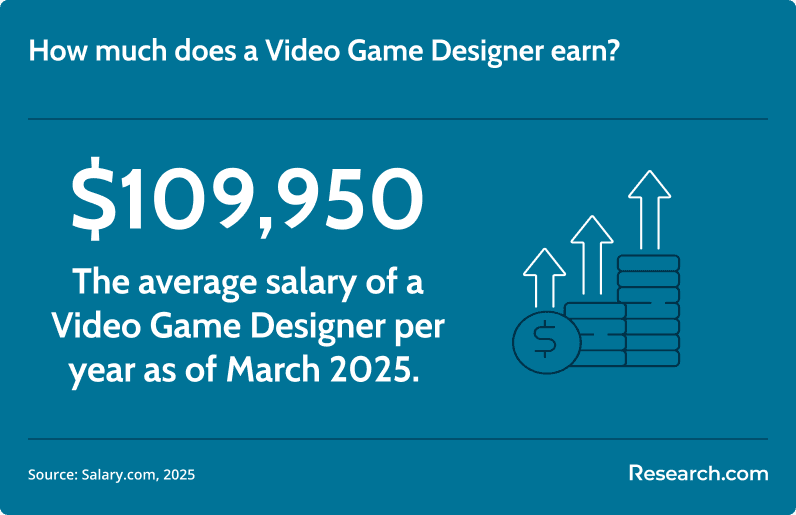
Salary potential is one reason the field attracts applicants. Salary.com lists an average annual salary of $109,950 for Video Game Designers in 2025. However, salary depends on role, location, studio size, experience, specialization, and project type.
Step-by-step path to becoming a Video Game Designer
- Study games like a designer. Play across genres and platforms, then analyze mechanics, onboarding, difficulty curves, level flow, menus, rewards, and failure states. Write short breakdowns of what works and what you would change.
- Learn the fundamentals. Build a base in game loops, systems design, level design, player motivation, playtesting, balancing, accessibility, and user experience.
- Choose a technical toolkit. Learn a game engine such as Unity or Unreal Engine. Designers do not always need to be expert programmers, but scripting basics in C#, C++, Python, Blueprint, or similar tools can help you prototype ideas independently.
- Build small playable projects. Start with compact games, levels, mods, quest samples, or mechanics prototypes. Finished small projects are usually stronger than ambitious unfinished projects.
- Consider formal education if it fits your goals. A degree in game design, computer science, animation, interactive media, software engineering, or writing can provide structure and networking. If cost is a concern, compare options such as affordable online college programs before enrolling.
- Create a portfolio website. Show playable work, screenshots, videos, design documents, tools used, team role, problems solved, and what changed after testing.
- Get production experience. Look for internships, student studios, indie projects, freelance work, mod teams, game jams, QA roles, or volunteer collaborations that lead to shipped or playable work.
- Network with purpose. Join developer communities, attend game jams and conferences, ask for portfolio feedback, and build relationships with designers, producers, artists, and engineers.
- Apply strategically. Tailor your portfolio to the role. A level design position should feature strong levels; a systems design role should show tuning, rules, balancing, and player behavior analysis.
Some adjacent fields can strengthen a game design profile. For example, learning how to become an information security officer may be useful for designers interested in multiplayer security, account systems, anti-cheat concerns, or online player safety.
| Stage | Main goal | What to produce |
| Beginner | Understand design language and basic tools. | Game analysis notes, simple prototypes, small engine experiments. |
| Portfolio builder | Show that you can finish and improve playable work. | Playable levels, mechanics prototypes, design documents, test results. |
| Entry-level applicant | Match your work to a specific job type. | Role-specific portfolio, resume, project breakdowns, team credits. |
| Early professional | Develop production judgment and specialization. | Shipped work, design ownership, measurable improvements, collaboration examples. |
What are the best degree programs for aspiring Video Game Designers?
The best degree depends on the kind of designer you want to become. Game design programs are the most direct route, but studios also hire people with backgrounds in computer science, animation, writing, UX, software engineering, and digital art. The key is choosing a program that helps you build practical projects, not just study theory.
| Degree path | Best fit | What to evaluate before enrolling |
| Game Design or Game Development | Students who want a direct foundation in mechanics, prototyping, level design, game engines, AI, VR, and production. | Portfolio requirements, studio courses, team projects, engine access, faculty industry experience, internship support. |
| Computer Science | Future technical designers, gameplay programmers, AI-focused designers, or systems-heavy designers. | Programming depth, algorithms, software engineering, graphics, game development electives, project-based learning. |
| Animation or Computer Graphics | Students interested in characters, motion, visual storytelling, 3D assets, and cinematic presentation. | 3D modeling tools, animation labs, game art courses, reel development, transferability to real-time engines. Students comparing costs can review affordable online graphic design degree options. |
| Interactive Media or UX Design | Students drawn to player experience, interfaces, onboarding, usability, mobile games, AR, VR, or accessibility. | UX research, prototyping tools, usability testing, interactive systems, portfolio outcomes. |
| Creative Writing or Screenwriting | Future narrative designers, quest designers, dialogue writers, and worldbuilding specialists. | Interactive storytelling, branching narrative, character writing, collaboration with design and production teams. |
| Digital Arts or Game Art | Students who want to shape visual identity, environments, concept art, and character design. | Portfolio development, art direction, 2D and 3D tools, game-ready asset workflows. Students exploring broad creative studies may compare online liberal arts colleges. |
| Software Engineering | Designers who want strong technical skills for tools, engine architecture, performance, and implementation. | Systems design, programming projects, collaborative software development, version control, debugging, and optimization. |
How to choose a game design-related program
- Check accreditation and institutional legitimacy. Do not choose a school based only on marketing language or game-themed course names.
- Review student work. Strong programs should produce portfolios, playable games, reels, prototypes, or capstone projects.
- Ask how often students work in teams. Game development is collaborative, so isolated coursework is not enough.
- Compare total cost, not just tuition. Include software, hardware, fees, travel, housing, portfolio expenses, and time away from work.
- Look for career support specific to games. General career services may not understand game design portfolios, game jams, studio hiring cycles, or production roles.
- Confirm transfer credit and online requirements. If you study online, ask whether you need specific hardware, synchronous sessions, or campus visits.
What skills do you need to become a Video Game Designer?
Good game designers do more than generate concepts. They make decisions that affect player behavior, production feasibility, pacing, difficulty, accessibility, and long-term engagement. The strongest skill set blends creativity, technical understanding, analytical thinking, and communication.
| Skill | Why it matters | How to demonstrate it |
| Game design fundamentals | Designers need to understand mechanics, loops, balance, pacing, feedback, goals, and constraints. | Create a playable prototype and explain the design choices behind it. |
| Level design | Levels guide attention, teach mechanics, create challenge, and shape emotion. | Build a level in Unity or Unreal Engine and include annotated design notes. |
| Storytelling and narrative design | Narrative-driven games depend on structure, character motivation, dialogue, quests, and player choice. | Develop branching dialogue, a quest design sample, or a playable story sequence. A creative writing degree can support this path when paired with interactive design work. |
| Programming and scripting basics | Technical fluency helps designers prototype, communicate with engineers, and understand implementation limits. | Show C#, C++, Python, Blueprint, Lua, or other scripting examples in a game context. |
| Visual design awareness | Even non-art designers must understand readability, composition, color, animation timing, and visual hierarchy. | Include screenshots showing how layout and visuals support player understanding. |
| Game engine proficiency | Most design work eventually needs implementation, testing, and iteration inside a real tool. | Publish short gameplay videos, downloadable builds, or engine-based prototypes. |
| Problem-solving | Designers constantly revise unclear tutorials, broken mechanics, pacing issues, balance problems, and player confusion. | Document a problem, test results, design changes, and the final improvement. |
| Collaboration and communication | Designers must explain ideas clearly to artists, programmers, writers, producers, and QA teams. | Use concise design documents, team project credits, and postmortems. |
| Player psychology | Motivation, frustration, challenge, reward, and flow all affect whether players continue playing. | Analyze playtest behavior and explain how design changes addressed it. Concepts from fields such as sports psychology careers can help designers think more carefully about motivation and performance. |
What certifications do I need to become a Video Game Designer?
Certifications are not usually mandatory for video game design jobs, but they can help you prove tool proficiency, especially if you do not have a game design degree or if you are changing careers. A certification is most useful when it supports a portfolio project. A badge without playable work rarely carries much weight.
| Certification | Best for | How to use it strategically |
| Unity Certified Associate from Unity Technologies | Designers building prototypes, 2D games, mobile projects, simulations, or interactive experiences in Unity. | Pair it with a playable Unity project that shows game physics, animation, scripting, and iteration. |
| Epic Games Game Design Professional Certificate for Unreal Engine | Designers interested in Unreal Engine, AAA-style workflows, VR, high-end visuals, environment design, or Blueprint scripting. | Use it to support a portfolio level, gameplay system, or environment built in Unreal Engine. |
| Autodesk Certified Professional in Maya or 3ds Max | Designers and artists focused on 3D modeling, animation, character work, or asset creation. | Show game-ready assets, animation tests, or environment pieces that can be used in an engine. |
| Certified Game Developer by the International Game Developers Association (IGDA) | Candidates who want a credential connected to game mechanics, storytelling, user experience, and game development knowledge. | Use it as a supplement to projects, not a substitute for production experience. |
When certifications make sense
- You are self-taught and need a structured way to validate tool knowledge.
- You are moving from art, writing, software, QA, education, or another field into game design.
- You want to learn a specific engine or workflow for portfolio development.
- You need a short-term credential while completing longer-term projects or a degree.
What software should I learn as a Video Game Designer?
Software choice depends on your design focus. A level designer may prioritize Unreal Engine or Unity, a systems designer may need spreadsheets and scripting, a narrative designer may use branching dialogue tools, and a game artist may work heavily in Blender, Maya, or 3ds Max. Beginners should avoid trying to master every tool at once. Pick one engine, build small projects, and add tools as your portfolio requires them.
Price List of the Most Commonly Used Software by Video Game Designers
| Software | Price | Primary use |
| Construct 3 | $59.99/month per user | Drag-and-drop development for 2D games and beginner-friendly prototypes. |
| GameSalad | $17-$25/month | 2D game creation for users who want a simplified development environment. |
| Blender | Free | Open-source 3D modeling, animation, and asset creation. |
| Godot | Free | 2D and 3D game development with an open-source engine. |
| GameMaker | $4.99-$79.99/month | 2D game development using visual tools and GML scripting. |
| Unity | $2,040-$2,950/month | 2D and 3D games, prototypes, simulations, and interactive experiences. |
| Wwise | Free (for beginners) and $7,000 (for pros) | Interactive audio, sound design, mixing, and immersive soundscapes. |
Source: ClickUp, 2025
How to choose your first toolset
- If you want to design levels: Learn Unity or Unreal Engine and build explorable spaces with clear objectives.
- If you want to design systems: Learn spreadsheets, basic scripting, and a game engine that lets you test rules quickly.
- If you want to design 2D games: Consider Godot, GameMaker, Construct 3, or Unity.
- If you want to work in game art: Add Blender, Maya, 3ds Max, Photoshop, or similar tools to your engine skills.
- If you want to work in audio-heavy design: Explore Wwise and learn how sound feedback affects player behavior.
What is the average salary of a Video Game Designer?
Video game design can offer strong earning potential, but the averages do not tell the whole story. Pay can vary by employer, location, platform, project budget, job title, seniority, specialization, and whether the position is full-time, contract, remote, or studio-based.
Salary.com reports that the average annual salary of a Video Game Designer is $109,950 as of March 2025. Its experience-based salary figures show gradual increases as designers gain professional experience.
| Experience level | Average annual salary |
| Entry-level Video Game Designers | $110,440 |
| Less than two years of experience | $111,306 |
| Two to four years of experience | $112,171 |
| Five to eight years of experience | $114,653 |
| Eight or more years of experience | $118,823 |
Students comparing technology careers may also want to review app developer salary information, since software and game careers can overlap in programming, UX, and interactive product design.
Can pursuing an accelerated CS degree enhance your career prospects?
An accelerated computer science path can help aspiring technical designers build stronger programming, algorithms, software design, and systems-thinking skills in less time than a traditional route. This can be useful for candidates who want to prototype mechanics, work closely with engineers, or pursue roles that sit between design and development.
Before enrolling in an accelerated CS degree, compare workload, transfer policies, accreditation, tuition, portfolio opportunities, and whether the curriculum includes projects relevant to games. A fast program is only valuable if you can still build demonstrable work while completing it.
How can I build a standout portfolio as a Video Game Designer?
A strong portfolio answers one question quickly: can this person design something playable and explain why it works? It should not be a gallery of vague ideas. It should show finished or testable work, your specific contribution, the tools used, the design problem, the process, and the results of iteration.
What to include in a game design portfolio
- Playable projects: Include downloadable builds, browser demos, videos, or links to game pages.
- Role clarity: State what you personally designed, especially on team projects.
- Design documents: Add concise documentation for mechanics, levels, quests, systems, or UI flows.
- Iteration evidence: Show what changed after playtesting and why.
- Tools and workflow: Name the engine, scripting tools, art tools, version control, and collaboration methods used.
- Focused samples: Tailor the portfolio to the job. A narrative design role needs different evidence than a technical design role.
If you need structured practice, online game development classes can help you build portfolio-ready projects while learning industry tools.
How can interdisciplinary expertise elevate video game design?
Game design benefits from knowledge outside games. Psychology can improve motivation and challenge design. Data analytics can reveal where players quit or struggle. Writing can strengthen quests and dialogue. Education can inform tutorial design. Cybersecurity can support safer online systems. Healthcare, simulation, and informatics can provide useful models for training games and serious games.
For example, professionals studying a health informatics career may learn how data, user behavior, and digital systems interact in high-stakes environments. Those ideas can translate into better dashboards, feedback loops, simulations, and player-centered systems in games.
How can artificial intelligence and emerging technologies transform video game design?
AI and emerging technologies are changing both how games are made and what players expect from them. Designers may use AI-assisted workflows for testing, content ideation, behavior simulation, personalization, and production support. However, AI does not remove the need for human judgment. Designers still need to make decisions about fairness, pacing, clarity, originality, player agency, and ethics.
Designers who want deeper technical knowledge may explore affordable online artificial intelligence degrees, especially if they are interested in AI-driven NPC behavior, procedural generation, adaptive difficulty, or player modeling.
Can Data Science Drive Innovation in Video Game Design?
Data science can help game teams understand how players behave after release or during testing. Designers can use analytics to identify where players abandon a level, which abilities are overpowered, how tutorials perform, or whether rewards encourage the intended behavior. Data should not replace design judgment, but it can challenge assumptions and support better iteration.
An affordable online masters in data science may be useful for designers who want to specialize in player analytics, personalization, live-service balancing, monetization analysis, or product strategy.
How Can Networking and Collaboration Accelerate a Video Game Designer’s Success?
Many game design opportunities come through relationships, portfolio feedback, game jams, community projects, and referrals. Networking is not just self-promotion. It is a way to learn production standards, understand studio expectations, find collaborators, and get honest critiques before applying.
Collaborative experience is especially important because designers rarely work alone in professional studios. You need to show that you can communicate with engineers, artists, writers, producers, and testers. Professionals exploring adjacent technical systems may also find ideas in fields such as cheap online nursing informatics programs, particularly around data management and user-centered digital workflows.
Can Video Game Design skills translate into success in other industries?
Yes. Game design skills can transfer to industries that use interaction, simulation, training, storytelling, engagement, or user experience. Education, advertising, defense simulation, healthcare training, product design, XR development, and corporate learning can all use game-like systems to teach, motivate, or model complex behavior.
Designers with interdisciplinary interests can explore fields where science, technology, and interactive communication meet. For example, reviewing jobs with masters in biotechnology can help some professionals understand how technical subject-matter expertise may pair with simulation, training, or educational game design.
Can cybersecurity expertise enhance video game design outcomes?
Cybersecurity knowledge is increasingly relevant for online and multiplayer games. Designers who understand security risks can make better decisions about account systems, trading mechanics, competitive integrity, cheating, player data, and online trust. While security is usually led by specialized professionals, designers can reduce risk by understanding how game mechanics may be exploited.
Students interested in this intersection can compare options such as the cheapest online master's in cyber security and consider how security knowledge might support multiplayer design, live operations, anti-cheat strategy, or digital asset protection.
What are the career pathways for a Video Game Designer?
“Video game designer” is an umbrella term. Studios often divide design work into specialized roles, and each role requires a different portfolio. Before applying, decide which type of design work you want to prove.
| Career pathway | Primary responsibilities | Best portfolio sample |
| Level Designer | Creates environments, objectives, enemy placement, puzzles, pacing, and spatial flow. | Playable level with annotated layout and playtest revisions. |
| Gameplay Designer | Designs mechanics, interactions, combat, movement, abilities, and moment-to-moment play. | Mechanics prototype with tuning notes. |
| Narrative Designer | Builds quests, dialogue, branching choices, character arcs, and story integration. | Quest sample, dialogue tree, or interactive story prototype. |
| Systems Designer | Creates progression, economies, rules, rewards, balancing models, and game loops. | Spreadsheet model, design document, and playable system prototype. |
| Creative Director | Leads the high-level vision for gameplay, art direction, narrative, and player experience. | Shipped projects, leadership examples, and cohesive design vision. |
| Technical Designer | Implements design ideas, scripts mechanics, and bridges design and engineering teams. | Engine prototype with scripting or Blueprint examples. |
| Independent Game Developer | Designs, builds, markets, and publishes games independently or with a small team. | Released indie game, store page, devlog, or playable demo. |
| UX/UI Designer | Improves menus, HUDs, onboarding, controls, accessibility, and overall player clarity. | Wireframes, interactive UI prototype, usability findings. |
| Game Producer | Coordinates schedules, teams, milestones, budgets, and project delivery. | Production plan, shipped project credits, team coordination examples. |
| Game Design Educator and Researcher | Teaches design methods, studies player experience, or researches interactive media. | Curriculum samples, research projects, publications, or teaching portfolio. |
How do I advance my career as a Video Game Designer?
Career growth in game design depends on more than years of experience. Designers advance by shipping work, solving harder problems, earning trust across teams, specializing in valuable areas, and learning how to guide others through production constraints.
Practical ways to move beyond entry-level design roles
- Keep improving your portfolio. Add polished Unity or Unreal Engine levels, systems prototypes, or game modes. Use platforms such as Itch.io, ArtStation, GitHub, or a personal website to present your work clearly.
- Specialize where studios need depth. Possible areas include AI-driven NPC behavior, procedural level generation, free-to-play monetization, accessibility, live-service balancing, VR interaction, or UX/UI design with tools such as Figma or Adobe XD.
- Use game jams strategically. Events such as Ludum Dare, Global Game Jam, and Epic MegaJam can help you practice scope control, collaboration, and rapid iteration.
- Strengthen technical implementation. Learn C# for Unity, Blueprint scripting for Unreal Engine, Lua for Roblox development, or other tools relevant to your target role.
- Document your decisions. Senior designers must explain trade-offs, constraints, feedback, and the reason behind each change.
- Take ownership of features. Volunteer to lead a level, system, game mode, tutorial, quest chain, or design review when appropriate.
- Develop leadership skills. Communication, mentoring, conflict resolution, prioritization, and project awareness become more important as you move toward Lead Designer, Design Director, or Creative Director roles.
- Stay informed without chasing every trend. Follow credible game development publications, talks, and postmortems, but focus on trends that improve your specific design discipline.
- Consider advanced education only when it has a clear purpose. A master’s degree in game design or an MBA related to game production may help with leadership, budgeting, strategy, or management, but it should align with your career plan.
If you are comparing game design with other career directions, you may also want to review best paying healthcare bachelor's degrees to understand how education-to-career trade-offs differ across fields.
What are the biggest trends you need to know as a Video Game Designer?
Game design is being reshaped by AI tools, immersive hardware, cross-platform expectations, accessibility standards, online economies, and data-informed development. Designers do not need to become experts in every trend, but they should understand how these changes affect player expectations and production workflows.
- AI-supported design and QA: Razer revealed its AI QA Copilot, which it says can streamline the quality assurance process in game development by 30-50% and increase cost savings by up to 40%. Tools like this may reduce repetitive testing work, but human designers still need to evaluate whether the game feels fair, clear, original, and enjoyable.
- Virtual reality growth: The global virtual reality (VR) gaming market is projected to reach $32.49 billion in 2024, with an expected compound annual growth rate (CAGR) of 21.6% from 2025 to 2030 (Grand View Research, n.d.). VR design requires special attention to comfort, motion, interaction, interface placement, and player embodiment.
- Cross-platform and cloud gaming: Players increasingly expect games to work across devices through services such as Xbox Cloud Gaming and NVIDIA GeForce Now. Designers must think about input methods, performance differences, screen sizes, and consistent progression.
- Blockchain, NFTs, and play-to-earn models: According to NFT Evening (2025), players are increasingly drawn to play-to-earn (P2E) crypto games that combine entertainment with digital assets. Designers should approach this area carefully, considering player trust, regulation, sustainability, and whether financial incentives improve or weaken the game experience.
- Accessibility and inclusive design: In 2024, GameU partnered with the Autism in Entertainment Workgroup to support inclusivity in game design (PR Newswire, 2024). Accessibility is not a last-minute setting; it affects controls, readability, difficulty options, audio cues, color use, cognitive load, and onboarding.
Students who are deciding whether to stay in games or explore other applied fields may also compare alternatives such as what school offers the best online medical assistant programs, especially if they are weighing cost, job stability, and career timeline.
Common mistakes aspiring Video Game Designers should avoid
| Mistake | Why it hurts you | Better approach |
| Building only ideas, not playable work. | Employers cannot evaluate design ability from concepts alone. | Create small prototypes, levels, mods, or interactive samples. |
| Choosing a program without checking accreditation or outcomes. | You may spend money on a credential that does not support employment or transfer. | Verify accreditation, review student portfolios, and ask about graduate outcomes. |
| Focusing only on tuition. | Software, hardware, fees, housing, and lost work time can change the real cost. | Compare total cost of attendance and available financial aid. |
| Trying to learn every tool at once. | Shallow tool knowledge rarely produces strong portfolio work. | Choose one engine, finish projects, then add specialized tools. |
| Sending the same portfolio to every role. | Studios hire for specific design needs. | Tailor samples for level design, systems design, UX, narrative, or technical design. |
| Ignoring playtesting. | Untested designs often fail in ways the designer cannot see alone. | Watch players use your work, collect feedback, and document changes. |
| Assuming salary averages are guaranteed. | Pay varies by employer, location, seniority, specialization, and contract type. | Research roles carefully and compare compensation with cost of living and job stability. |
Questions to ask before choosing a game design program
- Is the institution accredited, and by whom?
- What engines, tools, and production workflows will I use?
- Will I graduate with playable projects or only coursework?
- How often do students work in teams that resemble studio production?
- Does the program include internships, capstones, portfolio reviews, or industry mentorship?
- Can I specialize in level design, systems design, narrative design, UX/UI, technical design, or game art?
- What is the full cost, including software, hardware, fees, housing, and materials?
- How are online students supported if the program is remote?
- What transfer credit policies apply if I already completed college coursework?
- What kinds of roles do graduates actually pursue after completing the program?
Key Insights
- Video game design is a practical craft. A strong portfolio with playable work matters more than a list of game ideas.
- The demand for Video Game Designers is expected to increase by 4% between 2023 and 2033 (BLS, 2024), but entry into the industry remains competitive.
- The global video games market is valued at $227.60 billion in 2023, with projections reaching $490.81 billion by 2033 at a CAGR of 7.99% (Global Newswire, 2024).
- The average annual salary of a Video Game Designer is $109,950 as of March 2025 (Salary.com, 2025), with reported experience-based averages ranging from $110,440 for entry-level designers to $118,823 for those with eight or more years of experience.
- Good degree options include game design, computer science, animation, interactive media, UX design, creative writing, digital arts, and software engineering. The right choice depends on the role you want.
- Certifications can help validate Unity, Unreal Engine, Autodesk, or game development skills, but they are most valuable when paired with finished projects.
- AI, VR, cloud gaming, accessibility, blockchain models, and data-informed design are changing the field. Designers should learn the trends that directly support their target specialty.
- The safest career strategy is to specialize, build proof, test your work with real players, and keep improving your portfolio based on feedback.
References:
- Bureau of Labor Statistics. (2024). Multimedia artists and animators. U.S. Department of Labor. Bls.gov. Retrieved 25 March 2025.
- ClickUp. (n.d.). Best game design software for beginners & professionals. ClickUp.com. Retrieved 25 March 2025.
- GlobeNewswire. (2024). Video games market to reach USD 490.81 billion by 2033: Expanding professional gaming will drive innovation. GlobalNewswire.com. Retrieved 25 March 2025.
- Grand View Research. (n.d.). Virtual reality in gaming market analysis. GrandViewResearch.com. Retrieved 25 March 2025.
- IGN. (2024). Razer says its new AI can make game development quicker and cheaper, but insists humans still need to be involved. Me.ign.com. Retrieved 25 March 2025.
- Salary.com. (n.d.). Video game designer salary. Salary.com. Retrieved 25 March 2025.
Other Things You Should Know About Video Game Designers
Game designers need algebra, basic statistics, and probability to balance damage, loot, economy, and difficulty curves. Many studios expect designers to read spreadsheets, compare player data, and adjust numbers in tools like Excel or Google Sheets before changes go into a game build.
In 2027, essential software tools for video game designers include Unity for 3D game design, Unreal Engine for high-fidelity graphics, and Blender for 3D modeling. Proficiency in Adobe Creative Suite for textures and animations is also beneficial for a successful career in game design.


