2027 What Is a Systems Analyst: Salary & Career Paths?

Co-Founder and Chief Data Scientist
Choosing a systems analyst career is usually a practical question: can you turn an interest in technology, problem-solving, and business operations into a stable IT role with room to grow? For many high school graduates, college students, career changers, and early-career IT workers, the systems analyst path is attractive because it sits between business needs and technical execution.
This guide explains what systems analysts do, how much they can earn, what degrees and skills matter, which industries hire them, and how to decide whether this career fits your goals for 2027. It also covers cybersecurity, artificial intelligence, certifications, program selection, common mistakes, and ways to build a stronger job-market profile without assuming that a degree alone guarantees a high salary or promotion.
Quick Answer: Is Becoming a Systems Analyst Worth It?
A systems analyst career can be a strong option for people who enjoy understanding business problems, translating user needs into technical requirements, and improving software or information systems. The role offers competitive pay, multiple advancement paths, and demand across finance, healthcare, government, retail, manufacturing, and technology organizations.
It is not the best fit for someone who wants to focus only on coding or avoid stakeholder communication. Systems analysts spend substantial time gathering requirements, documenting workflows, coordinating with developers, testing solutions, explaining trade-offs, and helping teams adopt new systems.
Key Things You Should Know About a Systems Analyst Career
- Demand is connected to digital transformation: Organizations continue to modernize systems, automate workflows, and improve data use. Digital transformation spending is projected to grow at a 23.6% compound annual growth rate (CAGR) from 2022 to 2030.
- Pay can be competitive, but it varies: Entry-level systems analysts commonly start around $60,865 per year, while experienced professionals can earn up to $165,700. Some top earners make up to $276,000 depending on employer, specialization, and market.
- Career paths are flexible: Systems analysts can move into senior analyst roles, cybersecurity, data analysis, enterprise architecture, IT project management, IT director positions, or Chief Information Officer (CIO) roles.
- Job satisfaction is generally strong: 74% of IT professionals in North America report being satisfied with their roles, which suggests that many workers find IT careers sustainable and rewarding.
- Security knowledge matters more than ever: With the average cost of a data breach reaching $4.88 million in 2024, systems analysts increasingly need to understand risk, compliance, secure workflows, access controls, and data protection.
- What does a systems analyst do?
- How much does a systems analyst make for 2027?
- What are the career paths for systems analysts?
- What are the best degrees for systems analysts?
- How do you become a systems analyst?
- What tools and technologies do systems analysts use?
- How can I choose the right computer science program to advance my systems analyst career?
- Should systems analysts develop cybersecurity expertise?
- How can I build a competitive edge in the systems analyst job market?
- Can interdisciplinary skills enhance a systems analyst’s effectiveness?
- Should systems analysts diversify their technical education?
- Should I integrate engineering education to boost my systems analyst career?
- How can expertise in artificial intelligence enhance my role as a systems analyst?
- What industries hire the most systems analysts?
- What challenges do systems analysts face?
- How can further education and specialized certifications boost my career as a systems analyst?
- Can specialized healthcare informatics training enhance my role as a systems analyst?
- Is systems analyst a good career for 2027?
What does a systems analyst do?
A systems analyst evaluates how an organization uses technology and recommends improvements that make systems more reliable, efficient, secure, and useful for employees or customers. The work often begins with a business problem, such as slow reporting, duplicated data entry, outdated software, disconnected databases, or a process that creates errors.
The analyst studies the current workflow, gathers input from users, documents requirements, compares possible solutions, and works with developers, vendors, database teams, cybersecurity staff, and business leaders to implement changes. The role requires both technical understanding and the ability to explain technical choices in business language.
Systems analysts are different from business analysts, although the roles can overlap. A business analyst often focuses more broadly on process improvement, strategy, and stakeholder needs. A systems analyst usually goes deeper into the technology that supports those needs, including software behavior, data flows, integrations, testing, system constraints, and implementation details.
| Responsibility | What it means in practice | Why it matters |
| Requirements gathering | Interview users, review workflows, define business and technical needs | Prevents teams from building the wrong solution |
| Systems analysis | Map current systems, data movement, bottlenecks, errors, and dependencies | Helps identify root causes rather than surface-level symptoms |
| Solution design | Recommend software changes, integrations, automation, reports, or new platforms | Connects business goals with practical technology options |
| Testing and validation | Confirm that new systems meet requirements before and after launch | Reduces operational disruption and rework |
| Stakeholder communication | Translate technical constraints for managers and business needs for developers | Keeps projects aligned across departments |
| Security and compliance support | Consider access controls, data privacy, audit needs, and risk reduction | Protects sensitive information and supports regulatory obligations |
Systems analysts are needed in industries where information systems support daily operations. Banks use them to improve transaction processing and reporting. Hospitals rely on them for patient record systems and healthcare workflows. Retailers use them to strengthen inventory, e-commerce, and customer data platforms. Manufacturers need them for automation, supply chain, and production systems.
The career outlook is tied to organizations’ continued investment in technology. Digital transformation spending is expected to grow at a 23.6% compound annual growth rate from 2022 to 2030, and business process automation continues to be adopted by organizations that want to reduce manual work, improve accuracy, and control costs.
How much does a systems analyst make for 2027?
As of 2025, systems analysts in the United States earn between $83,985 and $114,285 per year, depending on experience, employer, location, industry, technical depth, and specialization. Pay is not automatic; analysts who combine domain expertise, strong documentation, systems thinking, communication, and modern technical skills are usually better positioned for higher-paying roles.
| Factor | Salary impact | What candidates should consider |
| Experience level | Entry-level systems analysts typically earn around $60,865 annually; mid-level professionals earn approximately $78,161 annually; top earners can make up to $276,000 | Hands-on projects, internships, business domain knowledge, and tool fluency can help early-career candidates compete |
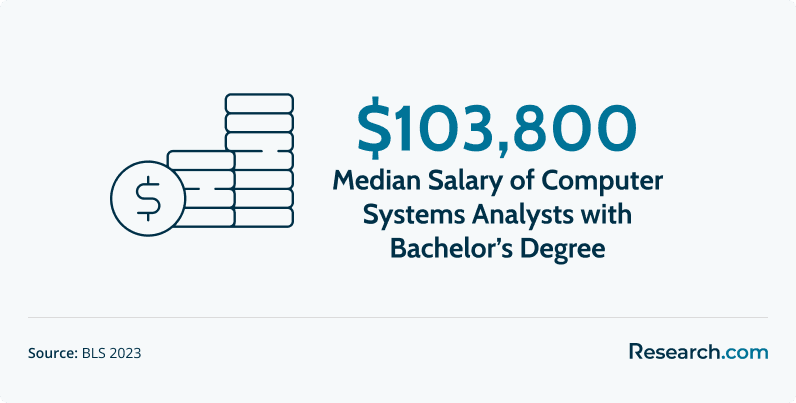
| Industry | Finance and insurance offer a median annual wage of $103,800 | Regulated and data-heavy sectors may pay more but can require stronger compliance and security knowledge |
| Location | Systems analysts in California often earn more than analysts in many other states | Higher salaries may reflect higher cost of living, employer concentration, or competitive labor markets |
| Employer | IBM, American Express, Cisco, Google, and Java are associated with higher salary ranges averaging between $121,000 to $276,000 annually | Large employers may expect stronger technical interviews, cross-functional experience, and specialized skills |
Compared with the 2023 median U.S. wage of $80,610, systems analyst compensation aligns with broader computer science salary trends. However, salary outcomes depend heavily on the role’s scope. A systems analyst supporting internal reporting may have a different salary trajectory than an analyst working on cloud migration, enterprise systems, cybersecurity, or high-value financial platforms.
How to Improve Your Salary Potential
- Build domain expertise: Finance, healthcare, manufacturing, insurance, and government systems often require specialized process and compliance knowledge.
- Strengthen technical credibility: Learn databases, APIs, systems documentation, testing, Agile workflows, cloud concepts, and basic security practices.
- Document measurable work: Employers value analysts who can show how a project reduced errors, improved cycle time, automated a workflow, or improved reporting.
- Move toward higher-impact systems: Enterprise resource planning, cybersecurity, analytics platforms, and customer-facing systems can offer broader responsibility.
What are the career paths for systems analysts?
Systems analyst careers can develop in several directions. Some professionals become senior analysts and lead larger projects. Others specialize in cybersecurity, data analytics, cloud computing, enterprise architecture, or business process design. Analysts with strong leadership and budgeting skills may move into IT project management, IT director roles, or executive positions such as Chief Information Officer (CIO).
Common Career Progression Options
| Path | Best fit for | Typical next skills to build |
| Senior systems analyst | Analysts who want larger projects, mentoring responsibilities, and more influence over technical design | Advanced requirements analysis, architecture awareness, stakeholder leadership, testing strategy |
| Cybersecurity-focused analyst | Professionals interested in risk, controls, compliance, access management, and secure system design | Security frameworks, risk assessment, identity and access management, incident awareness |
| Data analyst or analytics systems specialist | Analysts who enjoy databases, reporting, dashboards, metrics, and decision support | SQL, data modeling, analytics tools, data governance, visualization |
| IT project manager | Analysts who like planning, budgets, timelines, vendors, and cross-functional coordination | Project management methods, resource planning, communication, risk management |
| IT director or CIO | Experienced professionals who want to lead technology strategy at an organizational level | Business-IT alignment, budgeting, governance, people management, executive communication |
| Consultant or business analyst | Analysts who prefer client-facing work, process improvement, and strategic recommendations | Consulting methods, presentation skills, industry specialization, change management |
Moving from an entry-level systems analyst position into a senior role can take around two years, depending on experience, project complexity, technical readiness, and leadership ability. Higher-level management roles usually require broader business judgment, experience aligning IT investments with business goals, and the ability to manage competing priorities.
Specialization Areas Worth Considering
- Cybersecurity: Useful for analysts who work with sensitive data, regulated systems, access controls, or compliance-heavy workflows.
- Cloud computing: Valuable when organizations migrate systems, modernize infrastructure, or connect distributed applications.
- Enterprise architecture: Strong fit for analysts who want to understand how systems, applications, data, and business processes connect across the organization.
- Data science and analytics: Professionals who want to deepen analytical skills may consider affordable graduate options such as the cheapest master in data science.
Job Outlook and Long-Term Prospects
Systems analysts benefit from a labor market in which organizations continue to depend on technology for operations, decision-making, customer service, and security. The IT sector expects 356,700 job openings annually from 2023 to 2033, and 74% of IT professionals in North America report job satisfaction.
Those numbers do not guarantee employment for every applicant. They do show that technology roles remain a meaningful part of the economy. Candidates who combine technical literacy with business process knowledge are often better positioned than candidates who can only use tools without understanding organizational needs.
What are the best degrees for systems analysts?
The most common degree choices for aspiring systems analysts are computer science, information technology, management information systems, software engineering, and related technology programs. The best option depends on whether you want deeper programming and theory, applied IT skills, or a stronger business-and-technology blend.
| Degree option | What it emphasizes | When it makes sense |
| Computer science | Programming, algorithms, databases, software design, computing theory | Good for students who want strong technical depth and flexibility across software and systems roles |
| Information technology | Networks, systems administration, databases, cybersecurity, applied enterprise technology | Good for students who prefer practical IT systems, infrastructure, and operations |
| Management information systems | Business processes, information systems, analytics, project coordination, technology strategy | Strong fit for systems analyst roles because it connects business needs with technical solutions |
| Software engineering | Software development lifecycle, requirements, design, testing, maintainability | Useful for analysts who want to work closely with developers or move toward product and application roles |
| Mathematics, statistics, or liberal arts plus technical training | Analytical thinking, communication, quantitative reasoning, problem framing | Possible path for career changers who add certifications, projects, internships, or IT experience |
If you are asking what degree program to take to get 100K salary, computer science, information technology, and management information systems can be practical choices. Systems analysts can reach salary levels of $100K or more with experience, specialization, and strong performance, especially in sectors such as fintech or enterprise systems. Still, no degree guarantees a specific salary.
Online, Campus, and Graduate Education Options
- Online bachelor’s degrees: Accredited online programs can help working adults and career changers build relevant skills with more scheduling flexibility. An online computer programming degree may be useful for students who want stronger coding preparation.
- Master’s degrees: A master’s degree is usually not required for entry-level systems analyst jobs, but it may help professionals move toward leadership, architecture, cybersecurity, analytics, or advanced IT management.
- Skills-first pathways: In 2001, 36% of IT professionals did not hold a college degree. That historical data point shows that IT has long included nontraditional pathways, although many employers still prefer or require degrees for analyst roles.
Systems analysis also appears in sales and revenue operations environments, where organizations use customer relationship management platforms, sales automation, reporting systems, and customer data. If you are exploring What should I major in to get into sales, a management information systems or business analytics background may help you support sales teams through better systems, data, and workflow design.
Who Should Consider a Systems Analyst Degree Path?
- Good fit: Students who like technology but also want regular interaction with business users, managers, developers, and vendors.
- Good fit: Career changers who already understand a business domain such as healthcare, finance, retail, logistics, or operations and want to move into technology.
- Less ideal fit: People who want a job focused almost entirely on independent programming with minimal meetings or documentation.
- Less ideal fit: Students who dislike ambiguity, negotiation, user feedback, testing, or process mapping.
How do you become a systems analyst?
Becoming a systems analyst usually involves education, hands-on technical practice, business process exposure, and proof that you can translate needs into workable systems. The path can begin with a bachelor’s degree, an associate-level or accelerated program plus experience, or an internal transfer from another business or IT role.
Step 1: Choose a Relevant Education Path
Most systems analyst positions ask for at least a bachelor’s degree in computer science, information technology, management information systems, or a related field. Some candidates start with a 2-year computer science degree and then add certifications, projects, internships, or entry-level IT experience to compete for junior roles.
Step 2: Build Practical Experience Before You Graduate or Apply
Look for internships, help desk roles, junior IT support jobs, database assistant roles, quality assurance work, or business operations projects that involve software systems. The goal is to understand how users actually work, how systems fail, and how technical changes affect daily operations.
Step 3: Learn the Core Analyst Skill Set
- Requirements analysis: Ask precise questions, separate wants from needs, and document what the system must do.
- Workflow mapping: Understand how information moves through people, applications, databases, approvals, and reports.
- Data literacy: Become comfortable with databases, data quality, reporting logic, and basic analytics.
- Communication: Explain complex technical topics clearly to nontechnical users and translate business constraints for technical teams.
- Agile and DevOps awareness: Learn how modern teams plan, build, test, release, and improve systems iteratively.
Step 4: Create Evidence of Your Ability
A portfolio can help, especially for early-career candidates. Include process maps, sample requirements documents, mock user stories, database diagrams, testing plans, dashboards, or a case study explaining how you analyzed a problem and designed a solution. Do not share confidential employer data.
Step 5: Consider Certifications or Advanced Study When They Match Your Goal
Certifications and graduate degrees can strengthen your profile when they align with the roles you want. For example, cybersecurity, cloud, data analytics, project management, or business analysis credentials may support specialized analyst paths. A master’s degree can also help with leadership or advanced technical roles, but it should be evaluated against cost, time, and likely career benefit.
| Career stage | Recommended focus | What to avoid |
| High school graduate | Explore computer science, IT, MIS, business analytics, and introductory programming | Choosing a program only because it sounds technical without checking curriculum or accreditation |
| College student | Pursue internships, systems projects, database coursework, and business process exposure | Graduating with no applied project examples or workplace experience |
| Career changer | Connect prior industry knowledge with technical training and analyst documentation skills | Assuming certificates alone replace experience or domain knowledge |
| Entry-level IT worker | Volunteer for requirements gathering, reporting, testing, system rollout, or process improvement tasks | Staying only in support tasks without building analysis and communication experience |
The timeline often includes four years for a bachelor’s degree, followed by additional time to gain relevant work experience. Professionals who want to combine technology and finance may also review best finance degrees for high salaries, especially if they are interested in fintech, financial systems, data analytics, or IT management roles in finance.
What tools and technologies do systems analysts use?
Systems analysts use tools that help them understand business processes, document requirements, model data, manage projects, communicate with teams, test solutions, and evaluate system performance. The specific stack depends on the employer, industry, and type of systems being supported.
| Tool or technology category | How systems analysts use it | Examples of knowledge to build |
| Data modeling tools | Create Entity-Relationship Diagrams (ERDs), Data Flow Diagrams (DFDs), and database structure models | Data relationships, tables, fields, normalization, source-to-target mapping |
| Project management software | Track tasks, timelines, priorities, resource needs, risks, and stakeholder communication | Agile boards, sprint planning, issue tracking, project status reporting |
| Documentation tools | Write requirements, user stories, process maps, decision logs, acceptance criteria, and testing notes | Clear writing, version control, traceability, structured templates |
| Testing and quality assurance tools | Validate whether systems meet business and technical requirements before release | Test cases, user acceptance testing, defect tracking, regression testing |
| Artificial intelligence tools | Support analysis, automation, decision support, pattern recognition, and routine task reduction | AI use cases, risk limits, data quality, human review, governance |
| Cybersecurity and compliance tools | Support access control review, risk assessment, audit trails, and data protection requirements | Permissions, privacy, compliance requirements, vulnerability awareness |
Artificial intelligence is becoming more relevant to systems analysis. AI technologies are increasingly integrated into enterprise workflows, and a recent survey indicates that 42% of enterprise-scale companies have actively deployed AI. For systems analysts, this means more projects will involve automation, AI-assisted decision-making, data governance, and careful review of how systems use data.
Because tools change quickly, continuous learning is part of the job. Online courses, vendor training, workshops, professional communities, and top ranked computer science certifications can help analysts stay current in cloud computing, AI, cybersecurity, data analytics, project methods, or specific platforms.
How can I choose the right computer science program to advance my systems analyst career?
The right program is the one that helps you build both technical competence and business-facing problem-solving ability. A strong computer science or IT program for future systems analysts should include applied projects, databases, software development, systems design, cybersecurity fundamentals, analytics, communication-heavy assignments, and opportunities to work with realistic business cases.
Do not choose a program based only on ranking, convenience, or tuition. Check accreditation, course content, transfer policies, career services, internship access, faculty background, employer connections, and whether the curriculum includes current topics such as cybersecurity, data analytics, cloud systems, and artificial intelligence. For a broader view of degree outcomes, review What can you do with a computer science degree?
Questions to Ask Before Enrolling
- Is the institution properly accredited? Accreditation affects credibility, credit transfer, employer perception, and financial aid eligibility.
- Does the program teach databases, systems analysis, requirements, testing, and project work? A coding-only curriculum may not fully prepare you for analyst responsibilities.
- Are there internships, capstone projects, or employer-sponsored projects? Practical experience is valuable for entry-level analyst roles.
- Can you transfer previous credits? Transfer policies can affect total time and cost.
- What support exists for working adults or online students? Advising, tutoring, career coaching, and flexible scheduling can matter as much as course listings.
- Does the program publish realistic career outcomes? Be cautious of programs that imply guaranteed jobs or salaries.
Should systems analysts develop cybersecurity expertise?
Yes, cybersecurity knowledge is increasingly useful for systems analysts because analysts help shape how systems collect, store, process, and share information. Even when security is not your primary job title, you may need to document access requirements, identify sensitive data, support compliance reviews, and design workflows that reduce risk.
The average cost of a data breach reached $4.88 million in 2024, which makes security awareness more than a technical specialty. Analysts who understand risk assessment, user permissions, audit trails, encryption concepts, incident response basics, and compliance expectations can design more resilient systems and communicate more effectively with security teams. If you want a structured education path, compare options such as the cheapest online cyber security degree.
Cybersecurity Skills That Help Systems Analysts
- Access control: Define who needs access to which data and why.
- Data privacy: Recognize sensitive information and document handling requirements.
- Risk assessment: Identify where workflows, integrations, or users may create exposure.
- Compliance awareness: Understand that regulated industries may have stricter documentation and control requirements.
- Secure implementation planning: Include security review, testing, and monitoring in project plans.
How can I build a competitive edge in the systems analyst job market?
To stand out, show that you can do more than complete coursework. Employers want evidence that you can analyze messy problems, communicate with different groups, document requirements clearly, understand systems dependencies, and support successful implementation.
| Competitive edge | How to build it | Why employers care |
| Project portfolio | Create sample requirements documents, process maps, ERDs, user stories, dashboards, and testing plans | Shows how you think and communicate, not just what classes you completed |
| Industry knowledge | Learn workflows in finance, healthcare, retail, government, manufacturing, or another target sector | Analysts who understand the business context can gather better requirements |
| Technical fluency | Practice SQL, database concepts, APIs, cloud fundamentals, cybersecurity basics, and system documentation | Helps you work credibly with developers, data teams, and infrastructure teams |
| Communication practice | Present findings, write concise documentation, and learn to ask better stakeholder questions | Miscommunication is a common cause of failed or delayed systems projects |
| Advanced education | Consider graduate study when it supports a specific career goal, such as IT leadership or specialization | Programs such as an affordable online masters in information technology can validate advanced preparation when chosen carefully |
Common Mistakes to Avoid
- Choosing a school without checking accreditation: Accreditation can affect transfer credits, financial aid, and employer recognition.
- Looking only at tuition: Fees, books, technology requirements, lost work time, and transfer credit limits can change the real cost.
- Assuming all online programs are equal: Online programs vary widely in support, course quality, project work, and employer connections.
- Ignoring business communication: Technical skill alone is not enough if you cannot clarify requirements and manage stakeholder expectations.
- Relying only on certifications: Certifications are helpful, but employers also want applied experience and evidence of problem-solving.
- Expecting guaranteed salary outcomes: Salary depends on location, employer, industry, experience, and the value of the systems you support.
Can interdisciplinary skills enhance a systems analyst’s effectiveness?
Interdisciplinary skills can make a systems analyst more effective because real systems are rarely just technical. They involve people, workflows, interfaces, data, rules, incentives, and organizational change. Analysts who understand design, communication, psychology, operations, analytics, or finance can often ask better questions and propose more practical solutions.
For example, user experience and interactive design skills can help analysts improve interfaces and reduce workflow friction. Skills from game programming schools may also offer useful exposure to simulation, system logic, user interaction, and software architecture. The point is not that every systems analyst needs game development training; it is that broader technical and creative problem-solving can help analysts evaluate systems from more than one angle.
Should systems analysts diversify their technical education?
Diversifying your technical education can be useful when it directly supports the systems you want to analyze. For example, analysts working with embedded systems, manufacturing technology, hardware-integrated platforms, or industrial automation may benefit from understanding hardware-software relationships, control systems, and digital circuit concepts.
An online electrical engineering degree may be relevant for professionals moving toward technical environments where software interacts closely with devices, sensors, networks, or physical infrastructure. For many business systems analyst roles, however, databases, process analysis, cybersecurity, and cloud systems may be more immediately useful than engineering coursework.
Should I integrate engineering education to boost my systems analyst career?
Engineering education can strengthen systematic problem-solving, quantitative reasoning, and design discipline. It can be especially valuable if your target roles involve infrastructure, industrial technology, complex integrations, or systems where physical and digital components interact.
Before enrolling, compare the opportunity cost. If you want to analyze enterprise software, finance systems, healthcare platforms, or customer data workflows, an IT, computer science, MIS, cybersecurity, or analytics path may offer a more direct route. If engineering does match your goals, you can review cost-conscious options through inexpensive engineering colleges.
How can expertise in artificial intelligence enhance my role as a systems analyst?
Artificial intelligence can expand what systems analysts do by adding new ways to automate workflows, interpret data, flag anomalies, support decision-making, and improve user experiences. Analysts do not need to become AI researchers to benefit, but they should understand how AI systems depend on data quality, governance, privacy, testing, and human oversight.
AI-related skills are particularly useful when organizations want to add predictive features, automate repetitive decisions, improve reporting, or use AI tools in internal operations. Professionals who want deeper preparation can explore degrees in AI online, especially if they plan to work on AI-enabled business systems, analytics, or automation projects.
What industries hire the most systems analysts?
Systems analysts work wherever organizations depend on information systems to run operations, manage data, serve customers, comply with regulations, or make decisions. The role is especially common in industries with complex workflows, large databases, legacy systems, security requirements, and frequent technology upgrades.
| Industry | Why systems analysts are needed | Common focus areas |
| Company and enterprise management | Large organizations need analysts to standardize processes, integrate systems, and improve reporting across departments | Enterprise systems, workflow automation, operations platforms, executive reporting |
| Information technology and computer systems design | IT services firms build, configure, and maintain systems for clients or internal teams | System implementation, client requirements, integrations, application support |
| Finance and insurance | Financial organizations use complex systems for transactions, risk, reporting, compliance, and customer service | Data accuracy, system interoperability, automation, cybersecurity, AI-enabled tools |
| Healthcare | Healthcare organizations rely on patient information systems, telemedicine platforms, and regulated data workflows | Electronic health records, privacy, clinical workflow, compliance |
| Government agencies | Public sector organizations need secure, reliable systems for services, records, and operations | Cybersecurity, modernization, citizen services, compliance, legacy system upgrades |
| Manufacturing | Automation and IoT integration increase the need for analysts who understand operational systems | Production systems, supply chain, equipment data, process automation |
The finance and insurance sector is also seeing rapid technology adoption. The financial sector uses AI tools to automate tasks, reflecting the rapid adoption of advanced technologies. For systems analysts, that can mean more work involving data quality, model governance, workflow redesign, compliance, and system integration.
Fast-Growing Areas of Work
- Manufacturing automation: More connected systems can create demand for analysts who understand operations and data flows.
- Financial services technology: AI, machine learning, compliance, and transaction systems require careful analysis and controls.
- Healthcare technology: Patient data, telemedicine, privacy, and clinical workflows require specialized systems knowledge.
- Government modernization: Public agencies often need analysts who can improve legacy systems while protecting data and service continuity.
What challenges do systems analysts face?
Systems analysts often work in the difficult space between what users want, what the organization can afford, what developers can build, what security teams require, and what timelines allow. The job can be rewarding, but it is not simple.
| Challenge | Why it happens | Better approach |
| Unclear requirements | Users may describe symptoms rather than the underlying business need | Ask follow-up questions, observe workflows, document assumptions, and confirm requirements with stakeholders |
| Resistance to change | New systems can disrupt routines, job duties, and comfort with familiar tools | Explain benefits, involve users early, provide training, and address concerns before launch |
| Limited domain knowledge | New analysts may not understand industry-specific rules, terminology, or constraints | Study the business process, consult subject-matter experts, and validate documentation carefully |
| Developer-stakeholder miscommunication | Business teams and technical teams may use different language and assumptions | Use clear acceptance criteria, diagrams, prototypes, and regular review sessions |
| Cybersecurity risk | Systems often handle sensitive data, permissions, integrations, and external access | Include security requirements early rather than treating security as a final review step |
| Deadline pressure | Technology projects may face budget limits, executive pressure, or operational urgency | Prioritize requirements, communicate risks, and avoid promising features without technical validation |
Cybersecurity is one of the most serious areas of responsibility. The average cost of a data breach reached $4.88 million in 2024, marking a 10% increase from the previous year. Analysts may not own the entire security program, but they help shape requirements and workflows that can either reduce or increase risk.
Strong communication with developers is also essential. If requirements are vague, incomplete, or contradictory, technical teams may build a solution that does not solve the business problem. Effective systems analysts reduce that risk by clarifying decisions, documenting trade-offs, and keeping stakeholders aligned throughout the project.
How can further education and specialized certifications boost my career as a systems analyst?
Further education and certifications can help systems analysts move into more specialized or senior roles, but they work best when tied to a clear career goal. A certification in a tool you never use or a graduate degree unrelated to your target role may have limited value. Start by identifying the roles you want, then choose credentials that address the required skills.
An online master of computer science can be useful for professionals who want deeper technical theory, stronger software or systems knowledge, or preparation for advanced technology leadership. Other analysts may get more immediate value from certifications in cloud platforms, cybersecurity, data analytics, project management, or business analysis methods.
When Advanced Education Makes Sense
- You want leadership roles: Graduate study may support movement into IT management, architecture, or strategy-focused positions.
- You need technical depth: A master’s program can strengthen computing foundations for more complex systems work.
- You are changing specialties: Formal coursework can help you pivot into cybersecurity, analytics, AI, or enterprise systems.
- Your employer values credentials: Some organizations use degrees or certifications as promotion signals.
Can specialized healthcare informatics training enhance my role as a systems analyst?
Healthcare informatics can be highly valuable for systems analysts who want to work in hospitals, clinics, health insurers, telemedicine, public health systems, or healthcare technology companies. Healthcare systems involve sensitive data, clinical workflows, privacy expectations, interoperability challenges, and regulatory requirements.
An online bachelor's degree health informatics may help analysts understand patient information systems, health data management, clinical process improvement, and the connection between technology and care delivery. This specialization is most useful for professionals who specifically want healthcare roles rather than general IT analyst positions.
Is systems analyst a good career for 2027?
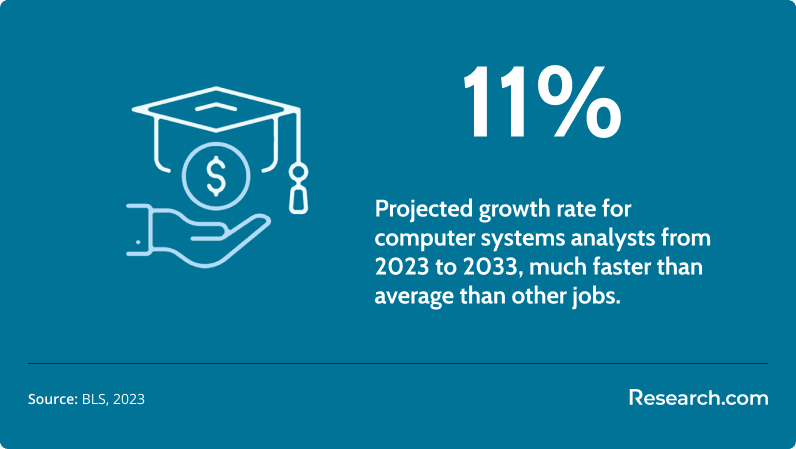
A systems analyst career can be a good choice for 2027 if you want a technology role that combines problem-solving, communication, business analysis, systems thinking, and ongoing learning. The demand for computer systems analysts is projected to grow by 9% from 2021 to 2031, faster than the average for other occupations.
The role can also offer favorable work-life balance depending on employer, project load, industry, and team culture. Many IT professionals report satisfaction with their roles, and systems analysts often have opportunities to work across departments and industries. However, deadlines, system failures, unclear requirements, and high-stakes implementations can create stress.
Pros and Cons of a Systems Analyst Career
| Pros | Cons |
| Competitive pay: In 2023, the median salary for systems analysts was $103,800, with top earners making over $270,000 | Continuous learning is required because tools, security risks, and business systems change quickly |
| Broad industry options in finance, healthcare, government, technology, manufacturing, retail, and insurance | Project deadlines can create pressure, especially during system launches or urgent fixes |
| Multiple advancement paths, including senior analyst, project manager, cybersecurity specialist, data analyst, IT director, and CIO | The role requires frequent communication with stakeholders who may have competing priorities |
| Strong fit for people who like both technology and business problem-solving | Ambiguous requirements can lead to rework if not managed carefully |
For students who need a lower-cost entry point, the cheapest online computer science degree may be worth comparing with local public universities, transfer-friendly community college pathways, employer tuition support, and accredited online IT or MIS programs.
Who Should Choose This Career?
- Choose it if: You enjoy solving operational problems with technology.
- Choose it if: You are comfortable interviewing users, documenting requirements, and working with developers.
- Choose it if: You want a tech role with business visibility and advancement options.
- Consider another path if: You want to spend nearly all your time writing code.
- Consider another path if: You dislike meetings, documentation, negotiation, or user feedback.

Here’s What Graduates Have to Say about Systems Analyst Work
-
: "
Systems analysis gives me a way to use technical knowledge while still working on business strategy. I like studying complicated workflows, finding the weak points, and recommending changes that make the organization run better. The role has also given me stability and clear room to grow. — Ansel
"
-
: "
My work as a systems analyst puts me in contact with teams across the company. Each project brings a different business problem, so the job stays interesting and keeps me learning. It is a strong fit for someone who likes technology, people, and structured problem-solving. — Signe
"
-
: "
I began in a junior systems analyst role and moved forward by learning new tools and taking on different kinds of projects. The field rewards analytical thinking, documentation, and communication. It is a practical career for someone who enjoys working with data, systems, and business teams. — Bram
"
Key Insights
- Systems analysts connect business problems with technical solutions. The role is not just coding or business strategy; it requires translating needs into systems that work in real organizations.
- A bachelor’s degree is the common path, but experience matters heavily. Computer science, information technology, software engineering, and management information systems are all relevant, especially when paired with internships, projects, or entry-level IT work.
- Salary potential is strong but not guaranteed. As of 2025, U.S. systems analysts earn between $83,985 and $114,285 per year, with variation by experience, employer, industry, and location.
- Cybersecurity, data, cloud, and AI skills can strengthen long-term prospects. These areas are increasingly connected to systems analysis because organizations need secure, automated, data-driven workflows.
- The best candidates can communicate clearly. Requirements gathering, stakeholder alignment, testing, and documentation often determine whether a systems project succeeds.
- Choose education carefully. Verify accreditation, compare total cost, review curriculum depth, ask about internships, and avoid assuming that any online or low-cost program will produce the same career outcomes.
- This career is a strong fit for problem-solvers who like both technology and people. If you prefer isolated technical work with little communication, software development, data engineering, or another technical specialty may be a better match.
References:
- Chowdhury, M.R. (2025, January 29). Role of a Systems Analyst: Duties, Skills and Industries. Indeed. https://www.indeed.com/career-advice/finding-a-job/role-of-system-analyst
- Indeed (n.d.). Systems analyst salary in United States. https://www.indeed.com/career/systems-analyst/salaries
- Salary.com. (n.d.-b). Systems Analyst Salary | Salary.com. https://www.salary.com/research/salary/listing/systems-analyst-salary
- How much does a systems analyst make? | PDQ. (n.d.-b). https://www.pdq.com/blog/how-much-does-a-systems-analyst-make
- U.S. Bureau of Labor Statistics (n.d.). Computer Systems Analysts: Occupational Outlook Handbook. https://www.bls.gov/ooh/computer-and-information-technology/computer-systems-analysts.htm
- ZipRecruiter (n.d.). Entry Level Systems Analyst Salary. https://www.ziprecruiter.com/Salaries/Entry-Level-Systems-Analyst-Salary
- ZipRecruiter (n.d.). Systems Analyst Salary. https://www.ziprecruiter.com/Salaries/Systems-Analyst-Salary
- U.S. Bureau of Labor Statistics (n.d.). Computer and Information Technology Occupations: Occupational Outlook Handbook. https://www.bls.gov/ooh/computer-and-information-technology
- G, J. (2022, December 6). IT job satisfaction statistics: Why working in IT is worth it - MyComputerCareer. MyComputerCareer. https://www.mycomputercareer.edu/it-job-satisfaction
- U.S. Bureau of Labor Statistics (n.d.). Most IT workers have college degrees: TED: The Economics Daily. https://www.bls.gov/opub/ted/2002/oct/wk3/art03.htm
- CareerOneStop. (n.d.). Occupation Profile for Computer Systems Analysts | CareerOneStop. https://www.careeronestop.org/Toolkit/Careers/Occupations/occupation-profile.aspx?keyword=Computer+Systems+Analysts&location=United+States&onetcode=15-1211.00
- Teal (n.d.). What Tools do Business Systems Analysts Use?. https://www.tealhq.com/software/business-systems-analyst
- LN Mishra, CBAP, CBDA, AAC & CCA (2024, August 8). Top 10 Industries / Sectors for Business Analysts in 2025. https://www.adaptiveus.com/blog/top-10-industries-for-business-analysts
- Top 10 challenges faced by Business Analysts - Techcanvass. (n.d.). https://techcanvass.com/blogs/challenges-faced-by-business-analysts.aspx?srsltid=AfmBOorrSOolEuWvn0QIKzOq1WhQ0m2dmF2g5BAaswVWNCf0sU87Ib-z
- Cost of a data breach 2024 | IBM. (n.d.). https://www.ibm.com/reports/data-breach
- How much can a computer systems analyst expect to get paid? (n.d.). https://money.usnews.com/careers/best-jobs/computer-systems-analyst/salary
- Ai, E. (n.d.). 5 Essential professional skills for success as a system Analyst. Expertia AI. https://www.expertia.ai/career-tips/5-essential-professional-skills-for-success-as-a-system-analyst-28651i
- Top 9 Best Programming Languages to Learn in 2024. (2024, June 21). tripleten.com/blog. https://tripleten.com/blog/posts/top-9-best-programming-languages-to-learn
- ITlearn, & ITlearn. (2024, October 26). 2024 Trends for Business Analysts: Key insights and future skills. Online Training – Courses & Certification | ITLearn360 -. https://www.itlearn360.com/2024-trends-for-business-analysts-key-insights-and-future-skills
- Writers, S. (2024, August 21). What is a Systems Analyst's Career | How To Become. ComputerScience.org. https://www.computerscience.org/careers/systems-analyst/
Other Things You Should Know About Systems Analyst Salary & Career Paths
In 2027, the average salary for a systems analyst is projected to be around $85,000 to $95,000 annually, depending on location, experience, and specialization. Major tech hubs often offer higher salaries, reflecting the high demand for skilled analysts in those regions.
In 2027, certifications such as Certified Information Systems Security Professional (CISSP), Microsoft Certified: Azure Solutions Architect Expert, and Project Management Professional (PMP) can enhance a systems analyst’s career prospects by demonstrating technical expertise and leadership skills.