2027 Pros and Cons of Being a Medical Biller and Coder

Co-Founder and Chief Data Scientist
Choosing medical billing and coding is not just a question of whether healthcare jobs are growing. The bigger question is whether this behind-the-scenes healthcare career matches the way you like to work: detailed documentation, insurance rules, coding accuracy, deadlines, software systems, and limited direct patient contact. For people who want a healthcare-adjacent job that can often be entered through certificates rather than a full degree, the field can be a practical option. For others, the repetition, compliance pressure, and technology changes can make it frustrating.
According to the latest data, employment for medical records specialists, a category that includes many medical billers and coders, is projected to increase by 9% from 2023 to 2033, with 16,700 new jobs expected during that period. The average annual salary for medical records specialists in 2023 was $53,690, although pay varies by employer, state, experience, and credential level. This guide explains the advantages, drawbacks, responsibilities, salary expectations, education routes, certifications, career advancement options, and technology trends so you can decide whether medical billing and coding is a good fit for your goals.
Quick Answer: Is Medical Billing and Coding a Good Career in 2026?
Medical billing and coding can be a good career for people who are detail-oriented, comfortable with healthcare documentation, able to learn coding rules, and interested in administrative healthcare work. It offers a relatively accessible entry path, steady demand, and possible remote work opportunities. However, it is not ideal for everyone. The work can be repetitive, deadline-heavy, sedentary, and affected by changing regulations, payer rules, and AI-assisted coding tools.
The strongest candidates are those who can combine accuracy, technology skills, medical terminology knowledge, and persistence when resolving denied claims. The career becomes more valuable over time when professionals earn recognized certifications, specialize in high-demand coding areas, or move into auditing, compliance, revenue cycle, or health information management roles.
Key Things You Should Know About the Pros and Cons of Being a Medical Biller and Coder
- Medical records specialist employment is projected to grow by 9% from 2023 to 2033, with 16,700 new jobs expected, which points to continued need for trained billing and coding professionals.
- The average annual salary for medical records specialists in 2023 was $53,690, with reported earnings ranging from $35,080 to $77,810 depending on role, location, industry, and experience.
- General medical and surgical hospitals provide many of the available jobs, employing medical records specialists at an average salary of $57,600.
- Location matters. California had the highest number of jobs, with 20,000 employed specialists and an average salary of $64,070, while Texas and Florida also offered large employment markets.
- Medical billers and coders work in hospitals, physician offices, outpatient care centers, nursing care facilities, insurance-related settings, and remote administrative roles.
- The career is often accessible without a degree, but recognized credentials, continuing education, and software proficiency can strongly affect hiring and advancement.
- Pros and cons of being a medical biller and coder
- What medical billers and coders do
- Where medical billers and coders work
- What a typical workday looks like
- Average salary for medical billers and coders
- How to enter the field without a degree
- Medical billing and coding certifications
- Job market and hiring outlook
- Affordable online education options
- Management and advancement paths
- Legal and privacy requirements
- Networking and mentorship
- Future trends in medical billing and coding
- Complementary clinical skills
- MPH degrees and career mobility
- Interdisciplinary academic programs
- Economic and policy changes
- Additional certifications for career growth
- Essential skills for success
- How AI is changing medical billing and coding
Pros and Cons of Being a Medical Biller and Coder in 2026
Medical billing and coding is attractive because it offers a healthcare career path that does not always require years of college. It can also support remote or hybrid work, depending on the employer. But the job is not simply data entry. It requires accuracy, knowledge of coding systems, insurance workflows, privacy rules, documentation standards, and payer-specific requirements. Before enrolling in a program or paying for certification preparation, weigh the benefits against the daily realities of the job.
| Best reasons to consider the career | Reasons to be cautious |
| Projected job growth of 9% from 2023 to 2033 | Deadlines, claim denials, and audits can create pressure |
| Possible entry without a full degree | Entry-level pay may be lower until you gain experience or credentials |
| Remote and flexible roles may be available | Remote jobs can be competitive and may require prior experience |
| Work supports healthcare operations without direct clinical care | People who want frequent patient interaction may find the work isolating |
| Certifications can lead to specialization, auditing, compliance, and management paths | Rules, code sets, payer policies, and software systems require ongoing learning |
Pros of Being a Medical Biller and Coder
- Steady employment outlook. A projected 9% growth rate from 2023 to 2033 suggests continued demand for professionals who can manage medical documentation and reimbursement workflows.
- Remote work may be possible. Many billing and coding tasks are computer-based, so some employers offer remote or hybrid arrangements, especially for experienced workers.
- The entry path can be shorter than many healthcare careers. You may not need a healthcare degree to begin. A focused training program and certification preparation can be enough for some entry-level roles.
- Advancement is possible with experience. Skilled coders and billers can move into auditing, compliance, revenue cycle management, supervision, consulting, or health information roles.
- Some jobs offer scheduling flexibility. Remote departments, third-party billing companies, and nontraditional healthcare settings may provide schedules outside the standard clinical shift model.
- Work settings are varied. Employers include hospitals, physician practices, outpatient centers, insurance-related organizations, nursing facilities, and administrative healthcare firms.
- Demand exists across many states. Large healthcare markets such as California and Texas employ many medical records specialists.
- Pay can become competitive with specialization. The average annual salary was $53,690 in 2023, with higher earnings possible in certain industries, locations, and advanced roles.
- The work is essential to healthcare finance. Accurate coding and billing help providers receive payment, reduce denials, and maintain compliance.
- The field rewards continuous learning. Professionals who keep up with coding updates, payer policies, and compliance rules can build stronger long-term prospects.
- It is a healthcare role with limited direct patient care. This appeals to people who want to work in healthcare operations rather than clinical service.
- Specialization can improve career options. Areas such as oncology coding, cardiology coding, inpatient coding, risk adjustment, and auditing can lead to more focused roles.
- Healthcare administration tends to remain necessary even when care models change. As long as providers document services and submit claims, billing and coding expertise remains important.
Cons of Being a Medical Biller and Coder
- Work volume can be heavy. High-volume departments often expect claims, edits, corrections, and denials to be handled quickly and accurately.
- Some tasks are repetitive. Reviewing documentation, entering codes, checking claims, and correcting errors can feel monotonous for people who need constant variety.
- Rules change frequently. Coding guidelines, payer policies, reimbursement rules, and compliance requirements require ongoing attention.
- Starting salaries may be modest. Entry-level workers without experience or advanced credentials may need time to reach higher-paying roles.
- Errors can have real consequences. Incorrect codes, missing documentation, or billing mistakes can cause denials, delayed payment, compliance risks, and lost revenue.
- Limited patient contact is not a benefit for everyone. If you want a hands-on healthcare role, this career may feel too removed from patient care.
- Peak billing periods can be stressful. Month-end, year-end, audits, payer deadlines, and backlog periods can increase workload.
- Technology skills are required. You must be comfortable learning electronic health records, billing platforms, coding tools, claim systems, and payer portals.
- Some routine tasks may be automated or outsourced. AI-assisted coding and revenue cycle automation can change job duties, making higher-level review and analysis skills more important.
- Career mobility may be limited without additional credentials. Workers who stop at entry-level billing or coding may find advancement harder.
- The job is usually sedentary. Long periods at a desk can be physically tiring without good ergonomic habits.
- The role may be under-recognized. Billing and coding professionals are central to reimbursement, but they may not receive the visibility given to clinical staff.
- Work-life balance depends heavily on the employer. Some hospitals, payers, and billing organizations have demanding productivity requirements or overtime needs.
Who Is This Career Best For?
- People who notice small details and can maintain accuracy under deadlines
- Students or career changers who want a healthcare role without direct clinical care
- Workers who are comfortable using software, spreadsheets, portals, and electronic records
- People who can study medical terminology, anatomy, payer rules, and coding systems
- Professionals who want a career ladder into compliance, auditing, or healthcare administration
Who Should Consider a Different Healthcare Path?
- People who want hands-on patient care, procedures, or bedside interaction
- Workers who dislike repetitive screen-based tasks
- Students who do not want to keep up with changing rules and continuing education
- Anyone expecting guaranteed remote work immediately after training
- People who prefer broad creative work over structured documentation and compliance tasks
In short, medical billing and coding can be a practical healthcare career in 2026, but it is best for people who enjoy precision, rules-based work, and administrative problem-solving. The following sections explain what the job involves, where billers and coders work, how much they earn, and how to prepare for the field.
What are the main responsibilities of a medical biller and coder?
Medical billers and coders help convert healthcare services into accurate records, claims, and payments. Their work connects clinical documentation, insurance reimbursement, patient accounts, and regulatory compliance. Accuracy matters because poor billing practices cost doctors around $125 billion each year, which illustrates why providers need trained professionals who can reduce claim errors and payment delays.
Although some jobs combine billing and coding, the two functions are different. Coding focuses on translating diagnoses, procedures, supplies, and services into standardized code sets. Billing focuses on using those codes to create, submit, track, correct, and resolve claims.
| Function | Main focus | Common tasks |
| Medical coding | Converting clinical documentation into standardized codes | Reviewing records, assigning ICD-10, CPT, and HCPCS codes, checking documentation, applying coding guidelines |
| Medical billing | Managing claims and payment workflows | Submitting claims, verifying insurance, posting payments, following up on denials, billing patients, communicating with payers |
| Combined billing and coding roles | Handling both documentation coding and revenue cycle tasks | Coding services, preparing claims, correcting rejections, communicating with providers, maintaining records |
Core Duties in Medical Billing and Coding
- Assign medical codes. Review medical documentation and apply the appropriate ICD-10, CPT, and HCPCS codes for diagnoses, procedures, services, and supplies.
- Prepare and submit claims. Use coded data to generate claims for insurers, government programs, or patients.
- Verify insurance information. Confirm coverage, eligibility, authorization requirements, and payer details before or during claim submission.
- Support compliance. Follow HIPAA, documentation standards, payer rules, and other healthcare regulations that affect billing and records.
- Track payments and denials. Monitor claim status, identify unpaid or rejected claims, and submit appeals or corrected claims when needed.
- Maintain patient records. Keep billing and coding information accurate, current, and properly documented.
- Communicate with providers and insurers. Clarify documentation, resolve discrepancies, request missing information, and coordinate with payer representatives.
- Answer billing questions. Help patients understand balances, claim status, coverage issues, and payment responsibilities.
- Audit records for errors. Review claims and documentation before or after submission to find coding mistakes, missing details, or compliance risks.
- Process payments. Post reimbursements, apply patient payments, reconcile accounts, and issue remaining balances when appropriate.
- Manage claim workflows. Follow claims from submission to payment or appeal so reimbursement is not delayed unnecessarily.
- Keep up with coding updates. Learn revisions to code sets, payer policies, and healthcare laws that affect reimbursement.
- Coordinate with other departments. Work with clinicians, front-office teams, administrators, and revenue cycle staff to keep documentation and billing aligned.
Why the Work Matters
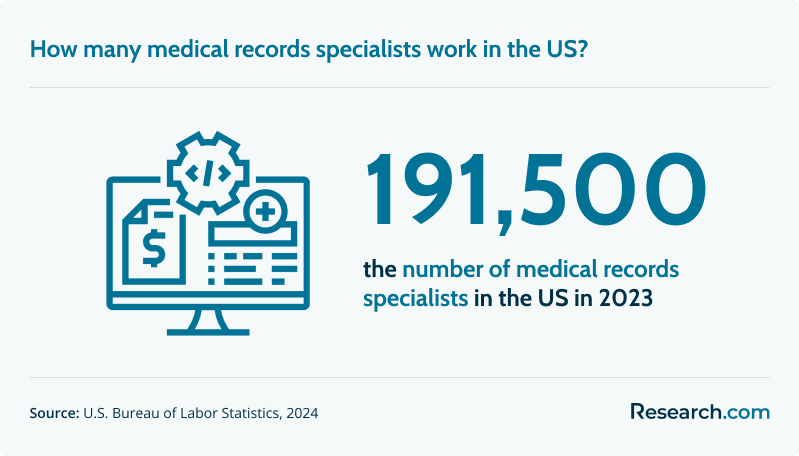
Billing and coding directly affect a provider’s revenue, compliance standing, and patient billing experience. As of 2023, 191,500 medical records specialists were employed in the United States, showing the scale of this administrative healthcare workforce. If you want a structured training route, accredited online medical coding certification programs can help you compare short-format options and understand what entry-level preparation may involve.
Where do medical billers and coders typically work?
Medical billers and coders are employed wherever healthcare services must be documented, coded, billed, reviewed, or reimbursed. Hospitals often have larger teams and more complex cases. Physician offices may involve broader front-office communication and a smaller administrative environment. Outpatient centers, nursing facilities, insurance-related organizations, and third-party billing companies also hire these professionals. Remote work has become more common in some organizations, but many remote roles still require demonstrated experience, productivity, and knowledge of payer systems.
| Work setting | What the work may involve | Potential fit |
| General medical and surgical hospitals | Higher claim volume, inpatient and outpatient documentation, complex coding needs | Good for people who want exposure to varied specialties and larger teams |
| Physician offices | Provider-specific coding, patient billing questions, insurance verification, smaller workflows | Good for people who prefer a smaller healthcare setting |
| Outpatient care centers | Same-day services, outpatient procedures, authorization and claim follow-up | Good for coders interested in ambulatory care |
| Nursing care facilities | Long-term care documentation, payer coordination, recurring billing needs | Good for professionals comfortable with ongoing patient account workflows |
| Insurance carriers and billing vendors | Claims review, reimbursement analysis, denial management, payer-side processes | Good for people interested in claims operations or revenue cycle analytics |
| Remote departments | Computer-based coding, claim edits, documentation review, productivity tracking | Good for experienced professionals who can work independently |
As shown in the chart below, the top industries employing medical records specialists in 2023 include general medical and surgical hospitals, with an average salary of $57,600, and offices of physicians, with an average salary of $46,010.
What is a typical workday like for a medical biller and coder?
A typical day depends on whether the role is coding-focused, billing-focused, or blended. A coder may spend much of the day reviewing documentation, applying codes, resolving coding edits, and querying providers for clarification. A biller may verify insurance details, submit claims, follow up on denials, post payments, and communicate with insurers or patients. In combined roles, the same professional may move between documentation review, claim creation, and account follow-up throughout the day.
| Part of the day | Common activities | Skills used |
| Start of shift | Review work queues, claim edits, coding backlogs, messages, and payer updates | Organization, prioritization, software navigation |
| Midday production work | Code encounters, submit claims, verify documentation, correct rejected claims, check eligibility | Medical terminology, coding accuracy, payer knowledge |
| Problem resolution | Research denials, request provider clarification, appeal claims, correct account errors | Analytical thinking, communication, persistence |
| End-of-day wrap-up | Document follow-ups, update claim notes, complete productivity logs, prepare pending items | Detail management, compliance awareness, time management |
In high-volume environments such as general medical and surgical hospitals or outpatient care centers, productivity expectations can be demanding. Remote professionals may gain schedule flexibility, but they still need strong self-management and consistent accuracy. If you are unsure whether the coursework and job duties will fit your learning style, Research.com’s guide on whether medical billing and coding is hard explains the common challenges students and new workers face.
What is the average salary of a medical biller and coder?
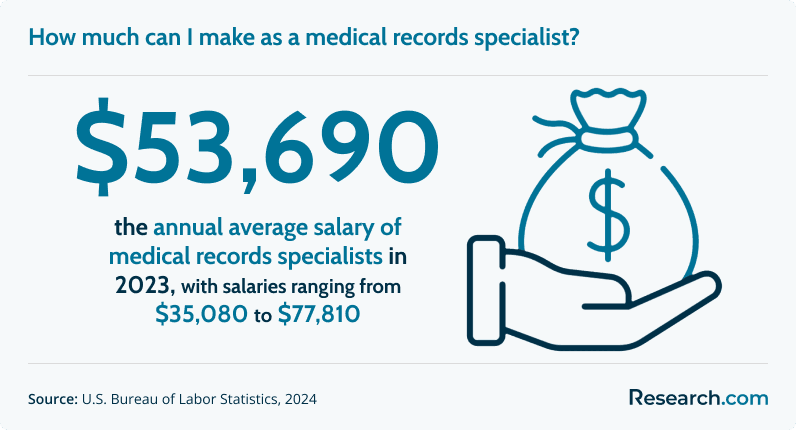
The average salary for a medical biller and coder in 2023 is approximately $53,690, with a range from $35,080 to $77,810. Pay depends on location, employer type, specialty, certification, experience, productivity expectations, and whether the role is entry-level, specialized, or supervisory.
Medical billers and coders, classified within medical records specialist data, earn more on average than medical assistants. For comparison, the average medical assistant associate degree salary is $43,350.
| Salary or employment detail | Figure | What it means for career planning |
| Average annual salary for medical records specialists in 2023 | $53,690 | A useful national benchmark, but not a guarantee for entry-level workers |
| Reported salary range | $35,080 to $77,810 | Experience, location, industry, and specialization can create wide differences |
| General medical and surgical hospitals | $57,600 | Hospitals may offer strong exposure to varied coding and billing workflows |
| Offices of physicians | $46,010 | Smaller clinical settings may pay less on average but can provide broad experience |
| Grantmaking and giving services | $74,840 | One of the higher-paying industry categories reported |
| Insurance carriers | $69,330 | Payer-side work may reward claims and reimbursement expertise |
| Other professional, scientific, and technical services | $72,700 | May include specialized administrative, consulting, or technical healthcare services |
| Software publishing | $67,040 | Technology-related healthcare documentation and billing roles may offer strong pay |
| Wholesale trade agents and brokers | $69,000 | A higher-paying category that may involve specialized business or claims-related functions |
Some professionals later transition into adjacent healthcare roles with different pay potential. For example, radiologic technologists earn a median annual wage of about $75,000, and students considering that clinical path can review 1 year radiology tech programs. That route is very different from billing and coding because it is patient-facing and clinical, so it should be considered only if you want direct care responsibilities.
Can you become a medical biller and coder without a degree?
Yes. Many people enter medical billing and coding without earning a college degree first. The more common route is to complete a focused training program that covers medical terminology, anatomy, coding systems, claim processes, reimbursement, compliance, and billing software. If your main question is how to become a medical coder, the answer usually involves training, certification preparation, practice with real-world documentation examples, and a plan for gaining entry-level experience.
A degree can still be useful for advancement, especially in health information management, healthcare administration, auditing, compliance, or supervisory roles. But for many entry-level billing and coding positions, employers may prioritize job-ready skills, certification, accuracy, and familiarity with coding guidelines.
How long does it take to become a certified medical coder?
Becoming a certified medical coder typically takes between 9 to 12 months, depending on the credential, program format, prior healthcare knowledge, and study pace. Shorter courses can help students move quickly, but a faster program also requires disciplined study because coding rules, anatomy, documentation standards, and payer processes take practice to master.
| Path | Typical timeline | Best for | Trade-offs |
| Short certificate or bootcamp-style course | Often designed for faster completion | Career changers who want focused preparation | May require extra self-study before certification exams |
| Certification preparation program | Commonly fits within the 9 to 12 months range | Students targeting CPC, CCS, CBCS, or similar credentials | Quality varies, so accreditation, curriculum depth, and exam support matter |
| Associate degree route | Longer than a certificate | Students who want broader health information or administrative preparation | Higher time and cost commitment |
| On-the-job entry plus later certification | Varies by employer | Workers who can start in front-office, claims, or records support roles | May be harder to land without prior training or credentials |
Certification is not a one-time commitment. For example, the Certified Professional Coder (CPC) from AAPC and the Certified Coding Specialist (CCS) from AHIMA require continuing education and periodic recertification. The AAPC CPC requires 36 continuing education units (CEUs) every two years. The CCS also requires recertification every two years with a specific number of CEUs. These requirements help coders remain current as coding systems and healthcare regulations change.
If you want to continue your education while working, compare regionally accredited online schools and confirm whether credits, certificates, or degrees align with your long-term goals. The next section explains the certifications most often associated with medical billing and coding careers.
What certifications are needed to become a medical biller and coder?
Certification can improve credibility, prepare you for employer screening, and show that you understand coding or billing standards. The best credential depends on your target setting. Physician office coding, hospital coding, outpatient coding, billing operations, auditing, and health data analysis may require different preparation.
| Certification | Organization | Best fit | What it signals |
| Certified Professional Coder (CPC) | American Academy of Professional Coders (AAPC) | Physician services and outpatient professional coding | Knowledge of diagnostic, procedural, and evaluation service coding |
| Certified Coding Specialist (CCS) | AHIMA | Hospital inpatient and outpatient coding | Ability to handle more complex diagnosis and procedure coding scenarios |
| Certified Coding Specialist - Physician-based (CCS-P) | AHIMA | Physician offices, urgent care clinics, ambulatory surgery centers | Outpatient and provider-based coding expertise |
| Certified Billing and Coding Specialist (CBCS) | National Healthcareer Association (NHA) | Outpatient billing and coding roles | Understanding of claims, insurance verification, reimbursement cycles, and coding basics |
| Certified Inpatient Coder (CIC) | AAPC | Hospital inpatient coding | Preparation for coding admissions, inpatient procedures, and hospital services |
| Certified Outpatient Coder (COC) | AAPC | Outpatient clinics, surgical centers, and physician offices | Skill in coding same-day outpatient services |
| Certified Health Data Analyst (CHDA) | AHIMA | Health data, reporting, analysis, and management roles | Ability to interpret healthcare data and support data-informed decisions |
How to Choose the Right Certification
- Choose CPC if you want physician-based or professional services coding.
- Choose CCS if you are aiming for hospital coding and are prepared for more complex documentation.
- Choose CBCS if you want a credential that includes billing and coding fundamentals for outpatient settings.
- Choose CIC or COC if you already know whether you want inpatient or outpatient specialization.
- Consider CHDA later if your goal is health data analysis rather than entry-level coding.
Before paying for a course, compare curriculum, exam preparation, practicum opportunities, job placement support, and total cost. Research.com’s guide to affordable online medical billing and coding schools can help you review lower-cost training options.
What is the job market for medical billers and coders?
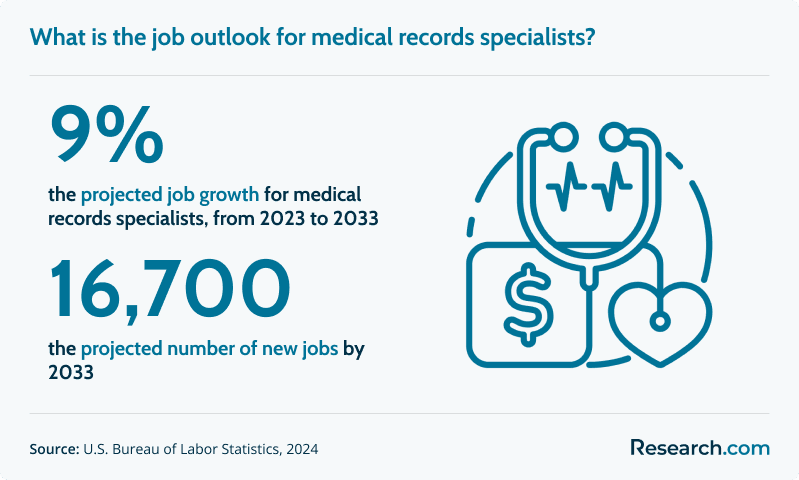
The job market is supported by healthcare volume, documentation requirements, electronic health records, payer complexity, and the need for accurate reimbursement. Employment of medical records specialists, including many medical billers and coders, is expected to grow by 9% from 2023 to 2033, with 16,700 new jobs projected during that period.
That outlook is positive, but it should not be read as a guarantee that every graduate will immediately land a high-paying remote job. Entry-level roles can be competitive. Employers may prefer candidates with certification, practical coding exercises, familiarity with EHR systems, denial management knowledge, and evidence of accuracy.
| Market factor | Why it matters | How to respond |
| Electronic health records | More documentation is digital, searchable, and tied to billing workflows | Learn common EHR and billing software concepts |
| Complex payer rules | Different insurers may have different documentation and claim requirements | Build denial management and payer research skills |
| Compliance oversight | Incorrect coding can create audit and repayment risks | Study HIPAA, coding guidelines, and documentation standards |
| Remote job competition | Remote roles attract applicants from wider labor markets | Gain experience, credentials, and strong productivity references |
| AI-assisted coding | Software may handle simpler tasks but still needs human review | Develop auditing, exception handling, and analytical judgment |
Professionals who want to move beyond entry-level roles may benefit from more advanced training in administration or revenue cycle operations. An accelerated healthcare management degree online can be relevant for coders and billers who want leadership, operations, or healthcare management responsibilities.
Are there affordable ways to advance your career with flexible online education?
Yes. If you are already working or trying to change careers without taking on unnecessary costs, look for programs that combine flexible scheduling, transparent tuition, recognized accreditation, certification preparation, and financial aid options. The cheapest program is not always the best value if it lacks exam preparation, coding practice, instructor support, or employer recognition. To compare cost-conscious options, review Research.com’s guide to medical coding and billing classes online with financial aid.
Questions to Ask Before Choosing an Online Program
- Is the school or program properly accredited or recognized for the credential I want?
- Does the curriculum prepare students for CPC, CCS, CBCS, or another specific certification?
- Are coding systems, medical terminology, compliance, and reimbursement included?
- Does the program include hands-on coding practice using realistic records?
- What is the total cost, including books, exam fees, software, and membership fees?
- Can I transfer credits later into a degree program?
- Does the school provide career support, resume help, externships, or employer connections?
Is there a management track for medical billing and coding professionals?
Yes. Medical billing and coding can lead to management, but advancement usually requires more than basic claim processing. Professionals who gain experience with coding quality, denial trends, payer rules, audits, compliance, and team workflows may move into roles such as billing supervisor, coding supervisor, revenue cycle analyst, compliance specialist, medical records lead, or health information manager.
Management roles often require broader knowledge of healthcare operations, leadership, reporting, budgeting, compliance, and process improvement. For workers balancing education with full-time employment, online degrees for working adults may offer a flexible way to build credentials while remaining employed.
| Career stage | Example roles | How to move forward |
| Entry level | Billing clerk, coding assistant, medical records technician, claims follow-up representative | Build accuracy, learn systems, earn a recognized credential |
| Experienced specialist | Certified coder, denial specialist, reimbursement specialist, risk adjustment coder | Specialize, document productivity, learn payer rules deeply |
| Advanced technical track | Auditor, compliance analyst, coding quality reviewer, revenue integrity specialist | Add auditing, compliance, or risk adjustment certifications |
| Leadership track | Billing supervisor, coding manager, health information manager, revenue cycle manager | Develop leadership, reporting, training, and healthcare administration skills |
How do legal and data privacy regulations impact medical billing and coding?
Medical billers and coders work with protected health information, so privacy and compliance are part of the job. HIPAA, documentation rules, payer contracts, audit standards, and data security policies affect how records are accessed, coded, stored, corrected, and shared. A billing or coding mistake is not only an administrative issue; in some cases, it can create compliance exposure, repayment demands, or patient trust problems.
Professionals should expect recurring compliance training and careful access controls. They also need to understand how to document claim changes, respond to audits, protect patient data, and follow employer policies for secure communication. Some healthcare workers broaden their compliance knowledge through advanced health-related education; for example, programs connected to online pharmacy school may be relevant for professionals pursuing broader healthcare regulation or medication-related administrative expertise, although they are not required for standard billing and coding roles.
What role does professional networking and mentorship play in advancing a career in medical billing and coding?
Networking helps billing and coding professionals learn how employers actually hire, which credentials matter in specific settings, and how experienced coders solve difficult documentation or denial problems. Mentorship can be especially valuable for new coders because real-world coding often involves incomplete documentation, payer-specific rules, conflicting edits, and judgment calls that are hard to master through coursework alone.
Good networking options include professional associations, certification groups, employer training teams, local healthcare administration events, LinkedIn communities, and peer study groups. If you are comparing administrative healthcare with patient-facing roles, reviewing options such as the fastest medical assistant programs can also clarify whether you prefer front-office, clinical support, or billing-focused work.
What future trends will redefine medical billing and coding?
Medical billing and coding is being reshaped by automation, AI-assisted documentation review, telehealth billing complexity, value-based reimbursement models, payer scrutiny, and increased demand for revenue cycle analytics. These changes do not remove the need for human expertise, but they can shift the best jobs toward professionals who can audit, interpret, investigate, communicate, and solve exceptions rather than simply enter codes.
- AI-assisted coding will expand. Software can suggest codes and flag inconsistencies, but humans are still needed to validate documentation, resolve ambiguity, and manage compliance risk.
- Denial management will remain important. As payer rules evolve, organizations need staff who can identify why claims fail and how to prevent repeat errors.
- Telehealth billing adds complexity. Remote care services may involve different coding, place-of-service, documentation, and payer requirements.
- Analytics skills will become more useful. Employers increasingly value professionals who can identify trends in denials, documentation gaps, undercoding, overcoding, and revenue leakage.
- Leadership opportunities may expand for revenue cycle experts. Professionals interested in broader operations can compare the best jobs in healthcare administration to see how billing and coding experience may connect to management careers.
Can acquiring complementary clinical skills boost my career success?
Clinical knowledge can help coders interpret documentation more accurately, especially when records involve procedures, imaging, anatomy, diagnoses, or specialty terminology. You do not need to become a clinician to succeed in billing and coding, but stronger understanding of patient care can make complex records easier to analyze.
Complementary clinical education is most useful when it supports your coding specialty or career direction. For example, a coder working with radiology, cardiology, surgery, oncology, or diagnostic services may benefit from deeper anatomy and procedure knowledge. Students interested in imaging-related healthcare careers can explore the best schools for sonography, but that path is more appropriate for people who want clinical training rather than a purely administrative role.
Can an MPH Degree Support Career Advancement in Medical Billing and Coding?
An MPH is not required for most medical billing and coding positions. However, it may support advancement for experienced professionals who want to move into public health administration, policy, compliance, population health analytics, healthcare operations, or leadership. The value depends on your career goal. If you want to remain a coder, certification and specialty experience may offer a more direct return. If you want to influence systems, policy, quality improvement, or organizational strategy, graduate education may be more relevant.
Professionals considering that route can compare cheapest MPH programs online to understand lower-cost graduate options. Before enrolling, ask whether the degree connects clearly to the roles you want and whether your employer values public health training for advancement.
How can interdisciplinary academic programs enhance career success in medical billing and coding?
Interdisciplinary education can strengthen coding accuracy and problem-solving when it adds relevant knowledge. Courses in anatomy, biology, healthcare ethics, informatics, statistics, compliance, and health administration can help professionals understand clinical documentation and organizational decision-making. The key is alignment. Do not pursue extra coursework simply to collect credentials; choose studies that support a specific role, specialty, or advancement plan.
For example, students who want deeper biomedical knowledge may review the fastest online biology programs. A biology degree is not necessary for entry-level billing and coding, but it may provide useful context for people pursuing broader healthcare, research, or clinical-administrative pathways.
How do economic and policy changes impact the medical billing and coding profession?
Medical billing and coding is closely tied to reimbursement policy, insurance coverage rules, regulatory enforcement, healthcare spending patterns, and provider revenue pressure. When payer rules change, billing workflows change. When documentation standards become more demanding, coders need more precision. When healthcare organizations face financial pressure, denial prevention and revenue integrity become more important.
Professionals who follow policy updates, payer bulletins, coding guideline changes, and audit trends can respond faster than those who rely only on old training. Broader academic study can sometimes help professionals interpret clinical and economic context; for example, an online biology degree may support healthcare literacy, although it is not a standard requirement for billing and coding employment.
How can additional certifications increase career opportunities?
Additional certifications can help experienced medical billers and coders move into specialized or higher-responsibility roles. Credentials in auditing, compliance, risk adjustment, inpatient coding, outpatient coding, or health data analysis can show employers that you can handle complex work beyond entry-level claim processing.
| Advanced focus | Example credential or skill area | Career opportunities it may support |
| Medical auditing | Certified Professional Medical Auditor (CPMA) | Auditor, compliance reviewer, documentation quality specialist |
| Risk adjustment | Certified Risk Adjustment Coder (CRC) | Risk adjustment coder, payer-side coding analyst, value-based care documentation specialist |
| Compliance | Healthcare compliance training or related credentials | Compliance analyst, revenue integrity specialist, audit support roles |
| Specialty coding | Inpatient, outpatient, oncology, cardiology, or surgical coding specialization | Specialized coder, coding quality reviewer, senior coding role |
| Leadership education | Healthcare administration or health information management coursework | Supervisor, manager, revenue cycle lead, health information role |
Some professionals ultimately decide they want a more clinical leadership pathway rather than a coding-focused career. In that case, options such as the easiest direct entry MSN programs may be worth researching, but they represent a major shift into nursing education and should not be confused with billing and coding advancement.
What essential skills are required for success in medical billing and coding?
Successful medical billers and coders combine technical knowledge with disciplined work habits. Employers look for accuracy, reliability, confidentiality, and the ability to resolve problems without creating compliance risk. Training can teach code sets and terminology, but long-term success depends on judgment, organization, and the willingness to keep learning.
| Skill | Why it matters | How to build it |
| Attention to detail | Small errors can cause denials, underpayment, overpayment, or compliance problems | Practice coding exercises, double-check work, use audit feedback |
| Medical terminology | Codes are based on diagnoses, procedures, anatomy, and provider documentation | Study terminology, anatomy, and specialty-specific documentation |
| Coding system knowledge | ICD-10, CPT, and HCPCS codes are central to claims and records | Use certification prep, coding manuals, and realistic case practice |
| Billing and reimbursement knowledge | Claims must meet payer rules and reimbursement requirements | Learn insurance basics, denial workflows, and claim lifecycle steps |
| Software proficiency | Most work happens in EHRs, billing systems, encoders, and payer portals | Seek programs with software exposure and practice data entry accuracy |
| Communication | Coders and billers must clarify documentation and explain claim issues | Practice concise provider queries, patient account communication, and payer follow-up |
| Compliance awareness | Patient privacy and accurate billing are legal and ethical requirements | Complete HIPAA training and follow employer policies closely |
| Adaptability | Rules, technology, and payer expectations change frequently | Complete CEUs, read updates, and stay active in professional communities |
If you are ready to compare training options, Research.com’s list of the best online schools for medical billing and coding can help you evaluate programs based on accreditation, flexibility, and career preparation.
How is artificial intelligence affecting medical billing and coding?
AI is changing the way medical billing and coding teams work. AI-powered tools can scan documentation, suggest codes, identify inconsistencies, detect missing information, and flag possible claim errors. This can reduce some routine manual work, but it also raises expectations for human reviewers. Employers still need professionals who can confirm whether suggested codes match the documentation, understand payer rules, correct exceptions, and recognize compliance risk.
The professionals most likely to remain competitive are those who can use AI tools without relying on them blindly. Human judgment is still important when documentation is ambiguous, when payer rules conflict, when a claim is denied, or when an audit requires clear reasoning. AI may reduce demand for purely repetitive tasks over time, but it can increase the value of coders and billers with auditing, analysis, documentation improvement, and revenue cycle skills.
AI adoption is also relevant in higher-paying industries. Top-paying industries for a medical biller and coder include grantmaking and giving services ($74,840), other professional, scientific, and technical services ($72,700), and insurance carriers ($69,330), where advanced technical and analytical skills may be especially valuable.
What Medical Billers and Coders Say About the Pros and Cons of the Career
- The flexibility is one of the biggest benefits for me, especially because much of my work can be done remotely. The hard part is keeping up with coding updates and still meeting deadlines without sacrificing accuracy. Patricia
- I like that the skills are useful in almost any healthcare setting. At the same time, denial follow-up and insurance appeals can be mentally draining. If you enjoy solving problems, the job can be satisfying. Chris
- This career fits me because I like independent, focused work. But it demands concentration. One small mistake can create a larger issue, so I have learned to review my work carefully before moving on. Andrew
Common Mistakes to Avoid Before Entering Medical Billing and Coding
- Choosing a program only because it is cheap. Low tuition does not help if the program lacks coding practice, certification preparation, or employer credibility.
- Assuming remote work is guaranteed. Remote roles exist, but many employers prefer candidates with experience, certification, and proven productivity.
- Ignoring accreditation and credential alignment. Make sure your program prepares you for the certification or role you actually want.
- Underestimating the difficulty of coding exams. Medical coding requires anatomy, terminology, guidelines, and applied practice, not memorization alone.
- Focusing only on salary averages. The average annual salary was $53,690 in 2023, but entry-level pay, location, and industry can differ significantly.
- Skipping software skills. Employers often expect comfort with EHRs, billing systems, encoders, spreadsheets, and payer portals.
- Not planning for continuing education. Credentials such as CPC and CCS require ongoing education and recertification.
- Confusing billing and coding with clinical healthcare jobs. This is primarily administrative and documentation-based, not hands-on patient care.
- Relying only on rankings or advertisements. Always compare cost, curriculum, outcomes, exam preparation, support services, and transfer options.
- Waiting too long to specialize. After gaining a foundation, specialization in auditing, risk adjustment, inpatient coding, outpatient coding, or compliance can improve career mobility.
Key Insights
- Medical billing and coding is a strong fit for detail-oriented people who want healthcare work without direct patient care.
- The field has a projected 9% growth rate from 2023 to 2033, with 16,700 new jobs expected, but candidates still need strong training and credentials to compete.
- The average annual salary for medical records specialists in 2023 was $53,690, with a reported range from $35,080 to $77,810.
- In 2023, 191,500 medical records specialists were employed in the U.S., and the largest healthcare employers included general medical and surgical hospitals and physician offices.
- General medical and surgical hospitals employed 47,530 specialists at an average salary of $57,600, while doctor's offices employed 35,910 specialists at $46,010 annually.
- California had the highest employment level, with 20,000 specialists and an average salary of $64,070; Texas and Florida employed 19,870 and 16,470 specialists, respectively.
- Top-paying industries include grantmaking and giving services ($74,840), other professional, scientific, and technical services ($72,700), insurance carriers ($69,330), wholesale trade agents and brokers ($69,000), and software publishing ($67,040).
- You can enter the field without a degree, but certification, practice with real medical documentation, and continuing education are important for long-term success.
- AI will not eliminate the need for skilled billing and coding professionals, but it will reward workers who can audit, analyze, troubleshoot, and apply judgment.
- The best decision is not “billing and coding or nothing.” Compare it against clinical, administrative, and health information careers based on your preferred work style, timeline, cost, and advancement goals.
References:
- U.S. Bureau of Labor Statistics. (2024). Occupational employment and wages, May 2023 - 29-2072 medical records specialists. Retrieved December 24, 2024, from BLS.
- U.S. Bureau of Labor Statistics. (2024). Medical records specialists. Retrieved December 24, 2024, from BLS.
- O*NET OnLine. (2024). Medical records specialists - 29-2072.00. Retrieved December 24, 2024, from O*NET OnLine.
Other Things You Should Know About Being a Medical Biller and Coder
Medical billers and coders must protect patient privacy under HIPAA, submit only accurate codes, and avoid unbundling, upcoding, and falsifying claims. They also follow payer rules and documentation standards used by employers, Medicare, Medicaid, and private insurers.
Certifications like the Certified Professional Coder (CPC) from AAPC are essential for medical billers and coders in 2027. These credentials can improve employability and potentially lead to higher earnings. Specialized certifications may also be beneficial depending on the coding field you choose.