
2027 How To Become a Certified Professional Coder (CPC): Salary & Career Paths

Co-Founder and Chief Data Scientist
Becoming a Certified Professional Coder (CPC) is a practical route into healthcare for people who want stable, detail-oriented work without providing direct patient care. CPCs translate diagnoses, procedures, services, and provider documentation into standardized medical codes used for billing, reimbursement, audits, reporting, and compliance. The role matters because healthcare organizations cannot get paid accurately—or maintain clean records—without reliable coding.
This guide is designed for career changers, healthcare support workers, students comparing medical billing and coding programs, and professionals deciding whether the CPC credential is worth the time and cost for 2027. You will learn what CPCs do, how to qualify for the exam, which education paths make sense, how salaries vary, what skills employers value, and how to choose training without overpaying or picking the wrong credential.
Quick answer: Is becoming a Certified Professional Coder worth it?
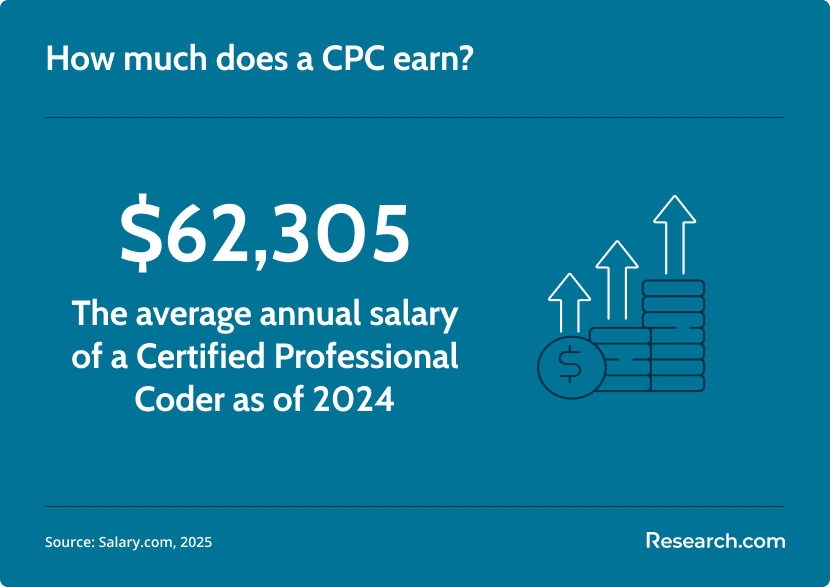
Becoming a CPC can be worth it if you want a healthcare career focused on documentation, coding accuracy, insurance reimbursement, and compliance rather than bedside care. The Bureau of Labor Statistics reports about 15,000 openings each year for medical records specialists, the broader occupational group that includes medical coders, and projects 9% growth from 2023 to 2033 (BLS, 2024). Salary.com lists annual CPC salaries between $57,205 and $70,205, with the average medical coding salary at $62,305.
The best candidates are comfortable reading clinical documentation, using code books or encoder tools, following rules carefully, and continuing to learn as coding guidelines change. The path is not ideal for people who dislike detailed administrative work, struggle with self-study, or expect certification alone to guarantee a high-paying remote job immediately.
Top reasons people pursue CPC certification
- Healthcare demand is steady: Medical records specialists are expected to grow by 9% from 2023 to 2033, which is much faster than the average for all occupations (BLS, 2024).
- Pay can improve with experience: Salary.com reports CPC salaries ranging from $57,205 to $70,205, while advanced roles such as Coding Director, Coding and Reimbursement Specialist, and Coding Manager may pay more depending on responsibility and employer.
- The work exists in several settings: CPCs may work for hospitals, physician practices, outpatient clinics, insurers, billing companies, government programs, consulting groups, and compliance teams.
- It can support remote or hybrid work: Many coding tasks are digital, but remote roles usually require proven accuracy, experience, productivity, and strong knowledge of payer rules.
- What does a Certified Professional Coder do?
- How do you become a Certified Professional Coder for 2027?
- What skills do CPCs need?
- Which education programs are best for aspiring CPCs?
- Self-paced vs. instructor-led CPC courses: which is better?
- What are the CPC exam prerequisites?
- Where can Certified Professional Coders work?
- How much does a Certified Professional Coder earn?
- What career paths can CPCs pursue?
- What trends are changing medical coding?
- Which additional certifications can strengthen CPC expertise?
- How can an affordable online healthcare administration degree support CPC career growth?
- How does CPC certification compare with other medical coding credentials?
- Can advanced education help CPCs move up?
- How do you maintain CPC certification?
- How can networking improve a CPC career?
- How can business knowledge help CPCs advance?
What does a Certified Professional Coder do?
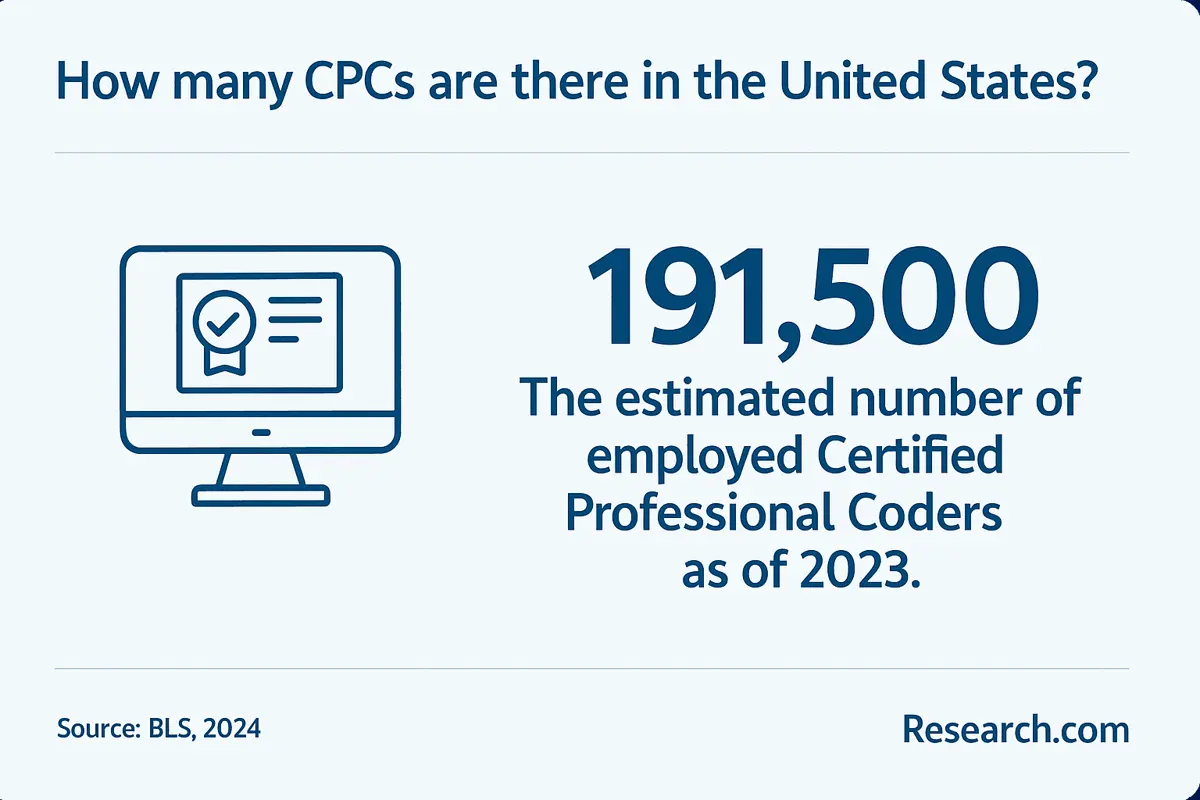
A Certified Professional Coder reviews healthcare documentation and assigns the correct medical codes for diagnoses, procedures, supplies, and services. The BLS reports about 191,500 medical records specialists in the US as of 2023, a category that includes many medical coding roles. CPCs help convert provider notes into codes used for insurance claims, patient records, reimbursement, reporting, and compliance.
In practical terms, CPCs sit between clinical care and the business side of healthcare. They do not diagnose patients or decide treatment, but they must understand clinical language well enough to determine whether the documentation supports the code being billed.
- Review medical documentation: CPCs read encounter notes, operative reports, lab documentation, physician orders, and patient charts to identify billable diagnoses, services, and procedures.
- Apply code sets correctly: They use ICD-10, CPT, and HCPCS codes to represent medical conditions, services, treatments, and supplies in a standardized format.
- Support billing and claims: CPCs help ensure that claims are coded accurately before submission so providers can pursue appropriate reimbursement.
- Check compliance: They follow payer rules, coding guidelines, documentation requirements, and privacy standards such as HIPAA.
- Investigate errors and denials: When claims are rejected or questioned, coders may help identify documentation gaps, code mismatches, or payer policy issues.
- Specialize by care setting: Some CPCs focus on outpatient visits, physician office coding, surgical coding, specialty clinics, audits, or reimbursement review.
| Typical CPC task | Why it matters |
| Reading provider notes | Codes must be supported by documented diagnoses, procedures, and medical necessity. |
| Assigning ICD-10, CPT, and HCPCS codes | Standardized codes allow payers and healthcare organizations to process claims consistently. |
| Reviewing claim issues | Accurate coding can reduce rework, denials, payment delays, and compliance problems. |
| Staying current on guidelines | Coding rules and payer policies change, so coders must keep skills updated. |
How do you become a Certified Professional Coder for 2027?
The CPC pathway is straightforward, but it requires disciplined preparation. You do not always need a degree, but you do need strong knowledge of anatomy, medical terminology, coding systems, documentation rules, and reimbursement basics. If you are comparing this route with broader medical coding careers, Research.com’s guide on how to become a medical coder explains the larger career field and salary context.
- Learn the foundations of healthcare documentation: Start with medical terminology, anatomy, physiology, pathophysiology, payer basics, and healthcare privacy rules. These topics make coding manuals easier to use and help you understand provider notes.
- Choose a training route: You can prepare through a certificate, associate degree, formal CPC course, community college program, employer training, or structured self-study. A formal program is especially useful if you are new to healthcare.
- Practice with ICD-10, CPT, and HCPCS: The CPC exam tests whether you can apply codes accurately, not just memorize definitions. Build speed using official coding manuals and timed practice questions.
- Consider entry-level healthcare experience: Billing assistant, front office, medical records clerk, prior authorization assistant, or revenue cycle support roles can help you understand real workflows before applying for coding jobs.
- Prepare for the AAPC CPC exam: The CPC exam includes 150 multiple-choice questions covering coding guidelines, medical terminology, anatomy, compliance, and code application. Many candidates use review courses, practice exams, and study groups.
- Take and pass the CPC exam: The exam lasts 5 hours and 40 minutes. Registration is completed through AAPC’s website, and candidates should be comfortable using their coding manuals efficiently under time pressure.
- Maintain the credential: AAPC requires CPCs to earn 36 continuing education units (CEUs) every two years to keep the certification active.
| Stage | What to focus on | Best for |
| Beginner preparation | Medical terminology, anatomy, coding basics, HIPAA, billing workflow | Career changers and students without healthcare experience |
| Exam preparation | CPC practice questions, code book navigation, guidelines, timed review | Candidates preparing to sit for the exam |
| First coding job | Accuracy, productivity, payer rules, documentation review, denial support | New CPCs building experience |
| Advancement | Auditing, specialty coding, compliance, management, revenue cycle strategy | Experienced CPCs seeking higher-responsibility roles |
What skills do CPCs need?
A CPC credential is valuable only if it is backed by usable skills. Medical coding is not a simple data-entry job. It requires clinical vocabulary, rule interpretation, documentation judgment, accuracy, and the ability to ask the right questions when information is incomplete.
- Medical terminology and anatomy: Coders need to understand body systems, diagnoses, procedures, medications, and clinical abbreviations so they can interpret provider documentation correctly.
- ICD-10, CPT, and HCPCS coding knowledge: CPCs must know how different code sets work and when each one applies. If you want structured training, compare accredited medical billing and coding programs before enrolling.
- Attention to detail: Small errors can lead to claim denials, incorrect reimbursement, compliance concerns, or extra administrative work.
- Analytical thinking: Coders must determine whether documentation supports a selected code, whether modifiers are appropriate, and whether a payer rule changes how a claim should be submitted.
- Communication: CPCs often need to clarify documentation with providers, explain claim issues to billing staff, or discuss coding decisions with auditors and managers.
- Time management: Productivity standards are common. Coders must work accurately while meeting deadlines and managing multiple charts or claim queues.
- Ethical judgment: The job requires coding what is documented, not what might have happened or what would produce the highest payment.
- Technology comfort: Electronic health records, encoder software, claim systems, payer portals, and auditing tools are now part of routine coding work.
Who is a strong fit for CPC work?
- People who enjoy rules, patterns, and structured problem-solving
- Healthcare workers who want to move away from direct patient care
- Administrative professionals who want a specialized healthcare skill
- Detail-oriented learners who can study independently and keep up with updates
Who may want a different healthcare path?
- People who want frequent face-to-face patient interaction
- Students who dislike reading dense policies, manuals, or clinical notes
- Candidates expecting immediate high pay with no experience
- Workers who are uncomfortable with audits, productivity tracking, or ongoing rule changes
Which education programs are best for aspiring CPCs?
You can become a CPC through several education routes. The best choice depends on your budget, timeline, prior healthcare experience, and career goals. A short coding certificate may be enough if your main goal is exam preparation. A degree may be better if you want broader health information, management, informatics, or leadership opportunities later.
| Program type | What it usually covers | Best for | Trade-off |
| Medical coding and billing certificate | ICD-10, CPT, HCPCS, billing, reimbursement, compliance, medical terminology | Students who want focused CPC preparation | May offer less general education or management preparation |
| Associate degree in medical billing and coding | Coding systems, claims, healthcare reimbursement, terminology, anatomy, office systems | Learners who want a credential beyond a short certificate | Takes longer than a certificate |
| Associate degree in health information technology | Health records, coding, data management, privacy, healthcare law, databases | Students interested in coding plus health information operations | May include topics beyond exam-focused coding |
| Bachelor’s degree in health administration | Healthcare operations, policy, finance, management, compliance, leadership | CPCs who want future supervisory or administrative roles | More time and cost than coding-only training |
| Bachelor’s degree in health informatics | Healthcare data, information systems, analytics, records, technology workflows | Students interested in coding, data quality, and health IT | Less narrowly focused on CPC exam preparation |
An associate degree in medical billing and coding or health information technology is a practical option for students who want coding-focused preparation with a recognized academic credential. A bachelor’s degree in health administration may make sense if you want management responsibilities later; Research.com’s overview of healthcare administration degree requirements can help you understand that route. If speed is the main priority, compare short-format options carefully and review whether 4-week medical certificate programs online provide enough depth for your current skill level.
How to choose a CPC education program
- Check accreditation or institutional credibility: Avoid programs that make vague promises without clear curriculum, faculty qualifications, or student support.
- Review exam alignment: The course should teach ICD-10, CPT, HCPCS, anatomy, terminology, guidelines, compliance, and exam-style practice.
- Compare total cost: Tuition is only one part of the price. Ask about books, coding manuals, exam fees, membership fees, software, retake costs, and extension fees.
- Ask about completion support: Look for tutoring, instructor access, practice exams, career services, externships, or job search guidance.
- Match the format to your schedule: Self-paced programs require discipline. Instructor-led programs cost more but may help students who need structure.
Self-paced vs. instructor-led CPC courses: which is better?
Both self-paced and instructor-led CPC courses can work. The better option depends on how you learn, how much structure you need, and how quickly you want to prepare. Self-paced study is usually more flexible and less expensive. Instructor-led training usually provides more accountability, scheduled lessons, and direct guidance.
The chart below uses the same cost examples cited in the original source material: instructor-led CPC courses cost around $3,999 and may include the AAPC CPC exam, one-year AAPC membership, and relevant materials (University of La Verne, n.d.). A self-paced option may cost around $2,099 and include digital textbooks, interactive content, and practice tests (Penn Foster, n.d.). Students comparing price-focused options can also review affordable online medical billing and coding courses.
| Course Format | Cost | Structure | Pace | Program Length |
| Self-Paced Courses | $2,099 | Flexible and independent | Learn on your own time | Up to 18 months to complete. |
| Instructor-Led Courses | $3,999 | Live classes and guided sessions | Fixed class schedules | 88 hours of classroom instruction and 25 hours of online learning. |
Source: University of La Verne, n.d.; Penn Foster, n.d.
Choose self-paced CPC training if:
- You have a predictable study schedule and strong self-discipline.
- You need a lower-cost option.
- You already have healthcare, billing, or medical terminology experience.
- You prefer reviewing lessons multiple times at your own speed.
Choose instructor-led CPC training if:
- You are new to healthcare and need more explanation.
- You learn better with deadlines and live instruction.
- You want direct access to an instructor for questions.
- You are preparing on a fixed timeline and need accountability.
What are the CPC exam prerequisites?
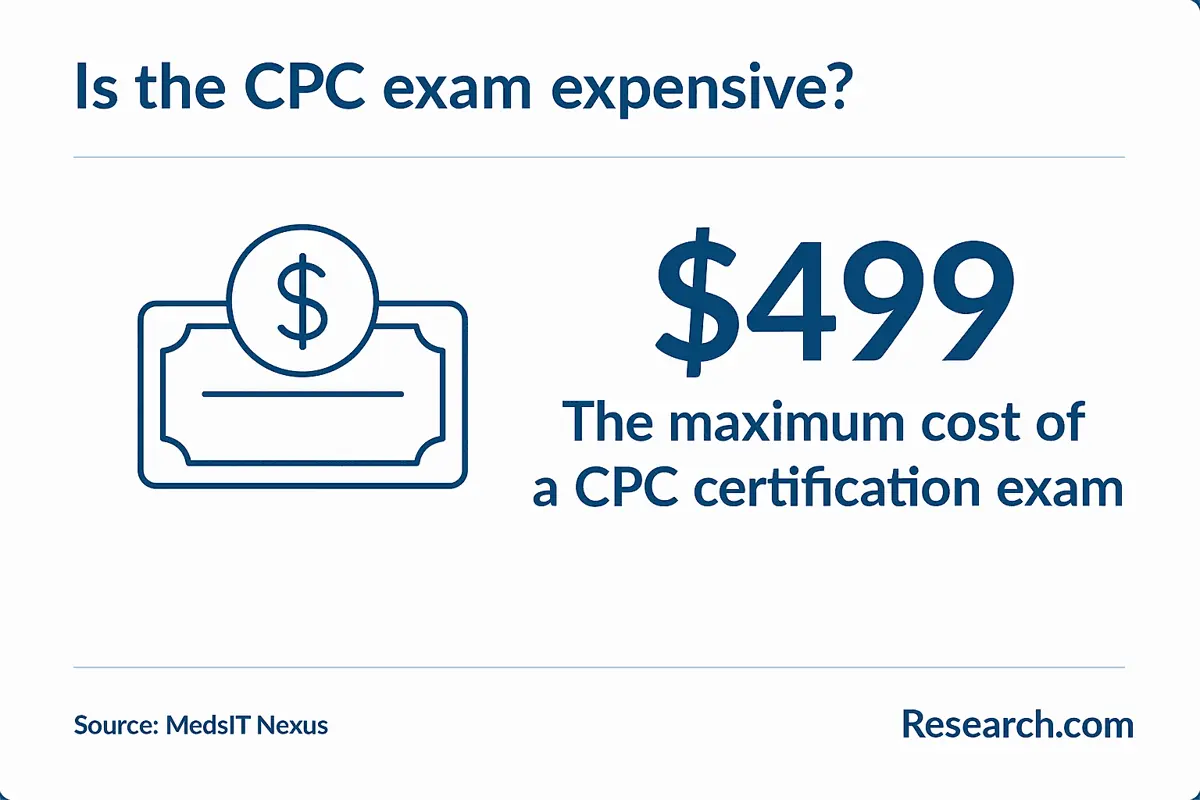
The CPC exam is offered by AAPC. A medical coding degree is not always mandatory, but candidates should not treat the exam as an entry-level vocabulary quiz. The exam requires applied coding knowledge, familiarity with official coding manuals, and the ability to work accurately under time limits. Candidates should also budget for the exam cost, which can be up to $499 (MedsIT Nexus, n.d.), along with membership, manuals, training, and preparation materials.
- Medical coding education is strongly recommended: A structured program can cover ICD-10, CPT, HCPCS, medical terminology, anatomy, reimbursement, and compliance. If you are planning your timeline, Research.com explains how long medical billing and coding school takes, including common 9- to 12-month pathways and accelerated or part-time options.
- Work experience can strengthen readiness: AAPC recommends at least two years of on-the-job medical coding experience. Some candidates sit for the exam after formal training, while others build experience through billing, records, front office, or healthcare support roles first.
- AAPC membership is required: Candidates taking the CPC exam through AAPC must be members. Membership is typically around $222 per year and can be renewed annually (AAPC, n.d.).
- Exam preparation is essential: Practice exams, code book drills, review courses, and timed study sessions help candidates build speed and accuracy. Workers with clinical support backgrounds may already have useful knowledge; for example, people familiar with medical assistant qualifications and skills may already understand terminology, patient workflows, and documentation basics.
- Official coding manuals are part of the process: The CPC exam is open-book, but that does not make it easy. You must know how to locate guidelines, code ranges, notes, and modifiers quickly.
| Cost or requirement | What to verify before you pay |
| Exam cost up to $499 | Confirm what is included, whether retakes cost extra, and whether your course bundle includes the exam. |
| AAPC membership around $222 per year | Check membership requirements, renewal timing, and student pricing if applicable. |
| Coding manuals | Ask whether books are included or must be purchased separately. |
| Training program | Compare curriculum depth, instructor support, practice exams, completion time, and refund policies. |
| CEUs after certification | Plan for 36 continuing education units every two years to maintain certification. |
Where can Certified Professional Coders work?
CPCs are most closely associated with healthcare providers, but their skills are also used by payers, billing vendors, auditors, government programs, compliance teams, and healthcare technology companies. The common thread is documentation: any organization that reviews, pays, audits, or analyzes healthcare claims may need people who understand medical coding.
- Hospitals, clinics, and physician practices: These employers use coders to translate patient encounters into claim-ready codes and support clean documentation.
- Outpatient and specialty practices: CPCs may focus on areas such as surgery, primary care, urgent care, women’s health, cardiology, orthopedics, or other specialties.
- Insurance companies: Payers hire coders to review claims, check coding accuracy, evaluate medical necessity, and resolve reimbursement questions.
- Medical billing companies: Third-party billing organizations rely on coders to process claims for healthcare practices and facilities.
- Government agencies: Programs connected to Medicare, Medicaid, public health, audits, and claims review may use coding expertise to support compliance and reimbursement oversight.
- Research and data organizations: Coding can support standardized healthcare data used in studies, registries, quality reporting, and analytics.
- Pharmaceutical and medical device organizations: Some roles involve coding clinical trial data, treatment-related documentation, or reimbursement information. A clinical path such as an online doctorate in pharmacy program is not required for CPC work, but may be relevant for professionals whose goals specifically intersect with pharmacy operations or pharmaceutical care.
- Legal, audit, and compliance settings: CPCs may review records in fraud investigations, malpractice support, payer disputes, or internal compliance audits.
How much does a Certified Professional Coder earn?
Salary varies by experience, employer, specialty, productivity expectations, location, credentials, and whether the role includes auditing, management, reimbursement strategy, or compliance. Salary.com reports an average medical coding salary of $62,305 and CPC salaries ranging between $57,205 and $70,205. ZipRecruiter reports higher figures for advanced roles: Coding Directors can reach $122,000, Coding and Reimbursement Specialists average around $97,000, and Coding Managers typically earn $83,000.
| Role | Reported salary figure | What usually drives the higher pay |
| Certified Professional Coder | $57,205 to $70,205 | Credential, accuracy, experience, specialty knowledge, and employer type |
| Average medical coding salary | $62,305 | General coding experience and coding productivity |
| Coding Manager | $83,000 | Team supervision, workflow oversight, quality control, and reporting |
| Coding and Reimbursement Specialist | $97,000 | Reimbursement strategy, payer rules, denials, and revenue cycle expertise |
| Coding Director | $122,000 | Leadership, departmental accountability, compliance, and operational strategy |
These figures should be treated as benchmarks, not guarantees. New CPCs may need time to build experience before qualifying for higher-paying remote, specialty, audit, or management roles.
What career paths can CPCs pursue?
CPC certification is often the first step rather than the final destination. After gaining experience, coders can specialize, move into auditing, support revenue cycle management, supervise coding teams, or transition into compliance and consulting.
- Medical Coder: Codes diagnoses, procedures, and services from clinical documentation. This is the most common starting point for CPCs. If you want broader healthcare mobility, understanding roles such as travel medical assistant careers can help you compare coding with patient-facing support work.
- Coding Auditor: Reviews coded records for accuracy, compliance, documentation support, and payer guideline adherence.
- Medical Billing Specialist: Focuses on claims submission, payment posting, denials, appeals, and reimbursement follow-up.
- Coding Manager: Supervises coders, monitors productivity, manages quality reviews, and coordinates workflow.
- Revenue Cycle Manager: Oversees the financial process from patient registration through coding, billing, collections, and denial resolution.
- Coding and Reimbursement Specialist: Works on payer policies, claim edits, reimbursement rules, and payment optimization within compliance boundaries.
- Compliance Officer: Helps healthcare organizations follow coding, billing, privacy, and reimbursement regulations.
- Healthcare Consultant: Advises practices or facilities on documentation improvement, coding workflows, audits, and revenue cycle performance. Specialty context can matter; for example, a consultant serving women’s health practices may benefit from understanding staffing and workflow topics such as OB-GYN medical assistant salary and career paths.
How to move from entry-level coding to advancement
- Build accuracy before speed; quality scores affect trust and promotion potential.
- Learn payer-specific rules and denial patterns in your setting.
- Volunteer for audits, specialty queues, or documentation improvement projects when ready.
- Add targeted certifications only when they match the roles you want.
- Document productivity, accuracy, training, and process improvements for future job applications.
What trends are changing medical coding?
Medical coding is being reshaped by payment reform, automation, cybersecurity concerns, specialty documentation, and data analytics. These trends do not eliminate the need for skilled coders, but they do change what employers expect. CPCs who understand documentation quality, compliance, and technology-assisted workflows will be better prepared than those who rely only on manual code lookup.
- Value-based care is changing coding priorities: As reimbursement models increasingly consider quality, outcomes, chronic care, and preventive services, coders need to understand how documentation supports those services. The CPT code set and value-based care are closely connected because CPT updates help represent more patient-centered services.
- AI and machine learning are entering coding workflows: Automation can assist with documentation review, code suggestions, and repetitive tasks. PR Newswire (2024) reported that companies such as Avodahmed and AIHealth are using AI to improve clinical documentation and medical coding processes. CPCs still need to validate output, understand exceptions, and catch unsupported codes.
- Healthcare data privacy is under pressure: The HIPAA Journal (2025) reported that 2024 was one of the worst years for healthcare data breaches, compromising more than 1 million records worldwide. Coders must understand privacy expectations because they routinely work with sensitive patient information.
- Specialty coding is becoming more valuable: Conifer Health (2024) highlights the complexity of specialty coding, where coders need deeper knowledge of procedures, terminology, diagnosis specificity, and documentation standards.
- Predictive analytics is influencing claims management: Business Wire (2025) reported that KODE raised $27 million in Series B funding to advance predictive analytics tools for medical coding and data management. These systems may help identify coding inconsistencies and potential denials before submission.
Which additional certifications can strengthen CPC expertise?
Additional credentials can help if they align with a specific role, specialty, or advancement goal. Do not collect certifications randomly. Employers value credentials most when they build directly on your current work, such as auditing, specialty coding, billing, compliance, documentation improvement, or revenue cycle management.
Allied health training can also help some coders understand clinical workflows more deeply. For example, an affordable pathway such as the cheapest medical assistant program may be useful for someone who wants patient-care context before moving into coding, but it is not a substitute for CPC exam preparation.
| Career goal | Useful development focus | Why it helps |
| Specialty coder | Specialty-specific coding education | Builds deeper knowledge of procedures, modifiers, and documentation patterns. |
| Coding auditor | Audit methods, compliance, documentation review | Prepares coders to evaluate accuracy and risk rather than only assign codes. |
| Revenue cycle role | Billing, denials, payer rules, reimbursement | Connects coding decisions to payment outcomes and operational performance. |
| Management | Leadership, reporting, workflow design, staff training | Supports supervision and department-level decision-making. |
How can an affordable online healthcare administration degree support CPC career growth?
CPC certification proves technical coding knowledge. A healthcare administration degree can add management, finance, policy, operations, and leadership skills. That combination is useful for coders who want to move into supervisor, revenue cycle, compliance, practice management, or healthcare operations roles.
If your long-term goal includes leadership, compare cost, transfer credit, accreditation, schedule flexibility, and employer tuition assistance before enrolling. Research.com’s guide to an affordable healthcare administration degree online can help you evaluate lower-cost options that may complement CPC experience.
How does CPC certification compare with other medical coding credentials?
CPC certification is especially associated with professional fee coding and outpatient physician services. Other coding or health information credentials may focus more on facility coding, inpatient records, broader health information management, data governance, or clinical documentation improvement. The right credential depends on where you want to work and what type of records you want to code.
| Credential path | Typical focus | When it makes sense |
| CPC certification | Professional coding, physician services, outpatient coding, CPT-heavy work | You want a recognized coding credential for physician practices, outpatient settings, billing companies, or payer review. |
| Facility or inpatient coding credentials | Hospital records, inpatient coding, facility reimbursement | You want to code hospital stays or facility-based services. |
| Health information management credentials | Records management, privacy, data quality, compliance, health information systems | You want broader health information roles beyond coding alone. |
| Administration-focused education | Healthcare leadership, operations, finance, policy, management | You want to pair coding knowledge with supervisory or revenue cycle leadership responsibilities. |
For CPCs who want to move beyond technical coding into leadership, an option such as a healthcare administration degree online accelerated may be worth comparing with additional coding credentials. The best choice depends on whether you want deeper coding specialization or broader management mobility.
How can business knowledge help CPCs advance?
Business skills help CPCs understand how coding affects revenue cycle performance, staffing, compliance risk, payer negotiations, denials, and operational efficiency. This is especially important for coders who want to become managers, consultants, reimbursement specialists, or directors.
Choose business education carefully. A healthcare-focused management or revenue cycle program is usually more relevant than an unrelated graduate business track. For example, an online sports management MBA may offer business training, but CPCs should verify whether its curriculum fits healthcare operations before treating it as a career-advancement investment.
Can advanced education help CPCs move up?
Advanced education can help if it directly supports the role you want next. A degree in healthcare administration may support management. Health informatics may support data-focused roles. Compliance education may support auditing and regulatory work. Clinical education may help only when your coding career intersects with that specialty.
For instance, online PharmD programs may be relevant for professionals pursuing pharmacy-related healthcare roles, but they are not necessary for most CPC positions. Before enrolling in any advanced program, compare the cost with your target role, employer requirements, and realistic salary progression.
How do you maintain CPC certification?
Maintaining CPC certification requires ongoing education and attention to coding updates. AAPC requires CPCs to earn 36 CEUs every two years. Beyond meeting the minimum requirement, coders should regularly review guideline changes, payer policies, compliance updates, and specialty-specific documentation expectations.
- Track CEUs early instead of waiting until the renewal deadline.
- Prioritize education tied to your current specialty or target role.
- Review annual coding guideline changes and payer updates.
- Keep documentation of completed CEUs, webinars, workshops, and training.
- Avoid unrelated coursework unless it clearly supports your career plan. For example, an ultrasound tech online school may provide clinical imaging context, but it is not a standard requirement for maintaining CPC certification.
How can networking improve a CPC career?
Networking helps CPCs learn about job openings, payer trends, audit issues, specialty updates, and employer expectations. It can also lead to mentorship, referrals, study support, and better insight into which certifications or degrees are actually valued in the market.
- Join professional coding associations or local chapters.
- Attend webinars focused on coding updates, compliance, denials, and specialty coding.
- Ask experienced coders how they entered remote, audit, or management roles.
- Build relationships with billing teams, providers, auditors, and revenue cycle leaders at work.
- If leadership is your goal, compare programs such as the fastest online MBA in healthcare management with coding-specific advancement options.
Common mistakes to avoid when pursuing CPC certification
| Mistake | Why it can hurt you | Better approach |
| Choosing a program based only on tuition | Cheap programs may exclude books, exam fees, support, or sufficient practice. | Compare total cost, curriculum, support, exam preparation, and completion policies. |
| Assuming certification guarantees a remote job | Many remote employers prefer proven coding experience and strong accuracy. | Build experience through entry-level healthcare, billing, records, or on-site coding roles if needed. |
| Ignoring accreditation and credibility | Weak programs may not prepare you for the exam or employer expectations. | Review institutional reputation, curriculum transparency, instructor access, and student outcomes when available. |
| Underestimating the exam | The CPC exam is timed and application-based. | Use timed practice tests and learn to navigate coding manuals quickly. |
| Collecting unrelated credentials | Extra certificates can waste money if they do not match your target role. | Add credentials only when they support a specific career move. |
| Forgetting CEU requirements | Letting certification lapse can interrupt job eligibility or professional credibility. | Plan for 36 CEUs every two years and track them consistently. |
Questions to ask before enrolling in a CPC program
- Does the program prepare students specifically for the CPC exam?
- Are ICD-10, CPT, HCPCS, anatomy, medical terminology, reimbursement, and compliance included?
- Are coding manuals, exam fees, AAPC membership, and practice tests included in the listed price?
- How much instructor support is available?
- Can students extend access if they need more time?
- Does the program offer career services, externships, resume support, or employer connections?
- What happens if you do not pass the exam on the first attempt?
- Is the format realistic for your schedule, work responsibilities, and study habits?
- Will this program help you reach your specific goal: first coding job, remote work, auditing, management, or specialty coding?
References:
- AAPC. (n.d.). Certified professional coder (CPC®) certification. AAPC certification overview. Retrieved 11 April 2025.
- AAPC. (n.d.). How long does it take to become a certified medical coder? AAPC medical coder timeline resource. Retrieved 11 April 2025.
- American Medical Association. (n.d.). CPT® code set helps push progress in value-based care payments. AMA CPT and value-based care resource. Retrieved 11 April 2025.
- Bureau of Labor Statistics. (2024). Medical records specialists. BLS Occupational Outlook Handbook. Retrieved 11 April 2025.
- Business Wire. (2025). KODE raises $27M in Series B funding to transform medical coding and data management. Business Wire announcement. Retrieved 11 April 2025.
- Conifer Health Solutions. (n.d.). The challenge of specialty coding. Conifer Health specialty coding resource. Retrieved 11 April 2025.
- HIPAA Journal. (2024). Biggest healthcare data breaches 2024. HIPAA Journal breach report. Retrieved 11 April 2025.
- MedsIT Nexus. (n.d.). How much does the CPC exam cost? MedsIT Nexus CPC exam cost guide. Retrieved 11 April 2025.
- Penn Foster. (n.d.). Medical coding professional training program. Penn Foster training program. Retrieved 11 April 2025.
- PR Newswire. (2024). AvodahMed and AIHealth improve clinical documentation and medical coding. PR Newswire announcement. Retrieved 11 April 2025.
- Salary.com. (n.d.). Certified professional coder salary. Salary.com CPC salary data. Retrieved 11 April 2025.
- University of La Verne. (n.d.). AAPC certified professional coder. University of La Verne CPC course information. Retrieved 11 April 2025.
- ZipRecruiter. (n.d.). Highest paying medical coder jobs. ZipRecruiter medical coder salary roles. Retrieved 11 April 2025.
Key Insights
- CPC certification is best suited for people who want a healthcare career centered on documentation, coding accuracy, reimbursement, and compliance rather than direct patient care.
- The BLS reports about 15,000 openings each year for medical records specialists and projects 9% growth from 2023 to 2033, making medical coding a stable field to consider.
- Salary.com lists the average medical coding salary at $62,305, while advanced roles such as Coding Director, Coding and Reimbursement Specialist, and Coding Manager can pay more when they involve leadership, reimbursement strategy, or specialized expertise.
- A degree is not always required, but structured training in ICD-10, CPT, HCPCS, anatomy, terminology, billing, and compliance can improve exam readiness and job competitiveness.
- Self-paced CPC courses may cost around $2,099, while instructor-led examples cost around $3,999; the right choice depends on your budget, learning style, and need for accountability.
- Certification alone does not guarantee immediate remote work or top pay. Experience, accuracy, productivity, specialty knowledge, and payer-rule expertise matter.
- Before enrolling, compare total cost, exam preparation, included materials, instructor support, credibility, and whether the program fits your career goal.
- To keep advancing, CPCs should stay current with coding updates, AI-assisted workflows, privacy rules, value-based care documentation, and specialty coding requirements.
Other Things You Need to Know About a Certified Professional Coder’s Career
The CPC exam tests medical terminology, anatomy, physiology, ICD-10-CM diagnosis coding, CPT procedure coding, HCPCS Level II, and compliance rules. AAPC’s exam includes 100 multiple-choice questions and a four-hour time limit, so strong code-book navigation is essential.
To maintain CPC certification in 2027, you need to complete 36 continuing education units (CEUs) every two years. These units can be earned through seminars, workshops, and approved courses from the American Academy of Professional Coders (AAPC) or similar organizations.
To take the CPC exam in 2027, candidates need at least two years of coding experience or 80 hours of coding education. The American Academy of Professional Coders (AAPC) recommends a thorough understanding of medical terminology and anatomy as well.


