
2027 How to Become a Licensed Counselor (LPC) in California

Co-Founder and Chief Data Scientist
Becoming a licensed counselor in California is a multi-stage process: you need the right graduate degree, supervised clinical experience, state and national exams, and ongoing continuing education. The path can be rewarding, but it is easy to lose time or money if you choose a program that does not align with California Board of Behavioral Sciences requirements. This guide explains how California counseling licensure works, what education and supervised hours are required, where counselors work, what salaries and job growth look like, and how to compare counseling programs before enrolling.
Quick answer: How do you become a licensed counselor in California?
To become a licensed counselor in California, you typically complete a qualifying master’s or doctoral counseling degree, register as an Associate Professional Clinical Counselor (APCC), complete 3,000 supervised post-degree hours, pass the California Law and Ethics Exam, pass the National Clinical Mental Health Counselor Examination (NCMHCE), and apply for licensure through the California Board of Behavioral Sciences. California commonly uses the LPCC credential rather than the generic “LPC” title used in some other states.
Key things you should know about becoming a licensed counselor in California
- California’s counseling workforce is expanding, with projected growth ranging from 11.2% for Marriage and Family Therapists to 18.8% for Substance Abuse, Behavioral Disorder, and Mental Health Counselors by 2034.
- Average pay varies widely by specialty. Genetic Counselors earn an average of $138,540 per year, while Substance Abuse, Behavioral Disorder, and Mental Health Counselors earn around $66,970 annually.
- In 2025, there were approximately 428,210 Substance Abuse, Behavioral Disorder, and Mental Health Counselors employed in California, showing substantial demand for behavioral health workers.
- California ranks at the top for employment of Substance Abuse, Behavioral Disorder, and Mental Health Counselors, with 61,310 professionals employed in the field in 2025.
- Counselors in California may work in mental health treatment, addiction recovery, rehabilitation, school and career counseling, family services, private practice, hospitals, community agencies, and nonprofit organizations.
- Steps to become an LPC or LPCC in California
- Education requirements for California counseling licensure
- California counseling industry overview
- California counselor job outlook
- Counselor salaries in California
- Work settings for counselors in California
- Counselor responsibilities and daily work
- Top Counselor Programs in California for 2027
- Financial aid options for counseling students in California
- Key steps to start a counseling career in California
- Counseling specialties with strong growth potential
- Is counseling in California worth it?
- Exam preparation for LPC licensure in California
- Career advancement for licensed counselors in California
- Specialized certifications for LPC careers in California
- Working with social workers in counseling practice
- Using behavior analysis in counseling careers
- Fastest way to become a counselor in California
- School counseling careers in California
- Mentorship for California counseling licensure
- Networking opportunities for future counselors
- Continuing education for licensed counselors
- Finding affordable LPC licensure programs
- Adding grief counseling to your practice
- Online counseling programs in California
What are the steps to become an LPC in California?
California’s counseling license pathway is regulated by the Board of Behavioral Sciences. Although many people search for “LPC,” California’s clinical counseling credential is generally referred to as the Licensed Professional Clinical Counselor, or LPCC. The process starts with graduate education and continues through associate registration, supervised practice, exams, and license renewal.
| Step | What you need to do | Why it matters |
| 1. Complete a qualifying graduate degree | Earn a master’s or doctoral counseling degree that meets California coursework, unit, practicum, and content-area requirements. | Your degree determines whether you can move forward without additional coursework. |
| 2. Register as an APCC | Apply to become an Associate Professional Clinical Counselor before collecting supervised post-degree hours. | Hours generally must be earned under the proper associate status and supervision structure. |
| 3. Complete supervised experience | Accumulate 3,000 post-degree work hours under supervision from a licensed counselor in California, with clinical mental health experience included. | Supervised practice builds clinical judgment and is required before full licensure. |
| 4. Pass the California Law and Ethics Exam | Take the state law and ethics exam during the first year of the post-degree practice period. | California expects counselors to understand state-specific legal and ethical obligations. |
| 5. Apply for full licensure review | Submit required documentation after completing supervised hours and exam requirements. | The Board reviews whether you have satisfied California’s licensing standards. |
| 6. Pass the NCMHCE | Complete the National Clinical Mental Health Counselor Examination. | The exam evaluates clinical decision-making, treatment planning, and counseling competence. |
| 7. Maintain the license | Complete continuing education every two years, including required law and ethics training. | Renewal keeps your license active and supports safe, current practice. |
Here's What Graduates Have to Say About Their Counselor Degrees
The online LPC program gave me the room to study around work and personal responsibilities while still staying connected to classmates with different life and professional experiences. -Jill
I needed a program that would not force me to pause my career. The online format helped me keep working, and virtual events introduced me to alumni and professionals who helped me explore internship and job options. -Alan
Having control over my study schedule made the degree manageable. Discussion boards also helped our cohort compare ideas, ask questions, and support each other through the program. -Miles
What are the educational requirements for California counseling licensure?
California requires a graduate-level counseling education before licensure. Applicants must hold a master’s or doctoral counseling degree from an accredited program that satisfies Board of Behavioral Sciences standards. Some students compare counseling degrees with related graduate psychology options, including an online doctorate in psychology, but the key issue is whether the program meets California counseling licensure requirements.
The degree must include at least 60 units, 280 face-to-face hours of supervised practicum or fieldwork study, and at least three semester units in each of the 13 core content areas required by the Board of Behavioral Sciences. These areas include counseling theories and techniques, human development, multicultural counseling, ethics, research, assessment, and related professional foundations.
If the Board finds that your degree is missing no more than six required core areas, you may be allowed to complete the missing graduate coursework. You have one year from Board notification to address those education deficiencies. This is why prospective students should verify program alignment before enrolling, especially if they are considering an out-of-state or online program.
Questions to ask before choosing a counseling program
- Does the program explicitly prepare students for California LPCC requirements?
- Does it include at least 60 units and the required 280 face-to-face practicum or fieldwork hours?
- Are all 13 California core content areas built into the curriculum?
- Will the school provide documentation needed for the Board of Behavioral Sciences?
- Does the program help students secure practicum or internship placements in California?
- If the program is online, are fieldwork placements available near your location?
What is the state of the counseling industry in California?
California has a large and diverse population, and access to culturally responsive mental health care remains a major workforce issue. According to U.S. Census Bureau information cited in the source material, nearly 40% of the population was made up of racial minorities in 2025. At the same time, parts of the behavioral health workforce do not fully reflect the state’s multicultural communities, with Asian and Hispanic/Latino populations underrepresented in several behavioral health professions.
This gap matters because counseling is built on trust, communication, and cultural understanding. Clients may be more likely to seek care, remain in treatment, and discuss sensitive concerns when services are accessible, respectful, and culturally competent.
Job growth also supports the case for entering the field. California’s projected growth through 2030 includes 17.3% for substance abuse, behavioral disorder, and mental health counselors. The need for a larger and more representative workforce creates opportunities for new counselors who are prepared to serve varied communities.
Compensation can also be favorable compared with national figures in some roles. Local substance abuse, behavioral disorder, and mental health counselors earn a median of $56,060, which is approximately 12.17% more than the average U.S. counselor in the same role.
Location affects earnings. Napa reports a median of $75,640 for mental health counselors, the highest LPCC salary in California in the cited O*NET data. Other higher-paying employment areas include San Jose-Sunnyvale-Santa Clara, Yuba City, SacramentoRosevilleArden-Arcade, and El Centro.
What is the job outlook for counselors in California?
The employment outlook for counselors in California is strong across several specialties, though growth differs by role. By 2034, Substance Abuse, Behavioral Disorder, and Mental Health Counselors are projected to grow by 22.1%, the highest rate among the listed counseling categories. Rehabilitation Counselors follow with projected growth of 16.8%.
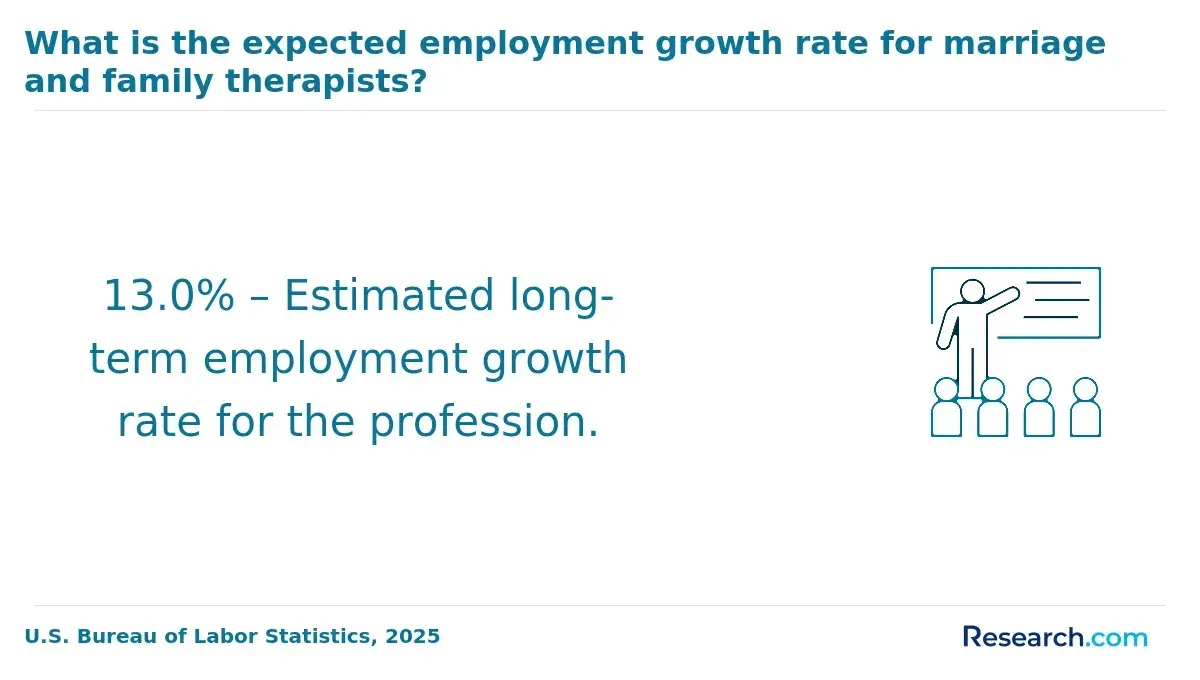
Educational, Guidance, School, and Vocational Counselors are projected to grow by 12.1%, reflecting continued need for academic, career, and student support services. Marriage and Family Therapists are projected to grow by 10.5%, showing sustained demand for relationship, family, and systems-focused therapy.
| Counseling specialty | Projected growth | What the growth suggests |
| Substance Abuse, Behavioral Disorder, and Mental Health Counselors | 22.1% by 2034 | Demand is high for addiction treatment, mental health care, and behavioral health services. |
| Rehabilitation Counselors | 16.8% by 2034 | More professionals are needed to support people with disabilities in employment, independence, and community integration. |
| Educational, Guidance, School, and Vocational Counselors | 12.1% by 2034 | Schools and education systems continue to need counselors for student success and career planning. |
| Marriage and Family Therapists | 10.5% by 2034 | Families, couples, and community agencies continue to rely on relationship-centered therapy services. |
How much do counselors in California make?
Counselor salaries in California depend on license type, specialty, location, employer, caseload, experience, and whether the counselor works in an agency, school, hospital, government setting, or private practice. In 2025, the annual average salary of LPCs in California was $76,140.
Specialization can make a major difference. Genetic Counselors earn an average of $138,540 per year, while Substance Abuse, Behavioral Disorder, and Mental Health Counselors earn around $66,970 annually. These figures should be treated as benchmarks rather than guarantees because individual earnings vary by region and work setting.
Where can I work as a counselor in California?
Counselors in California work in many settings, and each environment comes with different populations, schedules, documentation expectations, and advancement paths. Mental health clinics and counseling centers employ substance abuse, behavioral disorder, and mental health counselors. Rehabilitation facilities, vocational agencies, and community organizations employ rehabilitation counselors. Schools and colleges hire educational, guidance, school, and vocational counselors. Marriage and family therapists may work in private practice, hospitals, or community mental health agencies.
Other opportunities may be available in government agencies, nonprofits, employee assistance programs, correctional settings, crisis response teams, and corporate wellness or organizational support roles. In 2025, California employed the most substance abuse, behavioral disorder, and mental health counselors in the US at more than 53,000.
| Work setting | Common counselor responsibilities | Best fit for students who want to... |
| Community mental health agency | Provide therapy, crisis support, case coordination, and referrals. | Serve diverse clients and gain broad clinical experience. |
| Substance use treatment program | Support recovery planning, relapse prevention, group counseling, and behavioral health treatment. | Focus on addiction, co-occurring disorders, and recovery systems. |
| School or college | Help students with academic planning, emotional concerns, career goals, and crisis needs. | Work with youth, students, families, and educators. |
| Rehabilitation setting | Assist clients with disability-related barriers, employment readiness, and independent living goals. | Combine counseling with vocational and accessibility support. |
| Private practice | Provide individual, family, couples, or group therapy while managing business operations. | Build an independent clinical career after meeting licensing and practice requirements. |
What do counselors do?
Counselors help clients identify problems, understand patterns, build coping strategies, and work toward emotional, behavioral, academic, relational, or career goals. Their work may include assessment, treatment planning, individual counseling, group counseling, crisis intervention, documentation, referral coordination, and collaboration with other professionals.
In clinical settings, counselors may support clients experiencing anxiety, depression, addiction, trauma, grief, relationship problems, or life transitions. In school and educational settings, counselors may help students select courses, plan careers, manage stress, improve interpersonal skills, and access additional support services.
The exact scope of practice depends on license type, employer, setting, supervision status, and specialization. A new associate counselor may spend more time in supervised clinical work and documentation, while a fully licensed counselor may supervise others, lead programs, or operate an independent practice.
Top Counselor Programs in California for 2027
How do we rank schools?
This list was developed using Research.com’s established ranking methodology and education data sources. Program information was reviewed using the IPEDS database from the National Center for Education Statistics, Peterson's database and its Distance Learning Licensed Data Set, and the College Scorecard for cost and student outcome information.
Rankings can be a helpful starting point, but they should not replace a licensure check. Before enrolling, confirm that the program satisfies California Board of Behavioral Sciences requirements for your intended license path.
1. San Francisco State University
San Francisco State University offers a Clinical Mental Health Counseling program focused on preparing counselors to serve vulnerable and marginalized communities. The curriculum addresses psychosocial, cultural, and systemic barriers that affect client well-being. Students study traditional and post-modern counseling theories and gain applied experience through partnerships with over 150 community agencies and academic institutions.
- Program Length: 2 years
- Tracks/concentrations: Clinical Mental Health Counseling
- Estimated Cost per Credit: $690
- Required Credits to Graduate: 60
- Accreditation: Council for Accreditation of Counseling and Related Educational Programs (CACREP)
2. University of San Diego
The University of San Diego’s MA in Counseling, Clinical Mental Health Counseling is approved by CACREP and the National Board of Certified Counselors (NBCC). The program offers licensure-oriented pathways in Marital and Family Therapy and Clinical Mental Health Counseling. With only 30 students admitted each year, the program is structured for close advising, professional development, and access to the USD Career Development Center and alumni network.
- Program Length: 2 years
- Tracks/concentrations: Clinical Mental Health Counseling; Marital and Family Therapy
- Estimated Cost per Credit: $1,602
- Required Credits to Graduate: 60
- Accreditation: Council for Accreditation of Counseling and Related Educational Programs (CACREP)
3. Alliant International University
Alliant International University’s MA in Clinical Counseling emphasizes cultural competence, reflective practice, and critical thinking. Students study topics such as psychopharmacology, couple and family counseling, crisis response, trauma, and emergency intervention. The program includes a 700-hour supervised internship designed to help students work with clients from varied backgrounds.
- Program Length: 2 years
- Tracks/concentrations: Clinical Mental Health Counseling
- Estimated Cost per Credit: $762
- Required Credits to Graduate: 60
- Accreditation: Council for Accreditation of Counseling and Related Educational Programs (CACREP)
4. California State University Sacramento
California State University-Sacramento’s MS Counseling program prepares counselors with a focus on cultural competence, social justice, and professional growth. Students build a foundation in counseling theory, applied skills, and client resources. The program offers four CACREP-accredited specialization tracks for students pursuing distinct counseling roles.
- Program Length: 2 years
- Tracks/concentrations: Career Counseling; Rehabilitation Counseling; School Counseling; Marriage, Couple and Family Counseling
- Estimated Cost per Credit: $741
- Required Credits to Graduate: 60
- Accreditation: Council for Accreditation of Counseling and Related Educational Programs (CACREP)
5. National University
National University offers an online Master of Arts in Counseling Psychology for students preparing to counsel couples, children, and families. The curriculum considers both client and practitioner perspectives. Students choose either the Marriage and Family Therapist track or the Combined Marriage and Family Therapist/Licensed Professional Clinical Counselor track.
- Program Length: 22 to 23 months
- Tracks/concentrations: Marriage and Family Therapist, Combined Marriage and Family Therapist/Licensed Professional Clinical Counselor
- Estimated Cost per Credit: $913
- Required Credits to Graduate: 90
- Accreditation: Council for Accreditation of Counseling and Related Educational Programs (CACREP)
How to compare counseling programs in California
| Factor | Why it matters | What to verify |
| Licensure alignment | A strong academic program is not useful if it does not meet California requirements. | Ask whether graduates are eligible for APCC registration and California LPCC licensure steps. |
| Accreditation | Accreditation supports academic quality and may affect portability and employer recognition. | Confirm institutional accreditation and programmatic accreditation where relevant. |
| Practicum and internship support | Clinical placement quality affects training, supervision, and job readiness. | Ask how placements are approved, assigned, supervised, and documented. |
| Total cost | Tuition is only one part of the price. | Compare fees, books, residency costs, commuting, technology, and lost work time. |
| Format | Online, hybrid, and campus programs fit different schedules and learning styles. | Check synchronous class times, campus visits, fieldwork rules, and technology expectations. |
| Student support | Advising and exam preparation can reduce delays. | Ask about licensure advising, career services, alumni connections, and exam resources. |
What financial aid options support counseling students in California?
Graduate counseling education can be expensive, but students may reduce out-of-pocket costs through scholarships, grants, work-study, loans, employer tuition assistance, and school-based aid. The California Student Aid Commission (CSAC) offers grant opportunities such as the California Graduate Fellowship Program for students with demonstrated financial need. Many universities also provide merit scholarships, need-based grants, assistantships, payment plans, or department-specific awards.
Students considering a Master's in Marriage and Family Therapy should also research funding from professional organizations such as the American Psychological Association (APA) and the National Board for Certified Counselors (NBCC) Foundation. If you are comparing the MFT route, this guide to becoming a marriage and family therapist in California can help you understand how training, licensure, and funding decisions fit together.
Employer tuition reimbursement can also help, especially for students already working in behavioral health, education, social services, or healthcare. Read the conditions carefully. Some employers require a work commitment after graduation, and some only reimburse courses after you earn a minimum grade.
What are the key steps to pursue a career in counseling in California?
The best first step is to identify your target role: clinical mental health counselor, school counselor, rehabilitation counselor, marriage and family therapist, substance abuse counselor, or another specialty. From there, match your degree, practicum, supervised experience, and exams to the correct credential. For a more detailed licensing roadmap, review Research.com’s guide on how to become a licensed mental health counselor in California.
- Choose the counseling specialty you want to pursue.
- Confirm the California license or credential required for that role.
- Select a graduate program that meets Board of Behavioral Sciences requirements.
- Plan how you will complete practicum, internship, and post-degree supervised hours.
- Prepare early for the California Law and Ethics Exam and the NCMHCE.
- Build a professional network through supervisors, faculty, associations, and field placements.
- Keep careful records of coursework, supervision, hours, and exam completion.
Which counseling specialties in California offer the best growth potential?
Specialization can help counselors build expertise, serve specific populations, and stand out in a competitive job market. In California, demand is especially visible in substance abuse counseling, behavioral health, mental health treatment, trauma-informed care, geriatric counseling, educational counseling, and addiction recovery. Students interested in addiction and recovery services can start with this guide on how to become a substance abuse counselor in California.
The best specialty is not always the one with the highest projected growth. It should also match your clinical interests, tolerance for crisis work, preferred client population, desired work setting, and long-term income goals.
Is a career in counseling in California worth it?
A counseling career in California can be worth it for people who want purpose-driven work, can commit to graduate education and supervised training, and are comfortable with emotionally complex client needs. The state’s demand for mental health services, large population, and broad range of work settings create meaningful opportunities. However, the path requires patience. Licensure involves tuition costs, exams, documentation, supervision, and continuing education.
In 2025, there were 126,840 counselors working in California. See the chart below for a breakdown of the workforce by type.
Who should consider this career?
- Students who want to provide direct emotional, behavioral, academic, or family support.
- Professionals already working in social services, education, healthcare, or behavioral health who want clinical credentials.
- People who are willing to complete graduate school, supervised practice, and licensure exams.
- Future clinicians who value long-term client relationships and evidence-based practice.
Who may want a different path?
- Students looking for a short training program with immediate independent practice authority.
- People who are uncomfortable with documentation, legal compliance, crisis intervention, or supervision requirements.
- Applicants who cannot verify whether their chosen program satisfies California licensure rules.
- Individuals seeking guaranteed high salaries immediately after graduation.
How can I optimize my exam preparation for LPC licensure in California?
Strong exam preparation starts before the final months of your licensure process. Build a study calendar, gather official content outlines, use practice questions, and review California-specific law and ethics requirements. The California Law and Ethics Exam requires attention to state rules, mandated reporting, confidentiality, scope of practice, supervision, and professional conduct. The NCMHCE requires clinical reasoning and case-based decision-making.
Use practice exams strategically: take one early to identify weak areas, study those topics, then retest under timed conditions. Peer study groups and supervisor feedback can also help you connect exam concepts to real client scenarios. If you are comparing behavioral health licensure pathways, Research.com’s overview of psychologist licensure in California can help you understand how requirements differ across professions.
What are the career advancement opportunities for licensed counselors in California?
Licensed counselors can advance by deepening clinical expertise, supervising associates, managing programs, teaching, consulting, moving into agency leadership, or starting a private practice. Some counselors also expand into specialized populations such as trauma survivors, adolescents, families, older adults, clients with substance use disorders, or clients with co-occurring conditions.
Professional development should be intentional. Rather than collecting unrelated trainings, choose continuing education and certifications that support your target population and practice model. For a broader look at related roles, review Research.com’s guide to counseling careers.
What specialized certifications can advance my LPC career in California?
Specialized training can strengthen your practice when it is connected to real client needs. Common focus areas include trauma-informed care, addiction counseling, grief counseling, mindfulness-based therapy, family systems, crisis intervention, and culturally responsive practice. Certifications may help you build referral relationships, clarify your niche, and improve clinical confidence.
Academic preparation still matters. Students who want a stronger behavioral science foundation can compare programs through Research.com’s list of good colleges for psychology in California, especially if they are deciding between counseling, psychology, and related mental health fields.
How can interdisciplinary collaboration with social workers enhance my counseling practice in California?
Counselors rarely work alone. Collaboration with social workers can improve client care because social workers often bring expertise in case management, public benefits, housing resources, family systems, community referrals, and social determinants of health. For clients facing complex barriers, coordinated care can be more effective than isolated treatment.
Interdisciplinary collaboration can also help counselors understand systems-level issues that affect therapy outcomes. If you are considering a parallel or complementary career path, this guide on how to become a social worker in California explains another route into helping professions.
Can integrating behavior analysis boost my counseling career?
Behavior analysis can complement counseling by adding structured tools for observing behavior, measuring progress, and designing interventions. Counselors who work with developmental disabilities, behavioral challenges, school-based needs, or family systems may find behavior analytic methods especially useful.
This does not mean every counselor needs to become a behavior analyst. It means that targeted training can broaden your clinical toolkit when it aligns with your clients and setting. If you want to explore that path, Research.com’s guide on how to become a behavior analyst in California explains the certification-focused route.
What is the fastest way to become a counselor in California?
The fastest legitimate path is not about skipping requirements; it is about avoiding preventable delays. Choose a program that already meets California standards, complete paperwork correctly, secure practicum and supervised placements early, track hours accurately, and prepare for exams on a schedule. Accelerated or intensive programs may help, but only if they satisfy Board of Behavioral Sciences requirements.
Students trying to reduce the timeline should avoid out-of-state or online programs that cannot clearly document California eligibility. For a focused timeline strategy, see Research.com’s guide to the fastest way to become a counselor in California.
How can I pursue a career in school counseling in California?
School counseling is a distinct path that combines student support, academic planning, career development, crisis response, and collaboration with families and educators. It may require credentials that differ from clinical counseling licensure, so students should verify requirements before choosing a program.
If your goal is to work in K-12 or educational settings, review the steps for becoming a school counselor in California. Field experiences in schools, mentorship from practicing school counselors, and coursework in child development and educational systems can make the transition smoother.
What specialized mentorship can guide my licensure journey in California?
Mentorship can prevent costly mistakes during the California licensure process. A strong mentor can help you understand documentation, supervision expectations, exam timing, professional ethics, and job search strategy. Faculty advisors, site supervisors, licensed counselors, professional associations, and online communities can all provide guidance.
Before relying on informal advice, compare it with official Board requirements and your program’s licensure documentation. Research.com’s overview of California LPC license requirements can help you identify milestones and questions to discuss with mentors.
What networking opportunities are available for aspiring counselors in California?
Networking can help aspiring counselors find practicum sites, supervisors, jobs, mentors, and continuing education opportunities. California-based organizations such as the California Association of Marriage and Family Therapists (CAMFT), the California Counseling Association (CCA), and the California Association for Licensed Professional Clinical Counselors (CALPCC) offer events, conferences, webinars, and member communities. Local chapters of national organizations such as the American Counseling Association (ACA) may also host workshops and networking events.
Students should start networking before graduation. Introduce yourself during field placements, ask supervisors about hiring trends, attend association events, and stay connected with classmates. Many early counseling jobs come through practicum contacts, alumni networks, and professional referrals.
What continuing education opportunities are available for licensed counselors in California?
Continuing education helps California counselors maintain licensure, update clinical skills, and stay current with legal and ethical standards. Licensed Professional Counselors in California must complete continuing education units during each two-year renewal cycle.
- State Requirements: LPCs in California must complete a minimum of 36 hours of continuing education during each two-year license renewal period. Six of those hours must focus on law and ethics.
- Approved CE Providers: Courses should come from providers approved by the California Board of Behavioral Sciences. Examples may include accredited universities, professional counseling organizations, and approved continuing education providers such as the California Association of Marriage and Family Therapists (CAMFT) and the American Counseling Association (ACA).
- Specialized Training: Counselors can select topics tied to their practice, including trauma-informed therapy, substance abuse counseling, child and family therapy, grief work, cultural competence, and crisis intervention.
- Online and In-Person Formats: CE may be available through online courses, webinars, conferences, seminars, and workshops. Online options are flexible, while in-person events can offer stronger networking and applied practice.
- Professional Conferences: Events hosted by the California Counseling Association (CCA) or national groups such as the American Mental Health Counselors Association (AMHCA) can help counselors earn CEUs while learning about research, regulation, and practice trends.
How do I find affordable programs for LPC licensure in California?
Affordability should be evaluated by total cost, not tuition alone. Students should compare per-credit pricing, required credits, fees, clinical placement expenses, travel, technology, books, residency requirements, and the effect of enrollment on work hours. Some students pursuing California counseling licensure compare MFT pathways, including the cheapest online MFT programs.
- Start with accreditation and licensure fit: A low-cost program is not affordable if it leads to extra coursework or licensing delays.
- Compare total program cost: Multiply cost per credit by required credits, then add fees and fieldwork expenses.
- Ask about California placement support: Online programs may be flexible, but students still need approved supervised experiences.
- Review transfer credit policies: Transfer credits may reduce cost, but only if accepted and applicable to required coursework.
- Look for school-based aid: Department scholarships, assistantships, and payment plans can reduce financial pressure.
- Check employer support: Behavioral health employers may offer tuition reimbursement for employees pursuing counseling credentials.
Common mistakes to avoid
| Mistake | Why it causes problems | Better approach |
| Choosing a program based only on price | The cheapest option may not meet California requirements. | Confirm licensure alignment before comparing cost. |
| Assuming every online program works in California | State-specific coursework and fieldwork rules may differ. | Ask the school for written confirmation of California eligibility. |
| Ignoring practicum logistics | Students may struggle to find approved placements. | Ask how the program supports placement matching and supervision. |
| Relying only on rankings | A highly ranked program may not fit your budget, schedule, or specialty. | Use rankings as one factor, not the final decision. |
| Assuming salary outcomes are guaranteed | Pay varies by region, employer, experience, and license level. | Research local job postings and talk with working counselors. |
How can I integrate grief counseling into my practice?
Grief counseling focuses on helping clients process loss, adjust to life changes, and build coping strategies after bereavement or other major losses. Counselors who want to work in this area should pursue focused training in grief theory, complicated grief, trauma-informed care, family systems, and culturally responsive practices around death and mourning.
Workshops, supervised experience, mentorship, and specialized certifications can strengthen this practice area. For a deeper overview, read Research.com’s guide on how to become a grief counselor.
The Rise of Online Counseling Programs in California
Online counseling programs have become more attractive to California students who need flexibility while meeting graduate education requirements. They can be useful for working adults, career changers, parents, and students who do not live near a campus-based counseling program. However, online format alone should not drive the decision. Licensure fit, accreditation, practicum placement support, faculty access, and student outcomes are more important.
The California Board of Behavioral Sciences recognizes qualifying accredited programs that meet state standards. Online students still complete required coursework in areas such as counseling theory, ethics, human development, assessment, and clinical practice. They also need supervised field experience, which may require coordination with local agencies or approved sites.
Benefits and trade-offs of online programs for LPC licensure
| Factor | Potential advantage | What to watch carefully |
| Schedule flexibility | Students may continue working while completing coursework. | Synchronous classes, residencies, and practicum hours may still require fixed availability. |
| Cost control | Students may save on commuting or relocation. | Fees, technology costs, and fieldwork expenses can still add up. |
| Program access | Students outside major metro areas may have more school options. | Not every online program meets California licensure expectations. |
| Clinical training | Accredited programs can still offer rigorous coursework and supervised practice. | Placement support varies widely by school. |
| Networking | Virtual events, alumni groups, and online cohorts can support professional connections. | Students may need to be more proactive than they would be on campus. |
Students seeking flexible and potentially lower-cost routes may compare online MFT programs, especially if they are considering combined MFT and LPCC-oriented pathways. Always verify whether an online program meets California’s requirements before enrolling.
Key Insights
- California’s counseling license path generally leads to the LPCC credential, even though many students search using the broader “LPC” term.
- The core pathway includes a qualifying graduate degree, APCC registration, 3,000 supervised post-degree hours, the California Law and Ethics Exam, the NCMHCE, and continuing education.
- Program choice is the biggest early decision. Confirm California Board of Behavioral Sciences alignment before comparing tuition, format, or rankings.
- Demand is strong across several specialties, with Substance Abuse, Behavioral Disorder, and Mental Health Counselors projected to grow by 22.1% by 2034.
- Salary varies by specialty and location. In 2025, the annual average salary of LPCs in California was $76,140, while cited specialty averages ranged from $66,970 to $138,540.
- Online programs can be practical for working adults, but students must verify accreditation, coursework, practicum support, and California licensure eligibility.
- The most efficient route is not cutting corners; it is choosing the right program, documenting hours correctly, preparing early for exams, and avoiding licensure mismatches.
Related Articles for Nearby States
- 2027 How to Become a Licensed Counselor (LPC) in Nevada
- 2027 How to Become a Licensed Counselor (LPC) in Oregon
- 2027 How to Become a Licensed Counselor (LPC) in Arizona
- 2027 How to Become a Licensed Counselor (LPC) in Idaho
- 2027 How to Become a Licensed Counselor (LPC) in Utah
- 2027 How to Become a Licensed Counselor (LPC) in Washington
- 2027 How to Become a Licensed Counselor (LPC) in New Mexico
- 2027 How to Become a Licensed Counselor (LPC) in Colorado
- 2027 How to Become a Licensed Counselor (LPC) in Montana
- 2027 How to Become a Licensed Counselor (LPC) in Wyoming
References:
- California Board of Behavioral Sciences. (2025). Licensed professional clinical counselor (LPCC) requirements. https://www.bbs.ca.gov/applicants/lpcc.html
- California Board of Behavioral Sciences. (2025). LPCC application process. https://www.bbs.ca.gov/applicants/lpcc_apply.html
- California Board of Behavioral Sciences. (2025). Associate professional clinical counselor (APCC) registration. https://www.bbs.ca.gov/applicants/apcc.html
- California Board of Behavioral Sciences. (2025). Continuing education requirements for LPCCs. https://www.bbs.ca.gov/licensees/cont_ed.html
- CareerOneStop. (2025). Mental health counselors: Wages and outlook. https://www.careeronestop.org/Toolkit/Careers/Occupations/occupation-profile.aspx?keyword=mental%20health%20counselors
- National Center for O*NET Development. (2025). Mental health counselors. https://www.onetonline.org/link/summary/21-1014.00
- U.S. Bureau of Labor Statistics. (2025). Occupational Employment and Wage Statistics: Substance Abuse, Behavioral Disorder, and Mental Health Counselors. https://www.bls.gov/oes/current/oes211018.htm
- U.S. Bureau of Labor Statistics. (2025). Occupational Employment and Wage Statistics: Substance Abuse, Behavioral Disorder, and Mental Health Counselors. https://www.bls.gov/oes/current/oes211018.htm
- U.S. Census Bureau. (2025). Population projections for the United States: 2025 to 2060. https://www.census.gov/programs-surveys/popproj.html
- U.S. Bureau of Labor Statistics. (2025). Occupational Employment and Wage Statistics: California. https://www.bls.gov/oes/current/oes_ca.htm
- U.S. Bureau of Labor Statistics. (2025). Occupational Employment and Wage Statistics: Substance Abuse, Behavioral Disorder, and Mental Health Counselors. https://www.bls.gov/oes/current/oes211018.htm
Other Things You Should Know About How to Become a Licensed Counselor (LPC) in California
To become a Licensed Professional Counselor in California, you need a master's degree in counseling or a related field. The program must be accredited and include at least 60 semester hours of graduate coursework. Additionally, specific coursework in areas like ethics and mental health assessment is required.
To become a Licensed Professional Counselor in California, candidates must complete 3,000 hours of post-degree supervised experience. This experience must include specific hours in direct client contact and be overseen by a licensed supervisor, in accordance with the California Board requirements.
In California, an LPC specifically refers to Licensed Professional Clinical Counselors, focusing on mental health counseling and therapeutic intervention. Therapists can include various professions like marriage and family therapists (MFTs), who may deal with broader relational issues. Licensing criteria and scopes of practice can differ significantly between these roles.
To become a Licensed Professional Counselor (LPC) in California in 2027, you need to complete a master's degree in counseling or a related field, accrue supervised clinical experience, and pass the necessary exams, including the National Counselor Examination (NCE) and the California Law and Ethics Exam. Additionally, you must apply for licensure through the state's regulatory board.


