
2027 How to Become a Child Counselor

Co-Founder and Chief Data Scientist
Becoming a child counselor is not just a question of choosing a major. It is a regulated mental health career that usually requires graduate education, supervised clinical experience, state licensure, and ongoing training. For students, career changers, and helping professionals, the hardest part is often understanding which degree, license, and specialization actually lead to the kind of work they want to do with children and adolescents.
This guide explains the practical path to becoming a child counselor for 2027: what the role involves, how long training takes, which credentials matter, where child counselors work, how online programs fit into licensure, and what salary and job outlook data suggest about the field. It also covers decision points many students overlook, including accreditation, supervised hours, ethical duties, burnout risk, and specialization options such as trauma therapy, play therapy, addiction counseling, and applied behavior analysis.
Quick answer: how do you become a child counselor?
To become a child counselor, you typically complete a bachelor’s degree, earn a master’s degree in counseling, psychology, social work, or a closely related field, complete supervised clinical hours, pass a state-approved licensing exam, and maintain licensure through continuing education. Many professionals also pursue specialized training in child and adolescent therapy, trauma-informed care, play therapy, family therapy, or school counseling depending on the setting where they want to work.
- A master’s degree in counseling, psychology, social work, or a related mental health field is usually required for independent clinical practice.
- State licensure is required to provide counseling services independently, and requirements vary by state and credential.
- Child and adolescent counselors earn an average salary of $87,702 per year, with earnings affected by experience, location, employer type, and specialization.
- Specializations such as trauma therapy, autism spectrum disorders, play therapy, family therapy, and adolescent substance abuse counseling can help shape career direction.
- According to the Bureau of Labor Statistics, 534300 substance abuse, behavioral disorder, and mental health counselors will be needed by 2033.
- Continuing education is not optional for most licensed counselors; it helps professionals maintain licensure and stay current with evidence-based practices.
- What does a child counselor do each day?
- What ages do child counselors usually serve?
- Child counselor vs. child psychologist: what is the difference?
- What career paths are available in child counseling?
- What education do you need to become a child counselor for 2027?
- What licenses and certifications matter for child counselors for 2027?
- What skills make someone effective in child counseling?
- Which online programs can support child counseling training?
- How can child counselors reduce burnout risk?
- What ethical and legal duties do child counselors have?
- How much do child counselors make for 2027?
- Can you train to become a child counselor online?
- How do child counselors work with schools, families, and healthcare teams?
- What is the job outlook for child counselors for 2027?
- Why does accreditation matter in child counseling?
- How can organizational psychology strengthen a child counseling practice?
- How can online education broaden child counseling career options?
- Should child counselors consider addiction counseling credentials?
- Can applied behavior analysis help child counselors?
- What affordable advanced education options can support career growth?
What does a child counselor do on a daily basis?
A child counselor helps children and adolescents manage emotional, behavioral, developmental, family, and school-related concerns through age-appropriate therapeutic support. The work often combines direct counseling, assessment, documentation, parent communication, and collaboration with other professionals.
- Provides individual or group counseling: Child counselors meet with young clients in structured sessions where children can talk, play, draw, role-play, or use other developmentally appropriate ways to express thoughts and feelings.
- Uses evidence-based therapy methods: Depending on training and client needs, counselors may use play therapy, art-based interventions, family systems approaches, trauma-informed care, and cognitive-behavioral therapy.
- Works with parents, caregivers, and teachers: Many treatment plans require adults to reinforce coping skills, communication strategies, routines, and behavioral supports outside the counseling office.
- Screens and assesses concerns: Counselors may evaluate symptoms related to anxiety, depression, ADHD, grief, trauma, behavior problems, family conflict, or school stress using interviews, observations, and approved assessment tools.
- Builds treatment plans: A treatment plan identifies the child’s needs, counseling goals, intervention methods, progress markers, and how caregivers or school staff may be involved.
- Documents services: Clinical notes, treatment updates, consent forms, safety planning records, and referral documentation are part of responsible practice.
- Makes referrals when needed: If a child needs psychological testing, medication evaluation, intensive treatment, or specialized care, counselors may coordinate referrals to psychologists, psychiatrists, pediatricians, social workers, or crisis teams.
| Daily responsibility | Why it matters | Example in practice |
| Therapy sessions | Helps children process emotions and build coping skills | Using CBT strategies with a teen experiencing school anxiety |
| Parent consultation | Improves consistency between therapy and home life | Teaching caregivers how to respond to emotional outbursts |
| School collaboration | Supports children whose symptoms affect learning or behavior | Coordinating with a teacher about bullying-related distress |
| Assessment and treatment planning | Clarifies needs and guides measurable goals | Identifying trauma symptoms and creating a safety-focused plan |
| Documentation | Protects clients, supports continuity of care, and meets legal standards | Recording progress notes and informed consent details |
What age groups do child counselors work with?
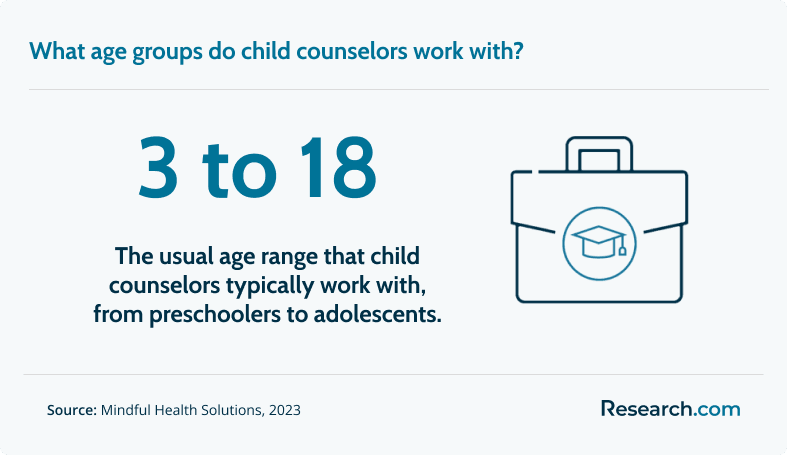
Child counselors commonly work with children and adolescents from about ages 3 to 18, although the exact age range depends on the counselor’s license, employer, clinical training, and specialization. Some professionals focus on early childhood, while others primarily support school-age children, teenagers, or young adults transitioning out of adolescence.
Counseling methods change significantly by developmental stage. A preschool child may communicate best through play, drawings, and caregiver-supported interventions. A school-age child may need help with anxiety, bullying, emotional regulation, grief, behavior problems, or family conflict. Teenagers may seek support for depression, identity concerns, peer pressure, self-esteem, trauma, academic stress, substance use risk, or relationship issues.
| Age group | Common counseling concerns | Common approaches |
| Early childhood | Developmental concerns, separation anxiety, trauma, emotional regulation | Play therapy, caregiver coaching, behavior routines |
| Elementary school age | Bullying, school stress, family changes, grief, attention or behavior concerns | Skill-building, CBT-informed tools, family collaboration |
| Middle school age | Peer conflict, self-esteem issues, anxiety, academic pressure | Talk therapy, coping plans, social skills support |
| Adolescents | Depression, trauma, identity concerns, substance use risk, relationship stress | CBT, trauma-informed care, family therapy, safety planning when needed |
What is the difference between a child counselor and a child psychologist?
Child counselors and child psychologists both help young people with emotional, behavioral, and mental health concerns, but they are not the same role. The biggest differences involve education level, assessment authority, diagnostic scope, and the type of services each professional commonly provides.
Education and training
A child counselor usually completes a master’s degree in counseling, social work, or a related mental health field. Training emphasizes therapy techniques, child development, ethics, treatment planning, family systems, crisis response, and supervised clinical practice. A child psychologist typically earns a doctoral degree, such as a Ph.D. or Psy.D., and receives deeper training in psychological testing, diagnosis, research, and complex clinical assessment.
If you are comparing mental health career routes and want a different clinical pathway, reviewing the cheapest online psychiatric nurse practitioner programs can help you understand how psychiatric nursing differs from counseling and psychology.
Scope of practice
Child counselors often provide ongoing therapy, coping-skills training, family support, school coordination, and behavioral interventions. Depending on state law and credential type, some counselors can diagnose mental health conditions, while others may work within a narrower scope or under supervision. Child psychologists are more likely to conduct comprehensive psychological evaluations for learning concerns, autism spectrum disorder, cognitive functioning, severe anxiety, depression, trauma, and complex developmental or behavioral conditions.
Work settings and treatment focus
Child counselors commonly work in schools, community agencies, outpatient clinics, nonprofit organizations, hospitals, and private practice. Child psychologists may work in clinics, hospitals, academic medical centers, private practices, assessment centers, or research institutions. In some cases, both professionals collaborate with psychiatrists, pediatricians, social workers, teachers, and family therapists to coordinate care.
| Comparison point | Child counselor | Child psychologist |
| Typical degree | Master’s degree in counseling, social work, or a related field | Doctoral degree, such as a Ph.D. or Psy.D. |
| Main focus | Therapy, coping skills, family support, school-related concerns | Assessment, diagnosis, therapy, research-informed interventions |
| Testing role | May use screenings and counseling assessments within scope | Often conducts in-depth psychological testing |
| Common settings | Schools, clinics, private practice, community agencies | Hospitals, clinics, private practice, research or assessment settings |
| Best fit for clients who need | Ongoing counseling and practical emotional or behavioral support | Complex diagnostic evaluation or psychological testing |
What are the different types of child counseling careers?
Child counseling is not a single job title. Professionals who work with children may enter schools, outpatient clinics, hospitals, family therapy practices, community agencies, residential programs, crisis services, or private practice. The best path depends on the population you want to serve, the license you pursue, and the kind of interventions you want to provide.
- School counselor: School counselors support students with academic planning, social-emotional development, bullying, family stress, behavior concerns, college or career planning, and referrals to outside mental health care when appropriate.
- Child and adolescent therapist: These clinicians provide therapy for children and teens experiencing anxiety, depression, trauma, grief, behavioral concerns, emotional dysregulation, or family conflict.
- Pediatric behavioral counselor: This role focuses on behavior change, emotional regulation, parent strategies, and intervention planning for concerns such as ADHD, oppositional behavior, or conduct-related challenges.
- Marriage and family therapist: Family therapists help children by addressing communication patterns, conflict, parenting challenges, transitions, and family-system dynamics that influence a child’s well-being.
- Trauma and crisis counselor: These professionals support children affected by abuse, neglect, loss, violence, medical trauma, disasters, or other destabilizing events using trauma-informed approaches.
- Play therapist: Play therapists use structured play as a therapeutic language, especially for younger children who may not be able to explain complex emotions verbally. Students exploring adjacent child-development careers may also want to review how much child life specialists make.
- Adolescent substance abuse counselor: These counselors work with teenagers affected by drug, alcohol, behavioral addiction, gaming, social media, or family substance-use concerns.
| Career path | Typical setting | Best fit if you want to... |
| School counselor | Elementary, middle, and high schools | Support students inside an educational environment |
| Child and adolescent therapist | Outpatient clinics, agencies, private practice | Provide ongoing therapy for mental health concerns |
| Family therapist | Family clinics, private practice, community agencies | Work with children through family relationships and systems |
| Trauma counselor | Crisis centers, hospitals, agencies, specialty clinics | Help children recover from abuse, grief, neglect, or acute stress |
| Play therapist | Private practice, child clinics, schools | Use play-based methods with younger children |
| Adolescent substance abuse counselor | Treatment centers, schools, clinics, community programs | Support teens and families affected by substance use |
What are the educational requirements to become a child counselor for 2027?
The typical route to becoming a licensed child counselor includes undergraduate study, graduate training, supervised practice, examination, and state licensure. Exact requirements vary by state and by license type, so students should verify rules with the state licensing board before enrolling in a program.
- Earn a bachelor’s degree: Most future child counselors begin with a bachelor’s degree in psychology, social work, education, human services, or a related field. A counseling-specific major is not always required, but coursework in development, human behavior, research methods, abnormal psychology, and family systems can help prepare you for graduate school. Students comparing counseling-related faith-based programs may also explore an online Christian counseling degree.
- Complete a master’s degree: Independent counseling practice usually requires a master’s degree in counseling, clinical mental health counseling, school counseling, psychology, social work, marriage and family therapy, or a related mental health field. Programs generally include counseling theory, ethics, diagnosis, child development, assessment, group counseling, multicultural counseling, crisis intervention, and supervised fieldwork.
- Finish supervised clinical experience: After graduate school, most states require supervised clinical hours, often around 2,000 to 4,000 hours. These hours allow new clinicians to practice under a licensed supervisor before independent licensure.
- Pass a licensing exam: Licensure often requires an exam such as the National Counselor Examination or a state-approved equivalent. Requirements differ for LPC, LCSW, LMFT, school counselor, and other credentials.
- Maintain licensure through continuing education: Licensed professionals must keep learning after initial licensure. Continuing education may include ethics, child and adolescent treatment, trauma care, mandated reporting, cultural competency, suicide prevention, and new therapeutic methods. If you are considering a shorter healthcare route instead of a counseling license, you can also compare 2 year medical degrees.
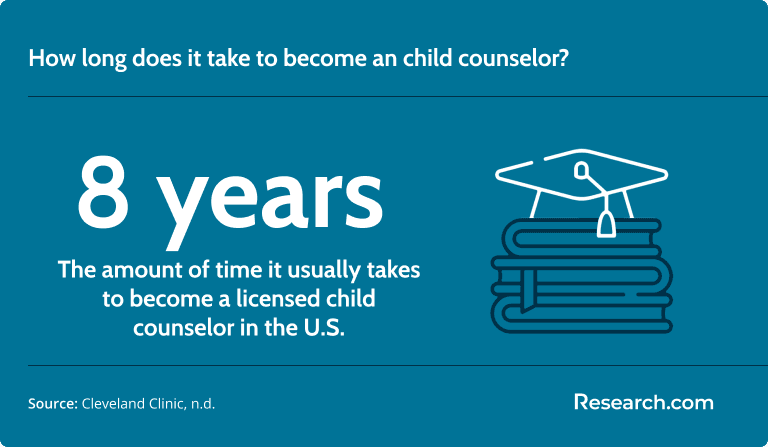
Becoming a child counselor typically takes at least eight years of education and training. A bachelor’s degree usually takes 4 years, followed by a master’s degree that commonly takes 2 to 3 years. After that, supervised clinical experience of 2,000 to 4,000 hours may take about 1 to 2 years depending on state rules, employment setting, and whether you complete hours full time or part time.
| Stage | Typical requirement | Decision point for students |
| Bachelor’s degree | Usually 4 years | Choose coursework that supports admission to counseling, psychology, or social work graduate programs |
| Master’s degree | Usually 2 to 3 years | Confirm the program aligns with the license you want in your state |
| Supervised clinical hours | Often around 2,000 to 4,000 hours | Ask how placements, supervisors, and post-graduate hours are arranged |
| Licensure exam | State-approved counseling, social work, or related exam | Check pass-rate support, exam preparation, and state board requirements |
| Continuing education | Required after licensure in most cases | Plan for ongoing training costs and renewal deadlines |
What certifications do you need to become a child counselor for 2027?
The most important credential for a child counselor is usually state licensure, not a voluntary certificate. Certifications can strengthen expertise, but they generally do not replace the license required to practice independently. The right credential depends on whether your graduate degree is in counseling, social work, marriage and family therapy, psychology, or school counseling.
- Licensed Professional Counselor: An LPC is a common route for clinical mental health counselors. Requirements generally include a relevant master’s degree, supervised clinical hours, and a licensing exam.
- Licensed Clinical Social Worker: An LCSW is common for professionals with a master’s degree in social work. It can support clinical work with children, adolescents, and families after required supervision and exam completion.
- National Certified Counselor: The NCC credential is offered by the National Board for Certified Counselors. It can demonstrate professional preparation, although state licensure rules still control independent practice.
- Child and Adolescent Mental Health Specialist: Some counselors pursue child-focused credentials or training to show advanced preparation in child and adolescent mental health.
- Certified Clinical Trauma Professional: Trauma-focused certification may be useful for counselors who work with children affected by abuse, grief, neglect, violence, or crisis events.
| Credential | Who it is for | How to think about it |
| LPC | Master’s-trained counseling professionals | Often a core license for clinical counseling practice |
| LCSW | Master’s-trained social workers | Useful for clinical work with children, families, agencies, and healthcare systems |
| NCC | Counselors seeking national professional certification | May strengthen professional credibility but does not replace state licensure |
| Child and adolescent specialization | Counselors focused on young clients | Helpful for demonstrating focused training in child mental health |
| Trauma certification | Clinicians working with trauma-exposed children | Useful when paired with supervised experience and evidence-based trauma training |
What skills do you need to be a good child counselor?
Effective child counselors need clinical knowledge, emotional steadiness, strong communication, and the ability to adapt therapy to a child’s developmental level. The work requires more than liking children; it requires disciplined listening, ethical judgment, cultural awareness, documentation skills, and comfort working with families and systems.
- Developmentally appropriate communication: Children do not always describe distress directly, so counselors must translate clinical concepts into language, activities, and examples that fit the child’s age.
- Active listening and observation: A child’s behavior, play, tone, body language, and interaction patterns may reveal needs that words do not.
- Patience and empathy: Trust often builds slowly, especially when children have experienced trauma, shame, family instability, or repeated disappointment from adults.
- Knowledge of child development: Counselors must understand what is typical at each age and what may signal emotional distress, developmental delay, trauma response, or a mental health condition.
- Clinical problem-solving: Treatment plans need to change when a child’s symptoms, safety, family situation, or school environment changes.
- Creativity: Play, art, stories, role-play, and visual tools can help children express what they cannot yet explain verbally.
- Ethical boundaries: Counselors must balance confidentiality, caregiver involvement, documentation, mandated reporting, and the child’s best interests.
- Collaboration skills: Many child counseling cases involve parents, guardians, teachers, pediatricians, social workers, psychologists, and sometimes courts or child welfare agencies.
Which online programs complement my child counseling education?
Online programs can be useful when they fill a specific gap in your training, such as family systems, crisis response, marriage and family therapy, trauma-informed care, or advanced counseling methods. They are most valuable when they are accredited, aligned with your state’s licensing requirements, and include supervised fieldwork if the credential requires it.
If you want to strengthen your ability to work with family dynamics, conflict, parenting stress, and relationship patterns that affect children, compare accredited online marriage and family therapy graduate programs. This type of training can complement child counseling because children’s symptoms often occur within family, school, and community systems.
How can child counselors prevent burnout and maintain work-life balance?
Child counseling can be emotionally intense. Counselors may hear disclosures involving abuse, neglect, grief, self-harm, family violence, bullying, or severe anxiety. Without boundaries and professional support, the work can lead to compassion fatigue, secondary traumatic stress, and burnout.
- Use supervision and consultation: Regular case consultation helps counselors process difficult work and make safer clinical decisions.
- Set realistic caseload limits: High-acuity cases require more emotional energy, documentation, and coordination than routine sessions.
- Protect time outside work: Recovery time, sleep, relationships, and personal routines are part of long-term professional sustainability.
- Use evidence-based boundaries: Clear policies for crisis contact, documentation, cancellations, caregiver communication, and after-hours availability reduce role confusion.
- Keep compensation and workload in view: Pay, benefits, supervision quality, and administrative burden all affect career satisfaction. For broader salary context, review how much counselors make.
What legal and ethical responsibilities do child counselors have?
Child counselors must protect young clients while also meeting legal duties that can override confidentiality in specific situations. Ethical practice includes informed consent, assent when appropriate, confidentiality limits, accurate documentation, mandated reporting, culturally responsive care, competent practice, and clear boundaries with children and families.
- Confidentiality: Children need privacy to build trust, but counselors must explain limits to both children and caregivers.
- Mandated reporting: Counselors are required to report suspected abuse or neglect according to applicable state law.
- Informed consent and assent: Parents or guardians often provide consent, while children should receive age-appropriate explanations of counseling whenever possible.
- Recordkeeping: Clinical documentation should be accurate, timely, secure, and consistent with legal and licensing standards.
- Scope of competence: Counselors should not treat concerns beyond their training without supervision, consultation, referral, or additional education.
- Dual relationships: Counselors must avoid relationships that could impair judgment, create conflicts of interest, or harm the child.
If you are still comparing counseling degrees and want a cost-conscious route, review the cheapest online master's in mental health counseling options while confirming that any program you consider meets your state’s licensure expectations.
How much do child counselors make for 2027?
Child counselor pay varies by license, employer, location, years of experience, caseload, setting, and specialization. The average salary for child and adolescent counselors is around $87,702 per year. Counselors in private practice or specialized clinical areas may earn more, while professionals in schools, nonprofits, or community agencies may earn less depending on funding and local demand.
Related roles in child and adolescent mental health show how compensation can differ across credentials and work settings:
- Marriage and Family Therapist: The average salary is $58,510. Earnings can vary for therapists who work with children’s issues, family conflict, and private practice clients.
- Clinical Psychologist: Clinical psychologists who work with children and adolescents can make $92,740 per year, especially when their work includes testing or complex clinical treatment.
- School Counselor: School counselors typically earn $61,710 while supporting students’ academic, emotional, and social development in educational settings.
- Licensed Clinical Social Worker: LCSWs in child and adolescent therapy can earn $58,380. Professionals who want broader human services preparation may compare a human services master's degree online.
| Role | Salary stated in source article | Common work settings |
| Child and adolescent counselor | $87,702 per year | Clinics, private practice, schools, agencies |
| Marriage and Family Therapist | $58,510 | Family therapy practices, clinics, community agencies |
| Clinical Psychologist | $92,740 per year | Hospitals, clinics, testing centers, private practice |
| School Counselor | $61,710 | Elementary, middle, and high schools |
| Licensed Clinical Social Worker | $58,380 | Hospitals, agencies, clinics, private practice |
The chart below compares salary information for child counselors and related occupations.
Can you become a child counselor online?
Yes, you can complete many academic requirements for child counseling through online programs, but you cannot become fully prepared for clinical practice through coursework alone. Accredited online bachelor’s and master’s programs can deliver counseling, psychology, social work, ethics, and child development coursework remotely, but supervised clinical hours must be completed in person at approved sites.
Online study can be a strong option for working adults, parents, rural students, and career changers, but only if the program supports the license you want in the state where you plan to practice.
| Online counseling education | Potential advantage | Risk to check before enrolling |
| Online bachelor’s degree | Flexible preparation for graduate study | May not qualify you for counseling licensure by itself |
| Online master’s degree | Can meet academic requirements if properly accredited and state-aligned | Some programs may not meet your state’s licensure rules |
| Hybrid or low-residency program | Combines online coursework with in-person skills training | Travel or residency costs may add up |
| Online continuing education | Convenient for license renewal and skill development | Not all courses satisfy board-approved continuing education rules |
- Flexibility: Online programs may allow students to study while working or managing family responsibilities.
- Access: Students can compare programs beyond their local area without relocating.
- Potential cost savings: Online learning may reduce commuting, relocation, and housing costs. Some learners also use affordable online courses for continuing education or prerequisite coursework.
How do child counselors collaborate with other professionals?
Child counselors rarely work in isolation. A child’s emotional health may involve home life, school performance, medical history, learning needs, trauma exposure, family conflict, or social services. Collaboration helps professionals coordinate care while respecting confidentiality and role boundaries.
- With parents and caregivers: Counselors may share strategies for routines, communication, emotional coaching, and behavior support.
- With teachers and school staff: Collaboration can help address bullying, classroom behavior, attendance, academic stress, or accommodations.
- With pediatricians and psychiatrists: Medical providers may evaluate physical health concerns, medication needs, sleep issues, or developmental questions.
- With psychologists: Psychologists may provide diagnostic testing, cognitive assessment, or specialized evaluation.
- With social workers: Social workers may assist with family resources, case management, child welfare concerns, and community supports. Understanding the difference between a social worker versus psychologist can help clarify team roles.
What is the job outlook for child counselors for 2027?
The job outlook for child counselors is tied to broader demand for mental health services, school-based support, behavioral health treatment, and services for children and adolescents. According to the source article, employment of substance abuse, behavioral disorder, and mental health counselors is projected to grow 19 percent from 2023 to 2033, much faster than the average for all occupations. The Bureau of Labor Statistics also reports that employment of school and career counselors and advisors is projected to grow 4 percent over the same period.
The source article states that employment is projected to move from 449,800 employed individuals in 2023 to 534,300 by 2033. Demand is influenced by greater awareness of youth mental health needs, expanded behavioral health services, school counseling needs, and the continued need for treatment in hospitals, mental health centers, community organizations, and private practices.
The chart below presents employment projections for substance abuse, behavioral disorder, and mental health counselors over the next decade.
How does accreditation affect career advancement in child counseling?
Accreditation matters because licensing boards, employers, doctoral programs, and internship sites may use it as evidence that your education met recognized academic and professional standards. A non-accredited or poorly matched program can create serious problems if it does not satisfy your state’s licensure requirements.
- Licensure alignment: Confirm that the program’s curriculum, internship requirements, and supervision structure match the license you plan to pursue.
- Employer confidence: Accredited training may strengthen your credibility when applying for clinical, school-based, or agency roles.
- Transfer and doctoral options: Accreditation can affect whether credits or degrees are recognized by other institutions.
- Professional mobility: If you may move states later, choose a program with strong documentation and licensing-board transparency.
For professionals considering advanced psychology pathways, reviewing online PsyD programs APA accredited can help clarify how accreditation expectations differ between counseling and psychology routes.
How can integrating organizational psychology benefit my child counseling practice?
Organizational psychology is not required for most child counselors, but it can be useful for professionals who move into supervision, program management, school mental health leadership, nonprofit administration, or clinic operations. Child counseling services often depend on teams, workflows, communication systems, staff training, and change management.
Training in motivation, leadership, conflict resolution, workplace communication, and program evaluation can help counselors improve service delivery, reduce staff friction, and coordinate multidisciplinary care. If your goal includes leadership or administration, compare options such as the cheapest online masters degree organizational psychology.
How can online education expand my child counseling career opportunities?
Online education can help child counselors add credentials, prepare for licensure, complete continuing education, or move into related areas without stepping away from work. It is especially helpful for professionals who need flexible scheduling, live far from campus, or want to compare a wider range of programs.
The key is to choose online education strategically. A program should be accredited, transparent about field placement requirements, aligned with state licensure, and relevant to your career goal. For example, MSW online programs may be appropriate for students who want a social work pathway into clinical, school, healthcare, or community-based child and family services.
Is becoming a child counselor worth it?
Becoming a child counselor can be worth it if you want a helping profession focused on children, can commit to graduate education and supervised training, and are prepared for emotionally demanding work. The career offers meaningful client impact and several practice settings, but it also requires licensure, continuing education, documentation, ethical responsibility, and strong boundaries.
| Choose child counseling if... | Consider another path if... |
| You want to provide therapy and support to children and adolescents | You want to prescribe medication or focus mainly on medical treatment |
| You are willing to complete a master’s degree and supervised hours | You want a career that requires only a short training program |
| You can work with parents, schools, and other professionals | You prefer work with little collaboration or documentation |
| You are comfortable with emotionally complex cases | You want to avoid crisis, trauma, or mandated reporting responsibilities |
| You value long-term professional learning | You do not want continuing education or license renewal obligations |
Common mistakes to avoid when planning a child counseling career
- Choosing a program before checking licensure rules: Always compare the curriculum with your state licensing board’s requirements before enrolling.
- Assuming every online program leads to licensure: Online coursework can be valid, but fieldwork, supervision, and state alignment still matter.
- Looking only at tuition: Consider fees, residency costs, supervision costs, exam fees, books, travel, and unpaid internship time.
- Ignoring accreditation: A cheaper program can become expensive if it does not qualify you for licensure or future study.
- Confusing certificates with licenses: A certificate can add expertise, but it usually does not authorize independent counseling practice.
- Underestimating documentation and ethics: Child counseling involves records, consent, confidentiality limits, mandated reporting, and legal responsibilities.
- Skipping burnout planning: Supervision, peer support, workload boundaries, and self-care are essential for staying in the field.
- Assuming salary outcomes are guaranteed: Pay depends on role, employer, state, license level, specialization, and experience.
Questions to ask before choosing a child counseling program
- Does the program meet academic requirements for the license I want in my state?
- Is the program accredited, and will licensing boards recognize it?
- How are practicum and internship placements arranged?
- Does the program include child and adolescent counseling coursework?
- What support is available for licensing exams?
- Can online students complete supervised hours near where they live?
- What are the total costs beyond tuition?
- Does the program prepare students for school counseling, clinical mental health counseling, social work, marriage and family therapy, or another specific pathway?
- What are typical employment settings for graduates?
- How does the program address ethics, mandated reporting, trauma-informed care, and cultural responsiveness?
Should child counselors consider pursuing an addiction counselor certification?
Addiction counseling training can be valuable for child counselors who work with adolescents, family substance-use concerns, trauma, foster care populations, juvenile justice settings, or community mental health programs. Not every child counselor needs this specialization, but it can improve assessment and referral skills when substance use affects a child or family system.
An addiction counselor certification may help professionals understand adolescent substance use, family patterns, relapse prevention, motivational interviewing, risk screening, and coordination with treatment teams. Before pursuing it, confirm whether the credential is recognized in your state and whether it supports your specific career goal.
Can child counselors benefit from an applied behavior analysis specialization?
Applied behavior analysis can help child counselors better understand behavior patterns, reinforcement, skill-building, and intervention design. This can be especially useful when working with children who have behavioral challenges, autism-related needs, developmental concerns, or difficulty with emotional regulation.
An ABA specialization is not the same as a counseling license, but it can add practical tools when used ethically and within scope. Students interested in this area can compare programs such as an online MS in psychology applied behavior analysis to see whether ABA coursework fits their professional plan.
What affordable advanced education options can further enhance my child counseling career?
Advanced education can support child counselors who want to specialize, supervise, move into leadership, expand clinical competence, or pursue doctoral study. Affordable options may include accredited online master’s programs, graduate certificates, continuing education courses, trauma training, family therapy coursework, and supervision-focused professional development.
The best option depends on your current license, career stage, and target role. A counselor who wants deeper clinical theory may compare the cheapest masters in psychology online, while someone focused on family systems, school services, trauma care, or social work may choose a different route.
Key Insights
- Child counseling usually requires a master’s degree, supervised clinical experience, a licensing exam, and state licensure.
- The full path commonly takes at least eight years: 4 years for a bachelor’s degree, 2 to 3 years for a master’s degree, and about 1 to 2 years for supervised clinical experience.
- Online programs can be a valid route, but clinical hours still require in-person supervised experience at approved sites.
- Accreditation and state licensure alignment are critical; choosing the wrong program can delay or block your ability to practice.
- The average annual salary for child and adolescent counselors is around $87,702, but pay varies by setting, location, license, and specialization.
- Employment of substance abuse, behavioral disorder, and mental health counselors is projected to grow 19 percent from 2023 to 2033, while school and career counselors and advisors are projected to grow 4 percent over the same period.
- Specializations such as trauma counseling, play therapy, family therapy, addiction counseling, and applied behavior analysis can help shape career options, but they should complement—not replace—licensure.
- Strong child counselors combine clinical skill with patience, ethical judgment, family collaboration, documentation discipline, and burnout prevention strategies.
Resources
- Cleveland Clinic. Child Psychologist. https://my.clevelandclinic.org
- Mindful Health Solutions. Therapy for Kids: 5 Signs that Your Child Should See a Therapist. https://mindfulhealthsolutions.com
- U.S. Bureau of Labor Statistics. Occupational Outlook Handbook: Substance Abuse, Behavioral Disorder, and Mental Health Counselors. https://www.bls.gov
- ZipRecruiter. Child And Adolescent Therapist Salary. https://www.ziprecruiter.com
Other things you should know about becoming a child counselor
To become a child counselor in 2027, you typically need a master's degree in counseling or a related field, such as social work or psychology. A state-issued license, which often requires completing a set number of supervised clinical hours and passing an examination, is also essential.
To practice as a child counselor in 2027, obtaining a state-specific counseling license is mandatory. Commonly required is the Licensed Professional Counselor (LPC) credential, which necessitates a master's degree, supervised clinical hours, and passing the National Counselor Examination (NCE).
Child counselor programs usually require 100 to 300 supervised practicum hours, plus a separate internship of about 600 hours for licensure-track master’s degrees. The hours must be completed under an approved supervisor and documented for state board review before graduation or license application.


