
2027 Most Affordable Master’s in Organizational Psychology Online

Co-Founder and Chief Data Scientist
An online master’s in organizational psychology is designed for people who want to improve how organizations hire, train, lead, motivate, and support employees. It can be a strong fit if you already work in human resources, leadership, consulting, training, analytics, or psychology-adjacent roles and want graduate-level skills without leaving your job to study full time.
The decision is not only about finding the cheapest program. You also need to know whether the degree matches your career goal, whether the school is properly accredited, how online learning compares with campus study, what practical experience is included, and whether the cost makes sense for the salary and roles you are targeting. This guide explains what to expect from an online master’s in organizational psychology, compares affordable program options, and shows how to evaluate admissions, curriculum, financial aid, career outcomes, and return on investment.
Quick answer: Is an online master’s in organizational psychology worth it?
An online master’s in organizational psychology can be worth it for students who want to apply psychology to workplace performance, employee selection, leadership development, organizational change, training, and employee well-being. The online format is especially useful for working adults because many programs offer asynchronous or flexible coursework. According to the Bureau of Labor Statistics, industrial-organizational psychologists earn an average salary of $154,380, although earnings vary by role, industry, location, employer, and experience.
| Best fit | Use caution if | Key decision factor |
| You want to move into HR analytics, talent development, organizational consulting, employee assessment, or workplace research. | You want to become a licensed clinical psychologist; organizational psychology is usually not a clinical licensure pathway. | Confirm that the program’s curriculum, accreditation, and practical experiences match your intended career. |
| You need a graduate program that can fit around full-time work or family responsibilities. | You need daily in-person interaction, campus labs, or face-to-face networking to stay motivated. | Compare online support, internship options, faculty access, and cohort structure. |
| You already have a background in psychology, business, HR, leadership, statistics, or research methods. | You have not checked whether you meet prerequisites in psychology, statistics, or research methods. | Review admissions requirements before applying and ask about bridge or prerequisite courses. |
What are the main benefits of an online master's in organizational psychology?
- Workplace problem-solving skills: Students learn how to diagnose organizational issues, improve employee selection, evaluate training, support leadership development, and use research to improve workplace outcomes.
- Flexible graduate study: Online delivery can make it easier to continue working while completing assignments, research projects, and discussion-based coursework.
- Career mobility: Graduates may work with executives, HR leaders, training managers, consultants, and organizational development teams to improve performance and employee experience.
- Cross-industry relevance: Organizational psychology skills apply to consulting firms, government agencies, universities, corporations, nonprofits, and research organizations.
What can I expect from an online master's in organizational psychology?
An online master’s in organizational psychology teaches students how to apply psychological research to real workplace decisions. Programs commonly cover employee assessment, selection systems, productivity, motivation, organizational change, leadership, training, research methods, statistics, and workplace culture. Instead of focusing on therapy or clinical treatment, this field examines how people behave at work and how organizations can make evidence-based improvements.
Students should expect a mix of theory, applied research, data interpretation, written analysis, case studies, group projects, and sometimes a thesis, capstone, practicum, or comprehensive exam. The strongest programs help students build both people-centered and data-centered skills: understanding employee behavior while also measuring outcomes through surveys, assessments, analytics, and program evaluation.
Where can I work with an online master's in organizational psychology?
Graduates may work in several settings, depending on their experience and the focus of their program. The largest employment areas for organizational psychologists include management, scientific, and technical consulting services, followed by state and local government and colleges and universities.
| Employment setting | How organizational psychology is used | Possible work examples |
| Management, Scientific, and Technical Consulting Services | Consultants help employers improve talent systems, leadership practices, employee engagement, and organizational change efforts. | Designing selection tools, analyzing engagement surveys, advising leaders during restructuring, evaluating training programs. |
| State Government | Professionals may support workforce planning, employee development, and public-sector program improvement. | Improving hiring systems, assessing employee needs, evaluating training outcomes. |
| Local Government | Organizational psychology can help local agencies improve service delivery, staff performance, and employee support systems. | Developing leadership programs, improving department communication, reducing turnover risks. |
| Colleges, Universities, and Professional Schools | Academic settings may involve teaching, research, program assessment, or institutional effectiveness work. | Teaching psychology courses, conducting workplace research, supporting organizational improvement initiatives. |
States with high employment levels include California, with about 240 organizational psychologists employed, and North Carolina, with about 40 organizational psychologists employed. The Los Angeles-Long Beach-Anaheim, CA metropolitan area has about 50 professionals working in this occupation. According to the BLS, there are about 1,030 industrial-organizational psychologists employed in the United States.
How much can I make with an online master's in organizational psychology?
Salary depends heavily on job title, employer, geography, seniority, and whether the role is classified as an industrial-organizational psychologist, HR specialist, consultant, analyst, professor, or manager. According to the BLS, industrial-organizational psychologists earn an average annual wage of $154,380.
| Category | Reported average annual wage | What it suggests |
| Industrial-organizational psychologists overall | $154,380 | This BLS figure reflects the occupation broadly and should not be treated as a guaranteed outcome for every graduate. |
| Management, Scientific, and Technical Consulting Services | $169,890 | Consulting can be one of the higher-paying areas, especially for professionals with applied experience and client-facing skills. |
| Local Government, excluding Schools and Hospitals | $164,850 | Public-sector roles may offer strong compensation in some locations, along with structured career paths. |
| Scientific Research and Development Services | $132,560 | Research-focused roles may appeal to students who enjoy assessment, data analysis, and study design. |
| California | $136,300 | California is listed among top-paying states, but cost of living should be considered when evaluating salary. |
| North Carolina | $86,400 | Pay can differ significantly by state, employer type, and job classification. |
- 2027 affordable online master's in organizational psychology programs
- How long does it take to complete an online master's in organizational psychology?
- Online vs. on-campus master's in organizational psychology
- Average cost of an online master's in organizational psychology
- Financial aid options for organizational psychology graduate students
- Admissions requirements and prerequisites
- Common courses in an online master's in organizational psychology
- Specializations in organizational psychology master's programs
- Trends shaping organizational psychology careers
- Accelerated online master's in organizational psychology options
- How to choose the best online master's in organizational psychology
- How to verify accreditation and academic quality
- Doctoral opportunities after an online master's in organizational psychology
- Career paths for organizational psychology graduates
- How to assess return on investment
- Combining organizational psychology with other disciplines
- Challenges students may face in online programs
- How online programs include practical experience and internships
- Job market for graduates with an online master's in organizational psychology certificate
- Most affordable options for earning a master's in psychology online
2027 Affordable Online Master's In Organizational Psychology
Affordable online master’s programs can reduce the upfront cost of entering or advancing in organizational psychology-related roles. The programs below are useful starting points for students comparing tuition, credit requirements, accreditation, and concentration options. Industrial-organizational psychologists earn an average salary of $154,380, and the BLS projects demand for these professionals to grow by 6% over the next decade. Students who want a broader comparison of budget-conscious psychology options can also review Research.com’s guide to affordable online psychology degrees.
How do we rank schools?
Research.com rankings are developed through research and data analysis. You can review the process in our methodology section. Data sources used include:
- IPEDS database
- Peterson’s database
- Distance Learning Licensed Data Set, College Scorecard database
- National Center for Education Statistics
| School | Online program | Credits | Tuition | Accreditation |
| Austin Peay State University | Master of Science in Industrial Organizational Psychology | 34 | $7686 | Southern Association of Colleges and Schools (SACS) |
| Liberty University | Master of Arts in Applied Psychology, Industrial and Organizational Psychology concentration | 36 | $8217 | Southern Association of Colleges and Schools Commission on Colleges (SACSCOC) |
| Touro University Worldwide | Master of Arts in Industrial & Organizational Psychology | 36 | $9000 | WASC Senior College and University Commission (WSCUC) |
| Purdue University Global | Master of Science in Psychology, Industrial/Organizational Psychology concentration | 65 units | $9432 | Higher Learning Commission (HLC) |
| Grand Canyon University | Master of Science in Psychology with an emphasis in Industrial and Organizational Psychology | 36 | $9737 | HLC |
1. Austin Peay State University
Austin Peay State University is a public university in Clarksville, Tennessee. Founded in 1927, APSU is a member of the Ohio Valley Conference and holds regional accreditation. Its fully online Master of Science in Industrial Organizational Psychology includes a 34-hour curriculum and ends with either a thesis or exam. The program emphasizes topics such as personnel assessment and organizational change.
- Program Length: 2 years (average)
- Tracks/Concentrations: Industrial and Organizational Psychology
- Tuition: $7686
- Required Credits to Graduate: 34
- Accreditation: Southern Association of Colleges and Schools (SACS)
2. Liberty University
Liberty University offers a fully online Master of Arts in Applied Psychology with a concentration in Industrial and Organizational Psychology. The 36-credit asynchronous program focuses on workplace behavior, conflict resolution, professional competence, and management. The curriculum incorporates a Christian worldview, and standardized admission tests are not required.
- Program Length: One two two years
- Tracks/Concentrations: Industrial and Organizational Psychology
- Tuition: $8217
- Required Credits to Graduate: 36
- Accreditation: Southern Association of Colleges and Schools Commission on Colleges (SACSCOC)
3. Touro University Worldwide
Touro University Worldwide provides a fully online Master of Arts in Industrial & Organizational Psychology. The program follows SIOP guidelines and offers concentrations in Coaching and Consulting, Human Resource Management, and Occupational Health Psychology. Coursework includes behavioral science, assessment, and data analysis for improving productivity and employee engagement. No GRE is required, and the program can be completed in as little as one year.
- Program Length: 12 months (accelerated)
- Tracks/Concentrations: Coaching and Consulting, Human Resource Management, Occupational Health Psychology
- Tuition: $9000
- Required Credits to Graduate: 36
- Accreditation: WASC Senior College and University Commission (WSCUC)
4. Purdue University Global
Purdue University Global, located in Davenport, IA, offers an online Master of Science in Psychology with a concentration in Industrial/Organizational Psychology. The program uses a 65-unit curriculum with optional practicum work and thesis or exam pathways. It focuses on applying psychology to workplace attitudes, employee evaluation, and related organizational issues. Purdue Global does not require the GRE for admission.
- Program Length: One year (average)
- Tracks/Concentrations: Industrial/Organizational Psychology, Addictions, Forensic Psychology, General Psychology
- Tuition: $9432
- Required Credits to Graduate: 65 units
- Accreditation: Higher Learning Commission (HLC)
5. Grand Canyon University
Grand Canyon University offers a Master of Science in Psychology with an emphasis in Industrial and Organizational Psychology. The program can be completed in 1.5 years and prepares students to analyze workplace issues such as conflict, organizational behavior, leadership, and management. Admissions decisions consider undergraduate GPA and GRE or GMAT scores.
- Program Length: 1.5 years
- Tracks/Concentrations: Industrial and Organizational Psychology
- Tuition: $9737
- Required Credits to Graduate: 36
- Accreditation: HLC
What graduates say about online master's programs in organizational psychology
- “Online study made it possible for me to keep working and still complete graduate coursework. The schedule flexibility helped me manage family responsibilities while building stronger professional skills.” — Troy
- “Being able to learn from anywhere helped me apply course concepts directly to my job. The online discussions and faculty support made the experience feel connected rather than isolated.” — Kirsten
- “Studying from home while completing a rigorous curriculum helped me better understand workplace dynamics. The degree gave me more confidence and opened new professional options.” — John
Key findings for prospective students
- The BLS reports an average annual wage of $154,380 for industrial-organizational psychologists, while other career salary sources may report different figures, such as $120,524, depending on methodology and job title.
- Online programs are often attractive to working adults because they can reduce commuting time and may offer asynchronous scheduling.
- The BLS projects employment for industrial-organizational psychologists to grow by 6% from 2022 to 2032.
- California and North Carolina are noted employment markets, with California listed as having the highest number of job opportunities in the original BLS-based data cited here.
- ROI depends on total cost, employer recognition, prior experience, career target, and whether the program includes applied projects, research, analytics, or internship opportunities.
How long does it take to complete an online master's in organizational psychology?
Most online master’s programs in organizational psychology take about one to two years to complete. Touro University Worldwide offers an accelerated option that can be completed in as little as 12 months, while Austin Peay State University lists an average completion time of about two years.
Program length depends on credit requirements, term structure, whether courses are asynchronous or scheduled, and whether you enroll full time or part time. Students who work full time should pay close attention to weekly workload, group project expectations, practicum requirements, and whether the program requires a thesis, exam, or capstone.
| Study pace | Typical timeline | Best for | Trade-off |
| Accelerated | 12 months | Students who can manage intensive coursework and want to finish quickly. | Less time for internships, networking, and slower skill development. |
| Full time | One to two years | Students who can prioritize graduate study while maintaining limited outside obligations. | May be harder to balance with full-time work. |
| Part time | Longer than one to two years | Working professionals, caregivers, or students who need a lighter course load. | Longer time before potential career benefits. |
How does an online master's in organizational psychology compare to an on-campus program?
An online master’s in organizational psychology can cover the same academic areas as an on-campus program, including assessment, research methods, organizational development, leadership, training, and employee behavior. The main difference is delivery. Online programs may offer asynchronous lectures, virtual discussions, remote projects, and digital collaboration tools, while campus programs provide more face-to-face interaction and easier access to in-person events.
Both formats can prepare students for psychology jobs and related roles in consulting, human resources, employee training, research, and organizational development. The better choice depends on how you learn, where you live, how much flexibility you need, and whether the program offers enough practical experience and professional networking.
| Factor | Online program | On-campus program |
| Schedule | Often more flexible, especially when courses are asynchronous. | More structured, with fixed class meetings and campus-based commitments. |
| Networking | Requires intentional participation in virtual events, group work, and alumni networks. | More spontaneous access to faculty, classmates, campus events, and local employers. |
| Practical experience | May include remote internships, applied projects, simulations, or local field placements. | May offer easier access to nearby campus partners and in-person placements. |
| Best for | Working adults, students outside commuting distance, and people who need flexible study. | Students who prefer in-person learning, campus resources, and structured interaction. |
What is the average cost of an online master's in organizational psychology?
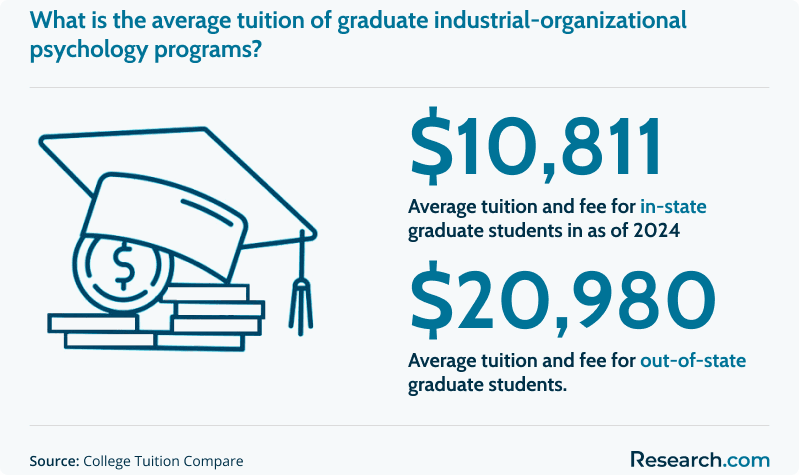
The average cost of an online master’s in organizational psychology is approximately $20,980 for graduate programs, based on 2023-2024 data. However, published tuition is only one part of total cost. Students should also compare fees, books, technology requirements, residency requirements, transfer credit policies, and how long it will take to graduate.
Several of the programs listed above are below that average. Austin Peay State University lists tuition of $7,686, Liberty University lists $8,217, and Touro University Worldwide lists $9,000. Students comparing business-oriented alternatives may also want to look at options such as an online MBA under 15k, especially if their goals are more management-focused than psychology-focused.
| Cost item | Why it matters | Question to ask |
| Tuition | Usually the largest direct expense. | Is tuition charged per credit, per term, per unit, or as a flat program rate? |
| Fees | Online, technology, graduation, and student service fees can increase total cost. | Are all mandatory fees included in the published estimate? |
| Transfer credits | Accepted graduate credits may reduce cost and time. | How many credits can transfer, and what documentation is required? |
| Time to completion | Longer enrollment can increase costs and delay career benefits. | What is the realistic completion timeline for working adults? |
| Practicum or residency requirements | Travel or placement requirements may add expenses. | Can practical requirements be completed locally or remotely? |
What are the financial aid options for students enrolling in an online master's in organizational psychology?
Online graduate students may qualify for several types of financial support, but eligibility depends on the school, enrollment status, citizenship status, degree type, and aid rules. Always confirm details with the financial aid office before enrolling.
- Scholarships: Awards such as Society for Industrial and Organizational Psychology scholarships may support students based on academic merit, field interest, or other criteria.
- Grants: Need-based grants may be available through federal, state, institutional, or private sources. Pell Grant eligibility is usually associated with undergraduate study, so graduate students should verify what grant aid actually applies.
- Federal Student Loans: Graduate students often use federal loans because they may offer structured repayment options.
- Work-Study Programs: Some schools provide part-time work opportunities, though availability for online graduate students varies.
- Employer Tuition Assistance: If the degree supports your current job or a future role within your company, ask whether your employer offers tuition reimbursement or direct billing.
Students considering advanced psychology pathways can also research financial aid for online doctorate in psychology programs. Aid packages differ by degree level and institution, so compare total net cost rather than relying only on listed tuition.
What are the prerequisites for enrolling in an online master's in organizational psychology?
Admissions requirements vary among different psychology degrees, but online master’s programs in organizational psychology commonly ask for academic preparation in psychology, research, or statistics. Some programs accept students from business, HR, social science, or leadership backgrounds if they can show readiness for graduate work.
- Bachelor's Degree: A degree from an accredited institution is typically required.
- Minimum GPA: Many programs expect a GPA of 3.0 or higher.
- Relevant Coursework: Psychology, statistics, and research methods courses may be required or preferred.
- Letters of Recommendation: Programs often request two or three academic or professional references.
- Statement of Purpose: Applicants usually explain their career goals, research interests, and reasons for choosing organizational psychology.
- Resume: A current resume can show work experience in HR, management, training, research, consulting, or related areas.
- GRE Scores: Some programs require GRE scores, while others waive or do not require standardized tests.
What courses are typically in an online master's in organizational psychology?
Coursework usually blends workplace psychology, research design, quantitative analysis, organizational systems, and applied intervention. Students should look for programs that teach both how to understand human behavior at work and how to measure whether an intervention actually improves outcomes.
- Foundations of Organizational Psychology: Introduces major theories, research traditions, and workplace applications.
- Research Methods: Covers how to design studies, collect data, evaluate evidence, and conduct research in organizations.
- Statistics for Psychology: Builds skills in data analysis, interpretation, and evidence-based decision-making.
- Personnel Assessment and Selection: Examines how organizations evaluate applicants and employees using valid and fair methods.
- Organizational Development: Focuses on planned change, culture, leadership, communication, and performance improvement.
Some programs also offer courses that overlap with a business psychology major or management-focused graduate study:
- Leadership and Management: Explores leadership behavior, decision-making, team performance, and organizational effectiveness. Students who want a broader business leadership credential may also compare an online MBA in leadership.
- Workplace Motivation and Attitudes: Looks at job satisfaction, employee engagement, motivation, morale, and workplace behavior.
- Training and Development: Teaches students how to design, implement, and evaluate employee learning programs.
What types of specializations are available in online master's in organizational psychology?
Specializations help students connect the degree to a specific career path. Before choosing a concentration, compare course requirements, faculty expertise, capstone options, and whether the specialization is recognized by employers in your target field.
| Specialization | Focus | Best for students interested in |
| Coaching and Consulting | Improving individual, team, and organizational performance through coaching methods and consulting frameworks. | Organizational consulting, executive coaching support, change management, leadership development. |
| Human Resource Management | Recruitment, selection, workforce development, employee relations, and performance systems. | HR leadership, talent acquisition, employee development, HR analytics. |
| Occupational Health Psychology | Workplace safety, stress, employee well-being, burnout prevention, and healthy work design. | Wellness programs, employee support, organizational risk reduction, workplace health initiatives. |
| Leadership Development | Leadership theory, assessment, coaching, succession planning, and management effectiveness. | Training leadership candidates, building leadership pipelines, advising managers. |
Trends Shaping the Future of Organizational Psychology
Organizational psychology is changing as work becomes more hybrid, data-driven, technology-enabled, and employee-centered. Students entering the field should choose programs that address current workplace realities instead of relying only on traditional theory.
Remote and hybrid workforces
Remote and hybrid work have changed how organizations manage engagement, communication, supervision, collaboration, and culture. Organizational psychology professionals may help employers design fair performance systems, reduce burnout, train managers for distributed teams, and evaluate whether hybrid policies are working.
Diversity, equity, inclusion, and belonging
Organizations continue to examine hiring, promotion, leadership development, and workplace climate through the lens of fairness and inclusion. Organizational psychologists can contribute by designing valid assessments, analyzing workforce data, evaluating DEIB initiatives, and helping leaders move beyond one-time training toward measurable change.
Artificial intelligence and workplace technology
AI is increasingly used in recruiting, employee assessment, productivity tools, workforce planning, and HR analytics. Organizational psychology graduates need to understand both the potential and the risks of these tools, including bias, transparency, employee privacy, and the human consequences of automated decision-making.
Employee mental health and well-being
Worker well-being has become a strategic issue for many employers. Organizational psychologists may help evaluate stressors, redesign work processes, support resilience programs, and measure whether wellness initiatives improve employee experience and retention.
People analytics and evidence-based management
Employers increasingly expect HR and organizational development decisions to be supported by data. Skills in statistics, survey design, assessment validation, and program evaluation can help graduates stand out in roles that require evidence-based recommendations.
Sustainability and corporate social responsibility
Employees and stakeholders often expect organizations to align operations with ethical, sustainable, and socially responsible practices. Organizational psychology can support culture change, leadership alignment, employee engagement, and measurement of values-based initiatives.
Students who are also interested in helping environments outside corporate settings may compare related counseling and education-focused pathways, including a cheap master’s in school counseling.
Can I Complete an Accelerated Online Master's in Organizational Psychology?
Yes. Some online organizational psychology programs offer accelerated formats that condense coursework into a shorter timeline. These can be useful if you already have strong academic preparation, a stable schedule, and the ability to complete intensive reading, writing, research, and group assignments quickly. Touro University Worldwide, for example, lists a 12 months accelerated format.
Before choosing a faster program, ask whether acceleration reduces access to internships, faculty mentoring, career services, or research opportunities. A shorter program is not automatically better if it limits the experiences you need for your career goal. Students comparing condensed psychology pathways can review accelerated psychology programs.
How to Choose the Best Online Master's In Organizational Psychology
If your long-term goal is to learn how to become an industrial organizational psychologist, start by choosing a credible, accredited graduate program with coursework that matches the work you want to do. Do not choose only by tuition or ranking position.
- Verify accreditation: Confirm that the institution is accredited by a recognized accrediting body. Accreditation affects credit transfer, employer acceptance, doctoral admissions, and financial aid eligibility.
- Match the curriculum to your goal: A student interested in HR analytics needs different electives than someone aiming for coaching, training, or occupational health psychology.
- Evaluate flexibility carefully: Many students choose online education for its flexibility, but flexibility varies. Check whether courses are asynchronous, synchronous, cohort-based, or self-paced.
- Calculate total cost: Include tuition, fees, textbooks, technology, travel, lost work time, and the cost of extending enrollment.
- Review faculty expertise: Look for instructors with experience in industrial-organizational psychology, HR research, consulting, assessment, analytics, leadership, or organizational development.
- Check student support: Strong online programs provide advising, library access, writing support, career counseling, technical help, and faculty availability.
- Ask about applied learning: Prioritize programs with capstones, consulting projects, internships, practicum options, research opportunities, or portfolio-building assignments.
| Common mistake | Why it can hurt you | Better approach |
| Choosing the lowest tuition without checking accreditation. | You may face problems with financial aid, employer recognition, transfer credits, or doctoral admission. | Verify accreditation first, then compare cost. |
| Assuming every online program is equally flexible. | Some programs require live sessions, group meetings, or fixed deadlines. | Request a sample schedule and weekly workload estimate. |
| Ignoring practical experience. | Employers may want evidence that you can apply psychology in real organizations. | Look for internships, capstones, consulting projects, or applied research assignments. |
| Relying only on rankings. | A highly ranked program may not fit your specialization, budget, or schedule. | Use rankings as a starting point, not the final decision. |
| Assuming salary outcomes are guaranteed. | Salary varies by role, employer, location, experience, and job market conditions. | Compare target job postings and alumni outcomes before enrolling. |
The chart below provides additional context on why students choose to earn degrees online.
How do you verify the accreditation and academic quality of online master's programs?
Start by confirming that the institution’s accreditor is recognized by the U.S. Department of Education or CHEA. Accreditation is a baseline quality check, not a guarantee that a program is the right fit. After that, evaluate curriculum depth, faculty qualifications, research expectations, student outcomes, technology support, and access to career services.
Academic quality is easier to assess when a program clearly explains its learning outcomes, required courses, assessment methods, applied experiences, and graduate pathways. Students who want faster completion should make sure accelerated options, including accelerated psychology programs, still meet the same academic and professional standards as longer formats.
Can an online master's in organizational psychology lead to doctoral opportunities?
An online master’s in organizational psychology can support doctoral study, especially if the program is accredited, research-oriented, and includes statistics, methodology, thesis work, or faculty-supervised research. Doctoral programs may evaluate your GPA, research experience, writing sample, recommendations, career fit, and faculty alignment.
If your goal is a PhD, PsyD, or another doctoral route, ask master’s programs whether graduates have entered doctoral study and whether faculty mentor students on research. Students comparing psychology doctorate pathways may also review options such as the easiest PsyD programs to get into, while keeping in mind that admissions standards and professional outcomes vary by program.
What career paths are available for graduates of online master's in organizational psychology?
Graduates can pursue roles in industrial-organizational psychology, HR, talent development, organizational development, consulting, research, training, and analytics. Some jobs may require additional experience, doctoral education, or specific employer qualifications. The degree can also support related academic or research roles.
| Career path | Typical focus | Reported average annual salary |
| Industrial Psychologist | Improves workplace productivity, assessment, employee well-being, and organizational systems. | $120,524 |
| Adjunct Psychology Professor | Teaches college psychology courses, often on a part-time or contract basis. | $140,525 |
| Clinical Psychology Professor | Teaches and conducts research related to clinical psychology. | $101,568 |
| Cognitive Psychologist | Studies mental processes such as learning, memory, attention, and perception. | $92,813 |
| Bachelor Psychology | Supports research, assists licensed psychologists, or works in entry-level human services and mental health-related roles. | $92,378 |
These roles show the range of opportunities connected to psychology training and are included among highest paying psychology jobs that students may want to compare.
How can I assess the return on investment for an online master's in organizational psychology?
To assess ROI, compare total program cost with realistic career outcomes. Do not rely only on average salary figures. Instead, identify the exact job titles you want, review current job postings, examine required experience, and ask programs for graduate employment information when available.
| ROI factor | What to review | Why it matters |
| Total net cost | Tuition, fees, aid, employer reimbursement, transfer credits, and time to finish. | A lower tuition program may produce stronger ROI if it meets your career needs. |
| Career alignment | Curriculum, specializations, capstone topics, and internship options. | The best-value program is one that supports the role you actually want. |
| Current experience | Your background in HR, analytics, psychology, management, training, or consulting. | Students with related experience may be able to move into advanced roles more quickly. |
| Employer recognition | Accreditation, school reputation, alumni network, and career services. | Employer familiarity can influence interview opportunities. |
| Opportunity cost | Work hours reduced, delayed promotions, or time away from family responsibilities. | Flexible online programs can reduce but not eliminate opportunity costs. |
For additional cost-benefit comparison across specialized psychology fields, students may review the most affordable online master's degree in forensic psychology.
Combining Organizational Psychology with Other Disciplines for Career Advancement
Organizational psychology becomes more marketable when paired with business, HR, analytics, leadership, or specialized psychology knowledge. Employers often value professionals who can understand workplace behavior, communicate with leaders, interpret data, and recommend practical interventions.
Organizational psychology and human resources
HR is one of the closest career matches. Organizational psychology can strengthen work in recruitment, employee selection, training, engagement, performance management, workforce planning, and employee relations. This combination can support roles such as HR manager, talent development specialist, employee relations consultant, or people analytics professional.
Organizational psychology and business management
Business knowledge helps organizational psychology graduates understand strategy, operations, budgeting, leadership, and change management. This blend can be useful for organizational development consultants, change management specialists, business performance analysts, and leadership development professionals.
Organizational psychology and data analytics
Data analysis is increasingly important in HR and organizational decision-making. Graduates who can design surveys, evaluate training, analyze engagement data, and explain results to decision-makers may qualify for roles involving people analytics, employee experience, or workforce research.
How interdisciplinary skills improve career options
Students who combine psychology with another applied skill set can pursue broader roles across consulting, government, corporate management, nonprofit leadership, and public policy. The advantage comes from being able to diagnose human behavior problems and connect them to measurable organizational outcomes.
Further education and specialized pathways
Some students build specialized expertise through certificates, second degrees, or adjacent graduate programs. For example, students comparing psychology-related master’s options may look at forensic psychology master's programs online accredited if their interests extend beyond workplace settings.
What challenges might students face in an online master's in organizational psychology?
Online programs require independence. Students must manage deadlines, participate in virtual discussions, complete reading-heavy courses, and build relationships without the built-in structure of campus life. Limited face-to-face networking can also be a challenge for students who want consulting, HR, or leadership roles where relationships matter.
Technical confidence is another factor. Students should be comfortable using learning platforms, video conferencing tools, digital libraries, statistical software, and collaboration systems. Before enrolling, ask whether the program offers orientation, writing support, tutoring, technical help, faculty office hours, alumni networking, and career coaching. Students considering nontraditional psychology-related routes may also review the requirements to become a therapist to understand how different psychology-adjacent careers vary.
How do online master's programs incorporate practical experiences and internships?
Online programs may include applied projects, virtual simulations, consulting-style assignments, capstones, practicums, remote internships, or local placements. These experiences help students turn theory into portfolio evidence, such as an employee engagement analysis, selection system review, training evaluation, or organizational change plan.
Before enrolling, ask whether practical experiences are required or optional, who finds placements, whether remote work is allowed, and how students are supervised. Some programs also allow electives or adjacent coursework that broadens professional preparation, including areas related to a master's in addiction counseling.
What is the job market for graduates with an online master's in organizational psychology certificate?
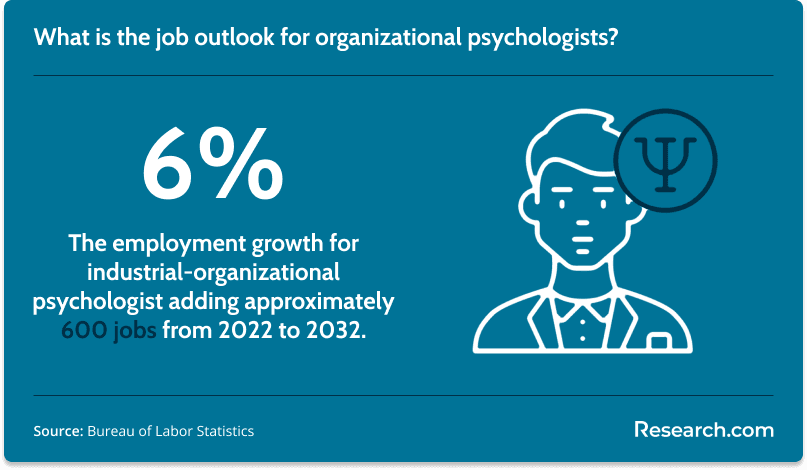
The job market is shaped by employers’ interest in productivity, employee satisfaction, leadership, mental health, DEIB, retention, and organizational efficiency. According to the BLS, employment for industrial-organizational psychologists is projected to grow by 6% from 2022 to 2032, adding approximately 600 new jobs.
The increasing focus on worker well-being and mental health at work also supports demand for professionals who can evaluate workplace conditions and recommend evidence-based improvements. Still, students should understand that “organizational psychology” may appear in job postings under many titles, including HR analyst, talent development specialist, organizational development consultant, training manager, employee engagement specialist, workforce researcher, and people analytics professional.
What are the most affordable options for earning a master's in psychology online?
The most affordable option is not always the program with the lowest published tuition. A truly cost-effective online master’s in psychology should be accredited, aligned with your career goal, manageable for your schedule, and transparent about fees and graduation requirements. Students interested in organizational psychology should compare whether low-cost psychology programs offer relevant concentrations in industrial-organizational psychology, human resources, leadership, assessment, or organizational development.
Budget-focused students can start by comparing tuition, credits, transfer policies, aid, employer reimbursement, and completion time. Researching the cheapest online master's degree in psychology can also help identify programs that provide graduate psychology training at accessible rates.
Affordability should support—not replace—fit. A low-cost program is most valuable when it provides the coursework, faculty support, applied experience, and credibility you need for your next career step.
Questions to ask before applying
- Is the institution accredited by a recognized accrediting body?
- Does the program focus specifically on industrial-organizational psychology, or is it a general psychology degree with a few workplace-related electives?
- Are classes asynchronous, synchronous, self-paced, or cohort-based?
- What practical experiences are included: internship, practicum, thesis, capstone, consulting project, or portfolio?
- Do faculty have experience in organizational psychology, HR, assessment, analytics, consulting, or leadership development?
- What are the total tuition and mandatory fees from start to graduation?
- Can employer tuition assistance, scholarships, loans, or transfer credits reduce the cost?
- What job titles do graduates pursue, and what support does the career office provide?
- If you plan doctoral study, does the curriculum include research methods, statistics, and thesis opportunities?
References
- Industrial-Organizational Psychologists. (2023, April 25). Bureau of Labor Statistics.
- Industrial Organizational Psychologist. (2024). ZipRecruiter; ZipRecruiter.
- Psychologists : Occupational Outlook Handbook: U.S. Bureau of Labor Statistics. (2024, April 17). Bureau of Labor Statistics.
- Top 6 Industrial/Organizational Psychologist Skills. (2020, October). Zippia.com.
Key Insights
- An online master’s in organizational psychology is best for students who want to improve workplace systems, not provide clinical therapy.
- The most important program checks are accreditation, curriculum fit, practical experience, faculty expertise, flexibility, and total net cost.
- Online study can work well for professionals, but students must be self-directed and intentional about networking and applied learning.
- Salary outcomes vary. The BLS reports an average annual wage of $154,380 for industrial-organizational psychologists, but job title, location, experience, and employer type strongly affect earnings.
- Affordable programs can provide strong value when they align with your career target and include applied projects, research, analytics, or internship opportunities.
- Do not choose a program based only on tuition or rankings. Choose the program that gives you the clearest path from graduate coursework to the role you want.
Other Things You Should Know About Online Master's In Organizational Psychology
An affordable online master’s in organizational psychology should come from a regionally accredited institution in 2027. Programs housed in business schools may also hold AACSB accreditation, but that is not required. Regional accreditation matters most for credit transfer, employer recognition, and eligibility for federal financial aid.
Yes, students may need a reliable internet connection and access to specific educational platforms used by the institution. Some programs might also require software like SPSS for data analysis, which could entail additional costs.


