2027 How to Become an Industrial Organizational Psychologist

Co-Founder and Chief Data Scientist
Choosing industrial-organizational psychology means deciding whether you want to use psychology to improve how people are hired, trained, led, evaluated, and supported at work. It is a strong fit for students and professionals who like human behavior, research, data, business problems, and organizational change more than one-on-one therapy or clinical diagnosis.
This guide explains how to become an industrial-organizational psychologist, what degree path usually makes sense, how long the process can take, where I/O psychologists work, how salaries vary, and how to evaluate online graduate programs without relying only on rankings or tuition. It also covers practical experience, certification, ethical issues, return on investment, and the workplace trends shaping this career in 2026.
Quick Answer: How Do You Become an Industrial-Organizational Psychologist?
Most industrial-organizational psychologists need at least a master’s degree in psychology, industrial-organizational psychology, organizational psychology, business psychology, or a closely related field. A doctoral degree can be useful for research-heavy, academic, consulting, senior leadership, or specialized roles. The path commonly takes six to nine years: four years for a bachelor’s degree, two to five years for graduate study, and additional time for internships, supervised practice, or early-career experience.
Certification is not always required for I/O psychology roles, but credentials from organizations such as the American Board of Professional Psychology (ABPP) can strengthen professional credibility. In 2023, industrial-organizational psychologists earned an average annual salary of $147,420, compared with $96,100 for clinical and counseling psychologists and $84,940 for school psychologists. Job growth estimates cited for the field include 6% from 2022 to 2032, or approximately 600 new jobs by 2032.
Key Things You Should Know Before Choosing This Career
- A graduate degree is usually the minimum serious credential. A bachelor’s degree may help you enter HR, analytics, training, or recruiting, but master’s-level preparation is typically needed for I/O psychology roles.
- A doctorate is not mandatory for every job. It can improve access to advanced consulting, research, academic, and high-level organizational roles, but many applied roles are open to master’s graduates.
- Experience matters as much as coursework. Internships, applied research projects, HR analytics work, consulting projects, and supervised practice help translate theory into workplace impact.
- Salaries can be strong, but they vary widely. Industry, location, degree level, experience, and job function all affect earnings.
- This is not clinical psychology. I/O psychologists focus on work systems, employee behavior, selection, training, leadership, culture, and organizational performance rather than diagnosing or treating mental health disorders.
- What is industrial-organizational psychology and why does it matter?
- What does an industrial-organizational psychologist do?
- What degree do you need to become an industrial-organizational psychologist?
- How important is practical experience?
- How can you become certified in industrial-organizational psychology?
- How long does it take to become an industrial-organizational psychologist?
- Which industries hire industrial-organizational psychologists?
- How is industrial-organizational psychology different from clinical psychology?
- How much do industrial-organizational psychologists earn?
- How should you choose an online doctoral program in I/O psychology?
- How can you check the accreditation and quality of online psychology programs?
- What ethical and legal issues matter in industrial-organizational psychology?
- What is the job market for industrial-organizational psychologists?
- How can you estimate the ROI of an I/O psychology degree?
- Which additional certifications can support an I/O psychology career?
- What challenges do industrial-organizational psychologists face at work?
- Which competencies are most important for success?
- What trends are changing industrial-organizational psychology?
- Can you enter I/O psychology without a traditional psychology degree?
- What career paths are available to I/O psychology graduates?
- What are the benefits of online advanced psychology programs?
What Graduates Say About Studying Industrial-Organizational Psychology
"My I/O psychology program helped me see work through both a human and analytical lens. The research training showed me how evidence can improve hiring, employee well-being, and organizational culture. Seeing those ideas change real workplaces has been one of the most meaningful parts of my career." - Alexis
"I was drawn to psychology because I wanted to understand behavior, but I/O psychology gave that interest a practical direction. The coursework connected theory with consulting problems, team dynamics, and leadership development. That preparation still shapes how I help organizations build stronger teams." - Ryan
"My route into I/O psychology was not perfectly straight, which is one reason the field appealed to me. I studied selection, organizational change, motivation, and workplace systems. In my nonprofit HR role, I now use those tools to support staff, improve engagement, and build a healthier culture." - Kelly
What is industrial-organizational psychology and why does it matter?
Industrial-organizational psychology, often called I/O psychology, applies psychological science to workplace problems. Instead of focusing on therapy or mental health treatment, I/O psychologists study how people behave at work and how organizations can make better decisions about hiring, training, leadership, performance, motivation, culture, and change.
The field matters because employers are under pressure to make fairer hiring decisions, retain skilled workers, manage hybrid teams, prevent burnout, develop leaders, and use employee data responsibly. I/O psychology gives organizations a research-based way to address those issues rather than relying only on intuition or tradition.
What I/O psychology helps organizations improve
- Hiring and selection: designing fair, valid, and job-related assessment processes.
- Employee development: building training programs, leadership pipelines, and coaching systems.
- Engagement and retention: identifying why employees stay, leave, disengage, or burn out.
- Organizational culture: measuring workplace norms and recommending changes that support performance and inclusion.
- Evidence-based HR decisions: using surveys, job analysis, psychometrics, and workforce data to guide decisions.
Students who want graduate-level preparation in workplace-focused psychology often compare programs such as a master's in organizational psychology online to determine whether the curriculum includes research methods, psychometrics, organizational behavior, and applied consulting projects.
What does an industrial-organizational psychologist do?
An industrial-organizational psychologist studies workplace behavior and turns that research into practical recommendations. The role may sit inside human resources, talent management, people analytics, organizational development, leadership development, consulting, government, or academic research.
Daily work varies by employer. Some I/O psychologists build employee surveys and analyze results. Others design hiring assessments, evaluate training programs, advise executives during reorganizations, or help managers improve team effectiveness. The unifying theme is that decisions should be evidence-based, ethical, and connected to measurable workplace outcomes.
| Responsibility | What it looks like in practice | Why it matters |
| Job analysis | Studying tasks, competencies, and conditions required for a role | Supports fair hiring, valid assessments, and accurate job descriptions |
| Employee selection | Designing interviews, tests, simulations, or scoring systems | Helps employers make consistent, job-related hiring decisions |
| Training and development | Creating or evaluating programs for employees and leaders | Improves skills, performance, and succession planning |
| Organizational research | Running surveys, focus groups, experiments, or workforce analyses | Turns employee feedback and behavior data into usable insight |
| Change management | Helping organizations communicate, adapt, and reduce disruption | Supports morale and productivity during restructuring or growth |
| Culture and engagement | Measuring workplace climate, motivation, trust, and belonging | Helps organizations identify risks before they become turnover or performance problems |
Professionals who want a broader leadership credential sometimes compare I/O psychology training with online MBA leadership programs. An MBA may be better for general management, while I/O psychology is usually stronger for assessment, research, employee behavior, and organizational systems.
What degree do you need to become an industrial-organizational psychologist?
The usual path begins with a bachelor’s degree, followed by a master’s or doctoral degree in psychology, industrial-organizational psychology, organizational psychology, applied psychology, business psychology, or a related field. Students who want to shorten the undergraduate stage may compare accelerated psychology programs, but speed should not come at the expense of accreditation, research training, or graduate school preparation.
A master’s degree is often enough for applied roles in consulting, HR analytics, talent management, organizational development, training, or employee assessment. Students concerned about affordability may also review options such as a master's degree under $10,000, but the key question is whether the program actually builds the psychology, measurement, statistics, and applied research skills needed for I/O work.
A doctoral degree, such as a PhD or PsyD, can be valuable for advanced research, academia, high-level consulting, specialized assessment work, or leadership roles. I/O psychology is also often discussed among the highest paying jobs with a PhD in psychology, but students should avoid assuming that any doctorate automatically leads to a specific salary.
Not every student starts in I/O psychology. Some begin with general psychology, applied psychology, business, human resources, or analytics before specializing later. If you are still comparing undergraduate or early graduate options, resources on quick online degrees can help you think through time-to-completion, but specialization and graduate readiness matter more than speed alone for this career.
Degree options compared
| Education level | Best for | Limitations |
| Bachelor’s degree | Entry-level HR, recruiting, training coordination, research assistant, or people operations roles | Usually not enough for independent I/O psychologist roles |
| Master’s degree | Applied I/O roles in organizations, consulting, analytics, assessment, and organizational development | May limit access to academic or advanced research positions |
| Doctoral degree | Research leadership, academia, senior consulting, specialized assessment, and advanced practice roles | Takes longer, costs more, and may not be necessary for every career goal |
The chart below summarizes common fields of study for I/O psychologists, based on information from The Society for Industrial and Organizational Psychology.
How important is practical experience?
Practical experience is essential because I/O psychology is an applied field. Coursework teaches research design, statistics, organizational behavior, and psychological theory, but employers also want proof that you can work with real data, real managers, real employees, and real organizational constraints.
Strong experience can come from internships, consulting projects, supervised practica, research assistantships, HR analytics work, employee survey projects, assessment development, or organizational development roles. These experiences help students learn how to communicate findings to non-psychologists, manage confidentiality, handle messy workplace data, and recommend changes that leaders can actually implement.
Experience that strengthens an I/O psychology résumé
- Completing an applied research project for an employer or nonprofit organization
- Helping design or validate a structured interview, assessment, or selection process
- Analyzing employee engagement, turnover, performance, or training data
- Supporting leadership development, change management, or culture initiatives
- Presenting findings to HR leaders, executives, or client stakeholders
- Participating in supervised consulting, practicum, or internship experiences
When comparing graduate programs, ask whether students complete applied projects with organizations, whether faculty have industry relationships, and whether the program provides support for internships or supervised practice.
How can you become certified in industrial-organizational psychology?
Certification is not universally required for industrial-organizational psychology jobs, but it can help demonstrate advanced competence, professional commitment, and credibility. Requirements vary depending on the credential, employer, and state. Some roles may also involve licensure considerations, especially when the title “psychologist” is regulated.
Typical steps to enter and strengthen the field in 2026
- Earn a bachelor’s degree from an accredited institution. If you are still choosing an undergraduate major, consider how which bachelor's degree is best depends on your goals; psychology, business psychology, applied psychology, human resources management, statistics, and business can all be relevant starting points.
- Complete a master’s degree or doctoral degree in psychology, I/O psychology, organizational psychology, or a related field, depending on your target role and state requirements.
- Build supervised experience through internships, practica, applied research, consulting projects, or entry-level organizational roles.
- Review certification requirements from professional organizations such as the American Board of Professional Psychology (ABPP).
- Prepare documentation, meet eligibility requirements, and complete any required examination or review process.
- Maintain the credential through continuing education, ethical practice, and any renewal requirements.
Before investing in certification, check whether it is valued in the roles you want. For some professionals, a portfolio of applied projects, advanced analytics skills, or leadership development experience may provide a stronger career return than an additional credential.
How long does it take to become an industrial-organizational psychologist?
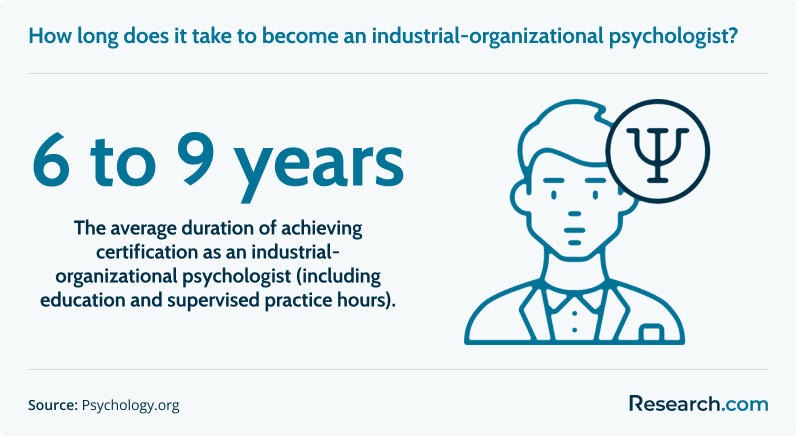
The path usually takes six to nine years, combining undergraduate education, graduate study, and applied experience. A common route includes four years for a bachelor’s degree and two to five years for a master’s or doctoral program, followed by internships, supervised practice, or early-career experience.
The timeline can be shorter or longer depending on the degree level, whether you study full time or part time, whether you transfer credits, and whether you pursue a doctorate. Students pursuing the full path from bachelor’s degree through doctorate may take up to 12 years, especially if they study part time, change fields, or complete extensive research and supervised experience requirements.
| Stage | Typical time | Decision point |
| Bachelor’s degree | Four years | Choose courses in psychology, statistics, research methods, business, and HR when possible |
| Master’s degree | Two to five years as part of the graduate-study range | Best for many applied organizational, consulting, and HR analytics roles |
| Doctoral degree | Two to five years as part of the graduate-study range, and often longer in full academic pathways | Useful for research-intensive, academic, senior consulting, or specialized practice goals |
| Internship or supervised experience | Additional time varies | Look for projects that show measurable workplace impact |
Students trying to reduce the total timeline sometimes explore whether they can complete a bachelor's degree online fast. That can help, but only if the program is accredited and prepares you for competitive graduate admission.
Which industries hire industrial-organizational psychologists?
Industrial-organizational psychologists work across consulting firms, corporations, government agencies, research organizations, universities, technology companies, healthcare systems, nonprofits, and large employers with complex workforce needs. The highest levels of employment are found in management, scientific, and technical consulting services and in state and local government agencies.
Scientific research and development services and management of companies and enterprises can also offer strong opportunities. In these settings, I/O psychologists may design selection systems, evaluate employee programs, lead workforce research, advise executives, or help organizations manage change.
Industries and common I/O psychology work
| Industry or setting | Common work | Who it suits |
| Consulting services | Assessment design, leadership development, employee surveys, change management, client advisory work | People who enjoy variety, presentations, travel, and client-facing problem solving |
| Government agencies | Selection systems, personnel research, workforce planning, training evaluation | Professionals interested in structured systems, public-sector impact, and compliance |
| Corporate HR or people analytics | Talent strategy, engagement research, performance systems, retention analysis | Those who want to work inside one organization and influence long-term culture |
| Research and development | Workforce studies, psychometric research, assessment validation, technology-enabled workplace tools | Professionals with strong quantitative, research, and measurement interests |
| Higher education | Teaching, research, graduate training, applied studies | Doctoral graduates interested in scholarship and academic careers |
The chart below shows how industrial-organizational psychologist earnings can differ by industry.
How is industrial-organizational psychology different from clinical psychology?
Industrial-organizational psychology and clinical psychology both use psychological science, but they serve different purposes. I/O psychology focuses on work behavior, organizational systems, employee performance, leadership, selection, and workplace well-being. Clinical psychology focuses on assessment, diagnosis, treatment, and prevention of mental health disorders.
| Comparison point | Industrial-organizational psychology | Clinical psychology |
| Main focus | Workplaces, employees, teams, leadership, and organizational systems | Mental health, diagnosis, therapy, and psychological treatment |
| Common settings | Corporations, consulting firms, government, research groups, universities | Healthcare, private practice, hospitals, clinics, universities, community agencies |
| Typical work | Job analysis, assessments, surveys, training, culture change, people analytics | Therapy, psychological testing, treatment planning, clinical research |
| Best fit for | Students interested in organizations, data, HR systems, and workplace improvement | Students interested in direct mental health care and clinical assessment |
If your goal is to help organizations make better decisions about people, I/O psychology may be the better match. If your goal is to provide mental health services, a path such as a clinical psychology degree online may align more closely with your interests and licensure goals.
How much do industrial-organizational psychologists earn?
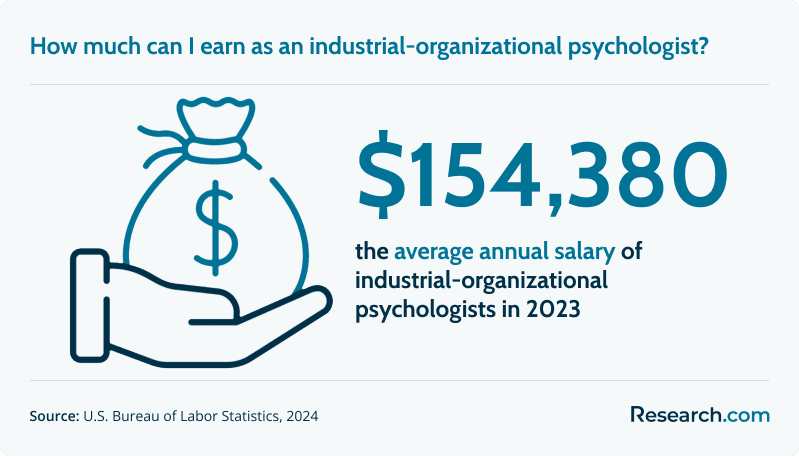
The article’s cited salary figures report an average annual salary of $154,380 in 2023 for industrial-organizational psychologists, while the summary figure above reports $147,420 for 2023. Salary results can differ by source, job title definition, employer type, and data collection method, so students should treat any average as a benchmark rather than a guarantee.
Several factors have a major effect on earning potential:
- Location: Salary can vary sharply by labor market. ZipRecruiter data cited here reports $153,412 annually for I/O psychologists in Sunnyvale, California and $113,319 in Providence, Rhode Island.
- Experience: Early-career professionals usually earn less than senior consultants, directors, principal researchers, or experienced specialists.
- Education: A doctorate can support higher-level roles, but a degree alone does not guarantee a salary. A focused credential may help in some cases; for example, students sometimes compare online certification programs that pay well before deciding whether a certificate or full graduate degree better fits their goals.
- Industry: Consulting, technology, research, and corporate leadership roles may offer different compensation structures than nonprofit, academic, or public-sector roles.
- Skill mix: Advanced statistics, psychometrics, people analytics, executive communication, and change management can improve competitiveness.
How should you choose an online doctoral program in I/O psychology?
An online doctoral program in industrial-organizational psychology should be evaluated on fit, rigor, faculty expertise, research expectations, applied learning, and total cost. Do not choose solely because a program is online, fast, or highly advertised. A doctorate is a major investment, so the program should clearly support the kind of work you want after graduation.
Questions to ask before applying
- Is the institution accredited by a recognized accreditor?
- Does the curriculum include advanced statistics, research design, psychometrics, job analysis, organizational theory, and consulting practice?
- Are faculty members active in I/O psychology research, consulting, or applied organizational work?
- What are the dissertation, capstone, residency, or in-person requirements?
- Can online students access research labs, datasets, career support, and faculty mentoring?
- What kinds of jobs do graduates obtain, and are outcomes reported transparently?
- Does the program support your target path: academia, consulting, corporate leadership, people analytics, or applied research?
Students comparing advanced options can review online PhD programs in industrial organizational psychology, then verify each program’s accreditation, curriculum depth, faculty qualifications, and student support independently.
How can you check the accreditation and quality of online psychology programs?
Accreditation is one of the first things to verify before enrolling in any online psychology program. It affects credit transfer, employer recognition, graduate school admission, and access to many forms of financial aid. Quality also depends on more than accreditation: curriculum, faculty, student support, outcomes, and applied training all matter.
Program quality checklist
| What to check | Why it matters | Warning sign |
| Institutional accreditation | Confirms that the school meets recognized academic standards | The school makes vague claims but does not name a recognized accreditor |
| Faculty expertise | Faculty shape research quality, advising, and professional preparation | Few faculty have I/O psychology, organizational psychology, or applied research experience |
| Curriculum | I/O roles require statistics, research methods, psychometrics, and organizational science | The program is mostly general psychology with little workplace-focused coursework |
| Applied experience | Projects and internships help students build evidence for employers | No clear practicum, consulting project, capstone, or applied research opportunity |
| Student outcomes | Graduation rates, employment outcomes, and alumni roles help evaluate value | The school avoids sharing meaningful outcomes or support resources |
Cost-conscious students often compare psychology programs across specialties. For example, a list of the cheapest masters in clinical psychology may be useful for understanding price ranges, but I/O-focused students should still prioritize a curriculum aligned with workplace psychology.
What ethical and legal issues matter in industrial-organizational psychology?
Industrial-organizational psychologists often work with sensitive employee data, selection tools, performance information, survey responses, and organizational decisions that can affect hiring, promotion, termination, and workplace opportunity. Ethical practice is therefore central to the field.
Key responsibilities include protecting confidentiality, using informed consent when appropriate, avoiding discriminatory practices, selecting valid assessment tools, communicating findings accurately, and monitoring algorithms or analytics systems for bias. I/O psychologists must also balance the needs of employers with fairness and respect for employees.
Ethical questions I/O psychologists should ask
- Is this assessment or intervention job-related and supported by evidence?
- Could the process disadvantage a protected or vulnerable group?
- Who has access to employee data, and how will it be protected?
- Have employees been told how their information may be used?
- Are leaders asking for conclusions that go beyond what the data can support?
- Does the recommendation improve organizational goals without undermining employee dignity or fairness?
Students who want intensive preparation in ethical and legal issues may compare graduate formats, including a one year masters in psychology, but they should confirm that accelerated programs still provide enough depth in research ethics, employment law, assessment, and data use.
What is the job market for industrial-organizational psychologists?
The job market is positive but specialized. The BLS projection cited in the original material reports 7% growth in I/O psychologist jobs from 2022 to 2032, compared with 4% for all occupations. The summary section also cites 6% projected growth from 2022 to 2032 and approximately 600 new jobs by 2032. Because this is a relatively small occupation, even favorable percentage growth may translate into a limited number of openings.
Demand is tied to several employer priorities: improving hiring quality, reducing turnover, supporting employee well-being, evaluating training, managing hybrid teams, using people analytics, and guiding organizational change. Graduates of traditional business doctorates and online DBA programs may work on organizational strategy from a business lens, while I/O psychologists bring deeper training in psychological measurement, employee behavior, and research-based workplace interventions.
How to improve your competitiveness
- Build strong quantitative skills in statistics, survey design, and data interpretation.
- Learn how to communicate technical findings to HR leaders and executives.
- Develop a portfolio of applied projects, not just course papers.
- Gain exposure to HR systems, employment testing, training evaluation, or people analytics tools.
- Join professional communities and seek mentors in consulting, corporate, government, or academic settings.
How can you estimate the ROI of an I/O psychology degree?
Return on investment depends on what you pay, how long you study, whether you continue working, how much debt you take on, and what roles you can realistically pursue after graduation. A lower-cost program is not always a better value if it lacks applied training, employer recognition, or research depth. A more expensive program is not automatically worth it unless it leads to stronger opportunities that match your goals.
ROI factors to compare
| Factor | What to evaluate | Why it affects ROI |
| Total cost | Tuition, fees, books, technology, residencies, travel, and lost income | The full price is often higher than tuition alone |
| Time to completion | Full-time, part-time, accelerated, or extended study | Longer timelines can delay earnings growth |
| Career alignment | Whether graduates enter roles similar to your target job | Relevant outcomes are more useful than generic employment claims |
| Applied experience | Internships, research, consulting projects, capstones, and faculty mentoring | Employers want evidence of workplace problem-solving ability |
| Debt risk | Borrowing amount, repayment plan, and expected salary range | High debt can reduce the benefit of higher earnings |
Students comparing costs across behavioral and psychology-related fields may also look at resources such as the most affordable BCBA programs online. Use those comparisons to understand pricing, but make sure the program you choose matches the I/O psychology career path you actually want.
Which additional certifications can support an I/O psychology career?
Additional credentials can help when they fill a specific skills gap. Useful areas may include people analytics, HR certification, project management, leadership coaching, assessment, data visualization, organizational change, or employment law. The best credential depends on whether you want to work in consulting, corporate HR, research, analytics, or leadership development.
Do not collect certifications randomly. Employers are more likely to value credentials that connect to your job function and are backed by applied experience. For example, a selection specialist may benefit more from assessment and psychometrics training, while an organizational development consultant may benefit more from change management or coaching credentials.
Some professionals also explore adjacent psychology specializations to broaden their perspective. A program such as an affordable online master's in forensic psychology may be relevant for students interested in legal, ethical, or assessment-heavy work, but it is not a substitute for I/O-specific training if your goal is workplace psychology.
What challenges do industrial-organizational psychologists face at work?
I/O psychologists often work in settings where business priorities, employee needs, legal requirements, and data limitations collide. The role can be rewarding, but it requires judgment, diplomacy, and the ability to explain complex evidence in practical terms.
- Resistance to change: Leaders or employees may reject new selection systems, performance processes, or culture initiatives, especially when changes affect power, routines, or accountability.
- Competing stakeholder interests: I/O psychologists may need to support organizational performance while also protecting fairness, employee privacy, and ethical standards.
- Sensitive data: Employee surveys, performance reviews, assessment scores, and analytics projects require strict confidentiality and careful communication.
- Pressure for simple answers: Executives may want quick conclusions, but workplace behavior is complex and data may not support easy claims.
- Technology and bias risks: AI-enabled hiring tools, monitoring systems, and predictive analytics can create fairness and transparency problems if not evaluated carefully.
- Keeping skills current: The field evolves as work models, employee expectations, analytics tools, and legal concerns change.
Which competencies are most important for success?
Successful I/O psychologists combine scientific training with business communication. They need to understand research methods and statistics, but they also need to earn trust, ask good questions, and translate evidence into decisions that organizations can implement.
| Competency | Why it matters | How to build it |
| Research design | Allows you to study workplace problems systematically | Take advanced methods courses and complete applied research projects |
| Statistics and analytics | Supports survey analysis, validation, program evaluation, and people analytics | Practice with real datasets and learn to explain findings clearly |
| Psychometrics | Critical for assessments, testing, selection, and measurement quality | Study reliability, validity, bias, and assessment design |
| Business communication | Leaders need concise recommendations, not academic jargon | Present findings to nontechnical audiences whenever possible |
| Ethical judgment | Workplace interventions affect opportunity, privacy, and fairness | Study professional ethics, employment law, and responsible data use |
| Change management | Good recommendations fail if organizations cannot implement them | Gain experience with stakeholder management and organizational development |
Students interested in assessment-heavy or legally adjacent psychology work may also compare fields such as the forensic psychologist career outlook, but I/O psychology remains distinct because its primary setting is the workplace.
What trends are changing industrial-organizational psychology?
Industrial-organizational psychology is changing as organizations rethink work, adopt new technologies, and face stronger expectations around fairness, well-being, and evidence-based people decisions. These trends create opportunities for I/O psychologists who can combine behavioral science with ethical data use.
AI and people analytics
Employers are using artificial intelligence, machine learning, and analytics tools in hiring, performance management, workforce planning, and employee listening. I/O psychologists can help evaluate whether these tools are valid, fair, explainable, and appropriate for the decisions being made.
Employee mental health and well-being
The COVID-19 pandemic increased attention on burnout, stress, flexibility, and psychological safety at work. I/O psychologists are often involved in measuring work climate, identifying stressors, and designing interventions that support both performance and well-being.
Remote and hybrid work
Hybrid teams raise questions about culture, collaboration, fairness, supervision, onboarding, and career advancement. I/O psychologists help organizations understand how work arrangements affect employees and how policies can be designed more equitably.
Fairness, inclusion, and legally defensible decisions
Organizations are under pressure to ensure that hiring, promotion, assessment, and performance systems are fair and job-related. This increases the need for professionals who understand validation, adverse impact, employee data, and ethical decision-making.
For a career-focused salary overview, readers can also review industrial organizational psychology salary information and compare it with their target industry, location, and degree level.
Can you enter I/O psychology without a traditional psychology degree?
It is possible to move toward I/O-related work without starting in psychology, especially if you already have experience in human resources, business management, analytics, training, organizational development, or consulting. However, the closer you want to get to formal I/O psychologist roles, the more important graduate training in psychology, research methods, statistics, and assessment becomes.
Professionals from other fields can bridge gaps through targeted coursework, graduate certificates, a master’s program, supervised projects, mentoring, and professional association involvement. Transferable skills in data analysis, employee relations, leadership development, survey research, or change management can be valuable, but they should be paired with I/O-specific knowledge.
Nontraditional pathways also exist in other psychology-related careers; for example, students sometimes research therapist education requirements when comparing helping professions. For I/O psychology, the key is not simply entering without a psychology background, but building enough scientific and applied competence to work responsibly with workplace behavior and employee data.
What career paths are available to I/O psychology graduates?
Industrial-organizational psychology graduates can pursue several career directions depending on degree level, experience, and interests. Some roles use the title industrial-organizational psychologist, while others sit under HR, analytics, consulting, research, talent strategy, or organizational development.
| Career path | Typical focus | Best fit for |
| I/O psychologist | Workplace research, assessment, selection, training, culture, and organizational interventions | Graduates with strong I/O psychology training and applied experience |
| People analytics specialist | Workforce data, dashboards, engagement trends, turnover analysis, and predictive modeling | Students with strong statistics, analytics, and business communication skills |
| Organizational development consultant | Change management, culture, leadership development, team effectiveness | Professionals who enjoy facilitation, stakeholder work, and practical interventions |
| Talent assessment specialist | Hiring tools, structured interviews, validation, assessment design, and selection strategy | Students interested in psychometrics, fairness, and employment testing |
| Training and development manager | Learning design, leadership programs, training evaluation, and employee development | Graduates who like teaching, program design, and performance improvement |
| Academic or research career | Teaching, publishing, supervising research, and advancing workplace psychology science | Doctoral graduates interested in scholarship and higher education |
If you are still comparing psychology career options more broadly, reviewing what can you do with a masters in psychology can help you see how I/O psychology differs from counseling, research, education, business, and applied behavioral roles.
What are the benefits of online advanced psychology programs?
Online graduate programs can make advanced psychology education more accessible for working adults, career changers, parents, military students, and students who do not live near a campus with an I/O psychology program. The format can be useful, but the program still needs to be rigorous, accredited, and aligned with your career goals.
- Lower total attendance costs may be possible: An affordable online master's in organizational psychology may reduce commuting, relocation, and campus-based expenses, though students should still calculate all fees and technology costs.
- Flexible scheduling can help working professionals: Online coursework may allow students to continue working while completing graduate requirements.
- Accreditation remains essential: Online delivery does not excuse weak academic standards. Verify institutional accreditation and review whether the program is respected by employers and graduate schools.
- Career advancement is possible when the curriculum fits: Programs with organizational behavior, research methods, psychometrics, HR systems, and applied projects can support roles in HR, consulting, analytics, and organizational development.
- Self-paced or asynchronous options can reduce scheduling pressure: Flexibility can help students balance work and study, but students must be disciplined and proactive about networking, faculty contact, and applied experience.
Common Mistakes to Avoid
| Mistake | Why it can hurt you | Better approach |
| Choosing a program without checking accreditation | It can affect transfer credits, employer recognition, financial aid, and graduate options | Verify accreditation before applying or paying deposits |
| Focusing only on tuition | A cheap program may lack applied projects, faculty access, or career support | Compare total cost, outcomes, curriculum, and experiential learning |
| Assuming online programs are all equivalent | Online programs vary widely in rigor, mentoring, and employer reputation | Review faculty, coursework, student support, and alumni roles |
| Ignoring statistics and research methods | I/O psychology relies heavily on evidence, measurement, and data | Build quantitative skills early and use them in applied projects |
| Confusing I/O psychology with clinical psychology | The training, work settings, and career goals are different | Choose based on whether you want workplace systems or mental health practice |
| Expecting salary averages to predict your income | Pay depends on degree, industry, location, skills, and experience | Research job postings in your target market and compare requirements |
Practical Steps to Start Your I/O Psychology Career
- Clarify your target role. Decide whether you are more interested in consulting, HR analytics, assessment, leadership development, organizational research, academia, or corporate HR.
- Choose the right degree level. A master’s degree can support many applied roles; a doctorate is more relevant for research, academia, senior consulting, and specialized positions.
- Verify accreditation and curriculum depth. Look for research methods, statistics, psychometrics, organizational behavior, job analysis, and applied projects.
- Build experience while studying. Seek internships, assistantships, consulting projects, employee survey work, or HR analytics opportunities.
- Create a portfolio. Include de-identified examples of survey analysis, training evaluation, job analysis, assessment design, dashboards, or organizational recommendations.
- Network in the field. Connect with I/O psychologists, faculty, alumni, HR leaders, and professional associations.
- Track ROI before enrolling. Compare total cost, debt, time to completion, job outcomes, and the salary range for roles you realistically want.
Key Insights
- Industrial-organizational psychology is best for people who want to apply psychology to workplaces, not provide clinical treatment.
- A master’s degree is commonly enough for many applied I/O roles, while a doctorate can support research, academic, senior consulting, and specialized career goals.
- The path often takes six to nine years, including four years for a bachelor’s degree and two to five years for graduate study, with additional time for internships or supervised experience.
- Salary figures cited for 2023 include $147,420 and $154,380, but actual earnings depend on location, industry, education, experience, and skill set.
- Job growth estimates cited for 2022 to 2032 include 6% and 7%, but the field is specialized, so students should build strong applied experience and quantitative skills.
- Online programs can be worthwhile when they are accredited, rigorous, and connected to your career goals; they are risky when chosen only for speed, convenience, or low tuition.
- The strongest I/O psychology candidates can combine research methods, statistics, psychometrics, ethical judgment, business communication, and practical organizational experience.
References:
- Moralo, T. S., & Graupner, L. I. (2022). The role of the industrial psychologist in managing the psychological impact of COVID-19 in the workplace. Frontiers in psychology, 13, 920894. DOI.
- O*NET OnLine. (n.d.). 19-3032.00 - industrial-organizational psychologists. O*NET OnLine.
- The Society for Industrial and Organizational Psychology. (n.d.). Top 10 work trends. SIOP.
- The Society for Industrial and Organizational Psychology. (n.d.). Demographics. SIOP.
- Zippia. (2024, April 5). Industrial/Organizational psychologist demographics and statistics [2024]: Number of industrial/Organizational psychologists in the US. Zippia.
- ZipRecruiter. (n.d.). Industrial organizational psychologist salary. ZipRecruiter.
Other Things You Should Know About How to Become an Industrial Organizational Psychologist
Employers usually verify a master’s or doctoral degree in psychology or I-O psychology, plus any state license if the role involves clinical practice. They may also check transcripts, internship or practicum records, and professional credentials through the issuing university or state licensing board.
In 2027, industrial organizational psychologists typically do not need a specific license, unlike clinical psychologists. However, certification from the Society for Industrial and Organizational Psychology can enhance career prospects. Verify any regulatory changes with the American Psychological Association for the latest requirements.